

So, what does it really take to run a great brainstorming session? Forget the old myth of a lightning bolt of inspiration striking a room full of "creative types." Effective brainstorming isn't magic; it's a structured process that anyone can learn and lead.
The best sessions I've ever been a part of weren't chaotic free-for-alls. They were carefully orchestrated to turn raw creative energy into real, tangible results. It all comes down to a simple, three-part framework.
The Modern Brainstorming Framework

The most productive brainstorming sessions always follow a clear path: Prepare, Ideate, and Act. This structure gives your meeting a distinct beginning, middle, and end. You start with a laser-focused goal, open the floodgates for ideas, and walk away with a concrete plan.
Think of this as the high-level roadmap. Once you understand these core phases, you'll be ready to dive into the specific techniques and tools that bring them to life. It’s like learning the rules of the game before you step onto the field.
To give you a clearer picture, here’s how these three phases work together.
The Three Phases of Effective Brainstorming
| Phase | Primary Goal | Key Activities |
|---|---|---|
| Prepare | Set the stage for success | Define the problem, invite the right people, and share context beforehand. |
| Ideate | Generate a high volume of ideas | Encourage wild ideas, defer judgment, and use creative techniques to spark thinking. |
| Act | Turn ideas into action | Discuss, cluster, vote on the best ideas, and assign clear next steps. |
Each phase is crucial. Skipping one is like trying to build a house without a foundation or a roof—it just won't work.
Phase 1: Prepare
This is where all the groundwork happens. Honestly, this phase is the secret to a successful outcome. It's about getting crystal clear on the problem you're trying to solve, inviting the right mix of people to the table, and arming them with all the context they need before the session starts. A well-prepared session is already halfway there.
Phase 2: Ideate
This is what most people picture when they think of brainstorming. The goal here is pure divergent thinking—you’re going for quantity over quality. The mission is to generate as many ideas as possible, no matter how out-there they seem. A good facilitator creates a safe space where every single thought is welcome, without any judgment.
Here's an interesting tidbit from experience and research: individuals often produce up to 50% more ideas when they brainstorm alone first, before sharing with the group. That’s why over 60% of teams now use a hybrid approach, combining solo brainstorming with group collaboration to get the best of both worlds.
Phase 3: Act
A brainstorming session without a follow-up is just a chat. This final phase is where you switch gears to convergent thinking. Now, the team works together to sort through the mountain of ideas, evaluate them, and prioritize the most promising ones. You decide which concepts you’re going to run with and assign clear, actionable next steps. This is what turns creative momentum into actual progress.
The point of brainstorming isn't just to have ideas—it's to make ideas happen. The Act phase is what separates a fun meeting from a valuable one.
This Prepare, Ideate, and Act model gives you a repeatable process for generating innovative solutions. By using it consistently, you can transform brainstorming from a random, hit-or-miss event into a reliable engine for solving problems.
For a deeper look at building this into your team's DNA, check out our guide on creating a complete ideation framework.
Setting the Stage for a Great Brainstorm
Let's be honest: brilliant ideas rarely strike like lightning. They're usually the product of a well-run process, and that process starts long before everyone gathers for the actual brainstorm.
Think of it as groundwork. This prep phase is the single most important factor in whether you'll walk away with a handful of game-changing ideas or just a lot of wasted time. Without it, you’re just crossing your fingers and hoping for the best. A little planning transforms a potentially chaotic meeting into a focused, high-energy session where creativity can actually happen.
Start with a Razor-Sharp Problem Statement
First things first: you need to know exactly what problem you're trying to solve. A vague goal like "improve the app" is a surefire way to get a rambling, unproductive discussion. You need a clear, focused prompt that gives your team a specific target.
I’ve found that the best way to frame the challenge is with a "How Might We" (HMW) question. It's a simple tweak in language, but it shifts the mindset from problem-focused to solution-oriented.
For instance, instead of dwelling on "Users are confused by our new dashboard," you can reframe it into actionable prompts:
- How Might We make the dashboard feel instantly intuitive for a first-time user?
- How Might We use visual cues to guide people to the most important features?
- How Might We slash the number of clicks it takes to get a core task done?
A great HMW question acts like a guardrail. It's broad enough to invite wild ideas but narrow enough to keep the conversation from veering completely off-course.
Assemble Your Brainstorming Dream Team
The people you invite will make or break your session. The biggest mistake I see facilitators make is inviting the same old group from a single team. That’s a recipe for groupthink, where everyone shares the same assumptions and nobody challenges the status quo.
Instead, you need to deliberately build a team with cognitive diversity. Pull in people with different roles, backgrounds, and ways of thinking.
- The Core Crew: Of course, you need the folks closest to the problem, like your product managers and engineers.
- The Fresh Eyes: Bring in someone from a totally different department—sales, customer support, you name it. They'll ask the "dumb" questions that are actually brilliant and challenge assumptions everyone else takes for granted.
- The Customer Advocate: Make sure someone is there whose main job is to represent the end user. This keeps the ideas grounded in reality.
The sweet spot for group size is usually 5 to 8 people. It’s big enough to get a good mix of ideas flowing but small enough that everyone can still contribute without feeling crowded out. If you have a larger group, plan to break them into smaller teams.
Create and Share a Briefing Document
Never, ever assume everyone is on the same page. To get your team ready to hit the ground running, put together a simple briefing document and send it out at least 24 hours in advance. This one small step saves a massive amount of time on the day.
Your brief doesn't need to be a novel. A single page with the essentials is all you need.
Key Takeaway: A pre-session briefing doc means the first 15 minutes of your meeting are spent generating ideas, not just catching people up. It's a simple act that respects everyone's time and focuses the creative energy right where it belongs.
Here’s what to include:
- The clear "How Might We" question.
- A short and sweet background on the problem.
- Any important constraints (e.g., budget, timeline, technical limits).
- Links to any relevant data, like user research or customer feedback.
To make this dead simple, we've put together a full guide and a ready-to-use brainstorming session template that walks you through all of this.
Prepare Your Brainstorming Space
Finally, get the logistics right. The environment, whether it's physical or digital, has a huge impact on the energy and flow of the session.
For an in-person session, book a room with lots of natural light and wall space. Stock up on the essentials: good sticky notes, sharpies that actually work, and dot stickers for voting later.
For a remote session, a digital whiteboard is non-negotiable. Tools like Miro or Mural are perfect for creating that shared visual space where ideas can be captured and organized. The key here is to set up your board before the session starts and make sure everyone has access. A little prep avoids those awkward moments of technical troubleshooting when you should be deep in creative flow.
Choosing The Right Brainstorming Technique
Alright, you’ve set the stage. You’ve got your dream team assembled, a perfectly framed "How Might We" question, and the digital (or physical) room is ready. Now for the main event: the ideation itself.
Just telling a group to "brainstorm" is like asking a chef to cook without a recipe. You might end up with something edible, but you're leaving a lot to chance. A structured approach is what separates a chaotic meeting from a session that delivers real, tangible results.
Every brainstorming technique is designed to spark creativity in a different way. The key is matching the method to your mission. Are you trying to get your quietest team members to contribute? Do you need to find a plan's weak spots? Or is the goal to generate dozens of ideas in a short burst? Your answer will point you to the right tool for the job.
I find it helpful to think about the process in three simple phases: defining the Problem, gathering the right People, and doing the Prep work. Get those right, and you're already halfway to a successful session.
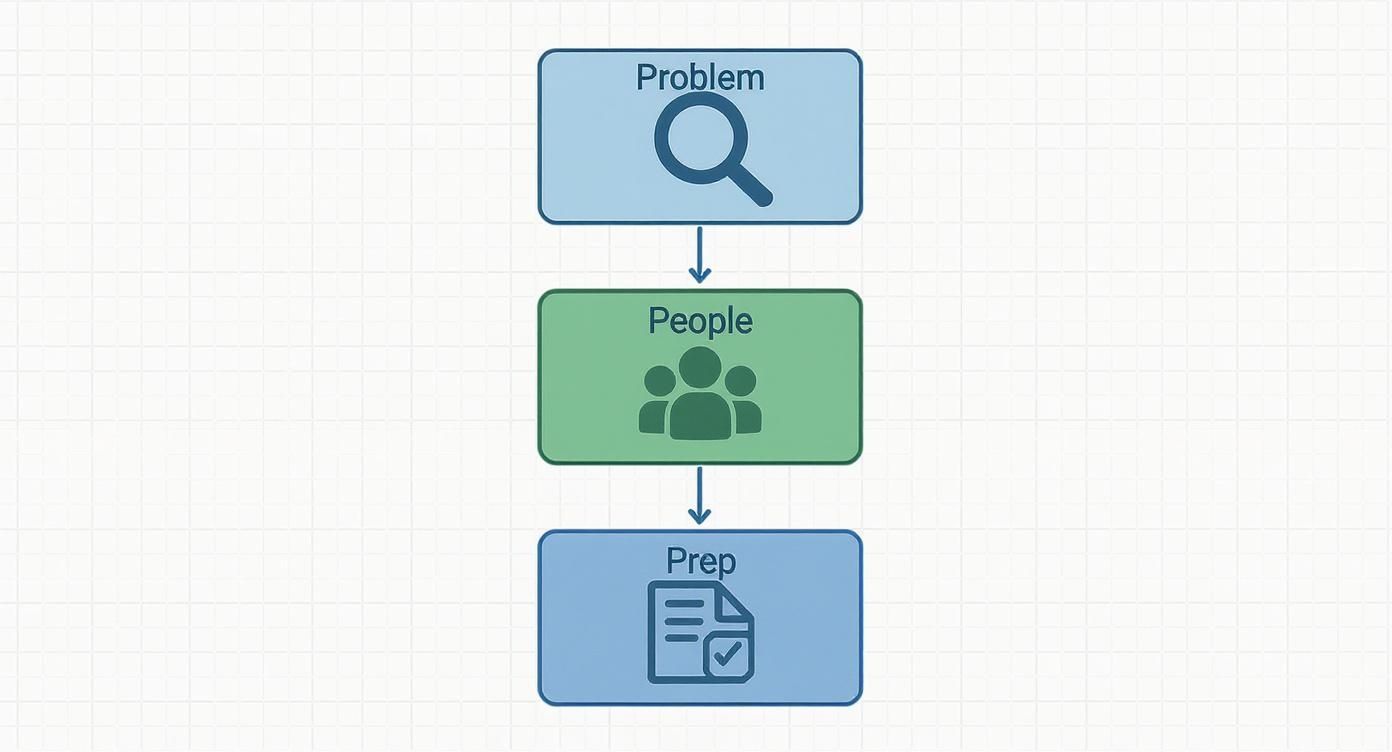
This simple flow is a great reminder that success starts long before anyone shares their first idea. It begins with a clear problem, the right team, and thoughtful preparation.
H3: Round Robin Brainstorming For Inclusive Ideation
Let's be honest—one of the biggest challenges in any group is making sure every voice is heard. It’s natural for a few dominant personalities to take over, which means you're missing out on valuable insights from quieter team members. This is exactly where Round Robin Brainstorming comes in.
The setup is incredibly simple but powerful. You pose the problem, and then each person shares one idea, going around the circle. No one gets to offer a second idea until everyone has shared their first. You just keep going for several rounds.
This structure completely shifts the group dynamic. It creates a safe space for introverts or more junior employees to contribute without having to fight for the spotlight. The result? A much richer and more diverse pool of ideas that truly represents everyone in the room.
Pro Tip: Make it a firm rule: no critiquing ideas as they're shared. The goal here is pure generation. Just get each idea onto the whiteboard or a sticky note and move on to the next person.
For our "How might we improve user onboarding?" prompt, a Round Robin might start like this:
- Sarah: "What about a gamified checklist to guide new users?"
- Tom: "We could create short, 30-second video tutorials for key features."
- Priya: "Maybe we could offer a personalized setup call with a success manager."
- David: "Let's send a series of welcome emails with one helpful tip each."
Every idea gets captured without judgment, creating a fair and balanced foundation for the rest of the session.
H3: Reverse Brainstorming To Find Problems Before They Happen
Sometimes, the most innovative way to find a solution is to figure out how to cause the problem. Reverse Brainstorming is a fantastic technique for identifying risks and getting ahead of potential issues. It completely flips the script.
Instead of asking, "How can we achieve X?" you ask, "How could we completely fail at X?" or "What would guarantee this project is a disaster?"
Let's stick with our onboarding example. The reverse prompt becomes: "How might we create the most confusing and frustrating onboarding experience imaginable?"
Suddenly, the pressure to be "right" is gone. The team is free to think of terrible ideas, which is often a lot more fun. They might come up with things like:
- Hide the sign-up button behind three clicks.
- Use dense, technical jargon on every screen.
- Make the tutorial videos 20 minutes long and unskippable.
- Never explain what any of the buttons actually do.
Once you have a solid list of failure points, you just flip them to create actionable solutions. "Use dense, technical jargon" becomes "Rewrite all copy in simple, clear language." It's a brilliant method for spotting pitfalls you would have otherwise missed.
H3: The SCAMPER Method For Innovating Existing Ideas
What if you aren't starting from scratch? The SCAMPER method is a go-to framework for improving an existing product, service, or process by looking at it from seven different angles.
SCAMPER is an acronym that guides your thinking:
- Substitute: What components, materials, or people can you swap out?
- Combine: Can you merge this with another product or service?
- Adapt: What can you add or tweak to serve a new purpose?
- Modify: Can you change the size, shape, color, or other attributes?
- Put to another use: Can this be used by a new audience or in a different industry?
- Eliminate: What can you remove, simplify, or reduce?
- Reverse: Can you reorder the process or turn it upside down?
For our onboarding prompt, a facilitator might guide the team through these prompts. For "Eliminate," someone might suggest removing three unnecessary form fields during sign-up. For "Combine," the team might propose merging the product tour with the welcome email series. It's a structured way to force your brain to think beyond the obvious fixes.
Choosing the right technique is a facilitator's secret weapon. To help you decide, here's a quick comparison of some popular methods.
Choosing the Right Brainstorming Technique
| Technique | Best For | Key Benefit |
|---|---|---|
| Round Robin | Ensuring equal participation from all team members, especially introverts. | Creates psychological safety and generates a diverse set of initial ideas. |
| Reverse Brainstorming | Proactively identifying risks, weaknesses, and potential failure points in a plan. | Uncovers hidden obstacles and strengthens a strategy by focusing on what could go wrong. |
| SCAMPER | Improving an existing product, service, or process that needs a fresh perspective. | Provides a structured framework to spark innovation beyond incremental changes. |
| Rapid Ideation | Generating a high volume of ideas in a very short amount of time. | Focuses on quantity over quality, breaking through creative blocks. |
Ultimately, the best technique depends on your specific goals for the session. Don't be afraid to experiment to find what works best for your team's unique dynamic.
Each of these methods provides a unique framework for generating ideas. To explore even more options and find the perfect fit for your next session, you can learn more about these and other structured brainstorming methods in our detailed guide.
Running Brainstorms with Remote and Hybrid Teams
You don't need a conference room to come up with great ideas. With the right game plan, remote brainstorming can be just as electric and productive as getting everyone in the same room—sometimes even more so. The secret is to deliberately build the energy and structure that physical spaces used to give us for free.
This isn't just about hopping on another video call. It's about using tools and techniques actually built for remote collaboration. It’s about taking potential hurdles, like time zones and the dreaded video fatigue, and turning them into advantages that spark deeper, more inclusive thinking.
Master Your Digital Whiteboard
Think of your digital whiteboard as the team's central nervous system for the entire brainstorm. Tools like Miro or Mural aren't just for digital sticky notes; they are living, shared spaces where ideas can collide and evolve. A well-prepped board is probably the single most important thing you can do to keep everyone focused and engaged.
Before anyone even joins the call, get your board set up. Create clearly labeled sections for each part of the session: a spot for the icebreaker, a few ideation zones, and a place to vote or prioritize later. A little prep work here goes a long way in cutting down on technical fumbling, letting the team dive straight into creative mode.
Keep the Energy High
Let's be real: video call fatigue can absolutely crush creativity. To fight it off, you have to be intentional about the session's pacing and energy. Short, focused sprints of activity will always beat long, meandering discussions.
Here are a few simple tricks that make a world of difference:
- Use Timers for Everything: Put a visible timer on every single activity, from the warm-up to each round of ideation. It creates a subtle sense of urgency and keeps things moving.
- Start with a Quick Icebreaker: Get everyone comfortable with the whiteboard and into a creative headspace with a simple, non-work-related warm-up.
- Schedule Breaks: If your session is going to run longer than 60 minutes, build in a mandatory five-minute break. Let people stretch and step away from their screens.
By actively managing the flow, you're not just running a meeting; you're orchestrating an experience. As the facilitator, you have to be the session's primary energy source.
Embrace "Async" Brainstorming
One of the biggest superpowers of a remote team is the ability to work asynchronously. Giving people a chance to contribute ideas on their own time before the live session is a game-changer. It almost always leads to more thoughtful, well-developed concepts.
This approach is also fantastic for inclusivity. It gives introverts, who might not jump into a fast-paced live discussion, the space they need to flesh out their thoughts. Team members in different time zones can contribute their best ideas without having to join a call at 10 PM. It really levels the playing field. To get started, you can explore some of our favorite virtual brainstorming techniques and see how to weave them into your process.
This flexibility taps into a key driver of creativity. A 2024 Gallup poll found that employee engagement is significantly higher for hybrid and remote workers—37% compared to just 28% for fully on-site staff. This happens because great ideas often surface outside of rigid meeting schedules, a reality backed up by the 98% of workers who want remote work options. You can read more about how global shifts are defining the workplace on weforum.org.
Using AI as Your Brainstorming Partner
Let's be clear: artificial intelligence isn't going to replace your team's creativity. Think of it as a way to supercharge it. When you bring AI into your brainstorming sessions, you get a tireless partner that can help you smash through creative blocks and explore avenues you might have otherwise missed.
https://www.youtube.com/embed/K3CFeTLiI7s
The best way to view an AI tool is as an idea generator, not a final decision-maker. It’s there to augment your team's thinking, freeing everyone up to do what humans do best: curate, refine, and connect disparate ideas into a coherent strategy.
Sparking Ideas with Actionable Prompts
The secret to getting great results from AI is all in how you ask. Vague prompts get you generic, uninspired answers. But when you get specific and give the AI a role to play, the responses can be surprisingly insightful.
Instead of just asking for "new ideas," try framing your prompts to challenge your own assumptions.
- "Act as a skeptical customer who just tried our new feature for the first time. What are your three biggest complaints or points of confusion?"
- "You are a marketing expert from a completely different industry, like high fashion. Give me 10 unconventional marketing angles for our B2B software product."
- "Generate five simple analogies to explain our complex service to a fifth-grader. Make them relatable."
Prompts like these force the AI to break out of its usual patterns. It gives you perspectives that can spark genuine debate and fresh thinking on your team.
Overcoming Creative Blocks and Scaling Ideation
One of the biggest wins with AI is its sheer speed and volume. Is your team feeling stuck? Hitting a wall? An AI can spit out dozens of concepts in a few seconds. This immediately gives you something to react to, build on, or even argue against—all of which are crucial for getting creative momentum back.
This capability is already changing how companies innovate. A Harvard Business School study from 2025 found that the introduction of AI tools led to a 2.2-fold increase in idea submissions for innovation challenges worldwide. It's obvious that AI can dramatically scale the ideation process. In fact, 63% of executives in a 2024 survey predicted their AI portfolios would have a material financial impact within just a couple of years.
As you start to weave AI into your daily work, an artificial intelligence enablement playbook can provide a solid framework for integrating these tools into your brainstorming workflow.
Key Takeaway: Use AI as your starting point, not your endpoint. Its ability to generate a high volume of diverse ideas provides the raw material your team needs to begin the essential human work of critical thinking and strategic selection.
If you're ready to go deeper with these techniques, our guide on AI-powered brainstorming tools is packed with more advanced strategies and prompts. When you start treating AI as a creative collaborator, your brainstorming sessions will become more dynamic, insightful, and a whole lot more productive.
Turning Your Best Ideas Into Action
The energy in a great brainstorming session is electric. But let's be honest, that buzz can fade fast. A digital whiteboard covered in hundreds of fantastic ideas is a great start, but it’s definitely not the finish line.
A brainstorm is only a win if it leads to real, tangible action. This is the moment you have to pivot—shifting from a "divergent" mindset (let's get all the ideas out there) to a "convergent" one (let's pick the right ones to move forward).
You have to bring some clarity to the creative chaos. It’s when you stop asking "what if?" and start asking "what's next?" Without this crucial step, even the most brilliant ideas risk becoming digital dust, lost in a sea of forgotten sticky notes. The goal here is to turn all that raw creativity into a focused plan everyone can get behind.
First, Make Sense of the Mess
Before you can pick the winners, you've got to organize the explosion of ideas. Start by looking for patterns and grouping similar concepts together. This is often called affinity mapping, and it’s perfect for seeing the bigger picture and identifying the core themes that popped up during your session.
For instance, after brainstorming ways to improve user onboarding, you might notice ideas naturally falling into a few buckets:
- In-App Guidance: Things like interactive tutorials, checklists, and tooltips.
- Communication: Ideas centered on welcome emails or personalized messages.
- Human Touch: Suggestions for live demos or calls with a support specialist.
As you start clustering, you’ll immediately see where the team's energy is. This simple act of organization transforms a messy collection of thoughts into a structured overview, making it way easier to talk through the most promising paths.
Prioritize What Really Matters
With your ideas sorted into themes, it's time to prioritize. Not all ideas are created equal—some have massive potential with little effort, while others are a huge drain on resources for a tiny gain. You need a straightforward, transparent way for the team to decide where to focus.
One of the best tools for this is the Impact/Effort Matrix. It’s just a simple 2×2 grid that helps you map out each idea based on its potential payoff versus the work required.
| Low Effort | High Effort | |
|---|---|---|
| High Impact | Quick Wins: Do these now! | Major Projects: Strategic initiatives that need planning. |
| Low Impact | Fill-Ins: Do if you have extra time. | Thankless Tasks: Avoid these. |
Another great technique, especially for getting a quick pulse on the room, is dot voting. Just give everyone a handful of "dots" (usually 3-5) to place on the ideas they're most excited about. This quickly surfaces which concepts have the most group consensus. It's fast, it's fair, and it works.
The goal of prioritizing isn't to kill good ideas. It's about deciding what to do right now. The ideas that don't make the cut can be moved to an "idea backlog" to revisit later.
Create a Dead-Simple Action Plan
You've done the hard work and picked your top one or two ideas. The final, critical step is to build a simple action plan. This is what connects your creative session to the team's day-to-day work and keeps the momentum going.
A good action plan just needs to answer three questions: what, who, and when?
For each winning idea, just make sure you capture the essentials:
- The Action Item: A clear, specific description of the very next step.
- The Owner: The one person responsible for seeing it through.
- The Deadline: A realistic due date.
By assigning clear ownership and a deadline, you turn a cool idea into a real commitment. That accountability is what makes the entire brainstorming effort worthwhile, driving actual progress for your team.
Common Brainstorming Questions Answered
Even the most well-planned brainstorming sessions can hit a snag. Knowing how to handle these common hiccups will make you a much more confident facilitator and keep the creative momentum going, especially as you figure out what works best for your specific team.
What's the Best Group Size?
This is probably the question I get asked most. While there's no single magic number, years of running these sessions have taught me that a group of 5 to 8 people is the sweet spot. It’s big enough to get a mix of different viewpoints but small enough that everyone can actually speak up and feel heard.
What if you have more people than that? Don't even try to wrangle a huge group discussion. Just break everyone into smaller pods of 3-4 people. Let them hash out ideas in those tight-knit groups and then have each pod share their best ones back with everyone.
What If the Session Stalls?
It happens. The energy in the room (or the Zoom call) just dies, and the flow of ideas dries up. The absolute worst thing you can do is try to force it. A stalled session is a signal that you need to change gears.
Sometimes, all you need is a quick five-minute break for people to stretch and reset. Or, you can jolt the group with a totally new approach. If you were doing fast-paced ideation, switch to something like Reverse Brainstorming. Posing the question, "How could we absolutely guarantee this project fails?" almost always gets a laugh and helps people look at the problem from a wild new angle.
How Do I Handle Dominant Personalities?
We've all been in that meeting. One or two people are so enthusiastic they unintentionally take up all the oxygen in the room, while quieter folks never get a word in. As a facilitator, it's your job to make sure everyone gets a turn.
This is where structured techniques are your best friend. Methods like Round Robin, where each person shares one idea in turn, are designed to solve this exact problem. It’s not about silencing enthusiastic participants but about creating a structure where every voice is heard.
You can also step in politely but firmly. A simple, "That's a great point, Alex. Now let's hear from someone who hasn't had a chance to speak yet," can completely rebalance the conversation. It gently reminds everyone of the ground rules without making anyone feel called out.
If you're looking for more deep dives into facilitation challenges and productivity strategies, the taskignite blog is a great resource to check out.
Ready to run brainstorming sessions that are structured, inclusive, and get real results? Bulby provides AI-powered guidance and proven exercises to help your remote team unlock its best ideas. Stop guessing and start generating innovation. Learn more at https://www.bulby.com.