
In a distributed world, standing still means falling behind. The most successful remote teams aren't just working; they're constantly evolving, refining their processes, and finding smarter ways to collaborate across distances. This commitment to ongoing refinement is the core of continuous improvement, and it's the engine that drives high-performing virtual teams forward. But what does it actually look like in practice, especially when you can't just gather in a conference room?
Forget abstract theories and generic advice. This guide provides 10 concrete continuous improvement examples tailored for remote and distributed organizations. Each example breaks down the problem, the step-by-step actions taken, specific remote-friendly facilitation techniques, and the measurable KPIs used to track success. At the heart of this evolution is a commitment to continuous software development process improvement, a crucial practice for tech teams aiming to boost efficiency and quality.
We'll move beyond the buzzwords and show you how frameworks like Kaizen, Agile, and Lean are powerful tools for boosting remote productivity, innovation, and team morale. You will leave with practical, replicable strategies you can implement immediately to build a culture of perpetual growth within your own team. Let's dive in.
1. Kaizen – Continuous Incremental Improvement
Kaizen is a Japanese business philosophy centered on making small, continuous improvements across all functions of an organization. Instead of pursuing large, disruptive changes, Kaizen promotes a culture where everyone, from leadership to frontline employees, actively seeks out and implements incremental enhancements. This approach accumulates significant gains over time, fostering a deep-seated culture of ongoing refinement.

This philosophy is particularly powerful for remote teams because it democratizes the improvement process. It encourages every team member, regardless of their location, to contribute ideas. The focus on small, manageable changes reduces the friction and complexity often associated with distributed collaboration.
How to Implement Kaizen with a Remote Team
Kaizen thrives on participation and structure. For distributed teams, this means creating clear, accessible channels for suggesting, evaluating, and implementing changes.
- Establish a "Kaizen Channel": Create a dedicated Slack or Teams channel where team members can submit small improvement ideas anytime.
- Run "Bulby" Brainstorms: Use a tool like Bulby for structured, anonymous brainstorming sessions. Prompt your team with a question like, "What’s one small thing we could change to make our daily stand-up 10% better?"
- Track and Celebrate Wins: Maintain a shared document or virtual whiteboard to log implemented improvements and their impact. Celebrate these small wins publicly to build momentum and reinforce the culture of continuous improvement. This is one of many continuous improvement examples that can build morale.
This approach transforms process refinement from a top-down mandate into a collective, bottom-up habit. If you are interested in exploring similar methodologies, you can discover more process improvement techniques on remotesparks.com.
2. Lean Methodology – Eliminate Waste and Maximize Value
Lean methodology is a system focused on maximizing customer value by minimizing waste. Originating from the Toyota Production System, its core principle is to identify and eliminate activities that don't add value, thereby streamlining processes and improving efficiency. This approach helps remote teams pinpoint and remove digital waste, such as redundant communication, inefficient workflows, or underutilized software tools.
For distributed teams, Lean is crucial for optimizing asynchronous and synchronous collaboration. It provides a framework to question existing digital habits, like excessive meetings or convoluted approval chains, that can quietly drain productivity. By focusing on value-driven activities, teams can achieve more with less effort, making this one of the most impactful continuous improvement examples for operational excellence.
How to Implement Lean with a Remote Team
Implementing Lean requires a structured approach to identifying and eliminating waste. For remote teams, this means creating collaborative, visual methods to map and refine digital processes.
- Conduct a Waste Audit: Use a tool like Bulby for a "Waste Hunting" session. Prompt your team with, "What is one task, meeting, or report that consumes our time but delivers little value?"
- Map Your Value Stream: Use a digital whiteboard to visually map a key process from start to finish. Identify every step, handoff, and tool involved to pinpoint bottlenecks and unnecessary loops.
- Focus on Flow: Prioritize eliminating interruptions and context-switching. Implement "focus time" blocks, streamline notification settings, and clarify communication channels to create a smoother workflow for everyone, regardless of their time zone.
This methodology shifts the team's focus from being busy to being effective. If you want to apply these principles to your business model, you can get started by learning how to use the Lean Canvas.
3. Six Sigma – Data-Driven Quality Improvement
Six Sigma is a highly structured, data-driven methodology aimed at reducing process variation and eliminating defects. The goal is to achieve near-perfection, defined as 3.4 defects per million opportunities. It uses statistical analysis and a rigorous project management framework, most notably DMAIC (Define, Measure, Analyze, Improve, Control), to drive significant quality and performance gains.
For remote teams, Six Sigma offers a powerful way to standardize operations and improve the quality of collaboration, even across different time zones. It provides a shared language and framework for tackling complex problems systematically. The focus on data removes subjectivity from performance discussions, which is crucial when face-to-face observation isn't possible.
How to Implement Six Sigma with a Remote Team
Implementing Six Sigma requires a disciplined approach to problem-solving. For distributed teams, this means leveraging digital tools to manage the process and foster data-centric collaboration.
- Start with a Single, High-Impact Project: Instead of a broad rollout, focus your initial effort on one well-defined process that is causing significant issues. This creates a manageable pilot project.
- Use Tools for Root Cause Analysis: During the "Analyze" phase of DMAIC, use a collaborative tool like Bulby to anonymously brainstorm potential root causes for a problem. This helps uncover issues without fear of blame. You can learn more about effective root cause analysis with cause and effect diagrams at remotesparks.com.
- Document and Share Learnings: Create a centralized repository (like a Confluence or Notion page) to document the project, the data, the solution, and the results. This makes the improvements transparent and replicable for other teams. This is one of the more structured continuous improvement examples on this list.
4. Agile Development – Iterative and Adaptive Improvement
Agile is an iterative development methodology focused on flexibility, continuous feedback, and adaptive planning over rigid, long-term project management. Originally created for software development, Agile principles are now widely adopted across various industries. This approach is exceptionally effective for remote teams that need to iterate quickly and respond to market changes, prioritizing collaboration and working solutions over comprehensive documentation.
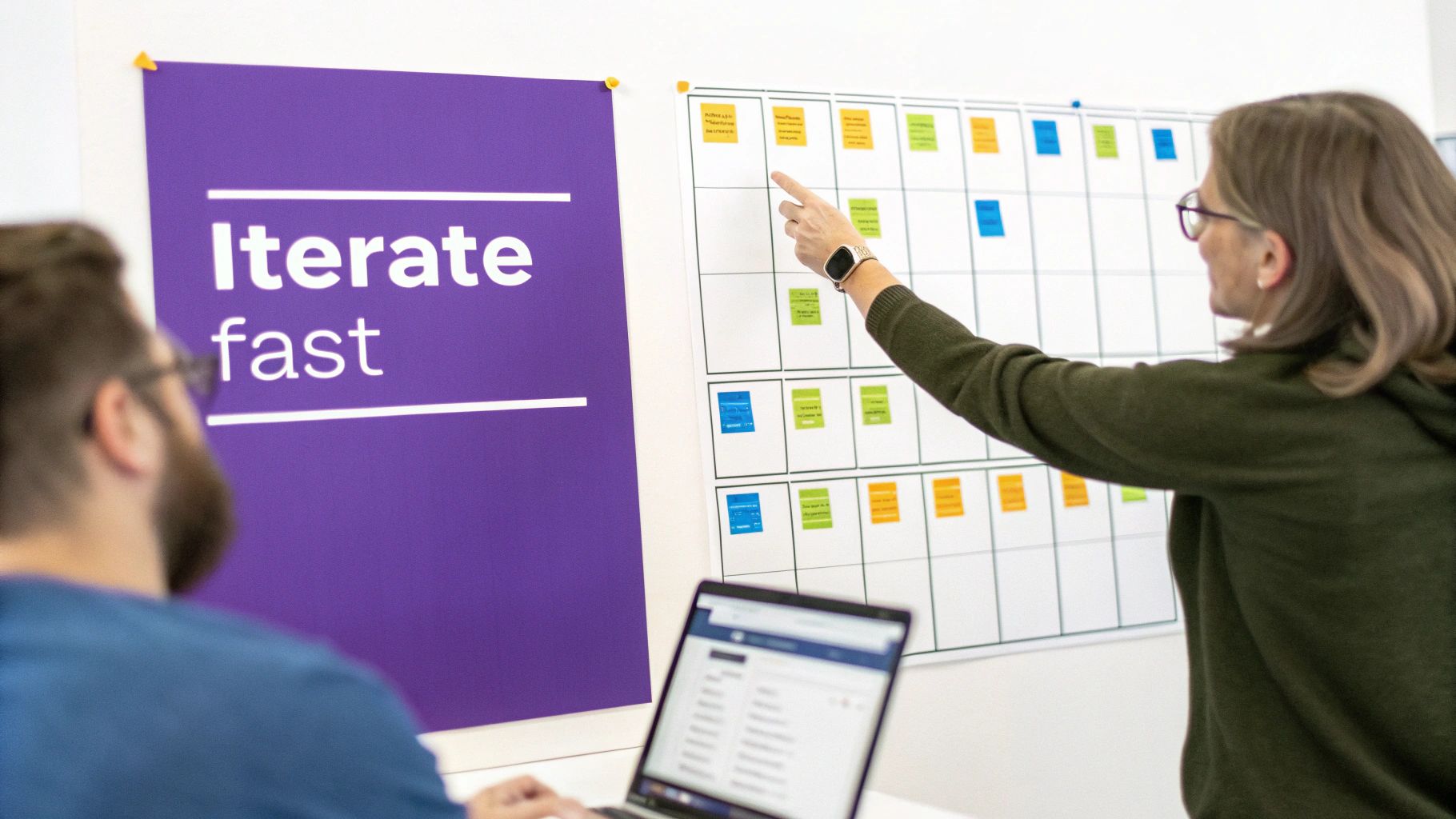
This methodology helps distributed teams break down large, complex projects into manageable, time-boxed iterations called "sprints." By delivering value in small increments, teams can gather feedback early and often, ensuring the final product aligns with user needs and business goals. This constant feedback loop is a core tenet of this approach.
How to Implement Agile with a Remote Team
Implementing Agile remotely requires clear communication, transparency, and the right digital tools to replicate the collaborative environment of a co-located team.
- Plan Sprints Collaboratively: Use a tool like Bulby for structured brainstorming sessions during sprint planning to generate and prioritize feature ideas or tasks. A prompt like, "What is the most valuable small feature we can deliver for our users in the next two weeks?" can focus the team's efforts.
- Conduct Asynchronous Stand-ups: For globally distributed teams, replace real-time daily stand-ups with async video updates using tools like Loom or Slack's video clips. This maintains daily alignment without creating scheduling conflicts across time zones.
- Use Visual Project Boards: Maintain a shared digital board (e.g., Jira, Trello, Asana) to provide a single source of truth for all work in progress. This transparency is crucial for keeping everyone on the same page, regardless of their location. This is one of the most visible continuous improvement examples in action.
By adopting these practices, Agile becomes a powerful framework for driving iterative progress. To dive deeper into planning effective sprints, you can explore these sprint planning best practices on remotesparks.com.
5. Design Thinking – Human-Centered Problem Solving
Design Thinking is a creative problem-solving methodology that places human needs at the center of innovation. It uses empathy, prototyping, and iterative testing to help teams develop solutions that are not only desirable but also feasible and viable. This approach is particularly valuable for remote teams developing new products or improving existing experiences, as it provides a structured framework for deep user understanding.
This methodology helps distributed teams build a shared understanding of user pain points, even when they cannot meet in person. By focusing on the end-user, it aligns product development with real-world needs, making it a powerful tool for customer-centric continuous improvement. Famous examples include Airbnb's design-led turnaround and Apple's deep focus on user experience.
How to Implement Design Thinking with a Remote Team
Effective remote Design Thinking requires structured facilitation and the right digital tools to replicate the creative energy of an in-person workshop. The goal is to deeply connect with user needs despite physical distance.
- Run Empathy-Building Sessions: Use a tool like Bulby for structured brainstorming focused on the user. Prompt your team with, "Based on our user interviews, what are the biggest frustrations our customers face daily?"
- Create Digital Journey Maps: Use online whiteboards like Miro or Mural to collaboratively map out the customer journey. This helps the entire team visualize pain points and identify opportunities for improvement.
- Prototype and Test Remotely: Develop low-fidelity prototypes using tools like Figma and share them with users for feedback over video calls. This iterative loop is one of the most effective continuous improvement examples for product development.
This approach ensures that innovation is guided by genuine user insights, not internal assumptions. If you want to dive deeper into this methodology, you can explore the design thinking process steps on remotesparks.com.
6. Retrospectives and Blameless Post-Mortems
Retrospectives are structured reflection sessions where teams evaluate what went well, what didn't, and what to improve after a project or sprint. Blameless post-mortems specifically focus on learning from system failures or incidents without assigning blame. This practice is essential for creating psychological safety in remote teams, ensuring that every member feels secure enough to share honest feedback and insights that drive genuine process improvements.
This approach transforms failures from dreaded events into powerful learning opportunities. For distributed teams, where context can be lost and misunderstandings can arise easily, a blameless framework prevents finger-pointing and encourages a focus on systemic, not individual, faults. It’s one of the most effective continuous improvement examples for building resilience and trust.
How to Implement Retrospectives with a Remote Team
Effective remote retrospectives depend on structured facilitation and a commitment to psychological safety. The goal is to gather honest feedback and convert it into concrete action items.
- Establish Clear Ground Rules: Start every session by stating the prime directive: "Regardless of what we discover, we understand and truly believe that everyone did the best job they could, given what they knew at the time, their skills and abilities, the resources available, and the situation at hand."
- Use the "Start, Stop, Continue" Format: This simple framework keeps the discussion focused. Ask team members to anonymously contribute ideas for each category: What should we start doing? What should we stop doing? What should we continue doing?
- Assign Action Items and Owners: The most critical step is turning discussion into action. Assign a clear owner and a deadline for each improvement item identified during the retrospective. Track these in a shared project management tool to ensure accountability and follow-through.
By consistently applying this practice, teams can systematically identify and eliminate recurring issues, strengthening their processes over time.
7. OKRs (Objectives and Key Results) – Goal-Setting and Alignment
OKRs (Objectives and Key Results) are a goal-setting framework for defining ambitious objectives and tracking them with measurable key results. Popularized by companies like Intel and Google, OKRs provide clarity, focus, and alignment across an organization. This is particularly crucial for remote teams, where a shared understanding of priorities is essential to prevent silos and duplicated efforts.
For distributed teams, OKRs transform strategy from an abstract concept into a concrete, actionable plan. They create a clear "why" behind the daily work, connecting individual contributions to the company's broader mission. This framework naturally integrates with continuous improvement by creating a structured cycle of setting goals, measuring progress, and learning from outcomes each quarter.
How to Implement OKRs with a Remote Team
Implementing OKRs effectively in a remote setting requires transparency, regular communication, and the right tools to keep everyone aligned.
- Define Objectives Collaboratively: Use a brainstorming tool like Bulby to run a session focused on a prompt such as, "What is the single most ambitious thing our team could achieve this quarter to advance our company's mission?" This ensures buy-in.
- Maintain a Central OKR Dashboard: Use a tool like Asana, Trello, or a shared Notion page to keep all OKRs visible to everyone. This transparency is key for remote alignment.
- Conduct Regular Check-ins: Schedule brief, weekly or bi-weekly check-ins to discuss progress, identify blockers, and adjust tactics. This keeps the OKRs from becoming a "set it and forget it" exercise.
- Use Failures as Learning Moments: Treat key results that were missed not as failures, but as data points. Discuss them in retrospectives to refine your approach for the next cycle. This is one of the most powerful continuous improvement examples for building a resilient, learning-focused culture.
By making goals and progress transparent, OKRs empower remote teams to move in a unified direction, even when physically apart. You can explore more about setting effective goals by reading about the OKR framework on whatmatters.com.
8. Psychological Safety and Inclusive Team Practices
Psychological safety is the shared belief that a team is safe for interpersonal risk-taking, such as sharing ideas, asking questions, or admitting mistakes, without fear of punishment or humiliation. This foundation of trust is crucial for continuous improvement, as it encourages the open dialogue and vulnerability needed to identify and solve problems. Google’s Project Aristotle famously identified it as the most important dynamic of effective teams.
For remote teams, intentionally fostering psychological safety is even more critical to bridge the physical distance and potential for miscommunication. When team members feel secure, they are more likely to engage in the candid feedback and collaborative problem-solving that drives progress. This is one of the most foundational continuous improvement examples because it creates the environment for all other methods to succeed.
How to Implement Psychological Safety with a Remote Team
Building trust in a distributed environment requires structured, intentional practices that make safety a default, not an afterthought.
- Model Vulnerability: Leaders should be the first to admit mistakes and openly share their learnings. This normalizes imperfection and encourages others to do the same.
- Run Bias-Reducing Brainstorms: Use a tool like Bulby for anonymous ideation sessions. Ask a prompt like, "What is one 'risky' idea you have for improving our product that you've been hesitant to share?" Anonymity ensures ideas are judged on merit, not origin.
- Establish Feedback Norms: Create clear, structured channels for feedback, such as regular one-on-ones, anonymous pulse surveys, or a dedicated "lessons learned" segment in retro meetings. To cultivate an environment where psychological safety thrives and continuous improvement can flourish, consider these proven strategies for building high-performing teams, emphasizing psychological safety and clear roles.
9. Feedback Loops and 360-Degree Feedback Systems
Feedback loops are systematic processes for gathering and acting on performance insights. A 360-degree feedback system broadens this by collecting input from an individual's entire professional circle, including peers, managers, and direct reports. This multi-directional approach provides a holistic view that a single manager's perspective cannot.
For remote teams, structured feedback is non-negotiable. It replaces the informal cues and spontaneous conversations lost in a distributed environment. Companies like Adobe have famously replaced annual reviews with their "Check-in" system, fostering continuous dialogue and development. This ensures that personal and professional growth becomes an ongoing, embedded practice, rather than a once-a-year event.
How to Implement Feedback Loops with a Remote Team
Effective remote feedback requires psychological safety and clear, accessible frameworks. The goal is to make giving and receiving feedback a low-friction, high-value habit.
- Establish a Feedback Framework: Train your team on a simple model like SBI (Situation-Behavior-Impact). This keeps feedback specific and focused on observable actions, not personal traits.
- Run Anonymous Feedback Sessions: Use a tool like Bulby to run an asynchronous 360-degree review. Ask specific, action-oriented questions like, "What is one thing [Teammate's Name] could start doing to improve team collaboration?"
- Create Actionable Plans: The loop isn't closed until feedback is acted upon. Guide team members to create simple, personal development plans based on recurring themes and follow up on progress in subsequent one-on-ones. This is one of the most powerful continuous improvement examples for individual and team growth.
10. Experimentation and A/B Testing Culture
A culture of experimentation empowers teams to move beyond assumptions by testing hypotheses, measuring outcomes, and making data-driven decisions. This approach uses methodologies like A/B testing to validate ideas and drive incremental improvements. For remote product and marketing teams, this provides a structured framework to learn quickly and build evidence-based habits.

This methodology is essential for remote teams that need objective data to align on decisions, reducing reliance on subjective opinions. Companies like Netflix and Spotify build their entire product strategy around this principle, testing everything from user interfaces to recommendation algorithms to ensure changes genuinely enhance the user experience.
How to Implement an Experimentation Culture with a Remote Team
Building an experimentation habit requires a shared process for generating, prioritizing, and analyzing tests. For distributed teams, transparent documentation and tooling are key to success.
- Brainstorm Hypotheses: Use a tool like Bulby for a collaborative session to generate testable ideas. Ask, "What is one assumption about our users that we could test to improve engagement by 5%?"
- Establish a Shared Repository: Create a central hub in a tool like Notion or Confluence to document all experiment plans, results, and key learnings. This ensures transparency and prevents duplicate efforts.
- Celebrate Learning, Not Just Winning: Publicly share the results of all experiments, especially the "failed" ones. Emphasize the value of the insights gained, which makes this one of the most powerful continuous improvement examples for fostering psychological safety.
10-Method Continuous Improvement Comparison
| Approach | Implementation Complexity 🔄 | Resource Requirements ⚡ | Expected Outcomes 📊 | Ideal Use Cases 💡 | Key Advantages ⭐ |
|---|---|---|---|---|---|
| Kaizen – Continuous Incremental Improvement | Low — small changes, needs consistent discipline | Low — minimal tools/time; team contributions | Gradual efficiency & waste reduction; measurable over months | Continuous ops improvement; remote team engagement | Sustainable gains, high employee ownership |
| Lean Methodology – Eliminate Waste and Maximize Value | Medium — requires value-stream mapping and culture shift | Medium — analysis time, facilitation, mapping tools | Significant cost/time reduction; improved value flow | Process-heavy workflows; waste elimination initiatives | Clear waste identification; stronger process efficiency |
| Six Sigma – Data-Driven Quality Improvement | High — rigorous statistical methods and governance | High — trained belts, analytics software, project teams | Quantifiable defect reduction and process consistency | High-volume, quality-critical operations | Rigorous, measurable quality improvements |
| Agile Development – Iterative and Adaptive Improvement | Medium — process and cultural changes (sprints, rituals) | Medium — tooling (boards), facilitator time, ceremonies | Faster delivery, better adaptability, regular feedback | Product development, fast-changing requirements, remote teams | Rapid iteration, improved collaboration and responsiveness |
| Design Thinking – Human-Centered Problem Solving | Medium — structured stages and cross-functional work | Medium — user research, prototyping resources, time | User-validated solutions; reduced risk of wrong-build | New products/services, UX and experience design | Deep user insight; higher desirability of solutions |
| Retrospectives & Blameless Post-Mortems | Low — structured facilitation; repeat cadence | Low — meeting time, documentation, facilitator | Improved learning, fewer repeat failures, stronger practices | Post-sprint/project reviews, incident learning | Builds psychological safety; actionable improvements |
| OKRs – Goal-Setting and Alignment | Medium — alignment, cadence, and visibility setup | Low–Medium — tracking tools, regular check-ins | Clear focus and measurable progress toward objectives | Strategic alignment across distributed orgs | Transparency of priorities; motivates stretch goals |
| Psychological Safety & Inclusive Practices | High — cultural change, leadership modeling | Medium — training, sustained behavioral effort | Higher engagement, honest feedback, more innovation | Teams needing trust for collaboration and creativity | Increases idea-sharing, retention, and learning |
| Feedback Loops & 360° Feedback Systems | Medium — design, calibration, and facilitation | Medium — platforms, time to collect and act on feedback | Comprehensive development insights; identifies blind spots | Performance development and leadership growth | Holistic perspectives; supports continuous development |
| Experimentation & A/B Testing Culture | Medium — statistical design and experiment governance | High — platforms, analytics, sufficient traffic/samples | Data-backed decisions; validated improvements and insights | Product/marketing optimization, hypothesis testing | Reduces rollout risk; drives measurable gains and learnings |
Start Small, Improve Continuously: Your Next Steps
The journey through these diverse continuous improvement examples reveals a powerful, unifying truth: sustained progress is not born from massive, one-time overhauls. Instead, it’s the result of small, consistent, and deliberate enhancements embedded into your team’s daily rhythm. We’ve seen how methodologies like Kaizen and Lean target incremental gains, while frameworks like Agile and OKRs provide the structure for iterative growth.
The key takeaway is that continuous improvement is less about adopting a rigid doctrine and more about fostering a culture of curiosity and psychological safety. It’s about creating an environment where asking "How can we do this better?" is a natural, blameless part of the workflow. For distributed teams, this cultural foundation is non-negotiable.
Weaving Improvement into Your Remote Workflow
The most successful remote teams don't treat improvement as a separate task on a to-do list. They integrate it directly into their operations. This looks like running structured retrospectives after every sprint, using blameless post-mortems to learn from failures, and establishing clear feedback loops that empower every team member to contribute.
The examples of Design Thinking and A/B testing show us that the best ideas come from understanding the end-user and being willing to experiment. You don't need a grand plan to start. You just need a single, focused initiative.
Your Actionable Path Forward
To translate these ideas into action, resist the urge to do everything at once. The spirit of continuous improvement is to start small and build momentum.
Here are your next steps:
- Choose One Focus Area: Don't try to implement Six Sigma and OKRs simultaneously. Pick one area that feels most pressing. Is it process waste? Team communication? Product quality?
- Select a Relevant Tactic: Based on your focus, choose one of the methods discussed. If you're struggling with inefficiencies, try a simple value stream mapping exercise from the Lean methodology. If team alignment is off, start with a single, clear OKR for the next quarter.
- Define a Measurable Goal: What does success look like? Define a clear, simple KPI. For example, "Reduce the time to resolve support tickets by 10% in the next 30 days."
- Facilitate, Measure, and Iterate: Use a remote-friendly facilitation technique to get your team involved. Run the experiment for a set period, measure your defined KPI, and discuss the results. Then, decide what to improve next.
Mastering this cycle is the single most valuable skill a modern team can develop. It’s the engine that drives innovation, enhances efficiency, and builds a resilient, high-performing culture that can thrive in any environment. The path to exceptional performance is paved with these small, intentional steps. Each one, no matter how minor, is a victory.
Ready to turn these continuous improvement examples into your team's reality? Bulby provides the structured, inclusive, and remote-first platform you need to facilitate powerful brainstorming sessions, retrospectives, and strategic workshops. Start transforming your team's culture today by exploring Bulby.