
In a distributed world, the product roadmap is more than just a plan. It's the connective tissue that aligns your remote team, prevents silos, and turns strategy into reality. Yet, many remote teams struggle with roadmaps that are either too rigid to adapt or too vague to provide clear direction, leading to misalignment, duplicated work, and wasted effort. The solution isn't a fancier tool, but a fundamentally better set of operating principles.
This guide provides 10 essential product roadmap best practices specifically adapted for the unique challenges of remote and distributed work. Forget generic advice; we are diving deep into actionable strategies for creating, communicating, and maintaining a roadmap that empowers your team to build impactful products, no matter where they are located.
You will learn how to move from a feature factory mindset to a value-driven approach. We will cover a comprehensive set of tactics, including:
- Anchoring your plan to a clear product vision.
- Focusing on measurable outcomes instead of just shipping features.
- Integrating customer research directly into your planning process.
- Establishing transparent communication and stakeholder management rituals.
By implementing these practices, your roadmap will transform from a static document into a dynamic source of clarity, motivation, and strategic alignment for your entire organization. Let's get started.
1. Vision-Driven Roadmap Alignment
A product roadmap without a clear vision is like a ship without a rudder. It might be moving, but it lacks purpose and direction. Vision-driven roadmap alignment is a fundamental practice where every initiative, feature, and task on your roadmap is directly tied to a single, compelling product vision. This ensures that your team isn't just building features; they are collectively building toward a shared, long-term goal.

For remote and distributed teams, this practice is non-negotiable. It provides the strategic context needed for autonomous decision-making, ensuring that even when team members are continents apart, their efforts are harmonized. The vision acts as a North Star, guiding prioritization and preventing the team from getting sidetracked by short-term distractions or conflicting stakeholder requests.
Real-World Examples
- Slack: Their vision to "make work simpler, more pleasant, and more productive" directly informs their roadmap, prioritizing features like Huddles and integrations that reduce friction in daily communication.
- Notion: With a vision to be an "all-in-one workspace," their roadmap logically prioritizes features that consolidate tools, such as databases, wikis, and project management, into a single platform.
How to Implement Vision-Driven Alignment
This approach is one of the most crucial product roadmap best practices because it transforms your plan from a simple list of features into a strategic communication tool.
Key Insight: A powerful product vision inspires your team and justifies your strategic choices. It answers the "why" behind every "what" on your roadmap, fostering buy-in and motivation.
To put this into practice, especially with a distributed team, follow these steps:
- Document and Centralize: Write your product vision as a clear, memorable statement. Store it in a highly visible and accessible location like your company wiki or the header of your digital roadmapping tool.
- Connect Initiatives to Vision: For every major item on your roadmap, include a short explanation of how it directly supports the product vision. This reinforces the strategic purpose behind the work.
- Use Collaborative Tools: For remote teams, use digital whiteboarding tools like Bulby for structured brainstorming sessions to define or refine your vision collaboratively. This ensures every team member feels a sense of ownership.
- Quarterly Vision Check-ins: Revisit the vision each quarter. Ask, "Does this still accurately reflect our goals and the market reality?" This keeps your guiding principle relevant and sharp.
This foundational step ensures your roadmap is not just a plan but a story about where you are going and why it matters. To dive deeper into structuring your strategic thinking, explore these product strategy frameworks that can help you define and articulate a powerful vision.
2. Customer-Centric Research Integration
Building a product based on internal assumptions is a direct path to failure. Customer-centric research integration is the practice of embedding continuous user feedback directly into the roadmap planning process. This ensures that every decision is grounded in real user needs, pain points, and behaviors, rather than what the team thinks customers want. It involves systematically gathering both qualitative and quantitative data to inform prioritization.

For remote and distributed teams, this practice is crucial for bursting the "echo chamber" bubble. Without the daily, informal feedback of an office environment, remote teams can become disconnected from their user base. A structured research process bridges that gap, ensuring the customer's voice is the loudest one in the virtual room when roadmap decisions are made.
Real-World Examples
- Airbnb: Their early obsession with customer research, including staying in host properties, directly drove product and design decisions that built trust and usability into their platform from day one.
- Intercom: By conducting over 50 customer interviews each month, their product team maintains a direct, current line to user needs, which heavily influences their roadmap priorities.
- Calendly: A deep focus on user friction points, uncovered through research, led to their signature one-click scheduling innovation, which became a core differentiator.
How to Implement Customer-Centric Research
Integrating user feedback is one of the most impactful product roadmap best practices because it de-risks development. It ensures you are building something people actually need and will use.
Key Insight: Your roadmap should be a direct response to customer problems, not a list of features you want to build. Consistent research is the bridge between your product strategy and market reality.
To integrate this into your workflow, especially with a distributed team, follow these steps:
- Assign a Research Owner: Designate a person or a small team responsible for organizing, conducting, and synthesizing research. This creates consistency and accountability.
- Share Customer Stories: Regularly share customer quotes, video clips, and key findings in team channels. This keeps the entire team, from engineering to marketing, connected to the user's perspective.
- Create a Research Cadence: Schedule a rotating system where different product team members observe live user research sessions. This direct exposure builds deep empathy.
- Connect Findings to Roadmap: Synthesize monthly or quarterly research reports that explicitly connect key findings to potential roadmap initiatives or shifts in priority.
This practice ensures your team's effort is always pointed toward solving real-world problems. To master the fundamentals, learn more about how to conduct effective user research for remote product development.
3. Outcomes-Based Planning Over Output Focus
A common roadmap pitfall is measuring success by the number of features shipped (output) rather than the value they create (outcomes). An outcomes-based approach shifts the focus from "what are we building?" to "what problem are we solving and how will we measure success?" This ensures every initiative on your roadmap is directly tied to a measurable business impact, like increased user retention or revenue growth.

For remote teams, this practice is crucial for combating "output-visibility bias," where teams build features just to demonstrate productivity. By defining success metrics upfront, you empower distributed teams to make autonomous decisions that genuinely move the needle. It creates a culture of accountability focused on impact, not just activity.
Real-World Examples
- Netflix: Measures roadmap success by its impact on subscriber growth and total engagement minutes, not by the sheer number of features launched.
- Spotify: Focuses its roadmap decisions on initiatives that directly contribute to increasing monthly active users and listening hours.
- Stripe: Prioritizes features that enable developer productivity and simplify transactions, linking their roadmap to core customer value.
How to Implement Outcomes-Based Planning
Adopting this mindset is one of the most transformative product roadmap best practices you can implement. It forces your team to think critically about the why behind their work and ensures resources are allocated to initiatives that deliver real value.
Key Insight: Focusing on outcomes makes your roadmap a strategic hypothesis. Each item is an experiment designed to achieve a specific, measurable result, which fosters a culture of learning and continuous improvement.
To put this into practice, especially with a distributed team, follow these steps:
- Define Success Metrics First: For every major initiative, define 2-3 primary success metrics before a single line of code is written. Examples include "increase user activation rate by 15%" or "reduce support tickets by 20%."
- Use an OKR Framework: Connect your roadmap initiatives to Objectives and Key Results (OKRs). This creates a clear, hierarchical link from daily tasks to high-level business goals.
- Establish Baselines: Before launching a new feature or initiative, measure and document the baseline metrics. This is the only way to accurately assess the impact of your work.
- Conduct Outcome Retrospectives: After a launch, hold a retrospective focused specifically on the results. Discuss whether the initiative met its goals, what you learned, and how to apply those lessons to the next item on the roadmap.
4. Time-Based Roadmap Structuring
A roadmap that treats a task due next week with the same level of detail as a goal for next year is destined to fail. Time-based roadmap structuring organizes initiatives into clear horizons, such as near-term, mid-term, and long-term. This provides critical flexibility for future plans while demanding concrete detail for immediate work, a balance that is essential for remote teams who thrive on clarity but need to adapt to market changes.
A popular framework for this is 'Now-Next-Later'. 'Now' covers the current work cycle (e.g., this quarter), 'Next' outlines what's coming in the near future (e.g., the following 1-2 quarters), and 'Later' holds high-level strategic themes for the long term. This structure manages stakeholder expectations by clearly communicating what is committed versus what is still being explored, reducing anxiety and miscommunication across time zones.
Real-World Examples
- Atlassian: Utilizes a rolling quarterly planning approach, which aligns perfectly with the Now-Next-Later model, allowing them to adjust priorities based on continuous feedback while maintaining a clear, short-term focus.
- GitHub: Organizes public roadmaps by quarter, providing clear, committed milestones for the 'Now' bucket while keeping future initiatives as broader explorations in the 'Next' and 'Later' columns.
How to Implement Time-Based Structuring
Organizing your plan into time horizons is one of the most effective product roadmap best practices for balancing immediate execution with long-term strategic agility.
Key Insight: A time-based roadmap acknowledges uncertainty. It allows your team to commit with confidence to near-term goals while leaving room for discovery and adaptation in the future.
To implement this structure with your distributed team, follow these steps:
- Define Your Horizons: Clearly establish what 'Now,' 'Next,' and 'Later' mean for your team (e.g., Now = current quarter, Next = Q3-Q4, Later = 2025+). Document these definitions.
- Keep 'Later' Thematic: Avoid assigning detailed features or specs to the 'Later' column. Instead, use broad strategic themes like "Improve Onboarding" or "Expand Integrations" to maintain flexibility.
- Communicate Changes Transparently: When an item moves between horizons (e.g., from 'Next' to 'Now'), clearly communicate the 'why' behind the shift. This builds trust and keeps everyone aligned.
- Schedule Regular Reviews: Institute a quarterly planning session to collaboratively reprioritize the roadmap and a monthly check-in to review the transition of items from 'Next' to 'Now.'
For teams considering different structuring methods, it can be beneficial to explore the 'Now Next Later' roadmap approach to see how it can be adapted to various business needs.
5. Transparent Communication and Shared Context
For distributed teams, the informal "water cooler" conversations that clarify strategic direction simply don't exist. This makes transparent communication and shared context essential for maintaining alignment and morale. This practice involves not just sharing the roadmap, but also openly documenting and communicating the rationale, trade-offs, and changes behind every decision.
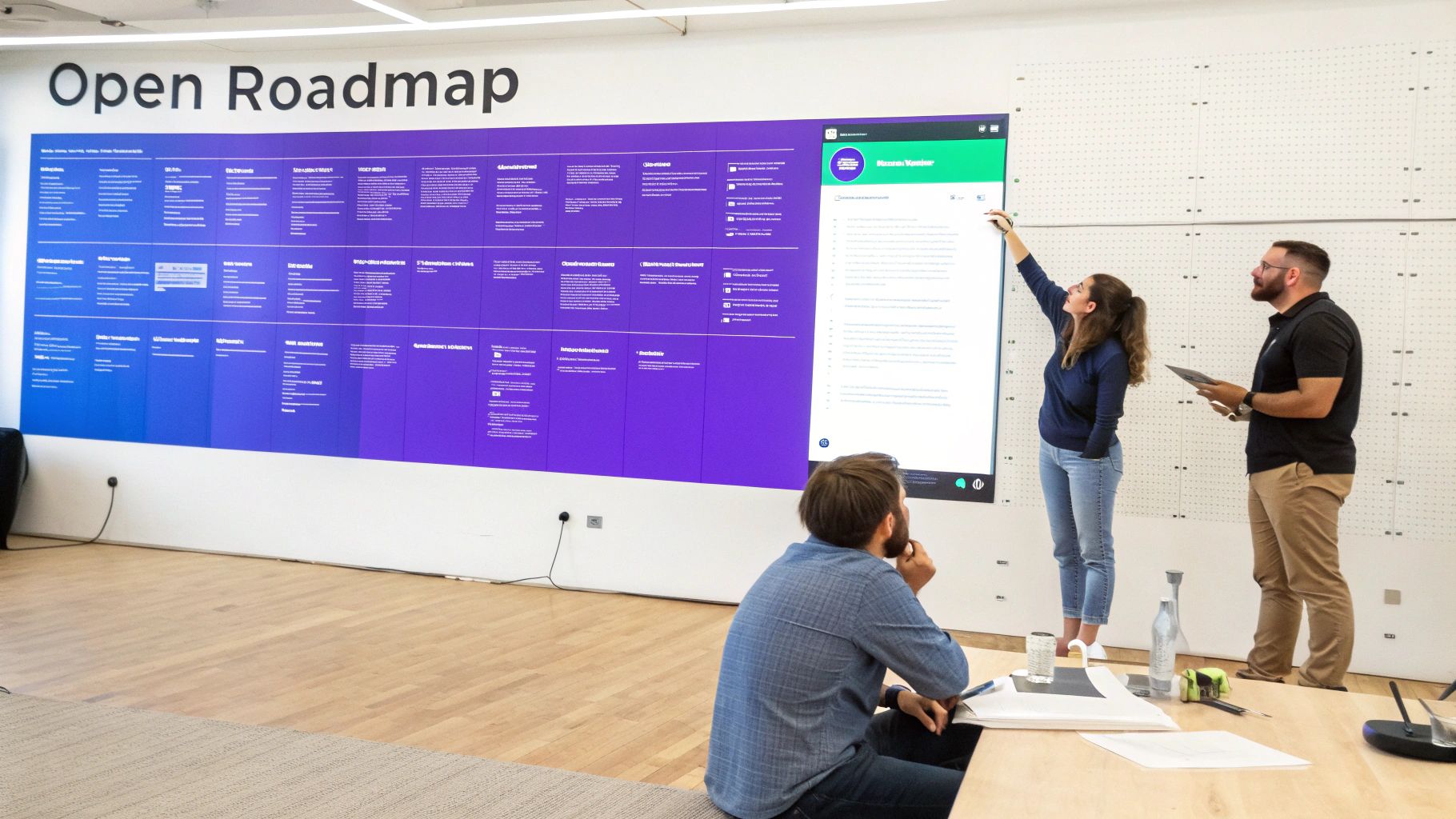
When team members across different time zones understand the "why" behind prioritization, it builds immense trust and empowers them to make better autonomous decisions. It prevents the frustration and disengagement that arises when strategic shifts seem arbitrary or are communicated poorly. Transparency transforms the roadmap from a top-down directive into a shared artifact that everyone understands and supports.
Real-World Examples
- GitLab: The company famously operates with extreme transparency, publishing its entire product roadmap publicly. Every decision is documented in detail, allowing both internal teams and external users to understand the strategic thinking.
- Buffer: Known for its transparent culture, Buffer openly shares its roadmap decisions and the reasoning behind them with both the team and its user base, fostering a strong sense of community and trust.
How to Implement Transparent Communication
Adopting this approach is one of the most impactful product roadmap best practices for remote-first organizations, as it directly addresses the communication gaps inherent in distributed work.
Key Insight: Transparency isn't just about sharing the final roadmap; it's about showing your work. Explaining the trade-offs and decisions made along the way is crucial for building trust and shared understanding.
To cultivate this practice within your distributed team, implement these steps:
- Document Decision Rationale: For every significant roadmap decision, create a record in your company wiki or project management tool explaining the context, the options considered, and the final reasoning.
- Establish a Communication Cadence: Share monthly or quarterly roadmap updates through multiple channels. Combine a detailed written summary for async consumption with a live, recorded Q&A session for real-time clarification.
- Explain What's Not Included: Explicitly communicate what you've decided not to build and why. Discussing these trade-offs is just as important as announcing new features, as it provides critical strategic context.
- Create a Roadmap FAQ: Proactively compile and answer common questions about the roadmap in a central, easily accessible document. This saves time and ensures consistent messaging across the organization.
6. Cross-Functional Collaboration and Input
Building a product roadmap in a silo is a recipe for failure. It creates a plan that is detached from technical reality, market needs, and go-to-market capabilities. Cross-functional collaboration is the practice of intentionally involving engineering, design, marketing, sales, and customer success in the roadmap planning process. This ensures every initiative is vetted for feasibility, customer value, and business impact from all angles.
For distributed teams, this collaboration cannot be left to chance. It requires structured, deliberate processes to gather diverse perspectives without descending into meeting chaos. When done right, this practice transforms the roadmap from a product team's wish list into a unified company commitment, ensuring everyone is aligned and ready to execute successfully.
Real-World Examples
- Amazon: Their "working backward" method forces collaboration from day one by requiring product, engineering, and marketing to co-create a press release for a new feature before any code is written.
- Asana: They utilize cross-functional "planning jams" where representatives from different departments come together in structured sessions to build and prioritize their quarterly roadmaps collaboratively.
How to Implement Cross-Functional Collaboration
This is one of the most critical product roadmap best practices because it builds a shared reality and collective ownership of the plan, which is essential for execution.
Key Insight: Your roadmap's success depends not just on what's on it, but on who helped put it there. Involving all functions early prevents costly surprises and builds a resilient, company-wide execution engine.
To implement this with a distributed team, follow these steps:
- Establish Clear Governance: Define who from each department is a stakeholder and what their role is in the roadmapping process. Document this in a shared space.
- Run Structured Input Sessions: Schedule dedicated, facilitated workshops instead of open-ended meetings. Use structured brainstorming tools like Bulby to ensure every function, from engineering to sales, has an equal voice.
- Create Feasibility Scorecards: Ask engineering to create and use a simple scorecard to rate roadmap candidates on technical complexity, risk, and resource needs. This brings objective data into prioritization discussions.
- Value and Document All Input: After a planning cycle, share a summary of the key inputs received from each team and how they influenced the final roadmap. This shows their contribution was heard and valued.
Incorporating these steps will ensure your roadmap is not only ambitious but also realistic and fully supported. To build a stronger foundation for these interactions, explore these team collaboration best practices designed for remote environments.
7. Assumption Documentation and Validation
Every product roadmap is built on a foundation of assumptions about user needs, market dynamics, and technical feasibility. Ignoring these assumptions is a recipe for wasted effort. Assumption documentation and validation is the practice of explicitly identifying, recording, and testing these underlying beliefs before committing significant resources to an initiative.
This practice is a powerful de-risking tool for any team, but it's especially critical for remote organizations. When team members are geographically dispersed, undocumented assumptions can lead to critical misunderstandings about the certainty of a plan. By making assumptions visible, you create a shared understanding of what is known versus what is merely believed, preventing costly misalignments down the line.
Real-World Examples
- Lean Startup Methodology: The entire framework is built on identifying and testing core business assumptions (the "leap-of-faith" assumptions) through Minimum Viable Products (MVPs).
- Google Ventures: Their famous five-day Design Sprint process is a structured method to rapidly prototype and validate critical assumptions with real users before any code is written.
- IDEO: The design firm uses assumption mapping to plot assumptions on an axis of "known/unknown" and "important/unimportant," helping teams prioritize which beliefs need immediate validation.
How to Implement Assumption Documentation
Adopting this process is one of the most impactful product roadmap best practices for building resilient and evidence-based plans. It shifts the team's focus from just delivering features to active learning and risk reduction.
Key Insight: A roadmap initiative is not just a deliverable; it's a collection of hypotheses. Your first job is to identify the riskiest hypothesis and find the cheapest, fastest way to test it.
To integrate this practice, especially with a distributed team, follow these steps:
- List Critical Assumptions: For each major roadmap initiative, list the 5-7 most critical assumptions that must be true for it to succeed. Ask, "What would cause this entire initiative to fail?"
- Use Collaborative Tools: Run a remote brainstorming session using a digital whiteboard like Bulby to have the entire team contribute and surface hidden assumptions that individuals might take for granted.
- Rate and Prioritize: Rate each assumption by its potential impact if wrong and your level of confidence that it's correct. Focus validation efforts on high-impact, low-confidence assumptions first.
- Design Lightweight Tests: Define simple experiments to validate your riskiest assumptions. This could be anything from user interviews and surveys to a simple landing page test.
- Integrate into Sprints: Make assumption validation a formal part of your process. The first step for any new epic shouldn't be writing code; it should be designing and running an experiment to test a core belief.
8. Regular Review Cycles and Iteration
A product roadmap is a living document, not a static artifact carved in stone. Market conditions shift, customer feedback pours in, and new data emerges. Regular review cycles and iteration ensure your roadmap remains a relevant, responsive, and accurate guide. This practice establishes a predictable cadence for reassessing priorities, adapting to change, and incorporating new learnings.
For a distributed team, these scheduled review cycles are indispensable synchronization points. They create dedicated moments for the entire team to align on the current state, discuss what's changed, and collectively adjust the plan. This proactive iteration prevents roadmap stagnation, keeping the team agile and engaged by demonstrating that their feedback and on-the-ground insights directly influence the product's direction.
Real-World Examples
- Spotify: The company famously operates with quarterly planning sessions and monthly check-ins to ensure their roadmap aligns with evolving strategic goals and team progress.
- Slack: With bi-weekly prioritization reviews, Slack's product teams can rapidly adjust their roadmap based on user engagement data and feedback from new feature releases.
How to Implement Regular Review Cycles
This is one of the most critical product roadmap best practices for maintaining momentum and relevance. It turns your roadmap from a rigid plan into an agile strategic tool. To foster continuous improvement and adaptability, incorporate regular review cycles, drawing inspiration from services that leverage Agile Sprints for iterative development.
Key Insight: A roadmap that never changes is a roadmap that is being ignored. Regular, predictable reviews build trust and ensure the plan reflects reality, not wishful thinking.
To establish a strong review cadence with your remote team, follow these steps:
- Schedule Dedicated Meetings: Book monthly or quarterly roadmap review meetings on the calendar. Treat them as non-negotiable rituals, not ad-hoc discussions that can be easily skipped.
- Use a Consistent Framework: Structure each review around a consistent set of questions: What have we learned since the last review? What assumptions were proven wrong? What new opportunities have emerged? What should we change?
- Publish Updates and Rationale: After each review, publish a summary of the changes and, most importantly, the "why" behind them. This transparency builds trust and keeps everyone aligned, even if they couldn't attend the meeting.
- Track Outcomes, Not Just Output: Connect roadmap items to key metrics. During reviews, assess progress against these outcomes to make data-informed decisions about what to continue, stop, or start. You can use a structured format similar to a sprint retrospective template to guide the discussion.
9. Buffer Capacity and Risk Management
A roadmap that is 100% committed is a roadmap that is 100% fragile. It creates a high-pressure environment where unexpected bugs, critical customer issues, or new opportunities can derail the entire plan. Building in buffer capacity is the practice of intentionally reserving a percentage of your team's time for unplanned but essential work, ensuring your roadmap remains resilient and realistic.
This practice is a lifeline for distributed teams. Without the informal oversight of a co-located office, scope creep can go unnoticed and team burnout can escalate quickly. By explicitly allocating capacity for technical debt, urgent fixes, and small improvements, you create a sustainable pace and empower your team to maintain product quality without needing constant top-down approval.
Real-World Examples
- Amazon: Many teams famously reserve significant sprint capacity, sometimes up to 30%, for operational excellence and paying down technical debt, ensuring system stability.
- GitHub: Teams are often encouraged to allocate around 20% of their time to pursue technical improvements, security enhancements, and internal tool development.
How to Implement Buffer Capacity
Including a buffer is one of the most practical product roadmap best practices because it acknowledges the reality of product development: the unexpected always happens. It shifts your roadmap from a rigid, breakable plan to an adaptable, antifragile strategy.
Key Insight: Buffer capacity is not "empty time"; it is a strategic investment in quality, stability, and team well-being. It gives your team the breathing room to solve problems correctly instead of just quickly.
To effectively integrate this into your remote workflow, follow these steps:
- Calculate Realistic Velocity: Determine your team's true capacity by accounting for non-coding time like meetings, emails, and context switching. A typical starting point is to reserve 20-30% as a buffer.
- Communicate the Buffer: Be transparent with stakeholders about this allocation. Frame it as a proactive investment in product health and risk management, not a lack of commitment.
- Establish Clear Governance: Create a simple system, like a Severity x Impact matrix, to decide what qualifies for the buffer. This prevents it from becoming a dumping ground for non-urgent feature requests.
- Protect the Buffer: Vigorously defend this allocated time from being absorbed by "important" planned work. Its purpose is to handle the unplanned.
- Track and Adjust: Monitor how the buffer is used. If it consistently overflows or is underutilized, review the allocation monthly and adjust it to better reflect your team's reality.
10. Stakeholder Alignment and Expectation Management
Misaligned expectations are a primary cause of roadmap failure. Stakeholder alignment is the proactive process of clarifying needs, establishing shared principles for prioritization, and communicating trade-offs explicitly with everyone from executives to customers. It ensures that the roadmap reflects a shared understanding of what success looks like and how you plan to get there.
For distributed teams, this practice is critical. The informal "hallway conversations" that smooth over misunderstandings in an office don't exist. Without deliberate alignment rituals, teams can discover major disconnects mid-execution, leading to wasted effort and frustration. Proactive management prevents surprises and builds trust across the organization.
Real-World Examples
- Stripe: Conducts highly visible quarterly stakeholder reviews where all input is gathered and discussed, ensuring transparency in how decisions are made.
- Figma: Maintains an explicit "roadmap principles" document that guides all stakeholder conversations, setting a consistent foundation for every discussion.
How to Implement Stakeholder Alignment
This is one of the most vital product roadmap best practices because it transforms your roadmap from a source of conflict into a tool for building consensus and momentum.
Key Insight: Proactive alignment isn't about getting everyone to agree; it's about ensuring everyone understands the 'why' behind the trade-offs you are making. Clarity prevents future friction.
To master this with a remote or hybrid team, follow these steps:
- Document Prioritization Criteria: Before you build the roadmap, get stakeholders to agree on the criteria you'll use to prioritize initiatives (e.g., customer impact, revenue potential, strategic fit).
- Create a Feedback Intake Process: Use a structured system like a dedicated form or a channel to collect stakeholder requests. Crucially, close the loop by showing how their input influenced decisions, even if it was deprioritized.
- Be Explicit About Trade-offs: Frame decisions clearly. State, "We are focusing on improving user onboarding this quarter, which means we are consciously deprioritizing the new reporting dashboard until Q3."
- Schedule Quarterly Reviews: Hold dedicated meetings to present the upcoming roadmap and its rationale. Use this time to gather feedback and address concerns before development begins.
Effective stakeholder management is a continuous effort, not a one-time event. To build stronger relationships and ensure everyone feels heard, discover these advanced stakeholder engagement strategies that work exceptionally well for distributed teams.
Product Roadmap Best Practices: 10-Point Comparison
| Practice | 🔄 Implementation Complexity | ⚡ Resource Requirements | 📊 Expected Outcomes | Ideal Use Cases | ⭐ Key Advantages |
|---|---|---|---|---|---|
| Vision-Driven Roadmap Alignment | High — cross-functional vision workshops and cascading | Medium-High — leadership time, facilitation, documentation | Strategic clarity and consistent prioritization across teams | Scaling orgs needing unified long-term direction | Eliminates paralysis; simplifies prioritization; boosts autonomy |
| Customer-Centric Research Integration | Medium-High — ongoing research cadence and synthesis | High — researchers, interview time, analytics tools | Data-driven priorities; lower risk of building unwanted features | User-facing products with ambiguous user needs | Reduces wasted work; improves product-market fit; informs decisions |
| Outcomes-Based Planning Over Output Focus | Medium — define metrics, measurement and review frameworks | Medium — analytics, measurement tooling, discipline | Clear business impact (retention, engagement, revenue) tied to initiatives | Teams focused on measurable business results | Prevents feature bloat; clarifies “why”; enables experiments |
| Time-Based Roadmap Structuring | Low-Medium — implement Now/Next/Later and quarterly cadence | Low-Medium — regular planning sessions and updates | Flexible commitments; clearer near-term focus with long-term options | Teams needing timeline clarity without overcommitment | Balances clarity and agility; reduces overcommitment |
| Transparent Communication and Shared Context | Medium — document rationale and maintain multi-channel comms | Medium — writing, presentations, wiki/communication tools | Increased trust, fewer misunderstandings, better async alignment | Fully remote or distributed teams with many stakeholders | Builds trust; reduces rumors; improves cross-team collaboration |
| Cross-Functional Collaboration and Input | High — coordinate representatives and structured sessions | High — time from product/eng/design/CS/marketing, facilitation | More feasible roadmaps with higher buy-in and fewer surprises | Complex products requiring technical and market alignment | Catches feasibility early; improves execution and buy-in |
| Assumption Documentation and Validation | Medium — map assumptions, confidence scores, validation plans | Medium — experiments, research, tracking systems | Faster learning, fewer wasted initiatives, clearer uncertainty | High-uncertainty projects and early-stage bets | Surfaces hidden risks; enables rapid validation and learning |
| Regular Review Cycles and Iteration | Medium — monthly/quarterly reviews and retrospectives | Medium — meeting cadence, reporting, stakeholder time | Continuous adaptation; prevents stale or "zombie" projects | Dynamic markets or products needing steady feedback loops | Keeps roadmap current; distributes planning workload |
| Buffer Capacity and Risk Management | Low-Medium — define buffer policies and governance | Low-Medium — protected capacity, tracking practices | Reduced burnout; ability to handle emergencies and debt | Teams with frequent unplanned work or technical debt | Protects quality and wellbeing; allows opportunistic work |
| Stakeholder Alignment and Expectation Management | High — stakeholder interviews, governance and escalation paths | High — leader time, steering committees, ongoing communication | Aligned priorities, fewer surprises, stronger stakeholder buy-in | Organizations with many internal/external stakeholders | Prevents misalignment; accelerates decisions; builds trust |
Building Your Roadmap as a Living Conversation
Navigating the complexities of product development, especially within a distributed team, requires more than just a list of features and deadlines. As we've explored, the most effective product roadmaps are not static artifacts but dynamic, living conversations. They are the central nervous system of your product strategy, connecting every decision, assumption, and action back to a shared vision and a deep understanding of customer needs.
The journey from a feature factory to an outcome-driven powerhouse is paved with the product roadmap best practices we've detailed. It’s about shifting your mindset from "what are we building?" to "what problems are we solving and for whom?". This fundamental change transforms your roadmap from a rigid project plan into a strategic communication tool that fosters alignment, builds trust, and empowers your remote team to do their best work.
Your Roadmap's New Mission: From Document to Dialogue
Think of your roadmap as the script for an ongoing dialogue. Each theme, initiative, and outcome is a talking point, inviting discussion, debate, and discovery. This conversational approach is the lifeline for remote and hybrid teams, where spontaneous alignment doesn't happen by the water cooler. It must be intentionally designed.
By integrating these practices, you achieve just that:
- Clarity and Purpose: A vision-driven and customer-centric foundation ensures everyone is rowing in the same direction, motivated by a clear "why."
- Strategic Focus: Moving to outcomes over outputs keeps the team focused on delivering value, not just shipping features. This prevents wasted effort and keeps the product lean and impactful.
- Transparent Alignment: Consistent communication, cross-functional input, and proactive stakeholder management dismantle silos and replace ambiguity with shared context. This is non-negotiable for distributed teams.
- Adaptive Agility: Embracing regular review cycles, documenting assumptions, and building in buffer capacity creates a resilient strategy that can adapt to new information without derailing progress.
Mastering these concepts turns your product roadmap from a source of anxiety into a source of competitive advantage. It becomes a tool that not only guides development but also energizes your team, aligns your stakeholders, and consistently delivers meaningful results for your customers and your business.
Taking the Next Step: Activate Your Strategy
Your roadmap is the story of your product's future. The principles in this guide are the narrative tools you need to make that story compelling, coherent, and successful. Don't let it become a document that gathers digital dust. Instead, make it the vibrant, central hub of your team's strategic conversations. Start by picking one or two practices to implement this quarter.
Perhaps it's formalizing your review cadence or introducing a new prioritization framework to ensure you’re truly focused on outcomes. The key is to start small, build momentum, and commit to the process. By treating your roadmap as a living conversation, you empower your distributed team to build not just a better product, but a better way of working together.
Ready to transform your roadmap from a static plan into a dynamic, collaborative hub? Bulby provides the structured framework and asynchronous tools to facilitate these critical strategic conversations, ensuring every voice on your remote team is heard and every decision is aligned. Turn your product roadmap best practices into reality and build a winning strategy together. Learn more at Bulby.