
Innovation isn't magic; it's a process. Relying on spontaneous 'aha!' moments is a recipe for falling behind, especially when your team is distributed across different time zones and locations. The secret to consistent, breakthrough thinking lies in structured methodologies. Without a clear system, brainstorming sessions become echo chambers, great ideas get lost in the noise, and remote teams struggle to find alignment.
But with the right approach, you can transform chaotic ideation into a powerful engine for growth. A structured process ensures that creativity is channeled effectively, leading to repeatable success rather than random luck. These frameworks for innovation provide the guardrails your team needs to explore new territory confidently and collaboratively. They turn abstract goals into concrete steps, making the complex task of creating something new feel manageable and focused.
This guide moves beyond theory to offer a practical playbook for today's teams. We will explore ten of the most effective frameworks for innovation, breaking down exactly how to use them. For each one, you’ll find:
- A simple definition and its core principles.
- Actionable, step-by-step guidance for implementation.
- Clear pros and cons to help you choose the right fit.
- Specific tips for running them with remote teams, including how to use tools like Bulby to facilitate seamless collaboration.
Our goal is to give you a clear roadmap to navigate complexity, spark meaningful creativity, and turn promising concepts into tangible business results. Let’s dive in.
1. Design Thinking
Design Thinking is a human-centered, iterative process that innovators use to understand users, challenge assumptions, and create novel solutions. Popularized by IDEO and the Stanford d.school, it stands out among other frameworks for innovation by prioritizing empathy above all else. It's not just a process; it's a mindset that puts the end-user at the heart of every decision.

This framework is exceptionally effective for solving complex, ill-defined problems where the user's needs are unclear. It follows five distinct phases: Empathize, Define, Ideate, Prototype, and Test. The non-linear nature of this process means teams can revisit earlier stages as they learn more, ensuring the final solution is genuinely user-validated.
How to Apply Design Thinking
- Empathize: Start by observing and engaging with your users to understand their experiences and motivations. A foundational element of this stage is conducting effective interviews; mastering mastering UX research interview questions is crucial for uncovering deep, actionable insights.
- Define: Synthesize your findings from the empathy stage to form a clear problem statement centered on the user's needs.
- Ideate: Brainstorm a wide range of creative solutions. This phase is about quantity over quality, encouraging bold and unconventional ideas.
- Prototype: Build inexpensive, scaled-down versions of your best ideas to investigate the solutions generated in the ideation phase.
- Test: Share your prototypes with users to gather feedback. This feedback loop is used to refine the solution and deepen your understanding of the user.
Why It Works for Remote Teams
Design Thinking’s structured, stage-based approach provides a clear roadmap for distributed teams. For instance, Airbnb famously used it to transform its struggling business by having its founders live with hosts, deeply empathizing with their experience to redefine the platform’s value. Remote teams can use digital whiteboards like Miro or FigJam to collaboratively map out user journeys and brainstorm ideas. To get started quickly, you can explore this complete Design Thinking workshop template. This framework excels at aligning teams around a shared understanding of the user, reducing ambiguity and fostering a culture of collaborative problem-solving, no matter where team members are located.
2. Lean Innovation / Lean Startup
Lean Innovation, often synonymous with the Lean Startup methodology, adapts lean manufacturing principles for the world of entrepreneurship and product development. Popularized by Eric Ries and Steve Blank, this framework centers on eliminating waste and maximizing learning through rapid experimentation. Its core mantra is the Build-Measure-Learn feedback loop.
This framework is highly effective for ventures operating under conditions of extreme uncertainty. Instead of extensive planning and development, teams build a Minimum Viable Product (MVP) to test their core hypotheses with real users as quickly as possible. This approach avoids building something nobody wants, allowing teams to pivot or persevere based on validated learning, making it one of the most practical frameworks for innovation.
How to Apply Lean Innovation
- Define a Testable Hypothesis: Start by identifying your riskiest assumptions about the customer, the problem, and your proposed solution. Frame these as clear, falsifiable hypotheses. A powerful tool for this is the Lean Canvas, and you can learn more about the Lean Canvas to structure your ideas.
- Build a Minimum Viable Product (MVP): Create the simplest version of your product that allows you to test your hypothesis. This could be a landing page, a demo video, or a single-feature app. Dropbox famously did this with a simple video demonstrating their file-syncing concept.
- Measure and Collect Data: Release the MVP to a small group of early adopters and collect quantitative and qualitative data on their behavior and feedback.
- Learn and Decide: Analyze the data to validate or invalidate your hypothesis. Based on what you've learned, decide whether to pivot (change a fundamental part of your strategy) or persevere (continue with the current approach and run the next experiment).
Why It Works for Remote Teams
Lean Innovation’s emphasis on small, rapid cycles is ideal for distributed teams. The framework reduces the need for lengthy, synchronous coordination by focusing on asynchronous experimentation and data analysis. For example, a remote team can define a hypothesis on Monday, build an MVP by Wednesday, and analyze user feedback by Friday, all without extensive meetings. Tools like Jira or Trello can track experiments, while analytics platforms provide shared access to results. This structure empowers remote teams to test ideas, learn from real users, and make data-driven decisions quickly and efficiently, fostering a culture of continuous improvement across any distance.
3. Jobs to Be Done (JTBD)
Jobs to Be Done (JTBD) is a framework for innovation that shifts the focus from customer demographics to the fundamental "job" a customer is trying to accomplish. Popularized by thought leaders like Clayton Christensen, it posits that people "hire" products or services to get a specific job done. This perspective helps innovators understand the real motivations behind consumer choices, moving beyond surface-level features to address core needs.
This framework is highly effective for identifying new market opportunities and creating products with a built-in demand. By understanding the functional, social, and emotional dimensions of the job, teams can design solutions that are not just better, but truly different. It frames the competition not as other products, but as any solution a customer might use to get their job done, revealing a wider competitive landscape.
How to Apply Jobs to Be Done
- Identify the Job: Conduct customer interviews to uncover the underlying progress they are trying to make in a given circumstance. Focus on their struggles and desired outcomes.
- Define the Job Statement: Articulate the job using a "job story" format, typically: "When [situation], I want to [motivation], so I can [expected outcome]."
- Analyze the Dimensions: Break down the job into its functional, emotional, and social components to gain a holistic understanding of the customer's needs.
- Map Competing Solutions: Identify what customers are currently "hiring" to do the job. This includes direct competitors and unconventional workarounds.
- Innovate on the Job: Brainstorm solutions that help customers get the job done better, faster, or more cheaply than existing alternatives.
Why It Works for Remote Teams
JTBD provides a powerful, shared language that aligns distributed teams around a deep understanding of the customer's true goal. For example, Netflix realized its job wasn't "renting movies" but "convenient entertainment without leaving home," which guided its pivot to streaming. Remote teams can use recorded customer interviews that members review asynchronously to build collective empathy. By using shared documents to define job stories and map competing solutions, teams can collaborate effectively regardless of time zones. The clarity of the JTBD framework is a key component in many successful product strategy frameworks because it removes ambiguity and centers everyone, everywhere, on the same customer-centric mission.
4. Blue Ocean Strategy
Blue Ocean Strategy is a business framework focused on creating new, uncontested market spaces, or "blue oceans," instead of battling competitors in existing, saturated markets, known as "red oceans." Developed by W. Chan Kim and Renée Mauborgne, this approach challenges organizations to make their competition irrelevant by creating a leap in value for both the company and its customers. It shifts the focus from competing to value innovation.

This framework is highly effective for businesses looking to break away from industry norms and redefine market boundaries. It utilizes tools like the Strategy Canvas and the Four Actions Framework (Eliminate, Reduce, Raise, Create) to systematically analyze an industry and identify opportunities for a new value curve. By focusing on what truly matters to customers, companies can simultaneously pursue differentiation and low cost.
How to Apply Blue Ocean Strategy
- Analyze the Current Market: Use the Strategy Canvas to map the current state of play in your industry. Identify the key factors that companies compete on and where investments are made.
- Apply the Four Actions Framework: Challenge the strategic logic of your industry by asking four key questions:
- Eliminate: Which factors that the industry takes for granted should be eliminated?
- Reduce: Which factors should be reduced well below the industry's standard?
- Raise: Which factors should be raised well above the industry's standard?
- Create: Which factors should be created that the industry has never offered?
- Explore New Market Space: Look across alternative industries, strategic groups, buyer groups, and complementary product offerings to reconstruct market boundaries.
- Formulate Your New Strategy: Use the insights gained to create a new value curve that offers a powerful and clear tagline, setting you apart from the competition.
Why It Works for Remote Teams
Blue Ocean Strategy’s analytical tools provide a clear, shared context for distributed teams to align on a future vision. For example, Cirque du Soleil created a blue ocean by blending elements of circus and theater while eliminating costly animal acts and star performers. Remote teams can use digital whiteboards with a Strategy Canvas template to visualize industry factors and collaboratively brainstorm new value propositions. Asynchronous research into non-customers and industry trends can be conducted independently, with findings brought to synchronous workshops for focused alignment. This makes it one of the most powerful frameworks for innovation when aiming to pivot or redefine a market from anywhere.
5. Agile Innovation / Agile Development
Agile Innovation adapts the principles of agile software development for broader innovation projects, focusing on iterative progress, continuous feedback, and adaptive planning. Originating from the Agile Manifesto, this framework champions flexibility and speed, breaking down large, complex projects into small, manageable increments called sprints. It prioritizes responding to change over following a rigid plan.
This approach is ideal for projects where requirements are expected to evolve and rapid delivery is a competitive advantage. By working in short cycles, typically two to four weeks long, teams can regularly deliver value, gather feedback, and adjust their direction. This cyclical process of Plan, Build, Test, and Review minimizes risk and ensures the final product is closely aligned with user needs and market demands.
How to Apply Agile Innovation
- Build a Backlog: Create a prioritized list of features, ideas, and tasks (user stories) that need to be completed. This serves as the single source of truth for the team's work.
- Plan the Sprint: At the start of each sprint, the team selects a small chunk of work from the top of the backlog to complete during that cycle.
- Execute and Collaborate: The team works on the selected tasks, holding brief daily stand-up meetings to synchronize efforts and address roadblocks.
- Review and Retro: At the end of the sprint, the team demonstrates the completed work to stakeholders (Sprint Review) and reflects on its process to identify areas for improvement (Sprint Retrospective).
Why It Works for Remote Teams
Agile’s emphasis on short cycles and frequent communication provides an essential rhythm for distributed teams. For example, Spotify’s famous squad model empowers autonomous remote teams to innovate rapidly within this framework. The structured cadence of sprints, reviews, and retrospectives creates predictable touchpoints that keep everyone aligned across different time zones. Remote teams can use tools like Jira or Asana to manage sprint backlogs transparently. Asynchronous daily stand-ups, where team members post updates in a shared channel, allow for flexible collaboration. This structure fosters accountability and continuous improvement, making it one of the most effective frameworks for innovation in a remote-first world.
6. Stage-Gate Innovation Process
The Stage-Gate process is a structured, risk-management framework that divides the innovation journey into distinct stages separated by decision-making gates. Developed by Robert G. Cooper, it stands out among other frameworks for innovation by enforcing rigorous evaluation at critical checkpoints. It's a roadmap that guides a project from idea to launch, ensuring resources are allocated to the most promising initiatives.
This framework is highly effective for large organizations managing complex and high-cost product development, such as in the pharmaceutical or manufacturing industries. It typically involves stages like Discovery, Scoping, Development, Testing, and Launch. At each gate, a project is evaluated against specific criteria, and a decision is made: go, kill, hold, or recycle. This systematic approach minimizes risk and maximizes the potential for commercial success.
How to Apply the Stage-Gate Process
- Define Stages: Break down your innovation project into distinct phases with clear activities and deliverables for each (e.g., market research, business case development, prototyping).
- Establish Gates: Create decision points between each stage. At each gate, define the criteria for evaluation, such as strategic fit, technical feasibility, and financial return.
- Assign Gatekeepers: Designate a cross-functional team of decision-makers responsible for evaluating projects at each gate.
- Execute and Review: Teams complete the work within a stage and present their deliverables at the corresponding gate for a go/kill decision.
- Iterate and Launch: Continue moving through the stages and gates until the project is successfully launched or wisely terminated. To explore this in more depth, see this guide to the essential steps of the innovation process.
Why It Works for Remote Teams
The Stage-Gate process provides a clear, structured, and transparent roadmap that is invaluable for distributed teams. Big companies like P&G and IBM have used it to manage vast product pipelines. For remote teams, the defined deliverables for each stage eliminate ambiguity, while the formal gate reviews create scheduled touchpoints for alignment. Using project management tools like Asana or Jira to track progress and shared document repositories like Confluence for gate review materials ensures everyone has access to the same information. This framework fosters accountability and disciplined execution, keeping complex remote projects on track and aligned with strategic goals.
7. Open Innovation
Open Innovation is a paradigm that shifts an organization's innovation focus from solely internal R&D to include external ideas, technologies, and talent. Popularized by Henry Chesbrough, it operates on the principle that valuable knowledge is not confined within a single company. This approach actively seeks out solutions from customers, partners, academia, and even competitors to accelerate progress.
This framework is exceptionally powerful for companies looking to solve complex problems that require diverse expertise or want to tap into a broader market of ideas. It challenges the "not invented here" syndrome by creating structured pathways for inbound innovation (sourcing external ideas) and outbound innovation (licensing internal ideas to others). The core idea is to create a porous boundary between the organization and its environment.
How to Apply Open Innovation
- Define the Challenge: Clearly articulate the specific problem or opportunity you want to address. A well-defined challenge attracts relevant and high-quality submissions from external contributors.
- Select the Model: Choose your approach, whether it's running a crowdsourcing competition, forming a strategic partnership, or acquiring a startup with promising technology.
- Launch and Engage: Use platforms like InnoCentive or internal portals to launch your challenge. Actively engage with the community to clarify questions and encourage participation.
- Evaluate and Select: Establish clear and transparent criteria to evaluate submissions. Involve a cross-functional team to review ideas based on feasibility, novelty, and strategic fit.
- Integrate and Implement: Develop a clear process for integrating the selected external solutions into your internal product development pipeline, ensuring IP rights are clearly defined from the start.
Why It Works for Remote Teams
Open Innovation is inherently suited for distributed work, as it thrives on leveraging a global talent pool. For example, the LEGO Ideas platform allows fans from anywhere in the world to submit and vote on new set designs, directly fueling LEGO's product pipeline without geographic limitation. Remote teams can easily manage this process using digital tools, acting as global coordinators and evaluators. You can facilitate this process in Bulby by creating a challenge space, inviting external contributors, and using its features to collaboratively review and rank submitted ideas. This framework empowers remote organizations to transcend physical boundaries and access the best ideas the world has to offer.
8. Design Sprint
A Design Sprint is a time-boxed, five-day process for rapidly solving big challenges, creating new products, or improving existing ones. Popularized by Jake Knapp and Google Ventures, it compresses months of work into a single week. This framework for innovation brings together a cross-functional team to move from a problem to a tested solution with incredible speed and focus.
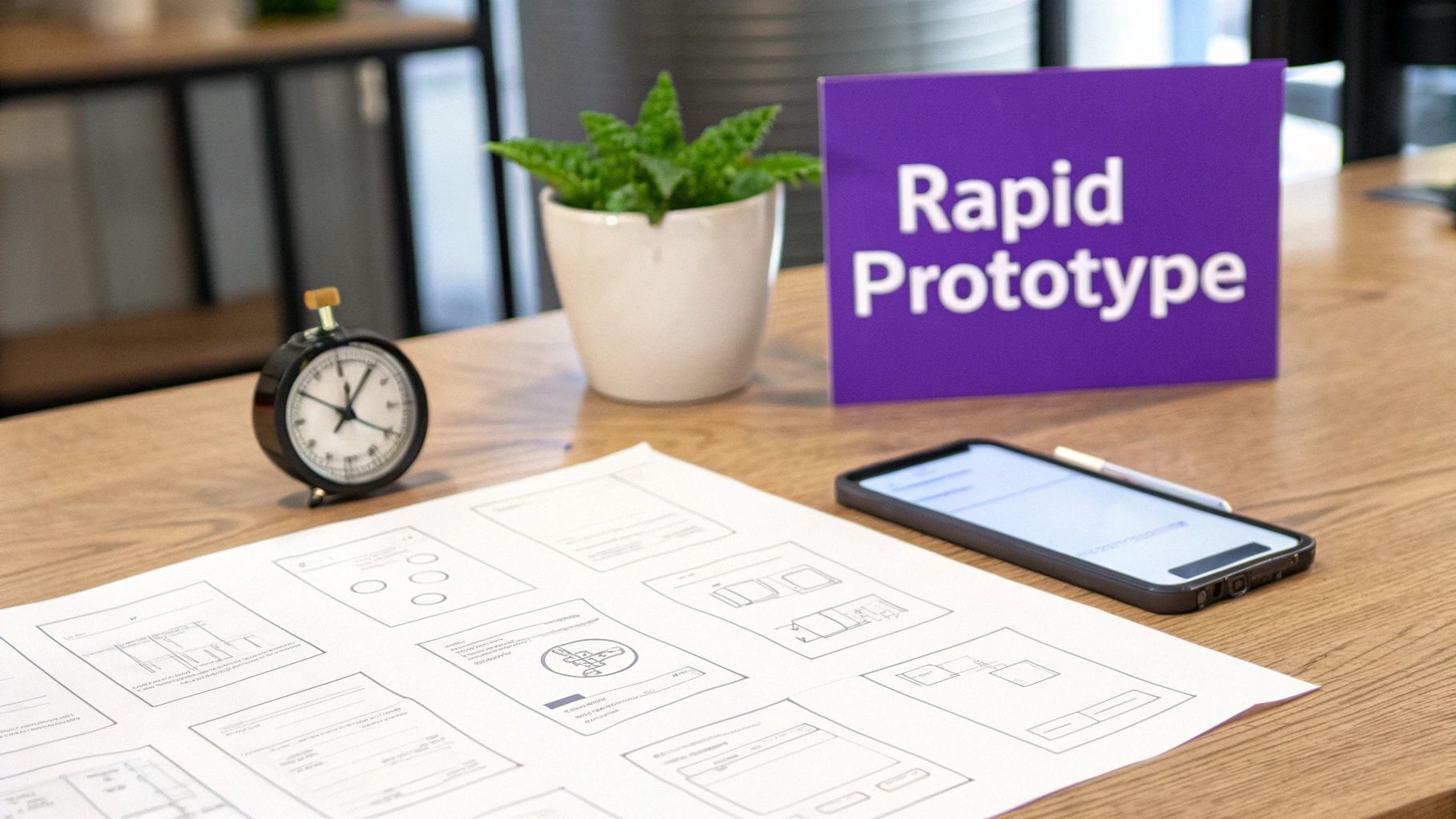
This highly structured framework is ideal for validating high-stakes ideas before committing significant resources. The process is broken down into five distinct days: Map, Sketch, Decide, Prototype, and Test. This linear progression ensures the team maintains momentum and produces a high-fidelity prototype that is tested with real users by the end of the week, providing critical insights and a clear path forward.
How to Apply a Design Sprint
- Map (Monday): The team aligns on a long-term goal and maps out the challenge. Experts are brought in to share knowledge, and the team chooses a specific target area to focus on for the rest of the week.
- Sketch (Tuesday): Instead of group brainstorming, each individual sketches detailed solutions to the problem, fostering diverse and well-developed ideas.
- Decide (Wednesday): The team critiques each solution and uses a structured voting process to decide which ideas have the best chance of achieving the long-term goal.
- Prototype (Thursday): A realistic prototype is built to simulate the final product. The focus is on creating a "façade" that real users can interact with.
- Test (Friday): The prototype is tested with five real users in one-on-one interviews to gather candid feedback and validate the solution.
Why It Works for Remote Teams
The Design Sprint’s rigorous structure and clear daily deliverables make it exceptionally well-suited for distributed teams. For example, Slack has used sprint-like processes to rapidly iterate on new features, ensuring alignment across their global team. Remote teams can use digital collaboration tools like Miro or FigJam for mapping and sketching, and conduct user tests via video conferencing. The intense focus helps remote teams cut through distractions and achieve tangible results quickly. To adapt this powerful process for a distributed environment, explore this guide to running a remote Design Sprint. This framework ensures that even when physically apart, teams can collaborate effectively to solve major business challenges in a matter of days.
9. The Kano Model
The Kano Model is a customer satisfaction framework that helps teams prioritize features by categorizing them based on their ability to satisfy customers. Developed by Noriaki Kano, it stands out among frameworks for innovation by shifting the focus from simply adding more features to strategically investing in the ones that matter most. It provides a nuanced understanding that not all features are created equal in the eyes of the user.
This framework is particularly powerful for roadmap planning and competitive analysis, helping teams decide where to invest limited resources for maximum impact. It classifies features into three main categories: Basic Needs (must-haves), Performance Needs (more is better), and Delighters (unexpected joys). This classification helps prevent over-investment in features that won't increase satisfaction while highlighting opportunities for true differentiation.
How to Apply The Kano Model
- Identify Features: Brainstorm a list of potential features or attributes for your product or service.
- Create a Kano Survey: For each feature, formulate two questions: one functional (how would you feel if you had this feature?) and one dysfunctional (how would you feel if you did not have this feature?). Answers are typically on a scale from "I like it" to "I dislike it."
- Survey Your Customers: Distribute the survey to a representative sample of your target audience to gather data on their preferences.
- Analyze and Categorize: Use a Kano evaluation table to analyze the survey responses and classify each feature into one of the categories: Basic, Performance, Delighter, Indifferent, or Reverse.
- Prioritize: Use the insights to inform your product roadmap. Prioritize all Basic Needs, invest strategically in Performance Needs, and sprinkle in Delighters to create a competitive edge and build customer loyalty.
Why It Works for Remote Teams
The Kano Model’s data-driven approach provides an objective foundation for decision-making, which is invaluable for distributed teams that need to align asynchronously. For instance, a software team can use a Kano analysis to settle debates about whether to build a new, exciting feature (a potential Delighter) versus fixing a subtle but critical bug (a Basic Need). Remote teams can conduct Kano surveys using tools like SurveyMonkey or Typeform and collaboratively analyze the results on shared whiteboards like Miro. By creating a visual Kano diagram, everyone on the team, regardless of their location, can see and agree on which features will drive the most customer value, ensuring the entire team is building a product that truly resonates.
10. The Double Diamond Framework
The Double Diamond is a visual map of the innovation process, guiding teams through two distinct phases of thinking: problem-finding and solution-building. Popularized by the British Design Council, it stands out among other frameworks for innovation by clearly structuring the journey from initial uncertainty to a well-defined outcome. It visualizes the creative process as two "diamonds," each representing a cycle of divergent and convergent thinking.
This framework is highly effective for structuring complex projects, ensuring teams don't jump to solutions before fully understanding the problem. The first diamond focuses on Discover (divergent thinking to explore the problem space) and Define (convergent thinking to pinpoint the core issue). The second diamond moves to Develop (divergent thinking to explore potential solutions) and Deliver (convergent thinking to test and launch a final solution).
How to Apply The Double Diamond Framework
- Discover: Begin by expanding your view of the problem. Conduct user research, market analysis, and broad brainstorming to gather as much information as possible. This is about asking questions and uncovering hidden needs, not finding answers yet.
- Define: Converge on the insights from the discovery phase. Synthesize your research to arrive at a clear, actionable problem statement or design brief. This focus provides the foundation for the next stage.
- Develop: With a clear problem defined, diverge again to explore multiple solutions. This phase encourages creative ideation, prototyping, and iterating on different concepts without committing to a single path too early.
- Deliver: Finally, converge on the most viable solution. Refine, test, and prepare it for launch. This stage involves finalizing the design, running pilots, and measuring impact.
Why It Works for Remote Teams
The Double Diamond’s explicit separation of divergent and convergent thinking provides a powerful structure for remote collaboration. It clarifies the goal of each meeting or workshop, preventing the common remote pitfall of mixing brainstorming with decision-making. For instance, a global service design agency can use the framework to ensure its distributed teams are aligned on project milestones. Remote teams can use a tool like Bulby for the divergent Discover and Develop phases to generate a wide array of ideas asynchronously. Digital whiteboards like Miro or FigJam are perfect for visualizing the diamond and tracking progress, ensuring everyone knows which phase the team is in and what is expected of them.
Top 10 Innovation Frameworks Comparison
| Framework | 🔄 Implementation Complexity | ⚡ Resource Requirements | ⭐ Expected Outcomes | 📊 Ideal Use Cases | 💡 Key Advantages |
|---|---|---|---|---|---|
| Design Thinking | Medium — iterative, facilitator skill needed | Moderate — user research & prototyping tools | User-validated, human-centered solutions | Product/service design, UX, early-stage ideation | Empathy-driven, adaptable, inclusive ideation |
| Lean Innovation / Lean Startup | Medium — experiment design & analytics | Moderate — MVP dev + measurement infrastructure | Rapid validated learning; waste reduction | Startups, fast-market tests, hypothesis-driven projects | Cost-efficient, data-driven pivots |
| Jobs to Be Done (JTBD) | Low–Medium — requires disciplined customer research | Low–Moderate — interview time and analysis | Clear product-market fit insights focused on customer jobs | Customer insight, feature strategy, positioning | Reveals unmet needs; aligns teams around jobs |
| Blue Ocean Strategy | High — strategic analysis and reframing | High — market research and organizational change | Differentiation and creation of new market space | Strategic repositioning, breakthrough market creation | Breakaway value creation; reduces direct competition |
| Agile Innovation / Agile Development | Medium — requires process discipline & ceremonies | Moderate — cross-functional teams and tooling | Incremental delivery and continuous improvement | Ongoing product development, iterative projects | Rapid feedback cycles; increased transparency |
| Stage-Gate Innovation Process | High — formal stages, gate reviews, heavy governance | High — documentation, review panels, resource allocation | Risk-managed portfolio with clear go/no-go decisions | Complex, capital-intensive projects (pharma, hardware) | Clear accountability; prioritizes resources effectively |
| Open Innovation | Medium–High — partner coordination & IP management | Moderate — platforms, community management, legal setup | Access to diverse external ideas and faster development | Crowdsourcing, co-creation, specialist problem solving | Global talent access; shares risk and expertise |
| Design Sprint | Medium — intense facilitation over short, fixed period | High (short-term) — full-team commitment for ~5 days | Rapid prototype and validated user feedback | Time-boxed problem solving, prototyping, alignment sprints | Fast alignment; produces testable concepts quickly |
| Kano Model | Low–Medium — survey design and categorical analysis | Low–Moderate — customer surveys and analysis tools | Prioritized features by impact on satisfaction | Feature prioritization, roadmap decisions, UX trade-offs | Clarifies must-haves vs delighters; optimizes resource focus |
| Double Diamond Framework | Low–Medium — conceptual structure, phase judgment required | Low — adaptable, integrates with other methods | Balanced divergence (research) and convergence (delivery) | Structured design projects, research-to-deliver workflows | Clear diverge/converge rhythm; flexible integration with other methods |
Choosing Your Framework: How to Turn Theory into Action
We've journeyed through a comprehensive landscape of frameworks for innovation, from the human-centric empathy of Design Thinking to the market-creating power of Blue Ocean Strategy. Each model offers a unique lens for viewing challenges and a structured path toward groundbreaking solutions. But understanding these frameworks is only the starting point; the real transformation happens when you move from theory to consistent, deliberate action.
The most common pitfall is searching for a single "perfect" framework. In reality, the best approach is rarely one-size-fits-all. The right choice is deeply contextual, depending on your team's size, your project's goals, and your organization's appetite for risk.
Key Takeaway: The goal isn't to become a master of one framework, but to build a versatile toolkit. Think of yourself as a skilled artisan selecting the right tool for a specific job, rather than a factory worker using the same machine for every task.
From Knowledge to Application: Your Next Steps
So, how do you bridge the gap between reading this article and sparking real innovation? It starts with a clear-eyed assessment of your current situation. Don't try to implement everything at once. Instead, pick one or two frameworks that seem most aligned with an immediate challenge you're facing.
Here are three actionable steps to get started:
-
Match the Framework to the Problem: Before you commit, diagnose your need. Are you trying to find a new market? Blue Ocean Strategy is your guide. Need to quickly validate a risky product idea with minimal resources? Lean Startup provides the playbook. Struggling to understand what truly motivates your customers? Jobs to be Done (JTBD) will help you uncover deep, unmet needs.
-
Run a Pilot Project: Choose a small, low-risk project to test your chosen framework. This creates a safe space for your team to learn, make mistakes, and adapt the process without the pressure of a high-stakes launch. For a remote team, a structured Design Sprint can be an excellent starting point, as its time-boxed nature and clear roles provide much-needed clarity in a virtual environment.
-
Combine and Customize: The most innovative teams don't follow these frameworks rigidly. They blend them. You might use the Double Diamond's "Discover" and "Define" phases to understand a problem, then apply Lean Startup's build-measure-learn loop to develop and test solutions. Once you understand the array of available approaches, applying robust decision-making frameworks is crucial to selecting the right innovation strategy for your specific challenge.
Cultivating an Innovation-Ready Culture
Ultimately, these frameworks for innovation are more than just process diagrams; they are cultural catalysts. They provide a shared language and a structured methodology that empower your team to think bigger, challenge assumptions, and navigate uncertainty with confidence. When everyone knows the "rules of the game," whether it's the stages of the Design Thinking process or the principles of Agile development, psychological safety increases. Team members feel more comfortable sharing bold, unconventional ideas.
For distributed teams, this structured approach is not just helpful; it's essential. Without the serendipitous interactions of an office, remote collaboration requires deliberate design. Frameworks provide the scaffolding that ensures everyone is aligned, engaged, and contributing their best work, regardless of their location. They transform chaotic virtual brainstorming sessions into productive, outcome-driven workshops.
The journey toward systematic innovation is a marathon, not a sprint. It requires patience, experimentation, and a commitment to continuous learning. By starting small, adapting these powerful frameworks to your unique context, and empowering your team with the right tools, you can build a resilient engine for growth that consistently turns brilliant ideas into tangible value.
Ready to supercharge your innovation process? Bulby is the AI-powered platform designed to bring these frameworks to life for remote and hybrid teams. With guided workflows, bias-reducing tools, and seamless collaboration features, Bulby helps you turn theory into action and unlock your team's full creative potential.