

Ever been in a meeting where everyone seems to agree on a plan a little too quickly? That uneasy feeling that no one is speaking up, even though the idea seems flawed? You’ve likely witnessed groupthink in action.
It’s a psychological trap where the overwhelming desire for harmony and conformity in a group leads to bad—sometimes disastrous—decisions. The pressure to fit in simply overrides individual critical thinking.
Unpacking the Psychology of Groupthink
Think of it like this: a project team gathers, and the first idea proposed gets a round of quick nods. It's not because it's the brilliant, game-changing solution everyone was waiting for. It's because debating it feels like hard work, and nobody wants to be the one to rock the boat.
That subtle, unspoken pressure to just agree is the core of groupthink. It creates a false harmony, a dangerous illusion of consensus that's a world away from true team alignment built on honest discussion.
The concept was famously explored by Yale psychologist Irving Janis in his 1972 book, 'Victims of Groupthink'. He studied major historical blunders, like the Bay of Pigs invasion, trying to figure out how groups of incredibly smart people could collectively make such terrible calls. Janis found that when the need for group unity becomes the top priority, it completely overshadows any realistic look at the alternatives.
Core Drivers of This Phenomenon
At its heart, groupthink is fueled by our deep-seated human need to belong. We want to be part of the team, to protect its harmony. This powerful drive can cause people to:
- Bite Their Tongues: Team members will stay silent and withhold their doubts, even when they see major red flags.
- Justify Bad Decisions: The group collectively talks itself into believing its decision is the only right one, actively ignoring warning signs.
- Feel Unbeatable: An "us-versus-the-world" vibe can emerge, creating a false sense of confidence that encourages the team to take huge, unexamined risks.
Groupthink is what happens when conformity steamrolls logic. The group's emotional need to agree overpowers its rational ability to think critically, leading to outcomes that no single person would likely support on their own.
This creates an echo chamber. Alternative ideas are ignored or shot down, and anyone who dares to dissent is pressured into silence or cast as an outsider. The team might look unified from the outside, but its decisions are built on a house of cards, completely missing the strength that comes from rigorous debate. This is precisely why understanding effective decision-making in groups is non-negotiable for any team that wants to win.
The Eight Warning Signs of Groupthink
Spotting groupthink early is the key to stopping it. It often starts as a subtle shift in how a team operates, but psychologist Irving Janis pinpointed eight specific symptoms that are major red flags. These signs show you exactly when a team's need for harmony starts to kill its ability to think clearly.
This diagram breaks down how the drive for cohesion and conformity can spiral into deeply flawed decisions.
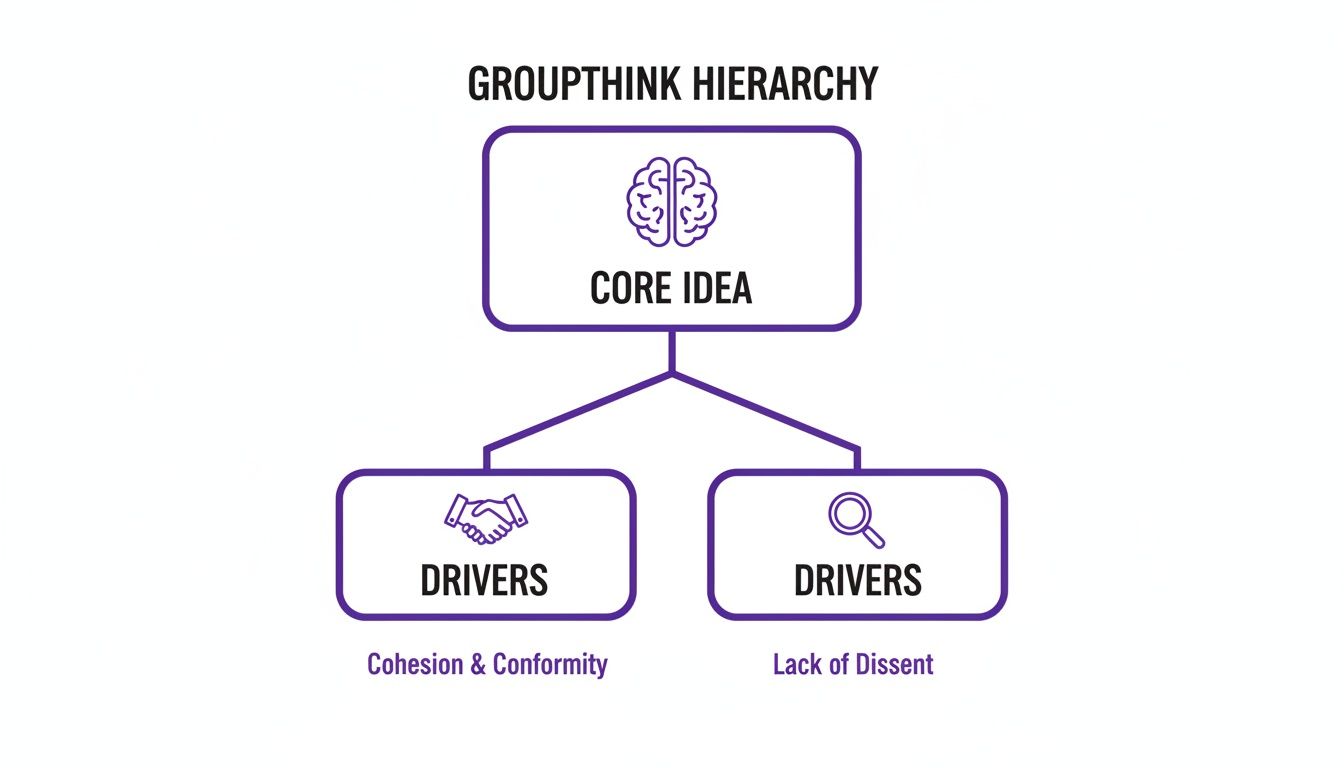
As you can see, groupthink isn't a single issue. It's a tangle of psychological pressures that quietly choke out individual thought. These symptoms generally fall into three buckets: overconfidence, closed-mindedness, and intense pressure to conform.
Overconfidence in the Group
The first couple of symptoms are all about a team's inflated sense of its own power and righteousness. This level of overconfidence creates massive blind spots, making the group feel like it can do no wrong.
-
Illusion of Invulnerability: The team feels invincible, which leads to wild over-optimism and a willingness to take huge risks. Think of a startup pouring its entire budget into a single unproven feature, absolutely convinced it's the next big thing. They just can't imagine failure.
-
Belief in Inherent Morality: Members become so sure of their "good" intentions that they stop questioning the ethics of their actions. They assume that because they're the good guys with a noble mission, whatever they decide must be the right thing to do.
This misplaced confidence makes it almost impossible for anyone to challenge the group's direction.
A Closed-Minded Approach
Next, the group starts actively walling itself off from anything that contradicts its preferred narrative. It’s like they’re building an echo chamber on purpose.
-
Collective Rationalization: The team finds ways to explain away any warnings or negative feedback. Instead of reconsidering their assumptions when a project falls behind, they’ll invent excuses or blame outside forces rather than admit the original plan might be flawed.
-
Stereotyped Views of Outsiders: Anyone who disagrees—be it a competitor, another department, or even a customer—is painted as weak, biased, or just plain stupid. This makes it incredibly easy to dismiss their opinions without a second thought.
When a team starts rationalizing away negative data and stereotyping critics, it has stopped learning and started defending. This defensive posture is a classic indicator that the group values its own consensus more than the truth.
Pressures Toward Uniformity
The last four signs are arguably the most powerful. This is where the social pressure to just go along with the group becomes overwhelming.
-
Direct Pressure on Dissenters: Anyone who raises a concern or questions the consensus gets shut down. A manager might tell them to "be more of a team player," which is really code for "stop disagreeing with us." The message is clear: your loyalty is being questioned.
-
Self-Censorship: People start silencing themselves. They have doubts, but they keep them bottled up to avoid rocking the boat or being seen as difficult. This is often driven by evaluation apprehension—a deep-seated fear of being judged by your peers. We cover how to tackle this in our detailed guide on evaluation apprehension.
-
Illusion of Unanimity: Silence is mistaken for agreement. The leader looks around the room, sees no one speaking up, and assumes everyone is on the same page. This false consensus gives the group even more confidence to press forward on a bad idea.
-
Self-Appointed "Mindguards": Certain members take it upon themselves to shield the leader and the group from inconvenient truths. They'll intercept negative feedback or keep dissenting voices from ever reaching the decision-makers, all in the name of "protecting" the group's unity.
What Groupthink Looks Like in the Real World
It's one thing to talk about theories and symptoms, but the real price of groupthink is measured in catastrophic failures, wasted potential, and sometimes, lost lives. When the quiet pressure to just agree overwhelms our ability to think for ourselves, the stakes can get incredibly high.
To really get a feel for how destructive this can be, we need to look at a few moments in history where groupthink turned a group of smart, capable people into a recipe for disaster. These aren't just old stories; they're powerful warnings about what happens when we value harmony over the hard truth.
The Pearl Harbor Attack: A Failure of Imagination
The 1941 attack on Pearl Harbor is one of the most sobering examples of groupthink in action. In the weeks leading up to the attack, U.S. military leaders had plenty of credible warnings about a potential Japanese strike. They even had intercepted communications. So, what went wrong?
The leadership team collectively waved off the threats, operating under a powerful illusion of invulnerability. They just couldn't imagine that the United States could be successfully attacked on its own soil. This overconfidence created a dangerous echo chamber. Any dissenting voices were shut down, and any intelligence that didn't fit their worldview was explained away. The human cost was staggering: 2,403 American deaths.
The core failure at Pearl Harbor wasn't a lack of intelligence, but a refusal to believe it. The group’s shared belief in their own superiority acted as a filter, rejecting any information that contradicted their preferred reality.
This tragedy shows how a team's biggest strength—in this case, confidence—can become its greatest weakness, blinding it to the very risks it needs to see most clearly.
The Salem Witch Trials: A Collective Delusion
Another chilling example is the Salem Witch Trials of 1692. This was a perfect storm of social pressure, isolation, and a rigid, unbending belief system that fueled a collective delusion. The community, led by a few influential figures, became absolutely certain that witchcraft was running rampant.
This created an intense, unspoken pressure to fall in line. If you voiced skepticism or tried to defend someone who was accused, you were likely to be accused of witchcraft yourself. This is a textbook case of direct pressure on dissenters and self-censorship.
Here’s how the spiral of groupthink took hold:
- Belief in Inherent Morality: The community saw itself on a righteous mission to stamp out evil, which they used to justify increasingly irrational and cruel actions.
- Self-Appointed Mindguards: Key community members actively protected the group from any doubt, reinforcing the witch narrative and shutting down anyone who dared to question it.
- Illusion of Unanimity: As more people were forced to confess just to save their own lives, the silence from everyone else was mistaken for agreement. This only strengthened the group's conviction.
The result was the execution of twenty innocent people based on little more than hearsay and forced confessions. The Salem Witch Trials are a powerful reminder of how social pressure can warp reality and lead to horrifying injustice.
From History to Your Next Team Meeting
These historical examples might feel a world away, but the same psychological traps are waiting for us in boardrooms, offices, and Slack channels today. The consequences might not be life and death, but they can absolutely be fatal for a business or a project.
Think about a product team that has fallen completely in love with its own idea. They have an illusion of invulnerability, convinced their design is perfect. Then, early user feedback comes in, and it’s overwhelmingly negative. Instead of pausing to listen, the team starts making excuses (collective rationalization), saying the testers just "don't get it." A few people on the team might even filter that negative feedback before it reaches the project lead.
Just like the commanders at Pearl Harbor ignoring warnings, this team is ignoring critical data. Exploring different decision-making examples in business can show you how to sidestep these common pitfalls. The end result is a failed product launch, a ton of wasted money, and a total disconnect from the market—a modern business disaster driven by the timeless dynamics of groupthink.
Why Remote Teams Are Especially at Risk
You might think groupthink is a problem for stuffy, old-school boardrooms, but the pressure to conform is just as strong in a digital workspace—sometimes even stronger. While remote work gives us incredible flexibility, it also sets the stage for groupthink to creep in and quietly sabotage a team's decisions.
The very tools we use to stay connected, like Slack or Microsoft Teams, can quickly turn into echo chambers. Conversations fly by, and the first few opinions dropped in a channel often steer the entire discussion. Who wants to be the one to pump the brakes on a fast-moving chat with a dissenting view? It's often easier to just stay quiet.
This creates a dangerous illusion of consensus, where everyone seems to agree not because an idea is brilliant, but because it’s simply the easiest path forward.

The Glitches in Digital Communication
Think about your last video call. It's tough to read the room, right? We lose almost all of the subtle, non-verbal cues that signal disagreement in person—a skeptical glance, a slight frown, or hesitant posture. This digital blind spot makes it incredibly easy for a few dominant voices to take over the conversation without anyone pushing back.
Quieter, more thoughtful team members often get left behind. They wait for the right moment to jump in, but by the time they've gathered their thoughts, the group has already moved on. Just like that, a potentially game-changing insight is lost forever.
The digital divide can create a false sense of unanimity. When non-verbal cues are absent and conversational turn-taking is awkward, silence is easily mistaken for agreement, allowing flawed ideas to advance without proper scrutiny.
Asynchronous communication has its own pitfalls. When you're trying to clear out a mountain of notifications, it's tempting to just drop a "+1" or a quick "looks good!" on a proposal and move on. The constant pressure to be responsive can kill deep, critical thinking, pushing teams to prioritize speed over quality.
Isolation Breeds Echo Chambers
Remote teams can easily become cut off from the rest of the company. Gone are the random "water cooler" chats or hallway conversations with people from other departments that often spark fresh perspectives. This isolation can create an "us-against-the-world" vibe, which is a classic breeding ground for groupthink.
History has shown this time and again. The Salem Witch Trials are a chilling example of how the likelihood of groupthink 'greatly increases when you remove outside influences.' This isn't just ancient history; a 2021 University of Pennsylvania study found that groupthink is a major roadblock to rational analysis, especially as groups get bigger and more isolated. For remote companies, this is a serious warning sign. You can read the full research on groupthink's mechanisms to dive deeper.
The dynamics of remote work can create unique vulnerabilities. Let's compare how some of these risk factors show up differently.
Groupthink Risk Factors in Remote vs In-Office Teams
| Groupthink Factor | In-Office Environment | Remote Environment |
|---|---|---|
| Lack of Diverse Input | Informal chats between departments expose people to different ideas. | Teams can become digitally siloed, rarely interacting with outside groups. |
| Pressure to Conform | Easy to see body language and social cues that signal agreement or dissent. | Silence on a call or a lack of comments on a doc is often misread as agreement. |
| Dominant Voices | A loud voice can dominate a meeting room, but others can still use non-verbal cues to react. | On video calls, the most assertive person can easily control the conversation flow. |
| Information Overload | Information is often filtered through structured meetings and direct conversations. | Constant notifications and asynchronous updates create pressure for quick, surface-level responses. |
These differences don't mean remote teams are doomed, but they do mean we have to be much more intentional about fighting groupthink. Without a conscious effort, a remote team can become a closed loop where the same ideas get recycled and reinforced until they feel like facts.
This is why building a culture of healthy debate is non-negotiable for remote teams. Leaders have to proactively create connections and encourage dissent. A huge part of this is knowing how to create psychological safety on your team, so everyone feels genuinely safe to speak up, even when they're miles apart.
How to Prevent Groupthink on Your Team
Spotting the signs of groupthink is one thing, but building a team culture that actively fights it is the real secret to high performance. The goal isn't to stop people from agreeing with each other. It’s about making sure that when they do agree, it’s because the idea has survived a healthy, rigorous debate—not because everyone was afraid to speak up.
This means shifting your priority from surface-level harmony to genuine psychological safety. When your team members feel safe enough to disagree, you unlock the diverse perspectives that lead to brilliant decisions. It's about hardwiring healthy dissent right into your team's DNA.

This picture gets to the heart of it. A groupthink-proof culture is one where ideas are shared openly and picked apart together, not just silently nodded along to. So, let’s get into the practical ways you can make this happen.
Foster a Culture of Constructive Disagreement
The best defense against groupthink is a culture where leaders actively ask to be challenged. This has to start at the top. If a manager kicks off a meeting by sharing their own opinion, they’ve just signaled the "right" answer. The discussion is over before it even started.
Instead, leaders should act as facilitators. Hold back your own views until everyone else has had a chance to speak. Make a point of openly praising people who raise tough questions or offer a different angle. You have to frame dissent not as a disruption, but as a critical part of getting to the best possible outcome. A big piece of this involves optimizing your meeting culture to make real debate the norm.
Implement Structured Decision-Making Processes
Free-for-all discussions are an open invitation for groupthink, especially on remote teams where the loudest person in the chat or on the call often wins. By putting some simple structures in place, you can ensure every voice gets heard and every idea is judged on its own merit.
Here are a few techniques you can start using tomorrow:
-
Appoint a Rotating Devil's Advocate: For any big decision, assign someone the official job of poking holes in the group's thinking. Their task is to challenge the consensus and force everyone to consider the downsides. Because it's a formal role, it takes away the social risk of being the "difficult one."
-
Break into Smaller Brainstorming Pods: Instead of throwing everyone into one big group discussion, split them into pairs or trios. Let them brainstorm solutions on their own first, then bring their best ideas back to the larger team. This stops one early idea from hijacking the entire conversation.
-
Use Anonymous Feedback Tools: Before you lock in a decision, use a quick, anonymous poll or survey to get a final gut check. You’d be amazed at the critical feedback that comes out when people don't have to attach their name to it.
A team that consistently makes good decisions doesn't rely on luck. It uses deliberate, structured processes to surface the best ideas, regardless of who they come from. These structures are the guardrails that keep a team from veering into the groupthink ditch.
Leverage Technology to Mitigate Bias
For remote and hybrid teams, technology is a double-edged sword. A chaotic Slack thread can quickly become an echo chamber. But the right tools can actually build bias-fighting techniques right into your workflow.
For example, platforms like Bulby guide teams through brainstorming sessions that encourage everyone to think for themselves before the group discussion begins. This approach is grounded in methods like the Nominal Group Technique, which is designed to give every single person an equal say. You can learn more about how it works in our guide on the Nominal Group Technique.
By using features like anonymous idea submissions or timed, individual brainstorming rounds, these tools systematically dismantle the social pressures that fuel groupthink. They create a level playing field where an idea from an intern gets the same serious consideration as one from a senior director. This ensures your final decision is a product of true collective intelligence, not just quiet, collective agreement.
Building a Culture of Constructive Disagreement
So, we’ve covered what groupthink is, why it’s so dangerous for decision-making, and what practical steps you can take to fight it. But tools and processes are only ever half the battle. The real, lasting antidote to groupthink is building a culture where healthy, constructive disagreement isn’t just tolerated—it’s actively encouraged from the top down.
It all starts with psychological safety. Team members need to feel genuinely secure that they can challenge the status quo without being penalized for it.
The Engine of Innovation
Don’t be afraid of a little friction. Constructive conflict is the true engine of innovation.
When a team can debate ideas on their merits, poke holes in shaky assumptions, and voice concerns openly, they build incredible resilience. It’s how you move past the false harmony of a quick consensus and into the territory of powerful, genuine collaboration. This is where you find the blind spots, sharpen your ideas, and land on the best possible solution.
To get there, it’s vital to master some effective workplace conflict resolution strategies. These techniques help turn what could be a tense argument into a productive dialogue.
Constructive disagreement isn't about creating conflict; it's about harnessing collective intelligence. The goal is to build a culture where the best idea wins, regardless of who it came from or how popular it was at the start.
Ultimately, creating a team that’s immune to groupthink is an ongoing commitment. It demands leaders who model intellectual humility, team members who are brave enough to speak their minds, and systems that protect those dissenting voices.
This is how you build a resilient, creative, and truly collaborative team that consistently makes better decisions together. It’s the single most important investment you can make in your team's long-term success.
Still Have Questions About Groupthink?
Knowing the theory is one thing, but spotting and stopping groupthink in the real world is a whole different ball game. Let’s tackle some of the most common questions that pop up when teams try to put these ideas into practice.
Is Groupthink Ever a Good Thing?
In short, no. While it's easy to confuse groupthink with strong team spirit, they're worlds apart. True groupthink is always a problem because it’s built on a foundation of suppressed dissent and a lack of critical thought.
There’s a massive difference between a team that’s genuinely aligned and one that’s just conforming. A truly aligned team gets there after hashing out different ideas, debating the pros and cons, and integrating all that feedback into a solid plan. Groupthink, on the other hand, creates a brittle illusion of agreement. It’s a consensus built on silence, and it tends to shatter the moment it hits a real-world obstacle.
The goal is always unity, not uniformity.
What Is the Leader's Role in Preventing Groupthink?
A leader's number one job in fighting groupthink is to foster psychological safety. It's all about creating a space where people feel safe enough to speak up, ask tough questions, and even challenge the boss without fear of getting shut down or sidelined. But saying you have an open-door policy isn't enough.
Leaders have to take deliberate steps. For example, a smart move is to keep your own opinion to yourself at the start of a meeting. That way, you don't inadvertently steer everyone toward your line of thinking. It's also crucial to actively solicit and even celebrate dissenting opinions. When someone pushes back constructively, frame it as a valuable contribution, not a disruption.
A leader's job isn't to have all the right answers, but to create a system where the right answers can emerge. By rewarding dissent and encouraging debate, they build a team that is resilient to the pressures of conformity.
This hands-on approach makes a healthy, debate-friendly culture your best defense against bad decisions.
How Can I Spot Groupthink in Virtual Meetings?
Groupthink can be especially sneaky in a remote environment. You lose all the subtle body language and side conversations that might signal disagreement in person. As a manager, you have to be extra watchful for the red flags on a screen.
Here are a few warning signs to look out for:
- Quick, Easy Agreement: Does everyone jump on board with an idea almost instantly? If there’s no debate about alternatives or potential downsides, be suspicious.
- Radio Silence from Key Players: Are your usual contributors suddenly quiet? Self-censorship is a classic symptom, especially when it’s time to make a final call.
- One or Two People Dominate: Is a single person or a small clique driving the entire conversation, with no one else pushing back or offering a different take?
- The "Let's Just Decide" Rush: Do you feel a constant pressure to wrap things up and move on, even for complex issues that clearly need more time?
If you start noticing these patterns, it’s time to hit the brakes. Slow the conversation down, start asking probing questions, and make a point of directly asking the quieter folks what they think.
Ready to build a team that’s immune to groupthink? Bulby provides a structured, guided brainstorming process that ensures every voice is heard and every idea gets a fair shot. By mitigating common biases from the start, Bulby helps your remote team move beyond conformity and unlock true innovation. See how it works at https://www.bulby.com.