
Think of a question as a door.
A closed-ended question is a locked door—it only opens with a specific key, like "yes," "no," or a single piece of information. It's direct and efficient.
An open-ended question is a door that swings wide open, inviting you to explore what's on the other side. It doesn't ask for a simple fact; it asks for a story, an opinion, or a detailed thought.
The Power of an Open Ended Question
Let's stick with that door analogy for a second.
Imagine you're trying to understand how a project is going. You could ask a closed-ended question like, "Is the project on schedule?" That's the locked door. You'll get a "yes" or "no," and the conversation pretty much ends there. It's transactional, designed to get a quick fact and move on.
Now, try an open-ended approach: "How do you feel about the project's progress so far?"
That's the door swinging open. You're not just asking for a status update; you're inviting your team member to share their perspective, voice hidden concerns, or even point out unexpected opportunities. You're starting a real conversation.
Sparking Deeper Conversations
For remote teams, this distinction is huge. We don't have those spontaneous chats by the coffee machine or in the hallway. We have to be intentional about creating space for real dialogue, and open-ended questions are the best tool we have to do it. They help bridge that digital divide, turning a routine check-in into a genuine exchange.
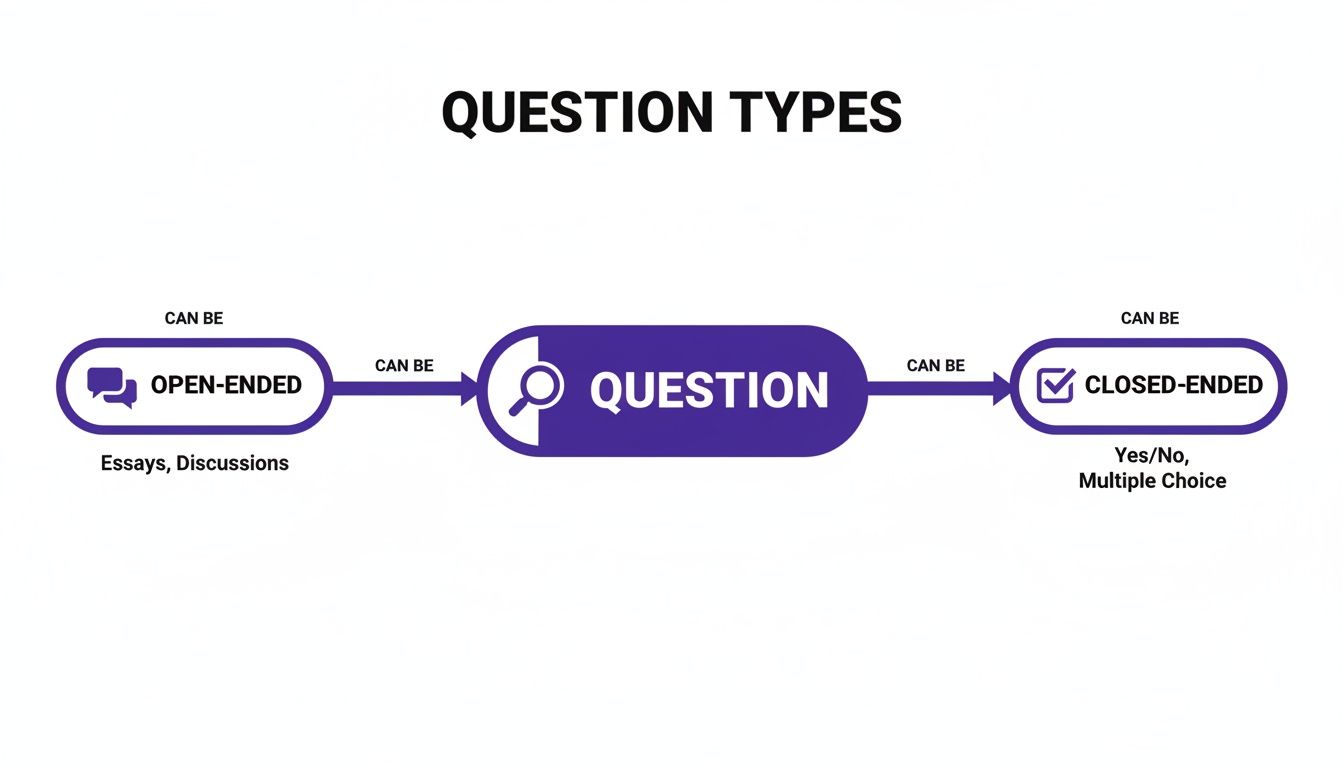
This simple diagram breaks it down visually: open-ended questions lead to rich discussions, while closed-ended ones are for quick confirmations.
Here’s a quick-glance table to help you keep them straight.
Open Ended vs Closed Ended Questions at a Glance
| Characteristic | Open Ended Questions | Closed Ended Questions |
|---|---|---|
| Purpose | To explore, understand, and gather detailed insights. | To confirm, verify, and gather specific facts. |
| Answer Format | Long, descriptive, and often narrative. | Short, often single-word answers (e.g., "Yes," "No," "Tuesday"). |
| Information Type | Qualitative (feelings, opinions, ideas). | Quantitative (data, facts, stats). |
This table makes it clear: each question type has its place. One uncovers the "why" and "how," while the other confirms the "what" and "when."
This isn't some new-age management fad, either. Open-ended questions have been a staple in fields like market research since the 1940s. What's changed is how vital they've become for modern, distributed teams. In fact, a Qualtrics study of over 10,000 workshops found that using open-ended questions can boost idea generation by a whopping 35%.
Mastering how you ask questions is a foundational skill if you want to improve workplace communication. It's about building a culture where everyone feels heard and valued—a critical part of establishing psychological safety, especially when your team is remote. You can learn more about that in our guide on https://www.remotesparks.com/how-to-create-psychological-safety/.
Why Remote Teams Thrive on Open-Ended Questions
When you're working remotely, you lose those spontaneous "water cooler" moments—the casual chats where great ideas often spark. Communication can easily become all business, just a series of scheduled, transactional check-ins. It's a real gap where innovation used to happen. This is exactly where mastering open-ended questions becomes a remote team’s superpower, helping to bridge that digital divide.

Think of these questions as a direct counter-attack to common remote work problems like disengagement, communication silos, and the dreaded Zoom fatigue. They have the power to turn a routine update into a meaningful conversation that actually builds connection and uncovers insights you'd otherwise miss.
Fostering Psychological Safety From a Distance
Consider the difference between two simple questions. If you ask, "Did you have a good week?" you'll probably get a quick "yes" or "no." It’s a conversational dead end.
Now, what if you asked, "What challenges did you face this week, and how did you navigate them?" That’s not a question; it’s an invitation. It sends a clear signal that it's okay to talk about struggles and be vulnerable, which is the very foundation of psychological safety. When people feel safe, they’re far more willing to share half-baked ideas, admit they made a mistake, or offer real, constructive feedback.
By shifting from simple status checks to genuine inquiry, leaders create an environment where every voice, not just the loudest, feels empowered to contribute. This approach is fundamental to building a resilient and creative remote culture.
This is especially critical for product managers and innovation leaders. An open question ensures that quieter team members have a chance to be heard and that diverse perspectives actually make it into the discussion. It's a practical strategy for dismantling groupthink before it can even start. For remote teams, these questions are powerful tools for connection and exploring effective remote team engagement ideas.
Unlocking Deeper Collaboration and Inclusion
Open-ended questions have a direct and immediate impact on the quality of your team’s collaboration. They are, quite simply, the keys to unlocking the collective brainpower of a distributed team.
Here’s how they help:
- They encourage detail: You get the rich context and personal perspectives behind the work, not just surface-level updates.
- They promote inclusivity: They naturally create the space for more introverted or reflective team members to gather their thoughts and contribute fully.
- They spark innovation: They shift the conversation from "what we did" to "what we could do."
When you start weaving these questions into your daily stand-ups, one-on-ones, and brainstorming sessions, you cultivate a more thoughtful and dynamic work environment. To dive deeper into making your online sessions more effective, explore these virtual collaboration best practices.
How to Craft Powerful Open Ended Questions

Knowing what an open-ended question is gets you in the door. Learning how to build one that actually works is what separates the novices from the pros. A powerful question isn't about being complex; it’s about having a clear goal and being intentional.
The best way to start is to use conversational openers that invite a story, not just a status update. This small tweak can completely change the tone and depth of a conversation.
Use Story-Based Starters
Certain phrases just work better. Think of them as launchpads for deeper conversations, giving people a clear runway to share what's really on their minds.
Here are a few of my go-to starters:
- "Tell me about a time when…" This immediately asks for a specific memory, which is always loaded with useful context and genuine emotion.
- "Walk me through your thought process on…" This gets you the how and why behind a decision, not just the final result.
- "What was your initial reaction to…" This is great for capturing gut feelings and candid first impressions that often get sanitized later on.
- "Describe what the ideal solution looks like to you." This simple prompt shifts the focus from current frustrations to future possibilities, which is where real innovation happens.
These starters give people a framework for their answers, making it far easier for them to share detailed thoughts. For a closer look at this, our guide on open-ended questions in research is a great resource.
Best Practices for Better Questions
Once you have a solid starting point, a few core principles will elevate your questions and help create a space where people feel safe enough to be honest.
1. Avoid Loaded Language
A loaded question is one that has the answer baked right in. Asking something like, "How much did you enjoy that amazing new feature?" immediately biases the response. It's much better to ask something neutral, like, "What were your thoughts on the new feature?" This gives them room for a genuine answer.
2. Ask One Question at a Time
It's so easy to accidentally stack questions, like, "What did you think of the design, and how would you improve the onboarding flow?" This just creates confusion. Unbundle them. Ask about the design first, then move on to the onboarding flow. You’ll get better, more focused answers for each.
Embracing silence is one of the most underrated facilitation skills. After you ask a question, pause. Give people the mental space they need to process the query and formulate a thoughtful response. Rushing to fill the silence often cuts off the deepest insights right before they surface.
3. Embrace the Power of Silence
Don't fear the pause after you ask a question. People need a moment to think, especially when you’re asking them to recall a memory or think through a complex idea. Fighting the urge to rephrase your question or jump in with another one is a hallmark of a confident facilitator.
This approach isn't just about feeling good; it gets real results. In remote collaboration, well-crafted open-ended questions can lead to a 50% deeper customer understanding. A global study by Kadence involving 8,000 surveys found that these questions uncovered critical trends, like how 73% of remote tech teams want more inclusive ways to share ideas.
Real-World Examples for Innovation Teams
Knowing the theory is one thing, but seeing open-ended questions in action is where it all clicks. For product and innovation teams, learning how to ask a great question isn't just a "nice-to-have" skill—it's how you uncover what users really need and build a team that actually innovates.
Let's look at a few "before and after" examples. The goal is always the same: turn a question that's looking for a simple nod into one that invites someone to tell you a story.

From Closed to Open in Customer Interviews
Customer interviews are supposed to be a goldmine of insight, but asking the wrong questions can lead you completely astray. A closed question gets you a quick answer; an open one gets you the truth.
Weak Question: "Do you like our new dashboard?"
- This is a classic trap. It begs for a simple "yes" or "no" and puts the user on the spot. Most people want to be polite, so they’ll just say yes, leaving you with useless, feel-good data.
Strong Question: "Walk me through your first impressions when you saw the new dashboard."
- Now we're talking. This version asks for a narrative. You’ll hear their initial thoughts, where they got confused, and what genuinely surprised them—all without leading them to the answer you want to hear.
Mixing open-ended and closed questions can make a huge difference. A CXL study of 15,000 customer interviews found that this hybrid approach helped teams understand the "why" behind user actions 45% more effectively. This ultimately led to a 27% higher innovation success rate for remote product teams. You can dig into the full study on how questions drive decision-making for more detail.
Upgrading Your Sprint Retrospectives
Sprint retrospectives are meant to spark real improvements, but they often fall flat because the questions are too generic.
Weak Question: "Did this sprint go well?"
- This usually leads to a vague group consensus and glosses over the individual frustrations or wins that really matter.
Strong Question: "What was one thing that energized you this past sprint, and one thing that drained your energy?"
- This question is fantastic because it gets personal. It provides specific, actionable insights into team morale, reveals hidden roadblocks, and tells you what's actually working on the ground.
When you reframe your questions this way, you stop collecting simple data points and start gathering meaningful stories. And for innovation, those stories are where the real value is hiding.
Enhancing Strategic Planning Sessions
In a high-stakes strategy meeting, the quality of your questions literally defines the quality of your future roadmap.
Weak Question: "Should we build this feature next?"
- This forces a binary choice and immediately shuts down any creative thinking about other solutions or the actual problem you're trying to solve.
Strong Question: "If we had unlimited resources, what would be the most impactful problem for us to solve for our customers in the next six months?"
- This question blows the doors wide open. It removes imaginary constraints and pushes the team to think big, aligning everyone on the core customer problem before getting stuck on a single solution.
Getting good at making this shift is a vital skill for anyone leading a team. To take your skills to the next level, check out our guide on powerful group brainstorming techniques.
Here's the rewritten section, designed to sound completely human-written and natural.
Common Mistakes to Avoid When Asking Questions
Knowing what makes a great open-ended question is only half the battle. The other half is spotting the common traps that can completely derail a conversation. A poorly framed question, even with the best intentions, can lead to confusing answers, biased feedback, or worse—total silence.
Think of it this way: a good question opens a door, but a bad one can slam it shut. By learning to recognize these pitfalls, you can make sure your questions consistently deliver the clear, honest insights you're after.
Asking Overly Broad Questions
We’ve all been there. You ask a huge, ambitious question like, "How can we improve the company culture?" or "What's the future of our industry?" and get… crickets. These questions are so massive that people don't even know where to begin. It’s like asking someone to "describe the ocean"—it's just too big to tackle.
- The Fix: Give people a starting point. Instead of asking about the entire industry, try something more focused: "What’s one trend you’ve noticed recently that you think will impact our customers the most?" Instead of fixing the whole company culture, narrow it down: "What is one thing we could change about our weekly meetings to make them more valuable?"
Combining Multiple Questions into One
This one is easy to do by accident, especially when you're excited. You might ask something like, "What did you think of the new design, and how does it compare to our competitor's app?" This forces the person to juggle two distinct thoughts at once, and they usually end up answering only one part of the question.
- The Fix: Ask one thing at a time. Seriously, just slow down. Ask about the new design first. Let them finish their thought completely. Then, you can follow up with, "Now, thinking about our competitor's app, how would you compare the two experiences?" This creates a much more natural conversation and gives you richer feedback on each topic. We talk more about why this helps people feel more comfortable in our guide on what is evaluation apprehension.
A great question should feel like an invitation, not an interrogation. If a question makes someone pause because they're confused about what you're asking, you've lost the momentum needed for a productive conversation.
Unintentionally Leading the Witness
A leading question subtly guides someone toward the answer you want to hear. For example, asking "Don't you think the new onboarding process is so much smoother?" puts people in an awkward spot. It’s socially difficult to disagree, so you end up with tainted, polite feedback instead of the truth.
- The Fix: Keep it neutral. Strip out any of your own opinions or emotionally charged words. A much better way to phrase that question is, "Walk me through your experience with the new onboarding process." This neutral approach gives people the freedom to share their honest, unfiltered thoughts—good, bad, or otherwise.
Integrating Open-Ended Questions into Your Workflow
Knowing what an open-ended question is and actually using them are two different things. The real test is weaving this skill into the fabric of your team's daily habits. It’s easy for good intentions to fall by the wayside, but a clear process can turn powerful questioning into a reliable part of your culture.
This is where having a dedicated tool can really make a difference. Platforms like Bulby are designed to systematize the process of asking better questions, taking away the friction and guesswork that often stop us in our tracks.
From Theory to Practice
Instead of hoping a facilitator pulls the perfect prompt out of thin air, a structured approach gives you quality and consistency every time. This is especially true for remote and hybrid teams, where asynchronous communication is a huge part of the day.
A guided workflow can embed these powerful questions right into your existing processes:
- Brainstorming Sessions: Imagine kicking off a session where an AI-guided flow instantly provides prompts built to spark deeper, more creative thinking from the very start.
- Team Retrospectives: You could use pre-built templates that ask about team energy, uncover hidden blockers, and celebrate those unexpected wins.
- Customer Feedback: Structure your interviews around questions that get to the real story behind user behavior, not just the surface-level opinions.
By making powerful questions the default, you’re not just running a better meeting—you’re building a culture of genuine curiosity. The right tool trains your whole team to think more critically and creatively over time.
This approach takes questioning from an inconsistent art form and turns it into a repeatable science. When your team has access to thoughtfully designed prompts and exercises, they spend less mental energy trying to figure out what to ask and can focus entirely on exploring the rich, detailed answers.
Ultimately, this consistency sparks more creativity and ensures every single person on the team feels empowered to contribute, no matter where they’re working from.
Got Questions? We've Got Answers
Even when you've got the hang of open-ended questions, a few practical details can still be fuzzy. Let's clear up some of the most common questions that pop up when putting these into practice.
How Many Open-Ended Questions Should I Actually Use in a Meeting?
This is a classic "it depends" situation, but a good rule of thumb is to focus on 3-5 core questions for a standard 60-minute brainstorming session. This gives you enough structure to guide the conversation without overwhelming the team or rushing through important topics.
The real goal here is depth, not breadth. One fantastic question that ignites a real, meaty discussion is always better than a laundry list of ten that only get surface-level answers.
Sticking to just a few key prompts gives each one room to breathe, leading to far richer insights.
What's the Best Way to Make Sense of All the Answers?
When you’ve got a mountain of great responses, the trick is to find the patterns hiding inside. Start by just reading through everything to get a feel for the room. Then, start looking for ideas that keep popping up, common feelings, or phrases that really stand out.
A simple and super effective way to do this with your team is affinity mapping. It sounds fancy, but it's easy:
- Grab the key ideas or direct quotes from the answers and pop each one onto its own virtual sticky note.
- Work together to drag and drop the notes into clusters based on similar themes.
- Once you have your groups, give each one a simple name that sums up the main idea.
This turns a jumble of qualitative feedback into a clear, visual map of your team's thinking, making it much easier to decide what to do next.
Can I Use These for Asynchronous Communication?
Absolutely! They are a secret weapon for asynchronous work, especially for remote teams scattered across time zones.
Dropping a well-crafted question into a shared document or a team chat channel gives people the freedom to think on their own time. You often get more thoughtful, creative, and diverse ideas this way, since not everyone does their best thinking on the spot in a live meeting.
Ready to make powerful, open-ended questions a natural part of your team's workflow? Bulby provides the structure and AI-guidance to transform your brainstorming sessions. Start your free trial today.