

We've all been there: a brainstorming session is called to solve a big problem, but an hour later, the whiteboard is mostly empty, and everyone feels drained. It’s a common story, and it’s not because your team isn't creative. It’s because the session itself was set up to fail.
Without a clear set of brainstorming rules, even meetings with the best intentions can quickly spiral into unproductive chaos.
Why Most Brainstorming Sessions Fail

When Alex Osborn first outlined brainstorming in his 1953 book Applied Imagination, he envisioned a process where groups could unlock incredible creative potential. The irony? Decades of research show that, more often than not, the opposite happens.
A landmark 1987 study was one of the first to put a number on it: groups brainstorming together came up with only about half as many ideas as the same number of people working alone. It’s a phenomenon called productivity loss, and it’s what makes so many of these meetings feel like a waste of time. This article dives deep into the research behind brainstorming findings.
The problem isn't a lack of good ideas. It's the lack of a structured environment where those ideas can actually surface.
The Hidden Barriers to Group Creativity
In an unstructured free-for-all, our brains naturally fall into a few predictable traps that kill creativity before it even gets a chance. Let's look at the three biggest culprits.
-
Production Blocking: Think of it as an idea traffic jam. In a typical meeting, only one person can talk at once. While you’re politely waiting your turn, a brilliant thought you had might just vanish. Or, someone else’s comment sends the conversation down a totally different path, and your idea gets lost in the shuffle.
-
Evaluation Apprehension: This is just a fancy term for the fear of sounding stupid. We’re all social creatures, and we don’t want to be judged. This fear makes us hold back our wilder, more unconventional ideas—the very ones that often lead to breakthroughs. Instead, we play it safe. You can explore this concept further in our guide on what is evaluation apprehension.
-
Social Loafing: Ever been in a group project where it felt like only a few people were doing the heavy lifting? That’s social loafing. When brainstorming, it’s easy for some people to mentally check out and assume others will pick up the slack. The sense of individual responsibility fades, and so does the creative output.
These silent forces are at play in nearly every unstructured meeting. To show how rules directly counteract these issues, here's a quick breakdown:
Common Brainstorming Pitfalls and Their Solutions
| The Pitfall (The 'Why It Fails') | The Psychological Barrier | The Rule-Based Solution |
|---|---|---|
| Chaos and Dominant Voices | Production Blocking: Only one person can speak at a time, causing a traffic jam of ideas. | Defer Judgment & Go for Quantity: By removing criticism, everyone feels safer to contribute simultaneously (especially with silent methods). |
| Self-Censorship & Safe Ideas | Evaluation Apprehension: The fear of judgment causes people to hold back their more creative or "weird" thoughts. | Encourage Wild Ideas: Explicitly asking for the impossible makes it safe to share unconventional thoughts without fear of ridicule. |
| Uneven Participation | Social Loafing: Individuals contribute less effort when responsibility is shared, assuming others will carry the load. | Build on the Ideas of Others: This rule actively requires engagement, as participants must listen and contribute, fostering a sense of shared ownership. |
This table makes it clear: the problems aren't random. They are predictable human behaviors that arise in unstructured group settings.
By not actively managing these psychological hurdles, a brainstorming session can unintentionally create an environment where the loudest voices dominate and the most creative ideas are never spoken.
This is exactly why simply telling a team to "brainstorm" is a recipe for disappointment. You need a better framework. A clear set of brainstorming rules isn’t about adding bureaucracy; it’s about creating a psychologically safe and focused space where your team's best ideas can finally come to light.
The Four Foundational Brainstorming Rules
To turn a chaotic meeting into a genuine wellspring of creativity, you need a solid foundation. The original brainstorming rules, first laid out by Alex Osborn, aren't just polite suggestions. They're guardrails, specifically designed to bypass our natural instincts for criticism and self-censorship.
Think of these rules as the operating system for a creative session. If you ignore them, you're running outdated software that’s bound to crash. But when you follow them, you create an environment where your team's collective genius can actually come out to play.
Rule 1: Defer Judgment
This is the absolute cornerstone of any effective brainstorm. Deferring judgment means putting a temporary ban on all criticism and evaluation. For now, no idea is too small, too silly, or too impractical.
The entire point is to create psychological safety—that feeling where team members are secure enough to take a risk without worrying about looking foolish. When you remove the threat of an instant shutdown, people stop filtering their thoughts. They start sharing freely. It’s like giving your team a creative hall pass.
The moment someone says, "That will never work," the creative flow stops. Deferring judgment isn't about accepting bad ideas; it's about creating the space for brilliant ones to emerge from unexpected places.
Rule 2: Encourage Wild Ideas
Let's be honest, the biggest breakthroughs rarely come from safe, predictable thinking. This rule is a direct order to think beyond the obvious and embrace the absurd. Wild ideas are what stretch the boundaries of a problem, and they often hold the seeds of truly original solutions.
Urge your team to throw out ideas that seem impossible, outlandish, or even a little fantastical. It’s like stretching a muscle before a workout; these "out-there" concepts warm up the brain's creative gears and make it easier to explore a much wider range of possibilities. Even if a wild idea isn't the final answer, it can be the spark that ignites a more practical but equally inventive thought in someone else.
Rule 3: Go for Quantity Over Quality
During a brainstorm, volume is the name of the game. Your mission is to generate as many ideas as possible in the time you have, without getting hung up on whether they're "good" or not. It’s a myth that one brilliant idea will strike like a bolt of lightning. The reality is that great ideas are usually found after sifting through a whole lot of average ones.
Imagine you're fishing. Your chances of catching a trophy fish are much better with a giant net than with a single hook and line. The same logic applies here. Setting a high target—like aiming for 100 ideas in 60 minutes—forces the group to move past the easy, surface-level solutions and dig deeper. This pressure for sheer volume helps short-circuit the brain's tendency to overanalyze every little thought.
The power of this rule is backed by a ton of research. Studies show that when teams stick to Osborn's rules, especially with the help of online tools, they can produce hundreds of ideas in just a few hours—way more than individuals working alone. Take IBM's famous 2006 Innovation Jam: it collected a mind-blowing 45,000 ideas from 150,000 participants. It's a massive testament to how focusing on quantity can unlock incredible creative potential. You can read the full research on collaboration technology and idea generation to see the data for yourself.
Rule 4: Build on the Ideas of Others
This final rule is what turns a collection of individual thoughts into a collaborative chain reaction. Instead of shooting down suggestions, team members are encouraged to listen closely and find ways to combine, twist, or improve on what’s already on the table.
This is often called "plus-ing" or the "Yes, and…" technique. When someone shares an idea, the next person builds on it by saying, "Yes, and we could also…" This simple shift in language completely changes the dynamic from competitive to collaborative. It creates a sense of shared ownership and can lead to powerful, hybrid ideas that no single person would have ever thought of on their own. This approach shares some common ground with other structured methods; you can learn more about how to capture individual ideas before group discussion in our guide on the Nominal Group Technique.
Putting the Rules into Action
Knowing the core brainstorming rules is one thing. Watching them come alive in a real session is where the magic happens.
Let's walk through a quick example. Imagine a remote team is trying to solve a classic problem: "how can we increase user engagement?" A good facilitator can take those abstract rules we just discussed and turn them into a powerful, creative engine.
The facilitator kicks things off on the video call, setting a very clear tone. "Okay, team, for the next fifteen minutes, our only job is to flood this digital whiteboard with ideas. Remember the rules: no judgment, no holding back. Go for wild ideas, and let's aim for a huge number of them. Just get it all out there."
This simple intro does something incredibly important—it creates psychological safety. It signals that this isn't a normal meeting; it's a creative sandbox where the usual rules of critique are suspended.
Sparking the Idea Flow
To get the ball rolling, the facilitator throws out a specific, open-ended prompt. "For the first five minutes, I want you to focus only on wild ideas. What's the most absurd, outlandish, or ridiculously fun thing we could do to get users to interact more? Forget about the budget, forget about engineering constraints. Let's just go big."
Almost immediately, an idea appears on the virtual board: "Launch a user's profile picture into space."
In a typical meeting, that might be met with eye-rolls or a polite "let's be realistic." But here, another team member instantly jumps on it, using the classic "Yes, and…" approach. They type: "Yes, and we could create a digital 'space launch' animation whenever a user hits a big milestone!"
Just like that, an impractical thought is transformed into a cool gamification concept. Someone else chimes in: "Yes, and we could partner with a local planetarium for a co-branded event!" A chain reaction has begun.
This simple, four-step flow is what guides a really productive session.
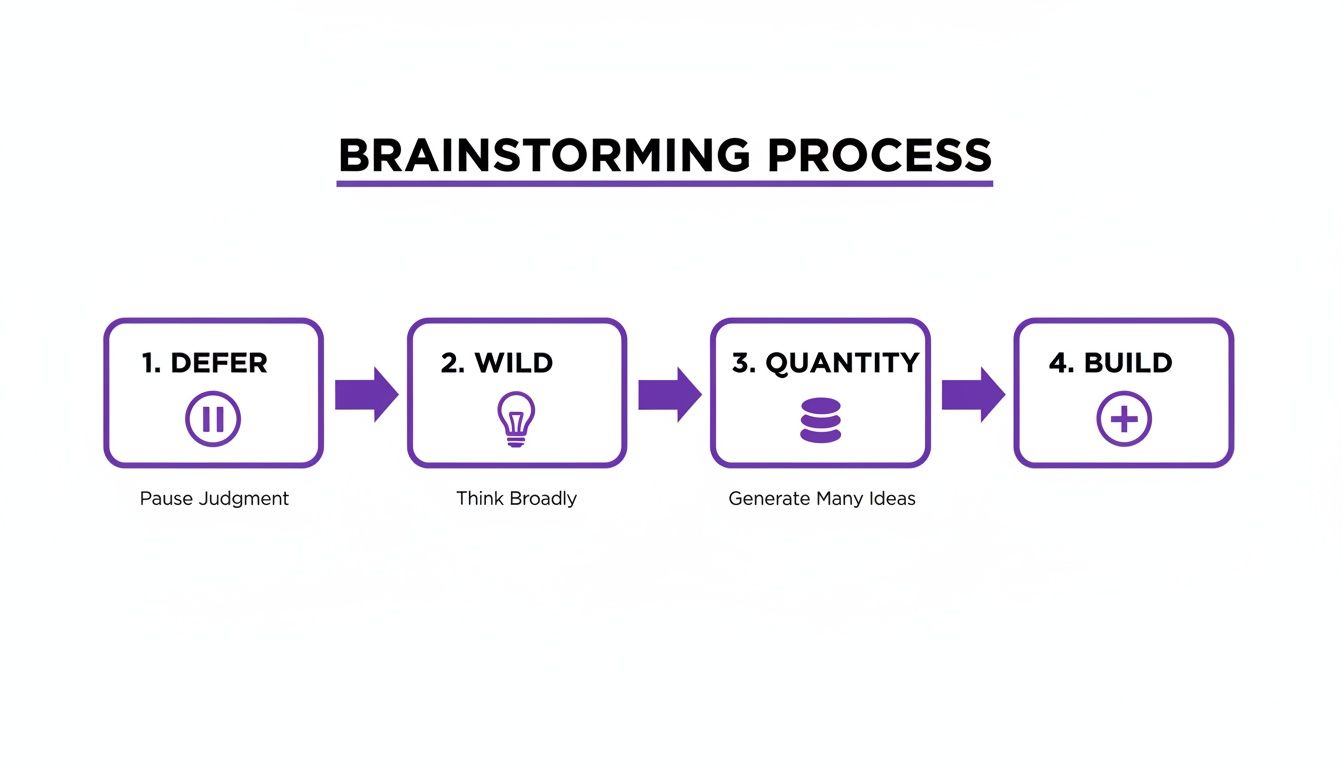
You can see how each rule builds on the last, creating a clear path from establishing a safe space to generating and connecting a ton of ideas.
Keeping the Momentum
After a few minutes, the flow of new ideas naturally starts to slow down. This is where a good facilitator steps back in. "Awesome work, everyone, we've got over 50 ideas here. For the next five minutes, let's switch gears and focus only on building. Pick any idea on this board—it doesn't have to be yours—and add one small twist or improvement to it."
This pivot keeps the energy up and reinforces that this is a team effort. It’s no longer about who came up with what, but about how we can collectively make the ideas stronger.
By following a simple script and gently reminding everyone of the rules, the facilitator steers the team clear of the usual brainstorming traps. If you need a hand structuring your own sessions, this brainstorming session template is a great place to start.
The facilitator's job isn't to have the best ideas. It's to create an environment where the team's best ideas can emerge and collide.
In just fifteen minutes, the team has generated a massive list of concepts, from the totally practical to the wonderfully ambitious. This didn't happen by accident. It's the direct result of a repeatable process grounded in the core brainstorming rules. The session ends not with a single "winner," but with a treasure trove of raw material ready for the next step: refinement and evaluation.
How to Adapt Brainstorming Rules for Remote Teams

Running a creative session online comes with its own set of hurdles. We've all felt the screen fatigue, struggled to read virtual body language, and seen quieter folks get lost in the digital shuffle. This is why you can't just copy and paste the classic brainstorming rules into a Zoom call and expect magic to happen.
Simply asking people to shout out ideas over video is a recipe for awkward silence. The real key is to thoughtfully adapt each rule for the tools and rhythms of a distributed team. You want to capture the electric energy of a great in-person brainstorm, but with all the advantages digital platforms bring to the table.
Making the Rules Work in a Virtual Space
Getting the core principles to stick in a remote setting is all about being intentional. It's less about which shiny new app you use and more about how you use it to create a space where people feel safe and empowered to think freely.
Here’s a practical look at how to translate the foundational rules for your remote crew:
-
Defer Judgment with Anonymity: Digital tools are your best friend here. Use virtual whiteboards or idea-collection apps that let people submit ideas anonymously. When a name isn’t attached to an idea, the fear of being judged plummets, opening the door for much bolder contributions.
-
Encourage Wild Ideas with Asynchronous Rounds: Who says a brainstorm has to start when the meeting does? Kick things off 24 hours early in a shared doc or a dedicated Slack channel. This gives your deep thinkers and introverts the quiet space they need to contribute their best—and often wildest—ideas without being talked over.
-
Go for Quantity Using Digital Templates: A blank digital canvas can be intimidating. Instead, structure your virtual whiteboard with grids or columns for different themes. This simple visual guide nudges people to fill the space, almost turning it into a game to generate a ton of ideas quickly.
For remote teams, structure is freedom. A well-designed digital process doesn’t kill creativity; it builds the guardrails that let ideas flow safely and freely, no matter where your team is.
Keeping the Collaborative Spark Alive
One of the toughest parts of remote work is recreating that spontaneous "yes, and…" energy that happens so naturally in person. You have to build it into the process.
This is where understanding how to keep your team engaged is vital; powering productivity in a remote work world is about using technology as a bridge, not a barrier. Encourage your team to use features like comment threads or stacked sticky notes on a Miro board to directly build on each other's suggestions.
This technique makes the connections between ideas visible and tangible. As a facilitator, you can then call them out: "I love how Sarah's idea here sparked three different builds. Let's dig into this thread a bit more." It celebrates collaboration and makes everyone feel like they’re building something together.
To get started, it's helpful to explore different virtual brainstorming techniques to find what fits your team's style. And if you want to take the guesswork out of it, a tool like Bulby can handle the heavy lifting, automatically putting these brainstorming rules into practice so everyone can participate on equal footing.
Adapting Brainstorming Rules for Different Team Setups
How you apply these rules depends heavily on whether your team is in the same room, spread across the globe, or a mix of both. Here’s a quick guide to help you adapt your approach.
| Brainstorming Rule | In-Person Application | Remote/Hybrid Application with Tech |
|---|---|---|
| Defer Judgment | The facilitator verbally reminds everyone to hold back criticism. "No bad ideas" is written on the whiteboard. | Use anonymous submission features in digital tools. Use emojis (👍, ❤️) for positive reinforcement instead of verbal feedback. |
| Encourage Wild Ideas | Warm-up exercises like "What's the worst possible idea?" are used to break the ice and lower inhibitions. | Set up a dedicated "Wild Ideas" section on a digital board. Use asynchronous rounds before the live meeting to allow for deep thinking. |
| Quantity Over Quality | The facilitator sets a timer and pushes the group to generate a high number of sticky notes in a short burst. | Use digital timers and templates that encourage filling up space. Gamify the session by setting a numerical goal (e.g., "Let's get 50 ideas in 10 minutes"). |
| Build on Others' Ideas | Team members cluster similar sticky notes together and verbally say "Building on that…" | Use comment threads, linking features, or color-coded stickies on a virtual whiteboard to show how ideas connect. |
Ultimately, the goal is the same no matter your setup: create a safe and structured environment where great ideas can emerge.
Using Technology to Supercharge Your Brainstorms
The classic brain storming rules we've discussed are timeless, but let's be honest: enforcing them can feel like herding cats. This is where the right technology can make all the difference, turning abstract principles into something you don't even have to think about.
Modern tools are built to sidestep the exact problems that sink most brainstorming sessions. Instead of a facilitator constantly saying, "no judgment yet!", the software itself can create the right environment. Imagine an exercise where everyone submits ideas at the same time, completely anonymously. Right away, you've solved production blocking (that awkward waiting for your turn to speak) and eased the fear of saying something silly. Every voice gets an equal shot.
Turning Chaos into Structured Creativity
The point of technology isn't to do the thinking for you; it's to build a better sandbox for your team to play in. Platforms like Bulby use structured workflows that gently guide everyone through the process, making sure the rules are followed without anyone needing to be a cop. A timed "wild idea" round with digital prompts, for example, can be just the nudge a team needs to get out of its creative rut.
Technology transforms the facilitator’s role from rule enforcer to creative guide. When the platform handles the structure, the team can focus entirely on the quality and quantity of their ideas, leading to more productive and engaging sessions.
This structured approach is a game-changer for remote and hybrid teams. It levels the playing field, so the loudest person on the Zoom call doesn't dominate the conversation. It gives quieter, more introverted team members the space they need to contribute their best work. For even more efficiency, you can explore some of the best free productivity apps to help organize and build on the ideas you generate.
Bringing in AI for Deeper Ideation
The really exciting stuff is happening with artificial intelligence. Think of AI not as a replacement for your team, but as a creative partner—a muse that can ask insightful questions or offer unexpected prompts to help you break free from your usual ways of thinking.
These systems don't just spit out answers; they create the perfect conditions for your team to find their own.
- AI-Powered Prompts: An AI can reframe your problem or add a surprising constraint, pushing your team to think sideways and uncover truly novel solutions.
- Automated Clustering: Once all the ideas are on the table, AI can instantly spot patterns and group related concepts together. This makes the jump from generating ideas to evaluating them smooth and logical.
This blend of smart structure and intelligent help turns what could be a messy meeting into a highly efficient idea factory. To see exactly how this works in practice, check out our guide on using AI for brainstorming and discover how these tools make the core rules more powerful than ever.
Got Questions About Brainstorming Rules? We've Got Answers.
Even with the best game plan, you're bound to run into a few hurdles when you try to put these ideas into practice. It's totally normal. Here are some quick answers to the questions we hear most often about making brainstorming rules stick.
What's the Single Most Important Rule?
If you can only get your team to master one thing, make it this: Defer Judgment. Hands down, it’s the most critical rule.
Think of it as the bedrock for everything else. Without it, people clam up. They won’t feel safe enough to toss out those "crazy" ideas or take a teammate's thought and run with it. Deferring judgment is what builds the psychological safety required for real creativity to happen. If you can get your team to just pause their inner critic, you've already won half the battle.
How Do You Handle Someone Who Keeps Breaking the Rules?
Ah, the "idea killer." We've all met one. This is where a good facilitator earns their keep, but the best approach is to be proactive. Before you even start, get everyone to explicitly agree to the brain storming rules. When the whole team commits to the process upfront, it's much easier to gently nudge people back on track.
If someone jumps in to critique an idea, the facilitator can step in with a simple, neutral redirect.
"Great point! Let's park that thought for the evaluation stage. For now, let's just keep the ideas flowing."
This acknowledges their input without killing the creative vibe. It’s also where tools can help. Many digital brainstorming platforms are designed to enforce the rules automatically, making it structurally harder for anyone to go off-piste.
Is It Better to Brainstorm Alone or in a Group?
Why not both? The most powerful approach is often a hybrid that gives you the best of both worlds. It usually looks something like this:
- Go Solo First (Brainwriting): Have everyone spend some quiet time generating ideas on their own. This prevents groupthink and lets introverts and deep thinkers contribute without pressure, often leading to a much larger pool of initial ideas.
- Come Together to Build: Once everyone has their individual thoughts down, bring the group together. Now the goal is to share, cluster, and build on what everyone came up with.
This "alone together" model taps into the raw productivity of individual focus and combines it with the spark of group collaboration. You get the depth of solo work and the magic of a shared creative session.
Ready to stop herding cats and start running brainstorms that actually work? Bulby builds these proven rules directly into a guided, AI-powered process. See how it can transform your remote team's creativity by visiting https://www.bulby.com.