

We've all been there: a team huddled in a conference room, staring at a blank whiteboard, waiting for a lightning bolt of genius to strike. But more often than not, that traditional, unstructured brainstorming session falls completely flat. Instead of sparking a fire of innovation, it just fizzles out.
The truth is, without a thoughtful plan, these meetings can do more harm than good, actively shutting down the very creativity they're meant to unleash.
Why Traditional Group Brainstorming Fails

Let’s be real. How many times have you walked out of a brainstorming session feeling it was a total waste of an hour? It’s a common experience. The same one or two people dominate the conversation, potentially good ideas get drowned out, and the team leaves with more questions than answers.
This isn’t just a hunch; it's a well-documented problem. The classic "shout out ideas as they come to you" method is fundamentally flawed because it ignores some basic truths about how people think and interact in groups. There are a few invisible forces at play that sabotage open participation, and knowing what they are is the first step to fixing the problem.
The Problem with Production Blocking
One of the biggest culprits is something called production blocking. It’s a fancy term for a simple problem: only one person can talk at a time. While one person is sharing, everyone else has to wait.
During that wait, a few things can happen. People might forget their own brilliant idea, get distracted by the current one, or just decide theirs isn't worth sharing anymore. It’s like an idea traffic jam where only one car gets through at a time, drastically cutting down on the total number of ideas the group can generate.
The Fear of Looking Foolish
Next up is evaluation apprehension, which is just a clinical way of saying "the fear of being judged." When people worry their idea might sound dumb, they’ll often choose to say nothing at all. This is especially true when managers or senior team members are in the room.
This fear kills a session’s creative potential. It encourages people to stick to safe, predictable suggestions instead of the wild, out-of-the-box thoughts that often lead to real breakthroughs. We dive deeper into this in our guide on what is evaluation apprehension.
A landmark meta-analysis of brainstorming studies found that groups generate only about 50% as many ideas as the same number of people working alone. This massive drop in productivity is a direct result of these common pitfalls.
Free-Riding and Social Loafing
Finally, you have to contend with social loafing, or free-riding. In any group setting, it's easy for some people to hang back and let the more extroverted or motivated folks do all the heavy lifting. They feel less individual responsibility for the outcome.
This isn’t always about being lazy. Sometimes people just assume their ideas aren't needed or that someone else will come up with something better. But when even a few people mentally check out, the group loses a huge chunk of its collective brainpower. It's clear that to get real results, we need a better way to brainstorm.
How to Prepare for a Successful Brainstorming Session
Ever been in a brainstorming session that just… fell flat? You know the one. Everyone stares at a blank whiteboard, a few half-baked ideas get thrown out, and you all leave an hour later with nothing to show for it.
The secret to a truly great brainstorming session isn't some magical creative spark that strikes during the meeting. It's the groundwork you lay before anyone even joins the call. Putting in a little effort upfront transforms a chaotic meeting into a powerhouse of innovation. Skipping this prep is like trying to bake a cake without a recipe—it’s going to be a mess.
Define the Problem With Crystal Clarity
This is the single most important thing you can do. A vague prompt like, "We need new marketing ideas," is a creativity killer. It’s too wide open, so people either freeze up or suggest things that are completely off-strategy.
Your job is to frame the challenge in a way that sparks curiosity. I’ve found the best way to do this is with the "How Might We" (HMW) format. It’s a simple trick that reframes a problem into an opportunity for innovation.
- Instead of: "Customer retention is dropping."
- Try: "How might we create a delightful onboarding experience for new customers to increase their first-month engagement?"
See the difference? The HMW version is specific, optimistic, and practically begs for creative solutions. It gives your team a clear, compelling target to aim for.
Assemble Your A-Team
The people in the room (or on the Zoom) will make or break your session. Don't just invite the usual suspects. You’re building a temporary, mission-driven team, and diversity is your superpower.
When you're putting together your invite list, think about:
- Different Perspectives: Pull in folks from across the company. Get an engineer, a marketer, and a customer support rep in the same session, and you’ll see the problem from angles you never imagined.
- A Mix of Tenures: Blend seasoned veterans who know the business inside and out with newer team members who bring fresh eyes and aren't afraid to question the status quo.
- Cognitive Variety: You need both the big-picture dreamers and the detail-oriented realists. They balance each other out perfectly.
The sweet spot for group size is usually four to seven people. It's small enough for everyone to get a word in but large enough to get a real mix of ideas flowing. If you need to include more people, plan on using smaller breakout groups during the session.
Give Everyone a Head Start with a Pre-Read
Asking people to show up to a brainstorm cold is a huge mistake. You’ll waste the first 15 minutes just getting everyone up to speed.
Instead, send out a short and sweet pre-read document at least a day or two ahead of time. This isn’t homework; it’s a primer to get everyone’s brain warmed up and on the same page.
It's a common myth that group brainstorming is less effective than individual work. While solo sessions might produce a higher quantity of raw ideas, the collaborative ones often deliver far greater business value. Research on a top product design firm found that group sessions drive revenue, build skills, and create a powerful organizational memory. Check out the full story on the hidden benefits of group brainstorming from Stanford's study.
Keep your pre-read to a single page. Nobody has time for a novel.
Before you hit send, run through this quick checklist to make sure you've covered all your bases. It's my go-to sanity check before any big creative session.
Brainstorming Prep Checklist for Facilitators
| Checklist Item | Why It Matters | Pro-Tip |
|---|---|---|
| Clear Problem Statement | Focuses the group's creative energy on a specific, relevant challenge. | Frame it as a "How Might We" question to inspire possibility. |
| Session Goals | Defines what success looks like and what you need to achieve by the end. | State 1-2 clear, measurable outcomes (e.g., "3-5 prioritized concepts"). |
| Relevant Background Info | Aligns everyone on key data, user feedback, or market context. | Use bullet points and visuals to keep it scannable and easy to digest. |
| Simple Agenda | Manages expectations and shows respect for everyone's time. | Include timings for each activity to keep the session on track. |
Nailing these prep steps means that when the session starts, you can dive right into the good stuff: generating and building on fantastic ideas.
If you want to dig deeper into setting up any collaborative session for success, we have a whole guide on preparing for a meeting more effectively.
Your Facilitator's Playbook for a Killer Brainstorming Session
Think of yourself as the session's conductor. Your job isn't to have the best ideas; it's to create an environment where everyone else's best ideas can emerge and shine. A well-run session feels less like a meeting and more like a guided creative journey—one with a clear beginning, middle, and end that leads to real results.
To pull this off, you need to be part facilitator, part meeting manager. Honing your effective meeting management tips will be the difference between a chaotic free-for-all and a genuinely productive brainstorm.
We’ll break down the session into three key phases: Divergence, Exploration, and Convergence. Each stage has a unique purpose, guiding the team from a wide-open field of possibilities to a handful of ideas you can actually act on. Getting this flow right is everything.

Before you even start, remember the basics: define your purpose, get the right people in the room, and make sure everyone has the context they need to contribute meaningfully.
The Divergence Phase: Opening the Floodgates
First up is Divergence. This phase is all about quantity over quality. The mission? Get as many ideas on the board as possible, no matter how wild or off-the-wall they seem. This is where you actively shut down the usual suspects like groupthink and fear of judgment.
A fantastic way to kick this off, especially with remote or hybrid teams, is Silent Brainwriting. Instead of a verbal scrum, give everyone five to seven minutes to silently jot down their ideas on digital sticky notes. It's a game-changer. This simple trick gives introverts and deep thinkers the space to contribute and stops the first few voices from dominating the entire conversation.
From there, you can move into a Round Robin. Go around the virtual room and have each person share just one idea from their list. This ensures every single person speaks up early, setting the tone for balanced participation. As the facilitator, your only job here is to capture the ideas—no discussion, no critique, just get them on the board.
The Exploration Phase: Finding the Patterns
With a whiteboard full of raw ideas, it's time to shift into the Exploration phase. Here, the group begins to make sense of the beautiful mess they've created. The goal isn't to pick winners yet; it's to understand, clarify, and start spotting connections.
A go-to method for this is Affinity Clustering. Working together, the team starts dragging the sticky notes into groups based on common themes. You'll quickly see patterns emerge. Maybe a bunch of ideas are about improving the customer onboarding experience, while another cluster forms around internal communication tools.
Keep the conversation flowing with simple, open-ended questions:
- "What’s the common thread you’re seeing in this group?"
- "Can you say a bit more about this idea?"
- "How does this sticky note relate to that one over there?"
This is a collaborative sense-making exercise. It helps everyone see the bigger picture and often sparks brand-new ideas as concepts start to merge. This is the core of great facilitation, and you can learn even more about how to do it well as you learn https://www.remotesparks.com/how-to-facilitate-workshops/ that truly deliver.
Facilitator's Pro-Tip: Use a timer! Setting a 10-minute clock for clustering creates a healthy pressure. It keeps the energy up and stops the team from getting bogged down in endless debate over minor details.
The Convergence Phase: From Ideas to Action
Finally, we arrive at the Convergence phase. The creative energy now shifts from "what if?" to "what's next?" Your job is to help the team narrow that big pool of ideas down to a select few they can actually move forward with. Without this step, even the most amazing brainstorm will feel like a waste of time.
One of the best and most democratic ways to prioritize is Dot Voting. Give every participant three to five virtual "dots" to place on the ideas they believe have the most potential. It’s fast, it’s visual, and it gives everyone an equal voice in the outcome.
To take it a step further, use an Impact/Effort Matrix. Draw a simple four-quadrant grid with "Impact" on the Y-axis and "Effort" on the X-axis. Take the top-voted ideas and, as a group, decide where each one belongs on the matrix.
This exercise instantly creates clarity:
- High Impact, Low Effort: These are your quick wins. Start them ASAP.
- High Impact, High Effort: These are your big strategic projects that need a real plan.
- Low Impact, Low Effort: Tackle these if you have spare time, but don't prioritize them.
- Low Impact, High Effort: These are the ideas you should probably park for now.
By the end of this phase, you should have a small, prioritized list of ideas. The final, critical step is to assign an owner and a clear "next action" to each one. This is how you turn creative energy into tangible progress.
Structured Digital Techniques to Unlock Every Voice
For remote and hybrid teams, technology can be your secret weapon for better brainstorming. It's not just about hopping on a video call. When you use digital tools with intention, you can systematically break down the classic barriers that kill creativity, like people talking over each other or fearing judgment.
The real shift happens when you embrace two powerful concepts: asynchronous and anonymous idea generation. Giving people the space to contribute on their own time, without their name attached, completely changes the dynamic. The social pressure melts away, and people no longer have to fight for airtime to share a brilliant thought.
Electronic Brainstorming Levels the Playing Field
This isn't just a hunch; it's a well-researched fact. For decades, studies on "electronic brainstorming"—where people type ideas into a shared system—have shown it consistently beats old-school verbal sessions, especially as the group gets bigger.
Why? Because digital tools get rid of the "one person at a time" bottleneck. A landmark 1993 study found that groups of 12 using anonymous digital tools came up with far more ideas than individuals who worked alone and then pooled their thoughts. The tech itself helps reduce common problems like production blocking (waiting for your turn) and free-riding, which can boost the total number of unique ideas by 30-50% in larger groups. You can dive into the specifics of how electronic groups outperform others in this classic research paper.
The biggest advantage of digital brainstorming is that it separates the act of generating ideas from the act of discussing them. This simple change gives introverts, remote employees, and deep thinkers an equal platform to contribute their best work.
So, how do you make this happen in your next meeting? Let's walk through a simple, powerful technique you can use right away.
Putting Digital Brainwriting into Practice
One of the most effective and straightforward methods for brainstorming in groups online is called Brainwriting. It's a simple exercise that guarantees every single person contributes from the get-go. Here’s a quick guide to running it on a virtual whiteboard like Miro, Mural, or FigJam.
-
Set Up Your Canvas: Create a shared digital board. Place your clear "How Might We…?" question at the top. Then, make a separate, labeled area for each person.
-
Silent Idea Generation (5-7 Minutes): Kick things off with five to seven minutes of silent, independent work. Everyone adds their ideas to their personal area using digital sticky notes. Remind the group that quantity is the goal here—no idea is too wild.
-
Rotate and Build (5 Minutes): Now for the collaborative part. After the first timer goes off, have everyone move to the digital space of the person "to their right" (it helps to pre-assign this). They'll spend the next five minutes reading the ideas already there and adding new ones inspired by what they see.
-
One Final Rotation (5 Minutes): Do it one more time. Participants move to a new section, read the ideas, and add their final builds and thoughts.
In just 15-17 minutes, you’ll have a board full of ideas that have been seen and expanded on by multiple people, all without anyone saying a word. The initial anonymity is key, as we cover in our guide to running an effective anonymous brainstorming session. This process ensures ideas are evaluated on their merit, not on who came up with them.
Comparing Brainstorming Methods for Remote Teams
Choosing the right approach is crucial when your team is distributed. A method that works wonders in a conference room can fall flat over a video call. The table below breaks down the key differences between traditional verbal brainstorming and more structured, digital-first techniques.
| Method | Best For | Key Benefit | Potential Pitfall |
|---|---|---|---|
| Traditional Verbal | Small, high-trust teams; simple problems that need quick, spontaneous ideas. | Builds team rapport and energy through live interaction. | Loudest voices can dominate; subject to groupthink and production blocking. |
| Digital Brainwriting | Introverted teams; complex problems; ensuring equal participation from everyone. | Separates idea generation from evaluation, boosting psychological safety. | Can feel less energetic or spontaneous than a live conversation. |
| Asynchronous Ideation | Geographically dispersed teams in different time zones; deep, reflective thinking. | Gives people time to think without pressure; fits into flexible schedules. | Lacks immediate feedback and collaborative spark; requires self-discipline. |
Ultimately, the best remote brainstorming sessions often blend these methods. You might start with asynchronous ideation to gather initial thoughts, move to a live digital brainwriting session to build on them, and then use a verbal discussion to prioritize the strongest concepts. This hybrid approach helps you get the best of both worlds.
Turning Your Group's Ideas Into Action
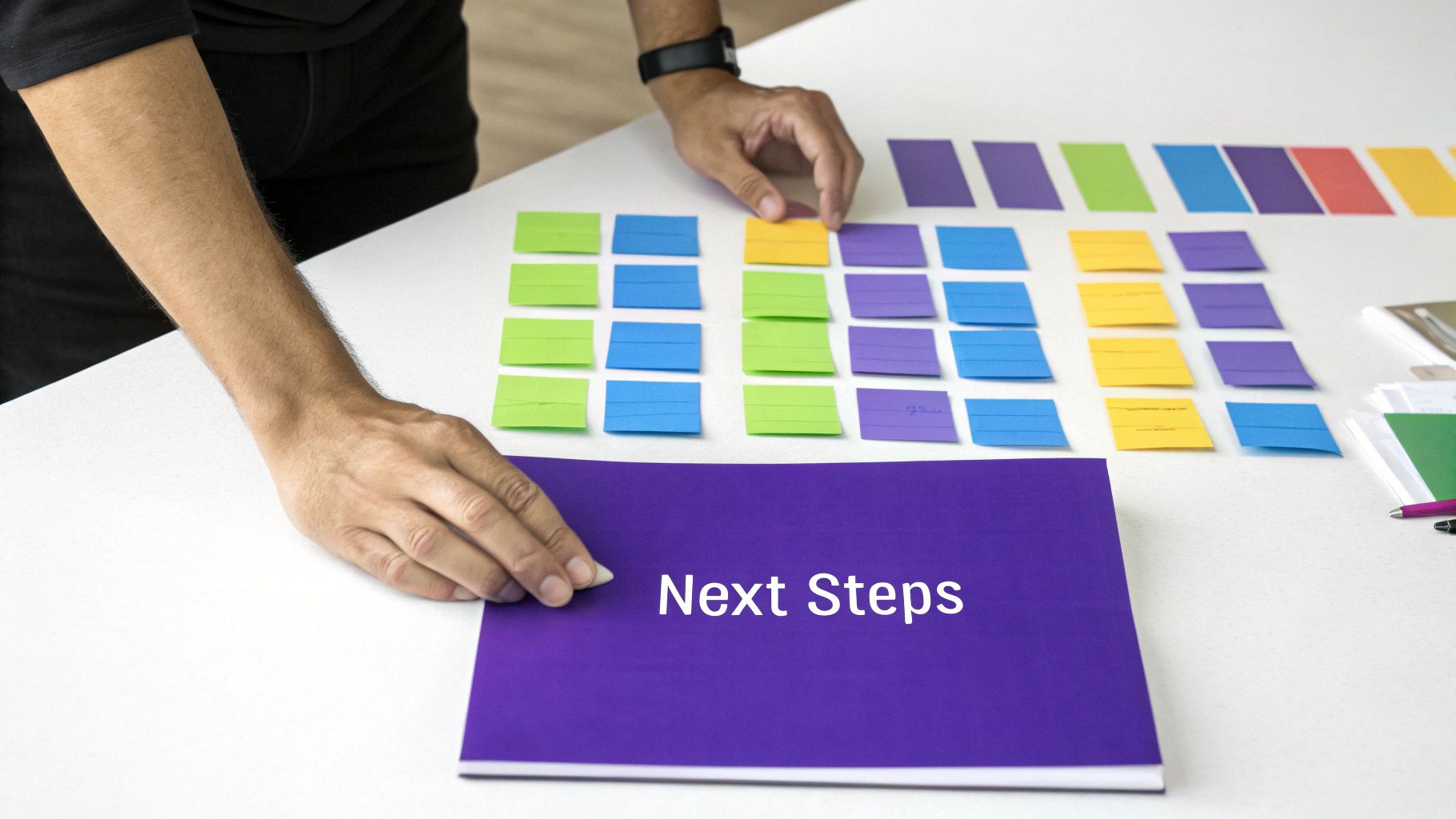
A digital whiteboard covered in colorful notes feels like a win, but it's not the finish line. The true success of any brainstorming session comes down to what happens next. All that creative momentum can fizzle out the moment the meeting ends unless you have a solid plan to sort, prioritize, and act on those ideas.
This is where you, as the facilitator, shift the group's energy. You've successfully opened them up to generate tons of possibilities; now it's time to guide them toward making concrete decisions. Let's make sure all that great work leads to real, tangible results.
Moving from Quantity to Quality
First things first, you need to make sense of the beautiful chaos. If you used the affinity clustering method we talked about earlier, you're already ahead of the game with ideas grouped into themes. This gives you an immediate visual cue for where the team's thinking is concentrated.
From there, you need a quick and fair way to see which ideas are really clicking with everyone. My go-to method for this is Dot Voting.
It's brilliantly simple:
- Give everyone dots: Each person gets a small number of virtual dots, usually between three to five.
- Let them vote: People place their dots on the ideas or clusters they think have the most promise.
- Talk it out: Take a look at the ideas that attracted the most votes. This isn't about making a final decision just yet, but it instantly surfaces the group's favorites.
Dot voting is a fantastic, low-stakes way to take the room's temperature. It gives you a clear visual of the front-runners and a natural starting point for a deeper conversation about what to prioritize.
Using Frameworks to Prioritize Ideas
Once you've narrowed it down to a shortlist, it's time to get a bit more strategic. Gut feelings are important, but a simple framework can help the team analyze their options more objectively. The Impact/Effort Matrix is a classic for a reason—it just works.
The idea is to plot your top ideas on a simple grid. The vertical axis represents the potential Impact (from low to high), and the horizontal axis shows the Effort it would take to implement (from low to high).
This exercise neatly sorts your ideas into four buckets:
- High Impact, Low Effort (Quick Wins): These are your golden tickets. They deliver a ton of value for not much work. Jump on these right away to build momentum.
- High Impact, High Effort (Major Projects): These are the big, game-changing initiatives. They’ll need serious planning and resources, but the payoff could be huge.
- Low Impact, Low Effort (Fill-ins): These are nice-to-haves. Easy to do, but they won't move the needle much. Keep them on the back burner for when you have extra time.
- Low Impact, High Effort (Time Sinks): Avoid these. They drain resources and deliver very little in return.
By mapping ideas visually, the Impact/Effort matrix shifts the conversation from "Which idea is coolest?" to "Which idea gives us the best strategic advantage right now?"
Defining Clear Next Steps and Ownership
You’ve got your prioritized ideas. Now for the most crucial part: turning them into action. I’ve seen it a thousand times—an incredible idea dies on the vine simply because no one was assigned to take the first step. An idea without an owner is just a wish.
Before anyone leaves that meeting, make sure you define two things for each of your top one-to-three ideas:
- A Single Owner: One person. Not a team, not a department. One person who is responsible for moving the idea forward. They don't have to do all the work, but they are the DRI (Directly Responsible Individual).
- The Very Next Action: Don't get bogged down in planning the entire project. Just define the immediate, tangible next step. Is it scheduling a 30-minute follow-up? Drafting a one-pager? Researching a specific tool? Keep it small and specific.
This clarity is everything. It keeps the energy high and ensures the transition from brainstorming to building is seamless. You can find more strategies for this in our guide on moving from idea to implementation.
Finally, document and share. A practical guide to meeting transcription can be a lifesaver here, ensuring no detail is lost. Send a recap email within 24 hours that includes a link to the final whiteboard, a summary of the prioritized ideas, and a clear list of owners and their assigned next steps. This simple follow-up makes it official and gets everyone on the same page.
Your Top Brainstorming Questions, Answered
Even the most carefully planned brainstorming session can hit a snag. Let's be honest, getting a group of people to think creatively together isn't always straightforward. Over the years, I've seen the same questions pop up time and time again.
Here are my go-to answers for the most common challenges you'll face when running a group brainstorm.
How Do You Handle a Dominant Personality in a Group Brainstorming Session?
We've all been there. One person with a lot of opinions (and a loud voice) starts to take over, and suddenly, everyone else clams up. The key isn't to shut them down directly but to lean on a solid structure.
Start the session with a silent, individual activity like brainwriting. Give everyone a stack of sticky notes or a private space on a digital whiteboard and have them jot down ideas on their own for 5-10 minutes. This simple trick gets everyone’s thoughts out in the open before a single word is spoken, leveling the playing field from the get-go.
When it's time to share, use a structured method like a Round Robin. Go around the "room" (virtual or physical) and give each person a minute or two to share one idea. If the dominant person tries to jump in, you can gently guide the conversation back on track. A simple, "Great point, Alex. Let's make sure we hear from everyone first—Sarah, what's on your mind?" works wonders. It's about facilitation, not confrontation.
What Is the Ideal Group Size for a Brainstorming Session?
For creative problem-solving, the magic number is usually between four and seven people. It's the sweet spot. Any smaller, and you risk not having enough diverse perspectives. Any larger, and people start to check out or feel too intimidated to speak up.
What if you have to include a bigger group? Don't try to brainstorm with 15 people in one giant conversation—it’s a recipe for chaos. Instead, break them out into smaller teams of three or four. Let these mini-groups work on the problem for a set amount of time, then have each one report their top ideas back to the main group. This keeps everyone engaged and accountable.
The goal isn't just to get more people in the room; it's to maximize the quality of contributions. Smaller breakout groups create psychological safety and increase individual accountability, leading to better, more thoughtful ideas from everyone involved.
How Can I Make Brainstorming More Engaging for a Remote Team?
Let’s face it, a standard video call where everyone just talks is draining. For remote teams, the secret to engagement is interaction and variety.
You absolutely need a shared visual space. A digital whiteboard tool like Miro or Mural is non-negotiable. It gets people doing things with their hands, not just listening.
Then, mix up the activities. A good remote session should have a natural rhythm. For example:
- Silent individual brainstorming to start.
- Group clustering, where everyone drags and drops related virtual sticky notes together.
- Dot voting to quickly see which ideas resonate most with the group.
And here’s a pro tip: use timers! Setting a timer for each activity creates a sense of pace and urgency. It keeps the energy up and shows you respect everyone’s time.
How Long Should a Brainstorming Session Last?
Keep it between 60 and 90 minutes. Anything longer, and you'll see energy levels plummet, especially in a virtual setting where screen fatigue is very real. You want people to leave feeling energized, not exhausted.
A solid 90-minute agenda might look something like this:
- Context & Warm-Up (10 mins): Get everyone on the same page about the problem and do a quick creative warm-up.
- Idea Generation (25 mins): This is the core divergent thinking phase. Use a structured exercise to get lots of ideas out.
- Clarify & Cluster (30 mins): As a group, discuss the ideas, group similar ones, and make sure everyone understands them.
- Prioritize & Plan (25 mins): Decide on the top ideas and, most importantly, define the very next steps.
If you’re wrestling with a really complex topic, don't try to cram it all into one marathon session. It’s far more effective to schedule two separate, focused 90-minute meetings.
Turn your remote sessions from chaotic to creative with Bulby. Our platform guides your team through structured brainstorming exercises that surface everyone's best ideas and turn them into actionable plans. Try it for free and see the difference.