
A business innovation model is really just your company's game plan for creating, delivering, and capturing value. It's less about what you sell and more about how you run the whole show—from operations and revenue to the way you treat your customers. Think of it as your unique recipe for long-term growth.
Understanding the Core Framework of Innovation

It's a common trap for leaders to think innovation is just about launching a new product. That’s part of the picture, of course, but a true business innovation model digs much deeper. It forces you to question the core assumptions of your industry and your company's place in it.
Let's use a restaurant as an example. Adding a new dish to the menu? That's product innovation. But changing how you deliver the food entirely—say, shifting from a traditional sit-down restaurant to a subscription meal-kit service—that's business model innovation. The food is still the star, but everything around it, from how you make money to how you connect with customers, is completely transformed.
Why a Model Is Essential for Growth
Without a clear model, innovation can feel like a chaotic scramble. Teams end up chasing the latest trends or building things that don't fit into a sustainable business structure. A formal innovation model acts as a set of guardrails, giving your efforts much-needed direction.
This is even more important for remote teams. When everyone is working from different locations and time zones, a shared framework keeps the entire team pulling in the same direction. It turns big, abstract ideas into a coordinated plan, so you’re not dealing with siloed work or wasted effort. In short, the model becomes a common language that unites your team around a single vision.
A business innovation model enables you to shift conversations from focusing only on today's business to boldly inventing your company's future. It provides a framework to explore and build what comes next, rather than just incrementally improving what already exists.
The Benefits of a Structured Approach
When you adopt a structured innovation model, you move away from guesswork and toward a process you can repeat for success. It gives you a system for spotting real opportunities and testing your assumptions before you sink a ton of money and time into them.
Here are some of the key advantages:
- Enhanced Competitiveness: You can build unique value that competitors can't easily copy, getting you out of the endless cycle of competing on price or features alone.
- Improved Agility: With a clear model, it's easier to pivot when the market changes because you understand the fundamental logic of your business.
- Greater Alignment: Everyone, from marketing to engineering, understands how their work contributes to the bigger picture.
Platforms like Bulby really bring these benefits to life. It offers guided brainstorming sessions designed to fit your chosen innovation model, making it simple for even distributed teams to work together on what's next.
Exploring Key Business Innovation Models
Now that we're on the same page about what a business innovation model is, let’s get into the fun part: the actual "recipes" you can use. Each one offers a completely different way to create value, and picking the right one comes down to your industry, what you have to work with, and what you’re trying to achieve.
Think of these models less like rigid blueprints and more like flexible frameworks. They're meant to be starting points that give your strategic thinking some structure and help your team channel its creative energy. Let's walk through five of the most effective models out there, using some simple analogies to bring them to life.

Disruptive Innovation: The Speedboat vs. The Cruise Ship
Disruptive Innovation isn’t about building a better version of what the big players already have. It’s about creating something simpler, cheaper, or more accessible that challenges them from the bottom up.
Picture a nimble speedboat zipping past a massive cruise ship. The speedboat can’t compete on luxury or five-star dining, but it can get to shallow coves and small ports the giant ship can't, serving overlooked customers at the low end of the market.
At first, the established companies often just ignore these disruptors. The profit margins look too small to bother with. But over time, that little "speedboat" gets better, adds more features, and starts moving upmarket, eventually stealing the cruise ship's mainstream customers. This approach is a game-changer for startups looking to carve out a foothold in a crowded space.
Open Innovation: The Collaborative Potluck
Imagine you're hosting a potluck dinner. Instead of slaving away in the kitchen trying to cook everything yourself, you ask everyone to bring their best dish. What you get is a fantastic, diverse meal that you could never have pulled off alone. That's the core idea behind Open Innovation.
This model throws out the old notion that all the best ideas have to come from your internal R&D team. Instead, it’s about looking outside your own four walls for new technologies, talent, and solutions. This could mean partnering with universities, crowdsourcing ideas from your customers, or even acquiring smaller startups. By working together, you can speed up progress, cut costs, and create a much richer "feast" of innovation.
Business Model Innovation: The Netflix Pivot
Sometimes, the most powerful change you can make isn’t to your product, but to how you deliver it. This is Business Model Innovation in a nutshell. The classic example is Netflix. They started out by mailing DVDs—the product (movies) was the same one Blockbuster offered, but their delivery model was a total game-changer: a subscription service with no late fees.
That was just the start. Netflix then disrupted its own model by shifting to streaming, fundamentally rewiring how we all consume entertainment. This approach forces you to question every part of your business, from how you make money to how you connect with customers, to find a better way to deliver and capture value.
Platform Innovation: The Thriving Marketplace
Platform innovation isn't about selling a single product; it's about building an environment where others can connect and create value for each other. Think of Airbnb, which doesn't own a single hotel, or Uber, which owns no cars. They built digital marketplaces—platforms—that bring together two different groups (hosts and guests, drivers and riders).
The magic here is the "network effect," where the platform becomes more valuable as more people join. Your role changes from being a direct provider to a facilitator, and you earn money from the interactions you make possible. It's an incredibly powerful way to build a scalable business that's hard for others to copy. You can dig deeper by exploring different models of innovation in business to see how they stack up.
At its core, every business innovation model is a story about how you will deliver unique value to a customer in a way that is profitable and sustainable. The model you choose is the plot of that story.
Lean Startup: The Scientific Experiment
Popularized by Eric Ries, the Lean Startup model treats a new venture like a science experiment. Instead of spending months building a "perfect" product behind closed doors, you begin with a Minimum Viable Product (MVP). This is the simplest, most basic version of your idea you can possibly build.
You then get that MVP into the hands of a small group of early adopters to gather real-world feedback. The whole point is to learn as quickly as you can what's working and what isn't, using a tight cycle of building, measuring, and learning. This method minimizes risk and wasted effort, making sure you end up with something customers actually want. It's particularly great for remote teams who need a clear process for testing ideas quickly and asynchronously.
Comparing 5 Key Business Innovation Models
To help you see the differences more clearly, we’ve put together a quick comparison of these five powerful models. Each has its own DNA—its core principle, ideal situation, and a real-world company that nailed it.
| Model | Core Principle | Best For | Example |
|---|---|---|---|
| Disruptive Innovation | Targeting overlooked market segments with simpler, cheaper solutions. | Startups or teams entering established markets. | Dollar Shave Club |
| Open Innovation | Sourcing ideas and solutions from outside the organization. | Companies needing to accelerate R&D or solve complex problems. | LEGO Ideas |
| Business Model Innovation | Changing the fundamental way the business operates and makes money. | Incumbents facing market shifts or new customer behaviors. | Adobe (from software sales to subscriptions) |
| Platform Innovation | Creating a network that connects two or more user groups. | Businesses that can benefit from strong network effects. | Etsy |
| Lean Startup | Testing assumptions quickly with minimal resources through an MVP. | Early-stage ventures or teams operating with high uncertainty. | Dropbox |
Ultimately, choosing the right business innovation model is a huge strategic decision that will steer your company's future. By getting a good handle on these core frameworks, you can start to see which approach truly fits your team's vision and strengths.
How Global Leaders Drive Innovation
Innovation isn't just a buzzword for startups; it's the engine that powers entire economies. If you want to build a truly effective business innovation model, a great place to start is by looking at the countries that consistently get it right. Their success isn't an accident. It’s the result of smart investment, a culture that celebrates creativity, and an intense focus on turning great ideas into real-world value.
By studying these global leaders, any company—even a fully remote one—can pick up on principles that work at the team level. You don’t need a national budget to copy their success. What you need is their mindset and a framework to build a competitive edge, no matter where your team logs in from.
Lessons From the World's Top Innovators
Every year, the Global Innovation Index (GII) ranks countries on their innovation chops. For an incredible fifteenth year in a row, Switzerland has claimed the top spot. That kind of consistency isn't just about a few big companies; it shows the power of a deep-rooted innovation ecosystem that values both cutting-edge research and practical, creative work.
The United States isn't far behind at number two, flexing its muscle in areas like venture capital and the sheer global reach of its brands. The latest GII report from the World Intellectual Property Organization (WIPO) shows how these two countries take different, yet equally powerful, paths to the top. It's worth exploring the full GII findings to see the diverse ways economies foster innovation.
The big lesson here? Lasting success comes from a balanced approach. Switzerland is a master at turning investments into high-quality inventions and creative products. The U.S., on the other hand, excels because of its dynamic market and unmatched ability to scale ideas into global giants.
Applying Global Strategies to Your Remote Team
So, how can a remote team apply these high-level insights? The trick is to translate the core principles into practical, everyday actions.
Here’s how you can adapt these winning strategies:
- Mirror Switzerland's Creative Output: The Swiss model is all about consistently generating high-value creative work. For a remote team, this means adding structure to your brainstorming. Forget unstructured free-for-alls where good ideas get lost. Instead, use guided exercises that make sure every thought is captured and properly evaluated—a must for asynchronous work.
- Emulate the US Venture Capital Mindset: The American innovation machine runs on a willingness to fund and test promising ideas fast. Your team can do the same by treating new projects like mini-investments. Give a new concept a small, fixed budget and a clear timeline to prove itself with a Minimum Viable Product (MVP), just like a VC would with a seed-stage startup.
The key takeaway is this: the same principles that build innovative nations—sustained investment, structured creativity, and a market-focused mindset—can build an innovative team. You're just creating your own micro-ecosystem for growth.
Of course, tools can make this a lot easier. For instance, Bulby offers AI-guided brainstorming exercises that bring that Swiss-style structured creativity right into your team's workflow. It helps organize thoughts and shape raw ideas into concrete concepts, creating an environment where innovation can thrive. These structured processes are also key to making better choices, and you can explore various decision-making examples to see how that plays out.
Ultimately, by borrowing from the playbooks of the world's innovation leaders, you can build a more resilient and forward-thinking business. You're creating a small-scale version of their successful ecosystems, perfectly suited to the unique rhythm of your remote team.
Choosing the Right Model for Your Remote Team
Picking a business innovation model isn't about grabbing a pre-made template off the shelf. It’s about finding a strategy that clicks with your company's unique DNA. For a remote team, this decision has an extra layer of complexity. The model you choose has to do more than just spur growth—it needs to fit neatly into the day-to-day realities of distributed work, like asynchronous communication and virtual collaboration.
The best choice really boils down to your team’s specific situation. Your industry, how much risk you’re willing to take, your company's size, and where you are in your growth journey all matter. A tiny startup trying to muscle its way into a crowded market has entirely different needs than a big, established company trying to keep nimble competitors at bay.
Answering the Core Strategic Questions
To find the right fit, you need to ask a few honest questions first. Think of these as practical filters that will help you quickly sift through the options and point your team in a clear direction. The whole point is to get everyone on the same page, making sure your remote team is rowing in unison.
Start with these key questions:
- Are we creating a brand-new market or shaking up an existing one? If you're building something from scratch, a model focused on customer discovery like Lean Startup is a great starting point. If you’re aiming to take on the big players, a Disruptive Innovation mindset might be the way to go.
- How much capital can we actually risk? Some models, like building a massive platform, demand a huge upfront investment. This is worlds away from a Lean Startup approach, which is all about testing ideas while spending as little as possible.
- What’s our stance on working with outsiders? If your team thrives on collaboration and you’re excited by external ideas, Open Innovation is a natural choice. But if your intellectual property is your secret sauce, you'll need a more guarded, closed-off approach.
The best business innovation model is the one that feels like a natural extension of your company’s culture and goals. It should make things easier, not more complicated—especially when your team is remote.
Models That Thrive in a Remote Setup
Some innovation models just work better with the rhythm of remote work. The built-in need for clear documentation and asynchronous communication can become major advantages when you have the right framework in place. Knowing how to foster innovation with remote teams is a game-changer for any company that wants to make the most of its distributed talent.
For example, the Lean Startup model is a fantastic fit for remote teams. It’s built around quick, documented cycles of building, measuring, and learning—a process that slots perfectly into asynchronous workflows. Team members can push sprints forward and analyze customer feedback across different time zones without ever losing steam.
Open Innovation also flourishes in a distributed world. It gives you a direct line to a global talent pool, letting you collaborate with experts, freelancers, and other companies no matter where they are. Modern digital tools make managing these external partnerships and weaving their ideas into your work smoother than ever. For a closer look, our guide on fostering innovation in remote teams dives into more specific tactics.
At the end of the day, the goal is to pick a model that empowers your team, not boxes them in. By thinking carefully about your strategy and the unique flow of your remote workforce, you can land on a business innovation model that will act as a powerful engine for real, sustainable growth.
Your Step-by-Step Remote Implementation Plan
Turning a great innovation model from a whiteboard concept into a real-world win takes a solid, step-by-step plan. This is doubly true for remote teams, where clear communication and structure aren't just nice-to-haves—they're the foundation of success. Think of this plan as your team's GPS, guiding you from that initial spark of an idea all the way to a tangible result.
This five-step process is built from the ground up for a distributed workforce, making sure everyone stays on the same page and moves forward together, no matter where they're logging in from.
Step 1: Set a Clear Innovation Goal
Before anyone writes a single line of code or sketches a prototype, you have to define what winning looks like. A fuzzy goal like "let's innovate" is a fast track to spinning your wheels and wasting resources. Your team needs a specific, measurable, and genuinely motivating target to rally behind.
This goal becomes your North Star, the fixed point that guides every decision. For a remote team, this kind of clarity is non-negotiable. It cuts through the noise of different time zones and work environments, keeping everyone focused.
- Ask: What specific pain point are we solving for our customers?
- Define: What does a successful outcome look like in 6 to 12 months?
- Clarify: How will we measure success? (e.g., getting 1,000 new users, cutting customer churn by 15%).
Nailing this down first ensures your innovation efforts are tied to real business outcomes right from the start.
Step 2: Build Your Core Remote Team
Once the goal is set, it's time to assemble your crew. Innovation is a team sport, and for a remote setup, you need a diverse group of self-starters who are masters of communication. You're looking for a healthy mix of skills—technical chops, creative thinking, and strategic oversight—to cover all your bases.
Keep your core innovation squad small enough to be nimble but big enough to get the job done. A team of three to seven people is usually the sweet spot. Make sure everyone knows their role and is all-in on the goal you've set.
This infographic gives you a simple way to think about which model fits your team size.
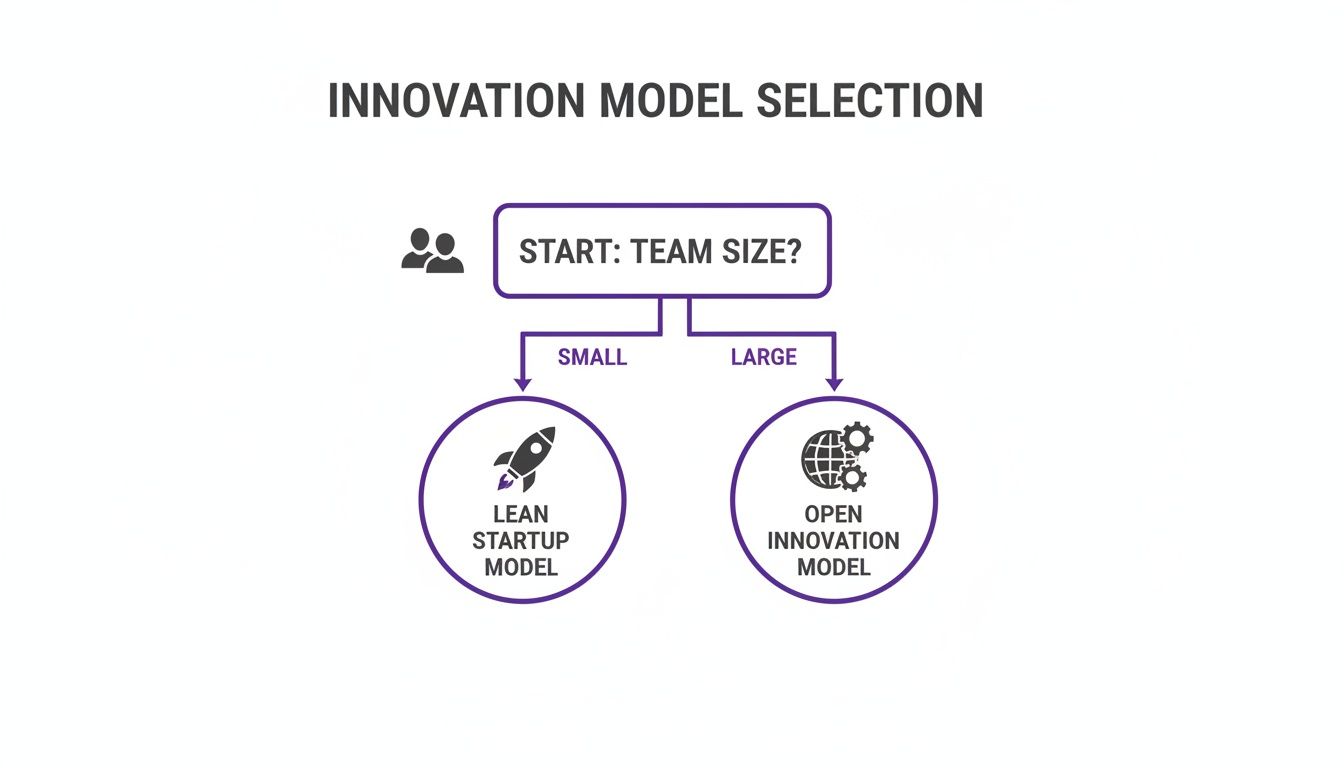
As you can see, smaller, agile teams are often a perfect match for a Lean Startup approach. In contrast, larger organizations might get more mileage from an Open Innovation model that taps into outside expertise.
Step 3: Run Structured Brainstorming Sessions
This is where the magic really starts to happen. Good brainstorming isn't just about throwing ideas at a wall; it's about generating a high volume of quality ideas. For remote teams, unstructured video calls can quickly turn into a chaotic mess. The solution? Lean on digital whiteboards and structured exercises to keep the creative energy focused and productive.
Using a tool like Bulby can be a game-changer here. It offers AI-guided brainstorming exercises that make sure every voice is heard and helps sidestep the cognitive biases that often kill creativity before it starts. This structured format works beautifully for asynchronous collaboration, letting team members contribute their best thinking when it suits them. You can find more strategies for this stage in our detailed guide to the innovation management process.
A great idea is worthless without a process to capture, evaluate, and act on it. Structured brainstorming turns creative energy into a pipeline of viable concepts.
A recent global survey found that continuous innovation is a huge driver of profitability, with top-performing companies being almost twice as likely to rate their innovation efforts highly. A major trend is customer-centric innovation, with 68% of leaders using AI for faster product prototyping. For remote teams, this just highlights how AI-assisted brainstorming can fuel collaboration and drastically shorten the path from idea to prototype. You can read the full report on business leader priorities.
Step 4: Prototype and Test With Real Users
An idea is just a guess until it meets reality. The next critical step is to build a quick, low-cost version of your concept—a prototype—and get it in front of actual users. Fast. This isn't about building something perfect; it's about learning.
Remote teams can run this phase efficiently with a few digital tools:
- Build a Simple Prototype: Use tools like Figma or even a basic slide deck to create a clickable mock-up.
- Find Your Testers: Recruit a small group of people from your target audience who will give you their honest, unvarnished opinion.
- Run Remote User Tests: Hop on a video call and watch them interact with your prototype. Record the sessions so the whole team can review and learn on their own time.
The whole point is to collect raw, unfiltered feedback on what works, what doesn't, and most importantly, why.
Step 5: Iterate Based on Feedback
The feedback you get from user testing is pure gold. Now, you need to analyze it, learn from it, and use it to make your idea stronger. This final step isn't a one-and-done; it's a continuous cycle of refinement.
Sort the feedback into common themes and figure out which changes will make the biggest impact. Then, update your prototype and test it again. This "build-measure-learn" loop is the engine of any great business innovation model. It helps you steadily reduce risk and move closer to a solution customers will actually love and open their wallets for. For remote teams, having a central hub for all this feedback is the key to keeping the cycle moving smoothly.
The Role of AI in Modern Business Innovation
Artificial intelligence isn't some far-off concept anymore—it's right here, acting as the engine for any modern business innovation model. Think of it as a catalyst. It's reshaping how we innovate at every step, from spotting tiny market shifts with predictive analytics to turbo-charging the time it takes to build a prototype.
For remote teams, this is a game-changer. AI-powered tools can break through common roadblocks like creative ruts or the communication delays that come with different time zones. They do this by automating structured thinking exercises and offering up data-backed prompts, which helps pull the team out of its usual biases. Suddenly, sophisticated innovation methods aren't just for massive R&D labs anymore; they're accessible to everyone.
Using Data and Automation to Speed Things Up
The growth of AI is staggering. The industry is on track to expand by more than 5x in just five years, and 83% of companies now say it's a top priority. With 72% of businesses already using AI and 92.1% of them seeing real results, its impact is undeniable.
Consider this: by next year, 97 million people will be working in the AI field, and the industry is set to grow at 36.6% annually through 2030. For a remote startup, those numbers send a clear message: using AI to guide your brainstorming isn't just a nice-to-have, it's a competitive must.
This is why AI is quickly becoming a central part of business strategy. To get a handle on how it can make your processes smoother and more efficient, it's worth exploring different AI automation strategies. It’s all about using technology to unleash what your team is truly capable of.
AI doesn't replace human creativity; it augments it. By handling the heavy lifting of data analysis and process management, AI frees up teams to focus on what they do best: thinking critically and generating groundbreaking ideas.
Tools like Bulby bring this idea to life. They guide teams through brainstorming sessions, making sure everyone can contribute and that the process actually leads somewhere. This is the kind of support any company needs to build an innovation engine that's both resilient and ready for the future. For more on this, check out our article on how AI can help us be more creative.
Frequently Asked Questions
It's natural to have questions as you dive into the world of business innovation. Let's clear up a few of the most common ones.
What Is the Difference Between a Business Model and a Business Innovation Model?
Think of your business model as your company's current playbook. It details how you make money right now—how you create value for customers and how you capture some of that value for yourself.
A business innovation model is totally different. It’s the framework you use to design future playbooks. It's your process for dreaming up, testing, and launching entirely new ways to compete and win. One is about running the business; the other is about reinventing it.
How Often Should a Company Revisit Its Innovation Model?
There isn't a one-size-fits-all answer, but a yearly review is a great starting point. You should also treat any major market event—like a game-changing new technology, a disruptive competitor, or a sudden shift in customer tastes—as a signal to take a fresh look.
The point isn't to constantly rip things up and start over. It's about staying aware. Regular check-ins make sure your innovation strategy still makes sense for where your industry is headed, not where it's been.
Don't wait for a crisis to innovate. The most successful companies treat their business model as a dynamic asset that evolves with the market, not a static document that gathers dust.
Can a Small Business or Startup Really Use These Models?
Absolutely. In many ways, these models are built for them. Frameworks like the Lean Startup were designed to help small, resource-strapped teams test big ideas without betting the farm.
For a startup, a good innovation model is a secret weapon. It provides a structured way to find product-market fit, pivot intelligently, and move faster than larger, more established competitors. It brings discipline to the chaos of starting something new.
Ready to build an innovation engine for your remote team? Bulby provides AI-guided brainstorming exercises that bring structure and clarity to your creative process.
Discover how Bulby can transform your team's ideas into action.