
Remote work has unlocked unprecedented flexibility, but it has also introduced a unique challenge: generating powerful, collaborative ideas across different time zones and screens. Traditional brainstorming doesn't always translate well to a distributed environment, often leading to uninspired outcomes or virtual meetings dominated by a few voices. The silence during a video call or the lack of engagement in a shared document are common pain points that stifle creativity. How can you ensure every team member contributes their best thinking when you're not in the same room?
This guide provides 12 proven content generation ideas specifically designed for the modern remote team. We move beyond generic advice to give you structured frameworks, practical techniques, and asynchronous methods that break down creative barriers. These strategies are built to turn distributed teams into innovation powerhouses, fostering inclusivity and unlocking diverse perspectives regardless of location. To further unlock innovation and generate breakthrough ideas, consider the potential of AI for creative problem solving, which can augment many of the techniques we'll cover.
Whether you're creating marketing campaigns, developing new product features, or solving complex business problems, the actionable strategies in this list will help you generate, refine, and execute your next big idea. You'll learn how to run everything from AI-powered brainstorming sessions and asynchronous idea voting to challenge-based ideation and reverse brainstorming. Forget ineffective, free-for-all video calls; it's time to implement structured processes that deliver tangible results and make your remote collaboration more creative and productive than ever.
1. AI-Powered Brainstorming Sessions
AI-powered brainstorming elevates traditional idea generation by integrating intelligent tools that guide, analyze, and enhance team creativity. Instead of relying solely on human input, this method uses AI to provide real-time suggestions, identify hidden patterns in discussions, and even detect cognitive biases to ensure a more inclusive and productive session. It acts as a digital facilitator, keeping the team focused and pushing the boundaries of conventional thinking.

This approach is one of the most effective content generation ideas for remote teams, as the AI can help bridge communication gaps and ensure all voices are heard, regardless of their location. For a comprehensive overview of how AI can assist in the entire content lifecycle, explore the top AI content creation tools.
How to Implement AI Brainstorming
- Define a Clear Goal: Before starting, establish a specific objective. For example, "Generate 10 blog post titles about Q4 marketing trends for SaaS companies."
- Choose Your Tool: Select a platform that fits your needs. Tools like Miro offer AI-enhanced boards that can cluster ideas, while dedicated platforms like Bulby guide the entire brainstorming process.
- Facilitate, Don't Follow: Use the AI’s suggestions as prompts, not directives. Encourage the team to build upon, challenge, or combine the AI-generated concepts with their own insights.
Key Insight: The goal of AI in brainstorming isn't to replace human creativity but to augment it. Treat the AI as a creative partner that can overcome mental blocks and introduce novel perspectives.
For those looking to dive deeper into this topic, you can learn more about the best tools for AI-powered brainstorming on remotesparks.com.
2. Role-Based Perspective Taking
Role-Based Perspective Taking is a structured brainstorming method where team members adopt different personas to generate ideas. By stepping into the shoes of a customer, competitor, or even a skeptical investor, your team can uncover blind spots and develop more empathetic and well-rounded content. This technique forces a shift away from internal biases and toward a deeper understanding of your audience’s true needs and pain points.
This approach is one of the most powerful content generation ideas for building audience-centric strategies, as it ensures the content speaks directly to specific user motivations. It draws inspiration from methodologies like IDEO's user-centered design and Edward de Bono's Six Thinking Hats, promoting a richer, more diverse set of concepts. To understand how this fosters better team collaboration, you can explore the benefits of cognitive diversity in remote teams.
How to Implement Role-Based Perspective Taking
- Develop Clear Personas: Create detailed descriptions for each role. Include their goals, challenges, and what they value. For example, "Sarah the Busy Project Manager" or "David the Cautious IT Director."
- Assign Roles to Team Members: Assign a specific persona to each participant. Encourage them to fully embody that character during the session.
- Use Persona-Driven Prompts: Guide the discussion with targeted questions like, "What would Sarah find most frustrating about our current onboarding process?" or "What solution would David be most skeptical of?"
Key Insight: This method isn't about acting; it's about empathy. The goal is to internalize another's viewpoint to generate content that genuinely resonates, solves problems, and builds trust with your target audience.
3. Asynchronous Idea Submission and Voting
Asynchronous idea submission and voting is a remote-friendly method where team members contribute ideas independently over a set period. Instead of a live brainstorming session, this approach allows for thoughtful, individual contributions, followed by a structured, collaborative voting process. It effectively accommodates different time zones and work schedules, ensuring everyone can participate without the pressure of real-time performance.
This process is one of the most inclusive content generation ideas because it minimizes groupthink and gives introverted team members an equal voice. By separating idea submission from evaluation, it encourages more diverse and original concepts. For those interested in mastering remote collaboration, you can learn more about fostering asynchronous creativity.
How to Implement Asynchronous Idea Submission
- Set Clear Submission Guidelines: Define the prompt and create a simple submission form or channel. For example, "Submit three blog post ideas targeting early-stage startups." Set a clear deadline, such as 48 hours.
- Use a Centralized Tool: Utilize platforms like Slack, Trello, or a dedicated tool like Bulby to collect ideas in one place. This keeps submissions organized and easily accessible for the voting phase.
- Structure the Voting Process: After the submission window closes, allow the team to vote on the collected ideas. Use simple systems like emoji reactions (👍, ❤️) or a dot-voting feature to rank concepts based on predefined criteria like relevance, originality, and feasibility.
Key Insight: The power of asynchronous brainstorming lies in giving individuals the time and space to think deeply. This delayed feedback loop prevents premature judgment and encourages more fully-formed, creative ideas to surface.
4. Challenge-Based Ideation Frameworks
Challenge-based ideation frameworks provide a systematic approach to content generation by focusing creativity on solving a specific problem. Instead of open-ended brainstorming, teams work within constraints defined by a challenge statement or a "How Might We" (HMW) question. This method channels energy toward producing actionable ideas that are directly aligned with business goals, turning abstract objectives into tangible content opportunities.
This structured process is one of the most effective content generation ideas for teams needing to connect their content strategy directly to user pain points or business challenges. By framing ideation as a problem-solving exercise, the outputs are inherently more valuable and purposeful. For a deeper look into the methodologies behind this approach, explore the design thinking process steps.
How to Implement Challenge-Based Ideation
- Frame the Challenge: Collaboratively define a clear and inspiring challenge statement. Start with a broad problem, such as "user engagement is low," and reframe it into an actionable HMW question, like "How might we create interactive content that makes learning our new feature feel like a game?"
- Generate Solutions (Ideas): With the challenge set, encourage the team to generate as many content ideas as possible that directly address the HMW question. At this stage, quantity is more important than quality.
- Refine and Prioritize: Group similar ideas and evaluate them against criteria like feasibility, audience impact, and alignment with the original challenge. Select the strongest concepts to develop further.
Key Insight: The power of this framework lies in its constraints. A well-crafted challenge statement provides just enough direction to focus creativity without stifling it, leading to more innovative and relevant content solutions.
5. Rapid-Fire Round-Robin Ideation
Rapid-fire round-robin ideation is a fast-paced, cyclical brainstorming technique where team members contribute ideas in quick succession. This method builds momentum and energy by having each person share an idea in a timed, structured turn, either building on a previous thought or introducing a completely new one. It ensures equal participation and prevents a few dominant voices from controlling the session.
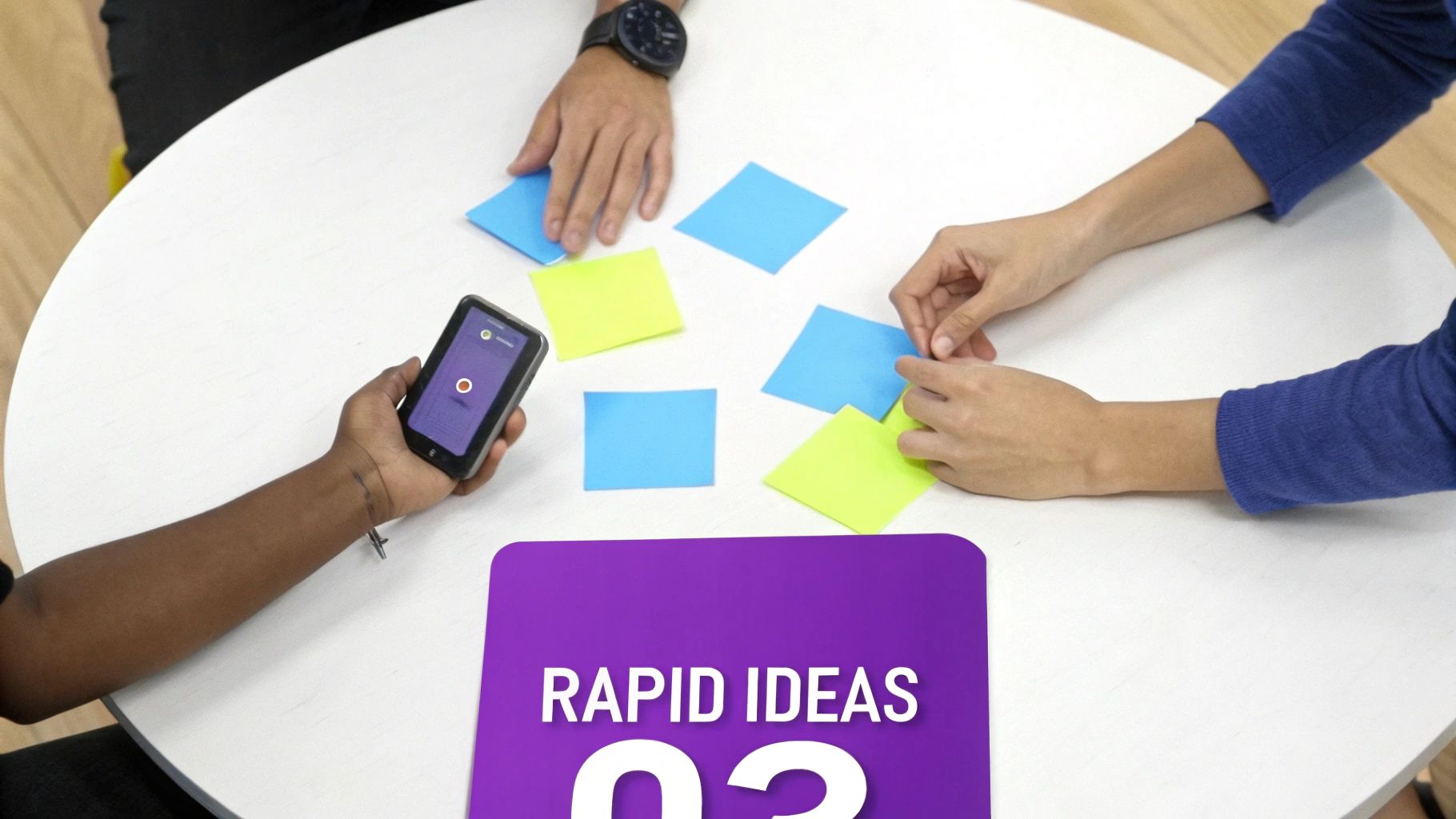
This structured yet energetic approach is one of the most effective content generation ideas for breaking through creative blocks and generating a high volume of raw concepts quickly. Its timed nature makes it ideal for synchronous remote sessions where maintaining focus and engagement is critical. For more structured idea-generation techniques, you can explore the brainwriting 6-3-5 method on remotesparks.com.
How to Implement Rapid-Fire Round-Robin Ideation
- Set a Clear Prompt: Start with a focused question, such as, "What are three unconventional video formats we could test on LinkedIn?"
- Use a Visible Timer: Set a short time limit for each person's turn, typically 1-2 minutes, to maintain a brisk pace and discourage overthinking.
- Go Around the "Room": Proceed in a set order, asking each participant to share one idea when it's their turn. Encourage a "pass" option to avoid pressure.
- Capture Everything: A designated facilitator should capture all ideas on a digital whiteboard or shared document without judgment or immediate discussion.
Key Insight: The goal of this technique is quantity over quality in the initial phase. By focusing on speed and participation, teams can generate a wide pool of ideas that can be refined and evaluated later.
6. Constraint-Based Creative Thinking
Constraint-based creative thinking flips the traditional brainstorming model on its head by intentionally imposing limitations to spark innovation. Instead of facing the paralysis of infinite possibilities, this method forces teams to find resourceful and inventive solutions within a defined set of boundaries, such as time, budget, or technology. This approach channels creativity, leading to more focused and often more brilliant outcomes.
This method is one of the most powerful content generation ideas because it mirrors real-world business challenges, making the resulting concepts more practical and achievable. By learning to innovate within limits, teams can produce high-impact content even with scarce resources. For a deeper look into structured creative processes, explore this guide on design thinking methodologies.
How to Implement Constraint-Based Thinking
- Define Your Constraints: Clearly establish the limitations. Examples include, "Create a 60-second video with a $0 budget," or "Write a blog post using only the 1,000 most common English words."
- Frame the Challenge: Present the constraints not as obstacles but as part of a creative puzzle. For instance, "How can we create our most engaging social media campaign ever using only user-generated photos?"
- Ideate and Iterate: Brainstorm solutions that work within the established rules. Encourage out-of-the-box thinking that embraces the limitations rather than fighting them.
Key Insight: Constraints are not a barrier to creativity; they are a catalyst for it. The "box" forces you to think differently and discover pathways you would have otherwise overlooked.
To see how limitations can fuel innovation in a broader context, consider the principles discussed in the lean startup movement.
7. Cross-Functional Team Diversity Mapping
Cross-functional team diversity mapping is a strategic approach that intentionally brings together individuals from different departments, roles, and backgrounds to generate content ideas. Instead of ad-hoc brainstorming, this method involves systematically mapping out the perspectives needed (e.g., engineering, sales, customer support, marketing) and ensuring each is represented. This reduces departmental silos and uncovers blind spots, leading to more holistic and innovative content.
This method is one of the most powerful content generation ideas for creating well-rounded material that speaks to different audience segments. By integrating diverse viewpoints from the start, you create content that is technically accurate, commercially viable, and customer-centric. Microsoft's inclusive design practices are a great example of how this thinking produces better products and content.
How to Implement Diversity Mapping
- Identify Key Perspectives: Before a session, list all the functional viewpoints relevant to your topic. For a new feature launch, this might include product, engineering, sales, marketing, and support.
- Map and Recruit Participants: Intentionally invite one or more people to represent each identified perspective. Aim for a balanced group to avoid one department's view dominating the conversation.
- Facilitate for Psychological Safety: Create an environment where every participant feels safe to share their unique insights, even if they contradict the majority opinion. Actively solicit input from quieter functions.
Key Insight: True innovation in content comes from the intersection of different disciplines. A sales lead knows customer objections, an engineer knows technical capabilities, and a support specialist knows common user pain points. Mapping ensures all these voices are in the room.
To learn more about building high-performing, diverse teams, explore Google's findings from its famous Project Aristotle.
8. Visual Mapping and Mind Mapping for Idea Organization
Visual mapping transforms abstract thoughts into tangible, organized diagrams, making it easier to see connections and identify new content opportunities. This method uses mind maps and flowcharts to externalize thinking, allowing teams to explore relationships between topics, structure complex narratives, and pinpoint knowledge gaps. By arranging ideas spatially, teams can break free from linear thinking and unlock more creative pathways.

This technique is one of the most powerful content generation ideas for visual thinkers and remote teams needing to align on a complex topic. Digital whiteboarding tools like Miro or FigJam make it a seamless, synchronous activity. To learn more about structuring your ideas, see this guide on how to make a mind map.
How to Implement Visual Mapping
- Establish a Central Theme: Start with a core concept or keyword at the center of your digital canvas. For example, "Future of Remote Work."
- Branch Out with Key Subtopics: Create primary branches for major sub-themes like "Technology," "Culture," and "Wellness."
- Add Detailed Ideas: Encourage everyone to add smaller ideas, questions, or data points to each branch. Use color-coding to categorize different types of content, such as blog posts, videos, or social media updates.
- Connect and Refine: Draw connections between related ideas across different branches to uncover unique content angles and series potential.
Key Insight: Visual mapping is not just for organizing existing ideas; it's a dynamic tool for discovery. The act of visually connecting concepts often reveals unexpected relationships that can inspire your most innovative content.
9. Reverse Brainstorming and Problem Inversion
Reverse brainstorming flips traditional problem-solving on its head by asking, "How could we make this worse?" or "What would guarantee failure?" This counterintuitive approach reveals hidden assumptions and uncovers innovative solutions by exploring what to avoid. By identifying potential pitfalls and root causes of problems, teams can proactively develop more robust and effective content strategies.
This method is one of the most insightful content generation ideas for identifying weak spots in your current strategy. For example, instead of asking "How do we increase engagement?" you would ask, "How could we create the most boring, irrelevant content imaginable?" The answers highlight what you must actively avoid, often revealing fresh pathways to genuine user interest.
How to Implement Reverse Brainstorming
- Define the Problem in Reverse: Clearly state the problem you want to cause or the goal you want to fail at. For example, "How can we ensure our next product launch video gets zero views?"
- Generate "Bad" Ideas: Encourage the team to freely brainstorm all the ways to achieve this negative outcome. No idea is too absurd. Think poor audio, confusing messaging, or a terrible call-to-action.
- Convert to Positive Solutions: Once you have a list of causes for failure, systematically reverse each one to create a concrete list of actionable solutions. "Poor audio" becomes "Invest in high-quality microphones and sound editing."
Key Insight: Focusing on failure removes creative pressure and helps teams identify critical success factors they might otherwise overlook. It’s a powerful way to "pre-mortem" your content before it ever goes live.
10. Iterative Refinement and Progressive Elaboration
Iterative refinement is a content generation approach where initial ideas are treated as starting points, not final products. Instead of aiming for a perfect concept upfront, teams build upon a core idea through multiple rounds of development, feedback, and enhancement. Each cycle adds more detail and clarity, transforming a rough draft into a fully realized piece of content.
This method is one of the most powerful content generation ideas for complex topics, as it allows for gradual validation and improvement. It mirrors the agile development process, ensuring the final output is well-vetted and aligned with audience needs. For teams interested in agile frameworks, Asana provides excellent resources on agile project management.
How to Implement Iterative Refinement
- Start with a Minimum Viable Idea: Begin with a basic concept or outline. For example, "A blog post about the benefits of asynchronous communication."
- Conduct Refinement Cycles: In the first cycle, expand the outline with key points. In the second, gather feedback from a subject matter expert. In the third, draft the full article and collect team input on tone and clarity.
- Track the Evolution: Use a version control system or a collaborative document to see how the idea matures. This helps the team understand the reasoning behind each change and stay aligned.
Key Insight: This process de-risks content creation by building in feedback loops. Instead of investing heavily in an unproven idea, you invest incrementally as the concept proves its value at each stage.
To learn more about applying continuous improvement to creative work, check out the principles of the Lean startup methodology.
11. Stimulus-Based and Random Word Association
Stimulus-based and random word association is a powerful divergent thinking technique designed to shatter linear thought patterns. By introducing an unrelated stimulus, such as a random word, image, or object, teams are forced to make creative leaps and form unexpected connections between the stimulus and their core challenge. This method deliberately disrupts conventional brainstorming to unlock fresh, non-obvious ideas.
This approach is one of the most effective content generation ideas for breaking through creative blocks when a topic feels exhausted. By forcing your team to connect "cloud security" with the random word "river," you might generate concepts like "data flow," "navigating security streams," or "preventing downstream vulnerabilities." For more on breaking mental barriers, explore the innovation techniques from IDEO.
How to Implement Random Word Association
- Define the Core Challenge: Clearly state the problem or topic. For instance, "Generate new angles for a webinar about remote team productivity."
- Generate a Random Stimulus: Use an online random word generator or pull a word from a dictionary. Let's say the word is "Bicycle."
- Force Connections: Ask the team to find connections, metaphors, or attributes that link the stimulus to the challenge. "Bicycle" might lead to ideas like "gears" (switching tasks), "balance" (work-life integration), or "momentum" (maintaining team energy).
- Develop the Concepts: Translate these abstract connections into concrete content ideas, such as "The 5 Gears of Asynchronous Work" or "Finding Your Team's Productivity Balance."
Key Insight: The value isn't in the random word itself but in the mental leap required to connect it to your topic. The most absurd-seeming connections often produce the most original and memorable ideas.
For those interested in the psychological principles behind this technique, Edward de Bono's work on "Lateral Thinking" offers a foundational understanding of its power.
12. Facilitated Workshop Structures and Session Design
Facilitated workshop structures transform chaotic brainstorming into a highly productive and organized process. This approach relies on a clear agenda, timeboxed activities, and skilled facilitation to guide a team toward specific content goals. By designing the session flow, you can ensure psychological safety, maximize engagement, and prevent common pitfalls like groupthink or dominant voices overshadowing others.
This structured format is one of the most reliable content generation ideas for distributed teams, as it provides the necessary framework to keep everyone aligned and focused. It turns a simple meeting into a dynamic, outcome-driven event, inspired by methodologies like Google Design Sprints and IDEO's innovation workshops.
How to Implement a Facilitated Workshop
- Design the Flow: Create a detailed agenda with timed activities. Start with a warm-up or icebreaker, move into divergent thinking (idea generation), and then transition to convergent thinking (refining and selecting ideas).
- Assign a Facilitator: Designate one person to guide the session, keep time, and ensure everyone participates. This person is not a contributor but a neutral guide for the process.
- Vary the Activities: Use a mix of techniques to maintain energy. Alternate between individual silent brainstorming, small group discussions, and full-group sharing to cater to different creative styles.
Key Insight: The structure isn't meant to restrict creativity; it's designed to unleash it. By removing procedural friction and creating a safe space, a well-facilitated workshop allows the best ideas to surface and be developed collaboratively.
12 Content Generation Ideas Comparison
| Technique | 🔄 Implementation Complexity | Resource Requirements | ⭐ Expected Outcomes | 💡 Ideal Use Cases | ⚡ Key Advantages / 📊 Impact |
|---|---|---|---|---|---|
| AI-Powered Brainstorming Sessions | High — AI integration, configuration, privacy controls | Significant: AI platform, data access, technical ops, training | High-quality, data-informed and equitable ideas ⭐⭐⭐⭐ | Distributed teams needing guided facilitation and bias mitigation | Fast idea volume, automated insights & documentation ⚡📊 |
| Role-Based Perspective Taking | Medium — persona design and facilitation required | Moderate: time to develop personas and facilitator involvement | More empathetic, balanced solutions ⭐⭐⭐ | Customer-centric design, UX research, stakeholder mapping | Generates diverse viewpoints and customer-focused ideas 📊 |
| Asynchronous Idea Submission and Voting | Low–Medium — tooling and clear timelines needed | Low: collaboration platforms and defined windows | Reflective, scalable idea pool with reduced groupthink ⭐⭐⭐ | Remote teams across time zones; async-heavy organizations | Inclusive scaling; reduces dominance effects; easier participation 📊 |
| Challenge-Based Ideation Frameworks | Medium — skilled framing of challenges required | Moderate: facilitator time, clear success metrics | Actionable, goal-aligned ideas with clearer evaluation ⭐⭐⭐⭐ | Problem-focused innovation, business-aligned brainstorming | Focuses effort; improves relevance and measurability 📊 |
| Rapid-Fire Round-Robin Ideation | Low–Medium — requires active facilitation and timers | Low: timer, facilitator, collaborative board | High quantity of ideas, often surface-level ⭐⭐ | Quick divergent sessions, energizing team warm-ups | Fast idea generation; enforces equal participation ⚡📊 |
| Constraint-Based Creative Thinking | Medium — needs deliberate constraint design | Low–Moderate: defined limits, facilitator guidance | Practical, resource-efficient solutions ⭐⭐⭐ | Resource-limited projects; optimization and feasibility challenges | Encourages implementable ideas and natural filtering 📊 |
| Cross-Functional Team Diversity Mapping | High — coordination and mapping needed | Significant: diverse participants, planning and tracking tools | Broad, robust solutions with fewer blind spots ⭐⭐⭐⭐ | Complex, cross-departmental problems and strategy work | Produces diverse perspectives and stronger organizational buy-in 📊 |
| Visual Mapping and Mind Mapping | Low–Medium — requires visual tools and literacy | Low: digital whiteboards and basic facilitation | Clear idea relationships and gap visibility ⭐⭐⭐ | Complex systems thinking; organizing non-linear ideas visually | Externalizes structure; aids synthesis and sharing 📊 |
| Reverse Brainstorming and Problem Inversion | Medium — skilled facilitation to invert problems safely | Low: facilitator, prompts; safe framing required | Novel insights and risk identification ⭐⭐⭐ | Risk analysis, breaking creative blocks, complex problems | Reveals assumptions; sparks unconventional solutions 📊 |
| Iterative Refinement and Progressive Elaboration | Medium–High — multiple rounds, tracking and evaluation | Moderate: time, version tracking, reviewers | Mature, actionable ideas with higher quality ⭐⭐⭐⭐ | Product development, long-term projects, prototyping | Improves idea quality and ownership through cycles 📊 |
| Stimulus-Based and Random Word Association | Low — simple to run; needs good prompts | Low: stimulus generators or props, facilitator | Highly original but often needs conversion to feasibility ⭐⭐⭐ | Breaking creative blocks; ideation warm-ups and lateral thinking | Generates unexpected connections; energizes teams ⚡📊 |
| Facilitated Workshop Structures and Session Design | High — comprehensive planning and skilled facilitation | Significant: facilitator, agenda prep, multiple activities | Maximized productivity, participation, and psychological safety ⭐⭐⭐⭐ | High-stakes workshops, cross-functional alignment, strategic sessions | Ensures structure, engagement, and clear follow-up outcomes 📊 |
Supercharge Your Remote Brainstorming and Bring Ideas to Life
The journey from a blank page to a pipeline filled with compelling content can feel daunting, especially for distributed teams. The challenge isn't a lack of creativity but a need for structure, process, and the right tools to channel that collective energy. This guide has equipped you with 12 powerful and diverse content generation ideas, moving beyond generic advice to offer concrete frameworks for every situation.
We've explored everything from using AI-powered sessions to break through creative blocks to implementing asynchronous voting to ensure every voice is heard, regardless of time zone or personality type. You now have a toolkit that empowers your team to tackle content ideation from multiple angles, whether through the structured logic of Reverse Brainstorming or the free-flowing creativity of Visual Mind Mapping.
From Ideas to Impact: Your Action Plan
The true value of these techniques lies in their application. A great idea is only a starting point; a repeatable system for generating many great ideas is what drives sustainable growth and market leadership. The key is to move from theory to consistent practice.
- Don't Overcomplicate, Just Start: Choose one or two methods from this list that best fit your team's current challenges. Is your team stuck in a rut? Try Constraint-Based Thinking. Are meetings dominated by a few voices? Implement an Asynchronous Idea Submission process.
- Create a Rhythm: Make ideation a regular, scheduled activity, not a last-minute panic. A dedicated weekly or bi-weekly session using one of these frameworks can transform your content pipeline from a trickle into a steady, reliable stream of high-quality concepts.
- Blend and Match Techniques: The most innovative teams don't rely on a single method. They build a flexible system. You can start a project with a Rapid-Fire Round-Robin session to generate a high volume of raw ideas, then use Visual Mapping to organize them, and finally apply an Iterative Refinement process to polish the most promising concepts.
Key Takeaway: The goal is not to find a single "perfect" brainstorming method. The goal is to build an adaptable ideation engine fueled by a diverse set of structured, inclusive, and repeatable creative exercises. This is how remote teams turn distributed talent into a competitive advantage.
Ultimately, mastering these content generation ideas is about more than just filling a calendar. It’s about fostering a culture of innovation where every team member feels empowered to contribute their unique perspective. It’s about building a system that consistently produces fresh, relevant, and engaging content that connects with your audience and drives business objectives. By moving away from unstructured "let's just brainstorm" meetings and embracing these focused frameworks, you create an environment where creativity can truly thrive, no matter where your team members are located.
Ready to turn these powerful frameworks into a seamless, repeatable process for your team? Bulby is the all-in-one platform designed to facilitate structured brainstorming sessions, guiding your team through proven exercises to unlock better, more innovative ideas. Stop wrestling with clunky tools and start generating brilliant content today with Bulby.