

The popular advice is simple: get the team in a room, throw ideas on a whiteboard, and wait for something brilliant to appear. That approach can produce energy, but it often produces the same safe topics, familiar formats, and polished versions of ideas competitors already use.
Content idea generation works better as an environment than as an event. Teams need deliberate space for research, uninterrupted contribution, challenge, selection, and refinement. AI can help expand that space, but only when people give it strong constraints and apply judgment afterward. The aim isn't to collect more suggestions. It's to build a reliable pipeline of concepts that are distinctive enough to earn attention and practical enough to become campaigns.
Table of Contents
- The Hidden Bottleneck in Creative Workflows
- Why Asynchronous Brainstorming Beats Live Meetings
- A Structured Framework for Divergent and Convergent Thinking
- Evaluating Ideas for Strategic Differentiation
- Turning Raw Concepts into Client-Ready Campaigns
- Building a Sustainable Ideation Culture
The Hidden Bottleneck in Creative Workflows
Many teams don't have an inspiration problem. They have a process problem.
A content calendar creates constant demand across blog posts, social content, videos, email, landing pages, and campaign assets. Upland's Kapost summary reports that B2B marketers need 67 ideas per quarter to be successful, while 39% say generating ideas is difficult or somewhat difficult, and 1 in 2 say they don't have enough ideas to fuel content marketing (Upland's content ideas research). The same source says an average blog post takes 4–5 hours when ideation, production, design, and approvals are included.
That workload changes the question. A strategist can't rely on occasional flashes of inspiration, and a creative director can't keep asking the same people to rescue an empty calendar. Idea generation has to become a repeatable operating discipline.
The meeting is not the method
Brainstorming became a formal ideation method through advertising executive Alex F. Osborn's 1953 book Applied Imagination. Its central premise was useful: separate idea production from judgment, suspend criticism during generation, and create a broad pool before selecting the strongest directions. A later Yale study by Donald Taylor, Paul Berry, and Clifford Block in 1958 helped make brainstorming a subject of empirical research, not merely a management slogan. This history is documented in the history of brainstorming from Regent University.
The problem isn't the principle. The problem is how teams apply it. A live meeting often asks people to generate, explain, defend, remember, and evaluate ideas at the same time. Participants edit themselves before an idea reaches the page. The loudest contributor sets the direction, while quieter specialists wait for an opening that never comes.
Practical rule: Treat the live meeting as a place for comparison and development, not the only place where ideas are born.
A better workflow starts with a clear challenge, gathers relevant evidence, and gives people time to contribute privately or asynchronously. Only then should the group discuss patterns, remove weak options, and shape the best concepts.
Build a pipeline, not a pile
A pipeline has movement. Ideas enter as observations, questions, tensions, or rough angles. They then pass through clustering, strategic testing, and concept development. A pile has no next step. It grows until someone chooses the easiest item to publish.
This distinction matters for agencies working across different clients and channels. A useful idea should connect to an audience problem, a business objective, and a specific executional opportunity. Resources such as YouTube video idea generator tips can help teams expand a format-specific starting point, but the strategist still has to decide whether the idea fits the brand, the audience, and the campaign's larger story.
The operational shift is modest but important. Stop scheduling meetings called “come up with ideas.” Schedule separate activities for research, silent generation, group synthesis, selection, and briefing. That sequence protects creative breadth without allowing endless ideation to delay a decision.
Why Asynchronous Brainstorming Beats Live Meetings
Live brainstorming feels productive because everyone is visibly participating. Yet visible participation isn't the same as original thinking.
When one person speaks, others must wait. That interruption creates production blocking, a loss factor identified in research on group brainstorming. People may forget a thought while waiting, abandon it because it no longer feels relevant, or reshape it to follow the current conversation. Evaluation apprehension adds another constraint. Participants avoid ideas that might sound naive, impractical, or too different in front of colleagues and clients.
Social loafing creates a further problem. In a large group, some people contribute less because responsibility is diffuse. Independent commentary on the research also notes that group performance is especially harmed as teams grow beyond about six or seven people, while individuals working alone can generate more original ideas than an equivalent number of people brainstorming together (The Conference Board's analysis of brainstorming).
Give people a quiet first pass
Asynchronous ideation removes the need to compete for airtime. Each participant can read the brief, inspect the evidence, and write without adapting their thinking to the first idea voiced in the room.
The American Psychological Association summarized experimental evidence showing that asynchronous idea generation produced a 71% higher idea rate per person per minute than synchronous brainstorming (the APA research summary). That doesn't mean every idea will be valuable. It means teams can create a wider raw pool before they spend group attention on judgment.
A practical pre-meeting workflow looks like this:
- Share the brief early: State the audience, business objective, constraints, proof points, channel, and decision date.
- Collect independent research: Ask each person to bring observations from customer conversations, search results, product usage, competitor content, or community questions.
- Write before discussion: Require every participant to submit ideas privately before seeing the team's combined list.
- Use anonymous contribution: Remove names during the first review when status or seniority might influence reactions.
- Keep the live session focused: Use meeting time to cluster, question, compare, and improve rather than repeat the same brainstorm.
Written contribution also creates a useful record. A strategist can see which themes recur, which assumptions differ across disciplines, and which ideas were dismissed too quickly. Teams working remotely may find this guide to asynchronous creativity useful when designing that contribution layer.
Use the meeting for productive friction
Asynchronous work shouldn't eliminate live collaboration. It should improve its starting point.
A live session is valuable when people can compare unlike ideas, expose hidden assumptions, and combine insights that no individual would have connected alone. The facilitator should first display the complete pool, then group related concepts without deciding too early. After that, the team can ask sharper questions:
- What audience tension does this idea address?
- What would make the idea specific to this brand?
- Which assumption must be true for it to work?
- Can a competitor copy the angle after reading the headline?
- What evidence would strengthen the concept?
The difference is structural. Live discussion becomes a refinement tool rather than a performance in which participants race to sound creative.
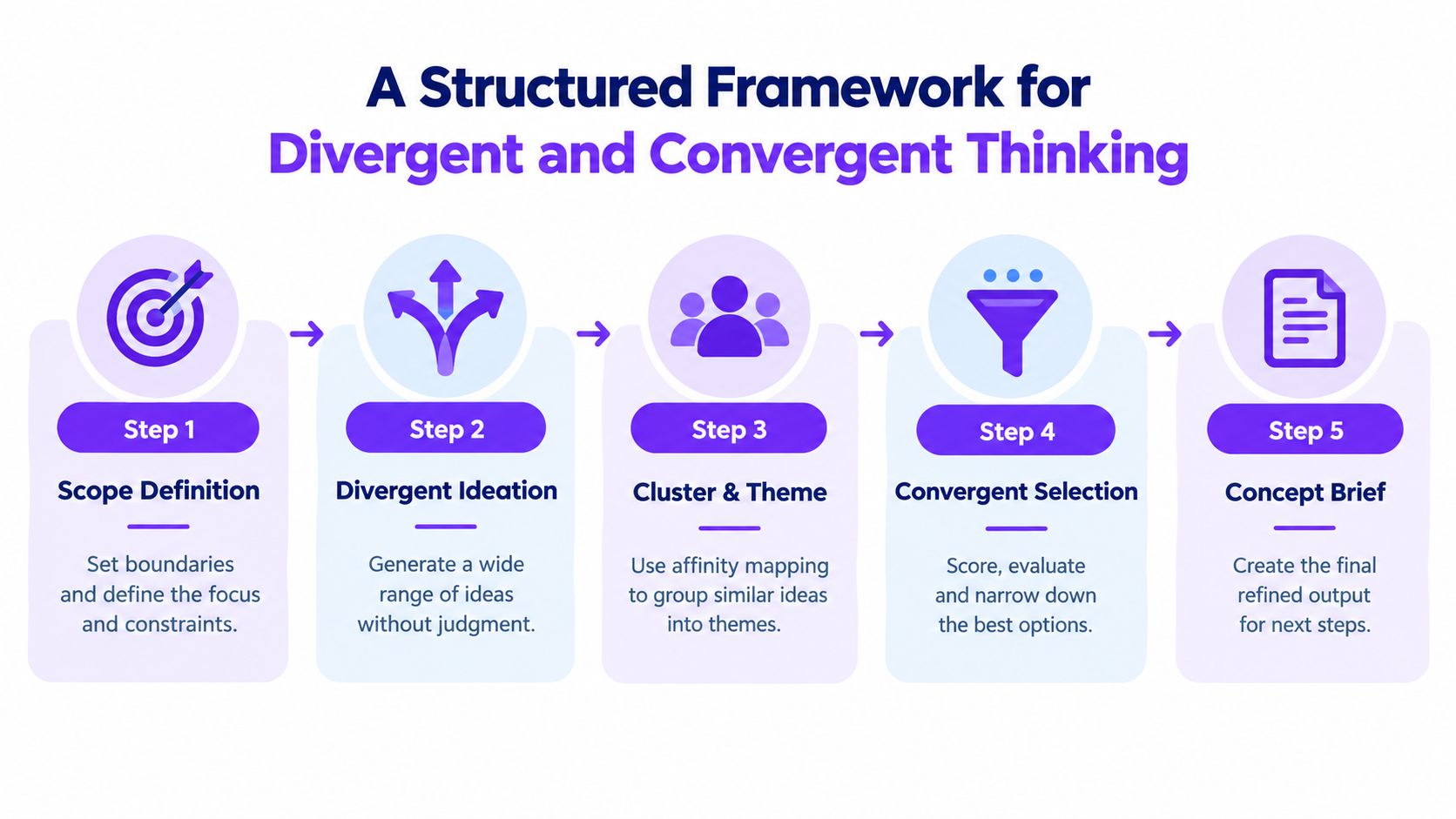
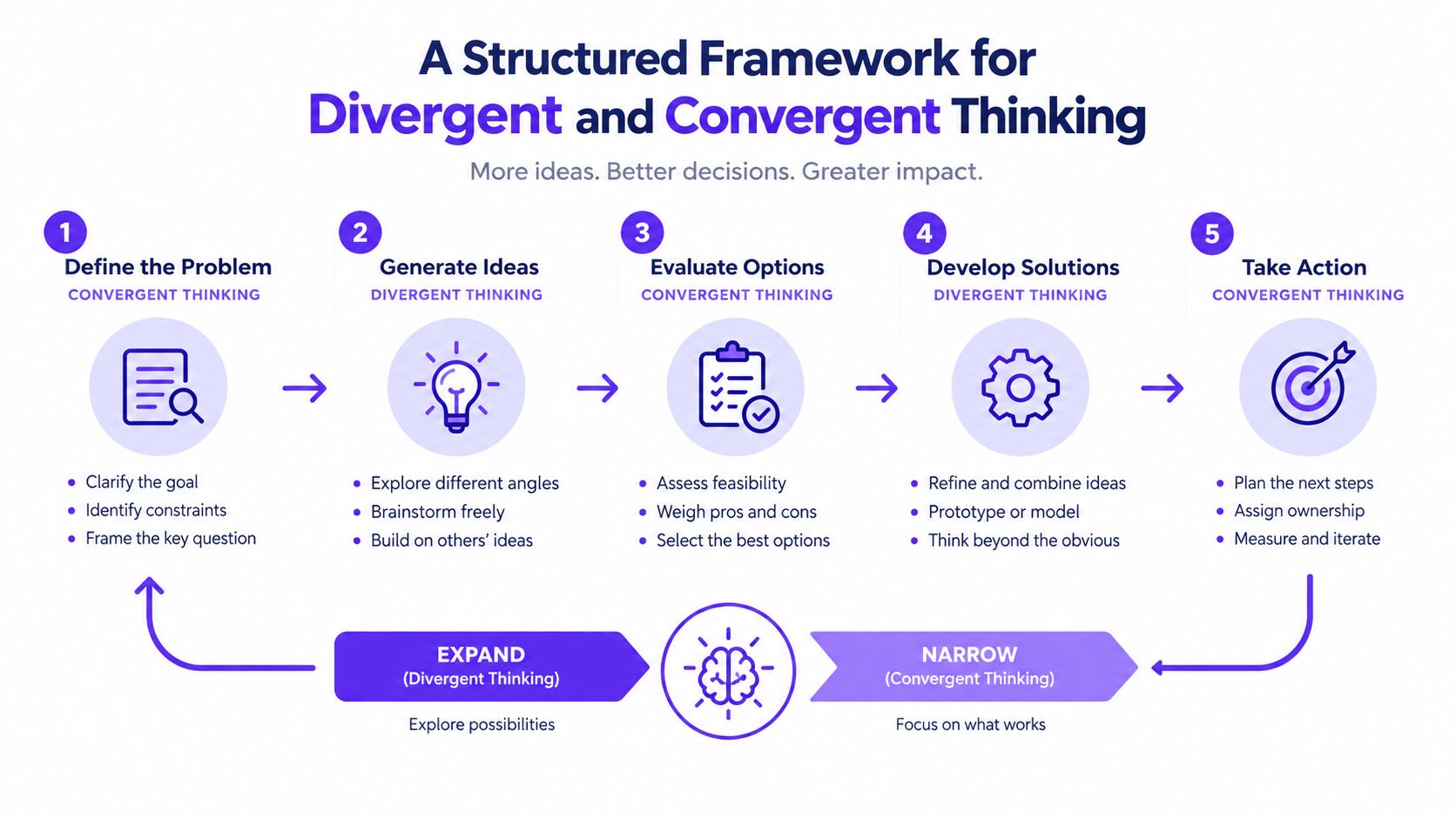
A Structured Framework for Divergent and Convergent Thinking
More ideas will not fix a poorly designed ideation process. Teams produce repetitive, low-differentiation content when they generate, judge, and rewrite concepts in the same conversation. A stronger system separates expansion from narrowing, and gives asynchronous work a clear role before live discussion begins.
Use six connected activities: define the scope, gather background, generate broadly, refine promising directions, evaluate against the brief, and select concepts that can enter production. The LLM-assisted ideation review cited earlier describes a similar progression, from scope definition and background gathering through generation, refinement, evaluation, and multi-idea selection.
Start with a brief that limits the problem
A weak prompt asks for “content ideas about cybersecurity.” A working brief identifies the audience, situation, desired change, channel, evidence, and boundaries.
Create campaign concepts for security leaders at growing software companies who struggle to explain technical risk to non-technical executives. The campaign should support a consultative sales motion, avoid fear-based messaging, and work across LinkedIn, email, and a short guide.
That brief gives both people and AI a problem worth solving. It also creates a basis for rejecting ideas that sound entertaining but do not support the strategy.
Gather tension before topics
Research should produce more than a keyword list. Look for contradictions, recurring questions, failed approaches, surprising workarounds, and the language customers use when describing the problem.
Review sales-call notes, support tickets, customer interviews, competitor positioning, search results, community discussions, and existing performance data. Trend research for TikTok surfaces platform-native formats and current audience behavior, which feed the evidence board as observations rather than as a substitute for brand insight.
The output is a short evidence board. Every observation should record its origin, the audience affected, and the strategic tension it reveals. This gives later prompts material to work from instead of inviting generic topic generation.
Separate raw generation from refinement
During divergent ideation, quantity has a specific job: expose options before the team commits to a familiar answer. Ask for opposing angles, unusual formats, audience-specific versions, contrarian claims, stories, demonstrations, comparisons, and ways to make each idea concrete. Do not ask participants to defend every suggestion yet.
AI works well as a sparring partner at this stage. Give it the evidence board and ask it to:
- produce angles from different audience roles;
- challenge assumptions in the brief;
- combine two unrelated observations;
- suggest formats that require audience participation;
- identify what would make each idea more distinctive;
- generate counterarguments from a skeptical buyer.
Avoid asking the tool for “the best ideas.” That instruction rewards fluent, familiar outputs. Request breadth first, then run a separate pass to test weaknesses. A structured workspace such as this ideation framework keeps prompts, votes, evidence, and final briefs in distinct stages rather than one undifferentiated thread.
Refine through combinations and constraints
After generation, cluster ideas by underlying insight rather than surface topic. Several webinar concepts may express one deeper theme: buyers want to compare implementation choices without joining a sales call.
Create a concept card for each promising cluster:
- Audience tension: What problem or contradiction creates attention?
- Core insight: What does the brand understand that others miss?
- Content promise: What will the audience learn, feel, or do?
- Execution: Which format makes the idea tangible?
- Proof: What supports the claim?
- Distinctive feature: Why will this feel different from competitor content?
Selection should produce more than a title. The concept must be clear enough for a writer, designer, strategist, and account lead to discuss the same direction without translating vague creative language.
Evaluating Ideas for Strategic Differentiation
A long idea list can hide a weak strategy. AI makes that risk more visible because it can produce fluent variations faster than a team can recognize that the variations are nearly identical.
Independent coverage describes common AI ideation failures as “repetitive topic lists,” “generic post ideas,” and “near-duplicate angles.” The same coverage reports that 68% of marketers identify quality and differentiation as their biggest hurdle as AI makes average content easier to produce (Siegemedia's content marketing trends coverage). The practical implication is clear: teams need a stronger filter than novelty of wording.
Score the idea behind the headline
A useful evaluation matrix separates strategic value from presentational polish. Score each concept against a small set of questions, using a consistent scale agreed by the team:
| Criterion | Question to ask |
|---|---|
| Audience tension | Does the idea address a problem people recognize but rarely articulate? |
| Strategic relevance | Does it support the campaign objective and the product's position? |
| Distinctiveness | Would the concept still feel specific if the brand name disappeared? |
| Evidence | Can the team support the central claim with credible material? |
| Executional strength | Does the idea naturally create useful formats, not just one headline? |
| Copy resistance | Does it depend on a proprietary insight, experience, method, or point of view? |
Don't let a high score in one category disguise a failure in another. A clever hook with no evidence is a liability. A relevant topic with no distinctive point of view is commodity content.
Detect synthetic originality
“AI hallucinated originality” often sounds polished. It uses unusual adjectives, combines fashionable themes, and presents a familiar idea in a slightly unfamiliar wrapper. The test is not whether the sentence sounds new. The test is whether the underlying audience insight, evidence, or mechanism is new to the brand's competitive context.
Ask the team to remove the headline and describe the idea in plain language. If several concepts collapse into “educate the audience about a common problem,” they belong in one cluster. Ask a second question: could a competitor reproduce the concept by entering the same prompt and using the same public information? If yes, the team needs a more specific source of differentiation.
An idea validation process can support this stage, but the judgment remains strategic. Tools can expose patterns and organize input. They can't decide whether a brand has earned the right to make a claim or whether an angle will matter to a particular buyer.
Choose a portfolio, not one winner
A campaign rarely needs six versions of the same idea. It needs a balanced group of concepts with different levels of familiarity, proof, format, and risk.
Select a small mix of dependable ideas, distinctive ideas, and exploratory ideas. Define what each one must prove before production. That approach gives stakeholders a reasoned choice without pretending that a scoring sheet can remove uncertainty from creative work.
Turning Raw Concepts into Client-Ready Campaigns
A client-ready campaign doesn't begin with the most polished sentence. It begins when a scattered set of observations becomes one clear strategic story.
Consider an agency preparing a campaign for a software company. The initial asynchronous board contains customer questions, sales objections, product capabilities, competitor claims, webinar formats, short-video hooks, and several ideas generated with AI. The material is useful, but it isn't presentable. It contains too many directions and no shared hierarchy.

Cluster the evidence before polishing the language
The strategist first removes duplicates and groups the board by customer tension. One cluster concerns confusion during vendor evaluation. Another concerns internal resistance to changing an existing workflow. A third concerns the gap between technical capability and executive confidence.
The team doesn't choose a headline yet. It writes a one-sentence insight for each cluster, then asks the copywriter, designer, account lead, and product marketer to add a different perspective. The designer identifies a visual demonstration for one cluster. The account lead connects another to the client's sales priority. The product marketer flags a claim that needs proof.
That cross-functional pass is where refinement earns its value. Each discipline tests the idea against a different failure mode.
Convert one cluster into a campaign spine
The team selects the cluster with the clearest audience tension and develops a campaign spine:
- Strategic premise: Buyers don't need more product features. They need a clearer way to compare the consequences of each implementation choice.
- Primary content idea: A decision-focused education series that makes hidden trade-offs visible.
- Message angles: cost of delay, operational complexity, internal alignment, and evidence for executive approval.
- Formats: a comparison guide, expert-led short videos, a diagnostic email sequence, and sales enablement material.
- Proof requirement: customer language, product documentation, and validated examples from the client's own experience.
- Next decision: test the premise with sales and customer-facing teams before production.
The raw board has become a narrative that a client can evaluate. It also gives production teams enough structure to work without flattening the original insight into generic “thought leadership.”
A collaborative process such as this idea-to-concept workflow can help teams preserve the connection between raw input, selected direction, and final brief. The platform matters less than the audit trail. Stakeholders should be able to see why an idea survived, which assumptions remain open, and what must happen next.
Building a Sustainable Ideation Culture
A team won't maintain originality through occasional creative workshops. It needs an environment that makes good behavior easier than improvisation.
That means storing research with the ideas it produced, recording why concepts were selected or rejected, and making asynchronous contribution a normal part of campaign planning. It also means protecting divergent work from premature approval pressure. If every rough thought must look client-ready immediately, people will submit safe variations of what already worked.
Make the workflow part of the operating rhythm
Create a shared challenge format for every ideation sprint. Include the audience, objective, constraints, evidence, decision owner, and delivery context. Give contributors a private space to add observations and ideas before the group reviews them. After selection, archive the unused concepts with their rationale instead of deleting them.
A permanent system improves institutional memory. New team members can understand previous decisions, account leads can avoid reopening settled debates, and strategists can spot recurring audience tensions across clients or product lines. This guide to a culture of innovation offers a useful reference for connecting creative practice with team habits.
Measure the process, not only the output
Creative return isn't limited to clicks or conversions. Track whether the team can produce clearer briefs, reduce duplicate concepts, involve relevant specialists earlier, and move from selected idea to approved direction with less confusion. Review the quality of rejected ideas too. A strong process may reject many concepts because it makes weak differentiation visible sooner.
Bulby is one option for this kind of workflow. Its AI-powered brainstorming platform guides teams through a structured session, supports anonymous idea sharing, collects and summarizes contributions, and surfaces promising ideas with actionable next steps.
The goal isn't to automate taste. It's to give taste better material to work with.
Keep the standard explicit: every selected concept must connect to a real audience tension, a defensible insight, and an execution that makes the difference visible. If the team can't explain those three connections, the idea isn't ready, regardless of how attractive the headline sounds.
Bulby helps marketing agencies, creative teams, and brand strategists move from a defined challenge through guided exercises, anonymous contributions, AI-supported inspiration, and organized next steps. Visit Bulby to give your next content idea generation sprint a clearer structure and a stronger path from raw thinking to campaign-ready concepts.