
In the world of remote and hybrid work, the standard slideshow presentation often fails to capture attention, let alone inspire creativity. The challenge isn't just sharing information; it's about creating a shared experience that sparks collaboration and generates brilliant ideas, even across different time zones. That "meeting-after-the-meeting" where the real brainstorming happens is gone, and a static deck shared over a video call is a poor substitute. When your team is distributed, you need a more deliberate approach to foster innovation.
This guide offers a collection of powerful, creative ideas for presentations designed specifically for the modern distributed workforce. We will move beyond generic tips like "add more images" and dive into structured, actionable frameworks that transform passive viewing into active participation. Forget the one-way monologue that puts your audience to sleep. The techniques here are built for interaction, engagement, and tangible outcomes.
You will find specific methods for turning your next virtual session into a dynamic workshop. Whether you're leading a brainstorming session, a project kickoff, or a strategic review, these concepts will help you:
- Engage your team with interactive elements.
- Generate better ideas through structured creativity.
- Achieve remarkable results with focused collaboration.
We'll cover everything from interactive whiteboarding and gamified ideation to narrative-based ideation and reverse brainstorming. Each idea comes with practical implementation steps and tips tailored for remote environments, ensuring you can immediately apply them to make your presentations more effective and memorable. Let's get started.
1. Interactive Virtual Whiteboarding Sessions
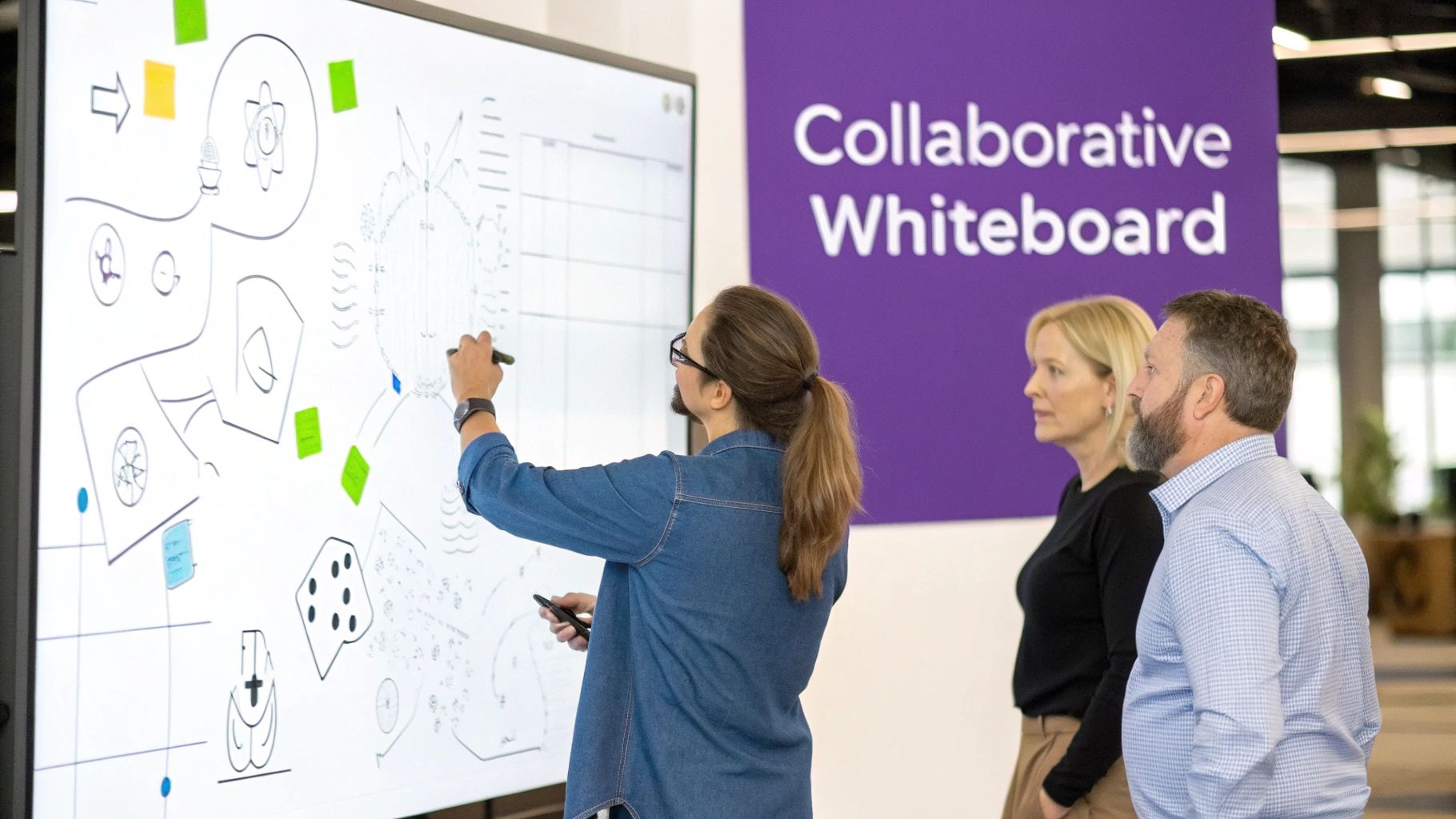
Transform your static presentation into a dynamic, collaborative workspace with an interactive virtual whiteboarding session. Instead of passively showing slides, this approach invites your audience to actively participate on a shared digital canvas. It's an excellent way to turn abstract brainstorming into tangible visual artifacts, making it one of the most effective creative ideas for presentations involving problem-solving or strategy.
This format is ideal for remote and hybrid teams needing to align on complex topics. By leveraging tools like Miro, Mural, or the integrated whiteboard in Microsoft Teams, everyone can contribute ideas simultaneously using digital sticky notes, diagrams, and sketches. This real-time collaboration ensures all voices are heard, breaking down the hierarchy often present in virtual meetings.
How to Implement It Effectively
To maximize engagement, treat the session less like a presentation and more like a guided workshop. To maximize engagement in virtual whiteboarding, consider strategies that promote active participation, such as incorporating player interaction and team-based challenges, similar to those found in successful group activities.
- Start with a Template: Don't begin with a blank canvas. Use a pre-built or custom template to provide structure and guide participants through the intended workflow.
- Establish Visual Rules: Assign specific colors to different speakers or themes to keep the board organized. Create designated zones for brainstorming, action items, and parking lot ideas.
- Designate a Moderator: A facilitator is crucial for keeping the session on track, preventing information overload, and ensuring the conversation remains focused on the key objectives.
- Schedule Synthesis Breaks: Pause every 10-15 minutes to synthesize and cluster emerging ideas. This prevents the board from becoming chaotic and helps the group identify patterns.
This technique, popularized by Google Design Sprints and design thinking practitioners, is perfect for product kickoffs, retrospective meetings, and brand strategy sessions. By making participation visual and hands-on, you foster a deeper sense of ownership and collective achievement. If you're looking for fun ways to warm up your team, you can even find some great interactive whiteboard games to kick things off.
2. Async-First Ideation with Structured Prompts
Break free from the constraints of real-time meetings by adopting an async-first ideation approach using structured prompts. Instead of demanding immediate responses, this methodology allows team members to contribute thoughtful ideas over several hours or days. It's one of the most inclusive creative ideas for presentations, as it respects different time zones and accommodates both quick thinkers and deep reflectors.
This format is a game-changer for distributed teams looking to generate high-quality insights without the pressure of a live brainstorming session. Using platforms like Slack, Notion, or dedicated async tools, you can pose carefully crafted questions that guide participants through specific cognitive frameworks. This ensures contributions are focused, well-developed, and aligned with strategic goals, preventing the common pitfalls of unstructured, on-the-spot brainstorming.
How to Implement It Effectively
To make async ideation successful, the quality of your prompts and the clarity of your process are paramount. The goal is to create a structured conversation that unfolds over time, rather than a chaotic free-for-all. To explore this concept further, consider diving into specific techniques that can unlock async creativity within your team.
- Use Research-Backed Prompts: Ground your questions in established creative frameworks like SCAMPER or the "Six Thinking Hats" to guide thinking in productive directions.
- Set Clear Deadlines: Establish a firm deadline with a built-in buffer. This gives everyone ample time to contribute without letting the process drag on indefinitely.
- Provide Response Examples: Show, don't just tell. Offer a clear example of the desired depth and format for responses to set a quality benchmark.
- Schedule a Live Synthesis Session: After the async period ends, schedule a short, focused live meeting to discuss, cluster, and prioritize the collected ideas.
This technique, championed by fully remote companies like GitLab and Automattic, is ideal for complex problem-solving, feature development, and long-term strategic planning. By decoupling ideation from meetings, you empower your team to contribute their best work on their own schedule, leading to more diverse and innovative outcomes.
3. Constraint-Based Creative Challenges
Turn your presentation into an innovation engine by using constraint-based creative challenges. Instead of open-ended brainstorming, this method deliberately imposes limitations like time, resources, or specific parameters to spark more focused and inventive solutions. It’s one of the most powerful creative ideas for presentations aimed at generating breakthrough thinking and concrete outcomes.
This approach is highly effective for product teams, creative agencies, and innovation-focused organizations needing to solve complex problems. By presenting a challenge with clear boundaries, you force participants to think unconventionally and find novel connections they might otherwise overlook. Famous examples include TED talks, where strict time limits drive concise and impactful storytelling, and design sprints that use compressed timelines to accelerate decision-making.
How to Implement It Effectively
To make this technique work, frame the constraints as a liberating part of the creative process, not a restriction. This reframes the challenge from “what can’t we do?” to “what can we do within these lines?”
- Explain the 'Why': Clearly communicate the creative rationale behind each constraint. For example, explain that a tight budget is meant to encourage resourcefulness, not just to cut costs.
- Start with Lighter Constraints: Begin with less restrictive boundaries and gradually tighten them as the team becomes more comfortable with the process. This builds creative momentum.
- Define Success Metrics: Provide clear criteria for what a successful solution looks like. This ensures everyone is working toward the same goal and can evaluate ideas objectively.
- Use Multiple Dimensions: Combine different types of constraints for a richer challenge. You might limit time, available tools, and the number of features a proposed solution can have.
- Schedule Reflection Time: After each constraint-based session, allow 5-10 minutes for the group to reflect on the process and the ideas generated.
This method, central to design thinking and agile development, is perfect for ideation workshops, product development kickoffs, and marketing campaign brainstorming. It channels creative energy efficiently and can be a fantastic way to find solutions for creative blocks that often arise from having too many options.
4. Diverse Perspective Rotation (De Bono's Six Thinking Hats)
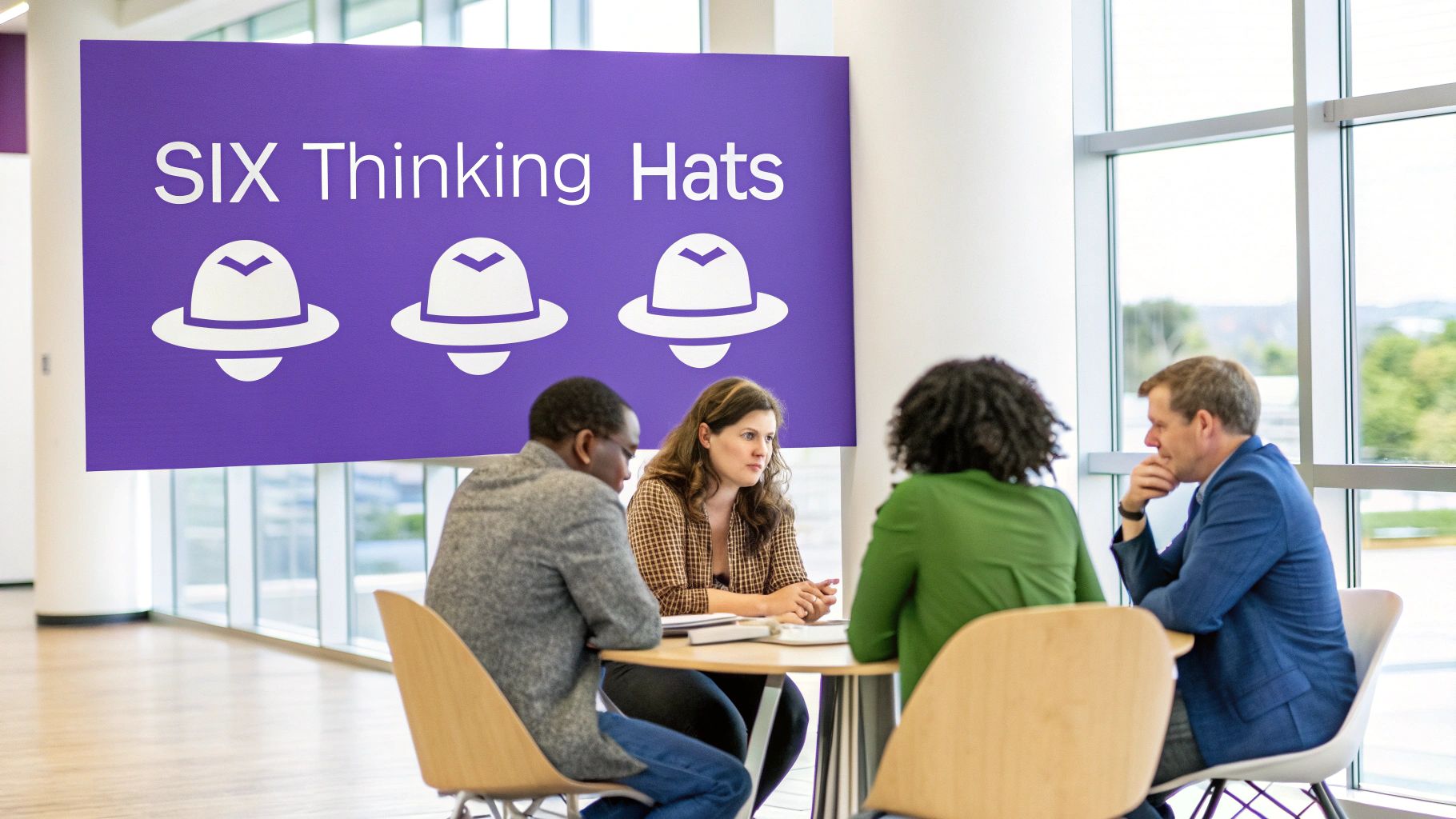
Break free from groupthink and ensure a 360-degree evaluation of your topic by structuring your presentation around De Bono's Six Thinking Hats. This method assigns participants a specific "thinking hat," each representing a different perspective: analytical (white), emotional (red), critical (black), optimistic (yellow), creative (green), and process-focused (blue). It systematically guides the discussion, ensuring a comprehensive analysis free from individual cognitive biases.
This structured approach is one of the most powerful creative ideas for presentations that require balanced decision-making or in-depth problem analysis. By forcing participants to step outside their usual thinking patterns, it promotes a richer, more collaborative environment. This methodology is particularly effective for remote and hybrid teams, where it can be challenging to gauge reactions and ensure all viewpoints are considered equally. Understanding the value of what cognitive diversity is is key to appreciating why this framework is so effective.
How to Implement It Effectively
To successfully integrate this framework, introduce it as a structured conversation rather than a traditional slide-based presentation. The goal is to facilitate a journey through different modes of thinking, not just to present information.
- Assign and Rotate Hats: Assign each participant or small group a specific hat. To prevent typecasting, make sure to rotate the hats during the session or in future meetings.
- Use Visual Cues: Employ physical props like colored hats or digital visuals like colored banners in your video call background to represent each thinking style. This reinforces the role-playing aspect.
- Time Each Perspective: Allocate a dedicated time block (e.g., 10-15 minutes) for each hat to ensure every perspective is given adequate depth without one dominating the conversation.
- Document Insights Systematically: As the facilitator (wearing the Blue Hat), carefully document the key points raised under each colored hat. This creates a clear, organized record of the collective thought process.
This technique was popularized by corporate training programs and is used by Fortune 500 companies for strategic planning and product teams for feature prioritization. It is ideal for high-stakes decisions where a thorough and unbiased evaluation is critical to success. By adopting this structured approach, you turn a standard meeting into an engaging and highly productive session.
5. Reverse Brainstorming (Inversion Thinking)
Flip conventional problem-solving on its head by dedicating a presentation to reverse brainstorming. Instead of asking "How can we succeed?", this technique forces your team to ask "How could this project spectacularly fail?" or "What would guarantee the worst possible outcome?". This counterintuitive approach is a powerful tool for proactively identifying hidden risks, blind spots, and unintended consequences.
This format is exceptionally valuable for product teams, marketing strategists, and project managers who need to anticipate obstacles before they arise. By systematically exploring failure scenarios, you uncover vulnerabilities that traditional forward-thinking often misses. This method, sometimes called a "pre-mortem," encourages critical thinking and builds resilience into your plans, making it one of the most strategic creative ideas for presentations focused on risk mitigation.
How to Implement It Effectively
To get the most out of a reverse brainstorming session, frame it as a constructive, pre-emptive strike against failure rather than a negative exercise. The goal is to identify weaknesses so you can fortify them. This is one of several powerful idea generation techniques that can strengthen your team's strategic planning.
- Define the "Anti-Goal": Start by clearly stating the worst possible outcome. For example, "Our goal today is to design the perfect plan to lose our top 10 clients in the next quarter."
- Generate Failure Points: Have the team brainstorm all the ways you could achieve this anti-goal. Encourage wild and pessimistic ideas without judgment.
- Convert Problems into Solutions: Once you have a comprehensive list of failure points, flip each one into a preventive action. For instance, "Poor customer service" becomes an action item to "Implement a 24-hour response time SLA."
- Prioritize and Assign: Use a risk matrix to plot each potential failure by its likelihood and impact. Assign owners to the highest-priority action items to ensure they are addressed.
This technique, used by organizations from Amazon for "failure mode analysis" to Google for project pre-mortems, transforms anxiety about failure into a structured plan for success. It ensures your team is not just optimistic but also prepared.
6. Multi-Sensory Immersive Presentations
Elevate your presentation from a simple information transfer to a memorable event by engaging multiple senses. A multi-sensory approach uses visual, auditory, kinesthetic, and even olfactory elements to create a deeply immersive experience. This is one of the most powerful creative ideas for presentations because it taps into how our brains naturally learn and retain information, with research showing it can enhance memory and creative thinking by up to 65%.
This format is especially effective for remote and hybrid teams where screen fatigue is a constant challenge. Instead of just another video call, you can mail physical materials ahead of time, incorporate ambient soundscapes, or even use virtual reality to transport attendees to a new environment. By moving beyond sight and sound, you create a richer, more engaging narrative that resonates on a deeper level.
How to Implement It Effectively
To successfully create a multi-sensory experience, focus on aligning each sensory element with a specific goal. When designing presentations that truly engage and retain information, especially multi-sensory ones, it's beneficial to explore the principles of immersive learning with AR/VR.
- Start Small: Begin by incorporating just two or three senses. For example, pair a compelling visual presentation with a curated playlist and a simple physical object participants can interact with.
- Mail a "Sensory Kit": Send a small package to attendees beforehand containing relevant items. This could include product samples, textured materials, or even scent cards related to your topic.
- Use Sound Deliberately: Design an audio landscape for your presentation. Use ambient sounds to set a mood, sound effects to punctuate key moments, or specific music to evoke an emotional response.
- Test All Technology: If using VR or other digital tools, conduct thorough testing with participants across different locations and time zones to ensure a smooth and frustration-free experience.
Popularized by experience design firms and luxury brands like Nike and Adobe, this technique is perfect for high-impact product launches, brand storytelling, and innovation workshops. By creating a holistic experience, you ensure your message is not just heard, but felt and remembered.
7. Structured Storytelling and Narrative-Based Ideation
Move beyond basic brainstorming by framing your ideation sessions within a narrative structure. This methodology uses proven storytelling frameworks, like the Hero's Journey, to guide the creation of compelling product concepts, marketing campaigns, and user experiences. Instead of just listing features, this approach helps teams build an emotionally resonant story around the problem, the solution, and the customer's transformation.
This format is particularly powerful for remote and hybrid teams needing to align on a vision and create something memorable. By using narrative as a tool, you anchor abstract ideas in a relatable, human-centric context. Methodologies like Donald Miller's StoryBrand have popularized this technique, demonstrating that clear stories help audiences understand value quickly. It’s one of the most effective creative ideas for presentations that need to inspire action and create a strong emotional connection.
How to Implement It Effectively
To successfully integrate storytelling, provide your team with a clear framework and guide them through the narrative development process. Treat the session like a writer's room where the "customer" is the main character.
- Provide a Story Structure Template: Begin with a simple template based on a known narrative structure (e.g., Hero's Journey, Freytag's Pyramid). This gives participants a clear path to follow.
- Identify Core Narrative Elements: Guide the team to define key story components. Who is the hero (the user)? What is their challenge (the problem)? What is the magic tool (your product) that helps them succeed?
- Use Character Development Exercises: Deepen the team's understanding of the user by creating detailed personas. What are their motivations, fears, and goals? This makes the "hero" more authentic.
- Create Competing Narratives: Encourage the group to develop two or three different story arcs for the same problem. Comparing these narratives helps identify the most compelling and effective angle.
This technique, famously used in Pixar's development process and by brand agencies building iconic brand stories, is ideal for product kickoffs, campaign strategy, and innovation workshops. By grounding ideation in a narrative, you ensure the final concept is not just functional but also meaningful and engaging.
8. Rapid Prototyping and Iterative Presentation Cycles
Shift your focus from perfection to progress with rapid prototyping and iterative presentation cycles. Instead of spending weeks crafting a single, high-stakes presentation, this method breaks the process into small, manageable loops of creating, presenting, and gathering feedback. It’s an approach built for speed and learning, making it one of the most effective creative ideas for presentations where agility is key.
This dynamic format is especially powerful for product teams, startups, and innovation labs operating in uncertain environments. It prioritizes tangible prototypes-whether a simple paper sketch, a clickable Figma wireframe, or a Notion doc-over abstract discussions. By presenting these early-stage ideas to stakeholders frequently, teams can validate assumptions, pivot quickly, and build solutions that truly meet user needs, all within compressed timeframes.
How to Implement It Effectively
To succeed with this method, you must cultivate an environment that values speed and learning over flawless execution. The goal is to get actionable feedback as fast as possible, not to deliver a polished final product in the first round.
- Set Strict Time-Boxes: Constrain each cycle to a specific timeframe, such as a one-week sprint. Allocate clear time blocks for prototyping, presenting, and synthesizing feedback to maintain momentum.
- Use Templates and Constraints: Don't start from scratch. Use established templates for wireframes, documents, or even presentation decks to accelerate the creation process and focus energy on the core idea.
- Schedule Regular Demo Sessions: Book recurring, non-negotiable feedback sessions with key stakeholders. Treat these as opportunities for collaborative problem-solving rather than formal reviews.
- Embrace Imperfection: Create psychological safety by celebrating what was learned from a "failed" prototype. The value is in the insight gained, not the initial execution. Focus documentation on decisions and key learnings.
Pioneered by methodologies like the Google Design Sprint, detailed in Jake Knapp's book Sprint, and the Lean Startup movement, this approach is ideal for new feature development, business model validation, and user experience design. By embedding presentation and feedback directly into the creation process, you ensure alignment and reduce the risk of building the wrong thing.
9. Cross-Functional Perspective Mixing and Skill-Based Pairing
Break down departmental silos and spark genuine innovation by structuring your presentation around cross-functional collaboration. This strategy deliberately pairs individuals from different backgrounds, like engineering and marketing, to tackle a problem from multiple angles simultaneously. Instead of a one-way information broadcast, it becomes a dynamic ideation session where diverse skill sets generate novel solutions that a single team might miss.
This approach is invaluable for remote and hybrid teams where functional groups can easily become isolated. By intentionally mixing perspectives, you can transform a standard project kickoff or strategy meeting into a powerful engine for creative problem-solving. It's one of the most effective creative ideas for presentations aimed at fostering a holistic, company-wide perspective and generating breakthrough concepts, famously practiced by organizations like IDEO to build multidisciplinary teams.
How to Implement It Effectively
To make this method work, you must create a structured environment where different viewpoints can merge productively rather than clash. The goal is to facilitate a "both, and" mindset instead of an "either, or" debate.
- Provide Contextual Onboarding: Start by having each functional group give a quick, 5-minute overview of their primary goals, constraints, and language. This builds empathy and creates a shared foundation.
- Use Structured Exercises: Employ frameworks like "How Might We" statements or role-playing scenarios that require input from each distinct skill set to be completed.
- Rotate Pairings: If the session is long, rotate the pairings or small groups every 30-45 minutes. This maximizes exposure to different ways of thinking and prevents groupthink from setting in.
- Create a Shared Language: Establish clear, jargon-free definitions for key project terms from the outset. A shared vocabulary is critical for ensuring everyone is solving the same problem.
This technique is perfectly suited for new product development, process improvement workshops, and complex problem-solving sessions. By making cross-pollination a core part of the presentation format, you not only generate better ideas but also build stronger, more collaborative relationships across the entire organization.
10. Gamified Ideation with Scoring and Progression Systems
Turn a standard brainstorming session into an engaging and competitive event by introducing gamification. This approach applies game mechanics like points, levels, leaderboards, and rewards to your presentation, transforming ideation into a challenge. It's one of the most powerful creative ideas for presentations aimed at boosting motivation and participation, especially in remote environments where video fatigue can stifle creative energy.
This format excels in energizing competitive teams or re-engaging members who are typically less vocal. By creating a structured system of recognition, you encourage deeper thinking and broader participation. Models like Salesforce's "Idea Champions" program or the competitive nature of hackathons show how gamified systems can drive innovation and make collaborative problem-solving more exciting and productive.

How to Implement It Effectively
To successfully gamify your presentation, focus on clear rules and meaningful incentives. The goal is to foster healthy competition that enhances collaboration, not just individual victory.
- Design a Balanced Scoring System: Reward quality over sheer quantity. Award points for well-developed ideas, constructive feedback on others' concepts, or ideas that directly solve a core problem.
- Make Rules and Scoring Transparent: Use a shared document or a slide to display the rules, point values, and a live leaderboard. This transparency ensures fairness and keeps participants motivated.
- Offer Meaningful Rewards: The rewards don't have to be monetary. They can include bragging rights, a small gift card, the power to choose the next team lunch spot, or leading the implementation of the winning idea.
- Recognize Diverse Contributions: Create ways to acknowledge non-visible contributions, such as "Best Synthesizer" for someone who connects disparate ideas or a "Team Player" badge for the most supportive participant.
This technique, popularized by tech startups and behavioral economists, is perfect for innovation challenges, feature brainstorming workshops, and marketing campaign development. By introducing structured play, you tap into intrinsic motivators, leading to higher-quality ideas and a stronger sense of shared accomplishment.
10-Point Comparison of Creative Presentation Ideas
| Presentation Format | Implementation complexity 🔄 | Resource requirements ⚡ | Expected outcomes 📊 ⭐ | Ideal use cases 💡 | Key advantages ⭐ | Key limitations |
|---|---|---|---|---|---|---|
| Interactive Virtual Whiteboarding Sessions | Medium — set up tools + facilitator | Moderate — collaborative whiteboard, video, training | Strong visual artifacts & inclusive participation — ⭐⭐⭐⭐ | Product design, remote creative workshops | Democratizes input; persistent visuals | Requires tech comfort; can get cluttered |
| Async-First Ideation with Structured Prompts | Low–Medium — prompt design & coordination | Low — PM/chat tools, time buffers | Deep, documented ideas; slower cadence — ⭐⭐⭐⭐ | Distributed teams, time-zone work, reflective tasks | Equal voice for introverts; permanent rationale | Slower pace; needs good written communication |
| Constraint-Based Creative Challenges | Medium — design & calibrate constraints | Low–Moderate — facilitation, timed sessions | Focused, practical solutions & prioritization — ⭐⭐⭐⭐ | Innovation sprints, resource-limited projects | Boosts creativity under limits; reduces paralysis | May frustrate teams; not for blue-sky only |
| Diverse Perspective Rotation (Six Thinking Hats) | Medium–High — training + disciplined facilitation | Low — framework materials, facilitator | Balanced evaluation; bias reduction — ⭐⭐⭐⭐ | Strategic planning, diagnostics, decision-making | Systematic bias mitigation; broad viewpoints | Can feel artificial; time-intensive per session |
| Reverse Brainstorming (Inversion Thinking) | Low–Medium — framing and facilitation | Low — facilitator, capture tools | Reveals risks and blind spots — ⭐⭐⭐ | Pre-mortems, risk mitigation, campaign stress-testing | Surfaces failure modes and contrarian ideas | Can create negativity; needs reframing into solutions |
| Multi-Sensory Immersive Presentations | High — production & coordination complexity | High — media, props, VR/AR, logistics | High engagement and retention — ⭐⭐⭐⭐ | Brand launches, high-stakes workshops, experiential labs | Emotional resonance; strong memory & buy-in | Costly; complex logistics; risk of spectacle over substance |
| Structured Storytelling and Narrative-Based Ideation | Medium — teach frameworks and guide practice | Low–Moderate — templates, training, testing | Compelling, shareable concepts — ⭐⭐⭐⭐ | Marketing, product narratives, pitches | Translates features into emotional value; alignment | Requires narrative skill; may oversimplify feasibility |
| Rapid Prototyping and Iterative Presentation Cycles | Medium — disciplined cycles & feedback gates | Moderate — prototyping tools, stakeholder time | Fast validation and learning — ⭐⭐⭐⭐ | Startups, product teams, user-testing workflows | Early risk reduction; objective feedback | Can feel chaotic; may trade depth for speed |
| Cross-Functional Perspective Mixing & Skill-Based Pairing | Medium–High — coordination & role clarity | Moderate — time, onboarding, facilitation | Novel idea combinations and cross-team buy-in — ⭐⭐⭐⭐ | Complex product problems, organizational innovation | Breaks silos; exposes blind spots | Initial productivity loss; potential conflicts |
| Gamified Ideation with Scoring and Progression Systems | Medium — design fair mechanics & rules | Moderate — gamification platform, rewards | Increased participation and energy — ⭐⭐⭐ | Low-engagement teams, workshops needing boost | Raises engagement; rewards contributions | Can favor quantity over quality; risk of unhealthy competition |
From Ideas to Impact: Your Next Steps
The journey from a blank slide to a standing ovation, whether virtual or in-person, is paved with intention and creativity. We've explored a wide range of creative ideas for presentations, moving far beyond the traditional model of a single speaker clicking through a static deck. The methods we've detailed, from Interactive Virtual Whiteboarding to Gamified Ideation, all share a common thread: they transform passive listeners into active participants. The era of the one-way information dump is over, especially for remote and hybrid teams who crave connection and engagement.
The true power of these techniques lies not in their novelty but in their ability to solve specific communication challenges. When you need to align a distributed team, a structured storytelling approach can build a shared narrative. When you're facing a complex problem, Reverse Brainstorming can reveal the hidden obstacles you need to address. The goal is no longer just to present information; it's to create a shared experience that sparks curiosity, fosters collaboration, and drives meaningful action.
Key Takeaways: From Theory to Practice
As you reflect on the ten strategies covered, three core principles stand out as universally critical for elevating your presentations:
Participation Over Proclamation: The most memorable presentations are conversations, not monologues. Techniques like Perspective Rotation and Cross-Functional Pairing are designed to intentionally break down the speaker-audience barrier. They create a space where every voice can contribute, leading to richer insights and stronger buy-in from your team.
Structure Unlocks Creativity: It's a common misconception that creativity is messy and unstructured. In reality, constraints breed innovation. Methods like Async-First Ideation with structured prompts and Constraint-Based Challenges provide the necessary guardrails that focus energy, prevent chaotic discussions, and guide your team toward a productive outcome. This is especially vital in a remote setting where unstructured meetings can quickly lose momentum.
Iteration is the Engine of Improvement: A presentation should not be a finished, polished artifact delivered from on high. Instead, view it as a living document. Rapid Prototyping and iterative cycles invite feedback early and often, ensuring the final output is not just your idea, but a co-created solution that resonates deeply with its intended audience. This agile approach de-risks big projects and builds collective ownership.
Your Action Plan for More Creative Presentations
Knowing these concepts is one thing; implementing them is another. The key is to start small, build momentum, and make creativity a habit, not a one-time event. Don't feel pressured to use every technique at once. Instead, be strategic and intentional.
Here’s a simple, actionable plan to get started:
- Step 1: Diagnose Your Next Meeting. Before planning your next presentation, ask yourself: What is the primary goal? Is it to generate new ideas, solve a specific problem, or align the team around a decision? Your answer will point you toward the most suitable creative method. For example, if you need to generate a high volume of ideas, try a Gamified Ideation session.
- Step 2: Pick One Technique and Commit. Choose a single method from this list that aligns with your goal. If you're new to this, Interactive Virtual Whiteboarding is an excellent and accessible starting point. Announce the format to your team beforehand so they know what to expect and can come prepared to participate actively.
- Step 3: Gather Feedback and Iterate. After the session, ask your team for direct feedback. What worked well? What felt clunky or confusing? Use this input to refine your approach for the next time. This continuous improvement loop is what will transform your team's creative and collaborative capabilities over time.
By consistently applying these creative ideas for presentations, you do more than just make meetings more interesting. You cultivate a culture of innovation, psychological safety, and active engagement. You empower your team to think differently, contribute more fully, and ultimately, produce better work. The impact extends far beyond a single slide deck; it redefines how your team communicates, collaborates, and succeeds in a distributed world.
Ready to supercharge your team's creative process with structured, AI-powered guidance? Bulby provides the framework to implement many of these techniques, helping you overcome cognitive biases and unlock breakthrough ideas in your next workshop or presentation. Explore how to facilitate more impactful sessions at Bulby.