
Innovation doesn't happen by accident. It's the result of specific, intentional actions that challenge the status quo and create new value where none existed before. This article moves beyond generic success stories to provide a deep, strategic breakdown of real-world disruptive ideas examples. We will dissect not just the "what," but the "how" and "why" behind each breakthrough.
Instead of just listing accomplishments, we're giving you a practical toolkit. For each example, you’ll find a detailed analysis of the disruptive strategy, its measurable impact, and the key lessons your team can apply immediately. We'll explore innovations across various domains, including:
- Process & Culture: Building environments that foster psychological safety and asynchronous collaboration.
- Technology & Tools: Leveraging AI-powered facilitation and real-time digital whiteboarding.
- Team Dynamics: Intentionally composing for cognitive diversity and mitigating hidden biases.
The goal is to equip your remote or hybrid team with replicable methods and actionable frameworks. To that end, each example includes a concrete brainstorming exercise designed for distributed teams. To foster truly innovative thinking and generate game-changing insights, exploring diverse prompt examples is essential. If you're using AI in your ideation, knowing how to craft effective inputs is crucial; you can find the best examples of prompts for powerful AI results to get started.
This isn't just a list; it's a playbook for building your team's capacity for repeatable, high-impact innovation. Let's dive into the examples that redefined their industries.
1. AI-Powered Brainstorming Facilitation
Traditional brainstorming often suffers from common pitfalls: groupthink, dominant personalities overshadowing quieter voices, and the creative energy fizzling out. AI-powered brainstorming facilitation disrupts this by introducing an unbiased, endlessly creative partner into the process, acting as a catalyst for deeper, more diverse ideation.
This method uses AI tools to structure, guide, and enhance brainstorming sessions. Instead of just a blank whiteboard, teams interact with an AI that can generate prompts, synthesize ideas in real-time, play devil's advocate, and even visualize concepts on the fly. It's a prime example of a process-based disruptive idea, augmenting human creativity rather than replacing it.
Strategic Breakdown
- Context: A product team is stuck in a rut, generating similar ideas for a new feature. They feel their brainstorming sessions are unproductive and repetitive.
- The Disruption: The team uses an AI facilitator. It kicks off the session with counter-intuitive "How Might We" statements based on user data. As team members add ideas, the AI clusters them into themes, identifies logical gaps, and poses clarifying questions. It removes the facilitator's personal bias and keeps the momentum going.
- Measurable Impact: The team generates 50% more unique ideas compared to previous sessions. The AI’s synthesis helps them identify three high-potential concepts they had previously overlooked, leading to a successful A/B test and a 15% increase in user engagement for the new feature.
Actionable Takeaways & Team Exercise
To implement this, start by defining a clear objective for your session. Use a large language model (LLM) to act as your facilitator.
Brainstorming Prompt: The "AI Provocateur"
- Setup (5 min): Define your core challenge (e.g., "How can we reduce customer churn?").
- AI Prompt (10 min): Ask your AI tool: "Act as a brainstorming provocateur. Given our goal to reduce churn, provide five unconventional or controversial assumptions about why our customers leave. For each, generate a 'How Might We' question."
- Ideate (15 min): As a team, brainstorm solutions for each AI-generated "How Might We" question.
- Synthesize (10 min): Feed the raw ideas back to the AI and ask it to "group these ideas into 3-5 distinct strategic themes and suggest a catchy name for each."
For a truly disruptive approach to ideation, explore how the revolutionary concept of a Prompt-to-App Workflow can turn these AI-generated concepts directly into functional prototypes, radically shortening the innovation cycle.
2. Asynchronous Collaborative Innovation
The pressure for instant feedback in real-time meetings often stifles deep, reflective thinking. Asynchronous collaborative innovation disrupts the traditional "all-hands-on-deck" workshop by creating a structured, time-flexible environment where ideas can be contributed, debated, and refined without the need for simultaneous participation.
This method leverages digital tools like shared documents, threaded conversations, and dedicated platforms to allow team members across different time zones to contribute thoughtfully. It levels the playing field, giving introverts and those who need more processing time an equal voice. This process-based disruption is a powerful example of how changing how we work can radically improve what we produce, particularly for distributed teams.
Strategic Breakdown
- Context: A global marketing team needs to develop a new campaign concept, but scheduling a single meeting across US, European, and Asian time zones is impossible. Past attempts resulted in key members being excluded or too tired to contribute effectively.
- The Disruption: The team leader sets up an asynchronous brainstorm in a shared document with clear guidelines and a 72-hour window. Team members add ideas, use comment threads to ask questions and build on others' concepts, and use emojis or a voting system to show support.
- Measurable Impact: The team achieves 100% participation, a first for any global initiative. The quality of ideas improves, as contributors have time to research and flesh out their thoughts. The final campaign concept, a blend of ideas from three different continents, results in a 20% higher engagement rate in international markets.
Actionable Takeaways & Team Exercise
To shift to an asynchronous model, focus on clarity and structure. Use a central document or tool as the single source of truth for the innovation process.
Brainstorming Prompt: The "Time-Shifted Idea Relay"
- Setup (15 min): Create a shared document (e.g., Google Doc, Notion page) with a clear prompt: "What is one bold, unconventional way we could solve [insert customer problem]?" Define the rules: contribution deadline, feedback period, and a designated "Synthesizer."
- Round 1: Ideation (24 hours): Each team member adds one to three well-defined ideas to the document. No discussion is allowed at this stage, only posting.
- Round 2: Elaboration (24 hours): Team members review all submitted ideas and are required to leave at least three constructive comments or questions on others' concepts, using threaded replies.
- Synthesize (Final Day): The designated Synthesizer reviews all contributions and feedback, then groups the ideas into strategic themes and presents the top three to five concepts for a final asynchronous vote.
For a deeper dive into optimizing this process, explore these strategies for fostering asynchronous creativity in remote teams to unlock your distributed team's full potential.
3. Structured Ideation Frameworks
Unstructured "blue sky" brainstorming often leads to chaos, unfeasible ideas, or a dead end. Structured ideation frameworks disrupt this by imposing a systematic process on creativity. Methods like Design Thinking, Jobs to Be Done (JTBD), and SCAMPER provide a reliable pathway to innovation, turning a potentially messy art into a repeatable science.
These frameworks guide teams through specific stages of thinking, from empathy and problem definition to prototyping and testing. By providing clear steps and constraints, they channel creative energy effectively, ensuring that ideation is focused, inclusive, and directly tied to user needs or business objectives. This is a disruptive idea because it challenges the myth that great ideas only come from spontaneous genius, democratizing innovation.
Strategic Breakdown
- Context: A marketing team is tasked with relaunching an existing product but keeps rehashing old campaign ideas. Their brainstorming sessions lack direction and fail to produce anything genuinely new.
- The Disruption: The team adopts the SCAMPER framework (Substitute, Combine, Adapt, Modify, Put to another use, Eliminate, Reverse). They go through each letter methodically, forcing them to look at the product from seven distinct, unconventional angles. The "Reverse" prompt, for example, makes them ask, "What if our product did the opposite of its main function?"
- Measurable Impact: The structured process yields two breakthrough concepts. The "Eliminate" prompt leads to a simplified, lower-cost version of the product that appeals to a new market segment, increasing market share by 5%. The "Combine" prompt results in a successful co-branded campaign, boosting brand visibility by 20%.
Actionable Takeaways & Team Exercise
To apply this, select a framework that aligns with your specific goal. If you’re problem-finding, use Jobs to Be Done. If you’re iterating on an existing solution, use SCAMPER.
Brainstorming Prompt: The "Jobs To Be Done" Reframe
- Setup (5 min): Identify your product or service (e.g., "our project management software").
- JTBD Prompt (10 min): As a team, answer the core JTBD question: "What 'job' are customers 'hiring' our product to do?" Think beyond features. Are they hiring it to "look organized in front of their boss," "reduce the mental stress of deadlines," or "win more client proposals"?
- Ideate (15 min): Based on the most compelling "job," brainstorm new features or services that would help the customer do that job even better. For example, if the job is "look organized," you might ideate on automated, client-ready status reports.
- Synthesize (10 min): Group the new ideas by how well they serve the core "job" and prioritize the top three concepts that would make your product the indispensable "employee" for that role.
4. Diverse Cognitive Diversity Intentional Composition
The most common barrier to breakthrough thinking isn't a lack of ideas; it's a lack of perspectives. Intentionally composing teams with diverse cognitive styles, professional backgrounds, and life experiences disrupts homogeneity, which often leads to incremental, predictable outcomes. This isn't just about demographics; it's about deliberately building a team that thinks differently.
This method involves assembling people who approach problems from varied angles: analytical thinkers, creative visionaries, pragmatic implementers, and empathetic customer advocates. This intentional blend creates constructive friction, challenges baked-in assumptions, and unlocks more robust solutions. It’s a powerful, human-centric disruptive idea that amplifies a team's collective intelligence, turning a group of individuals into an innovation engine.
Strategic Breakdown
- Context: An engineering team is designing a new software interface but consistently receives user feedback that it's "powerful but confusing." Their solutions always involve adding more features, making the problem worse because the team is composed entirely of like-minded senior engineers.
- The Disruption: A product manager intentionally disbands the old team and forms a new "ideation pod." It includes one original engineer, a junior UX designer, a customer support lead, and a data analyst from marketing. The support lead immediately highlights the top three user complaints in plain language, while the designer sketches low-fidelity UIs focused on simplicity, not feature density.
- Measurable Impact: The cognitively diverse team develops a radically simplified user flow that the original team had never considered. A/B testing reveals the new design reduces user error rates by 40% and increases task completion speed by 60%, directly addressing the core user feedback and improving customer satisfaction scores.
Actionable Takeaways & Team Exercise
To leverage cognitive diversity, you must first make it visible. This exercise helps map out your team's thinking styles to identify strengths and gaps.
Brainstorming Prompt: The "Cognitive Map"
- Setup (5 min): Choose a current challenge (e.g., "How can we improve our new user onboarding?"). Have each team member take a simple thinking styles assessment online (like a free VARK or cognitive style test) before the meeting.
- Map Creation (10 min): On a virtual whiteboard, create four quadrants: Analytical/Data-Driven, Creative/Visionary, Practical/Process-Oriented, and Empathetic/User-Focused. Have each team member place their name in the quadrant that best represents their primary thinking style.
- Ideate from Perspective (15 min): Address the challenge, but with a rule: each person must generate ideas from the perspective of a different quadrant. An analytical person must brainstorm wildly creative ideas, while a visionary must think about practical implementation steps.
- Synthesize Gaps (10 min): Discuss the results. Which quadrants were over or under-represented in your team's natural state? How did forcing a perspective shift change the nature of the ideas generated?
5. Bias Mitigation and Cognitive Debiasing Techniques
Our brains are wired with cognitive shortcuts, but these biases often sabotage innovation by leading us toward familiar, safe, and less creative solutions. Bias mitigation is the practice of consciously identifying and counteracting these mental roadblocks like anchoring, confirmation bias, and groupthink to unlock more objective and original thinking.
This approach disrupts the default, often flawed, human ideation process. By integrating techniques rooted in behavioral psychology, teams can systematically de-risk their decision-making and ensure that the best ideas rise to the surface, not just the loudest or first ones. It’s a powerful method for turning a team's cognitive bugs into features for generating truly disruptive ideas examples.
Strategic Breakdown
- Context: A marketing team is brainstorming a new campaign. The first idea mentioned by a senior leader, a TV ad, has anchored the entire discussion. Every subsequent idea is a slight variation of it, and no one is challenging the initial premise.
- The Disruption: The facilitator introduces a cognitive debiasing technique. They pause the discussion and ask the team to perform a "pre-mortem." The team must imagine it's six months in the future, the TV ad campaign has failed spectacularly, and then brainstorm all the reasons why. This breaks the anchor and forces a critical re-evaluation of the core assumption.
- Measurable Impact: The pre-mortem exercise generates a list of critical risks, including high costs and changing viewership habits. The team pivots to a digital-first strategy, resulting in a campaign with 3x higher ROI and a 40% increase in lead generation compared to projections for the original TV ad concept.
Actionable Takeaways & Team Exercise
To apply this, build awareness of common biases before you begin ideating. A great first step is to explicitly name the biases you want to avoid.
Brainstorming Prompt: The "Pre-Mortem"
- Setup (5 min): Clearly define the project, idea, or decision you are about to commit to (e.g., "We will launch a new premium subscription tier.").
- Imagine Failure (15 min): Instruct the team: "Imagine it is one year from now. The project has failed completely. Individually and silently, write down all the specific reasons why you think it failed."
- Share & Cluster (15 min): Go around the room and have each person share one reason from their list. Continue until all unique reasons are on a whiteboard. Group similar reasons into themes.
- Strengthen the Plan (10 min): Discuss the top 2-3 themes of failure. Brainstorm specific actions you can take now to prevent these outcomes.
To explore more ways to counteract mental shortcuts, check out these advanced cognitive bias exercises designed to improve critical thinking in teams.
6. Real-Time Collaborative Digital Whiteboarding
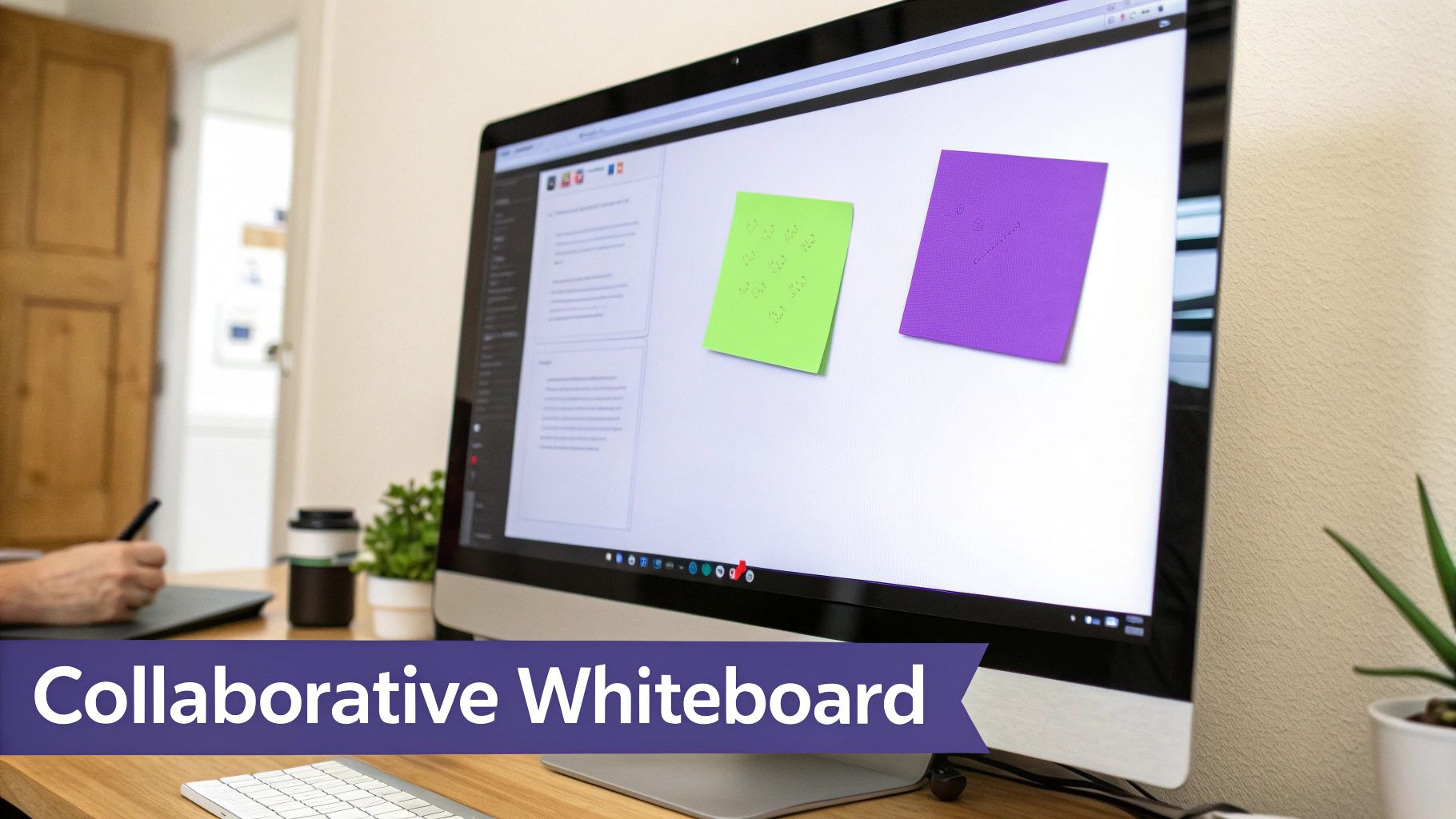
The spontaneous energy of a physical whiteboard session was once considered a casualty of remote work. Real-time collaborative digital whiteboarding disrupts this notion by recreating, and in many ways enhancing, that creative space in a virtual environment. It allows distributed teams to brainstorm, diagram, and ideate together on an infinite canvas, simultaneously.
This technology transforms a passive screen-sharing session into an active, participatory experience. Platforms like Miro and FigJam provide tools for sticky notes, drawing, and embedding media, making visual collaboration seamless. It’s a powerful disruptive idea because it digitizes a core creative process, making it more accessible, persistent, and scalable for teams regardless of location.
Strategic Breakdown
- Context: A globally distributed design team struggles to align on user flow concepts. Video calls lead to misinterpretations, and static design files shared over email fail to capture the dynamic nature of their brainstorming.
- The Disruption: The team adopts a digital whiteboard like Mural for a real-time user journey mapping session. Everyone can add sticky notes, draw connectors, and vote on ideas simultaneously. The visual canvas becomes a single source of truth that evolves with the conversation.
- Measurable Impact: The team reduces their concept-to-prototype time by 40% due to clearer, faster alignment. The persistent nature of the board allows asynchronous contributions from different time zones, leading to a 25% increase in cross-functional feedback and a more robust final design.
Actionable Takeaways & Team Exercise
To leverage this, focus on structure to avoid a chaotic canvas. Start with a pre-built template or define clear zones for different activities.
Team Exercise: The "Empathy Map" Canvas
- Setup (5 min): Choose a user persona your team is focused on. Create a new digital whiteboard and use a built-in "Empathy Map" template, or create four quadrants labeled: Says, Thinks, Does, and Feels.
- Ideate (15 min): Set a timer. Each team member silently adds digital sticky notes to each quadrant, capturing observations and assumptions about the user persona. Use color-coding for each participant.
- Cluster & Discuss (15 min): As a group, drag and drop related sticky notes together to form clusters within each quadrant. Discuss the emerging themes and insights.
- Synthesize (5 min): Summarize the key takeaways for the "Pains" and "Gains" sections of the empathy map. This visual artifact now serves as a shared foundation for future product decisions.
7. Rapid Prototyping and Iterative Testing
The traditional product development model often involves long, secretive planning cycles, culminating in a single "big bang" launch. Rapid prototyping and iterative testing completely disrupt this linear path by prioritizing speed, user feedback, and incremental learning over perfection. It’s a methodology that reduces risk by validating core assumptions with real users early and often.
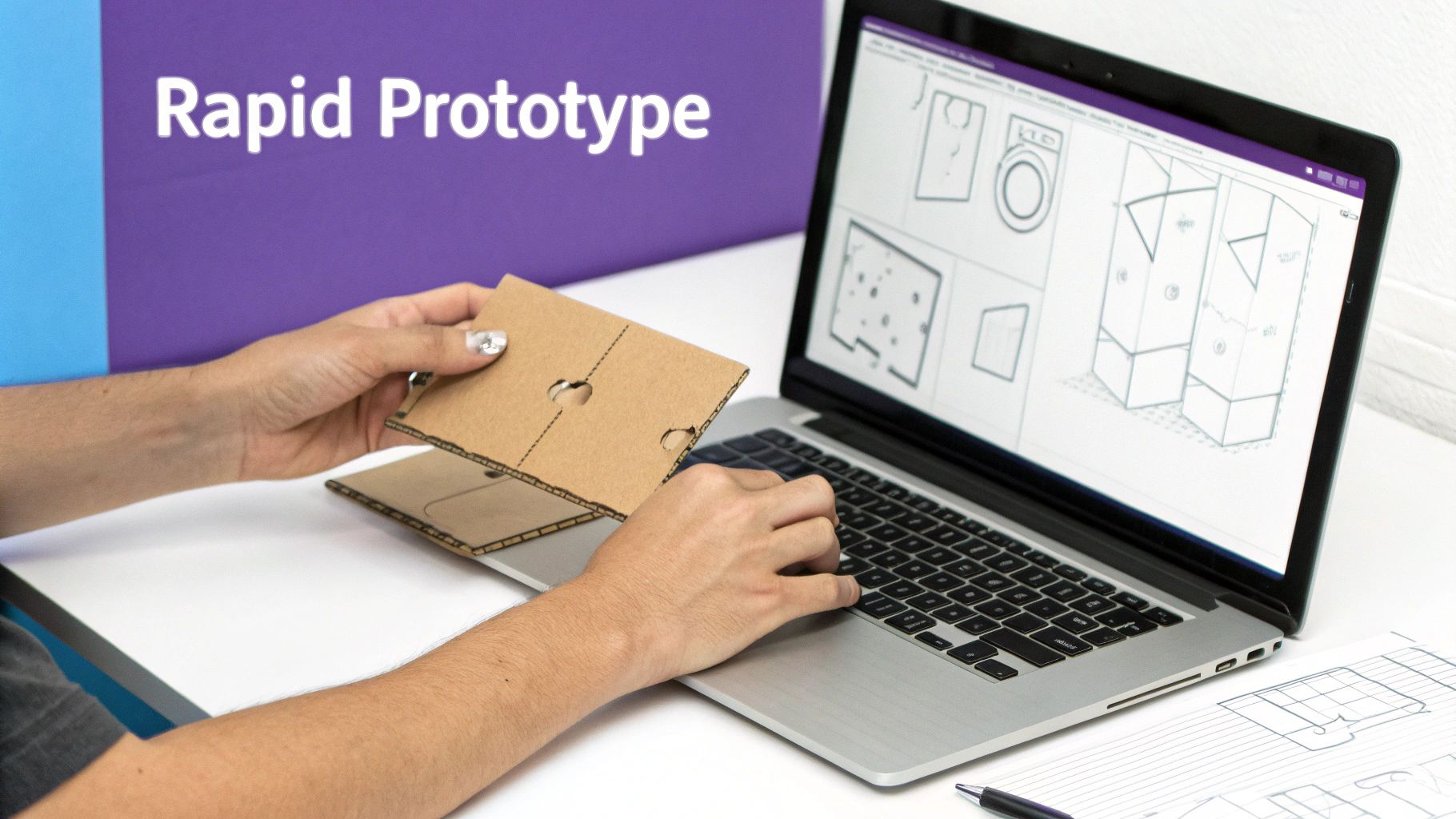
This approach, popularized by frameworks like the Lean Startup and Google's Design Sprint, involves creating a minimum viable product (MVP) or low-fidelity prototype, getting it into the hands of users, and using their feedback to inform the next version. It’s a powerful example of a disruptive idea because it shifts the focus from building a flawless product in isolation to co-creating a valuable solution with the market.
Strategic Breakdown
- Context: A startup has a groundbreaking idea for a new mobile app but a limited budget. A traditional, year-long development cycle is too expensive and risky.
- The Disruption: Instead of building the full app, the team creates a clickable prototype using simple design software in just one week. They test this prototype with 10 target users, uncovering a critical flaw in their initial user flow assumption. This feedback cycle is repeated three times over six weeks.
- Measurable Impact: The team avoids wasting an estimated $100,000 and six months of engineering time building a feature users found confusing. The validated prototype helps them secure a seed funding round 50% faster than projected, as they could demonstrate proven user demand and a clear product direction to investors.
Actionable Takeaways & Team Exercise
To adopt this model, shift your team’s mindset from "building to launch" to "building to learn." Start small and focus on testing one critical assumption at a time.
Brainstorming Prompt: The "One-Day MVP"
- Setup (5 min): Identify the riskiest assumption your product or feature is based on (e.g., "Users will be willing to manually input their daily expenses").
- Hypothesis (10 min): Frame this assumption as a testable hypothesis: "We believe that [target users] will [perform a specific action] because it provides [a specific value]. We'll know we're right when [a measurable success metric] is achieved."
- Prototype (20 min): As a team, brainstorm the absolute simplest, lowest-fidelity way to test this. Could it be a spreadsheet? A paper sketch? A simple landing page with a sign-up form?
- Action Plan (15 min): Outline the steps to build this "one-day MVP" and get it in front of at least five real users by the end of the week.
To master this process, it's crucial to understand the different techniques available. You can discover a range of effective rapid prototyping methods on remotesparks.com to find the best fit for your team’s next project.
8. Psychological Safety and Blameless Culture
Most organizations treat failure as something to be avoided, punished, or hidden. A culture of psychological safety disrupts this default by reframing failure as a data point for learning. It's an environment where team members feel secure enough to take interpersonal risks, such as admitting mistakes, challenging the status quo, or asking "silly" questions, without fear of punishment or humiliation.
This isn't about being nice; it's a strategic necessity for innovation. Groundbreaking ideas often sound foolish at first. In a fear-based culture, these ideas never get voiced. As shown by Google’s Project Aristotle, psychological safety is the single most important dynamic in high-performing teams, creating the fertile ground where disruptive ideas examples can actually emerge and be developed.
Strategic Breakdown
- Context: A software development team consistently misses deadlines because bugs are discovered late in the process. Team members are afraid to admit they don't understand a requirement or made a mistake, leading them to hide problems until they become critical.
- The Disruption: The team lead introduces a "blameless post-mortem" process. After a project failure, the focus is entirely on "what happened?" and "how can we prevent this in the future?" not "who is at fault?" The lead openly admits their own recent mistakes to model vulnerability.
- Measurable Impact: Within three months, the team reports a 40% increase in early bug detection. Team meetings become more candid, and members start proactively flagging potential risks. This leads to a 20% reduction in project delays and a significant improvement in both code quality and team morale.
Actionable Takeaways & Team Exercise
To build this culture, leaders must model the behavior they want to see. This means responding to bad news with curiosity instead of anger and actively inviting dissenting opinions.
Team Exercise: The "Failure Résumé"
- Setup (5 min): Explain to the team that the goal is to normalize and learn from mistakes, not to assign blame. Set the tone that this is a safe space.
- Individual Reflection (10 min): Each team member privately writes down two professional "failures" from the past year. For each, they write one sentence on what they learned from the experience.
- Group Share (15 min): Going around the room, each person shares one of their failures and the lesson learned. The leader must go first to demonstrate vulnerability.
- Pattern Recognition (5 min): As a group, discuss any common themes or systemic issues that emerged. What can be improved at a process level to prevent these types of failures?
Building this foundation is critical for any team looking to innovate. Learn more about the core principles of what psychological safety is at work to create an environment where bold ideas can thrive.
9. Cross-Functional Collaborative Platforms
Departmental silos are the silent killers of innovation, creating friction, redundant work, and lost context. Cross-functional collaborative platforms disrupt this by creating a unified digital ecosystem where ideas, tasks, documentation, and communication coexist. This eliminates the "tool sprawl" that forces teams to constantly switch contexts between different apps.
These platforms integrate brainstorming, project management, and knowledge bases into one accessible space. Instead of an idea living in one tool and its execution plan in another, the entire lifecycle is visible and connected. This is a powerful operational disruption that accelerates the journey from concept to launch by breaking down communication barriers and creating a single source of truth.
Strategic Breakdown
- Context: A marketing team, a product team, and an engineering team all work on the same product launch but use separate tools: one for campaign planning, another for feature tickets, and a third for code repositories. Information is lost in translation between meetings and emails.
- The Disruption: The company adopts a unified platform like Notion or Monday.com. The launch plan is now a central hub where the marketing campaign timeline, product feature tickets (Jira), and design assets (Figma) are all embedded and linked. Everyone sees the same real-time information.
- Measurable Impact: Cross-team meeting time is reduced by 30% because status updates are transparent. The time from feature approval to marketing handoff decreases by 40%, as all relevant documentation and specs are linked directly in the project hub. The launch is more cohesive, leading to a 10% higher initial adoption rate.
Actionable Takeaways & Team Exercise
To implement this, start by auditing your team's current tool stack and identifying points of friction. Don't try to replace everything at once; focus on integrating one critical workflow first.
Brainstorming Prompt: The "Workflow Unification" Audit
- Setup (5 min): Choose a recent cross-functional project (e.g., "last quarter's feature launch").
- Map the Journey (15 min): As a team, map out the project's lifecycle, from initial idea to final report. For each stage, list every software tool that was used (e.g., Slack for initial chat, Miro for brainstorm, Google Docs for spec, Jira for tickets, Email for approvals).
- Identify Friction (10 min): For each "handoff" between tools, ask: "What information was lost or had to be re-entered here? How much time did this take?"
- Consolidate (10 min): Brainstorm how a single, integrated platform could eliminate the top three friction points you identified. Focus on creating a single source of truth for the entire project.
10. Neurodiversity-Inclusive Brainstorming
Standard brainstorming formats often cater to a narrow, neurotypical communication style, inadvertently silencing valuable perspectives. Neurodiversity-inclusive brainstorming disrupts this by redesigning the ideation process to accommodate and leverage the unique cognitive strengths of individuals with ADHD, autism, dyslexia, and other forms of neurodivergence.
This approach acknowledges that creativity isn't a one-size-fits-all process. It involves offering multiple ways to contribute ideas, such as async written submissions, visual mind-mapping, and structured, turn-based discussions. By creating an environment where different thinking styles can thrive, teams can unlock more innovative and outlier ideas, making it a powerful example of a process-based disruptive idea.
Strategic Breakdown
- Context: A marketing team relies on high-energy, rapid-fire verbal brainstorming sessions. They notice that while some team members dominate the conversation, others, including a highly analytical dyslexic team member and an autistic strategist known for deep focus, rarely contribute.
- The Disruption: The team lead introduces a multi-modal brainstorming process. The agenda and core questions are sent out 48 hours in advance. The session now includes 15 minutes of silent, individual ideation on a digital whiteboard, a structured round-robin where each person shares one idea without interruption, and a final async period for adding further thoughts.
- Measurable Impact: The team sees a 40% increase in idea contribution from previously quiet members. The autistic strategist presents a meticulously detailed customer journey insight that was missed, and the dyslexic team member uses mind-mapping to visualize a non-linear campaign structure. This leads to a campaign that resonates with a previously untapped audience segment, boosting engagement by 20%.
Actionable Takeaways & Team Exercise
To implement this, proactively design flexibility into your ideation sessions. The goal is to create multiple paths for participation.
Brainstorming Prompt: The "Multi-Modal Ideation"
- Setup (Pre-Session): Define your core challenge (e.g., "How can we improve our new user onboarding?"). Send this out with the agenda at least one day before the session.
- Silent Ideation (10 min): At the start of the meeting, everyone silently adds their initial ideas to a shared digital space (like a Miro or FigJam board) using virtual sticky notes. This allows for individual processing without social pressure.
- Structured Sharing (15 min): Go around the group one by one. Each person has two minutes to share their top one or two ideas from the board. Enforce a "no interruptions, only clarifying questions" rule.
- Async Synthesis (Post-Session): Leave the digital board open for 24 hours. Ask team members to add any further thoughts, comments, or connections to the ideas presented. This accommodates reflective thinkers who process information more slowly.
10 Disruptive Brainstorming Strategies — Side-by-Side Comparison
| Approach | Implementation Complexity 🔄 | Resources & Training ⚡ | Expected Outcomes ⭐📊 | Ideal Use Cases 💡 | Key Advantages |
|---|---|---|---|---|---|
| AI-Powered Brainstorming Facilitation | High 🔄 — ML models, real-time integration, data pipelines | High ⚡ — cloud compute, data, user training | High ⭐⭐⭐⭐ 📊 — more ideas, bias reduction, equal participation | Remote or large teams, high-volume ideation | Scales analysis, automates synthesis and bias detection |
| Asynchronous Collaborative Innovation | Medium 🔄 — workflows, governance for async contributions | Medium ⚡ — collaboration tools, templates, coordination | Medium-High ⭐⭐⭐ 📊 — deeper, more thoughtful contributions; slower cycle | Distributed teams across time zones, reflective problem-solving | Inclusive scheduling, permanent ideation records |
| Structured Ideation Frameworks | Low–Medium 🔄 — predefined steps and facilitation scripts | Low ⚡ — templates, facilitator training | High ⭐⭐⭐⭐ 📊 — consistent, actionable ideas and predictability | Training new teams, repeatable problem types | Repeatable process, easy to teach and measure |
| Diverse Cognitive Composition (Intentional) | Medium–High 🔄 — deliberate team assembly, facilitation | Medium ⚡ — assessments, time for team-building | High ⭐⭐⭐⭐ 📊 — more innovative and robust solutions | Complex, multi-disciplinary problems | Reduces blind spots; increases novelty and robustness |
| Bias Mitigation & Cognitive Debiasing | Medium 🔄 — structured exercises and skilled facilitation | Low–Medium ⚡ — training, anonymity tools, templates | High ⭐⭐⭐⭐ 📊 — fewer premature dismissals; better originality | High-stakes decisions, overcoming groupthink | Preserves unconventional ideas; improves critical evaluation |
| Real-Time Collaborative Digital Whiteboarding | Low–Medium 🔄 — tool setup, session conventions | Medium ⚡ — subscriptions, reliable internet, basic training | Medium-High ⭐⭐⭐ 📊 — captures visual thinking; boosts collaboration | Visual design, mapping, synchronous co-creation | Visual shared canvas, simultaneous participation, persistent records |
| Rapid Prototyping & Iterative Testing | Medium 🔄 — short cycles, testing logistics, iteration management | Medium–High ⚡ — prototype materials, user access, tooling | High ⭐⭐⭐⭐ 📊 — validated ideas, reduced risk, faster learning | Product development, UX research, early validation | Fast user validation; reduces investment in unviable ideas |
| Psychological Safety & Blameless Culture | High 🔄 — sustained cultural change and leadership modeling | Medium ⚡ — training, rituals, time to build trust | Very High ⭐⭐⭐⭐⭐ 📊 — greater idea quantity and quality | Long-term innovation teams, high-trust orgs | Enables open critique, sustained innovation and engagement |
| Cross-Functional Collaborative Platforms | High 🔄 — integrations, migration, change management | High ⚡ — platform licenses, admin, training | High ⭐⭐⭐⭐ 📊 — smoother idea-to-execution flow; transparency | Organizations needing end-to-end idea pipelines | Single source of truth; reduces tool fragmentation |
| Neurodiversity-Inclusive Brainstorming | Medium 🔄 — bespoke accommodations and flexible formats | Low–Medium ⚡ — awareness training, adaptable tools | High ⭐⭐⭐⭐ 📊 — unique perspectives and increased creativity | Inclusive teams, organizations seeking diverse problem-solving | Unlocks underused cognitive strengths; improves inclusion |
From Idea to Impact: Making Disruption Your Team's Superpower
We've journeyed through a landscape of transformative concepts, from AI-powered facilitation to neurodiversity-inclusive brainstorming. The examples explored in this article are more than just interesting case studies; they are blueprints for a new way of working, thinking, and creating. They prove that the most powerful disruptions often begin not with a single flash of genius, but with a deliberate, systematic change in how we approach problems.
The core thread connecting all these disruptive ideas examples is a fundamental shift from unstructured, accidental innovation to intentional, process-driven creation. Success is no longer left to chance. It's engineered through structured frameworks, psychological safety, and a deep commitment to cognitive diversity.
Your Roadmap to Repeatable Innovation
The journey from a blank whiteboard to a market-shaking idea can feel daunting, but the lessons from these examples provide a clear path forward. The most critical takeaway is that disruption is a skill that can be learned and a process that can be implemented. It’s about building a team "superpower" rather than waiting for a superhero.
Here are the key principles to embed within your team's DNA:
- Structure Liberates Creativity: Frameworks are not restrictive; they are launchpads. By providing clear constraints and guiding questions, structured methods like SCAMPER or First Principles Thinking (as seen in our examples) eliminate cognitive overload and focus creative energy where it matters most.
- Diversity is a Strategic Asset: Assembling a team with varied backgrounds, skills, and cognitive styles is non-negotiable. The power of intentional cognitive diversity lies in its ability to generate a wider range of solutions and spot blind spots that homogeneous teams would miss entirely.
- Psychological Safety is the Fuel: No great idea has ever flourished in an environment of fear. Creating a culture where team members feel safe to propose radical ideas, challenge the status quo, and fail without blame is the single most important investment you can make in innovation.
- Technology is a Catalyst, Not a Crutch: The right tools, from asynchronous collaboration platforms to AI facilitators, can amplify your team's potential. They break down geographical barriers, mitigate human biases, and accelerate the feedback loop between ideation and validation, turning slow processes into rapid, iterative cycles.
Putting Disruption into Practice
So, where do you begin? The transition from reading about disruptive ideas examples to generating your own starts with a single, deliberate step. It's about choosing one practice, one tool, or one cultural shift and committing to it. Don't try to boil the ocean.
Start small. Pick one of the brainstorming exercises from this article and run it with your team next week. Introduce a new asynchronous tool to gather ideas before your next big project kickoff. Or, simply start your next meeting by explicitly stating that all ideas are welcome and there will be no judgment.
The goal is to build momentum. Each small success builds confidence and reinforces the value of this new approach. Over time, these individual actions coalesce into a powerful, self-sustaining culture of innovation. This is how you transform your team from passive observers of disruption into active, confident architects of the future. The next game-changing idea is out there, and your team now has the map and the tools to find it.
Ready to turn these principles into practice? Bulby is a collaborative platform designed to help remote and hybrid teams implement structured ideation frameworks, mitigate bias, and turn brainstorming sessions into a measurable source of innovation. Start building your team's superpower today at Bulby.