
In a rapidly evolving landscape, standing still is the same as falling behind. Continuous improvement isn't just a corporate buzzword; it's the engine that drives innovation, efficiency, and sustainable growth. But what does it actually look like in practice, especially for remote and product-focused teams? How do you move from abstract ideas about "getting better" to a concrete system that delivers measurable results? This is where a structured approach becomes critical.
This guide moves beyond theory to provide concrete examples of continuous improvement processes that you can implement today. We will explore ten proven methodologies, from the data-driven rigor of Lean Six Sigma and the focused discipline of the 5S system to the collaborative spirit of Agile retrospectives and the customer-centric approach of Design Thinking. We'll unpack frameworks like Kaizen, OKRs, and rapid experimentation, showing how they apply to modern work environments.
For each process, you will find a strategic breakdown, clear tactical steps for implementation, and key metrics to track progress. We'll also highlight common pitfalls to avoid and offer insights into how structured brainstorming tools can amplify their effectiveness for both co-located and distributed teams. Empowering your team leads is a crucial first step. To equip them with the necessary skills and resources for driving these initiatives, consider exploring a dedicated leadership toolset for managers. Whether you're aiming to refine product development, streamline operations, or foster a culture of innovation, these frameworks offer a clear roadmap to making 'better' a daily, achievable practice.
1. Lean Six Sigma
Lean Six Sigma is a powerful hybrid methodology that combines the waste-elimination focus of Lean with the defect-reduction, data-driven approach of Six Sigma. The core idea is to improve process performance by systematically removing waste and reducing variation. This dual-pronged attack makes it one of the most comprehensive examples of continuous improvement processes available.
The process is guided by the DMAIC framework: Define, Measure, Analyze, Improve, and Control. This structured, five-phase approach ensures that problems are clearly identified, measured with data, analyzed for root causes, and solved with sustainable improvements.
Strategic Breakdown & Examples
Lean Six Sigma has been a cornerstone of operational excellence for industry giants.
- Motorola: The originator of Six Sigma, Motorola used it to drastically reduce defects in its manufacturing lines, saving billions and setting a new standard for quality.
- General Electric (GE): Under Jack Welch, GE embedded Lean Six Sigma into its culture, applying it beyond manufacturing to financial services and other divisions. This led to massive efficiency gains and profit growth.
- Amazon: The methodology is evident in Amazon's fulfillment centers. They use it to minimize "waste" in the form of excess motion by workers, long wait times for products, and errors in packaging, ensuring faster, more accurate deliveries.
Key Takeaway: Lean Six Sigma excels by transforming quality control from a reactive function into a proactive, data-informed strategy. It forces teams to look beyond surface-level symptoms and address the root causes of inefficiency and error.
Actionable Tips for Implementation
- Start Small: Begin with a single pilot project to demonstrate value and work out implementation kinks before a full-scale rollout.
- Establish Clear Metrics: Define what success looks like from the start. Use KPIs like Defect Rate, Cycle Time, or Customer Satisfaction Score to track progress.
- Train Champions: Invest in training for team leaders who can champion the methodology and guide their teams through the DMAIC phases.
- Balance Data with Creativity: While data-driven, the "Improve" phase requires creative solutions. Use a structured brainstorming tool like Bulby to facilitate idea generation within the DMAIC framework, ensuring you explore innovative yet practical solutions.
For a deeper dive into the methodology and its tools, you can learn more about Lean Six Sigma process improvement techniques.
2. Kaizen
Kaizen, a Japanese term meaning "change for the better," is a philosophy centered on making continuous, incremental improvements. It involves every employee, from senior leadership to frontline workers, in the process of identifying and implementing small, ongoing changes. This approach fosters a powerful culture of constant refinement, making it one of the most foundational examples of continuous improvement processes.
The core principle is that big results come from many small changes accumulated over time. Instead of waiting for massive, disruptive overhauls, teams using Kaizen make consistent, daily efforts to streamline workflows, enhance quality, and eliminate waste.
Strategic Breakdown & Examples
Kaizen's power lies in its ability to embed improvement into an organization's DNA.
- Toyota: The most famous proponent, Toyota, uses Kaizen in its production system. Any worker on the assembly line can pull a cord (the "andon cord") to stop production if they spot a defect. This empowers individuals to make immediate improvements, ensuring quality is built into the process, not inspected at the end.
- Honda: Similar to Toyota, Honda's culture encourages employees to submit thousands of ideas for improvement each year. They focus on even the smallest suggestions, recognizing that collectively these ideas lead to significant gains in efficiency, safety, and product quality.
- Airlines: Many airlines apply Kaizen by creating systems for flight crews to provide immediate feedback on procedures after each flight. This constant feedback loop allows for rapid adjustments to everything from pre-flight checklists to in-cabin service, enhancing safety and passenger experience incrementally.
Key Takeaway: Kaizen democratizes the improvement process. It shifts responsibility from a dedicated quality team to every single employee, creating a proactive, engaged workforce that constantly seeks out and eliminates inefficiencies.
Actionable Tips for Implementation
- Establish Clear Feedback Channels: Create a simple, accessible system for employees to submit ideas. This could be a dedicated Slack channel, a digital suggestion box, or a recurring agenda item in team meetings.
- Celebrate Small Wins: Acknowledge and reward all contributions, no matter how small. This reinforces the value of incremental change and encourages continued participation.
- Document and Share Improvements: When an improvement is made, document the change and its impact. Share this success story across teams to inspire others and spread best practices.
- Focus on Process, Not People: Frame problems as opportunities to improve a process, not as individual failings. This creates a psychologically safe environment where people feel comfortable pointing out flaws.
3. Agile Methodology
Agile Methodology is an iterative project management and software development framework that prioritizes flexibility, collaboration, and customer feedback. Rather than a single "big bang" launch, projects are broken into small, incremental cycles called "sprints." This approach allows teams to adapt to change quickly, making it a powerful framework and one of the most dynamic examples of continuous improvement processes for fast-paced environments.
The process is built on a cycle of planning, executing, and reviewing work in short, time-boxed sprints, typically lasting two weeks. This regular cadence of delivery and reflection ensures the product and the process are constantly being refined based on real-world feedback and team learning.
Strategic Breakdown & Examples
Agile has become the default for modern software development and has expanded into marketing, HR, and other business functions.
- Spotify: The company famously organized its teams into "Squads," "Tribes," "Chapters," and "Guilds." This Agile-inspired structure promotes autonomy and fast, decentralized decision-making, allowing them to innovate on their product continuously.
- Netflix: Netflix applies Agile principles not just to software but to content creation and A/B testing. They release features and even show concepts incrementally, using user data from these small releases to guide their next steps and avoid costly, large-scale failures.
- Slack: The product's evolution is a testament to Agile. Slack constantly releases small feature updates and improvements based on user feedback, using short development cycles to respond to market needs rather than working on a rigid, long-term roadmap.
Key Takeaway: Agile excels by embedding learning and adaptation directly into the workflow. It shifts the focus from rigid, long-term plans to delivering value quickly and iteratively, making continuous improvement a natural byproduct of the development process.
Actionable Tips for Implementation
- Adopt Sprints: Structure work in fixed-length cycles (e.g., two weeks). This creates a predictable rhythm for planning, building, and reviewing progress.
- Hold Regular Retrospectives: At the end of each sprint, hold a meeting dedicated to what went well, what didn’t, and what to improve in the next cycle.
- Embrace Customer Feedback: Involve stakeholders and users throughout the process, not just at the end. Their input is crucial for guiding each iteration.
- Facilitate Agile Ceremonies: Use a structured brainstorming tool like Bulby to run sprint planning, backlog grooming, and retrospective sessions. This ensures all voices are heard and ideas for improvement are captured and turned into actionable tasks for the next sprint.
4. Design Thinking
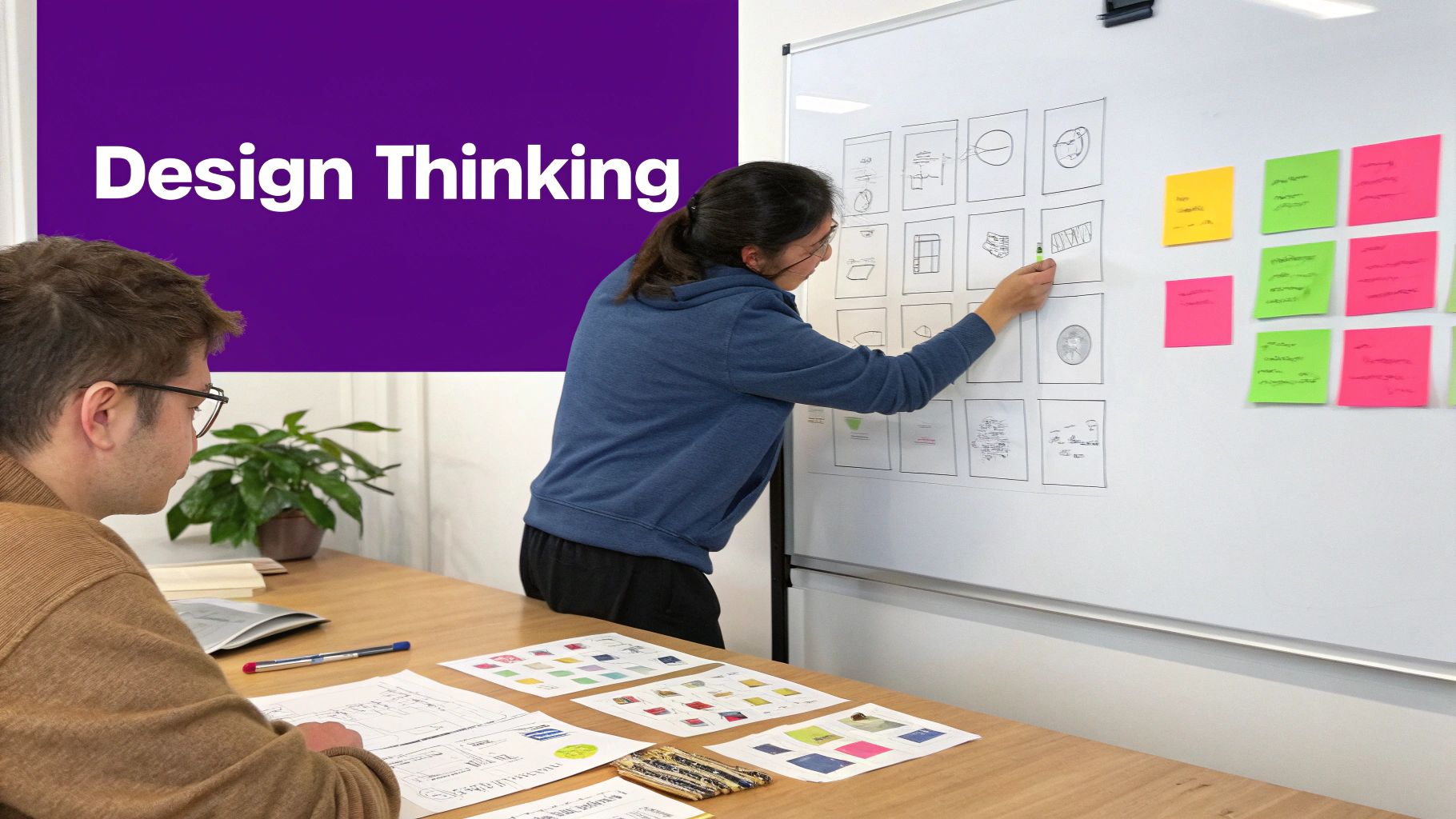
Design Thinking is a human-centered, iterative problem-solving framework that prioritizes empathy for the end-user. It focuses on understanding user needs deeply, defining problems from their perspective, brainstorming a wide range of solutions, and then prototyping and testing those ideas. This user-first mindset makes it one of the most effective examples of continuous improvement processes for product and service innovation.
The process typically moves through five phases: Empathize, Define, Ideate, Prototype, and Test. This non-linear, cyclical approach ensures that solutions are continuously refined based on real user feedback, leading to products that people genuinely want and need.
Strategic Breakdown & Examples
Design Thinking has been the engine behind many of the world's most beloved products and services.
- Apple: The company's legendary focus on user experience is a direct application of Design Thinking. From the intuitive interface of the iPhone to the unboxing experience, every detail is crafted with the user's feelings and needs in mind.
- Airbnb: Early in its history, Airbnb used Design Thinking to solve its low booking problem. By empathizing with users, the founders realized poor-quality photos were the issue, leading them to offer professional photography to hosts and dramatically improving the platform's appeal.
- Google Ventures (GV): GV popularized the "Design Sprint," a five-day process that compresses the Design Thinking framework into a single work week. This allows startups to quickly validate ideas and build user-tested prototypes, saving immense time and resources.
Key Takeaway: Design Thinking shifts the focus from building a feature to solving a genuine human problem. It champions continuous improvement by embedding user feedback directly into the creation and refinement cycle.
Actionable Tips for Implementation
- Create User Personas: Before brainstorming, develop detailed user personas. This grounds the team's ideation in the real-world context of the people you're designing for.
- Start with Empathy: Dedicate the initial phase purely to understanding the user. Conduct interviews, create journey maps, and gather qualitative data to uncover unspoken needs.
- Prototype Low-Fidelity First: Don't invest heavily in polished prototypes initially. Use simple tools like sketches, wireframes, or role-playing to test core concepts quickly and cheaply.
- Structure Your Brainstorming: Use a structured brainstorming tool like Bulby to guide the "Ideate" phase. Frame prompts around specific user pain points discovered during the empathy phase to generate highly relevant and creative solutions.
For a comprehensive guide on the framework, you can explore the different stages of the Design Thinking process.
5. OKR (Objectives and Key Results)
OKR, which stands for Objectives and Key Results, is a goal-setting framework designed to create alignment and engagement around measurable goals. The core idea is to connect ambitious, qualitative Objectives with specific, quantitative Key Results. This structure provides clarity on what needs to be achieved and how success will be measured, making it one of the most effective examples of continuous improvement processes for strategic execution.
The framework operates on a cyclical basis, typically quarterly, where teams set goals, track progress, and reflect on outcomes. This regular cadence forces teams to continuously learn and adapt their strategies based on real performance data, turning goal-setting into a dynamic, iterative process rather than a static annual exercise.
Strategic Breakdown & Examples
OKRs have been instrumental in focusing the efforts of some of the most innovative companies in the world.
- Intel: The framework's origin story begins at Intel under Andy Grove. He used OKRs to pivot the company's focus to microprocessors, aligning the entire organization around a single, critical "bet-the-company" objective.
- Google: Larry Page and Sergey Brin adopted OKRs early on from investor John Doerr. Google uses them to foster "10x thinking" by setting ambitious, often seemingly impossible, objectives that push teams to innovate rather than make incremental improvements.
- Airbnb: During periods of rapid growth, Airbnb used OKRs to maintain focus. For example, an Objective to "Enhance the Guest Experience" might have Key Results like "Increase 5-star reviews by 15%" and "Reduce customer support ticket response time by 20%."
Key Takeaway: OKRs excel by creating a direct, transparent link between daily work and top-level company strategy. It empowers teams by giving them clear, measurable targets while providing the autonomy to figure out how to hit them.
Actionable Tips for Implementation
- Set Aspirational Objectives: Objectives should be ambitious and inspiring. They answer the question, "Where do we want to go?"
- Define Measurable Key Results: Key Results must be quantifiable and verifiable. They answer the question, "How will we know we're getting there?" A good KR is a metric, not a task list.
- Focus on Outcomes, Not Outputs: Instead of a Key Result like "Launch three new features," use "Increase user engagement by 10%." This focuses the team on impact, not just activity.
- Structure Brainstorming Around KRs: When generating ideas to move the needle, use a tool like Bulby to focus the session. Frame the challenge as "How might we achieve a 20% increase in user retention this quarter?" to ensure all generated ideas directly support your Key Results.
6. Retrospectives (Retros)
Retrospectives are structured team meetings designed for reflection, where a team discusses what went well, what challenges they faced, and what they can improve in their next work cycle. Popularized by the Agile community, these sessions create a dedicated space for learning and adaptation, making them one of the most accessible examples of continuous improvement processes for any team.

The process is simple yet powerful: gather the team, reflect on a specific period (like a two-week sprint), generate insights, and create a short list of actionable improvements to implement immediately. This frequent, low-overhead cycle allows for rapid adjustments.
Strategic Breakdown & Examples
Retrospectives are a fundamental practice for high-performing teams across various functions.
- Agile Software Teams: A development team at Spotify might use a "Start, Stop, Continue" retro after a sprint to identify that daily stand-ups are running too long ("Stop"), a new code review checklist would be helpful ("Start"), and paired programming on complex tickets is effective ("Continue").
- Engineering Post-Mortems: Following a server outage, a site reliability engineering (SRE) team conducts a "blameless post-mortem." The focus isn't on who made a mistake but on systematically identifying process or system-level gaps that allowed the incident to happen and creating action items to prevent recurrence.
- Marketing Campaign Learnings: After a major product launch, a marketing team holds a retrospective to analyze campaign performance. They might discover that their social media ad creative performed below expectations, leading to an action item to A/B test different visuals in the next campaign.
Key Takeaway: Retrospectives democratize the improvement process. They empower the entire team to identify and own small, incremental changes, creating a culture of shared responsibility for process optimization.
Actionable Tips for Implementation
- Establish Psychological Safety: Create a safe environment where team members feel comfortable sharing honest feedback without fear of blame. Using anonymous input tools can be highly effective.
- Focus on Process, Not People: Frame discussions around workflows, tools, and systems. The goal is to improve the "how," not to criticize individuals.
- Assign Clear Owners: Every improvement idea must have a designated owner and a target date. This step transforms discussion into tangible action and ensures accountability.
- Use a Structured Format: Don't just ask "what can we do better?" Use a structured brainstorming tool like Bulby to guide the team through proven retrospective exercises, ensuring the session is focused, productive, and surfaces deep insights.
To learn more about running effective feedback sessions, you can explore these best practices for a retrospective meeting.
7. Rapid Experimentation and Testing
Rapid Experimentation is a methodology centered on quickly developing, testing, and iterating on ideas through small-scale, controlled experiments. Instead of relying on lengthy planning cycles and assumptions, teams generate hypotheses, test them with real users, and use the data to learn and adapt. This approach makes it one of the most agile examples of continuous improvement processes for product development and marketing.
The process is driven by a simple loop: Hypothesize, Test, Learn, and Iterate. This cycle ensures that business decisions are based on evidence rather than intuition, minimizing the risk of building features or launching campaigns that customers don't want.
Strategic Breakdown & Examples
Rapid experimentation is the lifeblood of many of the world's most innovative tech companies.
- Booking.com: The travel giant is famous for running thousands of A/B tests simultaneously on its platform. Nearly every new feature, design change, or copy tweak is an experiment, allowing them to continuously optimize the user experience based on real-time data.
- Netflix: From thumbnail images to user interface layouts, Netflix constantly tests variations with segments of its user base. This experimentation culture allows them to personalize experiences and improve engagement metrics at a massive scale.
- HubSpot: The company's growth marketing teams use rapid experiments to optimize every stage of the funnel. They test everything from call-to-action button colors to email subject lines and content offers to steadily increase lead generation and conversion rates.
Key Takeaway: Rapid Experimentation turns uncertainty into a competitive advantage. It builds a culture of learning where failure is not a setback but a valuable data point that guides the next iteration toward success.
Actionable Tips for Implementation
- Define Clear Hypotheses: Start with a well-formed hypothesis (e.g., "We believe changing the button color to green will increase sign-ups by 10% because it stands out more").
- Create Experiment Templates: Use a standardized template to document the hypothesis, metrics, target audience, and results for every experiment. This ensures consistency and makes learnings easier to share.
- Document All Learnings: Keep a centralized log of all experiments, both successful and failed. Failed tests often provide the most valuable insights into customer behavior.
- Structure Your Ideation: Use a brainstorming tool like Bulby to generate a backlog of testable hypotheses. This helps teams collaboratively define, prioritize, and structure experiments before they are launched, ensuring a clear focus on the most impactful ideas.
For teams looking to get started with creating testable concepts quickly, you can learn more about the principles of rapid prototyping.
8. 5S Methodology
The 5S Methodology is a workplace organization framework designed to create a clean, uncluttered, and efficient environment. It follows five sequential principles: Sort (Seiri), Set in Order (Seiton), Shine (Seiso), Standardize (Seiketsu), and Sustain (Shitsuke). By systematically removing unnecessary items and organizing what remains, 5S establishes a visual and logical workplace that reduces waste and improves safety and productivity. It's one of the most foundational examples of continuous improvement processes because it creates the stable environment needed for more complex initiatives to succeed.
This framework is highly adaptable, moving beyond physical factory floors to organize digital files, information flows, and even team processes. The goal is to make abnormalities and inefficiencies immediately obvious so they can be addressed quickly.
Strategic Breakdown & Examples
5S is a cornerstone of Lean thinking, proving its value across diverse industries.
- Toyota: As a pioneer of the system, Toyota uses 5S on its production lines to ensure every tool and part has a specific place. This visual management system minimizes time wasted searching for items and makes it instantly clear if something is missing or out of place.
- Hospital Emergency Rooms: In a high-stakes environment, 5S is used to organize life-saving equipment and supplies. Carts are laid out identically, and drawers are labeled, allowing medical staff to grab what they need without a second thought, improving patient outcomes.
- Software Development Teams: The 5S principles are applied to digital environments. Teams use it to create standardized folder structures in shared drives, consistent naming conventions for code repositories, and clean, archived communication channels in tools like Slack, reducing digital clutter and search time.
Key Takeaway: 5S is more than just housekeeping; it's a discipline that builds a culture of order and efficiency. It establishes a baseline of operational stability, making it easier to spot deviations from the standard and implement further improvements.
Actionable Tips for Implementation
- Start with a 'Red Tag' Event: For the "Sort" phase, physically or digitally "red tag" all items you are unsure about. Set them aside for a defined period (e.g., 30 days) and discard anything that isn't used.
- Create Visual Standards: For the "Set in Order" and "Standardize" phases, use labels, outlines, and color-coding for both physical tools and digital assets. A clear, visual system is intuitive and easy to follow.
- Schedule Regular Audits: The "Sustain" phase is the most difficult. Schedule regular 5S audits (weekly or monthly) using a simple checklist to ensure standards are maintained and to build accountability.
- Organize Your Idea Pipeline: Apply 5S to your innovation process. Use a tool like Bulby to sort unstructured ideas, set them in order by strategic priority, and create standardized templates for brainstorming sessions, ensuring your creative workspace is as organized as your physical one.
9. Feedback Loops and Listening Posts
Feedback Loops and Listening Posts represent a continuous improvement process centered on systematically gathering, analyzing, and acting on input from customers, employees, and stakeholders. The core principle is that the people closest to the product or service hold invaluable insights. Creating structured channels, or "listening posts," to capture this feedback ensures the organization remains agile and responsive to evolving needs.
This approach transforms feedback from a sporadic, reactive event into a proactive, ongoing dialogue. By closing the loop, organizations not only improve their offerings but also build stronger relationships by demonstrating that they value and act on the input they receive. It is one of the most customer-centric examples of continuous improvement processes an organization can adopt.
Strategic Breakdown & Examples
Modern, customer-obsessed companies build their entire product strategy around robust feedback loops.
- Salesforce: Through its "IdeaExchange" platform and customer advisory boards, Salesforce allows users to submit, vote on, and discuss new feature ideas. This direct line to its user base ensures its development roadmap is closely aligned with real-world customer needs.
- Microsoft: The Windows Insider Program gives millions of enthusiasts early access to builds of the operating system. This massive-scale listening post provides invaluable data on bugs, usability issues, and feature reception before a public release, enabling continuous, user-validated improvements.
- Slack: Slack maintains active community forums and closely monitors user feedback channels to identify pain points and desired features. This input directly influences their development sprints, leading to iterative updates that enhance the user experience based on real-world usage.
Key Takeaway: Feedback Loops institutionalize learning. They shift an organization's focus from internal assumptions to external realities, ensuring that every improvement effort is grounded in validated user needs and market demands.
Actionable Tips for Implementation
- Diversify Your Channels: Don't rely on a single source. Use a mix of surveys, 1:1 interviews, community forums, and usability tests to get a holistic view of user sentiment.
- Analyze for Themes: Raw feedback is noisy. Use tools to tag and categorize input to identify recurring themes and prioritize the most impactful issues or opportunities. For optimizing feedback collection and processing within your continuous improvement framework, consider adopting efficient customer feedback automation strategies.
- Create Clear Action Plans: Once a theme is identified, assign clear ownership for developing a solution. Track the progress from insight to implementation.
- Integrate with Ideation: Use feedback as direct fuel for brainstorming. A tool like Bulby can structure ideation sessions around specific customer pain points or suggestions, ensuring that creative problem-solving is directly tied to user-validated needs. Close the loop by sharing outcomes with the feedback providers.
10. Psychological Safety and Blameless Culture
Psychological safety is the shared belief that a team is safe for interpersonal risk-taking, such as asking questions, admitting mistakes, or offering new ideas without fear of punishment or humiliation. A blameless culture, its direct counterpart, shifts the focus from "who failed" to "what can we learn from this failure." This foundation of trust is one of the most critical, yet often overlooked, examples of continuous improvement processes.
Without this environment, genuine feedback is stifled, and innovative ideas are never shared. A blameless culture ensures that when things go wrong, the team's energy is channeled into process improvement and preventative measures rather than assigning blame, creating a cycle of learning and resilience.
Strategic Breakdown & Examples
This cultural framework is the secret ingredient behind many of the world's most innovative companies.
- Google: The famous "Project Aristotle" study identified psychological safety as the single most important dynamic of high-performing teams. This is put into practice through their blameless post-mortem culture, where engineering failures are analyzed systemically to improve reliability.
- Pixar: Their "Braintrust" meetings are a masterclass in psychological safety. Directors present works-in-progress to a group of peers for radical, candid feedback. The process works because criticism is directed at the film, not the person, and everyone shares the goal of making the story better.
- Netflix: The company’s "Freedom and Responsibility" culture encourages employees to take smart risks. While failure isn't celebrated, it's accepted as a byproduct of innovation, and the focus remains on the learnings gained from the experience.
Key Takeaway: Psychological safety is not about being "nice"; it's about creating a high-candor, low-fear environment. It unlocks the collective intelligence of the team, making it possible to identify and solve problems faster than in a culture driven by fear.
Actionable Tips for Implementation
- Model Vulnerability: Leaders should be the first to admit mistakes or say, "I don't know." This sets the tone for the entire team.
- Normalize Idea Iteration: Frame feedback as a collaborative effort to build upon an idea, not tear it down. Use phrases like, "What if we added…" instead of "That won't work because…"
- Separate the Person from the Idea: Establish clear ground rules for brainstorming and feedback sessions that focus on the substance of the work, not the individual who created it.
- Structure Brainstorming for Safety: When tackling sensitive topics or brainstorming bold new ideas, use a tool like Bulby to leverage anonymous input features. This allows team members to contribute freely without fear of immediate judgment, ensuring all perspectives are heard.
To foster this environment in your own team, you can learn more about how to create psychological safety in the workplace.
10 Continuous Improvement Processes Compared
| Method | 🔄 Implementation Complexity | ⚡ Resource Intensity / Speed | 📊 Expected Outcomes (⭐) | Ideal Use Cases | 💡 Key Advantages / Tips |
|---|---|---|---|---|---|
| Lean Six Sigma | High — formal DMAIC + statistical tools | High resource & time; certification required; slower to start | Measurable quality improvements and ROI ⭐⭐⭐⭐ | Operations, manufacturing, process-heavy teams | 💡 Pilot first; train leaders; pair with creative methods to avoid rigidity |
| Kaizen | Low–Medium — continuous incremental steps | Low cost but requires ongoing time commitment | Sustainable, cumulative improvements ⭐⭐⭐ | Culture change, frontline teams, continuous process refinement | 💡 Encourage small wins, regular retrospectives, capture suggestions |
| Agile Methodology | Medium — iterative rituals and roles (sprints, standups) | Moderate resources; needs disciplined teams and tooling; fast cycles | Faster time-to-market and adaptability ⭐⭐⭐⭐ | Product development, remote cross-functional teams | 💡 Align brainstorming to sprint cycles; define acceptance criteria |
| Design Thinking | Medium–High — multi-phase research and prototyping | Moderate–High — user research and prototyping resources; time-consuming | Highly user-centered, innovative solutions ⭐⭐⭐⭐ | UX, service design, early-stage problem discovery | 💡 Use personas and rapid prototypes; integrate user feedback early |
| OKR (Objectives & Key Results) | Low–Medium — goal-setting cadence and reviews | Low–Moderate — tracking tools and regular reviews | Clear alignment and outcome focus ⭐⭐⭐ | Strategic planning, quarterly prioritization, alignment across teams | 💡 Frame ideation around Key Results; review mid-quarter progress |
| Retrospectives (Retros) | Low — structured reflection format | Low resources; needs good facilitation; short sessions | Quick process improvements and team cohesion ⭐⭐⭐ | Sprint teams, continuous improvement, learning loops | 💡 Timebox sessions, assign owners, foster psychological safety |
| Rapid Experimentation & Testing | Medium — hypothesis-driven, iterative tests | Moderate — analytics/tracking infrastructure; fast iterations | Fast validated learning and reduced risk ⭐⭐⭐⭐ | Growth experiments, A/B testing, feature validation | 💡 Define clear hypotheses & metrics; document and iterate on failures |
| 5S Methodology | Low — five-step organization routine | Low — discipline and periodic audits; quick wins | Improved organization and efficiency (visual clarity) ⭐⭐ | Workspace/digital organization, asset and info management | 💡 Standardize templates/names, maintain regular audits |
| Feedback Loops & Listening Posts | Medium — set up channels and analysis workflows | Moderate — survey/interview tools and analysis effort | Customer-aligned improvements and trust building ⭐⭐⭐ | Product feedback, stakeholder engagement, service improvement | 💡 Use diverse channels, analyze themes, close the loop with actions |
| Psychological Safety & Blameless Culture | High — cultural change needing leadership modeling | Moderate — training, coaching, sustained commitment | Greater participation, risk-taking, and innovation ⭐⭐⭐⭐ | Creative teams, high-stakes projects, cross-functional collaboration | 💡 Set ground rules, model vulnerability, allow anonymous input when needed |
Making Improvement Your Competitive Edge
The journey through these diverse examples of continuous improvement processes reveals a powerful, unifying truth: sustained success is not a static destination. It is a dynamic, ongoing practice of learning, adapting, and evolving. From the rigorous, data-driven framework of Lean Six Sigma to the empathetic, human-centered approach of Design Thinking, each methodology offers a unique toolkit for transforming your team's potential into measurable progress. We've explored how Kaizen fosters a culture of small, incremental gains, how Agile Retrospectives create structured moments for reflection, and how the 5S Methodology brings order and efficiency to both physical and digital workspaces.
The core lesson is not to find one perfect process and implement it rigidly. Instead, the goal is to build a flexible, resilient system of improvement that becomes part of your team's DNA. The most successful organizations, especially in the fast-paced world of remote work and product development, are those that can fluidly blend these approaches. They might use OKRs for strategic alignment, run rapid experiments to validate product hypotheses, and cultivate psychological safety to ensure honest feedback can thrive. This adaptability is the true competitive advantage.
Weaving Improvement into Your Daily Workflow
Mastering these concepts moves your team from a reactive state, merely fixing problems as they arise, to a proactive one, actively seeking out opportunities for enhancement. This shift is monumental. It changes the conversation from "What went wrong?" to "How can we make this even better?"
Consider the practical implications for your team:
- For Product Teams: Combining Design Thinking for user discovery with Agile Retrospectives for process refinement creates a powerful dual-engine for building products that users love and that teams are proud of.
- For Remote Startups: Leveraging OKRs for focus and rapid experimentation for market validation allows you to move with speed and precision, making the most of limited resources.
- For Established Enterprises: Implementing Lean Six Sigma or 5S can unlock massive efficiency gains, while fostering a Kaizen mindset empowers every employee to contribute to the bottom line.
The ultimate takeaway is that continuous improvement is not an isolated event or a special project. It is a cultural commitment. It’s about creating an environment where curiosity is encouraged, experimentation is safe, and learning from failure is celebrated as a vital part of the growth cycle.
Your Next Step: From Reading to Doing
The most significant barrier to continuous improvement is inertia. The solution is to start small and build momentum. Don't feel pressured to implement a full-blown Six Sigma program overnight. Instead, pick one area of friction and apply one new process.
Here are some actionable next steps you can take this week:
- Identify a Pain Point: What is one recurring frustration for your team? A bottleneck in a workflow? A communication breakdown?
- Choose Your Tool: Select one of the processes we discussed that feels like the right fit for that problem. A simple 5S for a messy shared drive? A Retrospective for a project that felt chaotic?
- Schedule the Time: Block off 60-90 minutes on the calendar. Frame it as an experiment.
- Execute and Reflect: Run the process and, just as importantly, discuss how the process itself went. What worked? What could be better next time?
By taking this first small, deliberate step, you initiate a cycle of positive change. You prove to your team that improvement is not just an abstract concept but a tangible, achievable outcome. As these small wins accumulate, you build the confidence and cultural foundation necessary to tackle bigger challenges, transforming your team into a true engine of innovation and excellence. The journey begins not with a giant leap, but with a single, intentional step forward.
Ready to turn these examples of continuous improvement processes from theory into practice? Bulby provides structured, guided brainstorming templates for frameworks like Design Thinking, Retrospectives, and more, making it simple for any team to facilitate a powerful improvement session. Start building your culture of continuous improvement today at Bulby.