

In a remote team, the quality of your questions directly shapes the quality of your collaboration, innovation, and outcomes. Simple yes-or-no questions are efficient but often lead to conversational dead ends, shutting down the very discussions that spark breakthroughs. The most effective remote leaders and facilitators understand that the real magic happens when you master the art of the open-ended question.
These are the prompts that unlock detailed insights, encourage deeper reflection, and build psychological safety by signaling that every perspective is valued. They move conversations beyond surface-level updates and into meaningful strategic alignment. Whether you're running a brainstorming session, a team retrospective, or a user research interview, knowing which question to ask, and how to ask it, is a critical skill for driving progress.
This guide is a practical, ready-to-use toolkit designed specifically for remote and hybrid teams. We won't just give you a generic list; we provide ten distinct categories of powerful examples of open ended questions, each broken down with strategic analysis and actionable takeaways. You'll learn not just what to ask, but why it works and how to use it effectively in a virtual setting. We'll also provide specific facilitation tips, including how to structure these conversations using tools like Bulby, ensuring your questions don't just start a conversation but lead to clear, actionable outcomes. Forget theory and get straight to the questions that will transform your team's discussions from transactional to transformational.
1. What/How Discovery Questions
Foundational to any meaningful conversation, "What" and "How" questions are the simplest yet most powerful tools for gathering detailed information. Unlike closed questions that can be answered with a simple "yes" or "no," these prompts invite individuals to share their stories, rationale, and processes. They form the bedrock of effective communication, especially in contexts like user research, team retrospectives, and job interviews where understanding the "why" behind an answer is critical.

These questions are essential during the initial phases of a project. They help teams uncover user needs, define problem statements, and explore potential solutions without imposing preconceived notions. This type of inquiry is central to effective product discovery processes, where understanding the user's world is paramount.
When to Use This Approach
Use "What/How" discovery questions when your primary goal is to explore a topic broadly and gather rich, qualitative data. They are ideal for:
- Initial Research: Understanding a user's current workflow or pain points.
- Brainstorming Sessions: Kicking off ideation by exploring a problem space.
- 1-on-1 Meetings: Encouraging direct reports to reflect on their challenges and successes.
- Post-Mortems: Analyzing what happened during a project and how processes could be improved.
Examples and Tactical Tips
Here are a few examples of open ended questions using this framework, along with tips for applying them in a remote setting.
-
User Research: Instead of asking "Do you like our new feature?" ask, "What was your experience using the new dashboard for the first time?" or "How did this feature fit into your typical workflow?" This pushes users to narrate their experience.
-
Job Interviews: Move beyond "Do you have experience with Project Management?" to "How would you approach managing a project with a distributed team and a tight deadline?" This reveals their thought process and problem-solving skills.
Facilitation Tip for Remote Teams: Use a virtual whiteboard tool. Post a "How" or "What" question at the top of a frame and give team members five minutes of silent time to add their thoughts on digital sticky notes. This prevents groupthink and ensures all voices are heard before discussion begins.
2. Why Questions (Root Cause Analysis)
Designed to peel back the layers of a problem, "Why" questions are the essential tool for moving beyond surface-level symptoms to uncover the core issue. This investigative approach probes into the motivations, reasons, and underlying causes behind a particular behavior, decision, or event. It is particularly powerful in contexts like bug-fixing, process improvement, and understanding customer motivations, where the initial "what" is known but the "why" remains a mystery.
This method, famously systematized as the "Five Whys" technique within the Toyota Production System, prevents teams from applying superficial fixes to recurring problems. By repeatedly asking "why" until the root cause is identified, teams can develop more robust and lasting solutions. For directly gathering in-depth insights essential for discovery, interactive video platforms often support capabilities such as Mindstamp's Free Response Questions capability.
When to Use This Approach
Use "Why" questions when a problem has occurred, and you need to understand the fundamental reason to prevent it from happening again. They are ideal for:
- Problem-Solving Meetings: When a project went off track or a feature failed.
- Customer Feedback Sessions: To understand the deep-seated motivation behind a feature request or complaint.
- Process Improvement: Analyzing why a certain workflow is inefficient or causing friction.
- Team Retrospectives: Digging into the reason behind a team's frustration or a missed goal.
Examples and Tactical Tips
Here are a few examples of open ended questions using the "Why" framework, with specific tips for remote facilitation.
-
Product Development: Instead of asking "Did the last release cause issues?" ask, "Why do you think our user engagement dropped after the last update?" and follow up with successive "Why?" questions to drill down.
-
Employee Management: Move from "Is the current reporting process slow?" to "Why do you feel this process is inefficient?" This opens a dialogue about specific bottlenecks rather than just confirming a problem.
Facilitation Tip for Remote Teams: Structure a "Five Whys" exercise on a collaborative document. Start with the problem statement at the top. Create five numbered lines below it, asking the team to answer the first "Why?" Then, use their answer as the basis for the next "Why?" question. This visual, step-by-step approach keeps everyone focused and builds a logical chain of causality that the whole team can see.
3. Experience and Storytelling Questions
Experience and storytelling questions are designed to move beyond surface-level answers and tap into personal narratives. These prompts encourage individuals to recount specific events, capturing the context, emotions, and nuanced details that shaped their experience. Instead of asking for an opinion, they ask for a story, providing a much richer and more holistic understanding of a situation.

This narrative approach is incredibly powerful for building empathy and uncovering deep-seated motivations. Whether used in customer interviews or team-building exercises, stories reveal the human element behind data points and metrics. They are fundamental for teams looking to understand user journeys or foster a stronger, more connected culture.
When to Use This Approach
Use storytelling questions when you need to understand the "why" behind a behavior or feeling through a concrete example. They are ideal for:
- User Research: Capturing the complete user journey with a product or service.
- Brand Development: Uncovering authentic customer testimonials and brand impact stories.
- Team Retrospectives: Helping team members share experiences to build psychological safety.
- Employee Engagement: Understanding an employee's personal journey and connection to the company.
Examples and Tactical Tips
Here are a few examples of open ended questions framed for storytelling, along with practical tips for remote teams.
-
Customer Testimonials: Instead of asking "Are you satisfied with our service?" ask, "Can you walk me through the moment you realized our service was making a difference for you?"
-
Team Building: Move past "How was the last quarter?" and ask, "Describe your most memorable moment working on the recent project." This type of prompt is highly effective in a team retrospective meeting to foster connection.
Facilitation Tip for Remote Teams: During a video call, use a "virtual talking stick" method. Ask a storytelling question and have the first person share their story. When they finish, they pass the "stick" (nominate the next person to speak). This creates a structured yet natural flow and ensures everyone has a dedicated moment to share without interruption.
4. Hypothetical and Scenario-Based Questions
Hypothetical questions transport individuals into a specific scenario, asking them to describe how they would act or think. This technique is invaluable for assessing problem-solving skills, ethical judgment, and strategic thinking without relying on past direct experience. By presenting a controlled, fictional situation, you can evaluate a person's underlying thought processes and decision-making framework in a low-pressure environment.
These questions are staples in management consulting case interviews and behavioral psychology for a reason: they reveal how people connect concepts to action. For remote teams, they are a powerful tool in workshop settings to explore potential future challenges or prioritize features by forcing difficult choices. Understanding these skills is a key component of effective collaboration, which is covered in more detail in our guide on how to facilitate effective workshops.
When to Use This Approach
Use hypothetical questions when you need to assess future behavior, creativity, or problem-solving abilities rather than past performance. They are perfect for:
- Job Interviews: Evaluating a candidate's judgment and alignment with company values.
- Strategy Sessions: War-gaming potential market shifts or competitive threats.
- Product Prioritization: Forcing teams to make trade-offs and defend their reasoning.
- Conflict Resolution Training: Allowing team members to practice navigating difficult conversations.
Examples and Tactical Tips
Here are a few examples of open ended questions that use hypothetical scenarios, with tips for remote facilitation.
-
Job Interviews: Instead of "Are you a team player?" ask, "Imagine two key team members are in a deadlock over a technical decision, jeopardizing a sprint deadline. How would you intervene?" This uncovers their mediation and leadership style.
-
Product Design: Rather than "What features are most important?" try, "If you could only keep three features from our current product to relaunch it, which would they be and why?" This forces a discussion on core value propositions.
Facilitation Tip for Remote Teams: Use a polling tool to present a scenario with multiple-choice responses first. Once everyone has voted, open the floor for discussion, asking individuals from each camp to explain the "why" behind their choice. This structures the conversation and ensures everyone considers the options before speaking.
5. Perception and Opinion Questions
Perception and opinion questions are designed to uncover subjective viewpoints, beliefs, and interpretations. Unlike questions seeking factual answers, these prompts delve into how individuals understand and feel about a particular topic, brand, or situation. They are crucial for gathering qualitative data that reveals underlying attitudes and motivations, which are often more influential than objective realities.
These questions are fundamental in fields like market research, employee engagement, and policy development. They help organizations understand how they are perceived, what their stakeholders truly believe, and what emotional or cognitive drivers are at play. Answering "What do you think about…" can reveal far more about a user's loyalty or an employee's morale than a simple rating scale.
When to Use This Approach
Use perception and opinion questions when you need to understand the subjective "why" behind people's behavior and choices. They are ideal for:
- Brand Research: Assessing how your brand is perceived in the market compared to competitors.
- Employee Surveys: Gauging team morale, leadership effectiveness, and perceptions of company culture.
- Policy & Social Research: Understanding public opinion on complex social issues to inform strategy.
- Product Feedback: Capturing users' feelings and opinions about a product's value or usability.
Examples and Tactical Tips
Here are a few examples of open ended questions focused on perception, with tips for remote facilitation.
-
Brand Research: Instead of asking "Do you prefer our brand?" ask, "What is your perception of our brand's commitment to sustainability?" or "How do you feel our company culture is reflected in our products?"
-
Employee Engagement: Move beyond "Are you happy at work?" to "How do you perceive the leadership team's transparency regarding company goals?" This prompts a more nuanced reflection on specific leadership behaviors.
Facilitation Tip for Remote Teams: When discussing sensitive opinions, use an anonymous polling or feedback tool. Ask a question like, "What is one word you would use to describe our team's communication culture?" and display the responses in a word cloud. This ensures psychological safety and encourages honesty before opening up a more direct, non-anonymous discussion.
6. Comparison and Preference Questions
Comparison and preference questions move beyond simple discovery to understand the "why" behind a person's choices. By asking individuals to weigh options, discuss trade-offs, and explain their preferences, you uncover the specific criteria that drive their decisions. This is invaluable for making informed choices in product development, user experience design, and even team strategy.
These questions force a deeper level of cognitive processing than a simple "What do you think?" prompt. They require respondents to articulate their values and priorities, giving you a clear picture of what matters most to them. This method is heavily influenced by the work of consumer psychologists and choice architecture experts, who study how people make decisions when faced with multiple alternatives.
When to Use This Approach
Use comparison questions when you need to make a decision between two or more well-defined options and understand the rationale behind the final choice. They are ideal for:
- A/B Testing Feedback: Understanding why users prefer one design or feature set over another.
- Pricing Strategy: Determining how customers perceive the value of different pricing tiers or models.
- Prioritization Meetings: Helping teams decide which initiatives to focus on by discussing trade-offs.
- Career Development: Assisting team members in clarifying their professional priorities and goals.
Examples and Tactical Tips
Here are a few examples of open ended questions that leverage comparison, along with advice for remote facilitation.
-
Product Feedback: Instead of asking, "Do you like the new designs?" present both options and ask, "How would you compare this new design approach to the current one? What aspects of each do you prefer?" This uncovers specific elements that resonate with users.
-
Team Strategy: Rather than a broad question like "What should we work on next quarter?" frame it as a choice: "Given our limited resources, what are the trade-offs between focusing on new user acquisition versus improving retention for existing users?" This leads to a more strategic conversation about priorities.
Facilitation Tip for Remote Teams: Use a virtual whiteboard with two columns, one for each option you are comparing. Ask participants to silently add sticky notes to each column listing the pros and cons. Then, facilitate a discussion around the patterns that emerge, focusing on why certain points were raised.
7. Challenge and Improvement Questions
Challenge and Improvement questions are designed to uncover pain points, bottlenecks, and opportunities for growth. Instead of asking if things are going well, these prompts invite constructive criticism and proactive problem-solving. They are vital for fostering a culture of continuous improvement, as they give individuals permission to identify what’s broken and suggest how to fix it.
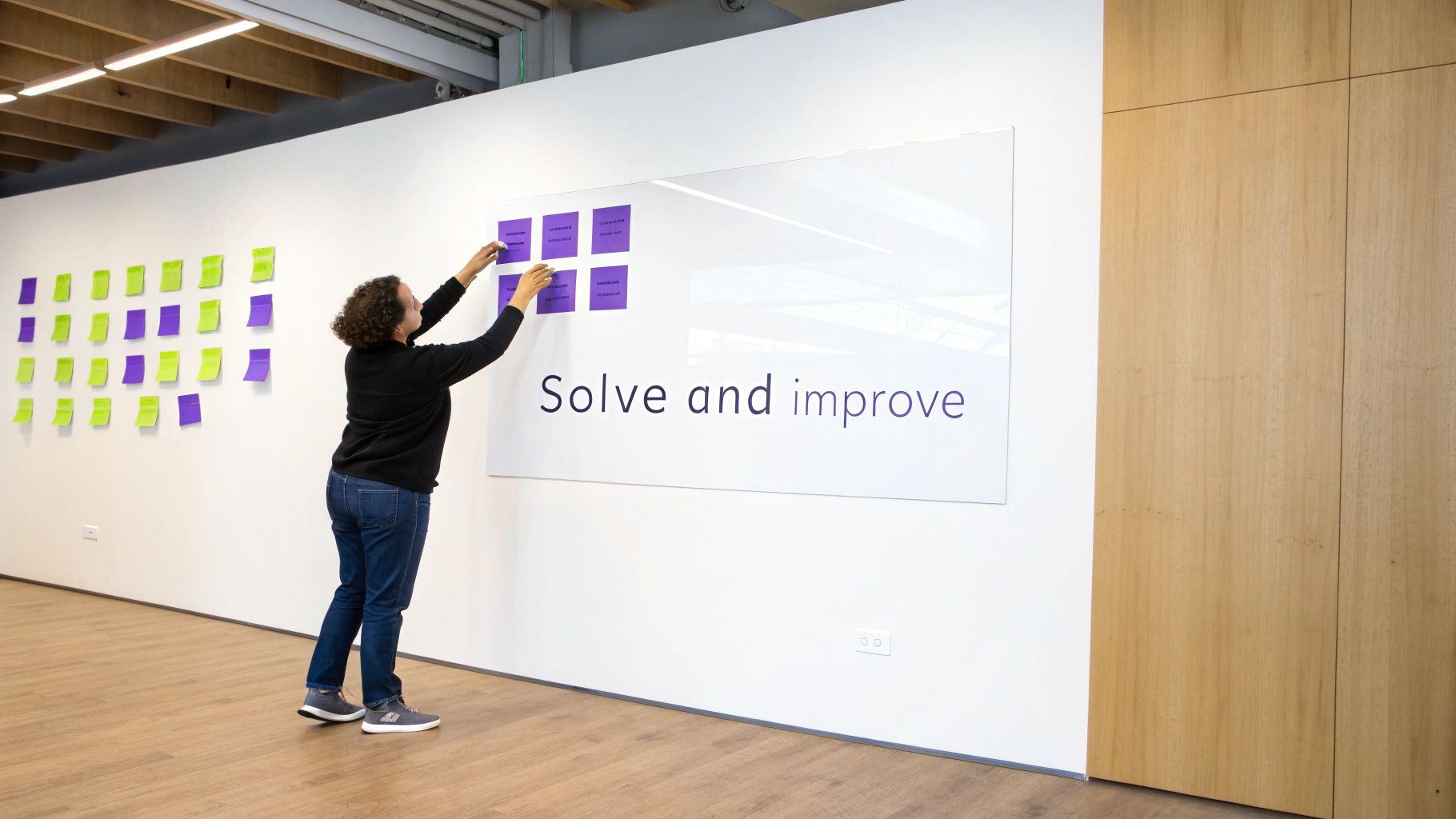
These questions shift the focus from blame to betterment, empowering team members, customers, and stakeholders to become active participants in progress. By framing challenges as opportunities, this approach turns potential complaints into actionable insights, a key principle in Lean and Agile methodologies. This mindset is crucial for any team looking to evolve its products, processes, and culture.
When to Use This Approach
Use challenge and improvement questions when you need to diagnose issues and gather ideas for enhancement. They are perfect for:
- Process Improvement: Identifying inefficiencies in a team's workflow.
- Customer Feedback: Uncovering frustrations and desires in your user base.
- Team Retrospectives: Creating a safe space for the team to discuss what went wrong and how to improve next time.
- Employee Engagement: Understanding what barriers are preventing individuals from doing their best work.
Examples and Tactical Tips
Here are a few examples of open ended questions that focus on challenges, along with tips for remote facilitation.
-
Process Improvement: Rather than "Is our process working?" ask, "Where do you see the biggest bottlenecks in our current workflow?" This question pinpoints specific areas needing attention.
-
Product Development: Instead of "Do you like the feature?" try, "If you could change one thing about this feature to make it 10x better, what would it be?" This encourages ambitious, solution-oriented thinking.
Facilitation Tip for Remote Teams: Use an anonymous feedback tool or a "safe zone" on a virtual whiteboard. Ask a question like, "What barriers prevent you from doing your best work?" and allow anonymous submissions. This reduces the fear of judgment and encourages more candid, honest feedback, which is essential for identifying deep-rooted issues.
8. Values and Motivation Questions
Diving deeper than surface-level preferences, values and motivation questions are designed to uncover the core principles that drive an individual's decisions and actions. These prompts explore what truly matters to people, from their personal aspirations to their professional motivators. Understanding these underlying drivers is crucial for building cohesive teams, fostering genuine employee engagement, and creating products that resonate on a more profound level.
These questions are powerful because they connect actions to identity. When a manager understands what motivates a team member beyond a paycheck, they can align tasks with their intrinsic goals. Similarly, when a product team understands the values a customer seeks in a brand, they can build more meaningful and loyal relationships. This approach is fundamental to creating a purpose-driven culture.
When to Use This Approach
Use values and motivation questions when you need to understand the "why" behind someone's behavior and build a deeper connection. They are ideal for:
- Career Development: Helping team members define a fulfilling career path.
- Team Building: Fostering empathy and understanding among colleagues.
- Leadership & 1-on-1s: Aligning individual motivations with team and company goals.
- Brand Strategy: Uncovering the core values that attract customers to your brand.
Examples and Tactical Tips
Here are a few examples of open ended questions that explore values, along with tips for applying them in a remote work environment.
-
Employee Engagement: Instead of asking "Are you happy at work?" ask, "What motivates you to do your best work each day?" or "What kind of impact do you want your work to have?" This shifts the focus from temporary satisfaction to long-term purpose.
-
Brand Research: Move beyond "Do you like our brand?" to "What values does this brand represent to you?" or "How does using our product align with what's important to you?" This uncovers the emotional connection that drives loyalty.
Facilitation Tip for Remote Teams: Create a safe space for sharing in 1-on-1s by starting with a vulnerable question yourself, like "One thing that's been motivating me lately is…" This builds psychological safety. In team settings, use an anonymous polling tool to have everyone submit one word describing a core personal value, then discuss the emerging themes as a group.
9. Solution and Ideation Questions
Solution and ideation questions are designed to unlock creativity and generate a wide range of possibilities. By framing challenges in an open-ended way, these prompts encourage teams to move beyond obvious answers and explore innovative solutions. Formulations like "How might we…" or "What if…" shift the focus from constraints to opportunities, creating a psychologically safe space for brainstorming.
This approach is fundamental to design thinking and other creative problem-solving methodologies. It helps teams break free from conventional thinking patterns and collaboratively build on each other's ideas, which is especially powerful in remote settings where structured creativity is key. For a deeper dive, explore these powerful ideation techniques to spark creativity.
When to Use This Approach
Use solution and ideation questions when you need to generate novel ideas rather than analyze existing ones. They are perfect for:
- Product Innovation: Discovering new features or solutions to address customer problems.
- Strategic Planning: Reimagining business models or long-term goals.
- Process Improvement: Brainstorming ways to enhance internal workflows and efficiency.
- Feature Kickoffs: Exploring multiple potential approaches to building a new product capability.
Examples and Tactical Tips
Here are a few examples of open ended questions using this framework, along with tips for remote facilitation.
-
Product Innovation: Instead of "Should we build a reporting feature?" ask, "How might we help our users feel more informed about their performance?" This opens the door to solutions beyond a simple report, like alerts, dashboards, or email summaries.
-
Team Problem-Solving: Move from "What's wrong with our deployment process?" to "What are some completely new ways we could approach deploying our software?" This invites radical ideas without immediately focusing on current limitations.
Facilitation Tip for Remote Teams: Run a "Crazy Eights" exercise. Give everyone a virtual whiteboard space divided into eight frames. Set a timer for eight minutes and challenge each person to sketch one idea per minute in response to a "How might we…" prompt. This fast-paced activity prioritizes quantity over quality, generating a wide variety of raw ideas for later refinement.
10. Clarification and Understanding Validation Questions
Ambiguity is the enemy of progress, especially in a remote setting where non-verbal cues are lost. Clarification and understanding validation questions are designed to eliminate misunderstandings by probing deeper into statements that are vague, complex, or abstract. They act as a safety net, ensuring everyone is on the same page before moving forward.
These questions are not about challenging someone's point; they are about achieving a shared reality. By asking for examples, definitions, or elaborations, you invite the speaker to paint a clearer picture, which is crucial for tasks like gathering requirements, providing feedback, and conducting detailed research. This approach is fundamental to active listening and forms the backbone of many qualitative research methods.
When to Use This Approach
Use this type of questioning whenever a statement could be interpreted in more than one way or when you need to translate an abstract concept into a concrete action. They are ideal for:
- Requirement Gathering: Ensuring you understand the precise needs of a stakeholder.
- Feedback Sessions: Unpacking general feedback like "make it more intuitive" into specific, actionable points.
- User Interviews: Digging deeper into a user's initial response to uncover underlying motivations.
- Conflict Resolution: Making sure you fully grasp each party's perspective without making assumptions.
Examples and Tactical Tips
Here are a few examples of open ended questions focused on clarification, along with tips for deploying them effectively in a virtual environment.
-
Feedback Discussions: A team member says a design "doesn't feel right." Instead of guessing, ask, "When you say it doesn't feel right, what specifically are you reacting to?" or "What does a 'right' design look like in practice for this feature?"
-
Requirement Gathering: A stakeholder asks for a "more robust reporting feature." Validate your understanding by asking, "Help me understand what you're looking for by describing the ideal scenario where you'd use this report." This shifts the focus from a vague term ("robust") to a tangible workflow.
Facilitation Tip for Remote Teams: When someone makes a potentially ambiguous statement in a video call, capture it on a shared virtual whiteboard or in the meeting chat. Then, use a clarification question like, "I've noted you said 'improve efficiency.' Can you give us one or two specific examples of what that looks like?" This makes the abstract term visible and encourages a focused, concrete response from the group.
10 Open-Ended Question Types Comparison
| Question Type | Complexity 🔄 | Resources ⚡ | Results/Impact 📊 | Ideal use cases 💡 | Strengths ⭐ |
|---|---|---|---|---|---|
| What/How Discovery Questions | 🔄 Moderate — open-ended flow, needs probing | ⚡ High — skilled interviewer + analysis time | 📊 Rich, contextual qualitative data | 💡 UX research, market research, interviews | ⭐ Deep insights; captures nuance & context |
| Why Questions (Root Cause Analysis) | 🔄 Low–Moderate — focused drilling (e.g., Five Whys) | ⚡ Moderate — iterative probing, possible follow‑ups | 📊 Identifies root causes and motivations | 💡 Problem diagnosis, process improvement, product decisions | ⭐ Reveals true motivations and systemic issues |
| Experience & Storytelling Questions | 🔄 Low — conversational but may drift | ⚡ High — time to collect, transcribe, interpret | 📊 Memorable, emotionally rich narratives | 💡 Ethnography, testimonials, user interviews | ⭐ Authentic, vivid context and emotional detail |
| Hypothetical & Scenario-Based Questions | 🔄 Moderate — scenario design affects validity | ⚡ Moderate — prep time for realistic scenarios | 📊 Shows reasoning, problem‑solving approaches | 💡 Interviews, design exercises, assessments | ⭐ Tests decision‑making; levels the experience field |
| Perception & Opinion Questions | 🔄 Low — straightforward phrasing | ⚡ Moderate — needs anonymity/comfort for honesty | 📊 Captures subjective viewpoints and positioning | 💡 Brand research, policy polling, perception studies | ⭐ Reveals varied perspectives and framing gaps |
| Comparison & Preference Questions | 🔄 Moderate — requires neutral option framing | ⚡ Moderate — analysis across multiple dimensions | 📊 Clarifies priorities, trade‑offs, value judgments | 💡 Product choices, pricing, UX design decisions | ⭐ Exposes decision criteria and relative value |
| Challenge & Improvement Questions | 🔄 Low–Moderate — negative focus needs care | ⚡ Moderate — follow‑ups to surface solutions | 📊 Surfaces pain points and improvement opportunities | 💡 Customer feedback, process optimization, retrospectives | ⭐ Identifies actionable problems and ideas |
| Values & Motivation Questions | 🔄 High — sensitive, needs trust and skill | ⚡ High — safe environment and skilled facilitation | 📊 Reveals core drivers, alignment, long‑term goals | 💡 Culture fit, strategic messaging, coaching | ⭐ Uncovers deep motivations and alignment signals |
| Solution & Ideation Questions | 🔄 Moderate — facilitation influences output | ⚡ High (sessions) — rapid idea generation but follow‑up needed | 📊 Produces many ideas and potential innovations | 💡 Workshops, innovation sprints, strategy sessions | ⭐ Encourages creativity and co‑creation |
| Clarification & Validation Questions | 🔄 Low — tactical checks during dialogue | ⚡ Low — quick to ask, may extend session time | 📊 Improves accuracy and completeness of data | 💡 Interviews, requirements gathering, reporting | ⭐ Prevents misunderstandings; confirms meaning |
From Questions to Breakthroughs: Your Next Steps
We've explored a comprehensive arsenal of examples of open ended questions, moving from simple "what" and "how" prompts to deep, values-driven inquiries. This journey wasn't just about building a list; it was about understanding the strategic power behind each question type and how to wield it effectively, especially within the unique dynamics of remote and hybrid teams. The right question, asked at the right time, can dismantle assumptions, reveal hidden user needs, and spark genuine innovation.
The core lesson is clear: intentionality is everything. A question is not just a request for information; it's a tool to frame thinking, guide conversation, and unlock potential. Simply asking more open-ended questions isn't enough. The real magic happens when you align your questions with a specific goal, whether it's uncovering the root cause of a problem, ideating new solutions, or understanding a teammate's core motivations.
Your Path from Theory to Practice
Mastering the art of questioning is an active, ongoing practice. It requires more than just memorizing a list of prompts; it demands a shift in mindset from providing answers to facilitating discovery. Here are the most critical takeaways to carry forward into your next team session:
- Goal-Oriented Questioning: Before any meeting, kickoff, or user interview, define your primary objective. Do you need to understand a past experience, brainstorm future possibilities, or challenge a current assumption? Choose your question category accordingly.
- Create Psychological Safety: The most powerful questions often require vulnerability. As a facilitator, your first job is to establish a space where team members feel safe to share half-formed ideas, voice dissenting opinions, and admit what they don't know.
- Listen Actively, Not Passively: The power of an open-ended question is only realized through deep listening. Pay attention to what is said, what is not said, and the non-verbal cues (even on video calls). Your follow-up questions, born from active listening, are often where the biggest breakthroughs occur.
- Structure for Inclusion: In a remote setting, structure is your best friend for ensuring equitable participation. Use techniques like silent brainstorming (e.g., using a digital whiteboard), round-robin sharing, and time-boxed responses to prevent the loudest voices from dominating the conversation.
Making Your Insights Actionable
Gathering rich, qualitative feedback is a monumental first step. However, these valuable conversations can quickly become lost without a structured process for synthesis. Once you've gathered rich insights from your open-ended questions, the next crucial step is to effectively analyze interview data to extract meaningful conclusions and drive breakthroughs. This involves identifying patterns, clustering themes, and translating raw notes into actionable next steps for your project or team.
The journey from a single question to a tangible outcome is a process. By deliberately practicing the techniques we've covered, you are not just improving your meetings; you are building a more creative, collaborative, and insightful team culture. Start small. Pick one question from one of the categories above for your next team retrospective or brainstorming session. Observe the shift in conversation, and build from there. You have the tools now, the next move is yours.
Ready to put these questions into action with a process designed for remote innovation? Bulby provides structured, guided exercises that embed these powerful questioning techniques directly into your workflow, helping your team overcome bias and turn great conversations into brilliant outcomes. Explore our library of proven innovation methods at Bulby.