
Finding a great business idea isn't about waiting for a lightning bolt of inspiration. It's more of a muscle you build through careful observation and asking the right questions. The truly brilliant concepts almost always come from one of three places: finding gaps in the market, solving a nagging frustration, or getting ahead of a new trend.
When you learn to look for these signals, coming up with ideas stops being a mysterious art and becomes a repeatable skill.
How to Start Generating Business Ideas
That blank page can feel pretty daunting, can't it? But every successful company, big or small, started right there. The secret isn't some stroke of genius; it's having a system.
The biggest mental shift you can make is to stop asking, "What cool thing can I build?" and start asking, "What real problem can I solve?" That single change puts the customer at the center of your thinking and is the bedrock of ideas people will actually pay for.
This isn't just about a one-time brainstorm. It’s about building a reliable system for your team to constantly find and flesh out new ideas. When everyone, especially in a remote setup, feels like they can contribute, you turn simple curiosity into a pipeline of potential business ventures.
Three Paths to Your Next Big Idea
Most winning business ideas don't appear out of thin air. They typically grow from one of three fertile grounds. If you start actively looking in these areas, you'll begin to see opportunities everywhere.
For a clearer picture, here’s a quick breakdown of these core starting points. This table can help you figure out which path feels most natural for you to explore first.
Three Paths to Your Next Big Idea
| Approach | What It Means | Ideal For |
|---|---|---|
| Market Gaps | Finding underserved needs or ignored customer groups. | Entrepreneurs who love niche communities and tailoring solutions. |
| Everyday Frustrations | Solving a personal or common pain point that's inefficient or annoying. | Problem-solvers who want to build something they'd personally use. |
| Emerging Trends | Capitalizing on new technologies, cultural shifts, or regulations. | Forward-thinkers who enjoy anticipating what's next. |
By keeping these three avenues in mind, you create a framework for discovery. You train your brain to constantly scan the world for what’s missing, what’s broken, and what’s next.
The flowchart below visualizes how these three pillars—Gaps, Frustrations, and Trends—feed into a repeatable process for uncovering solid business opportunities.
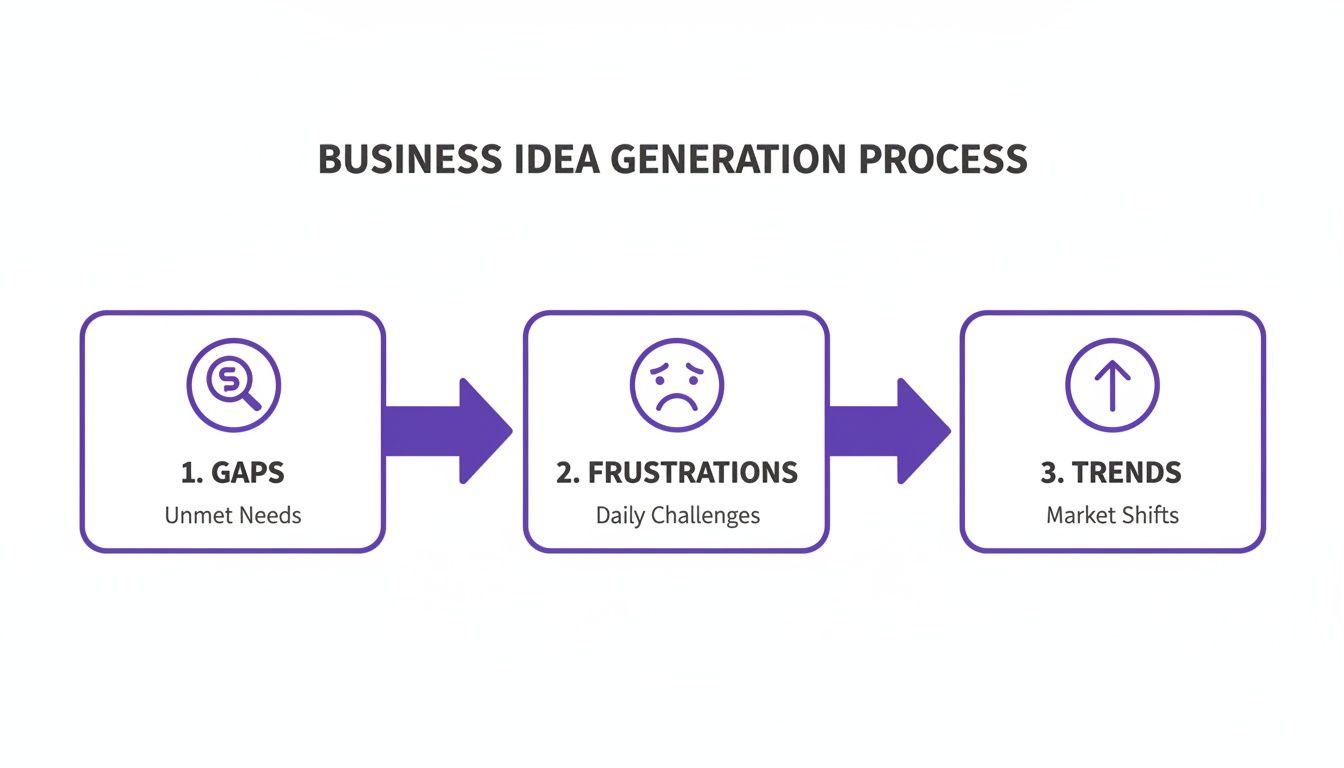
This really just shows that if you're actively looking for unmet needs, paying attention to what bugs you and others every day, and keeping an eye on where the market is headed, you'll never be short on ideas.
To dive deeper into the fundamentals, it helps to first https://www.remotesparks.com/define-generating-ideas/. And if you're just looking for some quick inspiration, checking out a list like these 12 profitable online business ideas to start today can get the wheels turning.
Use Proven Frameworks For Better Brainstorming

Let's be honest, those "what if" sessions that go nowhere are a huge time sink. While a free-for-all brainstorm can feel creative, it rarely leads to a reliable pipeline of good ideas.
This is where proven frameworks come in. Think of them as guardrails for your creativity. They provide just enough structure to keep the conversation from veering off-track while pushing your team to explore problems from angles you'd normally miss. Instead of just hoping for a lightning strike of inspiration, these methods give you a specific lens to look through, which almost always produces better, more actionable concepts.
Spark Innovation With SCAMPER
One of my favorite tools for this is the SCAMPER method. It's essentially a checklist that forces you to think differently about something that already exists, whether it's a product, a service, or even an internal process. It's fantastic for finding a clever twist on a competitor's offer or breathing new life into a stale marketing campaign.
The acronym guides you through seven different ways to think:
- Substitute: What can you swap out? Think components, materials, people, or even platforms. A subscription box service, for example, could substitute physical products with a digital-only version.
- Combine: Can you merge two separate ideas or features? A fitness app might combine its workout tracking with a meal-planning service.
- Adapt: What could you borrow from a completely different industry? A project management tool could adapt the "story" format from social media to deliver quick progress updates.
- Modify: How can you change the scale, shape, or feel of the experience? A local coffee shop could modify its model by launching a super-fast, drive-thru-only location.
- Put to another use: Can the product be used for something completely unintended? Cleaning slime was originally a kid's toy before it was put to another use detailing car interiors.
- Eliminate: What can you strip away to simplify things? An e-commerce site could eliminate the requirement to create an account, reducing friction at checkout.
- Reverse: Could you flip the process on its head? Instead of a restaurant where you go to the food, a food truck reverses the model and brings the food to you.
Deconstruct Problems With First Principles
If you want to create something truly disruptive, you have to learn to think from First Principles. This is all about breaking a problem down into its most basic, fundamental truths and building back up from there. You have to question every single assumption.
It’s how we got game-changers like SpaceX’s reusable rockets—they ignored decades of "how it's always been done" and started from scratch.
By constantly questioning the status quo and rebuilding from the ground up, you can identify opportunities that are completely invisible to those who only think by analogy or follow existing trends.
Let's say you're building a new banking app. A first-principles approach would ask: What is a bank at its absolute core? It’s a secure place to store value and a system to transfer it. Once you strip away all the assumptions about physical branches, tellers, and traditional fees, you start to see openings for entirely new financial products.
Focus On The "Why" With Jobs-To-Be-Done
The Jobs-to-be-Done (JTBD) framework is a powerful mental shift. It forces you to stop focusing on your product and start obsessing over what the customer is actually trying to accomplish. In JTBD terms, customers "hire" a product to do a specific "job." Your goal is to deeply understand that job.
A team building a calendar app isn't just selling a scheduling tool; they’re helping a user "find 30 minutes to collaborate with a remote colleague" or "protect my deep-work time from interruptions." Framing it this way unlocks all kinds of ideas for features that solve the real, underlying need.
This problem-first mindset is especially strong among younger entrepreneurs. The latest Global Entrepreneurship Monitor report revealed that individuals aged 18-24 are starting businesses at a faster clip than older generations, largely because they’re driven to solve real-world problems. With 72% expecting to create jobs, their fresh perspective shows just how powerful it is to focus on core needs. You can dig into the GEM USA report findings to see the full picture.
To go deeper, you can explore our guide on choosing the right ideation framework for your team.
Using AI to Kickstart Your Ideation
Let’s get one thing straight: AI isn't here to just spit out a generic list of business ideas. Think of it less like a search engine and more like a tireless brainstorming partner—one that can help you break out of your usual thinking patterns and explore totally new territory.
The real magic happens when you use AI to challenge your own assumptions. It can come up with dozens of angles on a single user problem, simulate how a market might look in five years, or even play devil's advocate to poke holes in a new concept before you sink a bunch of time and money into it.
This isn't just a fun exercise; it's becoming a core part of how new ventures get off the ground. According to Startup Genome, venture capital funding for AI and Big Data startups jumped by 33% this past year. These companies now make up 40% of all global VC investments. It’s a clear signal that weaving AI into your creative process is a must. You can dig into all the details in the full State of the Global Startup Economy report.
It’s All About the Prompt
The old saying "garbage in, garbage out" has never been more true. If you give an AI a lazy, vague prompt, you'll get lazy, vague ideas back. The trick is to give it context, constraints, and a specific role to play.
Let's say you're a product manager trying to improve a project management tool. Instead of asking for "new feature ideas," you get specific.
Prompt Example: "Act as a product manager for a SaaS company that builds project management software for small, fully remote creative agencies. Our users are struggling with tracking asynchronous feedback on video projects. Generate 10 unconventional feature ideas that solve this problem without adding another notification system."
See the difference? This prompt lays out the user, the exact pain point, and a crucial constraint (no more notifications!). This forces the AI to think creatively and gives you genuinely useful starting points. If you want to dive deeper, we've put together a list of the best AI tools specifically for brainstorming.
Next-Level AI Tactics for Deeper Insights
Once you get the hang of basic prompts, you can use AI for more advanced strategic thinking. These techniques help you get inside your customers' heads and validate your ideas from different angles.
- Build Your Customer Personas: Feed the AI some demographic data, known pain points, and user goals. Ask it to flesh out a few detailed personas for a niche market. Suddenly, you're not building for a generic "user" anymore; you're building for "Maria, the freelance video editor."
- Simulate the Future: Give your AI a dump of current market data and industry news. Then, ask it to play futurist. What trends might emerge in your industry over the next 3-5 years? How will customer needs change? This helps you build for where the market is going, not where it is today.
- Find Your Competitors' Blind Spots: This one is my favorite. Have the AI analyze customer reviews and marketing language for your top three competitors. Ask it to find recurring complaints, frustrations, or missing features. That's not just market research; that's a ready-made list of opportunities.
Overcoming Common Brainstorming Roadblocks
Even the best teams hit a wall. When the creative energy just fizzles out, it’s rarely because there are no good ideas in the room. The real culprits are often the invisible hurdles that stop great thinking in its tracks.
These roadblocks are especially tough for remote teams. Without the natural flow of an in-person session, unspoken biases and weird group dynamics can easily take over and quietly kill a brainstorming meeting.
The first step to breaking down these barriers is simply knowing they exist. Your goal is to create a space where everyone feels safe to contribute, and the best idea wins—no matter who it came from.
Neutralize the HiPPO Effect
Ah, the classic HiPPO: the Highest Paid Person’s Opinion. It’s one of the most common innovation killers out there. The moment a senior leader throws their idea into the ring first, it can unintentionally steer the entire conversation and shut down other creative paths. Team members might hold back perfectly good ideas simply because they don't want to seem like they're challenging the boss.
This isn’t just about respecting authority; it’s about a deep-seated fear of failure. Nobody wants to look foolish or risk their career by disagreeing with the person who signs their checks. The GEM Global Report found that a staggering 49% of people who spot a business opportunity don't pursue it precisely because of this fear. Now, imagine that pressure in a group setting. You can dig into more of these global entrepreneurship trends to see just how widespread this is.
So, how do you get the HiPPO out of the water? Level the playing field.
- Go Anonymous First: Have everyone submit their initial thoughts on a digital whiteboard or shared doc before the meeting starts. This way, ideas are evaluated on their own merit, not on the job title of the person who came up with them.
- The Leader Speaks Last: If you’re the leader in the room, make it your personal rule to stay quiet until everyone else has spoken. It's a simple, powerful way to show your team that their ideas are valued and expected.
Break Free From Groupthink
Groupthink is that cozy, dangerous state where everyone starts nodding along to avoid rocking the boat. The desire for harmony overrides critical thinking, and suddenly the team rallies around a half-baked idea just because it's the path of least resistance.
On a remote call, this is even more insidious. A few seconds of silence can easily be mistaken for unanimous agreement.
The most dangerous thing about groupthink is that it creates a false sense of security. The team feels invincible, convinced their first idea is brilliant, which can lead to taking on massive, unvetted risks.
To snap out of it, you have to build in some healthy friction. Try using a framework like "Six Thinking Hats," where you assign people specific roles—the optimist, the critic, the data geek. This forces the team to look at an idea from all angles instead of just one. We also have other strategies for overcoming creative blocks that often lead to groupthink.
Challenge Confirmation Bias
We’re all wired for it. Confirmation bias is our brain's natural shortcut to favor ideas that already line up with what we believe. In a brainstorming session, this means we jump on concepts that feel familiar and instinctively shoot down anything that challenges our worldview.
While it's an efficient way to process information, it's absolutely lethal for innovation. It traps your team in an echo chamber where the same old ideas get recycled over and over.
To break the cycle, you have to actively look for reasons why an idea might fail. Formally assign someone the role of "devil's advocate" for each session. Their only job is to poke holes in the most popular ideas and question the group's assumptions. It's not about being negative—it's about stress-testing your concepts to make them truly resilient.
So, Which Ideas Are Actually Worth Pursuing?
Coming up with a bunch of great business ideas is the easy part. The fun part, even. The real work starts when you have to decide which one to actually bet on. A brilliant concept is nothing more than a starting point. Before you pour your time, money, and soul into a project, you need to shift from "I think this is a good idea" to "I have proof that people will actually pay for this."
This whole validation process is about one thing: de-risking your next move. It’s about getting out of your own head and gathering real-world feedback—no matter how small—to see if your core assumptions hold up. If you skip this, you’re not building a business; you’re just gambling.
Get Objective and Prioritize Your Ideas
When your team is buzzing with exciting possibilities, it's easy to get attached to the flashiest idea, not necessarily the most viable one. To cut through the noise and personal biases, it’s best to bring some simple math into the conversation with a scoring model.
A fantastic framework for this is called RICE:
- Reach: How many people will this actually touch in a set timeframe? (e.g., 500 new customers per quarter).
- Impact: How much will this move the needle for each person? (Use a simple scale: 3 for a massive impact, 2 for medium, 1 for low).
- Confidence: How sure are you about your Reach and Impact numbers? Be honest. (e.g., 100% is a sure thing, 50% is a pure guess).
- Effort: How much time will this devour from your team? (Estimate in "person-months" to keep it simple).
Scoring each idea this way gives you a clear, data-driven ranking. It forces everyone to look at the same criteria and helps you focus on what really has potential.
Start Validating Without Breaking the Bank
You don’t need a massive budget or a fully-built product to start testing the waters. The goal here is to check your biggest, riskiest assumptions as quickly and cheaply as possible. A huge piece of this puzzle is figuring out if the market is even big enough, which is often measured by the Total Addressable Market (TAM).
For remote teams especially, these lean validation tactics are perfect:
Launch a "Coming Soon" Page: Set up a simple one-page website explaining what you're building and why it's great. Add an email signup form to collect interest. If people sign up, you've got your first flicker of validation.
Run a Tiny Ad Campaign: Spend just $50-$100 on some targeted social media ads pointing to your landing page. Your click-through rate and cost per email signup are powerful early signs of whether you’ve struck a nerve.
Talk to Potential Customers: This is a big one. Find people in your target audience and just have a conversation. Don't pitch them. Ask about their problems, how they currently solve them, and what they wish was better. Does your idea naturally fit into that conversation?
Remember, these early steps aren't about selling—they're about learning. Every single conversation, click, and signup is a data point telling you whether to press forward or head back to the drawing board.
These techniques are the bedrock of the lean startup method. If you want to get more structured about mapping out your business model, you should check out our guide on what a Lean Canvas is and how you can use it.
Frequently Asked Questions About Business Ideation

Even with a great playbook, you're bound to run into questions when you start generating business ideas. Let's tackle some of the most common ones I hear from teams who are just getting started.
How Do I Know If a Business Idea Is Good?
A "good" idea isn't about being totally unique. It’s about solving a real problem for a specific group of people who are actually willing to pay for a solution. It's that simple.
The best concepts always check three boxes:
- A Clear Value Proposition: What are you actually offering, and to whom?
- A Defined Target Market: Who, specifically, needs this? The more niche, the better at first.
- A Viable Path to Profitability: How will you eventually make money from this?
Ultimately, the market is the real judge. The moment of truth comes when you talk to potential customers. Their genuine excitement (or total indifference) is the most valuable data you can get.
How Should We Brainstorm With a Remote Team?
Trying to brainstorm over a single video call is a recipe for disaster. The loudest voices tend to dominate, and people in different time zones are left out. The secret is to blend asynchronous and real-time collaboration.
Give everyone 24-48 hours to drop their raw ideas into a shared space like a digital whiteboard or a simple document. This gives people time for deep, uninterrupted thinking. Then schedule a shorter, high-energy live session to discuss, group, and build on what everyone contributed.
This approach levels the playing field, making sure your introverted team members and those on different schedules can share their best thoughts before the groupthink kicks in.
How Many Ideas Should We Aim For?
In the beginning, it's all about quantity over quality. Seriously. The goal is to get a huge volume of ideas out on the table so you can push past the obvious ones. For a single brainstorming session, aiming for 50-100 ideas is a solid target.
Don't filter yourself. Just get them all out there.
Once you have that big pool of raw material, you can shift your focus to quality. That's when you bring in frameworks like an impact/effort matrix or a RICE score to whittle down the list to the top three to five ideas truly worth exploring.
What If My Idea Already Exists?
Relax. This is usually a good thing. Competition means someone else has already proven there’s a market for what you want to do. They've done some of the hard validation work for you.
Now, your job is to find the cracks in their offering.
Look closely at your competitors and ask where they're falling short. Can you deliver a much better user experience? Serve a niche audience they’re overlooking? Offer it at a better price? Or maybe just build a brand that connects with people on a deeper level? Your advantage doesn't have to be a brand-new invention; often, it’s just executing better than the next person.
Stop letting great ideas slip away in disorganized meetings. Bulby provides a structured, AI-guided brainstorming platform that helps remote teams generate, refine, and prioritize their best concepts. Transform your virtual collaboration into a powerhouse of creativity by visiting https://www.bulby.com to start your free trial.