
In today's dynamic work environment, fostering genuine collaboration and innovation is more critical than ever. Whether your team is in the office, fully remote, or a hybrid of both, finding effective group activities for work can feel like a significant challenge. The right activities move beyond simple team-building exercises; they become powerful engines for creativity, problem-solving, and building authentic connection among colleagues. This isn't about forced fun or trust falls; it's about structured, purpose-driven engagement that yields measurable outcomes.
This guide provides a comprehensive roundup of 10 actionable activities designed to break down creative barriers, enhance collaboration, and produce tangible results for modern teams. We skip the generic advice and dive straight into the specifics you need to succeed. You'll find practical steps, expert tips, and real-world examples to transform your team's creative process and drive meaningful innovation forward.
Inside, we cover a range of powerful techniques, including:
- Structured Brainstorming Sessions with AI Guidance
- The Six Thinking Hats Method
- Remote Collaborative Mind Mapping
- Reverse Brainstorming (Inversion Technique)
- Role-Playing and Perspective-Taking Scenarios
Each entry is a complete toolkit, detailing the purpose, ideal group size, required time, and step-by-step instructions. We also include variations for remote and hybrid teams, plus facilitation tips to ensure a smooth and productive session. These group activities for work are designed not just to generate ideas, but to refine them, improve decision-making, and strengthen the core collaborative fabric of your team, no matter where they are located. Let’s get started.
1. Structured Brainstorming Sessions with AI Guidance
Traditional brainstorming often falls short, dominated by loud voices and unstructured thinking. Structured brainstorming with AI guidance transforms this classic group activity for work by using technology to create a more inclusive, systematic, and productive ideation process. These sessions use AI-powered frameworks to guide teams through proven creative techniques, ensuring every participant contributes effectively.

This method combines step-by-step prompts with AI suggestions in real-time to help teams break through creative blocks. Platforms like Bulby offer guided brainstorming modules for remote product teams, while Miro's AI features enhance virtual whiteboarding sessions. The goal is to level the playing field, making sure that great ideas aren't lost in the noise. For those looking to integrate technology into their creative processes, exploring the best AI tools for business operations can significantly enhance your structured brainstorming sessions.
How to Implement AI-Guided Brainstorming
- Set Clear Objectives: Define the problem or challenge you need to solve. A clear goal focuses the AI's suggestions and the team's efforts.
- Encourage Quantity Over Quality: During the initial phase, the aim is to generate a large volume of ideas. The AI can help by providing diverse thought-starters and alternative angles.
- Leverage Anonymity: Use tools that allow for anonymous initial contributions. This creates psychological safety, encouraging participation from introverted team members and reducing fear of judgment.
- Use Asynchronous Modes: For globally distributed teams, allow participants to contribute ideas on their own time. The AI can then collate and theme these ideas for a later synchronous refinement session.
- Refine and Prioritize: After the initial idea dump, use AI features to group similar concepts, identify unique outliers, and facilitate a structured voting or prioritization process. Learn more about how AI can help us be more creative.
2. The Six Thinking Hats Method
Conflict and unfocused debate can derail collaborative decision-making, especially in remote settings. The Six Thinking Hats method, developed by Edward de Bono, is a powerful parallel thinking technique that organizes discussions and ensures every angle of an issue is considered. This framework assigns each participant a specific thinking "hat," allowing the group to explore a topic from multiple perspectives simultaneously and without personal bias.
This structured approach transforms potentially confrontational debates into collaborative explorations, making it one of the most effective group activities for work. The goal is to separate ego from performance by having everyone look in the same direction at any one time. Companies like Microsoft and IBM have used this technique for everything from product decisions to innovation workshops, proving its value in complex problem-solving. It ensures a comprehensive analysis by systematically guiding the team through facts, feelings, risks, benefits, creativity, and process.
How to Implement The Six Thinking Hats Method
- Assign Hats and Set a Sequence: Introduce the six hats: White (facts), Red (emotions), Black (cautions), Yellow (benefits), Green (creativity), and Blue (process). Decide on the order, typically starting with White for data and ending with Blue for summary.
- Time-Box Each Hat: Allocate a short, focused interval (e.g., 5-10 minutes) for each hat. This maintains momentum and prevents the team from getting stuck in one mode of thinking.
- Practice Parallel Thinking: During each interval, everyone in the group must "wear" the same colored hat. For instance, when it's time for the Yellow Hat, all participants focus exclusively on the positive aspects and potential benefits.
- Facilitate Objectively: The facilitator (wearing the Blue Hat) guides the process, keeps time, and ensures the conversation stays on track and adheres to the rules of the current hat.
- Capture All Inputs: Document the key points, ideas, and concerns raised under each hat. This record becomes a balanced and comprehensive overview for making a final decision. You can find more detail on how to run this and other similar activities in this guide on creative thinking exercises for groups.
3. Remote Collaborative Mind Mapping
Remote collaborative mind mapping transforms traditional brainstorming into a dynamic, visual experience for distributed teams. This technique uses digital whiteboarding tools to create interconnected concept maps in real-time, helping teams organize complex information, explore relationships between ideas, and visualize solution pathways from different locations. It’s an ideal group activity for work when needing to structure thoughts collectively.
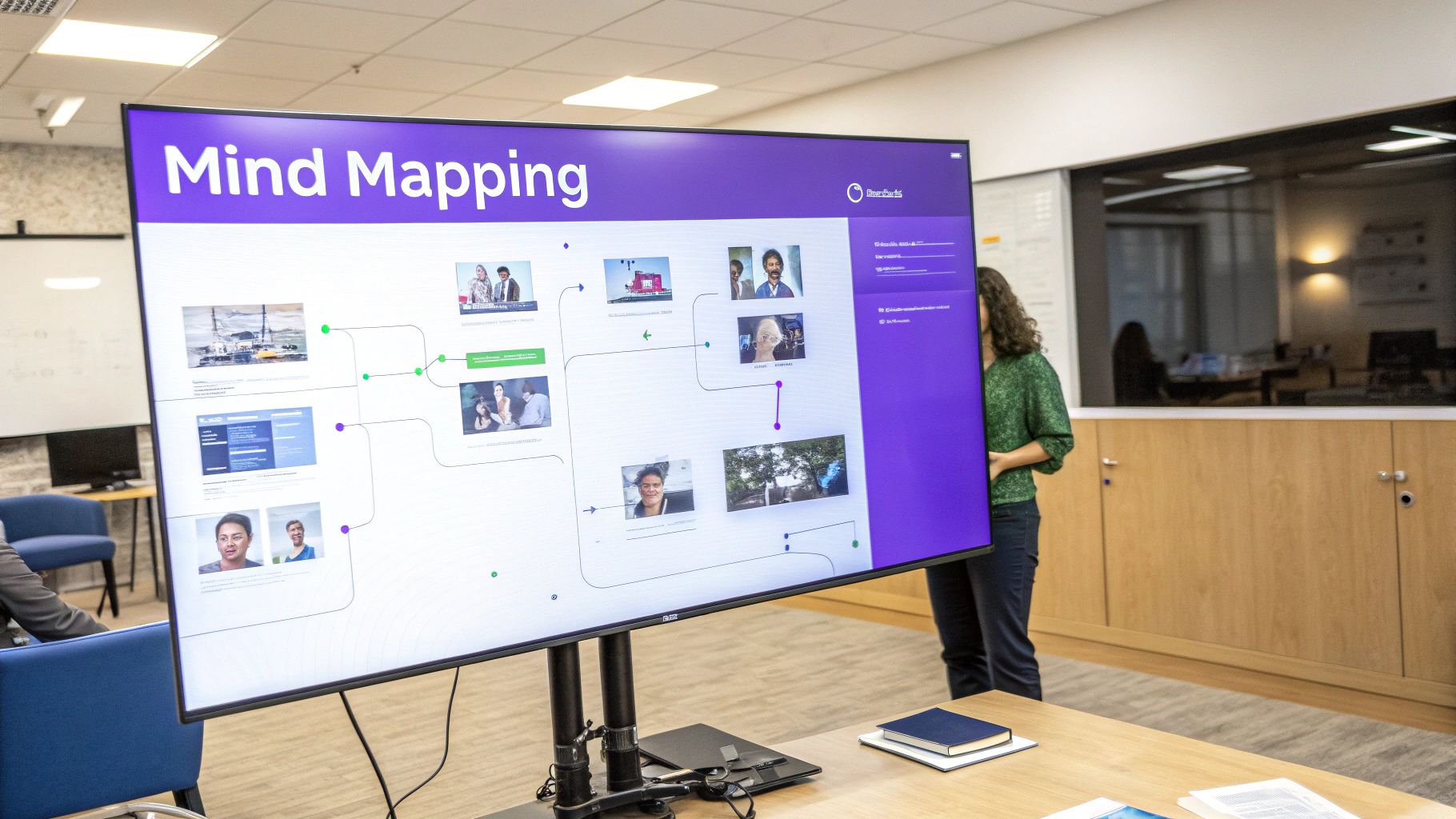
This method allows every team member to contribute branches to a central idea simultaneously, making it highly interactive and inclusive. Tools like MindMeister, XMind, and Coggle are popular for this, enabling tech startups to build product roadmaps or design agencies to map out client projects. For teams looking to visually organize ideas and processes, frameworks like remote collaborative mind mapping are crucial. This can be extended to understanding user flows by applying principles of customer journey optimization to map out every touchpoint effectively.
How to Implement Remote Collaborative Mind Mapping
- Start with a Clear Central Concept: Place your main problem, project, or question at the center of the digital canvas. This becomes the anchor for all subsequent ideas.
- Encourage Free Association: Ask team members to add primary branches representing major themes or ideas related to the central concept. Don't worry about structure initially.
- Use Visual Cues: Assign different colors, icons, or font styles to different branches or contributors. This helps organize the map visually and track idea ownership.
- Build Out Sub-Branches: Dive deeper into each primary branch by adding smaller, more detailed sub-branches. This is where the granular details and action items emerge.
- Review and Refine: Once the map is populated, facilitate a group discussion to connect related ideas, identify patterns, and prioritize key branches for further action. Learn more about effective brainstorming and mind mapping techniques.
4. Speed Brainstorming (Rapid-Fire Round-Robin)
Traditional brainstorming can often get bogged down by overthinking or dominated by a few vocal participants. Speed brainstorming, also known as a rapid-fire round-robin, injects energy and equality into ideation by forcing quick, unfiltered contributions. This high-energy group activity for work requires team members to generate and share ideas in rapid succession under strict time limits, ensuring everyone gets a chance to speak.
The core principle is to prioritize quantity and momentum over polished, perfect ideas. By moving quickly from person to person, the technique minimizes self-censorship and encourages spontaneous thinking. This method is highly effective in environments where quick turnarounds are needed, such as advertising agencies developing campaign concepts or tech startups generating feature ideas for a weekly sprint. Companies like Buffer and Slack use similar rapid ideation techniques to maintain agility and creativity within their remote teams.
How to Implement Speed Brainstorming
- Set the Stage: Begin by clearly stating the problem or question. Explicitly establish a "no-judgment" rule where all ideas, no matter how wild, are welcome.
- Keep Groups Small: For the best pace and engagement, limit each brainstorming group to 4-8 people. This ensures the "rapid-fire" nature of the activity is maintained.
- Use a Timer and a Facilitator: A facilitator keeps the round-robin moving and enforces time limits for each person's turn (e.g., 30-60 seconds). This structure is key to preventing long monologues.
- Document in Real-Time: Use a digital whiteboard or a shared document where a designated scribe can capture every idea as it's shared. This creates a visible, collective pool of thoughts.
- Separate Ideation from Refinement: After several rounds of rapid idea generation, schedule a separate session 24-48 hours later. This allows the team to return with fresh eyes to discuss, group, and prioritize the best concepts.
5. Reverse Brainstorming (Inversion Technique)
Standard brainstorming focuses on generating solutions, but what if the most insightful path to success is by planning for failure? Reverse brainstorming, also known as the inversion technique, flips the creative process on its head. This powerful group activity for work asks teams to identify ways to cause a problem or make an existing one worse, uncovering hidden risks and weak points in the process.
This method, popularized by thinkers like Charlie Munger, is especially effective for risk assessment and preemptive problem-solving. For instance, Amazon reportedly uses inversion to explore potential product safety failures, while manufacturing teams use it to proactively identify causes of defects. By analyzing what could go wrong, teams can develop more robust and resilient strategies. Platforms that support collaborative mind mapping are ideal for visually tracking inverted problems and their corresponding solutions.
How to Implement Reverse Brainstorming
- Clearly Define the Problem: Start with a specific problem or goal. For example, "How can we increase user retention?"
- Invert the Problem: Flip the statement to focus on the opposite outcome. The new prompt becomes, "How could we ensure our users leave and never come back?" or "What would absolutely ruin our user retention?"
- Brainstorm Causes for the Inverted Problem: Encourage the team to generate as many ideas as possible that would lead to this negative outcome. No idea is too outrageous at this stage.
- Group and Identify Root Causes: Collect all the "negative" ideas and look for common themes or underlying issues. These are your most significant risks.
- Convert Problems into Solutions: Once you have a clear list of potential failures, flip them back into positive, actionable solutions. An idea like "Make the app confusing to navigate" becomes a solution: "Develop a clear, intuitive user interface and conduct usability testing."
6. Anonymous Idea Submission and Evaluation
Status bias and groupthink can stifle innovation, preventing great ideas from surfacing. Anonymous idea submission and evaluation is a powerful group activity for work that neutralizes hierarchy and fear of judgment. This method allows team members to submit ideas through a digital platform without revealing their identity, ensuring that proposals are judged solely on their merit, not on who suggested them.
This approach creates a psychologically safe environment where introverts, junior employees, and remote team members feel empowered to contribute their most creative thoughts. Companies like Spotify have used similar models in their internal innovation programs to source groundbreaking ideas from all levels of the organization. The core principle is simple: focus on the idea, not the individual. By separating the two, teams can engage in more objective and productive discussions, leading to better outcomes. For a deeper dive, learn more about how to run effective anonymous brainstorming sessions.
How to Implement Anonymous Idea Submission
- Choose the Right Platform: Use tools like a shared document, a dedicated form (like Google Forms), or specialized software that supports anonymous contributions.
- Set Clear Guidelines: Provide a clear prompt, submission criteria (e.g., problem, proposed solution, potential impact), and a firm deadline. This ensures all ideas are presented in a consistent format.
- Establish Evaluation Criteria: Before the review, agree on how ideas will be judged. Common criteria include feasibility, impact, alignment with company goals, and resource requirements.
- Facilitate an Unbiased Review: Gather the team to discuss and evaluate the submitted ideas without revealing the authors. Use a structured process like dot voting to identify the top contenders.
- Reveal Authorship Strategically: Once the best ideas have been selected, you can reveal the authors to assign ownership and recognize their contributions. This step reinforces the value of participation.
7. Role-Playing and Perspective-Taking Scenarios
Stepping into someone else's shoes is a powerful way to unlock innovation and empathy. Role-playing and perspective-taking scenarios are group activities for work that move teams beyond their own assumptions by having them adopt the viewpoints of different stakeholders. This technique encourages participants to embody personas like customers, competitors, or future users to uncover fresh insights and creative solutions.
This method forces a shift in mindset, revealing pain points and opportunities that are easily missed from an internal perspective. For example, Airbnb famously hosts sessions where employees role-play as guests to better understand the user journey, while product teams at Dropbox use detailed customer scenario walkthroughs to refine features. The goal is to build deep, empathetic connections with the people you serve, leading to more user-centric products and services. Platforms like Bulby facilitate these sessions by providing structured templates for persona development and scenario mapping, ensuring the activity is productive and focused.
How to Implement Role-Playing Scenarios
- Develop Detailed Personas: Create comprehensive profiles for each role. Include demographics, motivations, pain points, and specific goals. The more detailed the persona, the more immersive the experience.
- Set the Scene: Define a clear scenario or problem for the team to navigate from their assigned perspective. For remote teams, use virtual backdrops or shared digital whiteboards to create an immersive environment.
- Provide Role Cards or Scripts: Give participants a clear brief on their character. This helps them stay in character and focus on the persona's unique needs and challenges without feeling lost.
- Record Key Insights: Assign a scribe to capture important quotes, ideas, and "aha" moments that emerge from each perspective. This ensures valuable insights aren't forgotten after the session.
- Debrief and Synthesize: After the role-play, hold a debriefing session. Discuss what each person learned, what surprised them, and how these new perspectives can be applied to the project at hand.
8. Constraint-Based Ideation
Unlimited resources and endless time can paradoxically lead to creative paralysis. Constraint-based ideation flips this script by imposing specific limitations on the brainstorming process, forcing teams to think more resourcefully and creatively. This group activity for work channels focus by defining a tight box, which often leads to more practical and innovative solutions than open-ended ideation.
This method isn't about stifling ideas; it's about giving them direction. By setting boundaries around time, budget, technology, or materials, you challenge your team to find clever workarounds and focus on what’s truly essential. For instance, indie game developers often create groundbreaking games by working within strict hardware limitations, and Kickstarter projects excel by designing products that can be built with a limited budget. It’s a powerful way to turn limitations into a source of strength.
How to Implement Constraint-Based Ideation
- Define Clear Constraints: Start by establishing specific and transparent limitations. Are you limited by a $1,000 budget, a two-week timeline, or the requirement to use only existing software? Make sure everyone understands the "box" they are working in.
- Start Loose and Tighten Gradually: If your team is new to this method, begin with broader constraints and add more specific ones in later rounds. This iterative tightening prevents teams from feeling overwhelmed initially.
- Combine Constraint Types: For a more complex challenge, layer multiple constraints. For example, "Develop a marketing campaign for a new feature with a $500 budget that must be executed within 48 hours using only our internal social media channels."
- Visualize the Boundaries: Use visual aids like "constraint cards" or a dedicated section on a digital whiteboard to keep the limitations top-of-mind. This constant reminder helps anchor the ideation process.
- Celebrate Ingenuity: Actively recognize and celebrate ideas that creatively solve the problem within the given constraints. This reinforces the value of resourceful thinking and encourages future participation in similar group activities for work.
9. Divergent-Convergent Thinking Cycles
Many brainstorming sessions produce a flurry of ideas but struggle to translate them into concrete actions. Divergent-Convergent Thinking Cycles solve this problem by creating a structured rhythm for innovation. This methodology, central to frameworks like Stanford's Design Thinking, alternates between two distinct phases: divergent thinking (generating a wide range of possibilities without judgment) and convergent thinking (analyzing, refining, and selecting the best ideas to move forward).
This dual-cycle approach ensures that creative exploration is balanced with practical decision-making, making it one of the most effective group activities for work when you need both innovation and results. Platforms like Bulby integrate this process into guided brainstorming modules, providing clear transitions that help remote teams avoid getting stuck in endless ideation. Companies like Google and Microsoft use similar innovation workshops to fuel product development, proving its value in high-stakes environments. This method provides the structure needed to explore freely and then focus purposefully.
How to Implement Divergent-Convergent Thinking Cycles
- Set Strict Phase Boundaries: Clearly announce the start and end of each phase. During the divergent phase, enforce a "no criticism" rule to encourage wild ideas. During the convergent phase, introduce specific criteria like impact, feasibility, and alignment to guide selection.
- Use Visual Cues: Use different colors, icons, or sections on a digital whiteboard to visually separate divergent ideas from convergent decisions. This helps participants mentally switch between the two modes of thinking.
- Record Everything First: Ensure all ideas from the divergent phase are captured and visible before beginning the convergence process. This prevents premature judgment and ensures every concept is considered on its merits.
- Schedule Breaks Between Phases: A short break between divergence and convergence allows the team to reset mentally. This transition is crucial for shifting from a creative, expansive mindset to a more analytical and critical one. To better understand the creative mindset, you can learn more about what divergent thinking is in psychology.
- Repeat the Cycle for Refinement: Don't limit yourself to a single cycle. Use the output of one convergent phase as the starting point for another round of divergent thinking to dig deeper into promising solutions.
10. Diversity-Driven Ideation with Cognitive Diversity Mapping
Standard brainstorming can unintentionally favor dominant thinking styles, leading to homogenous ideas. Diversity-driven ideation with cognitive diversity mapping is a powerful group activity for work that intentionally leverages different thinking styles, backgrounds, and expertise to foster groundbreaking innovation. This structured approach recognizes that a mix of perspectives is a catalyst for creativity and problem-solving.
This method involves identifying and mapping the cognitive diversity within a team before an ideation session. Research from McKinsey consistently shows that diverse teams financially outperform less diverse competitors by as much as 35%. Tech giants like Microsoft build on this by creating cross-functional teams that combine engineering, design, and marketing perspectives to build better products. The goal is to consciously assemble a "whole brain" group that can analyze problems from every conceivable angle, preventing blind spots and unlocking truly innovative solutions.
How to Implement Diversity-Driven Ideation
- Map Your Team's Cognitive Diversity: Before the session, use assessments (like Myers-Briggs, DiSC, or Herrmann Brain Dominance Instrument) to understand the thinking preferences of participants. Are they analytical, creative, relational, or process-oriented?
- Intentionally Mix Breakout Groups: Create small, diverse teams for breakout sessions. Ensure each group has a mix of cognitive styles, roles, departments, and backgrounds to spark dynamic conversations and avoid groupthink.
- Use Explicit Rotation and Roles: Assign roles within groups (like devil's advocate, visionary, or pragmatist) and rotate them. This technique ensures that different perspectives are explicitly sought out and valued during the discussion.
- Train Facilitators on Mitigating Bias: A skilled facilitator is crucial for creating psychological safety. They must be trained to recognize and gently redirect unconscious biases, ensuring every voice is heard and respected.
- Document Perspective Origins: When evaluating ideas, note which diverse perspectives or combinations of thinking styles contributed to the most promising solutions. This reinforces the value of cognitive diversity for future group activities for work. You can use platforms like Bulby to run research-backed exercises designed specifically to harness the power of diverse teams.
Comparison of 10 Group Ideation Activities
| Technique | 🔄 Implementation complexity | ⚡ Resource & speed | ⭐ Expected outcomes / 📊 Impact | 💡 Ideal use cases | Key advantages |
|---|---|---|---|---|---|
| Structured Brainstorming Sessions with AI Guidance | Medium–High — platform setup, training, facilitation | Moderate resources; synchronous + asynchronous; medium speed ⚡ | ⭐⭐⭐⭐ — high-quality, measurable insights; strong tracking 📊 | Product development, innovation sprints, campaign strategy 💡 | Equal participation; bias detection; idea tracking |
| The Six Thinking Hats Method | Low–Medium — simple rules but needs skilled facilitation 🔄 | Low resources; structured pacing; moderate speed ⚡ | ⭐⭐⭐⭐ — systematic, balanced decisions; reduces conflict 📊 | Decision-making, sprint planning, workshops 💡 | Ensures all perspectives; shortens meetings |
| Remote Collaborative Mind Mapping | Low–Medium — tool familiarity and moderation 🔄 | Moderate resources (whiteboard tools); real-time visual speed ⚡ | ⭐⭐⭐⭐ — strong visual clarity; identifies connections 📊 | Strategic planning, feature exploration, content mapping 💡 | Captures non-linear thinking; reusable visual record |
| Speed Brainstorming (Rapid-Fire) | Low — simple rules; needs tight facilitation 🔄 | Low resources; very fast ideation ⚡⚡ | ⭐⭐⭐ — high idea volume quickly; quality varies 📊 | Quick ideation, campaign concepts, sprint kickoffs 💡 | Fast output; forces spontaneity; equal turns |
| Reverse Brainstorming (Inversion) | Medium — reframing skill and facilitation required 🔄 | Low–Moderate resources; slower analytical pace ⚡ | ⭐⭐⭐⭐ — strong at risk discovery and blind-spot ID 📊 | Risk assessment, contingency planning, safety reviews 💡 | Reveals hidden assumptions; improves robustness |
| Anonymous Idea Submission and Evaluation | Low–Medium — platform management and moderation 🔄 | Moderate resources (platform + governance); asynchronous speed ⚡ | ⭐⭐⭐⭐ — improves inclusivity and idea quality; reduces status bias 📊 | Employee suggestions, innovation challenges, product feedback 💡 | Eliminates hierarchy bias; boosts participation |
| Role-Playing & Perspective-Taking Scenarios | Medium–High — scenario design and facilitation 🔄 | Moderate resources (prep time, assets); slower sessions ⚡ | ⭐⭐⭐⭐ — strong empathy and user insight; memorable impact 📊 | UX design, customer empathy, market expansion 💡 | Builds stakeholder insight; uncovers unmet needs |
| Constraint-Based Ideation | Low–Medium — requires careful constraint design 🔄 | Low resources; focused pace; efficient output ⚡ | ⭐⭐⭐⭐ — practical, implementable solutions; reduces scope creep 📊 | Startup ideation, rapid prototyping, cost-limited projects 💡 | Drives practicality; improves resource efficiency |
| Divergent–Convergent Thinking Cycles | Medium–High — phase management and facilitation 🔄 | Moderate–High resources (time); deliberate pace ⚡ | ⭐⭐⭐⭐⭐ — balances creativity and action; produces actionable outputs 📊 | Complex problem-solving, strategic initiatives, product development 💡 | Prevents premature evaluation; clear milestones |
| Diversity‑Driven Ideation with Cognitive Diversity Mapping | High — assessments, team design, skilled facilitation 🔄 | High resources (recruiting, training); slower but high-value ⚡ | ⭐⭐⭐⭐⭐ — higher innovation & decision quality (research-backed) 📊 | Breakthrough innovation, new-market entry, strategic planning 💡 | Produces more novel solutions; reduces groupthink |
Sparking Innovation, One Activity at a Time
The journey through these ten powerful group activities for work reveals a fundamental truth: innovation is not accidental, it is engineered. From the structured chaos of Speed Brainstorming to the empathetic depth of Role-Playing Scenarios, each technique offers a unique pathway to unlocking your team's collective genius. We have moved beyond the outdated image of a chaotic, unstructured free-for-all and into an era of intentional, facilitated creativity.
The core lesson from these methods is that the process of idea generation is just as important as the ideas themselves. By implementing structured frameworks, you create an environment of psychological safety where every team member feels empowered to contribute. Techniques like Anonymous Idea Submission directly combat groupthink and authority bias, ensuring that the best ideas rise to the top, regardless of who suggested them. Similarly, the Six Thinking Hats method provides a common language for collaboration, preventing conversations from derailing into unproductive debate.
From Theory to Tangible Results
Adopting these practices is about more than just finding the next big idea; it's about building a resilient, adaptable, and highly engaged team culture. When you regularly engage in diverse group activities for work, you are actively training your team's creative muscles. You are teaching them to:
- Approach problems from multiple angles: Reverse Brainstorming and Constraint-Based Ideation force teams to break free from conventional thinking patterns and explore unconventional solutions.
- Leverage cognitive diversity: The Diversity-Driven Ideation method demonstrates that true innovation comes from synthesizing a wide range of perspectives, backgrounds, and thinking styles, not from seeking consensus.
- Balance creativity with practicality: The Divergent-Convergent Thinking Cycles provide a crucial rhythm to your innovation process, ensuring that expansive brainstorming is followed by focused, actionable decision-making.
These are not just one-off exercises for an annual offsite. They are practical tools designed to be integrated into your weekly sprints, project kickoffs, and strategic planning sessions. The true value emerges when these activities become a regular part of your team’s operational rhythm, creating a continuous engine for improvement and innovation.
Your Next Step: Putting Action into Practice
The sheer number of options can feel overwhelming, but the path forward is simple: start small and be consistent. You don't need to implement all ten methods tomorrow. The goal is to begin building momentum.
Here is a simple action plan to get started:
- Choose One Activity: Select a single activity from this list that best addresses a current challenge your team is facing. Is your team stuck in a rut? Try Reverse Brainstorming. Do you need to generate a high volume of ideas quickly? Go with Speed Brainstorming.
- Schedule a 30-Minute Session: Block out a short, dedicated time slot in the next week to try it. Frame it as an experiment, lowering the pressure and encouraging open participation.
- Gather Feedback: After the session, ask your team what worked and what didn’t. Use their feedback to refine your approach for the next time. Continuous improvement applies to your innovation process itself.
By taking this first small step, you initiate a powerful ripple effect. You signal to your team that their ideas are valued, that creativity is a priority, and that collaboration is the key to solving complex challenges. Over time, this commitment to structured group activities for work will transform your team from a group of individuals into a cohesive, innovative force capable of achieving remarkable results.
Ready to supercharge your team's creativity without the hassle of manual facilitation? Bulby is an AI-powered platform that streamlines the best group activities for work, guiding your team through research-backed exercises to unlock breakthrough ideas. Explore how you can run more effective and engaging workshops today at Bulby.