
Across 75 major countries, mentions of AI in legislative proceedings rose 21.3% in 2024, from 1,557 in 2023 to 1,889, according to Stanford University's AI Index policy and governance report. Rules are multiplying outside your team. Inside it, you don't need more meetings. You need a small operating system that decides which bets run, who can stop them, and what evidence earns scale.
Table of Contents
- What Innovation Governance Is and Why Teams Need It
- Setting Priorities Across Competing Bets
- Decision Rights From Idea to Scale
- Enabling Conditions Behind Flat Results
- Risk Rules That Keep Experiments Moving
- Portfolio Metrics That Do Not Punish Originality
- Whose Voices Change Which Ideas Survive
- Run One Governed Experiment This Month
What Innovation Governance Is and Why Teams Need It
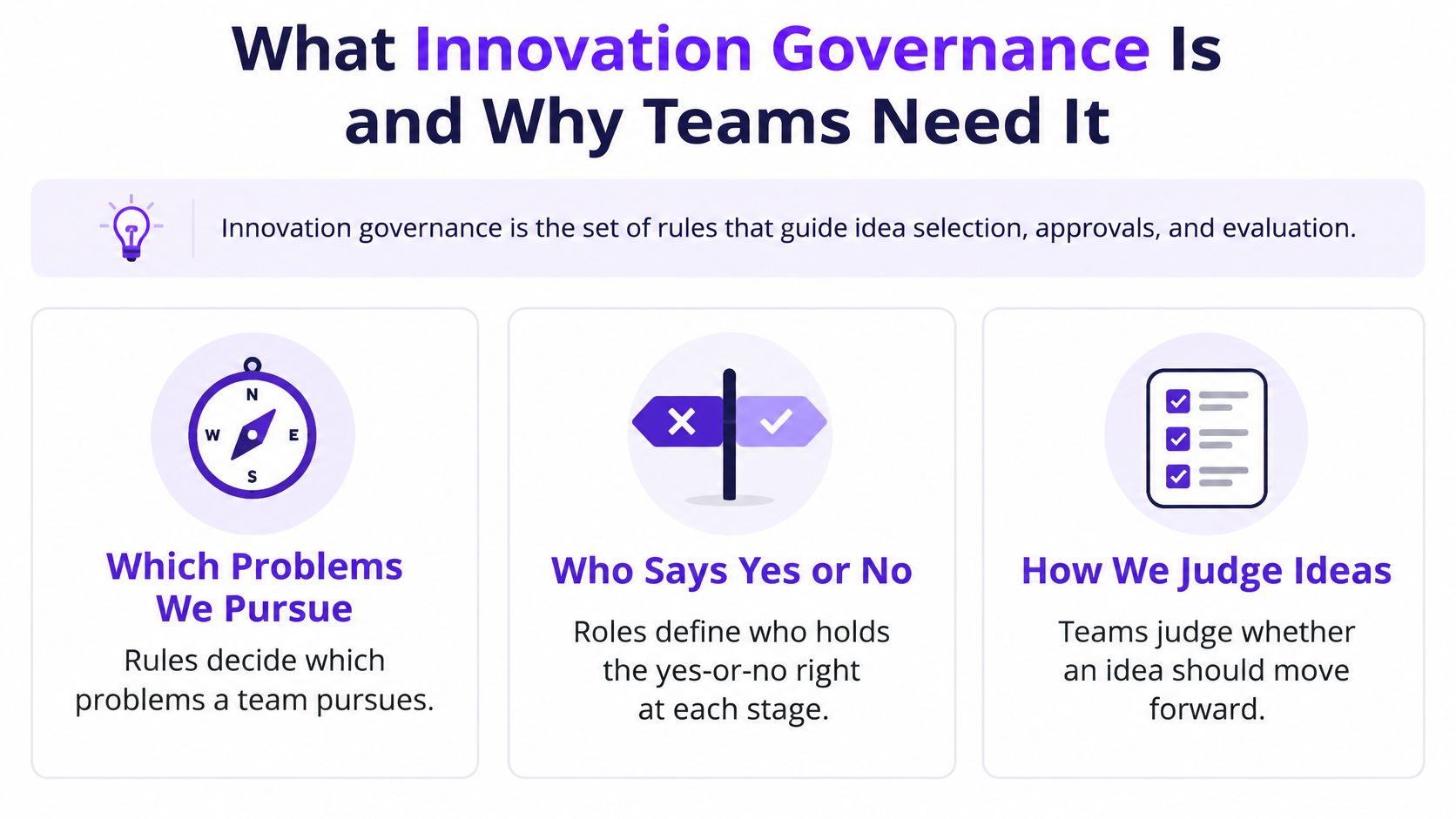
Innovation governance is the set of rules that decide which problems a team pursues, who holds the yes-or-no right at each stage, and how the team judges whether an idea created value. That's the whole definition. If a rule doesn't change one of those three decisions, it's decoration.
Say a creative team gets three requests on Monday. A client wants a new campaign territory, a product manager wants an AI feature test, and a senior leader wants last year's concept revived. Without governance, the loudest request wins and the team can't explain why the others waited.
Why scale makes informal choices expensive
The World Intellectual Property Organization press release on global R&D estimates that global R&D expenditure increased by more than 3.3% in real terms in 2025 and is projected to rise by 3.6% in 2026, reaching approximately $3.4 trillion. The same release states corporate R&D alone grew by 5.8% in real terms in 2025 to about $1.5 trillion, with software, artificial intelligence, and defense-related research as major drivers.
Your team isn't spending at that scale, but you're competing inside it. Money now comes from companies, governments, universities, and investors together, so choices cross owners, partners, data, and intellectual property. A strategy poster sets direction but assigns nobody a decision. A legal review bolted on at the end catches problems after you've paid to build the work.
A kitchen pass, not a committee
Think of tickets at a kitchen pass. Green tickets move on a clear brief and a chosen metric. Amber tickets need a named owner who checks the risk before service. Red tickets wait for explicit sign-off because the downside is real.
A good governance rule lets safe work move faster and makes risky work wait for a reason you can name.
If you're starting from scratch, you can build a governance framework with clear roles around those three rights before you write any policy. The payoff is practical. Weak concepts stop getting funded by habit, strong ideas stop waiting for a monthly meeting, and everyone can point to the brief that authorized the test.
What follows is deliberately small. You'll set priorities on one page, assign decision rights in a table, sort work into risk tiers, and track a metric set that can stop, pause, or scale a bet.
Setting Priorities Across Competing Bets
Start with a shortlist of problems, not a backlog of ideas. Ideas are cheap to generate and hard to compare. Problems can be ranked because each one names a user, a cost, and a consequence if you ignore it.
If you're unsure how centralized those choices should be, it helps to find the right governance structure for your team's size before you lock the process. A small agency team can keep ranking with one portfolio owner. A larger product group may need separate owners for client work and platform work, but the list itself stays shared.
Build the one-page list
- List every live problem: Write the user it affects and the revenue, cost, or risk it touches. Drop items that name a solution but no affected person.
- Agree the criteria first: Score customer value, strategic fit, cost to test, and learning value if it fails. Decide these before anyone pitches a favorite concept.
- Score in the open: Use a simple scale and write one sentence justifying each score. The sentence matters more than the number because it exposes guesses.
- Set a portfolio split: Reserve capacity for near-term client work, tested improvements, and longer exploratory bets. This is your team's choice, not a benchmark to copy.
- Rank inside each bucket: Cap active bets at what you can brief and review properly in one monthly portfolio meeting.
A structured comparison helps here, and product prioritization frameworks can give you scoring language if your team argues from gut feel. Don't import a framework whole. Borrow the criteria, then cut anything your reviewers won't use.
Keep the list alive
Re-score a bet when a result arrives. If the learning question is already answered, move it down even if the team likes the work. If a test reveals a bigger adjacent problem, add that problem as a new line instead of expanding the old bet subtly.
Date the page and keep it to one screen. When a stakeholder asks why a project isn't running, you point to the rank, the bucket, and the justification sentence. That's governance doing its job in plain sight.
Decision Rights From Idea to Scale
A small experiment should not need the same approval as a decision that could affect customers or the brand. Set decision rights in the experiment brief, then use the stage decision and dissent log to show who made the call and why.
| Stage | Decision owner | Evidence to proceed | Pause or kill when |
|---|---|---|---|
| Frame the opportunity | Challenge owner | Named user, constraint, and one success signal | No person or customer is affected |
| Design the experiment | Experiment lead | Hypothesis, baseline, time box, and risk tier | Amber or red risk has no assigned owner |
| Run a low-risk test | Team, using a logged brief | Brief filed and metric chosen before the test | Privacy, IP, safety, or brand-harm flag appears |
| Review the result | Portfolio owner | Result versus baseline and cost to continue | No uplift and no remaining learning question |
| Scale or stop | Portfolio owner for green; executive for red | Trust checks passed, or a written stop note | Incident, unfair impact, or weak value |
Walk the rows in order
The challenge owner frames the opportunity by naming the affected user, the constraint, and one success signal. If no one is affected, stop before designing a test.
The experiment lead writes the hypothesis, baseline, time box, and risk tier into the brief. For a low-risk test, the brief is the permission to proceed. A committee would add delay without improving the decision.
The team runs the test and records the result against the baseline. The portfolio owner then writes a scale note or a stop note. Either outcome makes the next choice clearer: one supports further investment, the other frees people to work elsewhere.
Scaling depends on risk. The portfolio owner can approve a green bet; a red bet requires an accountable executive because a mistake could affect customers, the brand, or the balance sheet. Teams that need shared language for these calls can use decision-making frameworks to distinguish reversible choices from one-way doors.
The gap this fixes
The Governance Institute of Australia report on AI deployment and governance found that 90% of surveyed Australian organizations reported using AI, yet adoption was usually isolated and often lacked leadership oversight. The report also found that 93% struggled to quantify business impact.
Those findings point to a practical governance problem: a team needs to know who decided, what evidence counted, and whether the work justified its cost.
Contrarian rule: More boards are not automatically better. A central committee that meets after the work is done can only review decisions already made.
Instead, put governance where choices happen: in the experiment brief, the stage decision, and a dated log of dissent. Record the evidence, the owner, and the reason for proceeding, pausing, or stopping. The log makes disagreement useful: it shows which concern mattered and whether the decision changed when new evidence arrived.
Assign one person to each owner role, file the first brief, and review the next decision against it. Keep the process light enough that a low-risk idea can move without waiting for a committee.
Enabling Conditions Behind Flat Results
Flat results don't always mean weak creativity. Sometimes the ideas are fine and the conditions around them are broken.
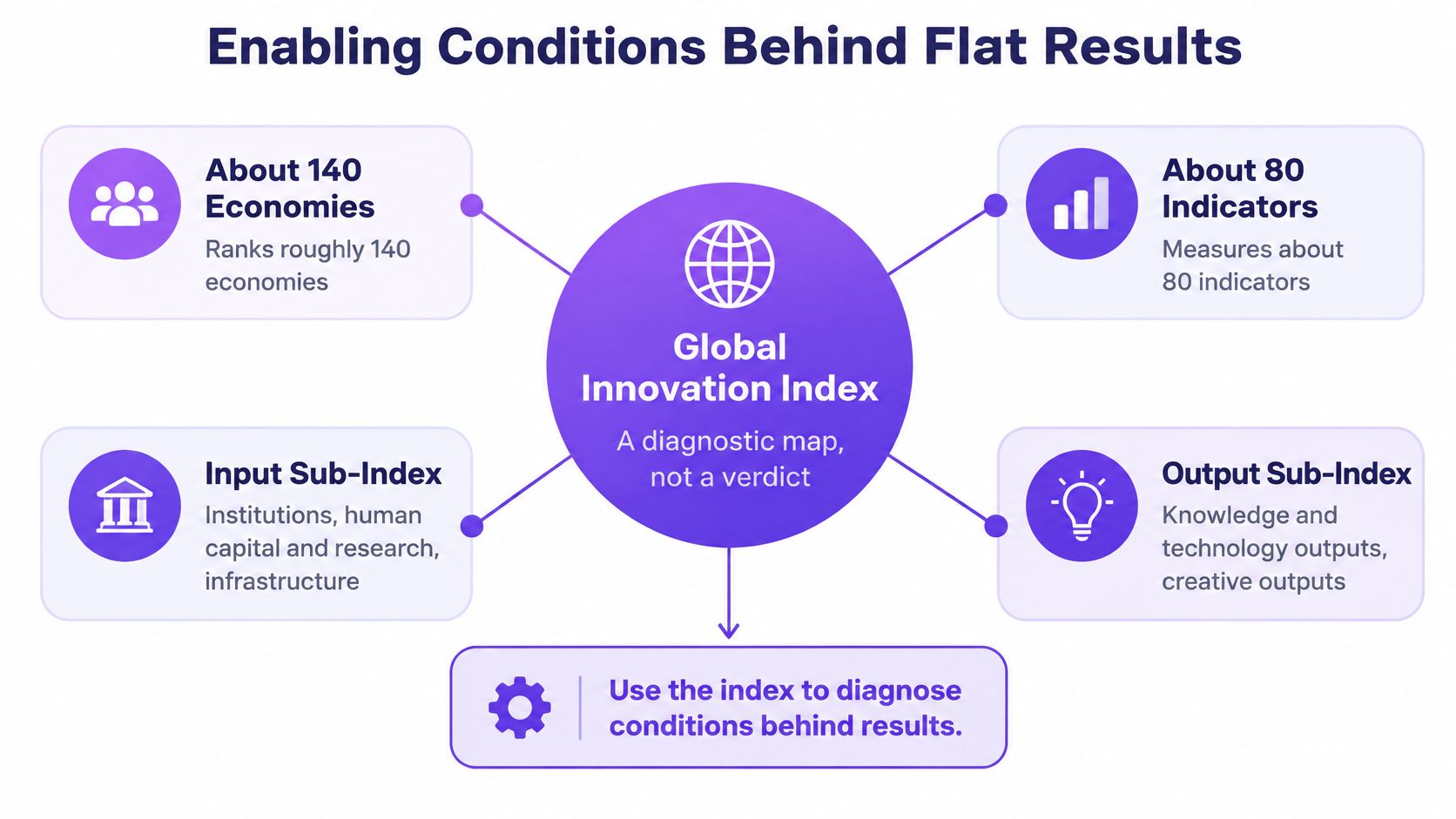
The World Intellectual Property Organization's Global Innovation Index ranks roughly 140 economies and evaluates innovation ecosystems through approximately 80 indicators. Its Innovation Input Sub-Index covers institutions, human capital and research, infrastructure, market sophistication, and business sophistication, while its Innovation Output Sub-Index covers knowledge and technology outputs and creative outputs.
Use that split only as a diagnostic map. It matters because it moves judgment beyond R&D budgets and patent counts toward the conditions that turn ideas into value. A country, or a team, can spend heavily and still harvest little if talent, infrastructure, or commercial paths are missing.
Translate inputs and outputs to a team
- Seeds are ideas: Concepts, prototypes, and campaign territories entering the system.
- Soil is capability: Talent, research skill, data access, and tools that connect.
- Weather is timing: Budget release, client deadlines, and leadership attention.
- Harvest is shipped value: A product customers use or a campaign that changes behavior, not a polished slide deck.
A dead portfolio can mean funding is stuck in one favored bet. It can mean the team lacks a skill, waits weeks for data, or has no route from prototype to a client offer. None of those problems is solved by asking people to brainstorm harder.
Before you add headcount or another workshop, tag each active bet in one of three ways. Is it weak at input, weak in process, or weak at output? Then fix that layer first.
When results are flat, check the enabling conditions before you blame the brainstorm.
Risk Rules That Keep Experiments Moving
Speed and care aren't opposites. They become opposites only when every experiment gets the same approval path.
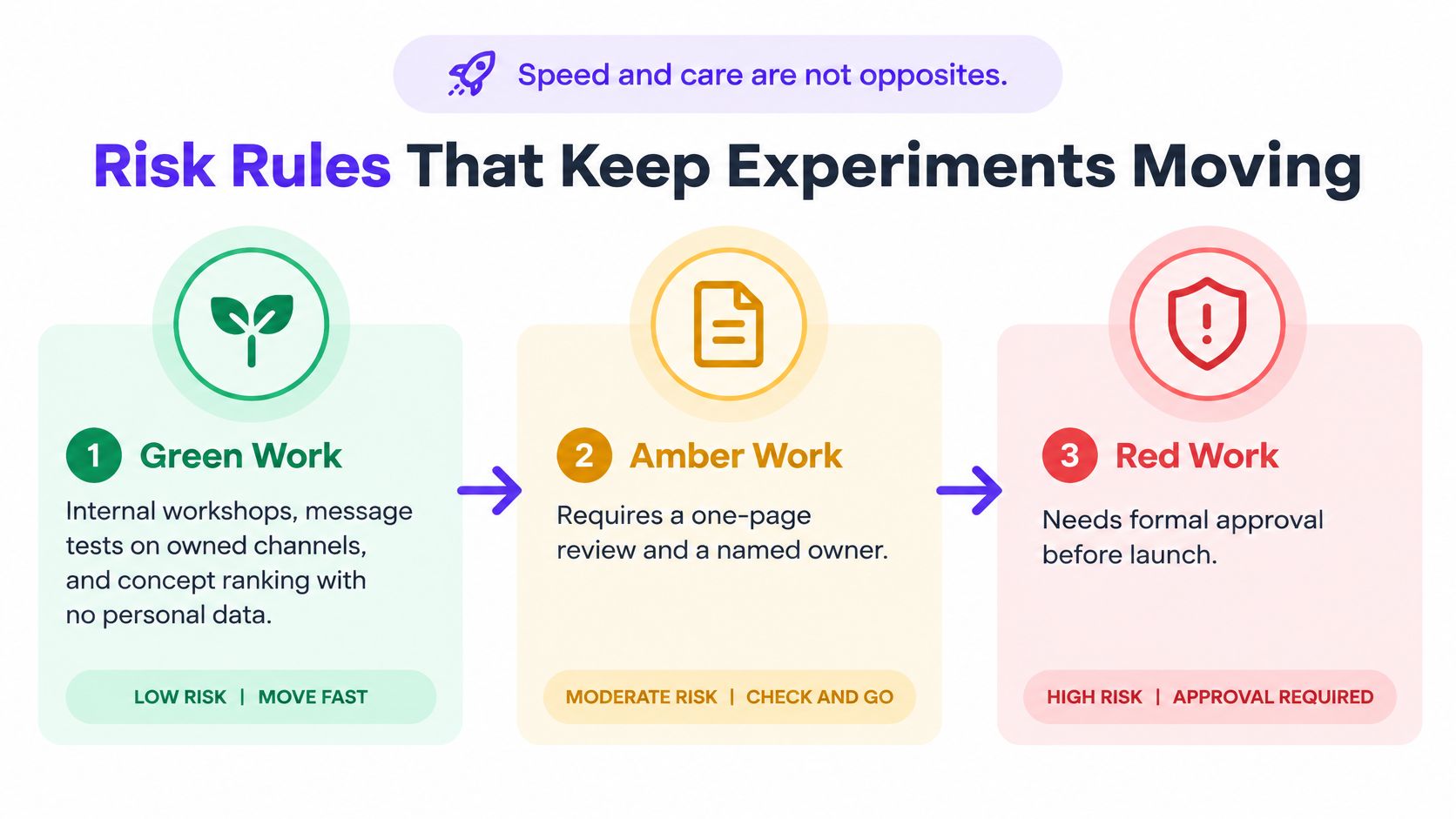
| Tier | Typical work | Before the test | After the test |
|---|---|---|---|
| Green | Workshops, owned-channel copy tests, anonymous concept ranking | One-page brief and a success metric | Review at the time box |
| Amber | Customer-data pilot, partner content, public brand claim | Named owner plus privacy and IP check | Watch complaints, quality, and consent |
| Red | Public AI affecting people, regulated claims, large spend | Mapped harms, evaluation set, baseline, escalation threshold | Restrict, retrain, or retire |
Put each tier in plain examples
A new campaign line tested with your own audience panel is usually green. A lookalike audience built from client data is amber because consent, provenance, and partner rights now matter. An automated offer that changes prices for real customers is red because people can be treated unfairly at scale.
For green tests, keep momentum with tight cycles. The CrowdTamers guide to minimum viable sprints is useful when you need a fast message test without turning it into a research program. Pair that pace with a clear idea validation process so a quick win still leaves evidence you can review.
Run red work as a loop, not a stamp
NIST's AI Risk Management Framework organizes the work into four continuous functions, Govern, Map, Measure, and Manage, and treats governance as cross-cutting rather than a final gate. The framework recommends documented testing, benchmarking, monitoring, and periodic reassessment of whether your metrics still work.
Put those functions on one red example:
- Govern: Name the accountable owner and the risk tolerance before anyone builds.
- Map: Name intended users, affected non-users, and plausible harms.
- Measure: Check accuracy, resilience, bias, privacy, explainability, and human-review performance against a baseline.
- Manage: Restrict the release, retrain the system, add controls, or retire it when thresholds are crossed.
Each red concept needs a defined use context, an evaluation dataset, a baseline comparator, and an escalation threshold. Without those four items, you aren't running an experiment. You're shipping a hope.
Governance is cross-cutting, not a final stamp.
Mislabeling creates both failure modes. Treat every sticky-note session as red and people will do shadow work outside the system. Treat a customer-data pilot as green and you'll create incidents that kill trust in experimentation itself.
Label your next three experiments before you debate the ideas. The tier decides the paperwork, the owner, and how fast you can move.
Portfolio Metrics That Do Not Punish Originality
Count what changes a decision. Drop every number that only makes activity look busy.
| Metric | Question it answers | Decision it changes |
|---|---|---|
| Validated-value uplift versus baseline | Did the bet beat the current offer, campaign, or process? | Scale or stop |
| Share of experiments with a documented evaluation | Did green, amber, and red work leave a record? | Whether an experiment can be reviewed at all |
| Time to remediate a material risk | Are amber and red issues closed in days, not quarters? | Whether a paused bet resumes or is retired |
| Failure or incident rate | Is speed creating harm? | Whether the tier for a work type is tightened |
| Share of experiments meeting the trustworthiness bar before release | Is red work leaking into production? | Whether a release is blocked |
| Shipped ideas not from the most senior person in the room | Is the room widening the portfolio? | Changing the framing and voting process |
| Kill rate of weak concepts inside the time box | Are weak bets being stopped? | Brief review; zero means nothing is stopped, above half of green tests means a vague brief |
Read the core five
Validated-value uplift versus baseline is the lead metric. It asks whether the bet beat the current offer, campaign, or process, not whether people enjoyed the workshop. No baseline means no claim of progress.
Documentation coverage sounds dull until a stakeholder asks why you scaled something. If there's no evaluation record, there's nothing to review, defend, or learn from. The same applies to remediation time. A risk you found quickly but fixed slowly is still an open risk.
Failure and incident rates tell you whether speed is creating harm. The trustworthiness share tells you whether red work is leaking into production before it passes the bar you set in advance.
Add the two measures dashboards skip
Track how many shipped ideas came from someone other than the most senior person in the room. A low share doesn't prove bias by itself, but it's a strong prompt to change framing, voting, or who speaks first.
Track the kill rate inside the time box too. Treat the range as directional, not universal. A zero rate usually means nothing is being stopped. A very high rate on green tests usually means the brief was vague, so teams tested concepts that never had a clear user or metric.
If you need a broader starting point, how to measure innovation can help you separate output counts from outcome evidence. Then cut ruthlessly.
Don't count ideas generated, meetings held, or patents filed as progress. They're inputs at best.
Add data only as a throughput check. How long does approved access take, and did that data asset produce a prototype or a measurable customer result? Review the set monthly and retire any metric that never changes a proceed, pause, or stop decision.
Whose Voices Change Which Ideas Survive
A portfolio can pass every compliance check and still be dull, biased, and blind. Who frames the problem decides which ideas look sensible later.
The team in this image is doing the visible part of collaboration. Governance has to handle the invisible part, whose objection gets recorded and whose idea survives contact with status.

The OneTrust data and AI survey report found that 73% of governance-focused leaders reported that AI had exposed critical gaps in visibility, collaboration, and policy enforcement, and 75% said AI revealed limitations in legacy governance processes. It also cites HPE's 2025 global survey finding that fewer than half of organizations demonstrated competency across data-preparedness and governance stages, while legal, HR, and security functions were increasingly excluded from AI initiatives.
Translate that to an agency or product team. If account, research, support, and the people closest to the customer arrive after framing, the portfolio repeats last year's campaign with new wording. Concerns about unconscious bias in creative ideas and inequality in innovation aren't abstract here. They show up as familiar faces winning familiar arguments.
Adding seats is not the same as changing decisions
Status, time pressure, and the first AI suggestion can collapse a room onto one idea in minutes. More voices won't help if the process still rewards speed, confidence, and seniority.
This short video is worth watching before your next selection meeting because it gives the team a shared reference point for how discussion shapes choices.
Use three practices instead of a slogan:
- Anonymous contribution: A junior strategist and a director submit lines without names attached, so the work is ranked before the résumé.
- Rotating challenge role: One assigned person argues the kill case for ten minutes before any favorite is picked. Rotate it so dissent isn't one person's personality.
- Dissent note: The decision log records the objection that was overruled, who made the call, and who would bear the downside after launch.
Contrast two pitch weeks. In the first, the loudest executive creative director picks the line on sight. In the second, three contradictory territories survive to test because the challenge role protected them long enough to gather evidence.
After launch, ask who benefited and who carried the risk, including the client audience. If the same groups benefit and the same groups absorb the downside, your participation design is a governance problem, not a culture poster.
Run One Governed Experiment This Month
Don't launch a governance program. Run one live bet under the rules and see whether a decision changes.
Four weeks, one bet
Week 1, frame it. Pick one client, product, or campaign problem. Name the challenge owner and write the user, the constraint, and one success signal on the priority page.
Week 2, collect before you debate. Invite the working group plus one person who usually arrives late, such as support, legal, research, or the account lead who hears client objections first. Use brainwriting with anonymous submissions so status doesn't pick the opening idea. Bulby is an online AI brainstorming tool that uses brainwriting, anonymous submissions, and AI-generated sparks, and its process moves from entering the challenge and inviting the team with one link through random exercises to an AI summary of the strongest ideas with next steps.
Week 3, tier and test. Label the chosen concept green, amber, or red. Log the owner, baseline, metric, and time box, then run only what that tier allows. If a privacy, IP, safety, or brand flag appears, pause and re-tier instead of arguing around it.
Week 4, decide in writing. Compare the result with the baseline. Write a scale note or a stop note, record any objection that was overruled, and name who owns the next action or the retirement.
Skip the new committee, the maturity model, and the policy binder. If the note changed a decision, released budget, blocked a risky release, or freed the team from weak work, your innovation governance system is already working.
Put this operating system on your next real challenge with Bulby, where anonymous brainwriting collects ideas before status shapes the shortlist and AI summaries turn the session into clear next steps. Try the public demo session with no login on the question "How might we improve team meetings to save time?", then bring the strongest output into your experiment brief, risk tier, and decision log.