
In today's complex work environment, building a cohesive and innovative management team requires more than just good intentions. It demands strategic, engaging experiences that sharpen decision-making, foster psychological safety, and align leadership on critical goals. Traditional team-building exercises often fall short, feeling disconnected from the real challenges managers face. This is where management games for team building come in, transforming abstract leadership concepts into tangible, memorable experiences.
These activities are not about trust falls or generic icebreakers. Instead, they are structured simulations designed to test and improve critical skills like strategic planning, resource allocation, and cross-functional communication under pressure. They provide a safe space for leaders to experiment with new approaches, identify hidden team dynamics, and build genuine rapport based on shared problem-solving. For leaders seeking fresh perspectives beyond traditional methods, exploring these 9 Next-Level Corporate Team Building Activities can provide valuable inspiration.
This guide provides a curated list of 10 powerful games and simulations designed specifically for modern management teams, whether they're in the same room or spread across the globe. We'll explore how each activity works, its specific benefits, and how you can use tools like Bulby to amplify the outcomes, ensuring every session translates into measurable improvements in collaboration and performance. Get ready to move beyond the conventional and unlock your management team's true potential.
1. Escape Room Challenges
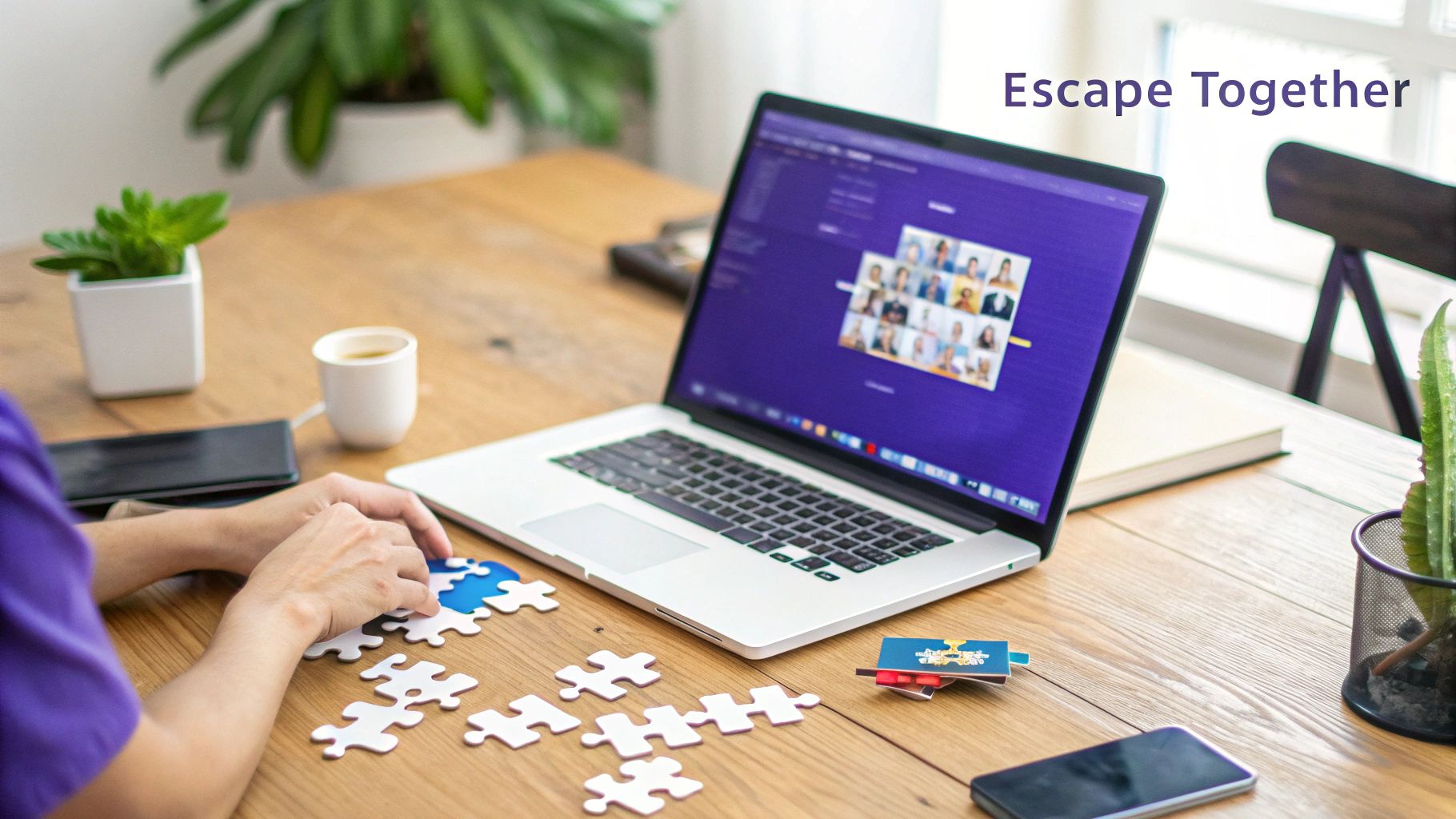
Virtual escape rooms are immersive, time-bound challenges where teams collaborate to solve puzzles, decipher clues, and achieve a common goal. They transport your management team from their daily tasks into a high-stakes scenario that demands sharp communication, creative problem-solving, and efficient delegation. This makes them one of the most effective management games team building activities available for remote and hybrid teams.
The shared sense of urgency breaks down formal hierarchies and encourages natural leadership skills to emerge. Managers must think on their feet, trust their teammates' judgments, and synthesize diverse pieces of information under pressure, revealing team dynamics in a controlled, engaging environment.
Why It Works for Management Teams
Escape rooms are excellent for observing how leaders perform under pressure. You can see who steps up to organize the chaos, who excels at detailed analysis, and who keeps the team motivated. The experience provides a tangible, shared memory that strengthens interpersonal bonds long after the game ends. Companies like Google, Microsoft, and Airbnb use providers like The Escape Game and Puzzle Break to foster this exact kind of collaborative resilience.
How to Implement It Effectively
- Choose a Relevant Theme: Select a scenario that aligns with your industry or a current project, such as a "cybersecurity breach" for a tech team, to make the problem-solving more relatable.
- Assign Rotating Roles: Before starting, assign roles like Timekeeper, Scribe (to note clues), and Lead Communicator. This ensures everyone is actively involved and prevents one or two voices from dominating.
- Use Breakout Rooms Strategically: If the platform allows, use video conference breakout rooms to simulate splitting up to solve different puzzles, forcing smaller groups to communicate their findings back to the main team.
- Conduct a Thorough Debrief: The real value comes after the game. Host a debrief session to discuss what went well, where communication broke down, and how the team can apply these lessons to real-world projects.
For more ideas on similar challenges, explore these team problem-solving activities on remotesparks.com.
2. Innovation Challenge Tournaments
Innovation Challenge Tournaments are structured competitions where management teams develop novel solutions to specific business problems under a tight deadline. Teams are given a prompt, a set of constraints, and a timeframe to brainstorm, refine, and present an innovative idea. This format gamifies strategic thinking and transforms routine problem-solving into an energetic, competitive experience.
This approach is one of the most dynamic management games team building activities because it directly mirrors the high-stakes environment of business innovation. Managers must collaborate to analyze a problem, ideate creatively, and build a compelling business case for their solution, all while competing against their peers. The process reveals who excels at strategic thinking, persuasive communication, and practical execution.
Why It Works for Management Teams
This format is a powerful tool for identifying and nurturing intrapreneurial talent within your leadership group. It encourages managers to think beyond their departmental silos and contribute to broader organizational goals. The competitive element drives a higher level of engagement and pushes teams to produce their most creative work. Companies like 3M and Google use similar internal innovation challenges to source groundbreaking ideas and foster a culture of continuous improvement.
How to Implement It Effectively
- Create a Specific but Open Brief: The problem statement should be well-defined (e.g., "Reduce customer onboarding time by 20%") but not so restrictive that it stifles creativity.
- Form Cross-Functional Teams: Intentionally mix managers from different departments like marketing, finance, and operations to ensure a diversity of perspectives and more robust solutions.
- Provide a Clear Evaluation Rubric: Before the challenge begins, share the judging criteria, such as Feasibility, Impact, Creativity, and Presentation Quality. This ensures fairness and focuses team efforts.
- Commit to a Winning Idea: The biggest motivator is seeing an idea come to life. Allocate a small budget or dedicated resources to pilot or prototype the winning concept, showing that the organization values innovation.
To structure your competition effectively, you can find a suitable ideation framework on remotesparks.com.
3. Business Simulation Games
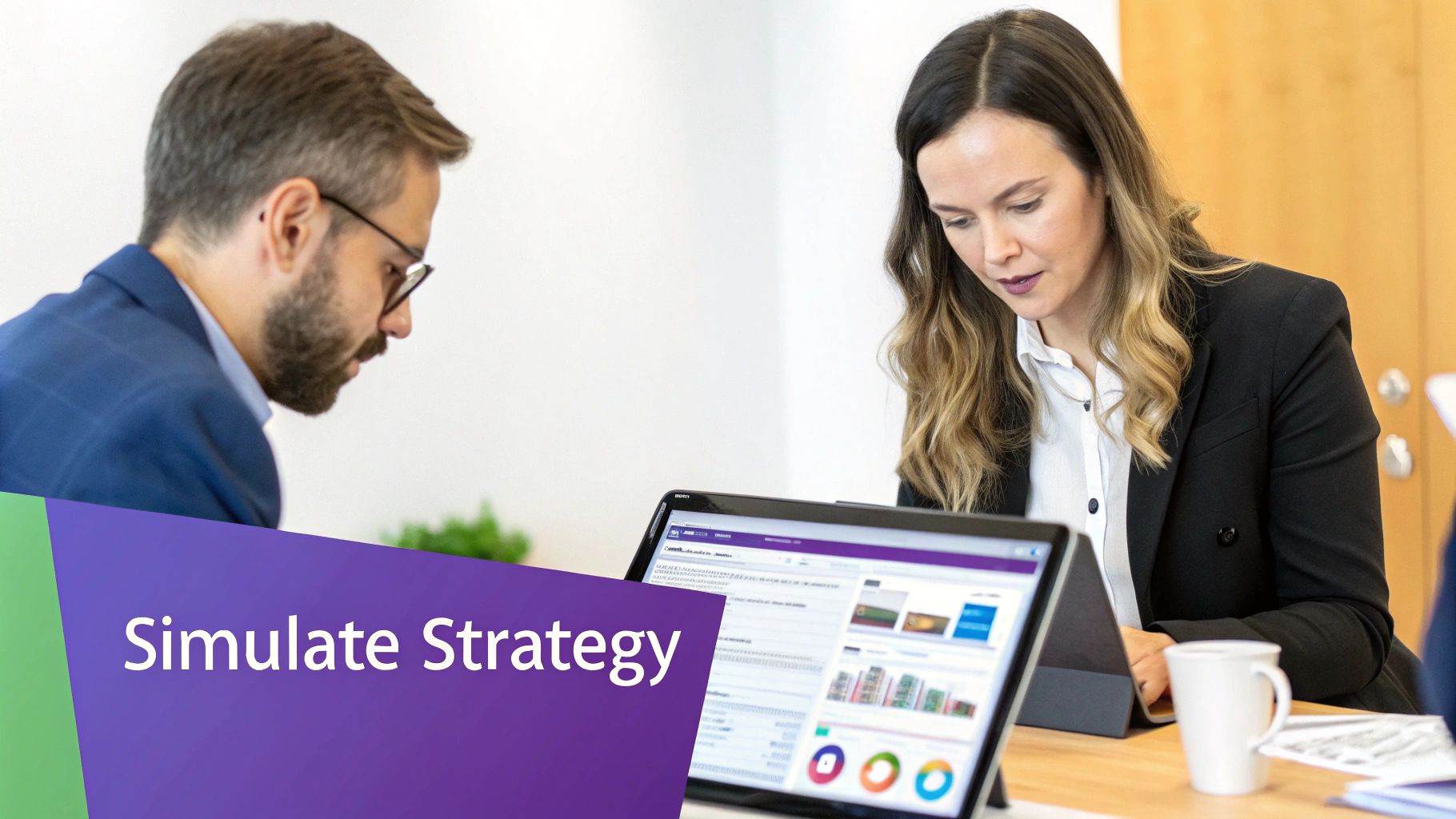
Business simulation games place your management team at the helm of a virtual company, challenging them to make high-stakes strategic decisions in a competitive market. Participants manage everything from finance and marketing to product development, experiencing the direct consequences of their choices over several simulated quarters or years. This creates a powerful, risk-free environment to practice strategic thinking, making it one of the most impactful management games team building activities for developing business acumen.
These complex simulations move beyond simple problem-solving and force managers to engage in systems thinking. They must analyze market data, anticipate competitor moves, and align cross-functional decisions to achieve long-term goals, mirroring the complexities of real-world executive leadership.
Why It Works for Management Teams
Business simulations are unparalleled for revealing a team's strategic alignment and decision-making processes. You can observe how the team balances short-term wins with long-term sustainability and how they navigate trade-offs between departments. Esteemed MBA programs and Fortune 500 companies use platforms like Capsim and Marketplace Simulations precisely because they build a shared understanding of business operations and financial drivers.
How to Implement It Effectively
- Provide Pre-Game Training: Ensure everyone understands the game's mechanics and financial metrics by holding a dedicated training session before the simulation begins.
- Rotate Roles Each Round: Assign specific roles like CFO, Head of Marketing, and VP of R&D for each simulated period. Rotating these roles gives every manager a deeper appreciation for different functional perspectives.
- Tie Results to Company Goals: Frame the simulation's objectives around a real-world company challenge, such as market expansion or launching a new product line, to make the lessons more applicable.
- Facilitate Strategic Debriefs: After each round, facilitate a discussion focused on strategy. Ask questions like, "Why did we make that investment?" and "What would we do differently knowing what our competitors did?"
To further sharpen your team's strategic thinking, explore these different decision-making frameworks on remotesparks.com.
4. Murder Mystery Dinner Parties (Virtual)
Virtual murder mystery parties are interactive storytelling experiences where each manager assumes a unique character and collaborates with the team to solve a fictional crime. These events combine role-playing, problem-solving, and communication in an entertaining format, making them a standout choice for management games team building. Participants receive character briefs, clues, and objectives, all managed through a video conferencing platform.
The informal and playful setting encourages managers to step outside their typical roles, fostering creative thinking and deductive reasoning. As the plot unfolds, the team must work together to connect evidence, question suspects (each other), and reach a consensus. This dynamic environment reveals how individuals handle ambiguity, persuade others, and contribute to a collective investigation under a lighthearted premise.
Why It Works for Management Teams
This activity is exceptional for observing negotiation, influence, and information analysis skills in a low-stakes setting. It highlights who can build alliances, who pays attention to subtle details, and who can articulate a compelling argument. For an engaging social and problem-solving activity, consider a murder mystery dining experience where teams work together to uncover clues and solve a fictional crime. Companies like Whodunit Entertainment and The Murder Mystery Co. specialize in corporate events that build camaraderie and sharpen these essential management skills.
How to Implement It Effectively
- Choose a Professional Theme: Opt for a mystery with a corporate or relatable setting, such as a "scandal at a tech conference," to maintain a professional yet engaging tone.
- Provide Briefs in Advance: Send out character roles and backstories at least a few days ahead of time. This gives participants time to understand their character's motivations and prepare.
- Assign Listening-Based Roles Strategically: Give more introverted team members roles like the "Private Investigator" or "Detective," which are centered on listening, observing, and piecing together information from others.
- Encourage Costumes and Props: Simple props or virtual backgrounds significantly increase immersion and engagement. Encourage participants to embrace their characters to maximize the fun and creativity.
- Facilitate a Post-Game Debrief: After the killer is revealed, host a discussion about the team's problem-solving process. Ask questions like, "Which pieces of evidence were misleading?" and "How did we decide who to trust?" to connect the game to real-world collaboration.
5. Cross-Functional Hackathons
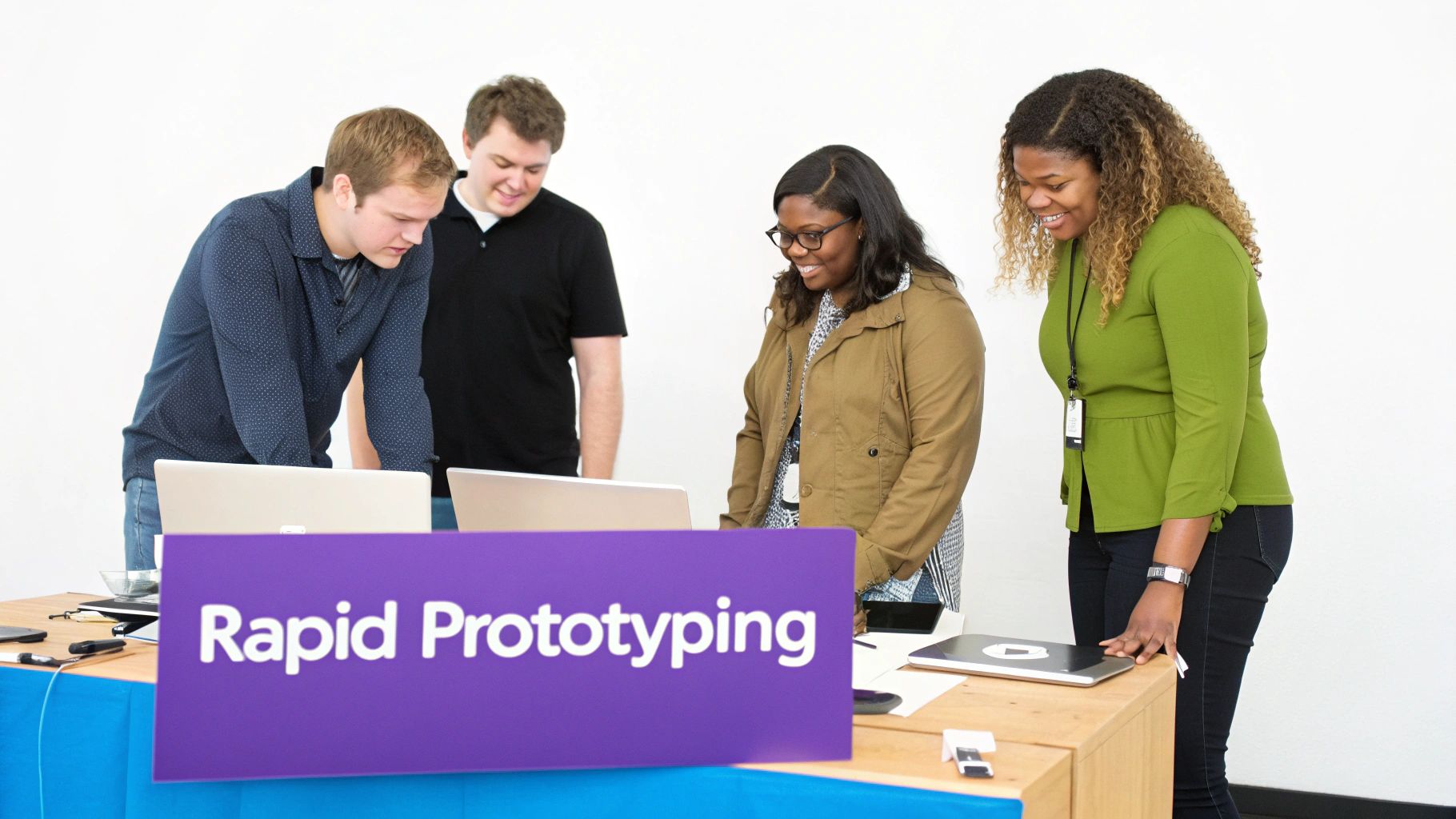
Cross-functional hackathons are intensive, time-bound events where teams from different departments collaborate to solve specific problems or create innovative product prototypes. These events break down organizational silos and immerse management teams in a high-energy environment that accelerates innovation and demonstrates what’s possible when diverse skills combine. This makes them a powerful and dynamic choice for management games team building.
The compressed timeline forces managers to prioritize ruthlessly, communicate with extreme clarity, and leverage each member's unique expertise. It’s a real-world simulation of a high-stakes product launch, revealing a team's ability to innovate, adapt, and execute under pressure while fostering a shared sense of accomplishment.
Why It Works for Management Teams
Hackathons are the ultimate test of strategic thinking and collaborative execution. They provide managers with a platform to move beyond theoretical discussions and produce tangible outcomes. The process reveals natural leaders, creative problem-solvers, and those who excel at bringing disparate ideas into a cohesive vision. Tech giants like Microsoft and Facebook famously use internal hackathons to spur innovation, leading to creations like Seeing AI and the original "Like" button.
How to Implement It Effectively
- Provide Clear Project Briefs: Define a clear problem or challenge but allow teams total creative freedom in how they solve it. This structure gives purpose without stifling innovation.
- Ensure Balanced Team Composition: Intentionally create teams with complementary skills, for example, pairing a marketing manager with an engineering lead and a finance expert, to ensure a well-rounded approach.
- Allocate Mentoring Resources: Assign senior leaders or subject matter experts as floating mentors who can provide guidance, answer questions, and help teams overcome technical or strategic roadblocks.
- Use a Brainstorming Framework: Kick off the ideation phase with a structured brainstorming tool like Bulby to generate a wide range of creative ideas and ensure all voices are heard before teams commit to a direction.
6. Strategic Board Games & Modern Cooperative Games
Modern board games, available on virtual platforms like Board Game Arena, offer complex, engaging scenarios that challenge managers to think strategically and work together. Games like Pandemic, Ticket to Ride, or Catan are far more than simple entertainment; they are intricate simulations of resource management, long-term planning, and risk assessment that mirror real-world business challenges. This makes them a uniquely effective and enjoyable tool for management games team building.
The gameplay requires leaders to negotiate, form alliances, and make difficult decisions with limited information and resources. In a cooperative game like Pandemic, the entire team works against the game itself, fostering a powerful sense of shared purpose and forcing clear communication to prevent a global crisis. These experiences reveal how managers handle shared resources, adapt to changing circumstances, and contribute to a collective strategy.
Why It Works for Management Teams
Strategic board games provide a low-stakes environment to practice high-stakes skills. A game of Ticket to Ride can highlight a manager’s foresight in resource planning, while Catan reveals their negotiation and trade tactics. These games are excellent for identifying different strategic thinking styles within a team, from aggressive risk-takers to cautious, long-term planners. Logistics companies have used Ticket to Ride to informally train route planning, while business development teams use Catan to practice negotiation principles.
How to Implement It Effectively
- Choose the Right Game: Select a game that matches your team’s dynamic. Cooperative games like Pandemic are great for fostering unity, while competitive games like Catan can sharpen negotiation skills.
- Schedule Recurring Sessions: Host a monthly or quarterly "Board Game Hour." Regular play builds camaraderie and turns the activity into a valued team tradition rather than a one-off event.
- Keep It Time-Bound: Choose games that can be completed within a reasonable timeframe (60-90 minutes) to respect work schedules and maintain high energy levels.
- Facilitate a Post-Game Debrief: After the game, lead a discussion connecting in-game decisions to workplace challenges. Ask questions like, "How did we manage our shared resources?" or "What communication tactic was most effective in our negotiations?"
Explore platforms like Board Game Arena to find hundreds of games suitable for your team's next strategic session.
7. Role-Based Decision-Making Simulations
Role-based decision-making simulations are structured exercises where managers are assigned specific roles, often with competing priorities or incomplete information. The goal is to negotiate a solution to a complex problem, such as a budget allocation, organizational restructuring, or crisis management. These simulations force participants to step outside their usual perspectives and appreciate the challenges faced by other departments.
This dynamic creates a microcosm of the organization, highlighting how different viewpoints and information silos impact collective decisions. As participants advocate for their assigned roles, they develop empathy, enhance their negotiation skills, and learn to find common ground. It's a powerful method for improving cross-functional collaboration and strategic thinking, making it one of the most insightful management games team building activities.
Why It Works for Management Teams
These simulations reveal the hidden mechanics of organizational decision-making. Managers see firsthand how departmental objectives can clash and learn to build consensus despite conflicting interests. The experience fosters a more holistic understanding of the business. Renowned institutions like the Harvard Negotiation Project use similar exercises to train executives in complex bargaining and conflict resolution, proving their value in high-stakes corporate environments.
How to Implement It Effectively
- Use a Relevant Scenario: Base the simulation on a realistic business challenge your company has faced or could face. This makes the exercise immediately applicable and engaging.
- Create Clear Role Briefs: Provide each participant with a confidential brief detailing their role, objectives, key information, and "non-negotiables." This asymmetry is crucial for a realistic simulation.
- Allow for Role Reversal: If time permits, run a second round where managers switch roles. This deepens their understanding and empathy for colleagues in different functions.
- Debrief Extensively: This is the most critical step. After the simulation, facilitate a discussion on the decision-making process, communication breakdowns, and key takeaways. Focus on what was learned about collaboration and how it can be applied back at work.
8. Collaborative Art & Creative Projects
Collaborative art projects are group activities where teams work together to create something artistic, such as a physical mural, a company video, or a digital collage. These initiatives transport your management team away from spreadsheets and strategy decks, tapping into right-brain thinking to foster camaraderie through non-business creative expression. This approach makes for uniquely engaging management games team building, especially for teams needing a break from purely analytical tasks.
The process of co-creating something tangible or digital encourages a different kind of problem-solving and communication. Managers must negotiate ideas, build on each other's contributions, and align on a shared creative vision. This builds trust and reveals how the team handles ambiguity and subjective decision-making in a low-stakes, positive environment.
Why It Works for Management Teams
Creative projects are excellent for breaking down communication barriers and fostering a more personal connection among leaders. It’s a powerful way to see how your team manages a project with no single "right" answer, emphasizing collaboration over individual achievement. Companies like Slack and various creative agencies use collaborative art to strengthen team identity and celebrate shared culture, especially during periods of remote work.
How to Implement It Effectively
- Provide a Clear Theme: Give the team a guiding theme or constraint, such as "Our Company Values in Action" or "The Future of Our Industry," to focus their creative energy.
- Use Accessible Digital Tools: For remote teams, use intuitive tools like Miro for digital murals, Canva for collaborative designs, or a simple video editor. The goal is participation, not technical mastery.
- Emphasize Process Over Polish: Make it clear that the objective is to collaborate and have fun. The quality of the final "masterpiece" is secondary to the shared experience of creating it.
- Share and Celebrate the Output: Showcase the final creation in a company-wide channel or virtual gallery to recognize the team's collective effort and build morale.
To discover more ways to unlock your team's creative potential, explore these team creativity exercises on remotesparks.com.
9. Team Problem-Solving Olympics
A Team Problem-Solving Olympics is a high-energy, competitive event where teams go head-to-head across a series of diverse, short challenges. This format moves beyond a single activity, testing a wide range of skills like logic, creative thinking, communication, and resource management. By structuring these activities as a tournament with leaderboards and points, you create a dynamic and engaging environment.
This gamified approach makes it one of the most versatile management games team building formats because it allows different team members to shine in different events. One manager might excel at a logic puzzle, while another thrives in a rapid-fire creative brainstorming challenge, ensuring everyone gets a chance to contribute meaningfully. The competitive spirit fuels collaboration and reveals how teams strategize and adapt under pressure.
Why It Works for Management Teams
The Olympics format is brilliant for assessing a management team's collective agility and identifying where specific skill sets lie. Observing how teams allocate their members to different challenges provides insight into their strategic thinking. Companies like Deloitte and Microsoft use internal competitions to spot emerging leaders and diagnose team-wide skill gaps in a low-stakes, constructive way. The variety of challenges ensures that the activity remains engaging and prevents any single person or skill type from dominating.
How to Implement It Effectively
- Design Diverse Challenges: Create a mix of events that test different abilities. Include logic puzzles (e.g., Sudoku races), communication tests (e.g., one person describing a complex image to the others), and creative problem-solving tasks.
- Balance Difficulty: Ensure the challenges are appropriately difficult and consistent across teams. The goal is to challenge, not frustrate. Test the activities beforehand to gauge completion time and complexity.
- Use Results Diagnostically: Pay attention to which challenges were the most difficult for the teams. This data is invaluable for identifying potential skill gaps that may need to be addressed with targeted training or development.
- Celebrate Participation: While the competitive aspect is key, emphasize and reward participation, creative solutions, and great teamwork, not just the final winners. This fosters a positive and inclusive atmosphere.
10. Virtual Peer Coaching & Reverse Mentoring Programs
Virtual peer coaching and reverse mentoring are structured programs designed to build ongoing learning relationships by pairing team members. These pairings often deliberately mix experience levels, departments, or backgrounds, fostering an environment where participants can coach each other on specific skills, provide feedback, and share diverse perspectives. This continuous interaction makes it a powerful long-term strategy for management games team building.
This approach dismantles traditional top-down learning models and promotes mutual growth. Junior employees might mentor senior leaders on digital tools or new market trends (reverse mentoring), while peers can coach each other on leadership challenges, building psychological safety, cross-functional understanding, and a stronger leadership pipeline.
Why It Works for Management Teams
This model is exceptional for developing empathy and breaking down departmental silos. When a marketing manager is paired with an engineering lead, they gain invaluable insight into each other's worlds, leading to more holistic decision-making. The structure provides a safe space for managers to be vulnerable and work through challenges with a trusted peer. Companies like General Electric and Accenture have famously used these programs to accelerate skill development and foster an inclusive, collaborative culture.
How to Implement It Effectively
- Provide a Clear Framework: Don't just pair people up and hope for the best. Provide coaching frameworks (like the GROW model), question guides, and clear objectives for each pairing.
- Establish Confidentiality: Create psychological safety by setting strict confidentiality norms from the outset. This encourages open and honest dialogue without fear of judgment.
- Use Tools for Collaboration: Encourage pairs to use brainstorming tools for collaborative problem-solving during their sessions. This can help structure conversations and capture actionable ideas.
- Schedule Regular Checkpoints: Implement checkpoints every quarter to gather feedback, celebrate successes, and make adjustments to the program as needed.
To optimize these interactions, explore best practices for productive one-on-one meetings.
Team-Building Management Games: Top 10 Comparison
| Activity | 🔄 Implementation complexity | ⚡ Resource / time requirements | 📊 Expected outcomes | 💡 Ideal use cases | ⭐ Key advantages |
|---|---|---|---|---|---|
| Escape Room Challenges | Moderate — platform setup + facilitation | Low — video conferencing, stable internet, moderate prep time | Improved teamwork, communication patterns; short-term engagement | Remote/hybrid trust-building, short workshops | Highly engaging; reveals problem‑solving styles. ⭐⭐⭐ |
| Innovation Challenge Tournaments | High — design briefs, judging, facilitation | High — judges, facilitation, prototyping budget, multi-phase time | Actionable ideas, prototypes, cultural momentum toward innovation | Product ideation, R&D sprints, strategic challenge solving | Produces business-relevant ideas; aligns innovation to goals. ⭐⭐⭐⭐ |
| Business Simulation Games | High — scenario design and training | Medium–High — simulation platforms, prep, multiple sessions | Strong systems thinking, strategic decision skills; measurable metrics | Management/executive development, strategic planning practice | Teaches business acumen with realistic consequences. ⭐⭐⭐⭐ |
| Murder Mystery Dinner Parties (Virtual) | Low–Moderate — scripts and role prep | Low — video conferencing, optional props, light facilitation | Social bonding, creative engagement, relaxed rapport | Social events, onboarding, culture-building sessions | Memorable, lowers hierarchy, encourages play. ⭐⭐⭐ |
| Cross-Functional Hackathons | High — logistics, mentoring, outcomes management | High — 24–48h commitment, tooling, mentors, prizes | Rapid prototypes, cross-team collaboration, potential products | Rapid product development, cross-silo innovation | Tangible outputs; breaks down silos quickly. ⭐⭐⭐⭐ |
| Strategic Board & Cooperative Games | Low — rules and facilitation only | Low — digital platform or hosted session, short time blocks | Improved negotiation, consensus, risk assessment | Regular team bonding, negotiation or consensus practice | Low barrier to entry; repeatable and enjoyable. ⭐⭐⭐ |
| Role-Based Decision-Making Simulations | Moderate–High — role design and safe facilitation | Medium — scenario prep, skilled facilitator, debrief time | Greater empathy, negotiation skill, reveal org dynamics | Leadership training, organizational change simulations | Builds perspective-taking; realistic learning moments. ⭐⭐⭐ |
| Collaborative Art & Creative Projects | Low–Moderate — brief and tool coordination | Low — digital tools (Miro/Figma/Canva), flexible time | Boosts creativity, psychological benefits, shareable outputs | Creativity activation, culture rituals, team showcases | Activates divergent thinking; inclusive contribution. ⭐⭐⭐ |
| Team Problem-Solving Olympics | High — multi-challenge design and scoring | Medium–High — platform management, simultaneous staffing | Broad engagement; reveals skill gaps across domains | Large-group engagement, skills diagnostics, celebrations | Variety highlights diverse talents; scalable. ⭐⭐⭐ |
| Virtual Peer Coaching & Reverse Mentoring | Moderate — pairing and ongoing structure | Low–Medium — recurring meeting time, coaching guides | Cross-functional learning, leadership pipeline, psychological safety | Talent development, D&I, knowledge transfer programs | Cost‑effective development; builds lasting relationships. ⭐⭐⭐⭐ |
From Games to Growth: Integrating Play into Your Management Strategy
The journey through these management games for team building, from high-stakes Escape Room Challenges to collaborative Hackathons, reveals a powerful truth: strategic play is a serious business tool. The activities we've explored are far more than simple icebreakers or one-off social events. They are dynamic, interactive laboratories where your leadership team can practice and refine the very skills essential for navigating today’s complex business landscape. The real value emerges not during the game itself, but in the echoes that follow, a process that must be managed with intention.
Treating these experiences as isolated events misses the most significant opportunity for growth. The true return on investment comes from connecting the dots between the game and the daily grind. The collaborative problem-solving required to master a Business Simulation Game directly mirrors the strategic thinking needed to navigate a tough market quarter. The communication skills honed during a Virtual Peer Coaching session are the same ones that prevent project silos and foster a culture of transparent feedback.
Key Takeaways for Lasting Impact
The most effective management games for team building are those that are deliberately integrated into a broader strategy of leadership development. As you move forward, keep these core principles in mind:
- Purpose Before Play: Always start with the "why." Are you trying to improve cross-functional communication, spark innovation, or enhance strategic decision-making under pressure? Select a game that directly targets that specific objective. A Murder Mystery is great for deductive reasoning, while an Innovation Challenge Tournament is built for creative output.
- Facilitation is Non-Negotiable: A well-run game is fun, but a well-facilitated game is transformative. The debrief session is where the magic happens. This is your chance to guide the conversation from "what we did" to "what we learned" and, most importantly, "what we will do differently."
- Bridge the Gap to Reality: Actively help your team see the parallels. Ask direct questions during the debrief: "When have we faced a communication breakdown like this on the Project X initiative?" or "How can we apply the rapid-prototyping mindset from the Hackathon to our upcoming product launch?" This makes the lessons tangible and immediately applicable.
Your Action Plan: Turning Play into Progress
Transforming these insights into sustained behavioral change requires a clear, actionable plan. Don't let the momentum from a successful team-building session fade away. Instead, channel that energy into a structured follow-up process to ensure the lessons stick.
- Document and Share Key Insights: After each session, use a shared document or a tool like Bulby to capture the key takeaways, a-ha moments, and action items that came out of the debrief. What communication patterns were observed? What new problem-solving approaches were discovered?
- Assign Actionable Follow-ups: Translate the insights into concrete next steps. If the team identified a flaw in its decision-making process during a Role-Based Simulation, the follow-up action might be to trial a new decision-making framework (like DACI) for the next two weeks.
- Schedule a "Retro" on the Game's Impact: A month after the activity, hold a brief 30-minute retrospective. Discuss what lessons have actually been applied. What stuck? What didn't? This reinforces the importance of the exercise and holds the team accountable for integrating the new behaviors.
Ultimately, investing in management games for team building is an investment in your organization's resilience, agility, and innovative capacity. By moving beyond mere entertainment and embracing these activities as powerful training tools, you build a leadership team that is not only more connected but also better equipped to lead your company toward future success. The laughter and competition are the catalysts, but the lasting growth is the ultimate prize.
Ready to elevate your team's brainstorming and turn the creative energy from these games into concrete, actionable ideas? Bulby provides the structured canvas you need to capture, develop, and prioritize insights from any team-building activity. Explore how you can supercharge your strategic sessions by visiting Bulby today.