
Innovation models are really just playbooks for turning a good idea into something real. Think of them less like a lightning strike of pure genius and more like a reliable recipe for growth. Each model gives you a set of steps and ingredients to transform a creative spark into a measurable business outcome.
Why Bother With an Innovation Model?
Innovation isn't just some corporate buzzword; it's the engine that keeps a business alive and growing. Without a structured approach, brainstorming sessions often fizzle out, leading to wasted time and missed chances. This is exactly where a solid innovation model makes all the difference.
These frameworks are like roadmaps, guiding your team from that first napkin sketch all the way to a market-ready product. They give everyone—from the engineers building it to the marketers selling it—a common language and a shared process. For remote and distributed teams, this is a game-changer. A clear model ensures everyone is pulling in the same direction, no matter where they are.
The Real Engine of Business Growth
Companies are putting serious money behind structured innovation. In 2022, corporate R&D spending blew past USD 1 trillion for the first time ever. On top of that, 79% of companies say innovation is a top-three priority, and 66% are upping their investment to stay ahead.
A well-defined model turns that spending from a risky bet into a calculated move. It helps companies:
- Cut down on risk: By following a proven path, you can test your big assumptions early, long before you build something nobody actually wants.
- Work smarter, not harder: A clear framework gets rid of confusion and streamlines how work gets done, helping teams move faster.
- Build a creative culture: When people know the "rules of the game," they feel more comfortable and empowered to share their best ideas.
- Keep everyone on the same page: A shared model provides a common vocabulary, which is essential for coordinating work across departments and time zones.
A well-chosen innovation model turns abstract creativity into a tangible asset. It provides the discipline needed to systematically explore new territories and the structure required to build something valuable when you get there.
Ultimately, understanding the different processes of innovation and picking the right model is a fundamental first step. It's like choosing the right blueprint before you start building. It ensures every ounce of effort contributes to a stronger, more resilient, and forward-thinking company.
A Breakdown of Major Innovation Models
Think of innovation models as different recipes in a cookbook. You wouldn't use a cake recipe to bake bread, right? In the same way, the innovation approach that launches a scrappy startup isn’t the right fit for a global corporation trying to defend its market share. Each model is a unique blueprint for growth.
Let's unpack the most common frameworks you'll encounter. Getting a handle on these will help you pick the right path for your team's specific goals, resources, and company culture.
This image gives you a great visual for how these models act as a plan for growth and keep everyone pulling in the same direction.
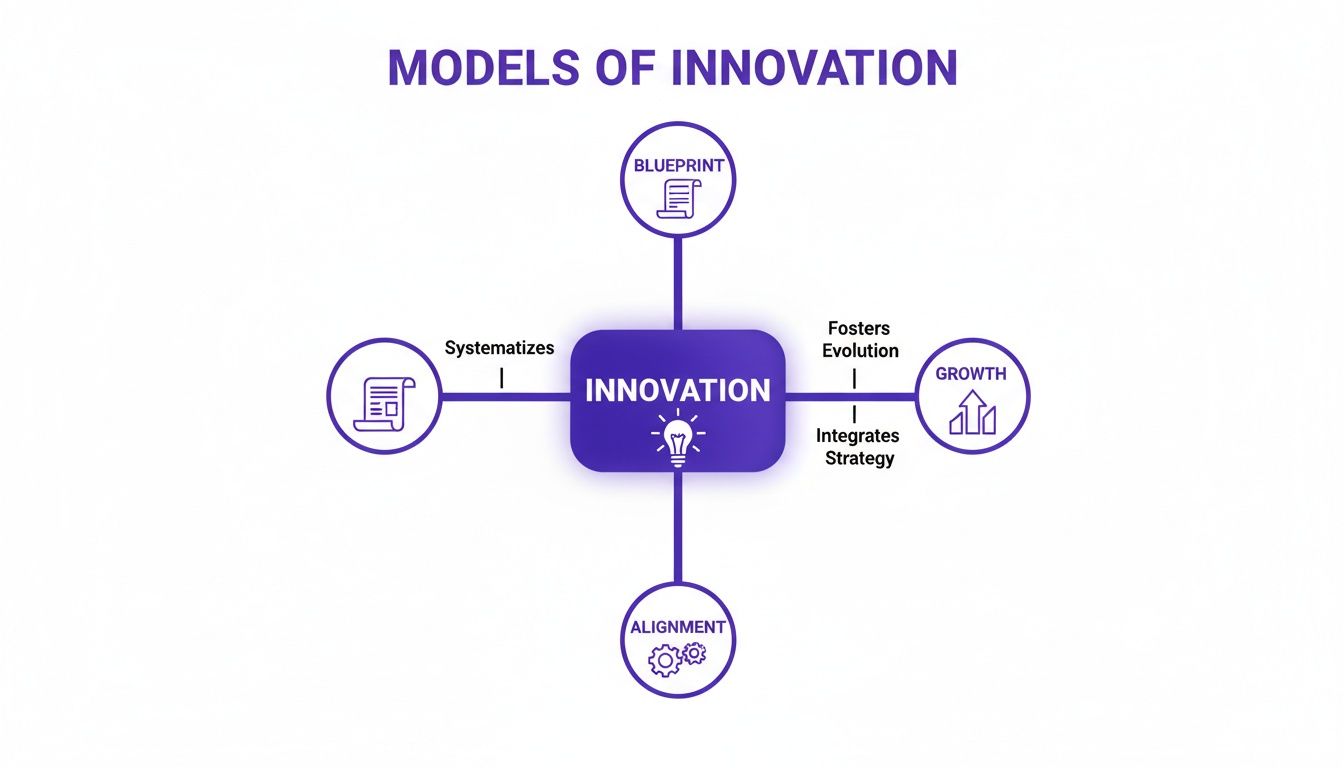
It’s a good reminder that a great idea (the lightbulb) is just the start. You need a solid plan (blueprint), a way to push forward (growth), and a clear connection to your company’s overall strategy (alignment).
Open vs. Closed Innovation
The big question here is simple: where do your best ideas come from? Do you believe all the smartest people are already on your payroll, or could some of them be outside your office walls?
Closed Innovation is the classic, old-school approach. Picture a secretive R&D lab, like the one at Apple under Steve Jobs. Every idea is born, nurtured, and launched entirely in-house. This gives you iron-clad control over your intellectual property and keeps your brand message tight.
On the flip side, Open Innovation is all about looking outward. Companies using this model actively hunt for ideas from customers, university labs, suppliers, and sometimes even their rivals. A textbook case is Procter & Gamble’s "Connect + Develop" program, which brought them blockbuster products like the Swiffer from external inventors.
- Closed Pros: You own everything, the brand stays consistent, and development is confidential.
- Closed Cons: You risk becoming insular and can suffer from "not-invented-here" syndrome, cutting you off from a world of talent.
- Open Pros: You get access to a massive pool of diverse ideas, can often move faster, and you share the risk.
- Open Cons: IP negotiations can get messy, it can dilute the brand if not managed well, and it requires a culture built on trust.
Incremental vs. Radical Innovation
This pair of models is all about the size of the leap you're trying to make. Are you improving the gas mileage on your current car, or are you inventing a teleportation machine? A healthy company often needs a bit of both.
Incremental Innovation is the bread and butter of most businesses. It’s about making small, steady improvements to what you already have. This is low-risk, predictable, and keeps the revenue flowing. Just think about the annual iPhone updates—each one is a little bit better than the last.
Radical Innovation is the opposite; it’s about creating something the world has never seen before. It often springs from new technology and can create entirely new markets. The invention of the personal computer is a perfect example—it completely rewired how we work and live.
While radical innovation gets all the glory and headlines, it's the steady drumbeat of incremental innovation that usually pays the bills and funds those big, risky bets. You need one to optimize today and the other to build tomorrow.
Disruptive Innovation
Coined by the brilliant Clayton Christensen, Disruptive Innovation is one of the most powerful—and most misunderstood—models out there. A disruptive idea isn't just a "big" or "game-changing" one. It’s a very specific process where a smaller, scrappier company successfully takes on the big, established players.
It usually starts when the new company targets a forgotten corner of the market with a simpler, cheaper product, or creates a new market where one didn't exist. Netflix did this perfectly. They started by mailing DVDs, a service Blockbuster laughed at. But over time, they got better, moved upmarket, and we all know how that story ended. To dig deeper into this and other approaches, check out our guide on the core types of innovation.
Platform Innovation
Why build a single product when you can build an entire ecosystem? That’s the thinking behind Platform Innovation. The goal isn’t to sell one thing, but to create a space where other people can connect and create value for each other.
Look no further than Apple's App Store or Google's Android. They didn’t create millions of apps themselves. Instead, they built the platforms that empowered developers to build their own businesses. This creates a powerful network effect—the more people who join, the more valuable the platform becomes for everyone.
Other Key Models to Know
Beyond those big four, a few other specialized models of innovation in business are worth having in your toolkit.
- User-Driven Innovation: This model puts your customer in the driver's seat of creation. LEGO Ideas is a fantastic example, where fans submit their own designs for new sets and vote on which ones get made. The company isn't guessing what people want; they're asking them directly.
- Frugal Innovation: Known in some circles as "Jugaad," this is the art of doing more with less. It's about creating simple, affordable, and surprisingly effective solutions, often in places with limited resources. It’s innovation born from necessity.
- Business Model Innovation: This isn't about changing your product, but changing how you make money. When Rolls-Royce stopped selling jet engines and started selling "Power by the Hour"—basically, a subscription for flight time—they completely changed the game. The Double Diamond design process is a popular framework teams use to explore and validate these kinds of new value propositions.
Comparing Innovation Models Pros and Cons
To make it easier to see how these models stack up, here’s a quick comparison of their strengths and weaknesses.
| Model | Pros (Advantages) | Cons (Disadvantages) |
|---|---|---|
| Closed Innovation | Full control over IP, brand, and secrecy. | Can lead to stale ideas and slow progress. |
| Open Innovation | Access to a vast pool of external ideas and talent. | IP can be complex; requires a culture of trust. |
| Incremental Innovation | Low-risk, predictable returns, easy to manage. | Can be outpaced by more ambitious competitors. |
| Radical Innovation | Can create new markets and huge competitive advantages. | High-risk, expensive, and has a high failure rate. |
| Disruptive Innovation | Allows smaller players to unseat market leaders. | Very difficult to predict and manage the "upmarket" move. |
| Platform Innovation | Creates powerful network effects and scalable growth. | Takes a long time to build momentum and attract users. |
| User-Driven Innovation | Ensures product-market fit by co-creating with users. | Can be slow and may result in niche, not broad, appeal. |
| Frugal Innovation | Low-cost, fast to develop, and highly practical. | May lack the polish or features of premium products. |
| Business Model Innovation | Can create durable, hard-to-copy competitive moats. | Difficult to implement and requires significant organizational change. |
Ultimately, choosing the right model comes down to knowing your company—your market position, your appetite for risk, and your vision for the future. By understanding these different blueprints, you can make a smarter choice and put your team on a path to real, meaningful growth.
See How Real Companies Use Innovation Models
The theory is great, but seeing models of innovation in business in the wild is what really makes the concepts stick. Looking at how iconic companies put these ideas to work shows that they aren't just academic theories—they're powerful engines for real growth.
Let's dive into some stories of how giants of industry used specific models to build their empires, turning abstract ideas into tangible success.
Apple and the Mastery of Closed Innovation
For decades, Apple was the poster child for Closed Innovation. Under Steve Jobs, the company operated like a fortress. Every single part of product development, from the first sketch to the final microchip, happened inside Apple’s walls. This secretive, top-down approach gave them an obsessive level of control.
What did that get them? A beautifully integrated ecosystem of hardware and software that just worked. Products like the iPod, iPhone, and MacBook felt seamless because they were born from the same mind, built under one roof. This model also fiercely protected Apple’s intellectual property and created a consistent brand experience that competitors found nearly impossible to copy.
By keeping everything in-house, Apple created a powerful competitive advantage. The complete control over design and technology allowed them to deliver a user experience that was, at the time, unparalleled.
Ultimately, this strategy let Apple set the pace for the entire industry, releasing game-changing products that always felt like they arrived from the future.
Procter & Gamble and the Power of Open Innovation
In the early 2000s, the consumer goods giant Procter & Gamble (P&G) hit a wall. Its internal R&D pipeline was getting sluggish. Their solution? A radical shift toward Open Innovation with a program they called "Connect + Develop."
Instead of relying only on their 7,500 in-house researchers, P&G started looking outside for brilliant ideas. They began actively seeking out partnerships with independent inventors, small startups, and even other large companies. This move brought them some of their biggest blockbuster products.
Here are a few that might surprise you:
- The Swiffer: The core technology for this cleaning revolution came from an external inventor.
- Olay Regenerist: Key ingredients for this top-selling anti-aging cream were found through external partnerships.
- Mr. Clean Magic Eraser: This cleaning powerhouse was actually developed in Japan and brought into the P&G family through open collaboration.
By opening its doors to outside ideas, P&G boosted its innovation success rate and slashed development costs, proving that great ideas really can come from anywhere.
Netflix and the Art of Disruptive Innovation
Netflix is the textbook example of Disruptive Innovation. When they started, they didn't try to take on Blockbuster head-to-head by opening more stores or stocking more new releases. Instead, they went after a niche market the big players ignored: people who didn't mind waiting a day for a DVD in the mail and absolutely hated late fees.
Their initial service wasn't "better" in the traditional sense—it was just simpler and cheaper. But Netflix never stopped improving, eventually making the leap from mail-order DVDs to streaming. This move didn't just improve their service; it changed the entire business model of home entertainment. A key part of executing any innovation model is transforming an idea into a tangible prototype, and Netflix mastered this cycle.
By the time Blockbuster saw the writing on the wall, it was too late. Netflix had already built a massive subscriber base and created a new content delivery system that made physical video stores obsolete. Our guide to innovation process examples has more stories just like this one.
Airbnb and the Rise of Platform Innovation
Here’s a wild thought: Airbnb became a hospitality giant without building a single hotel. They did it by mastering Platform Innovation. The company simply created a two-sided marketplace that connects people with spare rooms (hosts) to people looking for a place to stay (travelers).
The real value isn't a product; it’s the network. Every new host makes the platform more attractive to travelers, and every new traveler makes it more valuable for hosts. This is called a network effect, and it created a competitive moat that traditional hotel chains have struggled to cross.
By focusing on trust, user experience, and building a sense of community, Airbnb didn’t just enter the hospitality market—it completely redefined it, creating an entirely new way to travel.
How to Choose the Right Innovation Model
So, how do you pick from all these different models of innovation in business? It’s not about grabbing the flavor of the month. It’s about finding the one that truly fits your company's DNA.
What works for a scrappy startup trying to topple a giant will be a disaster for a market leader focused on defending its position. Making the right call here can be the difference between a game-changing breakthrough and a lot of wasted time and money.
The decision demands a hard look in the mirror. You've got to consider everything: your company's size, what your industry is doing, how much risk you can stomach, and what your ultimate goals are. There's no magic bullet, just a smart match between your reality and what a particular model does best.
Assess Your Current Position
Before you can figure out where you’re going, you need to know exactly where you are. The first step is a completely honest internal audit. Start by sizing up your company’s core strengths, weaknesses, and the market you operate in.
Your analysis should dig into a few key areas:
- Company Size and Resources: A massive corporation with a huge R&D budget can swing for the fences with Radical Innovation. A startup with limited cash, on the other hand, might get more mileage from Frugal or User-Driven models that don't need a ton of upfront investment.
- Industry and Market Dynamics: Are you in the fast-and-furious tech world where things change overnight, or a more stable, mature industry? A company in a constantly shifting environment might need to juggle a few models at once, including Disruptive Innovation, just to stay in the game.
- Risk Appetite: How much failure can your organization handle without panicking? Incremental Innovation is your safe bet, offering predictable, low-risk wins. But if you’re chasing those massive, 10x rewards, you have to be ready for the higher chance of failure that comes with Radical or Disruptive approaches.
Choosing an innovation model is an act of strategic alignment. It’s about matching your method to your mission, ensuring the path you take leads directly to the future you want to build.
A Decision-Making Framework for Your Team
To make this less abstract, get your team together and walk through a simple checklist. Answering these questions as a group helps get everyone on the same page and builds buy-in for the direction you choose.
Start by asking:
- What’s our main goal here? Are we defending our market share? Breaking into a new one? Making our internal processes better? Or are we trying to invent something the world has never seen before?
- What's our timeline? Do we need small, quick wins to build momentum (think Incremental), or are we playing the long game to redefine an entire industry (hello, Radical)?
- Where do our best ideas come from? Do we have all the brainpower we need in-house (Closed)? Or would we be better off tapping into ideas from customers, partners, or even academics (Open)?
- How will we know if we're winning? You absolutely have to define success before you start. For a deep dive on this, check out our guide on how to measure innovation to help you set the right benchmarks.
Considering the Remote Work Factor
For distributed and remote teams, this decision has another layer of complexity. The model you choose not only has to match your business goals but also has to actually work for a team that isn't in the same room. Models that rely on those spontaneous "water cooler" moments are going to fall flat.
Instead, lean into models that play to the strengths of remote work.
- Open Innovation is a fantastic fit. It’s all about collaborating with outside partners, which distributed teams are already wired to do across different locations and time zones.
- User-Driven Innovation also shines in a remote setup. Digital tools make it incredibly easy to connect with, gather feedback from, and even co-create with a global customer base.
- In general, any structured model with clear processes and good documentation tends to work better for remote teams than approaches that depend on informal, unstructured chats.
By taking the time to think through your company's position, your goals, and the reality of how your team works—especially if you're remote—you can pick a model that truly fuels your growth. This isn't just a box-ticking exercise; it's about focusing your efforts to give yourself the best possible shot at success.
Putting Innovation Models to Work in Remote Teams
Choosing an innovation model is one thing. Actually making it work with a team spread across different cities or even continents? That's where the real work begins.
All those little moments that spark great ideas in an office—the spontaneous whiteboard session, the quick chat in the hallway—vanish when you’re remote. To succeed, you have to be incredibly intentional about recreating that creative energy.
It's all about swapping out spontaneous collisions for deliberate, structured collaboration. The goal is to build a virtual space where every single voice can be heard and contribute, no matter where they are.
Creating Your Digital Innovation Hub
Think of a "digital innovation hub" not as a single piece of software, but as an ecosystem of tools and rituals that wire your team for creativity. It’s your virtual R&D lab, brainstorming room, and project tracker, all in one.
To get your hub up and running, you’ll need a few key pieces:
- A Central Knowledge Base: This is your team's single source of truth. Use a tool like Notion or Confluence to document everything from half-baked ideas to detailed project roadmaps. Transparency is a remote team's best friend.
- Asynchronous Communication Channels: Platforms like Slack or Microsoft Teams are great for day-to-day chatter, but you need dedicated channels for innovation to keep conversations focused and productive.
- A Dedicated Ideation Platform: This is where the real brainstorming happens. A purpose-built tool for structured ideation can not only replace in-person sessions but often make them more effective.
The need for these tools is growing fast. The global innovation management market is expected to jump from USD 2.74 billion in 2025 to a massive USD 9.22 billion by 2033, with the IT sector driving much of that growth.
Leveraging Asynchronous Brainstorming
For remote teams, asynchronous brainstorming is a superpower. Trying to sync up a real-time session across multiple time zones can be a nightmare. Async work gives everyone, especially introverts, the space to think deeply and contribute when they're at their most creative—not just when a meeting is on the calendar.
The beauty of asynchronous work is that it decouples great ideas from a specific time or place. It democratizes creativity, giving everyone an equal chance to reflect and bring their best thinking to the table.
But async brainstorming needs structure. Without it, you’ll end up with a messy, forgotten document. This is where a tool like Bulby shines, guiding teams through research-backed exercises that sidestep common pitfalls like groupthink.
By walking participants through a step-by-step process, the platform ensures the team stays on track and explores ideas systematically, even without a facilitator in the room.
Facilitating Different Innovation Models Remotely
Your digital toolkit needs to be flexible. Different models of innovation in business demand different approaches, and a one-size-fits-all strategy will only hold your remote team back.
Here’s how you can adapt your facilitation for a few key models:
-
Open Innovation: Use digital platforms to launch idea challenges where external partners can submit their thoughts. Tools like online survey forms or collaborative whiteboards (Miro is great for this) are perfect for gathering and sorting input from a wide net of contributors.
-
User-Driven Innovation: Tap into video conferencing to run deep-dive interviews with customers anywhere in the world. Use product feedback tools to collect, tag, and analyze user suggestions, effectively turning your customer base into an extension of your R&D team.
-
Incremental Innovation: Set up a crystal-clear project management system like Jira or Asana. This creates a transparent backlog where anyone can suggest small improvements, and the team can prioritize and track them.
When you pair the right tools with clear workflows, a remote setup becomes a true advantage. For more ideas on this, check out our guide on fostering innovation in remote teams. A well-run remote team doesn't just mimic the office—it can be more focused, inclusive, and creatively powerful.
Common Questions About Innovation Models
Even when you get the theory, putting it into practice brings up a whole new set of questions. Choosing the right innovation model—and actually making it work—means you'll have to deal with real-world challenges and figure out how to adapt these frameworks to your company's unique situation.
Let's dive into some of the questions that pop up most often for leaders and their teams. Getting straight answers can clear things up and help you move forward, especially if you're trying to drive innovation with a remote or distributed team.
Can a Company Use More Than One Innovation Model?
Absolutely. In fact, the most resilient companies almost always do. This is often called an "ambidextrous" approach, where you're simultaneously protecting your current business while building for the future.
Think of it this way: a company might lean on Incremental Innovation to make steady improvements to its flagship product—the one that pays the bills. This keeps existing customers happy and revenue stable. At the same time, they could have a small, almost separate team dedicated to Disruptive Innovation, exploring a wild new technology or a market no one else is looking at. The trick is to give each team its own space, budget, and mindset so they aren't tripping over each other.
How Do You Measure the Success of an Innovation Model?
There’s no magic dashboard here. Your success metrics have to be tailored to the specific model you're using and what you're trying to achieve. You need to decide on your key performance indicators (KPIs) before you start, so everyone knows what "good" looks like.
Here’s a quick breakdown of how the goals change:
- For Incremental Innovation: Success is pretty straightforward. You're looking at things like higher customer satisfaction scores, cost reductions from making a process more efficient, or a slow and steady climb in market share.
- For Disruptive Innovation: Early on, success is less about profit and more about traction. You might track how quickly you're entering a new market, how many pilot projects get off the ground, or even how many patents you're filing.
- For Open Innovation: Here, you'd measure the flow of outside ideas. How many submissions did you get? What percentage of those moved into development? How much new revenue came from products that started as an external idea?
What Is the Biggest Innovation Challenge for Remote Teams?
For remote and distributed teams, the biggest hurdle is creating a culture of psychological safety and sparking those random, creative conversations. When you’re not in the same room, it's just harder to build the kind of trust that lets people toss out half-baked, potentially brilliant ideas without worrying about looking foolish. Those "water cooler" moments where creativity strikes don't just happen on Slack.
You have to be intentional about it. Leaders need to make it clear that experiments are encouraged and that failures are just learning experiences. It also means using tools for structured brainstorming, setting aside time for virtual creative jams, and having clear communication channels to close the distance and build a team that feels connected and safe enough to innovate.
Which Innovation Model Is Best for a Startup?
Startups are all about being lean and moving fast, so they naturally gravitate toward models that don't require a huge bank account. Frameworks like Disruptive, Frugal, or User-Driven Innovation are a fantastic fit.
These models are built for resource constraints. Disruptive innovation helps you find customers the big guys are ignoring. Frugal innovation is all about building a simple, "good-enough" solution to get your foot in the door. And user-driven innovation uses direct customer feedback to guide your product, which dramatically lowers the risk of building something nobody actually wants.
Ready to overcome the challenges of remote brainstorming and unlock your team's full creative potential? Bulby provides the structured, guided exercises you need to facilitate any model of innovation.
Learn more and start your first session at https://www.bulby.com.