

Resistance to change shouldn't be treated as an obstacle to bulldoze. It’s actually valuable feedback in disguise. The real secret is to get to the ‘why’ behind the hesitation, build a rock-solid communication plan, and, most importantly, involve your team directly to create a sense of ownership. This simple shift in perspective turns pushback into a productive conversation and makes the whole process a lot smoother.
Why Change Fails and How to Flip the Script

Let’s be real for a moment. Most big change initiatives seem like they're set up to fail from day one. Leadership announces a bold new direction, and you can almost feel the wave of uncertainty and skepticism ripple through the virtual hallways.
This isn’t just a gut feeling; the numbers are pretty stark. Studies consistently show that around 70% of change efforts fail to hit their targets. A huge part of that is the human element—about 37% of employees actively resist change, often because they don't trust leadership, don't understand the reasons, or are just plain scared of what's coming next.
But what if we've been looking at this all wrong? Instead of treating resistance as a problem to be squashed, what if we saw it as a source of critical information?
Resistance isn't just stubbornness. It's a perfectly natural human response when routines get disrupted. It’s a signal that something important—a familiar process, a core value, or even just a sense of security—feels threatened. When you start treating that resistance as feedback, you move from issuing commands to having a real conversation.
Getting to the Root of Resistance
Pushback is rarely about just one thing. It's usually a tangled mess of psychological, logistical, and cultural factors. To even begin untangling it, you have to understand where it's coming from, which is even trickier in a remote team where you can't read the room.
When change is announced, your team starts asking questions, often silently. Digging into the drivers behind their hesitation is the first step toward building trust.
Here’s a quick look at the most common reasons people push back, framed to help you start the right conversations.
Common Drivers of Resistance to Change
| Driver of Resistance | What It Looks Like in a Remote Team | Initial Question to Ask |
|---|---|---|
| Fear of the Unknown | Team members ask vague questions about job security or become quiet during virtual meetings. Productivity might dip. | "What's the biggest question or concern on your mind right now about this change?" |
| Loss of Control | Employees disengage from new initiatives, stick to old methods, or complain about not being consulted. | "If you were in charge, what's one thing you would have done differently in this process?" |
| Disruption of Routine | You hear sighs on calls when new tools are mentioned. People miss deadlines while learning new workflows. | "Which part of your current workflow are you most worried about losing or having to change?" |
| Past Negative Experiences | Cynical comments pop up in Slack. You hear things like, "Here we go again," or see a general lack of enthusiasm. | "Thinking about past changes here, what's one lesson we can learn to make sure this time is better?" |
By asking targeted questions, you open the door for genuine dialogue instead of letting concerns fester in private DMs and silent frustration.
A Practical Framework for Remote Teams
Many change projects stumble because of predictable roadblocks. We've all seen it happen. Understanding things like the 8 common digital transformation challenges is a great starting point, but you need more than just awareness. You need a plan.
This guide is designed to give you that practical roadmap. The journey from a good idea to something your team actually uses and embraces is a long one, and we've covered the end-to-end process here: https://www.remotesparks.com/from-idea-to-implementation/. This framework will help you diagnose the real sources of friction on your team and create a path forward that builds momentum instead of creating more conflict.
Getting to the Real "Why" Behind the Pushback
When you're leading a change, it's all too easy to label any pushback as simple stubbornness. That's a classic leadership trap. The truth is, resistance isn't just an obstacle; it's a signal. If you learn to read that signal correctly, you can fix the root cause instead of just wrestling with the symptoms.
Jumping straight to solutions without understanding the real problem is like trying to fix an engine without popping the hood. You might get lucky, but you're far more likely to make things worse. Real progress starts the moment you stop guessing and start getting genuinely curious.
This is even more critical for remote teams. You can't just read the room or pick up on nervous energy during a coffee break. You have to be much more intentional about uncovering the friction points hiding behind screens and Slack statuses.
Taking the Team's Pulse with Anonymous Surveys
One of the quickest ways to get an honest read on how your team is really feeling is with a short, anonymous pulse survey. Anonymity is non-negotiable here. It creates the psychological safety people need to be candid without worrying about how they'll be perceived. You're not after names—you're looking for patterns.
Forget those long-winded annual surveys. I’m talking about 3-5 sharp questions that someone can answer in less than two minutes. The whole point is to capture immediate, gut-level reactions to the change.
Try asking questions like these:
- On a scale of 1-10, how clear is the reason for this change? (This tells you if your initial "why" message landed.)
- What is your single biggest concern about how this will affect your daily work? (This is gold for uncovering logistical fears and practical hurdles.)
- What one question do you have that hasn't been answered yet? (This highlights the information gaps causing uncertainty.)
The answers will quickly reveal if the resistance is about the change itself (the "what") or the way you're rolling it out (the "how").
Structuring Your One-on-One Conversations
Surveys give you the big picture, but one-on-ones are where you dig into the details. Just asking a vague, "So, how are you feeling about the change?" won't get you very far. You need to guide the conversation.
Give your managers a simple conversation guide to use during their regular check-ins. This keeps things consistent and focuses the discussion on understanding, not debating. Remember, the goal isn't to convince the employee in this moment; it's to listen.
A solid guide might include prompts like:
- "Walk me through your initial reaction when you first heard about this." This cracks the door open to their emotional response.
- "From where you're sitting, what do you see as the biggest potential hurdles for our team?" This reframes them as a partner in problem-solving.
- "What support or information would make you feel more confident as we move forward?" This is a direct, actionable request for what they need.
By equipping your managers this way, every one-on-one becomes a chance to gather crucial insights into both the logical and emotional sides of resistance.
Visualizing Where the Resistance Lives
Once you have all this feedback, you need to make sense of it. A quick mapping exercise can show you exactly where the strongest pockets of resistance are, so you can focus your energy where it matters most. This is where stakeholder mapping becomes an invaluable tool for change management. By figuring out who is most affected and who holds the most influence, you can stop using a one-size-fits-all approach.
Think of it this way: Resistance is rarely a monolith. The engineering team might be worried about new workflows, while the sales team is concerned about compensation changes. A generic response will fail both groups.
Draw a simple two-by-two grid. On one axis, plot a person's or team's level of influence. On the other, plot their level of support for the change, from high resistance to high support.
This simple visual instantly tells you who your champions are, who's on the fence, and who needs your attention right now. It turns a cloud of abstract feelings into a clear, actionable roadmap.
Building a Communication Plan That Earns Trust
When your team is remote, communication isn't just a nice-to-have skill—it's the very foundation of any change you're trying to make. You can't rely on a quick chat in the hallway or reading the room to get everyone on the same page. Your communication plan has to pull all the weight, moving beyond simple updates to build real, genuine trust.
The best way to get ahead of resistance is to build a narrative that connects with your team as people. They need to understand the "why" behind a change, not just the "what." This story has to be honest, empathetic, and you've got to repeat it consistently across every channel you use.
Crafting Your Core Change Narrative
First things first, you need a compelling story. This isn't about corporate spin; it's about framing the change in a way that actually means something to your team. A good narrative links the change to the company's bigger mission, tackles potential concerns before they even come up, and paints a vivid picture of where you're all headed.
As you shape this story, think about these key pieces:
- The Problem: Get crystal clear on the challenge or opportunity that’s making this change necessary. Why is this happening now?
- The Vision: Describe what success looks like. Don't be vague—make it tangible and something people can get excited about.
- The Path: Briefly outline the major steps to get there. It’s important to acknowledge that the road might be a little bumpy.
- The "WIIFM": This one is critical. Directly answer the "What's In It For Me?" question for every person on your team.
I’ve seen organizations stumble when their vision is muddled or confusing, which is a fast track to employee anxiety and pushback. A clear vision, built on an honest look at past wins and losses, is absolutely essential for a smooth transition.
Creating a Single Source of Truth
In a remote setup, misinformation can spread like wildfire, especially on tools like Slack or Teams. One off-the-cuff comment can quickly become "fact," creating a ton of unnecessary panic. The best way to fight this is with a single, easy-to-find "source of truth."
This could be a live document on your company intranet, a dedicated channel with pinned resources, or a shared project board. The tool you use doesn't matter nearly as much as your commitment to keeping it meticulously updated.
Your central hub should have everything: the official story, timelines, important documents, an FAQ, and recordings of meetings. Every single time a question pops up, your first instinct should be to point people back to this resource. This one habit can shut down the rumor mill before it even gets started.
It's also worth thinking bigger than just your immediate team. Effective stakeholder engagement is crucial for getting buy-in from everyone and building that widespread trust you need.
Running Proactive and Transparent Forums
Don't just sit back and wait for concerns to bubble up. You have to be proactive and create spaces for open, honest conversation. I’ve found that regularly scheduled "Ask Me Anything" (AMA) sessions with leadership are incredibly powerful for building both trust and transparency.
Here’s a quick guide to running a great AMA:
- Collect questions beforehand: Use a tool that allows anonymous submissions. You'll get much more candid questions this way.
- Answer the tough questions first: Don't sidestep the difficult topics. Hitting them head-on shows you have nothing to hide.
- Be honest when you don't know: It's perfectly fine to say, "That's a great question, and we don't have an answer yet, but here’s how we're going to figure it out." Authenticity builds far more trust than pretending to have all the answers. Our guide on how to build trust in remote teams has more practical advice on this.
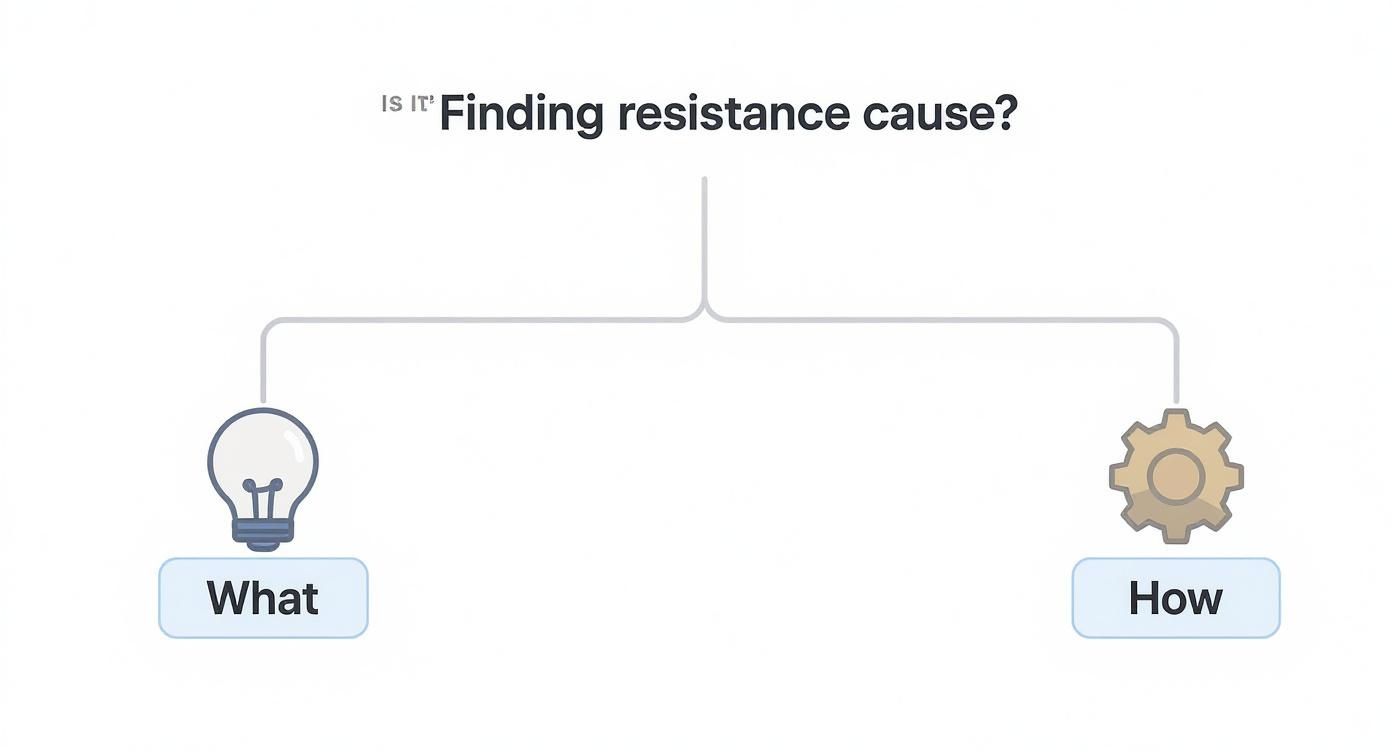
This kind of thinking helps you figure out if resistance is coming from the change itself ('What') or the way it’s being rolled out ('How'). Once you diagnose the source, you can adjust your communication to focus on either the core vision or the practical side of the plan.
And don't underestimate the power of a personal video message. A short, unscripted video update from a leader can feel so much more personal and sincere than a polished email. It's a simple way to bridge the distance and show you genuinely care.
Turn Your Team into Change Champions

The biggest mistake I see leaders make is treating change as something they push onto their team. The real magic happens when you flip that script and start building the change with them. This single shift—from dictating to collaborating—is what turns skeptical employees into your most vocal supporters.
Think about it. When change feels like it's happening to you, your defenses go up. It’s a natural human reaction. But when you give people a seat at the table and a hand in shaping the outcome, they develop a powerful sense of ownership. That feeling is the secret sauce for transforming resistance into momentum.
Build a Network of Change Champions
Your first move should be to identify and empower a network of "Change Champions." Forget about titles and org charts for a minute. These are the people on your teams who are influential, respected, and socially connected, regardless of their official role.
They are your eyes and ears on the ground. They get the team's real, unfiltered perspective and can tell you what’s actually going on. By bringing them into the process early, you're not just getting feedback; you're giving them a genuine stake in the outcome.
So, what does a Change Champion actually do?
- They're a two-way radio: They can explain leadership’s vision in plain language to their peers and, just as importantly, bring grassroots concerns straight back to you.
- They lead by example: Seeing a trusted colleague embrace a new tool carries so much more weight than a top-down memo.
- They translate the "why": They know how to connect the dots between a high-level goal and what it means for their team’s daily grind.
When you officially recognize this group, you give their influence a platform. You're arming them to guide their colleagues through the messy parts of a transition. It's a key strategy for building high-performance teams that can handle whatever comes their way.
The Power of Pilot Programs and Co-Creation
Don't aim for a perfect, big-bang launch. That’s a recipe for disaster. Instead, kick things off with a small pilot program. Grab a representative group from different areas and let them test the new process or software in a low-stakes setting. This isn't just about finding bugs; it’s about making implementation a team sport.
You can also give your team a say in how changes are rolled out. The "what" and "why" might be set in stone, but the "how" is where you can invite them to co-create the solution. This tactic directly tackles one of the biggest drivers of resistance: a perceived loss of control.
Research consistently shows that resistance plummets when employees feel prepared and supported. Involving them in the process is the most direct way to boost their readiness and prove that you’ve got their backs. You can read more on the psychological drivers of resistance to see just how critical this is.
Remember, the most valuable thing you get from a pilot program isn't a perfect workflow. It’s the raw, honest feedback. It’s your chance to listen, adapt, and show your team that their experience matters.
Facilitating Virtual Workshops That Create Ownership
For remote teams, virtual workshops are where the real collaborative work happens. But let's be honest, a poorly run video call can suck the life out of a room. The trick is to design sessions that are hyper-focused, interactive, and built to produce tangible results.
This is where tools like Bulby can make a huge difference. They provide a structured way to guide your team through exercises that pull ideas from everyone, not just the loudest person in the virtual room.
Try framing a workshop around a question like this: "What are the top three roadblocks we'll hit when we launch this, and how can we solve them together before they happen?"
This simple prompt completely changes the dynamic. It stops being a complaint session and becomes a proactive problem-solving sprint. When your team helps build the plan to overcome the obstacles, they're not going to fight against it later.
To help you get started, here's a quick comparison of different engagement techniques that have worked well for remote teams I've managed.
Engagement Technique Comparison for Remote Teams
| Technique | Best For | Key Benefit | Remote Implementation Tip |
|---|---|---|---|
| Change Champion Network | Building trust and improving two-way communication. | Leverages existing social networks and peer influence to build buy-in organically. | Create a private chat channel for champions to share feedback and get early updates. |
| Pilot Programs | Testing new tools or complex workflow changes. | Allows for real-world testing and iteration, reducing the risk of a full-scale failure. | Choose a cross-functional group to ensure you get diverse perspectives on the process. |
| Co-Creation Workshops | Solving implementation challenges and designing team-specific workflows. | Fosters a deep sense of ownership by making team members part of the solution. | Use breakout rooms and a shared digital whiteboard to facilitate small-group brainstorming. |
Each of these methods is powerful in its own right, but they work best when used together.
Ultimately, turning your team into champions means being willing to share power. When you invite people to help build the future instead of just telling them to show up for it, you’re doing more than overcoming resistance—you’re building a stronger, more resilient organization.
How to Sustain Momentum After the Launch
Getting a major change initiative over the finish line is a huge win, and you should absolutely celebrate it. But the real work? That starts the day after launch. The initial excitement fades, old habits start creeping back in, and all that hard work can unravel if you're not careful.
Sustaining momentum isn't about brute force. It's about embedding the new way of doing things into the team's daily rhythm until it feels more natural—and obviously better—than the old way. This is where you prove the change was worth all the effort.
Measure What Matters Most
To keep a change going, you have to know if it's actually working. Gut feelings won't cut it. You need a smart mix of hard data and real human feedback to see the complete picture.
First, look at the numbers. If the change involved a new software tool, don't just track logins. Dig deeper. Are people using the advanced features that were supposed to save them time? Or are they just using it like a prettier version of the old system? Low adoption of a key feature is a huge red flag.
But data only tells you what is happening, not why. That's where you need to talk to your team.
The point of measuring isn't to micromanage your team. It's to spot the friction you couldn't see before launch. If a feature has low usage, it might not be stubbornness—it could be a sign the training missed the mark or the new workflow is just plain awkward.
Getting that qualitative insight is the key. It helps you figure out if you're dealing with genuine resistance or just practical problems that are easy to fix.
Celebrate Small Wins and Recognize Early Adopters
Momentum is fueled by positive reinforcement. Right after a launch, you have to be on the lookout for small victories and celebrate them loudly. When people see the change leading to real, tangible benefits for their coworkers, skepticism starts to fade pretty quickly.
Did a team use the new project management tool to catch a problem before it blew up? Share that story in your main Slack or Teams channel. Did someone figure out a clever shortcut that saved everyone an hour of busywork? Give them a public shout-out in the next all-hands meeting.
These little acts of recognition are incredibly powerful.
- They create social proof. When people see their peers succeeding with the new system, it makes them think, "Hey, maybe I should give this a real shot."
- They build positive momentum. Celebrating wins directly connects the change to success, flipping the narrative from "disruption" to "improvement."
Your early adopters are your best friends here. They're the ones who will find these initial wins, so make them heroes. It rewards them for taking the leap and shows everyone else that getting on board is the path to recognition.
Create a Continuous Feedback Loop
Launching a change isn't the end of the conversation—it’s the start of a brand new one. To make any change stick, you need a simple, ongoing way for people to share feedback and for you to act on it. This shows the team they have a voice and that their experience matters.
One of the best ways to do this is with regular team retrospectives focused specifically on the new process. These aren't just gripe sessions. They should be structured meetings aimed at answering three simple questions:
- What’s going well with the new way of working?
- What’s still feeling clunky or causing headaches?
- What's one small experiment we can try next week to improve it?
This approach keeps the conversation moving forward. By focusing on small, actionable tweaks, you give the team ownership over making the change better over time. You can learn how to get this right by checking out our guide on how to run an effective retrospective meeting in our detailed guide.
When you combine clear metrics, consistent celebration, and a strong feedback loop, the post-launch phase stops being a waiting game and starts being a period of learning and refinement. This is how you make sure your hard work actually pays off for the long haul.
Got Questions About Handling Change Resistance?
Even the best-laid plans hit a snag. When you're steering your team through a big change, you’re bound to face some tough, on-the-ground questions. Here’s how to handle some of the most common challenges that pop up.
How Do I Handle a Key Employee Who Is Actively Resisting?
When an influential person on your team is digging their heels in, you have to deal with it—fast. Ignoring it is the worst thing you can do, because the situation will only fester.
Pull them aside for a private conversation. Your first job is to listen, so go into that one-on-one with genuine curiosity, not your defenses up. You need to get to the root of their concerns. More often than not, your loudest critics are also your most passionate employees, and they might have spotted a real problem you missed.
Validate what you can in their perspective and try to find some common ground. If it makes sense, ask them to help you solve the very problem they’ve pointed out. This can channel their energy from fighting the change to making it better. If they're working off bad information, gently correct them with the facts.
But what if they won't budge and their attitude starts poisoning the team? It’s time to be firm. You have to be crystal clear about which parts of the change are non-negotiable and what you expect from them, while still being empathetic about how tough the transition feels.
What Is the Single Most Important Thing to Reduce Resistance?
If I had to pick one thing, it’s this: communicate the "why." You have to explain the reason for the change clearly, consistently, and with genuine conviction. It's the most powerful tool you have.
People can handle a lot of disruption if they understand the logic behind it. They need to see how this new direction connects to the company's mission, its long-term health, or its ability to serve customers. Just announcing what is changing is never enough. You have to sell them on why it's a must-do.
Frame the change as a necessary step forward, not just another random decision from the top. When you give people context, you take away the fear of the unknown—a primary driver of resistance. Once the "why" clicks, they can start to find their place in the new picture.
Our Last Change Failed. How Do We Overcome Skepticism?
If your team has scar tissue from a past initiative that crashed and burned, their skepticism is completely justified. You can't just sweep that history under the rug; you have to face it head-on.
Kick off your communications by acknowledging the elephant in the room. Try something like, "I know the rollout for Project X was rough, and we learned a ton from it. Here’s exactly what we're doing differently this time to get it right."
That simple act shows you respect their experience and aren't blind to their concerns. It's the first step to rebuilding trust. Then, you have to prove things are different.
- A more inclusive process: Show them how they'll be involved in planning and feedback this time.
- Better resource allocation: Demonstrate that you've secured the budget, tools, and time needed for success.
- A clearer, more realistic vision: Articulate a focused goal and a more manageable timeline to differentiate this from past failures.
When you bring the team into the fold and prove you’ve learned from history, you can start to thaw that change fatigue and earn back the trust you need to move forward.
Ready to transform resistance into collaboration? Bulby provides the AI-powered tools and guided exercises your remote team needs to brainstorm solutions and build ownership together. Stop pushing change and start co-creating it by visiting Bulby's website to see how.