
Let's get straight to the point: open-ended questions are conversation starters, not conversation stoppers. They're the kind of questions that can't be answered with a simple 'yes' or 'no'.
Think of it like this: a closed question is a locked door. An open-ended question is the key that unlocks it, inviting people to walk through and explore what's on the other side.
What Are Open-Ended Questions and Why Should You Care?

Picture your team in a brainstorming session. You’re trying to nail down a new product feature. If you ask, "Do you like the current design?" you’re going to get a round of one-word answers. "Yes." "No." "It's fine." The conversation grinds to a halt before it even begins. That's a closed-ended question at work—it shuts down discussion.
Now, let's flip the script. What if you asked, "What aspects of the current design are creating the most friction for our users?" See the difference? Suddenly, you've opened the door to real stories, specific examples, and genuine insights. That's the magic of an open-ended question. It shifts the entire dynamic from a simple poll to a deep exploration.
Why Asking the Right Questions is a Superpower
For anyone leading a remote team, managing a product, or facilitating a workshop, learning to ask great questions is a game-changer. It’s how you uncover what’s really going on, build a sense of safety where people feel comfortable sharing, and spark genuine innovation. When you ask better questions, you get better answers. It's that simple.
The payoff is both immediate and significant. Open-ended questions:
- Spark Deeper Thinking: They push people past their initial, surface-level reactions.
- Create Real Dialogue: Instead of a rigid Q&A, you get a natural, flowing conversation.
- Uncover Hidden Gems: You’ll discover pain points, opportunities, and ideas you never would have found otherwise.
- Build Stronger Teams: Taking a genuine interest in someone's detailed thoughts is a powerful way to build trust and connection.
This isn’t a new-age management fad. The power of open-ended questions has been a cornerstone of great communication for decades. Their impact in sales became undeniable after 1957, when research showed that top salespeople asked 56% more open-ended questions in their initial meetings. The result? They achieved a 17% higher close rate.
The quality of our lives is determined by the quality of our questions.
— Tony Robbins
That wisdom goes way beyond the sales floor. In a remote brainstorming session using a tool like Bulby, a single well-phrased question can be the difference between a dull, unproductive meeting and a breakthrough moment. It’s all about creating a space where everyone feels heard and empowered to contribute their best thinking.
To really nail this, it helps to see the two question types side-by-side.
Open Ended vs Closed Ended Questions at a Glance
This table breaks down the fundamental differences, making it easy to see when and where to use each type.
| Characteristic | Open Ended Questions | Closed Ended Questions |
|---|---|---|
| Purpose | To explore, understand, and gather rich detail. | To confirm, clarify, and get specific, quick answers. |
| Answer Type Elicited | Detailed, narrative, and subjective responses. | "Yes," "No," a single word, or a specific fact. |
| Brainstorming Use | Ideal for starting discussions and generating new ideas. | Best for narrowing down options or making decisions. |
Understanding this distinction is the first step. By learning how to ask open ended questions, you can start unlocking your team's creative potential and turn every conversation into an opportunity for discovery.
How Open Questions Spark Breakthrough Ideas
Have you ever been in a meeting where one person's comment just clicks and changes the entire conversation for the better? That spark almost never comes from a closed-off question like, "Are we all on the same page?" It’s usually ignited by a prompt that opens the door to new possibilities.
These open-ended questions are the fuel for breakthrough moments, and they're especially crucial for remote teams.
When everyone is in a different location, it’s all too easy for that creative energy to fizzle out. A quick chat message can be easily misunderstood, and you lose the natural, free-flowing vibe of being in the same room. This is where a smart questioning strategy becomes your secret weapon. It deliberately carves out space for deeper thinking, pushing your team past the easy, surface-level answers that can dominate virtual calls.
Unlocking Your Team's Cognitive Potential
The real magic of asking "what if…?" or "how might we…?" is how it dismantles the mental roadblocks that kill creativity. Two of the biggest offenders you'll see in any team setting are groupthink and anchoring bias.
- Groupthink: This is that all-too-common scenario where everyone wants to get along, so they avoid conflict and just agree. People end up suppressing their own doubts or brilliant ideas just to maintain harmony, leading to weak decisions.
- Anchoring Bias: This happens when the very first idea mentioned becomes the "anchor" that every other idea gets compared to. Once it's out there, it's incredibly difficult for the team to think beyond that initial suggestion.
Open-ended questions are a direct assault on these biases.
When you ask something like, "What perspectives are we completely missing here?" you're giving everyone explicit permission to disagree and break free from the pull of groupthink. A question like, "Let's pretend our first idea is impossible. What other paths could we explore?" instantly lifts that anchor, freeing the team to navigate uncharted territory.
An open-ended question is not just a request for information; it's an invitation to co-create a new reality. It tells your team, 'Your unique perspective is not only welcome here—it’s essential.'
This entire process is really about sparking divergent thinking—a way of thinking that focuses on generating as many solutions as possible without judging them upfront. It's all about quantity over quality in the early stages. If you want to get a better handle on this, our guide explains what divergent thinking is in psychology and why it’s so critical for innovation. By fostering this exploratory mindset, you shift your team from passively nodding along to actively creating together.
From Quiet Meetings to Dynamic Idea Generation
In a remote meeting, silence can be a killer. Is John deep in thought, or is he just checking his email? An open-ended question cuts through that uncertainty and turns it into productive energy. Think of it as a specific, low-pressure invitation to contribute.
Instead of putting someone on the spot with a direct, "Sarah, what do you think?" which can feel like an interrogation, you can open the floor to everyone: "What's one assumption we're making about our customers that might be totally wrong?"
This simple shift lowers the barrier to entry. It feels much safer for people to share a half-formed thought or a tiny observation. This is a game-changer for introverted team members or those who need a moment to process before speaking. It gives them the runway they need to formulate their thoughts, ensuring their valuable insights don't get lost in a meeting dominated by the loudest voices.
To really get the ball rolling, you might even get inspiration from a list of unforgettable interview questions designed to provoke deeper answers. This small change in how you ask questions can completely transform your team's output, turning a quiet, awkward meeting into a dynamic session buzzing with ideas.
A Practical Guide to Crafting Powerful Questions

Knowing what open-ended questions are is one thing. Knowing how to actually write them well? That's where the real magic happens. A great question is like a well-made tool—it’s simple, focused, and designed for a specific job. So, let's move from theory to practice and break down how these prompts work.
It all starts with a single word. Simple openers like "How," "What if," and "Why" are the engines of exploration. They signal to our brains that we need to dig deeper for a thoughtful response, not just give a quick thumbs-up.
Think of these words as different lenses for looking at a problem. "How" asks for process and possibility. "What if" invites imagination by removing constraints. "Why" pushes for a deeper understanding of the root cause.
Start with Strong Foundations
The best open-ended questions are built on a clear, simple structure. The aim is to spark a conversation, not to confuse everyone with a complex, multi-part monster of a question. A poorly phrased prompt can accidentally shut down the very discussion you’re trying to start.
Here are the essential ingredients of a powerful question:
- A Clear Opener: Kick things off with words that demand detail, like How, What, Why, Tell me about, or Describe.
- A Specific Focus: Narrow the scope. Instead of a vague "What do you think about the project?" try something like, "What has been the most challenging part of this project so far?"
- Neutral Language: Frame the question without injecting your own bias. This creates a safe space for people to give honest, unfiltered answers.
That last point is a big one. A leading question like, "Don't you think the new design is a huge improvement?" isn't a real question at all—it's just a disguised attempt to get agreement. It corners people, making it almost impossible for them to offer a different opinion.
Avoid Common Questioning Traps
As you start writing your own prompts, keep an eye out for a few common mistakes that can derail a good brainstorming session. Just being aware of these pitfalls is half the battle.
The most common mistake? Asking a question that’s way too vague. A prompt like "Any ideas?" or "What are your thoughts?" often leads to crickets because it’s too broad. You’re asking your team to come up with both a topic and an opinion on it, which is a lot of mental work.
A great question isn't about getting the 'right' answer. It's about getting the richest, most insightful thinking from the group. The goal is to unlock perspectives, not to validate your own.
Instead, always give people a clear container for their thoughts. For example, rather than asking "What can we do better?" try a more focused prompt like, "What is one process we could change that would save our team an hour each week?" This gives everyone a specific target to aim for.
Phrasing for Maximum Impact
The way you word a question has a direct effect on the quality of the answer you get. The goal is to be intentional, steering clear of defensive reactions while encouraging expansive, creative thinking.
Tip 1: Be Mindful of "Why"
"Why" is a fantastic tool for getting to the root of an issue, but it can sometimes put people on the defensive. A question like, "Why did you miss the deadline?" can feel like an accusation. A simple rephrase—"What were some of the obstacles that got in the way of the deadline?"—gets to the same information but keeps the tone collaborative and focused on problem-solving.
Tip 2: Keep it Singular
Don't ask multiple questions at once. A prompt like, "What do you think of the marketing plan, and how can we improve the social media strategy?" forces the listener to track two separate ideas. Ask one focused question at a time to get a clear, detailed answer for each.
Tip 3: Use Follow-Up Questions to Go Deeper
Your first question is just the starting point. The real insights often emerge from the follow-up. Simple prompts like "Can you tell me more about that?" or "What would that look like in practice?" are incredibly effective for peeling back the layers of an idea. You can explore how these techniques are used in our detailed guide on open-ended questions in research.
This disciplined approach has proven benefits. In sales, for instance, an analysis of over 10,000 calls revealed that reps who used open-ended questions in the first five minutes closed 28% more leads. They uncover pain points and build trust by asking things like, "How do your current tools fall short for your workflow?" rather than "Are you happy with your tools?" To see how this applies in various scenarios, you can find more insights about open-ended sales questions at Spotio.com. Mastering this skill turns every conversation into an opportunity for discovery.
Real-World Examples for Any Brainstorming Scenario

It’s one thing to understand the theory, but having the right question ready to deploy at the right moment is what really counts. Think of this section as your personal toolkit, filled with road-tested questions you can pull out for your team's most common challenges.
These aren't just generic prompts; they're conversation starters. Each one is designed to get your team past the obvious, surface-level chatter and dive straight into what truly matters. Whether you're trying to dream up a new product or just make your weekly meetings better, the right question changes everything.
Questions for Product Feature Ideation
When you're working on a product, the real goal is to solve a genuine problem for your users. These questions help cut through the noise to find unmet needs and spark ideas that actually add value.
- What’s a point of friction in our user's daily workflow that we could eliminate?
- If we were building this product from scratch today, what would we do differently?
- What’s a common user complaint we’ve written off as a “cost of doing business”?
- How might our most passionate users describe the one thing our product is missing?
- If we had an unlimited budget, what’s the single most ambitious feature we would build?
- What job are users "hiring" our product to do that we never even intended?
- In what ways could our product simplify our user's life outside of its main purpose?
Questions for Marketing Campaign Strategy
A great marketing campaign connects with people on both an emotional and a practical level. The questions below are designed to get your team into the customer's mindset and find creative ways to earn their attention.
The most powerful open-ended questions in marketing aren't about your product; they're about your customer's story. By understanding their world, you can find where your brand fits in naturally.
Use these to get beyond talking about channels and tactics and start exploring the core story you want to tell.
- What is the one key feeling we want our audience to have after seeing this campaign?
- What major assumptions are we making about our target audience that might be totally wrong?
- How could we tell our brand’s story without ever mentioning a single product feature?
- What conversation is already happening in our industry that we could join or reshape?
- If our biggest competitor launched this exact campaign, what would we secretly admire about it?
Questions for Solving User Experience Problems
Good UX is all about empathy. When something feels clunky or confusing, you have to understand the “why” behind a user’s struggle. These questions are meant to put your team directly into the user's shoes. To see how companies collect this kind of rich, qualitative data, it's helpful to explore various customer feedback form templates and see how they phrase their questions.
- At what specific point in the journey do people seem to get the most confused or frustrated?
- What piece of feedback have we dismissed in the past that might actually hold the key to this problem?
- How would someone with zero technical knowledge describe this issue?
- From the user's point of view, what would a "magical" solution to this problem look like?
- What are the hidden costs—in time, effort, or frustration—that our users are paying because of this issue?
Questions for Team Process Improvement
Even the most high-performing teams can find better ways to work together, especially when everyone's remote. These prompts open the door for constructive, blame-free conversations about making small, consistent improvements.
- What’s one recurring task that always seems to take way more time than it should?
- How could we make our team meetings more valuable and less of a status update?
- What is something we should stop doing to free up more time for high-impact work?
- How can we get better at sharing direct, helpful feedback with each other?
- What does an ideal work week look like for our team, and what’s standing in the way of it?
Of course, this is just a starting point. Feel free to tweak these questions or use them as a launchpad for your own. For an even bigger library, check out our complete list of open-ended questions examples to find the perfect prompt for any situation. The real goal is to build a habit of asking thoughtful, exploratory questions that unlock your team's collective genius.
Common Mistakes to Avoid When Asking Questions
Knowing how to ask a great open-ended question is only half the battle. Just as important is knowing what not to do. It's surprisingly easy to accidentally shut down a conversation, leading to confused silence instead of the rich dialogue you were hoping for.
By sidestepping these common mistakes, you can make sure your questions actually work as intended. You'll create a space where your team feels genuinely encouraged to share their best thinking. Once you learn to spot these missteps, you'll find every brainstorming session gets a whole lot more productive.
Asking Questions That Are Too Vague
One of the most frequent traps is asking a question that's just too broad. A prompt like, "What are your thoughts?" or "Any ideas?" feels open, but it can actually paralyze a group. Why? It puts a double burden on everyone: first, they have to figure out what you're even talking about, and then they have to come up with an opinion on it.
This lack of focus usually leads to awkward silences or watered-down, generic answers. When people don’t know where to start, they often don't start at all.
- Before: "What do you think about the new marketing campaign?"
- After: "What's one aspect of the new marketing campaign that you believe will resonate most with our target audience?"
See the difference? The "after" example gives the team a clear starting point. It guides them toward a specific area for discussion but still leaves plenty of room for a wide range of detailed answers.
Accidentally Leading the Witness
A leading question is a sneaky one—it's a closed question masquerading as an open one. It subtly nudges people toward the answer you want to hear, which is a fast track to groupthink and kills off any chance for honest disagreement.
For example, asking, "Don't you agree that this new feature is a huge improvement?" makes it socially awkward for someone to say, "Actually, no." It sends a clear signal that you're looking for validation, not real feedback. This is especially harmful in a remote setting, where people might already be hesitant to speak up—a phenomenon we explore in our guide on what is evaluation apprehension.
A truly open question invites exploration without pointing toward a specific destination. It’s a compass, not a map.
To avoid this, just strip your own opinions and biases out of the question. Keep your language neutral, and you'll create a much safer space for people to be honest.
- Before: "How amazing was the new onboarding flow?"
- After: "What was your experience navigating the new onboarding flow for the first time?"
Overwhelming the Team with Too Many Questions
While open-ended questions are powerful, you can definitely have too much of a good thing. Firing off too many prompts at once is a surefire way to cause cognitive overload and burn people out. This is particularly true for surveys; a long list of open text fields often causes people to just give up and close the tab.
In fact, market research firms have found that keeping open-ended questions to about 10% of the total is a solid rule of thumb. One study showed that going over this limit increased respondent fatigue by a whopping 45%. In a live session, the solution is even simpler: stick to one clear, focused question at a time. This keeps the conversation moving forward without overwhelming anyone.
Supercharge Your Sessions with Structured Questioning
Knowing what to ask is a powerful skill, but asking the right questions consistently, especially when your team is spread out, is a whole other challenge. This is where moving from a manual, on-the-fly approach to a more structured one can completely change the game.
Tools like Bulby are designed to handle the heavy lifting. Instead of just hoping someone on the call asks a great open-ended question, these platforms provide a guided experience with exercises built on proven creative methods.
From Good Questions to Guided Workflows
Think of it like having an expert facilitator’s brain baked right into your software. Bulby, for example, uses AI-powered guidance and a library of research-backed activities to lead your team through a strategic sequence of prompts. It’s not just a list of random questions; it's a structured journey designed to get you to a specific goal.
The process is refreshingly simple:
- Pick a Goal: You choose an exercise that fits what you're trying to do, whether it's "Crazy Eights" for a flood of new ideas or a "Sailboat Retrospective" to gather team feedback.
- Follow Guided Prompts: The tool then serves up a series of expertly crafted open-ended questions. These are designed to take your team through the natural rhythm of creative thinking—first exploring lots of possibilities (divergent), then narrowing down to the best ones (convergent).
- Capture Insights Seamlessly: As your team shares their thoughts, every idea is automatically captured and organized. Nothing gets lost, and everything is ready for the next step.
This is all about refining a vague thought into a powerful question that actually sparks ideas.
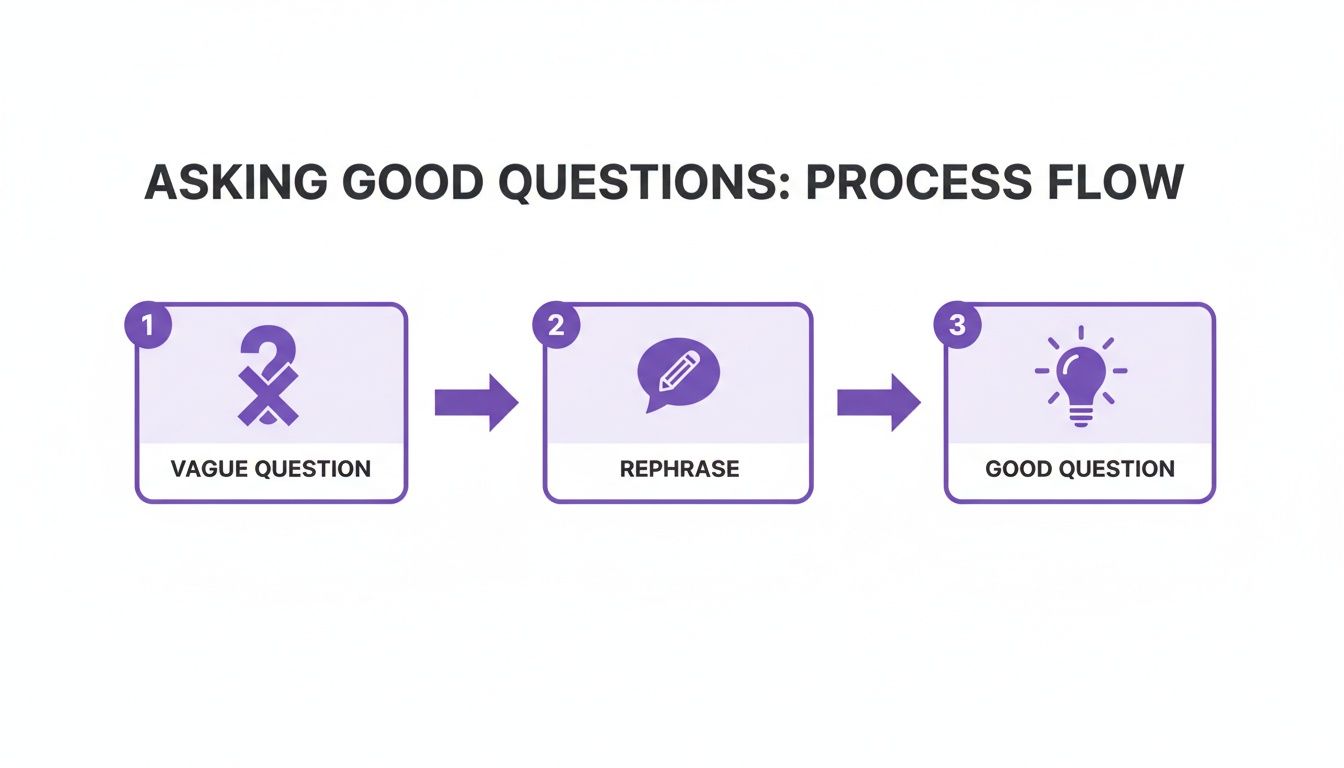
That simple flow—from a fuzzy query to a sharp, insightful one—is the heart of structured brainstorming. It’s a process that technology can now help automate and improve.
An Example Workflow in Action
Let’s say your team needs to brainstorm new product features. Instead of kicking things off with a vague, "Any ideas for new features?", a guided platform might take you through a sequence like this:
- Step 1 (Empathy): "Describe a recent moment when a user felt frustrated with our product." This first question immediately grounds the team in a real-world user problem.
- Step 2 (Ideation): "How might we turn that moment of frustration into one of delight?" Now the team is encouraged to think creatively and without limits, focusing purely on solutions.
- Step 3 (Refinement): "What would be the simplest version of that solution we could build first?" This final prompt helps everyone zero in on a realistic, actionable first step.
By building the principles of great open-ended questions directly into the technology, you create a repeatable system for innovation. It takes out the guesswork and ensures every brainstorming session is set up for success from the start.
This approach turns brainstorming from an unpredictable art into a more reliable science. When you use tools to guide the questioning process, teams can consistently push past creative blocks and get to much better, more focused results. It makes the power of a perfectly-timed question accessible to everyone on the team, not just the seasoned facilitator.
Got Questions? We've Got Answers
You're ready to start asking better questions, but a few practical things might be on your mind. Let's tackle some of the most common queries that pop up when teams get serious about open-ended questioning.
How Many Questions Should I Prep for a Meeting?
A good rule of thumb is to prepare 3-5 solid, primary questions that get right to the heart of your meeting's goal. This keeps everyone on track without overwhelming them.
Think of these as your session's guideposts. You can always use smaller, on-the-fly follow-ups like, "Interesting, tell me more about that," or "What would that actually look like?" to explore the answers you get.
What if My Question Is Met with Total Silence?
First off, don't panic! A bit of silence is actually a good thing. It means people are thinking instead of just blurting out the first thing that comes to mind.
If the silence starts to feel uncomfortable, you’ve got a few moves:
- Try rephrasing it: Sometimes, asking the same thing in a different way makes it click.
- Offer a starting point: Give a quick example to spark an idea for them.
- Narrow the scope: Ask something more specific, like, "What's the very first part of this that comes to mind?"
Silence isn't a failure. It's often the sound of a team processing something important. The space you give them to think is just as crucial as the question itself.
Are These Just for Group Meetings? Or Can I Use Them in 1-on-1s?
Absolutely! In fact, they’re a game-changer for one-on-one conversations. They're perfect for coaching, giving feedback, or just getting a real sense of where someone is at.
Using open-ended questions turns a simple status update into a real conversation. Asking things like, "What’s been the most energizing part of your work lately?" or "What’s the biggest roadblock you're facing?" builds trust and uncovers the kind of insights that simple check-ins miss. For managers and team leads, they're pure gold.
Ready to turn your brainstorming sessions from chaotic to brilliant? Bulby gives you the structure and AI-powered prompts to make sure every meeting is packed with great ideas. Start your free trial and feel the difference.