
In psychology, divergent thinking is that wonderful, messy process where your mind generates a whole host of unique ideas from a single starting point. It’s less like a laser beam finding a target and more like a firework exploding into a hundred different sparks of light.
This is your brain in “explore mode,” branching out in every possible direction instead of trying to narrow things down to just one right answer.
Exploring Your Mind's Creative Potential

Think of your mind as having two gears. One is a focused, logical gear for solving problems. The other is a wide-open, exploratory gear for creating possibilities. Divergent thinking is the engine that powers that creative gear.
It’s all about spontaneous, free-flowing thought where the goal isn't to find the right answer, but to unearth as many potential answers as you can dream up.
This idea really took off in the psychology world thanks to J.P. Guilford back in 1956. He set it apart from its logical partner, convergent thinking, which is all about finding that single, correct solution. Guilford's work was a big deal because it framed creativity as something we could actually study and measure, not just some mysterious trait you were born with.
The Foundation of Creative Thought
At its heart, divergent thinking is about mental flexibility. It’s the powerhouse behind so many activities we consider "creative," like:
- Brainstorming: Tossing out a ton of ideas without worrying if they’re good or bad.
- Problem-Solving: Seeing multiple ways to tackle a tricky challenge.
- Innovation: Finding surprising connections between completely unrelated concepts to create something new.
It's the psychological equivalent of a sparkler sending out countless points of light from a single source. Each spark represents a new idea, a different perspective, or a unique possibility, illuminating the path to innovation.
This ability to generate options is the crucial first step in any creative journey. Just look at well-known creators and you'll see examples of how creativity soared, offering fantastic inspiration for unlocking your own potential.
Learning to flex this mental muscle isn't just for artists or inventors. It’s a fundamental part of how we think, helping us adapt, innovate, and solve problems every single day.
Once you understand what divergent thinking is, you’ll start seeing it everywhere. If you’re ready to dig deeper, our guide on creativity and creative thinking is the perfect next step.
Divergent vs Convergent Thinking Explained
To really get a handle on divergent thinking, it helps to understand its partner in crime: convergent thinking. These aren't rival approaches duking it out for control of your brain. Think of them more like two sides of the same coin, working together to solve problems effectively.
Let’s try a simple analogy. Imagine you're faced with a challenge, like "How can we get to the other side of this river?"
Divergent thinking is when your mind explodes with possibilities. Build a raft! Find a shallow crossing! Swing on a vine like Tarzan! Train a flock of birds to carry us across! You’re not judging, just generating as many ideas—wild, practical, or otherwise—as you can.
Then, convergent thinking kicks in. It’s the part of your brain that looks at that list and says, "Okay, the bird idea is out. The vine looks risky. But building a raft… we have the materials for that. Let's focus on that one." It’s all about narrowing down, analyzing, and picking the single best path forward.
Different Mindsets for Different Goals
The core difference between the two really comes down to their purpose. Divergent thinking is all about exploration. The goal is to go wide, to produce a massive quantity of ideas without worrying about their quality just yet. It's about opening up the problem and seeing what’s possible.
Convergent thinking, on the other hand, is about evaluation. It's the moment you apply logic, criteria, and critical judgment to that big list of ideas. The goal here isn't to create more options but to make a decision and find the most logical, workable solution.
Here's another way to look at it: Divergent thinking is like a brainstorming session where every idea gets a "Yes, and…" Convergent thinking is the follow-up meeting where you ask, "But how would that actually work?"
A team that only ever diverges will have a whiteboard full of fantastic ideas but never make any progress. On the flip side, a team that jumps straight to convergence will likely settle for the most obvious solution, missing out on potentially groundbreaking innovations.
Comparing the Two Approaches
To truly unlock creative potential, you need to deliberately shift between these two modes. First, you open up the possibilities (diverge), and only then do you start narrowing them down to make a choice (converge).
This table breaks down the key differences at a glance:
Comparing Divergent and Convergent Thinking
| Characteristic | Divergent Thinking | Convergent Thinking |
|---|---|---|
| Primary Goal | Generate many possibilities | Find a single, best solution |
| Process | Spontaneous, free-flowing, non-linear | Logical, systematic, linear |
| Key Question | "What if…?" or "How many ways…?" | "What is the correct answer?" |
| Outcome | A broad list of creative options | A single, well-defined decision |
| Best For | Brainstorming, idea generation, exploration | Problem-solving, decision-making, analysis |
Understanding how and when to use each approach is the foundation of creative problem-solving. For a closer look at the other half of this powerful duo, check out our guide on what is convergent thinking.
How Your Brain Comes Up With New Ideas
That sudden flash of insight—the "aha!" moment—can feel like a bit of magic. But what's really happening inside your head isn't magic at all; it's a fascinating process where your brain actively runs simulations of the future.
Psychologists call this episodic future thinking. Think of it as your own personal simulator. You’re not just replaying old memories (that’s episodic memory). Instead, you're using those memories as building blocks to construct brand-new, detailed scenarios of what could happen. This kind of mental time travel is the engine behind divergent thinking.
Every time you ask "what if?", you fire up this powerful cognitive machinery. You’re projecting yourself into different potential futures, exploring the possibilities, and connecting dots that seemed unrelated before. It's less about remembering what was and more about imagining what could be.
The Power of Future-Focused Imagination
The link between imagining the future and coming up with fresh ideas is more than just a cool theory—it's backed by solid research. Studies consistently show a strong connection between a person's ability to vividly imagine future events and their skill in divergent thinking.
For example, a 2021 study found that the richness of a person's imagined futures accounted for between 15.7% and 19.3% of their success in generating new ideas. What's really interesting is that the study found recalling past events just didn't have the same predictive power. This really puts the spotlight on future-oriented thought as a key ingredient for creativity.
This image below does a great job of showing the difference between the exploratory, open-ended nature of divergent thinking and the more focused, single-answer approach of convergent thinking.
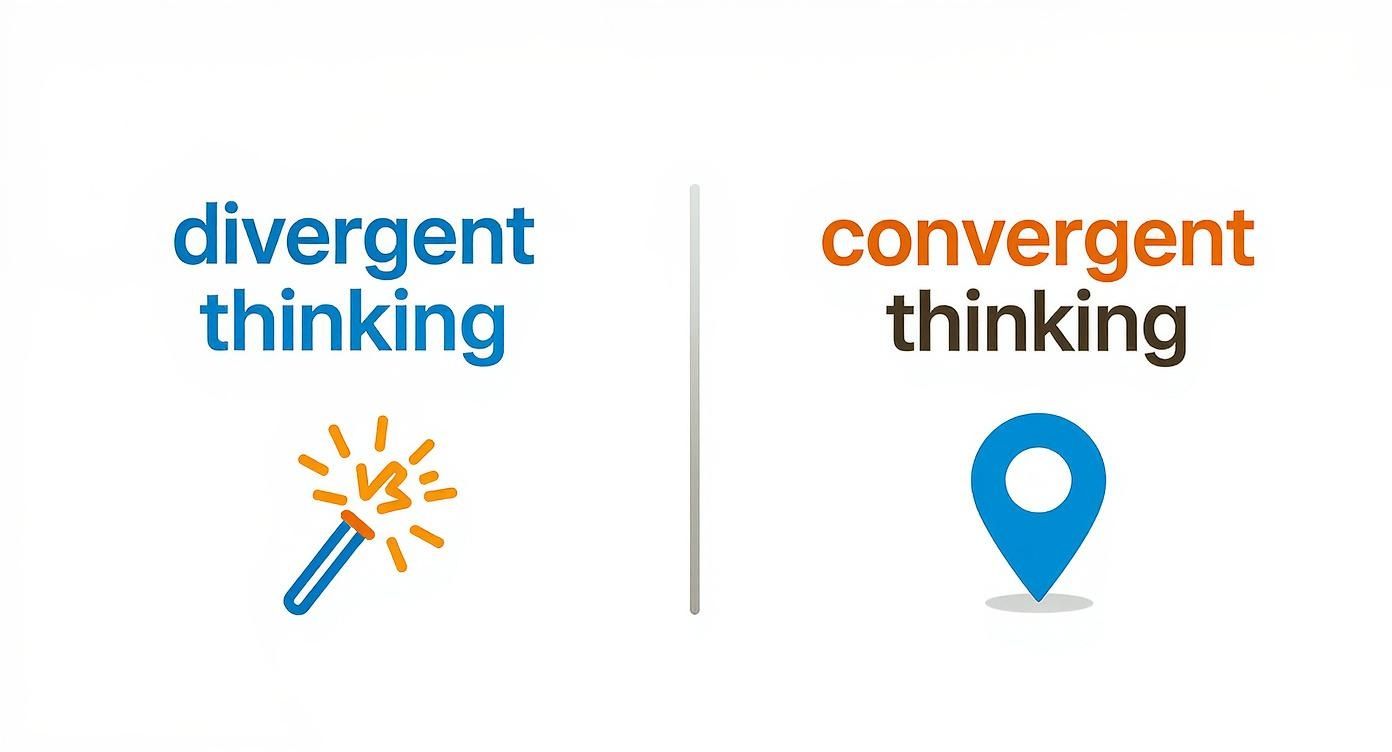
As you can see, divergent thinking branches out in many directions, while convergent thinking narrows everything down to a single point.
From Daydreams to Concrete Ideas
This mental simulation process is what lets us step outside the box of what we already know. It's how an entrepreneur first pictures a new service that doesn't exist yet or how a writer maps out the entire world of a novel. They are blending past experiences with pure imagination to build a reality that isn't here yet.
By mentally placing things in a future context, we can connect seemingly random dots and turn what feels like daydreaming into a genuinely productive exercise. It’s the tool that transforms abstract thoughts into tangible concepts.
To see this in action, you can check out examples of how this kind of thinking leads to real-world products, like these 88 creative app ideas. And if you want to get better at organizing these future-focused ideas, a great next step is to learn how to build a creativity mind map to give your thoughts structure.
How Do We Actually Measure Divergent Thinking?

Creativity can feel like this big, abstract, almost magical thing. But what if I told you we can actually measure it? Psychologists have figured out how to break down this seemingly spontaneous skill into something we can understand and even quantify.
These measurements are the backbone of well-known assessments like the Torrance Test of Creative Thinking. They don't just give you a single "creativity score." Instead, they break it down into four core components. Knowing what they are helps you see where your own creative muscles are strong and where you might have room to grow.
To make this real, let's use a classic creativity prompt: "How many uses can you think of for a paperclip?"
Fluency: It's All About Quantity
First up is Fluency. This one is straightforward: it’s the total number of ideas you can come up with. That’s it. We’re not worried about quality or genius here, just sheer volume.
If you rattle off 20 different uses for a paperclip in two minutes, your fluency score is 20. This is the foundation of divergent thinking—the more ideas you generate, the higher the probability that one of them will be a game-changer.
Originality: How Far Off the Beaten Path Are You?
Next, we have Originality. This metric gets at the uniqueness of your ideas. How surprising or novel are they? Common answers like "hold papers together" or "reset a router" are pretty standard, so they’d score low on originality.
But what if you came up with "use it as a conductor to complete a tiny circuit" or "a miniature hook for an ant-sized fishing rod"? Now we're talking. Those ideas are much less common and would earn a high originality score. This is where you reward the brain for stepping away from the obvious.
Flexibility: Can You Switch Categories?
Flexibility measures your mind's ability to "change gears" and produce ideas across different categories. If all your paperclip ideas are about fastening things (pinning a hem, closing a chip bag, holding papers), you're staying in one lane, and your flexibility score would be low.
A high-flexibility thinker might jump between completely different conceptual groups:
- Tools: A makeshift screwdriver, a lock pick, a fishhook.
- Art: Material for a wire sculpture, a hook for an ornament.
- Fashion: An emergency earring hook, a temporary tie clip.
This shows you aren't just stuck in one mental rut; you can approach the problem from all sorts of angles.
Elaboration: How Much Detail Can You Add?
Finally, there's Elaboration. This looks at the level of detail and richness in your ideas. An answer like "make jewelry" is a good start, but it's pretty bare-bones.
A much more elaborate idea would be: "unwind the paperclip, twist the center into a tight spiral, and thread a small bead onto one end to create a unique pendant for a necklace." See the difference? This metric values your ability to not just state an idea but to truly flesh it out.
To wrap it all up, these four pillars give us a clear way to look at creativity.
The Four Pillars of Measuring Divergent Thinking
| Metric | What It Measures | Example (Uses for a Paperclip) |
|---|---|---|
| Fluency | The total number of ideas generated. | Listing 20 different uses. |
| Originality | The statistical rarity or uniqueness of ideas. | "A miniature antenna for a DIY radio." |
| Flexibility | The number of different categories ideas fall into. | Thinking of uses in tools, art, and fashion. |
| Elaboration | The amount of detail and development in an idea. | "Twist it into a spiral to create a pendant." |
Together, these metrics show that creativity isn't just about a single "aha!" moment. It's about generating a wide, varied, and well-developed landscape of possibilities.
Why Modern Teams Need Divergent Thinking
In today's world, the ability to innovate isn't just a nice-to-have; it's a matter of survival. When we move past the textbook definition of what is divergent thinking in psychology, we start to see its real-world power for teams. It’s the engine that helps groups break free from comfortable, yet stagnant, ways of thinking.
Too often, teams get stuck in "groupthink," where everyone agrees just to keep the peace, shutting down better, more creative ideas before they even have a chance. Divergent thinking is the antidote. It forces a team to explore a wide, and sometimes conflicting, range of perspectives.
Instead of jumping on the first decent idea that comes along, the group is encouraged to pause and ask, "What else could we do?" This simple question is the key to building a team that can adapt and thrive, no matter what challenges come its way.
Building an Adaptable Team Culture
The most successful companies don't just solve the problems in front of them; they're constantly looking for better problems to solve. That requires a team that’s comfortable with a little chaos and skilled at exploration. Fostering divergent thinking is how you build that muscle.
It cultivates a few key qualities:
- Curiosity: A genuine desire to explore "what if" scenarios without rushing to judgment.
- Comfort with Ambiguity: The ability to move forward when the path isn't perfectly clear.
- Persistence: The grit to keep generating ideas, especially when the first few attempts fall flat.
When a team has these traits, they stop seeing tough challenges as roadblocks. Instead, they become opportunities for real breakthroughs. They learn to explore the entire landscape of possibilities before deciding on a single path.
Divergent thinking shifts a team's default setting from "find the right answer" to "discover all the possible answers." This simple change is the foundation of a truly innovative and resilient culture.
Fostering Innovation Through Psychological Traits
This style of thinking is all about exploring as many solutions as possible. It's often measured by testing how many ideas someone can generate, a skill known as ideational fluency. Research in organizational psychology backs this up, with studies showing that team brainstorming can increase the number of unique ideas by 50% or more compared to individuals working alone.
This creative explosion relies on traits like curiosity, a willingness to be different, and perseverance. These are the very things that fuel innovation. You can dig deeper into how these psychological traits support creative outcomes.
Ultimately, the most forward-thinking teams operate with a two-step rhythm. First, they diverge to create a rich pool of creative options. Only then do they converge to make a smart, strategic choice. This ensures they're not just being efficient, but truly effective.
Practical Exercises to Boost Your Creativity
Knowing what divergent thinking is and actually doing it are two different things. Your creative mind is like a muscle—it needs regular workouts to stay strong and flexible. The key is to find exercises that gently nudge you out of your usual thought patterns and into new territory.
These tried-and-true techniques are perfect for getting your team’s creative engine running, whether you’re in the same room or collaborating from afar. Let’s walk through a few powerful methods you can put into practice right away.
Brainwriting 6-3-5
Ever been in a brainstorming session where the same two people do all the talking? Brainwriting is the perfect antidote. It’s a silent, structured technique that gives everyone an equal voice and dedicated time to think.
It’s called 6-3-5 for a reason, and the process is beautifully simple:
- Get six people together.
- Each person jots down three ideas in five minutes.
- When the timer goes off, everyone passes their worksheet to the person on their right.
- In the next five-minute round, you add three new ideas, but this time you can build on what’s already on the page.
- Repeat this six times until your original worksheet makes its way back to you.
Do the math: in just 30 minutes, this method can crank out a staggering 108 ideas (6 people x 3 ideas x 6 rounds). It’s a remarkably efficient way to pool your team’s brainpower without the chaos of a free-for-all discussion.
The SCAMPER Method
Let’s be honest, not every great idea comes out of thin air. Sometimes, the most brilliant innovations are just clever twists on what already exists. The SCAMPER method is basically a creative checklist that helps you look at an old problem or product in seven new ways.
Think of it as a set of creative prompts:
- Substitute: What parts or materials can you swap out? (e.g., using bamboo instead of plastic).
- Combine: Can you merge two separate things into one? (e.g., a phone case that’s also a wallet).
- Adapt: How could you adapt this for a totally different purpose? (e.g., using drone technology for emergency medical deliveries).
- Modify: What happens if you change the scale, shape, or color? (e.g., creating a mini, travel-sized version of a popular product).
- Put to another use: Can this be used by a different person or in another industry? (e.g., using memory foam, originally for astronauts, in mattresses and shoes).
- Eliminate: What could you remove to simplify it? (e.g., taking all the unnecessary buttons off a remote control).
- Reverse: What if you flipped the process or turned it upside down? (e.g., a restaurant that serves dessert first).
SCAMPER forces you to challenge your assumptions. It's an incredible tool for anyone working on product development or looking to improve a process.
Mind Mapping
Linear, bulleted lists are great for organizing, but they don't always spark creativity. Mind mapping is a visual technique that works the way your brain does—by making connections. You start with one central idea and branch out, creating a web of related thoughts and possibilities.
This visual layout makes it easier to spot relationships between ideas that you might otherwise miss.
For remote teams, this is where digital tools like Bulby really shine. Everyone can jump onto a shared canvas to add, link, and expand on ideas in real-time. It turns a brainstorming session into a living, visual document of your team's thinking. If you’re looking for more inspiration, exploring a few different creative thinking exercises can keep your team's innovative spirit alive.
Got Questions About Divergent Thinking? Let’s Clear Things Up.
As you start wrapping your head around this concept, a few common questions usually pop up. Let's tackle them directly to clear up any confusion.
Is Brainstorming Just Another Word for Divergent Thinking?
Not exactly, though they're closely related. Think of it this way: divergent thinking is the mental engine—it's the actual cognitive process of branching out and generating a wide range of ideas.
Brainstorming, on the other hand, is a specific vehicle you use to get that engine running. It's one of the most popular techniques for encouraging divergent thought, but it’s not the only one. Divergent thinking is the "what" (the mental act), while brainstorming is a "how" (one method to do it).
Can You Actually Have Too Much Divergent Thinking?
Absolutely. It might sound strange, but endless idea generation without a filter can lead to total paralysis. Imagine a team that does nothing but explore new possibilities—they'd be stuck in a creative loop, never actually committing to a single path or shipping a single project.
The real magic happens when you create a healthy rhythm: diverge to open up possibilities, then converge to make a decision and move forward. Without that balance, you just spin your wheels.
The goal is a healthy rhythm between exploring widely and deciding wisely. Too much of either stalls progress.
Are Some People Just Naturally More Creative Than Others?
It can certainly seem that way, and while some personality traits might give people a head start, divergent thinking is fundamentally a skill. It's not some fixed talent you're either born with or you're not.
Like any muscle, it gets stronger the more you work it out. Consistently practicing exercises, like the ones we’ve covered, and simply getting into the habit of asking "what if?" can make a huge difference in anyone's creative abilities.
Ready to turn these creative exercises into a seamless process for your remote team? Bulby provides guided, research-backed brainstorming sessions that ensure every idea is heard and explored. Transform your team's potential into powerful results at https://www.bulby.com.