
Have you ever looked back on a past event and thought, "I knew that was going to happen"? That feeling, the unshakable sense that an outcome was obvious after it has already occurred, is what psychologists call hindsight bias.
It's a tricky mental shortcut that makes us believe past events were far more predictable than they actually were. Our brain essentially tidies up the messy, uncertain past, making it look like a straight line leading to the present.
The Hidden Trap of I Knew It All Along

Let's picture a scenario. Your product team just launched an exciting, ambitious new feature. The user research looked solid, the team was buzzing with energy, and everyone felt confident. A month later, though, the numbers are in—engagement is dismal. The feature is a dud.
What happens next is crucial. In the team retrospective, the tone starts to shift. A developer might say, "I always thought the back-end complexity was a bad sign." The marketing lead chimes in, "To be honest, the messaging never felt quite right to me." All of a sudden, the failure seems completely predictable, a misstep everyone should have seen from a mile away.
That's hindsight bias in action. Once the outcome is known, our minds work backward to connect the dots, making the result feel inevitable. The real uncertainty and complex variables that existed before the decision was made simply vanish, replaced by a clean, but false, narrative.
Why This Mental Shortcut Matters
This isn't just a quirky memory glitch. For product teams and remote collaborators, hindsight bias can be a serious roadblock to learning and innovation. When we start believing that past outcomes were obvious, we stop looking for the real lessons.
Hindsight bias is so common it's often called the “knew-it-all-along” effect. Classic studies have shown that once people know the outcome of an event, they consistently overestimate how likely they thought it was beforehand—sometimes by as much as 20–30 percentage points.
The table below breaks down the core components of this cognitive bias.
Hindsight Bias at a Glance
This table provides a quick summary of the fundamental aspects of the 'knew-it-all-along' effect.
| Concept | Description |
|---|---|
| Cognitive Distortion | The tendency to see past events as having been more predictable than they actually were. |
| Common Phrase | "I knew it all along." |
| Primary Effect | It distorts our memory of our original predictions, making us feel like we were "right" all along. |
| Key Trigger | Learning the final outcome of an event, whether positive or negative. |
| Impact on Decisions | Leads to overconfidence in future judgments and an inability to learn from past mistakes accurately. |
In short, knowing the ending of the story changes how we remember the beginning.
This bias has a few nasty side effects that can really hurt a team's performance:
- It Kills Risk-Taking: If every failure is viewed as an "obvious" mistake in retrospect, who is going to stick their neck out for a bold new idea? Innovation dies.
- It Blocks Real Learning: Instead of fairly evaluating a decision based on the information available at the time, teams start blaming people for not seeing signs that were only clear with hindsight.
- It Erodes Psychological Safety: A culture where people feel the need to say "I told you so" just to protect themselves is toxic. It kills trust and discourages the honest collaboration needed to solve hard problems.
Hindsight bias rarely works alone. It often partners with other mental shortcuts, like what is confirmation bias, where we naturally favor information that confirms what we already believe. Recognizing how these biases team up is the first step toward building a smarter, more objective team culture. Once you see how easily our view of the past can get twisted, you can start putting systems in place to make better decisions going forward.
Why Our Brains Create False Certainty

That "I knew it all along" feeling isn't a character flaw or a sign you're being dishonest. It’s actually a standard feature of how our brains are wired. We are natural storytellers, constantly trying to make sense of a chaotic world by weaving together neat, cause-and-effect narratives. Once we know how something ends, our brain immediately gets to work tidying up the past to fit that ending.
Think of it like re-watching a great mystery movie. The first time through, you were on the edge of your seat, genuinely guessing who the culprit was. But watching it a second time? Knowing the ending completely changes everything. Every subtle clue, every suspicious glance from the real killer now seems painfully obvious. You can't help but see a straight, clear line from the opening scene to the final reveal. This is exactly what hindsight bias does to our real-life memories.
The Three Faces of Hindsight Bias
This mental shortcut isn’t just one simple feeling; it’s actually a combination of three distinct psychological ingredients. Breaking them down helps explain why hindsight bias feels so convincing and becomes so deeply ingrained in our thinking.
These three components work together so smoothly that we barely notice them, creating a new, tidier version of the past that fits perfectly with our present reality.
-
Memory Distortion: This is where our brain quietly rewrites history. We genuinely misremember what we originally thought before an event happened. You might recall feeling uncertain about a new project, but after it becomes a wild success, your memory shifts. You now remember being confident in its potential all along.
-
Inevitability: This is the part that convinces us the outcome was always going to happen. It makes the event feel predetermined, as if it were a single, unavoidable conclusion. The countless other possibilities that existed beforehand simply fade away, making the actual result seem like the only one that could have ever occurred.
-
Foreseeability: Here’s the classic "I knew it" moment. We start to believe not only that the outcome was inevitable but that we personally could have predicted it—or even did predict it. This is where overconfidence starts creeping in, warping our ability to accurately judge our own decision-making skills.
Hindsight bias is a form of memory distortion where knowing the outcome of an event causes you to believe you could have—or did—predict it. It replaces the genuine uncertainty of the past with a false sense of clarity.
This whole process is a mental shortcut, an efficient way for our brain to process the world. Creating a simple, clean story is far less demanding than holding onto the messy, complex, and uncertain reality of what really happened. To better understand and combat cognitive overload, which can seriously cloud our judgment, is to see why our brains take these shortcuts in the first place.
Why This Automatic Process Is So Tricky
Our brains perform this storytelling trick automatically. It's not a conscious choice. It's an instinctive process to reduce cognitive dissonance—that uncomfortable feeling of holding two conflicting beliefs. The messy uncertainty of the past clashes with the known certainty of the present, and our brain quickly resolves the conflict by simply editing the memory.
This automatic editing is what makes the bias so hard to spot in ourselves. It feels less like we’re changing our minds and more like we’re just remembering things correctly. This cognitive shortcut is similar to others; for a deeper dive, you can learn about what is recency bias and how it also influences our decisions.
By recognizing that hindsight bias is a universal human trait, not a personal failing, teams can start building systems that account for it. This isn’t about blaming people for having a normal human brain; it’s about creating processes that help us all see the past a little more clearly.
How Hindsight Bias Impacts Remote Teams
Hindsight bias can creep into any team, but its effects are often amplified in a remote setting. The natural distance and asynchronous communication create the perfect conditions for this cognitive trap to take root and cause some serious damage.
When we aren't in the same room, we lean heavily on written records—Slack messages, Jira tickets, and project documents. After a project stumbles, it's dangerously easy to scroll back through a Slack channel and cherry-pick a single message that, with the benefit of hindsight, now seems like an obvious red flag.
When Communication Records Become Evidence
The digital paper trail that makes remote work possible can be turned against itself. A casual question about a project’s timeline, which was just a point of curiosity at the moment, can be reinterpreted later as a clear signal of doubt. This is where the "knew-it-all-along" effect weaponizes your team's own records.
Let's walk through a real-world example. A product team decides to run an A/B test for a new checkout flow. After debating two versions, 'A' and 'B,' they move forward with version B based on the data they had. But the test fails, and version B tanks the conversion rate.
Suddenly, during the remote post-mortem, a designer says, "I always felt the user flow in B was too complex." Someone else pulls up a month-old Jira comment where a developer asked, "Are we sure about the API call timing on this?" What were once minor discussion points are now held up as definitive proof that the failure was obvious and completely predictable.
This triggers a few destructive outcomes:
- A Culture of Blame: Instead of analyzing the decision-making process, the team starts looking for a scapegoat—the person whose "obvious" warning was ignored.
- Reduced Collaboration: Team members get nervous about asking questions or voicing minor concerns, fearing their words might be used against them later if things go south.
- Failed Learning: The real reasons for the A/B test's failure—maybe a flawed hypothesis or poor user segmentation—get ignored in favor of the much simpler, hindsight-driven story.
Hindsight bias transforms neutral past communications into a trail of "evidence," making it nearly impossible to have an honest discussion about what was truly known at the time a decision was made.
This classic study on hindsight bias illustrates the effect perfectly, showing how knowing the outcome completely skews our perception of how predictable it was.
The graph shows that individuals told an outcome beforehand assigned a much higher probability to that event happening than those who assessed it without that knowledge. It's the "I knew it all along" effect in a chart.
The Erosion of Psychological Safety
The biggest casualty of unchecked hindsight bias is psychological safety. When every failed experiment or missed deadline gets treated like an obvious mistake, people simply stop taking the creative risks that lead to real breakthroughs.
Innovation demands a willingness to be wrong. It requires trying things that might not work out. But if every misstep is met with a chorus of "we should have seen this coming," the team's creative engine will grind to a halt. People will start sticking to safe, incremental changes instead of chasing bold ideas.
This fosters a toxic environment where covering your own back becomes more important than solving problems. People start writing defensive emails and Slack messages just to create a paper trail proving they had "concerns," in case they need it later. This CYA ("cover your assets") behavior completely undermines the trust and vulnerability a high-performing remote team needs.
A team simply can’t thrive without that foundation of trust. For anyone looking to strengthen their team's core, you might find our guide on how to create psychological safety really helpful.
Ultimately, hindsight bias makes honest, blameless post-mortems impossible. Without the ability to look back at decisions fairly—based on the information available at that time—a team is doomed to repeat its mistakes, all while thinking they've learned their lesson.
The True Cost of Misremembering the Past
When hindsight bias creeps in, it does more than just mess with our memories—it actively torpedoes a team's ability to learn from what actually happened. This isn't some harmless mental quirk. It has a real business cost, distorting how we look at our wins and our losses, which leads to some seriously flawed thinking for the future.
Let’s say a team takes a huge swing on a risky product feature. Against all odds, it’s a massive hit. Hindsight bias immediately convinces everyone that their success was a sure thing, a product of pure genius. The critical role that luck or perfect timing played gets completely brushed aside. This creates a dangerous overconfidence, encouraging them to take the same kinds of wild swings again, forgetting how close they came to striking out.
Now, flip the script. Imagine a team makes a smart, data-driven decision, but it fails because of a totally unpredictable shift in the market. Hindsight bias makes that failure look obvious, and the team starts beating themselves up for not seeing the future. What's the result? They become timid and afraid to take chances, avoiding the very calculated risks that are necessary for real innovation. In both cases, the actual lessons are lost.
The Breakdown of Accountability and Learning
Hindsight bias makes a fair post-mortem impossible. It wrecks accountability by judging old decisions with the clarity of a crystal ball—using information nobody had at the time. This fosters a culture where you can't tell the difference between a good process that had a bad outcome and a terrible process that just got lucky.
This twisted perspective directly kneecaps a company’s ability to learn. Research in strategic management shows this exact problem. When evaluators know a business decision turned out badly (like a failed acquisition), they consistently rate the original choice as far less competent than people who see the same information without knowing the outcome. It leads teams to focus on blame (“How did they not see that coming?”) instead of digging into the real, sensible trade-offs they were making at the time.
A decision should be judged by the quality of the process, not the quality of the outcome. Hindsight bias flips this, making teams reward lucky guesses and punish thoughtful risks.
Ultimately, this harms everything from forecasting to resource allocation. If teams can't learn from the past accurately, they can't plan for the future effectively. This is a huge factor behind many common startup mistakes that only seem glaringly obvious with the benefit of hindsight.
How Success and Failure Become Unreliable Teachers
Hindsight bias turns both wins and losses into poor teachers. It strips away all the messy, important context you need to actually get better.
- When you succeed: You chalk it all up to skill and ignore the role of chance. This leads to overconfidence and repeating risky bets that probably won't pay off a second time.
- When you fail: You see the outcome as inevitable and your decision as a clear screw-up. This creates risk aversion and a culture of blame, killing the experimentation that leads to breakthroughs.
This cycle is especially toxic for groups trying to navigate complex choices together. The bias prevents teams from building the solid frameworks they need for consistently good judgment. For more on this, check out our guide on improving decision-making in groups. When we misremember the past, we give up our chance to build a smarter future, stuck repeating the same patterns while thinking we've learned our lesson.
Actionable Strategies to Mitigate Hindsight Bias
Knowing hindsight bias exists is one thing. Actually doing something about it is another challenge entirely. Since you can’t just flip a switch to turn off this automatic mental shortcut, you need to build systems and habits that force a more honest look at the past. The real goal isn't to eliminate the bias—that's impossible—but to weaken its grip on your team's learning, planning, and culture.
By putting a few structured processes in place, you create a reliable record of what your team was thinking before everyone knew how things would turn out. This record acts as an anchor to reality, stopping memory from conveniently rewriting history.
This infographic really highlights where hindsight bias hits organizations the hardest.
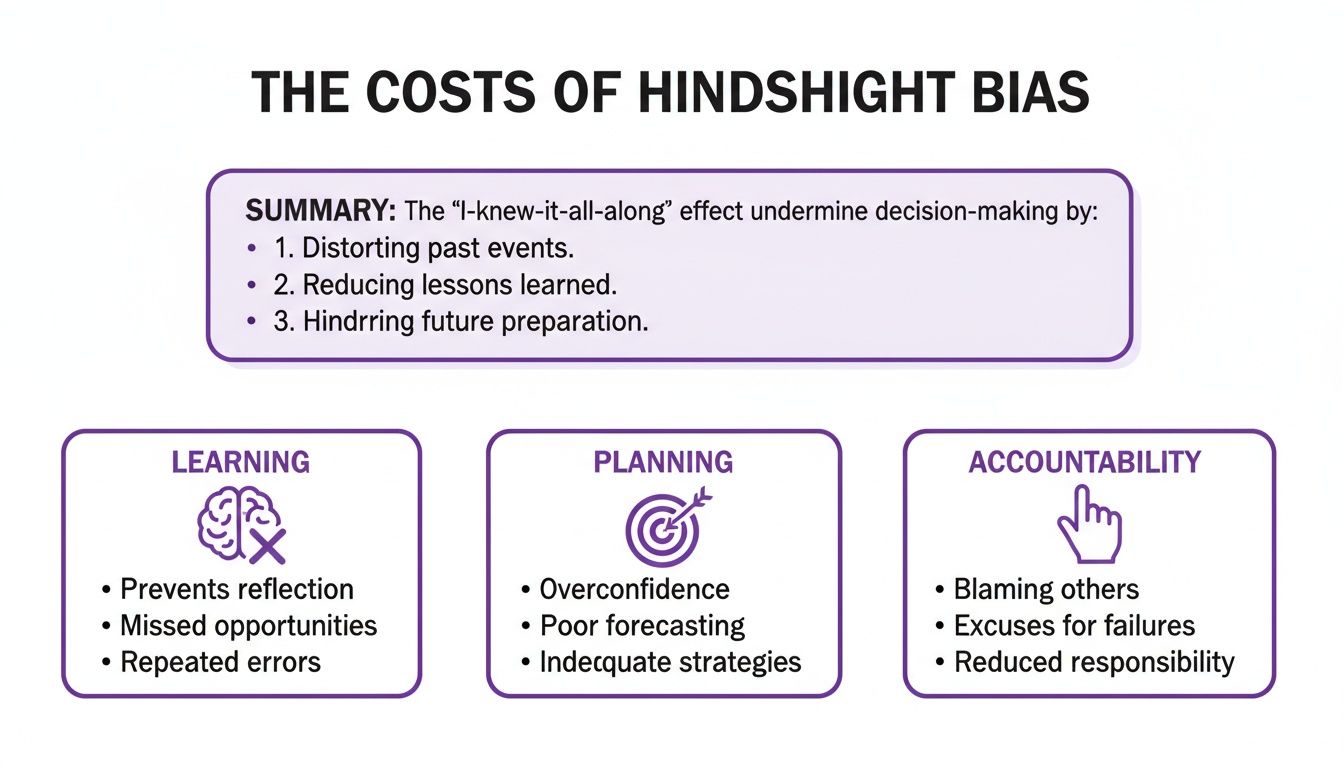
As you can see, the bias directly sabotages learning, poisons strategic planning, and erodes accountability—all essential ingredients for a high-performing team.
Run a Pre-Mortem, Not Just a Post-Mortem
One of the most powerful ways to head off hindsight bias is to imagine total failure before a project even kicks off. This is the whole idea behind a pre-mortem. It’s a proactive exercise where your team assumes a project has already failed spectacularly, then works backward to figure out all the reasons why.
Instead of just asking, "What could go wrong?" a pre-mortem asks, "Okay, this project was a complete disaster. What did go wrong?" That tiny shift in perspective is incredibly freeing. It gives everyone permission to voice concerns without feeling like they're being negative or unsupportive, and it shines a light on hidden threats, unspoken assumptions, and weak spots in the plan.
For remote teams, a pre-mortem is perfect for asynchronous work. Just create a shared doc where each person can list every possible reason for the project's hypothetical doom. This creates a priceless written record of the team's foresight before hindsight has a chance to creep in.
Keep a Decision Journal
Hindsight bias loves to feast on our fuzzy, unreliable memories. A decision journal is the perfect antidote. It creates a simple, time-stamped record of your thought process that you just can't argue with later.
A solid decision journal entry should capture:
- The Situation: What’s the context? What problem are you trying to solve?
- The Options Considered: What were the different paths you could have taken?
- The Decision Made: State the final choice, loud and clear.
- The Rationale: This is the most important part. Why did you choose this path based on the information you had at that moment?
- Your Expectations and Confidence Level: What do you think will happen? On a scale of 1-10, how confident are you?
When you eventually review the outcome, you can compare it to your original thinking, not your new, hindsight-tinted version of events. This practice forces an honest look at your judgment and shuts down the "I knew it all along" narrative before it even starts.
Conduct Blameless Post-Mortems
Once a project wraps up—whether it was a smashing success or a total dud—the review process is where hindsight bias can do some serious damage. A blameless post-mortem changes the game by shifting the focus from who messed up to what can be improved systemically. The goal isn't to pinpoint who was wrong but to figure out what part of the process can be made better.
The core question of a blameless post-mortem isn't "Why didn't you see this coming?" It's "What did we know at the time, and was our decision reasonable based on that information?"
To keep the discussion productive, ground it in the evidence you created before the outcome was known—like your decision journal or pre-mortem notes. This stops the conversation from turning into a finger-pointing session based on Monday-morning quarterbacking. By focusing on process improvements, like better communication channels or clearer approval steps, the team can actually learn something valuable without creating a culture of fear.
To help you get started, we've outlined a few techniques you can implement right away. The key is to choose a mix of proactive and reactive methods that fit your team's workflow.
Hindsight Bias Mitigation Techniques
| Technique | When to Use It | Key Benefit for Remote Teams |
|---|---|---|
| Pre-Mortem | Before a project kickoff or major initiative. | Excellent for asynchronous collaboration; allows all voices to be heard without the pressure of a live meeting. |
| Decision Journal | When making any significant, reversible, or irreversible decision. | Creates a personal, time-stamped record that holds individuals accountable to their past logic, not their rewritten memory. |
| Blameless Post-Mortem | After a project concludes (whether successful or not). | Fosters psychological safety by focusing on systems, not individuals, which is crucial for building trust in a remote setting. |
These techniques transform abstract concepts into practical team habits that lead to smarter decisions over time. If you're looking for more ways to build these skills, exploring structured activities can be a game-changer. You can find more hands-on ways to challenge your team's thinking in our detailed guide on cognitive bias exercises.
Got Questions About Hindsight Bias? We’ve Got Answers.
Even after you get the hang of what hindsight bias is, putting that knowledge into practice can bring up some tricky questions. Let's tackle some of the most common ones that pop up when teams start trying to get a handle on this sneaky bias.
Think of this as your go-to guide for navigating hindsight bias in the real world.
What’s the Difference Between Hindsight Bias and Confirmation Bias?
This is a great question because these two often show up together, but they’re definitely not the same thing. The easiest way to tell them apart is to think about timing.
Hindsight bias is a post-game analysis problem. It kicks in after everything is said and done, making you feel like an outcome was totally obvious from the start. It’s that classic "I knew it all along" feeling that conveniently rewrites your memory of what you actually thought before.
Confirmation bias, on the other hand, is all about the lead-up. It happens before and during the decision-making process. It’s when you unconsciously hunt for information that backs up what you already believe, while turning a blind eye to anything that challenges your view.
In a nutshell: Hindsight bias changes the past to match the present. Confirmation bias filters the present to protect your beliefs.
Let’s say you’re convinced a new marketing campaign will be a smashing success. Confirmation bias is you only reading case studies that praise that strategy. If the campaign flops, hindsight bias is you saying, “You know, I always had a gut feeling that message wouldn’t land.”
Is Hindsight Bias Always a Bad Thing?
It might surprise you, but some psychologists think hindsight bias serves a purpose. It helps our brains create tidy stories out of messy, unpredictable events, making the world feel a little more orderly and less chaotic. It’s a mental shortcut that can lower anxiety.
But in a business setting? That false sense of clarity is a huge liability. For any team trying to innovate and grow, the downsides are just too great.
Here’s why it’s a problem for teams:
- It pumps up overconfidence for future decisions.
- It kills any appetite for smart risk-taking.
- It creates a blame culture that destroys psychological safety.
- It stops you from actually learning from what happened—good or bad.
So, while it might offer a tiny bit of individual comfort, it’s a bias you absolutely have to manage if you want your organization to thrive.
How Can I Run a Post-Mortem Without Hindsight Bias Taking Over?
Running a post-mortem that isn't contaminated by hindsight bias is all about focusing on the process, not the outcome. The goal is to learn, not to point fingers at "obvious" mistakes that were anything but obvious at the time.
First, anchor the conversation in the past. Before you discuss anything, pull up the documents that were created before the outcome was known. We're talking project plans, risk logs, pre-mortem notes, and decision journals. This immediately transports everyone back to their original mindset.
Next, watch your language. Instead of asking, "Why didn't we see this coming?" try asking, "Based on what we knew then, was this a reasonable decision?" This simple reframe shifts the conversation from judgment to evaluation.
Finally, look for systemic issues, not individual slip-ups. Was our data incomplete? Was there a communication breakdown? When you focus on improving the system, you get actionable takeaways for the future without putting anyone on the defensive.
How Does Documenting Decisions Help Fight Hindsight Bias?
Documentation is your secret weapon against hindsight bias. Why? Because this bias thrives on our fuzzy, unreliable memories. When you write down your decisions, assumptions, and predictions as they happen, you create a time-stamped record of the truth.
This record acts as an anchor to reality.
When you're reviewing a project later, this documentation makes it almost impossible for someone to claim they "knew it all along" when their own notes say the opposite. It holds everyone accountable to their actual thought process, not a revised one.
And this isn't about playing "gotcha." It’s about building a culture of intellectual honesty. It changes the conversation from "what I remember feeling" to "what we decided based on this data." This is how you foster real learning and build the kind of psychological safety where evaluations are fair and rooted in fact.
Ready to build a brainstorming process that defeats cognitive biases like hindsight bias from the start? Bulby provides guided, structured exercises designed for remote teams to foster genuine creativity and objective analysis. Discover how to unlock your team's best ideas by visiting https://www.bulby.com.