
Picture your last team meeting. Was it a genuinely collaborative session, or did it feel more like a verbal wrestling match where the loudest voice came out on top? For too many of us, it’s the latter. Parallel thinking is a structured method that gets everyone on your team thinking in the same direction, at the same time, cutting out the friction and arguments that kill good ideas.
Why Traditional Meetings Fail Us
Let’s be honest, most brainstorming sessions follow a predictable, frustrating pattern. Someone throws out a new idea, and almost immediately, someone else chimes in with all the reasons it won't work. A third person jumps in to defend the original thought, and suddenly, the meeting is just a series of arguments and counter-arguments.
This is adversarial thinking. It’s the debate-club model we’re all used to, where the goal is to prove who’s right. But it’s a battle of egos that leaves great ideas dead on the floor and makes people feel defensive or shut down. This combative style is deeply rooted in our culture, but it's incredibly inefficient. Instead of building on ideas, we spend all our energy tearing them down. The goal shifts from finding the best solution to simply winning the argument.
A New Direction for Collaboration
Parallel thinking, a concept developed by Edward de Bono in his 1985 book Six Thinking Hats, offers a much-needed alternative. It completely changes the dynamic of teamwork by moving from adversarial debate to synchronized exploration. Instead of fighting each other, everyone focuses on the same aspect of a problem at the same time. You can see how structured thinking impacts team results in these fascinating workplace productivity statistics.
The core idea behind parallel thinking is simple: at any given moment, every person in the meeting is focused on the same mode of thinking. It’s about cooperative exploration, not competitive debate.
This structure transforms a chaotic free-for-all into an organized, focused process. Think of it like building a house. Adversarial thinking is like having all the builders stand around arguing about the best way to lay a single brick. Parallel thinking is getting everyone to work on the foundation together, then the walls, then the roof—each step is a focused, collective effort.
Parallel Thinking vs Adversarial Thinking at a Glance
To really see the difference, it helps to put these two approaches side-by-side. One is about winning a fight; the other is about exploring a landscape together.
| Aspect | Adversarial Thinking (Debate) | Parallel Thinking (Exploration) |
|---|---|---|
| Goal | Prove who is right; win the argument. | Explore a subject fully from all angles. |
| Process | Argument and counter-argument. | All participants think in the same mode at the same time. |
| Focus | Attacking the other person's logic. | Laying out all ideas side-by-side. |
| Outcome | A winner and a loser; often creates conflict. | A rich map of the topic; collaborative decisions. |
| Energy | Drains energy through conflict and defense. | Creates energy through collaboration and discovery. |
The contrast is pretty stark. Adversarial thinking is about clashing, while parallel thinking is about creating a shared understanding before making any judgments.
The Core Benefits of This Approach
Adopting this method brings some immediate, powerful advantages, especially if your team is stuck in a cycle of unproductive meetings. The goal isn’t to avoid criticism, but to give it a proper time and place, ensuring every perspective gets heard without derailing the whole conversation.
This approach helps to:
- Reduce Ego and Conflict: By separating the modes of thinking, criticism is aimed at the idea itself, not the person who suggested it. It takes the personal sting out of feedback.
- Encourage Full Participation: The quieter, more reflective people on your team finally have a clear, structured opening to share their thoughts on facts, feelings, or risks without having to fight for the spotlight.
- Increase Efficiency: Teams stop wasting time going in circles. Instead, you move through a topic systematically, making sure you’ve covered everything from the potential risks to the exciting benefits.
It’s also crucial to understand that parallel thinking is a fantastic tool for preventing groupthink, that sneaky psychological trap where the desire for harmony leads to bad, unexamined decisions. You can dive deeper into this common team dysfunction in our guide on what groupthink is in psychology. By intentionally including time for cautious and critical perspectives, this structured approach ensures you’re not just nodding along.
The Six Thinking Hats Framework Explained
To really get a handle on what is parallel thinking, you need a practical tool. That's exactly what Edward de Bono gave us with his Six Thinking Hats framework. This isn't some kind of personality quiz; it's a set of six distinct thinking modes that anyone can consciously "put on" to look at a problem from a specific angle.
Think of each hat as a different lens. When the entire team wears the same color hat at the same time, everyone is looking at the problem through the same lens. This simple rule makes sure every viewpoint gets explored in a structured way, without the usual conflict. This shared focus is the real magic of parallel thinking.
This diagram shows the shift from the messy, argumentative style of debate to the clean, structured exploration that parallel thinking offers.
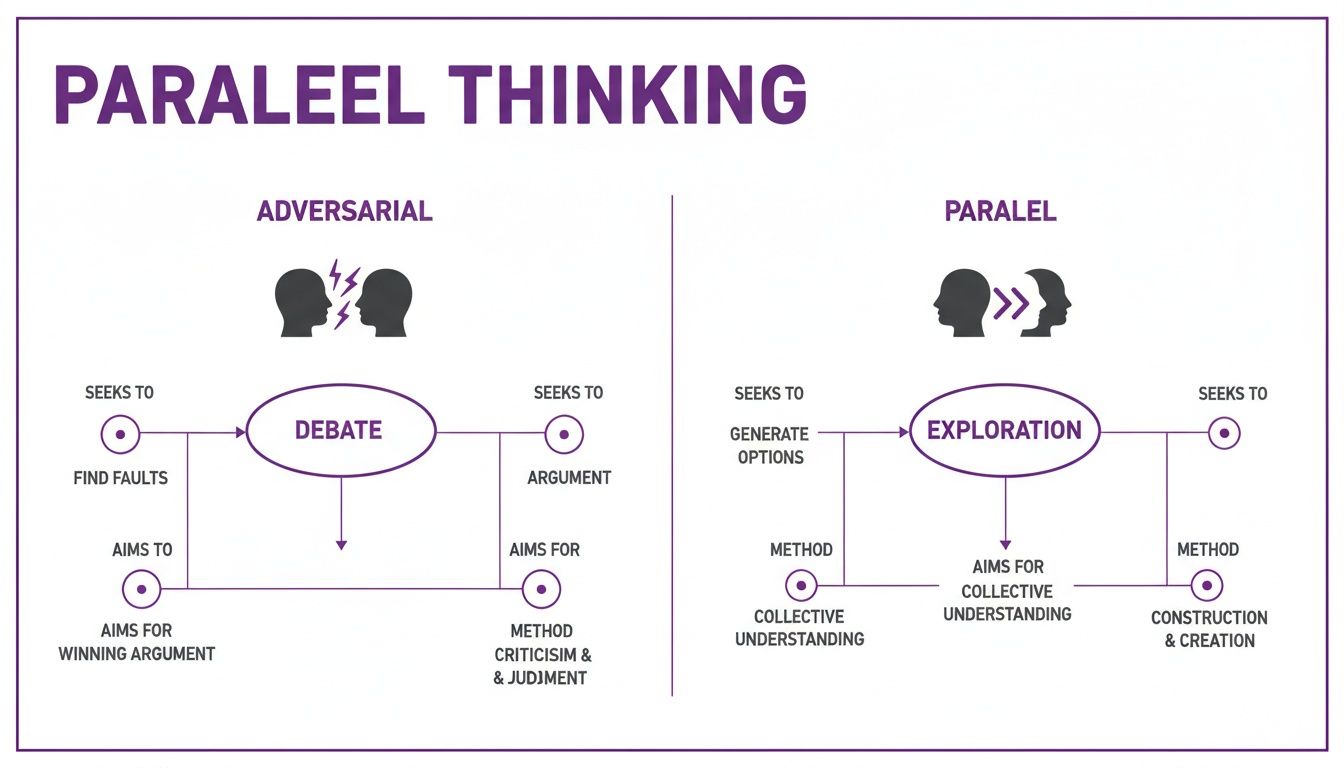
You can see it right there: adversarial thinking is a clash of ideas, while parallel thinking gets everyone pulling in the same direction, aiming all their mental energy at a shared goal.
The White Hat for Neutral Facts
The White Hat is all about the cold, hard facts. When your team puts on this hat, the only things on the table are objective information, data, and figures. There's no room for opinions or interpretations—just what we know for sure and what we need to find out.
- Prompt: "What are the plain facts of this situation?"
- Prompt: "What data do we have, and what data do we need to get?"
This first step anchors the whole conversation in reality. It builds a shared foundation of facts before anyone’s emotions or opinions can muddy the waters.
The Red Hat for Emotion and Intuition
Next up is the Red Hat. This is where everyone gets to voice their feelings, hunches, and gut reactions without having to explain or justify them. It’s a vital step because it gives a platform to intuition, something that often gets pushed aside in overly logical discussions.
By making emotions a legitimate part of the process, the Red Hat stops those feelings from secretly hijacking the more "logical" hats. It's a formal acknowledgment that gut feelings play a real role in how we make decisions.
Team members can openly share their excitement, their fears, or their doubts. Questions like, "What's your gut reaction to this?" or "How does this idea make you feel?" are perfect for this hat.
The Black Hat for Cautious Judgment
The Black Hat is probably the most overused hat in regular, unstructured meetings. But here, it has a very specific and crucial job: to be the voice of caution. It’s all about spotting potential risks, weaknesses, and problems before they happen. It’s the hat that asks, "What could possibly go wrong here?"
- Focus: What are the potential negative outcomes and roadblocks?
- Focus: Does this clash with our current resources, rules, or strategies?
- Focus: Are there any logical holes in this argument?
This isn't about being negative for the sake of it. It’s about smart, proactive risk management that makes sure the team is ready for whatever challenges might pop up.
The Yellow Hat for Optimistic Benefits
As the complete opposite of the Black Hat, the Yellow Hat is the lens of sunshine and optimism. When wearing this hat, the team deliberately looks for the benefits, opportunities, and best-case scenarios.
It encourages everyone to explore the positive side of an idea, but still with a logical mindset. You might ask, "What are the biggest potential upsides?" or "What's the best way to make this work?" This makes sure good ideas get a fair hearing before they’re shot down by premature criticism.
The Green Hat for Creative Thinking
The Green Hat is where the new ideas come from. This is the mode for pure creativity, wild brainstorming, and exploring all possibilities without judgment. It’s about generating alternatives and coloring outside the lines. If you're looking for more ways to spark new ideas, our guide on what is divergent thinking in psychology offers some great techniques.
Under the Green Hat, no idea is too "crazy." The whole point is to push past the obvious answers and see what else is out there. A facilitator might ask, "Are there any other ways we could tackle this?"
The Blue Hat for Process Control
Finally, the Blue Hat is the conductor of the orchestra. It's the facilitator's hat. It doesn't get into the topic itself; instead, it focuses on the thinking process. The person wearing the Blue Hat manages the order of the other hats, sets the agenda, and keeps everyone on track.
It's used at the very beginning of a session to define the problem and what a successful outcome looks like. Throughout the meeting, it pops up to steer the conversation, asking, "Which hat should we put on next?" and summarizing the progress made so far.
A Superpower for Modern Remote Teams
In a world of distributed work, where teams connect mostly through screens, the old ways of collaborating are showing their cracks. The unstructured, free-for-all nature of traditional meetings just doesn't translate well to a virtual environment. This is where understanding what is parallel thinking becomes less of a "nice-to-have" skill and more of a genuine superpower for any successful remote team.

The shift to remote work has introduced unique challenges that this structured thinking method directly addresses. Without the non-verbal cues we rely on in person, video calls can easily be dominated by the loudest or quickest speakers, leaving others to tune out. Parallel thinking is designed to level that playing field.
Fostering Psychological Safety from Afar
One of the biggest hurdles for remote teams is creating psychological safety—an environment where everyone feels secure enough to contribute ideas without fear of personal criticism. Parallel thinking is a fantastic tool for building this trust.
When the entire team is "wearing" the critical Black Hat, for instance, feedback is directed at the idea itself, not the person who proposed it. This simple shift takes the personal sting out of critique, turning it into a constructive part of the process rather than a confrontational attack. It ensures that even quieter team members have a designated, safe moment to voice concerns or share bold, creative ideas. This kind of structure is essential for unlocking the full potential of your team's cognitive diversity.
By separating ego from the idea, parallel thinking creates a culture where the best concepts can win, regardless of who they came from. It turns a potential argument into a shared exploration.
This structured approach is a direct antidote to meeting chaos. We know that unstructured remote collaboration can increase meeting time by a staggering 27% while draining everyone's focus. Parallel thinking reclaims that efficiency by giving every moment a clear purpose.
From Chaotic Calls to Focused Outcomes
Imagine a typical remote brainstorming session about a new product feature. It often devolves into a messy back-and-forth where one person is talking about potential risks while another is still trying to generate creative ideas. The result? Video call fatigue and very few concrete action items.
Now, picture that same meeting using a parallel thinking framework like the Six Thinking Hats:
- Blue Hat (5 mins): The facilitator kicks things off, setting a clear agenda and goal for the session.
- White Hat (10 mins): Everyone shares known facts about user needs and market data in the chat or on a digital whiteboard. No opinions, just data.
- Green Hat (15 mins): The team focuses solely on generating as many feature ideas as possible, no matter how wild.
- Black Hat (10 mins): Now, the group collectively identifies potential risks or weaknesses for the top ideas.
This disciplined flow transforms a draining video call into an efficient, inclusive, and highly productive workshop. Of course, even with a great structure, it helps when people know how to improve conversation skills to make their points clearly and confidently.
With parallel thinking, everyone contributes, every angle is covered, and the team ends the meeting with clear, actionable next steps.
Running Your First Parallel Thinking Workshop
So, how do you actually put parallel thinking into practice? This is where the magic really happens. Leading your first workshop can feel a little intimidating, but it’s actually a surprisingly simple process once you have a clear roadmap. Think of this as your guide to confidently running a session that gets real results, even if your team is spread out all over the place.
The secret is using the Six Thinking Hats framework as your agenda. It’s that simple. Each "hat" represents a different mode of thinking, and you guide your team through them one at a time. This structure is what prevents conversations from spiraling into debates or going around in circles.
This is a game-changer for remote teams. When you’re not in the same room, it’s easy for discussions to get chaotic. For tech teams and startups, applying the Six Hats in a virtual workshop keeps everyone focused on the same page at the same time. This simple switch can help reclaim the 40% productivity loss that the APA attributes to task-switching and multitasking. For a closer look at this structured thinking method, you can explore the Six Thinking Hats methodology further.
A Simple Workflow for Virtual Facilitation
A good workshop isn't just a meeting; it has a logical flow that builds momentum. Here’s a tried-and-true sequence that works for almost any problem-solving or brainstorming session. Just remember to set a timer for each step to keep things moving.
- Start with the Blue Hat (5-10 minutes): This is all about setting the stage. Clearly state the problem you’re trying to solve, walk everyone through the agenda (which hats you’ll use and why), and define what success looks like for the session.
- Move to the White Hat (10-15 minutes): Time to get grounded in facts. Ask everyone to share only what they know for sure—objective data, hard numbers, and established information. I like to use a digital whiteboard to list everything out so we all start from the same reality.
- Unleash the Green Hat (15-20 minutes): Now, let the creativity flow. Encourage wild ideas, out-of-the-box suggestions, and anything in between. The only rule here is that all criticism is banned. The goal is pure idea generation.
- Explore with the Yellow Hat (10-15 minutes): Let’s look on the bright side. With a long list of new ideas, the team now focuses entirely on the positives. What are the benefits? The potential upsides? The best-case scenarios for the top ideas?
- Assess with the Black Hat (10-15 minutes): Okay, time for a reality check. The team works together to spot the potential risks, weaknesses, and roadblocks for the ideas you’ve just been optimistic about. It’s structured, constructive criticism.
- Check in with the Red Hat (5 minutes): To wrap up, give everyone a chance to share their gut feelings and emotional reactions, no justification needed. A quick poll or just going around the "room" works great to capture the group's intuition.
Tips for a Smooth Remote Session
Running a workshop virtually requires a little extra thought. If you want to get really detailed, our guide on creating a workshop agenda template has some great structures you can borrow.
The facilitator's main job is to be the guardian of the process. Your role isn't to contribute ideas but to ensure the team stays on track, respects the current hat's rules, and that every voice is heard.
If you're gearing up for a virtual session, checking out some solid online course tips can help you create a more engaging and effective environment. A well-run virtual space makes all the difference. Simple tools like digital timers and shared whiteboards are your best friends for keeping the energy up and the session on schedule.
Common Mistakes and How to Avoid Them

While the idea of parallel thinking is simple, putting it into practice can be tricky. Even with the best intentions, teams often hit a few common snags. Knowing what these are ahead of time can help you steer clear of them and make the whole process feel a lot more natural and productive.
The biggest mistake I see is people getting stuck in their "favorite" hat. We all know that one colleague who is a natural critic—the permanent Black Hat—ready to find the flaw in every idea. On the flip side, you might have an eternal optimist who only sees the world through the sunny Yellow Hat, glossing over real-world risks.
This completely undermines the point. The magic of parallel thinking happens when everyone looks at the problem from the same angle at the same time. It’s about building mental flexibility, not just letting people camp out in their comfort zones.
Keeping the Process on Track
So, how do you stop one person's perspective from hijacking the session? The facilitator has to be on their game. A few simple, practical guardrails can keep everyone moving in the same direction.
- Enforce Time Limits: Put a timer on the screen where everyone can see it. When the time is up for a hat, you move on. This simple trick keeps the pace moving and prevents anyone from getting stuck in a single thinking mode.
- Encourage Anonymous Feedback: The emotional Red Hat can be the hardest. People often feel exposed sharing their gut feelings. Try using an anonymous poll or a shared document to gather those unfiltered reactions. You’ll get much more honest input.
- Protect the Green Hat: This one is non-negotiable. During the creative Green Hat phase, there can be absolutely zero criticism. The second a Black Hat comment enters the space, the creative wellspring dries up. Shut it down immediately.
A facilitator's main job is to be the guardian of the process. You have to gently but firmly redirect the conversation if it strays. Remind everyone, "Great point, but let's save that for the Black Hat. Right now, we're all wearing Green."
Addressing Facilitator Pitfalls
The other major pitfall is a passive facilitator. If the person wearing the Blue Hat isn't actively guiding the session, it will quickly devolve back into the same old adversarial debate you were trying to escape.
Think of the facilitator as the conductor of an orchestra. They aren't playing an instrument; they're making sure everyone plays their part at the right time to create a cohesive whole. Their focus is entirely on the process of thinking, not the content of the ideas themselves.
This is especially critical when tackling sensitive topics that stir up strong emotions. Understanding why people hold back, a concept known as evaluation apprehension in team settings, can help you create a safer space. By setting clear ground rules and leading the team with confidence, a good facilitator allows genuine parallel thinking to take root.
Got Questions? We've Got Answers
Even with a great framework, you're bound to have questions when you try something new. Let's tackle some of the most common ones about parallel thinking so you can start with confidence.
Can I Use Parallel Thinking By Myself?
Absolutely. While it’s fantastic for teams, parallel thinking is a game-changer for solo decision-making. By consciously putting on each of the six hats, you can step outside of your usual thought patterns.
For instance, if you’re a natural risk-assessor (a classic Black Hat thinker), forcing yourself to spend time in the Yellow Hat (benefits) and Green Hat (creativity) modes can open up possibilities you’d normally dismiss out of hand. It’s like having your own personal board of advisors.
Is Parallel Thinking The Same As Brainstorming?
Not quite. It’s better to think of brainstorming as just one piece of the parallel thinking puzzle. A classic brainstorm is really just a Green Hat activity—all about generating a ton of new ideas.
Parallel thinking is the whole system. It gives structure to the creative chaos of brainstorming by adding dedicated time for facts (White Hat), feelings (Red Hat), risks (Black Hat), benefits (Yellow Hat), and managing the whole process (Blue Hat).
It takes the raw, creative energy of a brainstorm and wraps it in a process that ensures you look at the situation from every important angle. This makes the ideas you generate much more well-rounded and ready for action.
What Is The Most Important Job for a Facilitator?
The facilitator's number one job is to be the Blue Hat—the conductor of the orchestra. They aren't there to add their own ideas, but to keep the entire process on track with a steady, neutral hand.
This means they are responsible for a few key things:
- Directing Traffic: Making sure the team is using the right hat at the right time, and for the right duration.
- Watching the Clock: Keeping the session moving to maintain energy and focus.
- Making Space for Everyone: Ensuring every voice is heard and every person has a chance to contribute.
A skilled facilitator knows how to gently redirect the conversation when it drifts away from the current hat's focus. Without that impartial guidance, the structure can fall apart, and you end up with a messy conversation instead of focused collaboration.
Ready to see how this can change your team's virtual meetings? Bulby gives you the structure and guidance to run focused, creative, and inclusive workshops every single time. Find out how our AI-powered tool can help your team think better together at https://www.bulby.com.