
In today's fast-paced, often-remote work environment, team collaboration is more than a buzzword. It's the engine of innovation and productivity. But what separates teams that merely coexist from those that truly thrive? The difference lies in a deliberate, structured approach to working together. This isn't about adding more meetings or flooding chat channels; it's about implementing proven systems that foster psychological safety, clarity, and genuine connection.
This guide moves beyond generic advice to provide a comprehensive roundup of team collaboration best practices. Each point is a practical, actionable strategy designed to address the real challenges of modern teamwork, especially for remote and hybrid teams. You will learn not just what to do, but why each practice matters and exactly how to implement it with concrete steps and examples.
We’ll cover essential strategies from establishing crystal-clear communication channels and defined roles to fostering psychological safety and celebrating team wins. You will get a clear blueprint to build a more cohesive, effective, and engaged team. We’ll also show you how tools like Bulby can streamline these practices, transforming good collaboration into your greatest strategic advantage. This article provides the specific, actionable insights you need to stop simply managing tasks and start building a high-performance culture.
1. Clear Communication Channels
Establishing clear communication channels is the foundation of all effective team collaboration best practices. This means creating a structured, predictable environment where everyone knows where to find information, who to ask for help, and which tool to use for specific conversations. Without this structure, messages get lost, updates are missed, and a simple question can turn into a day-long scavenger hunt across emails, chats, and project management boards.
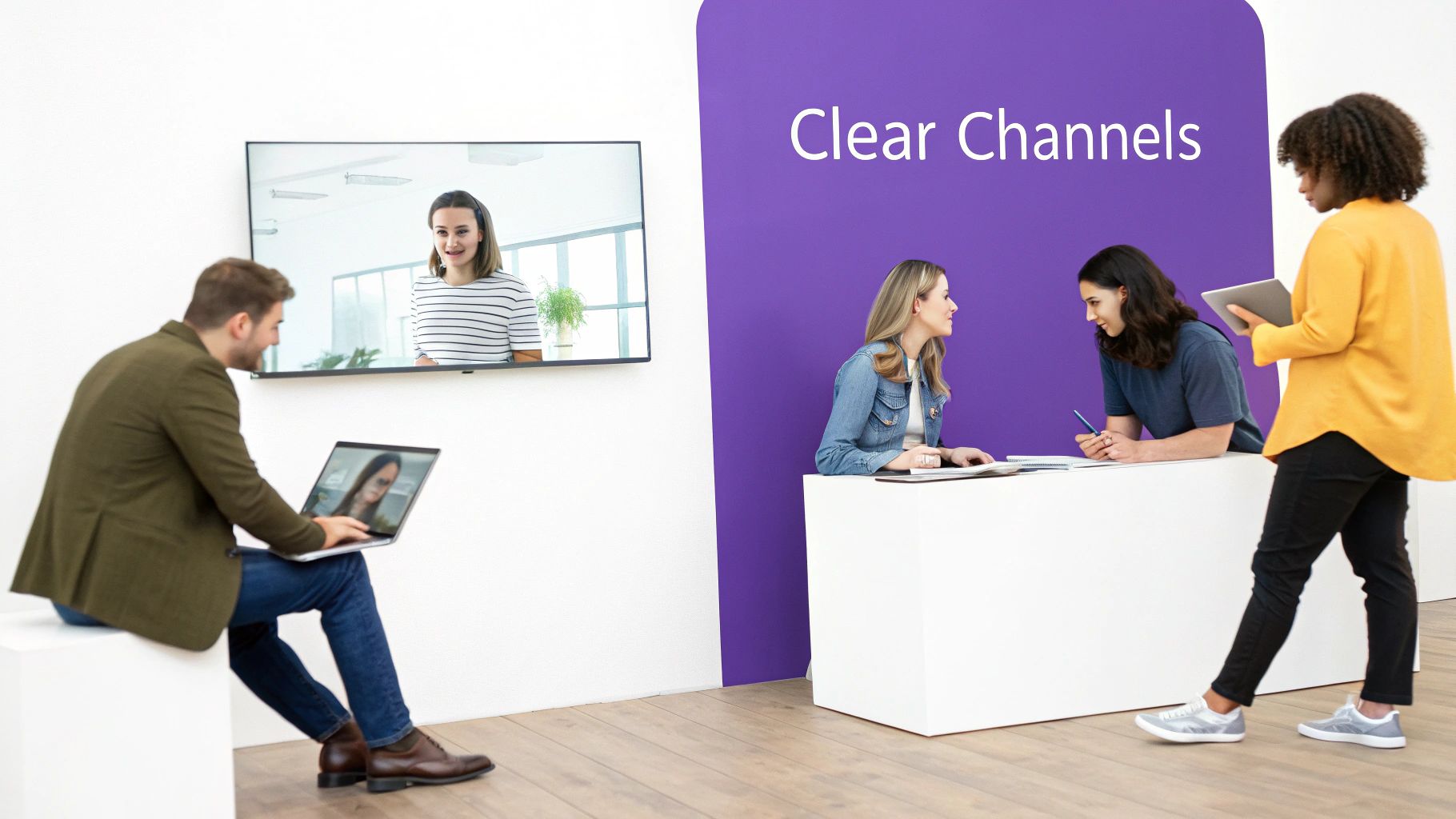
The goal is to reduce cognitive load and friction, enabling team members to focus on their actual work rather than on the process of communicating. This involves intentionally selecting tools for both synchronous (real-time) and asynchronous (non-simultaneous) interactions and defining clear protocols for their use.
Why It Matters
A well-defined communication ecosystem prevents information silos, reduces misunderstandings, and ensures that every team member, regardless of their location or time zone, has equal access to critical information. This transparency builds trust and psychological safety, empowering people to contribute openly.
How to Implement It
- Create a Communication Charter: Document your team's communication norms. Specify which tool is for what purpose. For instance, use Slack for urgent, quick questions and project-specific channels, Asana for task-related updates, and email for formal, external communication.
- Organize Your Channels: Don't let your chat app become a chaotic free-for-all. Create dedicated channels for each project (
#proj-phoenix), topic (#design-feedback), and social connection (#watercooler-chat). This makes information easy to find and follow. - Leverage Threaded Conversations: Enforce the use of threads in tools like Slack or Microsoft Teams. This keeps conversations organized and prevents main channels from becoming cluttered with multiple, overlapping discussions.
- Set Communication Boundaries: To prevent burnout, establish clear expectations around response times and "do not disturb" hours. This is especially crucial for distributed teams working across different time zones.
For a deeper dive into structuring your team's communication, explore these additional strategies for improving team communication on remotesparks.com. By being deliberate about your channels and norms, you create a more efficient and less stressful collaborative environment.
2. Defined Roles and Responsibilities
Clearly defining roles and responsibilities is a cornerstone of effective team collaboration best practices, eliminating the ambiguity that leads to dropped balls and duplicated efforts. It involves articulating each member's specific duties, decision-making authority, and areas of accountability. When everyone understands who owns what, the team can move forward with confidence and speed, avoiding bottlenecks caused by confusion or hesitation.
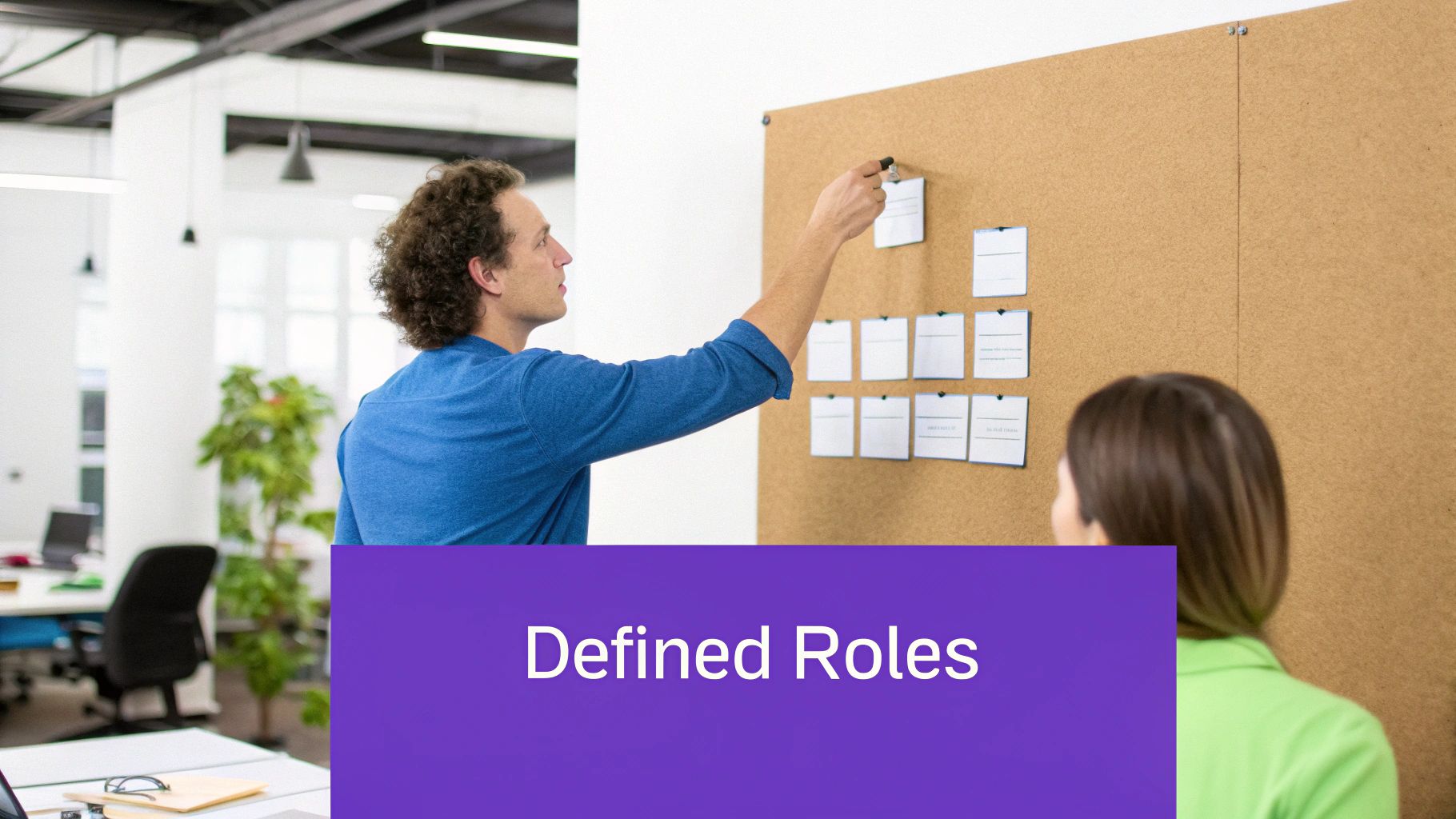
The primary goal is to create a transparent operational framework where tasks have clear owners and dependencies are visible to all. This is particularly vital in remote and hybrid settings where you can't just lean over a desk to ask who is handling a certain task. Frameworks like RACI (Responsible, Accountable, Consulted, Informed) and the defined roles within Agile methodologies like Scrum provide proven structures for achieving this clarity.
Why It Matters
Role ambiguity is a major source of conflict, stress, and inefficiency. When roles are clear, individuals feel a stronger sense of ownership and empowerment, which boosts both morale and productivity. This clarity ensures that all necessary functions are covered, reduces the risk of important work falling through the cracks, and accelerates project timelines by making it obvious who needs to be involved in key decisions.
How to Implement It
- Use a RACI Matrix: For each major project task or deliverable, create a chart that maps out who is Responsible (does the work), Accountable (owns the outcome), Consulted (provides input), and Informed (is kept up-to-date). This simple tool resolves confusion before it starts.
- Document and Visualize Roles: Create a living document or a visual organizational chart that outlines each person's core responsibilities and decision-making authority. Make it easily accessible to everyone on the team and review it quarterly or at the start of new projects.
- Conduct Role Clarity Workshops: When onboarding new members or kicking off a major initiative, run a workshop dedicated to defining and aligning on roles. Use this session to discuss expectations, handoffs, and potential areas of overlap.
- Define SCRUM Roles Clearly: If using an Agile framework, ensure everyone fully understands the distinct responsibilities of the Product Owner (defining what to build), the Scrum Master (facilitating the process), and the Development Team (building the product).
For teams looking to formalize this process, tools like Asana's role assignment features can help embed these responsibilities directly into your workflow. By investing time in defining roles upfront, you prevent downstream chaos and build a more resilient, accountable team.
3. Regular Feedback and One-on-Ones
Moving beyond sporadic annual reviews to a culture of continuous feedback is one of the most impactful team collaboration best practices. This involves implementing a structured cadence of individual meetings between managers and team members, creating a dedicated space to discuss progress, challenges, and career development. When paired with peer-to-peer feedback, this system fosters alignment, accelerates growth, and uncovers roadblocks before they escalate.
This approach, popularized by frameworks like Kim Scott's Radical Candor, shifts feedback from a dreaded event into a routine, supportive dialogue. It makes conversations about performance and well-being a normal part of the work week, building trust and psychological safety. Companies like Netflix and Google have famously built their success on cultures of radical transparency and continuous feedback loops.
Why It Matters
Regular one-on-ones prevent small issues from becoming major problems, ensure employees feel heard and valued, and keep individual goals aligned with team objectives. This direct line of communication is crucial for catching early signs of burnout, clarifying expectations, and providing personalized coaching. It creates an environment where team members are empowered to take ownership and are confident in their developmental path.
How to Implement It
- Establish a Reliable Cadence: Schedule one-on-ones as recurring, non-negotiable meetings (weekly or bi-weekly is ideal). This consistency signals that these conversations are a priority.
- Share a Collaborative Agenda: Use a shared document where both manager and employee can add topics. While the manager should have key points, let the employee drive the conversation to address what's most important to them.
- Use a Structured Feedback Model: When giving feedback, use a simple framework like SBI (Situation-Behavior-Impact). This keeps comments specific, objective, and focused on actionable outcomes rather than personal judgments.
- Ask Open-Ended Questions: Encourage genuine dialogue by asking questions like, "What's one thing we could do to improve our team's process?" or "What has been the most energizing part of your work recently?"
For comprehensive development and early alignment, consider incorporating structured feedback mechanisms, such as this a practical guide on 90-day reviews and goal setting, alongside regular one-on-one discussions. By systemizing feedback, you transform it from a source of anxiety into a powerful tool for collaboration and growth.
4. Psychological Safety
Psychological safety is the shared belief that a team is safe for interpersonal risk-taking. It’s an environment where team members feel comfortable speaking up, asking questions, sharing ideas, or admitting mistakes without fear of being embarrassed, punished, or ostracized. This concept, popularized by Harvard researcher Amy Edmondson and validated by Google's Project Aristotle, is a cornerstone of effective team collaboration best practices.
The goal is to create a culture of high trust and mutual respect where vulnerability is seen as a strength, not a weakness. When psychological safety is high, teams unlock their full creative and problem-solving potential because people are more focused on achieving collective goals than on self-preservation.
Why It Matters
High-performing teams thrive on psychological safety. It directly correlates with increased innovation, better decision-making, and higher engagement. When people feel safe, they are more likely to voice dissenting opinions, which helps prevent groupthink and leads to more robust solutions. This climate of trust also accelerates learning from failures.
How to Implement It
- Model Vulnerability: Leaders should be the first to admit their own mistakes or knowledge gaps. Saying "I don't know, what do you think?" or "I was wrong about that" sets a powerful precedent for the entire team.
- Frame Work as a Learning Problem: Position challenges and projects not as execution tests with a risk of failure, but as learning opportunities with an uncertain outcome. This encourages experimentation and honest reporting.
- Practice Blameless Post-mortems: When something goes wrong, focus the analysis on "what happened?" and "what can we learn?" rather than "who is at fault?". This shifts the focus from blame to systemic improvement.
- Actively Solicit Input: During meetings, make a point to explicitly ask quieter team members for their thoughts. Use phrases like, "We haven't heard from Sarah yet, I'd love to get your perspective on this."
Building this kind of environment is fundamental to team cohesion. For more strategies, discover how to build trust in teams on remotesparks.com. By prioritizing psychological safety, you create the conditions for your team to do its best work.
5. Goal Alignment and Transparency
Effective team collaboration best practices depend on everyone pulling in the same direction. Goal alignment and transparency ensure that individual tasks are not just busy work but meaningful contributions to a larger, shared mission. This involves using frameworks like Objectives and Key Results (OKRs) to create a clear line of sight from an individual's daily efforts to the company's highest-level strategic goals.
When team members see how their work directly impacts team and company objectives, their motivation and sense of ownership skyrocket. This shared understanding eliminates wasted effort, prevents teams from working at cross-purposes, and empowers individuals to make better autonomous decisions. It moves the team from a collection of individuals to a unified, purpose-driven force.
Why It Matters
Transparent, aligned goals are the ultimate antidote to disengagement and duplicated work. When everyone understands the "why" behind their tasks, they are more resilient, innovative, and focused. This clarity is especially vital in remote or hybrid environments where it is easy for employees to feel disconnected from the company’s broader vision and progress.
How to Implement It
- Adopt a Goal-Setting Framework: Implement a system like OKRs, pioneered by companies like Intel and Google. Define a clear, ambitious Objective and 3-5 measurable Key Results to track progress toward it.
- Cascade and Connect Goals: Ensure individual and team goals are explicitly linked to organizational objectives. This creates a visible hierarchy where everyone can see how their contributions roll up to the bigger picture.
- Make Goals Public: Use a central dashboard or shared document to make all goals, from the CEO down, visible to everyone. This transparency fosters accountability and encourages cross-functional support.
- Review Progress Regularly: Goals are not a "set it and forget it" exercise. Dedicate time in team meetings to review progress toward Key Results, discuss obstacles, and adjust plans as needed, ideally on a quarterly basis.
To ensure you select the right approach for your team, you can explore various goal-setting frameworks on remotesparks.com. By making goals visible and connected, you build a powerful foundation for focused and purposeful collaboration.
6. Active Listening and Empathy
True collaboration extends beyond tasks and deadlines; it’s rooted in understanding. Fostering active listening and empathy means cultivating the ability to hear and appreciate colleagues' perspectives, concerns, and ideas without immediate judgment. This practice involves processing not just the words spoken, but also the underlying emotions, motivations, and context.
This skill is not passive. It's an active engagement that requires presence, curiosity, and a genuine desire to connect. When teams prioritize empathy, they transform routine interactions into opportunities for deeper alignment and stronger relationships, making it one of the most vital team collaboration best practices for building a cohesive and resilient group.
Why It Matters
Active listening and empathy are the antidotes to misunderstanding and conflict. They build psychological safety, encouraging team members to share nascent ideas or voice concerns without fear of dismissal. This leads to more innovative problem-solving, as diverse viewpoints are genuinely considered, and strengthens interpersonal bonds, which is especially critical in remote or hybrid settings where organic connection is less frequent.
How to Implement It
- Practice Reflective Listening: After someone speaks, paraphrase their point to confirm your understanding. Start with phrases like, "What I'm hearing is…" or "It sounds like you're concerned about…" This shows you are engaged and clarifies potential misinterpretations.
- Ask Open-Ended Questions: Instead of asking yes/no questions, use questions that encourage detailed responses, such as "Can you walk me through your thought process on this?" This invites deeper sharing and shows you value their perspective.
- Eliminate Distractions: When in a conversation, especially a video call, put away your phone, close unnecessary tabs, and give the speaker your full attention. This non-verbal cue signals respect and focus.
- Validate Emotions: Acknowledge a colleague's feelings, even if you don't agree with their conclusion. Saying "I can see why that would be frustrating" validates their experience and helps de-escalate tension, opening the door for a more productive discussion.
By embedding these habits into your daily interactions, you shift the team's focus from just speaking to truly understanding, a cornerstone of high-performing, collaborative teams.
7. Collaborative Decision-Making
Effective team collaboration best practices hinge not just on communication, but on how decisions are made. Collaborative decision-making involves structuring processes to include relevant stakeholders, balancing efficiency with valuable, diverse input. This isn't about reaching a consensus on every minor choice; it's about creating clear frameworks for when and how to involve the team, moving beyond top-down directives to foster shared ownership.
This approach ensures that choices are vetted from multiple perspectives, which improves the quality of the outcome and significantly increases buy-in from the people who will execute the plan. When team members feel their insights are heard and valued, they become more invested in the success of the decision, reducing friction during implementation.
Why It Matters
A structured approach to collaborative decision-making prevents analysis paralysis and avoids the "too many cooks in the kitchen" problem. It taps into the collective intelligence of the team, leading to more robust and innovative solutions. This transparency builds trust and empowers individuals, as seen in models like Buurtzorg's self-managed teams, where autonomy is paired with clear decision-making protocols.
How to Implement It
- Define Decision-Making Roles: Use a framework like a RACI (Responsible, Accountable, Consulted, Informed) matrix to clarify who has the final say, who provides input, and who just needs to be updated. This eliminates ambiguity upfront.
- Differentiate Decision Types: Not all decisions are equal. Categorize them as either "Type 1" (major, irreversible) or "Type 2" (minor, easily reversible). Type 1 decisions require more extensive consultation, while Type 2 decisions can be made quickly by individuals or small groups.
- Use Structured Input Techniques: Employ methods like the "Six Thinking Hats" or appointing a "Devil's Advocate" to encourage diverse viewpoints and challenge assumptions. Set clear deadlines for feedback to keep the process moving.
- Document and Communicate Decisions: Once a decision is made, document it along with the core reasoning behind it in a central, accessible place. Announce the outcome clearly to the entire team, ensuring everyone is aligned and understands the path forward.
By establishing these clear protocols, you can leverage your team's collective wisdom without sacrificing speed. For more in-depth strategies, discover how to master the art of collaborative decision-making on remotesparks.com.
8. Diversity and Inclusion Practices
Fostering diversity and inclusion is a critical component of modern team collaboration best practices. This goes beyond hiring people from different backgrounds; it involves intentionally creating an inclusive environment where every team member feels psychologically safe, valued, and empowered to contribute their unique perspective. Without this, diverse teams cannot unlock their full potential, and collaboration can falter due to hidden biases and a lack of belonging.
The goal is to move from simply having a diverse team to actively practicing inclusion. This means embedding equity into your processes, from hiring and onboarding to daily meetings and feedback sessions. Research from McKinsey consistently shows that diverse teams outperform their less diverse counterparts, driving better decision-making and innovation.
Why It Matters
An inclusive environment ensures that the cognitive diversity present in your team can be fully leveraged. It reduces groupthink, enhances problem-solving capabilities, and increases employee engagement and retention. When people feel they belong, they are more likely to speak up, share novel ideas, and challenge the status quo, which is the lifeblood of any innovative team.
How to Implement It
- Establish Diverse Hiring Panels: Use structured interviews with standardized questions and a diverse group of interviewers to mitigate unconscious bias in the hiring process. This ensures a more equitable evaluation for all candidates.
- Train the Team on Bias Awareness: Regularly conduct training on unconscious bias and microaggressions. This equips team members with the language and awareness needed to identify and address non-inclusive behaviors constructively.
- Rotate Meeting Facilitation: Avoid having the same person lead every meeting. Rotating facilitation responsibilities among different team members, including junior ones, ensures more voices are heard and different leadership styles are experienced.
- Build in Accessibility: Make inclusivity a default setting. Use captions in video calls, provide materials in advance, and ensure all digital tools and documents are accessible to team members with disabilities.
For a deeper understanding of how to build and lead high-performing, inclusive teams, consider exploring the research on inclusive leadership from Harvard Business Review. By actively championing diversity and inclusion, you cultivate a richer, more effective collaborative culture.
9. Knowledge Sharing and Documentation
Effective team collaboration best practices depend on creating systems that capture, organize, and share institutional knowledge. This involves building a culture where documenting processes, decisions, and project outcomes is a standard part of the workflow, not an afterthought. When information lives only in one person’s head, it creates bottlenecks, slows down onboarding, and puts the team at risk if that person leaves.

The goal is to create a single source of truth that is easily accessible and searchable for everyone. This empowers team members to find answers independently, reduces repetitive questions, and ensures that valuable insights are preserved and built upon over time. Companies like GitLab have famously built their entire remote-first culture around an extensive public handbook, demonstrating transparency and efficiency.
Why It Matters
A robust knowledge-sharing system democratizes information, ensuring every team member has the context they need to make smart decisions and contribute effectively. It accelerates problem-solving, prevents the team from reinventing the wheel, and fosters a culture of continuous learning and improvement. This is crucial for scaling teams and maintaining consistency.
How to Implement It
- Choose a Central Knowledge Base: Select a tool like Notion, Confluence, or a simple shared drive to serve as your team's central wiki. Ensure it has powerful search functionality.
- Establish Documentation Standards: Create simple templates for common documents like project briefs, meeting notes, and process guides. Consistency makes information easier to consume and update.
- Integrate Documentation into Workflows: Make documentation a required deliverable for projects. For example, a project isn't "done" until the corresponding how-to guide is published in the knowledge base.
- Schedule Knowledge-Sharing Sessions: Host regular, informal sessions like "lunch-and-learns" or technical deep dives where team members can share their expertise on a specific topic.
To build a truly resilient system, explore these additional knowledge management best practices on remotesparks.com. By making documentation a shared responsibility, you create a more self-sufficient and knowledgeable team.
10. Celebration and Recognition
Implementing practices that systematically acknowledge individual and team achievements is a powerful yet often overlooked element of effective team collaboration best practices. This goes beyond annual bonuses; it's about creating a culture where contributions, milestones, and wins (both big and small) are consistently seen and celebrated. This reinforces positive behaviors, boosts morale, and shows team members that their hard work is valued.

The goal is to foster a positive feedback loop where recognition motivates further effort and strengthens team bonds. When people feel appreciated, they are more engaged, more likely to support their colleagues, and more committed to the team's shared goals. This practice turns individual achievements into collective morale boosters.
Why It Matters
A strong culture of recognition combats burnout and improves retention by creating a positive and psychologically safe environment. It clarifies what success looks like and reinforces company values in a tangible way. Celebrating effort, not just outcomes, also encourages innovation and resilience by showing that learning from failure is just as important as success.
How to Implement It
- Make It Specific and Timely: Don't wait for a performance review. Acknowledge an achievement as soon as it happens. Instead of a generic "good job," say, "I appreciated how you navigated that difficult client conversation with such patience and expertise. It reflected our 'customer-first' value perfectly."
- Create Peer-to-Peer Channels: Recognition shouldn't only come from the top down. Use a dedicated Slack channel (
#kudosor#props) or a tool like Bonusly to empower teammates to publicly recognize each other's contributions. This builds a strong, supportive network. - Celebrate the Process: A project might fail, but the team may have shown incredible resilience or innovative problem-solving along the way. Celebrate these moments of learning and effort to build a culture that isn't afraid to take smart risks.
- Vary Your Recognition Methods: Mix it up to keep it meaningful. A public shout-out in a team meeting, a thoughtful email, a small gift card, or even an extra day off can all be effective. The key is to match the recognition to the scale of the achievement and the individual's preferences.
By embedding celebration into your team's regular cadence, you transform it from a rare event into a continuous source of motivation and connection.
Top 10 Team Collaboration Practices Comparison
| Practice | Implementation Complexity 🔄 | Resource & Speed ⚡ | Expected Outcomes & Impact 📊 | Ideal Use Cases 💡 | Key Advantages ⭐ |
|---|---|---|---|---|---|
| Clear Communication Channels | 🔄 Medium — set protocols & tool choices | ⚡ Low–Medium — tools + maintenance time | 📊 Greater transparency & faster responses — ⭐⭐⭐⭐ | Remote teams, fast-paced ops, cross-functional work | Reduces errors, improves response time & accountability |
| Defined Roles and Responsibilities | 🔄 Medium — role docs, RACI, periodic updates | ⚡ Low–Medium — documentation effort | 📊 Clear ownership, fewer overlaps — ⭐⭐⭐⭐ | Scaling teams, regulated environments, project delivery | Eliminates confusion, improves delegation & accountability |
| Regular Feedback and One-on-Ones | 🔄 Medium–High — scheduling + coaching | ⚡ High — manager time & training | 📊 Higher engagement, early issue detection — ⭐⭐⭐⭐ | Talent development, retention focus, performance improvement | Strengthens relationships; supports growth and retention |
| Psychological Safety | 🔄 High — cultural change, leader modeling | ⚡ Medium–High — sustained leadership effort | 📊 More innovation, better team performance — ⭐⭐⭐⭐⭐ | R&D, high-innovation teams, learning organizations | Encourages candor, risk-taking, and information sharing |
| Goal Alignment and Transparency | 🔄 Medium–High — OKRs, dashboards, cadence | ⚡ Medium — tooling + review cadence | 📊 Aligned effort; measurable outcomes — ⭐⭐⭐⭐ | Strategy execution, cross-team projects, scaling orgs | Prevents misalignment; improves focus and prioritization |
| Active Listening and Empathy | 🔄 Medium — training and practice | ⚡ Medium — time for dialogue & coaching | 📊 Fewer conflicts; better decisions — ⭐⭐⭐⭐ | Customer-facing teams, conflict resolution, leadership | Strengthens trust, improves problem-solving and EQ |
| Collaborative Decision-Making | 🔄 High — frameworks, facilitation skills | ⚡ Medium–High — time for inclusion | 📊 Better buy-in and decision quality — ⭐⭐⭐⭐ | Cross-functional initiatives, change programs, open-source | Increases transparency and stakeholder commitment |
| Diversity and Inclusion Practices | 🔄 High — sustained programs and policy work | ⚡ High — recruitment, training, assessments | 📊 Broader perspectives; improved innovation — ⭐⭐⭐⭐ | Market expansion, product innovation, employer branding | Reduces groupthink; improves market insight & performance |
| Knowledge Sharing and Documentation | 🔄 Medium — systems and standards | ⚡ Medium — content creation & maintenance | 📊 Faster onboarding; less single-point risk — ⭐⭐⭐⭐ | Remote/large teams, high turnover, technical orgs | Builds institutional memory; speeds problem-solving |
| Celebration and Recognition | 🔄 Low–Medium — rituals & platforms | ⚡ Low — low-cost, recurring time | 📊 Boosts morale and retention — ⭐⭐⭐ | Culture building, remote teams, frequent milestones | Reinforces values, increases motivation and engagement |
From Theory to Transformation: Making Collaboration Your Superpower
We've explored a comprehensive set of team collaboration best practices, from establishing crystal-clear communication channels and defining roles to fostering psychological safety and celebrating achievements. Each principle serves as a critical building block for a high-performing, resilient, and innovative team. However, the true value of this knowledge lies not in understanding it, but in applying it consistently.
Transforming your team's collaborative dynamic isn't about implementing all these ideas overnight. That approach leads to overwhelm and superficial adoption. Instead, the path to mastery is incremental and intentional. The goal is to move from theory to a lived reality where effective collaboration is simply "the way we work."
Your First Steps on the Path to Collaborative Excellence
So, where do you begin? The most effective strategy is to start small and build momentum. Don't try to boil the ocean.
-
Diagnose Your Biggest Challenge: Take a moment to reflect with your team. Where is the most friction? Is it in unclear responsibilities (Practice #2)? Do team members hesitate to share novel ideas for fear of judgment (Practice #4)? Does information get lost in a sea of chat messages (Practice #1)? Identify the one area that, if improved, would have the most significant positive impact.
-
Commit to One or Two Practices: Once you've identified your primary challenge, select the corresponding practice from this article. For instance, if meetings feel unproductive and decisions are slow, focus on implementing a framework for collaborative decision-making (Practice #7). If team members seem disengaged, start by introducing more intentional celebration and recognition (Practice #10).
-
Create a Simple Action Plan: For the practice you've chosen, outline concrete, achievable steps. If you're focusing on knowledge sharing (Practice #9), your first step might be to create a standardized template for meeting notes and designate a single, accessible location for them. If your goal is better feedback (Practice #3), you could start by simply scheduling 30-minute one-on-ones every two weeks. The key is to make the first step easy to take.
The Compounding Effect of Consistent Effort
Mastering collaboration is a journey, not a destination. It’s an ongoing commitment that pays compounding dividends. When you create psychological safety, you unlock more creative ideas. When you align on goals, you eliminate wasted effort and boost motivation. When you practice active listening, you build trust and reduce misunderstandings. Each practice reinforces the others, creating a powerful, self-sustaining cycle of high performance and mutual respect.
This commitment is especially vital in today's distributed work environments. To truly make collaboration your superpower and transform your team's approach, it's vital to embrace crucial remote work best practices that enhance productivity and teamwork. Integrating these specialized remote-first habits with the foundational principles of collaboration will ensure your team thrives, regardless of physical location.
Ultimately, investing in team collaboration best practices is an investment in your people and your mission. It's about building an environment where every individual feels seen, heard, and empowered to contribute their best work. This foundation of trust, clarity, and shared purpose is what separates good teams from truly transformational ones. Start today, stay consistent, and watch as your team’s collective potential is unleashed.
Ready to supercharge your team's brainstorming and decision-making? Bulby is a collaborative AI tool designed to facilitate workshops and creative sessions, ensuring every voice is heard and every idea is captured. Transform your meetings from passive discussions into dynamic, action-oriented collaborations by trying Bulby today.