
Ever wonder how some companies seem to launch one successful product after another? It's not magic. It's a system. Innovation models are the structured frameworks that turn a raw idea into something real and market-ready.
Think of them less like random "lightbulb moments" and more like a strategic playbook or a trusted recipe. They give you a repeatable process for creating value and keeping your edge.
What Are Innovation Models and Why Do They Matter?
Let's bust a common myth: innovation isn't about a lone genius having a sudden breakthrough in a lab. Real, sustainable innovation is a disciplined process. This is especially true for remote and distributed teams who need crystal-clear, systematic approaches to stay aligned and get things done.
Innovation models provide that structure. They become a shared language and a common roadmap, making sure everyone is pulling in the same direction, even if they're in different time zones. To dive deeper into the basics, you can explore the fundamental definitions of innovation in business in our detailed guide.
Adopting this kind of system isn't just a nice-to-have anymore; it’s a competitive necessity. We’ve moved past the days of isolated R&D departments working on passion projects. Today, it’s all about building and managing a deliberate portfolio of innovation efforts. This shift shows that we finally get it: lasting growth requires a reliable engine for creating and shipping great ideas, not just getting lucky once in a while.
The Shift to Systematic Innovation
Ever since the 2008 financial crisis, we've seen a huge push toward structured innovation, especially in larger and remote-first companies. It’s no longer an afterthought. According to a 2023 global survey by the Boston Consulting Group, a staggering 79% of companies now rank innovation as a top-three priority.
On top of that, 66% planned to increase their innovation spending, with over 40% aiming for a major boost. This isn't just talk; it's a massive investment in formal systems like stage-gate pipelines and corporate incubators to get predictable results. You can read the full research about these innovation priority findings from BCG.
An innovation model is essentially your organization’s recipe for success. It takes the guesswork out of creating something new, providing clear steps and checkpoints to ensure your efforts are focused, efficient, and aligned with strategic goals.
Different Recipes for Different Goals
A great chef doesn’t use the same recipe for a soufflé and a steak. In the same way, businesses need different innovation models for different challenges. There's no single framework that fits every single situation. For a fantastic look at how this applies to your core business, check out this guide to business model innovation in the AI era.
In this guide, we'll walk through several of the most important models, each with its own unique strengths:
- Design Thinking: Perfect for getting into your customers' heads to create solutions they’ll actually love.
- Lean Startup: The go-to for rapidly testing business ideas and figuring out what works without wasting a ton of money.
- Open Innovation: Ideal for when you need to look outside your own walls to find fresh ideas and accelerate progress.
- Stage-Gate: A rock-solid method for managing big, complex projects with clear go/no-go decision points.
Once you understand these different "recipes," your team can pick the right one for any challenge. That's how you turn creativity from a lightning strike into a reliable, repeatable business function.
Exploring the Most Effective Innovation Models
Knowing you need a system for innovation is a great start. But which one? Picking the right playbook is the crucial next step because not all innovation models are built the same. Each gives you a different way to look at a problem and a unique path to a solution. Think of them like tools in a workshop—you wouldn't use a hammer to saw a board.
Let's walk through four of the most powerful and proven models out there: Design Thinking, Lean Startup, Open Innovation, and the Stage-Gate process. To make sure these ideas really click, we'll use a simple analogy for each one.
This map shows how innovation isn't a siloed activity but something that connects directly to your company's structure, processes, and even how you manage remote teams.
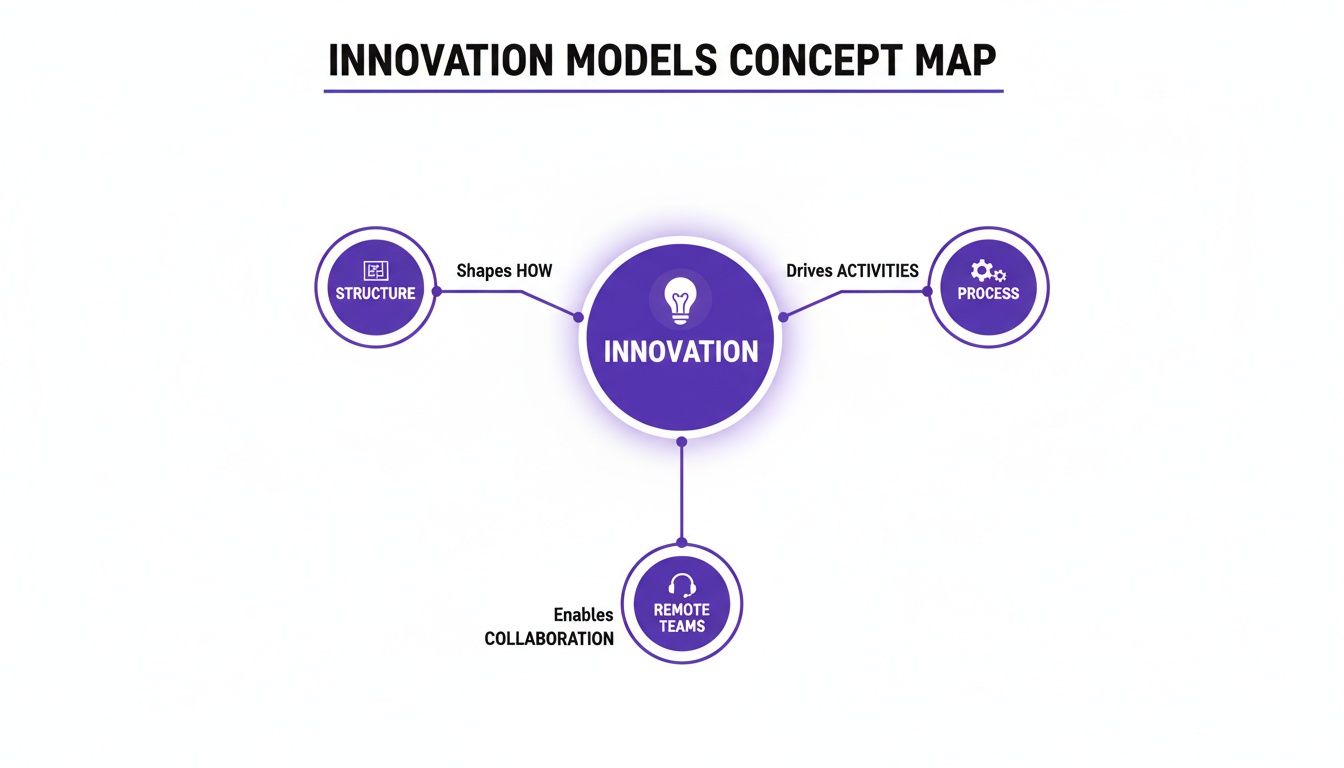
What this really shows is that lasting innovation comes from an integrated system where the right framework meets smart collaboration.
Design Thinking: The Detective Method
Think of Design Thinking as a detective's investigation. A good detective doesn't just show up and name a suspect. They immerse themselves in the scene, talk to everyone involved, and truly understand the situation before forming any theories. It all comes down to empathy.
This model puts the user at the very heart of everything. It doesn’t start with a clever idea for a product; it starts with a deep, genuine understanding of your customer's real-world needs, pains, and even the desires they can't quite articulate. This focus ensures you're solving a problem that actually matters to someone.
The process flows through a few key phases:
- Empathize: Get to know your users through interviews, observation, and research.
- Define: Turn your findings into a clear, concise problem statement.
- Ideate: Brainstorm as many solutions as possible without shooting anything down.
- Prototype: Create simple, low-cost versions of your best ideas.
- Test: Show your prototypes to real users, get their feedback, and refine.
For remote teams, this approach works beautifully with the right digital tools. Virtual whiteboards like Miro or Mural easily stand in for physical walls during empathy mapping and brainstorming sessions. User interviews are just as effective over a video call, and collaborative design platforms let your team build and tweak prototypes together, no matter where they are.
The Lean Startup: The Scientist Method
If Design Thinking is the detective, then the Lean Startup method is the scientist. This model is all about treating your business ideas like hypotheses. Instead of just assuming they're brilliant, you test them through careful, controlled experiments.
Coined by Eric Ries, the whole thing runs on the build-measure-learn feedback loop. Forget spending years perfecting a product in a secret lab. Instead, you build a Minimum Viable Product (MVP)—the most basic version of your idea that still provides value and lets you gather real-world feedback.
This constant cycle of testing and learning saves an incredible amount of time and money. You get your MVP out there, measure how people actually use it, and use that hard data to decide whether to pivot (change direction) or persevere. To see what kind of results these models can drive, it's helpful to understand the different types of innovation in business they can unlock.
Distributed teams are practically built for the Lean Startup's fast pace. With tools for agile project management, A/B testing, and data analytics, remote teams can build, measure, and learn with amazing speed.
Open Innovation: The Community Cookbook
Imagine you want to create the world's greatest chili recipe. You could lock yourself in the kitchen for a decade, or you could throw a neighborhood potluck and ask everyone to bring their best batch. Open Innovation is the potluck.
It’s based on a simple, powerful truth: not all the smart people work for you. This model encourages you to actively look for and bring in outside ideas, technologies, and perspectives. It's about breaking down the walls of your organization and innovating with the world.
It generally comes in two flavors:
- Inbound Open Innovation: This is when you bring external knowledge in. A classic example is LEGO using its LEGO Ideas platform to source new set designs directly from its fan community.
- Outbound Open Innovation: This involves letting some of your internal, unused ideas go out. Think of a company licensing out a patent for a technology it developed but doesn't plan to use.
Remote teams can be masters of Open Innovation since they already live and breathe digital collaboration. They can run online ideation challenges, partner with startups in virtual accelerators, and tap into global expert networks with ease. When building out a formal plan, a solid digital transformation strategy framework can provide the structure needed to integrate these external inputs effectively.
Stage-Gate: The Video Game
Think of the Stage-Gate model as a video game. To reach the final boss, you have to beat a series of levels, and at the end of each one, a gatekeeper decides if you're skilled enough to move on.
This framework carves a massive, complex project into a sequence of distinct stages (the levels). Between each stage sits a gate—a formal review where key stakeholders check the project’s progress against a clear set of criteria.
At every gate, one of four decisions is made:
- Go: The project gets the green light and resources for the next stage.
- Kill: The project is shut down, saving the company from investing more in a bad idea.
- Hold: The project is put on ice until certain issues are resolved.
- Recycle: The project is sent back a stage for more work.
This model brings a ton of discipline to the innovation process, making it perfect for large-scale, high-risk projects where a lot of capital is on the line. For remote teams, that structure is a huge plus. It creates clear milestones and deliverables, keeping everyone aligned even when they're miles apart.
Choosing Your Innovation Playbook
So, which model is right for you? It depends entirely on your goals, your team, and the problem you're trying to solve. Here’s a quick rundown to help you decide.
| Innovation Model | Primary Focus | Best For | Key Benefit for Remote Teams |
|---|---|---|---|
| Design Thinking | Deep user empathy and understanding human needs. | Solving ambiguous or poorly defined user problems. | Fosters deep connection and shared understanding through digital collaboration tools. |
| The Lean Startup | Speed, validated learning, and iterative development. | Launching new products or ventures in uncertain markets. | Enables rapid, data-driven cycles using agile and analytics platforms. |
| Open Innovation | Sourcing and co-creating with external partners. | Tapping into diverse expertise and accelerating R&D. | Natural fit for distributed teams already skilled in online collaboration and networking. |
| Stage-Gate | Risk management, governance, and project control. | Large, complex, or high-investment projects. | Provides clear structure and alignment through shared project management dashboards. |
Ultimately, the best innovators don't just stick to one playbook. They understand the strengths and weaknesses of each and know how to blend them to fit the unique challenge at hand. The goal is to build a flexible innovation engine, not a rigid, one-size-fits-all process.
How Global Trends Are Reshaping Innovation
Picking the right innovation model isn’t just an internal whiteboard exercise. It’s a direct response to the powerful forces shaping our markets. The best innovation models are the ones that actually fit the world we live in, and right now, a few massive trends are rewriting the playbook for everyone.
These aren't just minor adjustments, either. They're fundamental shifts in how businesses create and deliver value. Trying to innovate without acknowledging them is like trying to navigate a new city with a map from ten years ago—you're going to get lost.
The Great Shift from Products to Services
One of the biggest changes we’re seeing is the move away from selling one-off products to offering ongoing services. This is often called servitization. Just think about it: we used to buy software on a CD, but now we subscribe to services like Adobe Creative Cloud or Microsoft 365.
The entire focus has shifted from a single transaction to building a lasting relationship with the customer. Value has to be delivered month after month, which means you need a constant loop of feedback, updates, and improvements. This makes iterative frameworks like Lean Startup and Design Thinking incredibly useful. For remote teams, it means committing to continuous collaboration, not just siloed project sprints.
Globalization and the Rise of Remote Work
The world has never been more connected, and neither have our teams. Globalization, supercharged by the boom in remote work, has created a totally new reality for how we get things done. Innovation isn't happening in a single R&D lab anymore; it’s being built across continents and time zones.
Of course, this creates its own set of challenges. How do you spark that creative fire when your team has never even shared a coffee? How do you keep everyone aligned on a complex project when half your communication happens while the other half is asleep? This is where structured innovation models save the day.
A well-defined framework becomes the connective tissue for a distributed team. It creates a shared language and a predictable process that cuts through the complexity, ensuring great ideas don't get lost in translation or fall through the cracks.
For instance, a Stage-Gate process with clear digital checkpoints keeps a global team on the same page. A well-run remote Design Thinking workshop can do wonders for bridging cultural divides and uncovering universal customer needs.
The Driving Force of AI and Data
The most powerful trend of all might just be the way artificial intelligence and big data are being woven into the innovation process. AI is no longer just a tool for making things faster; it’s becoming a true creative partner. It can sift through mountains of data to spot hidden opportunities, generate completely new ideas, and even help prototype them.
This data-driven approach takes a lot of the guesswork out of innovation. Instead of relying solely on gut feelings, teams can now use predictive analytics to test their assumptions and make smarter bets on what to build next. Understanding how AI can help us be more creative is quickly becoming a non-negotiable skill for any team that wants to stay ahead.
These trends are pushing innovation to be more global, data-informed, and AI-powered. According to the World Intellectual Property Organization’s Global Innovation Index 2023, which ranks 132 economies, Switzerland leads for the 13th year in a row, followed by Sweden and the United States. WIPO also noted that top corporate R&D spending soared past USD 1 trillion for the first time, driven largely by tech firms. It’s a clear signal that structured, digital-first innovation models are now at the very heart of growth.
See How Leading Companies Apply These Models
Theory is one thing, but seeing innovation models come to life is where the real learning happens. These frameworks aren't just dusty concepts in a business textbook; they're the engines behind some of the most incredible company growth stories we've seen. By looking at how the pros put them to work, we can start to see the direct, and often massive, impact these structured approaches can have.
Let's dive into a few powerful examples of these models in action. Each story gives us a peek into a specific challenge, the model chosen to tackle it, and the remarkable outcome that followed, making these strategies feel tangible and, more importantly, achievable.
Airbnb Masters Empathy with Design Thinking
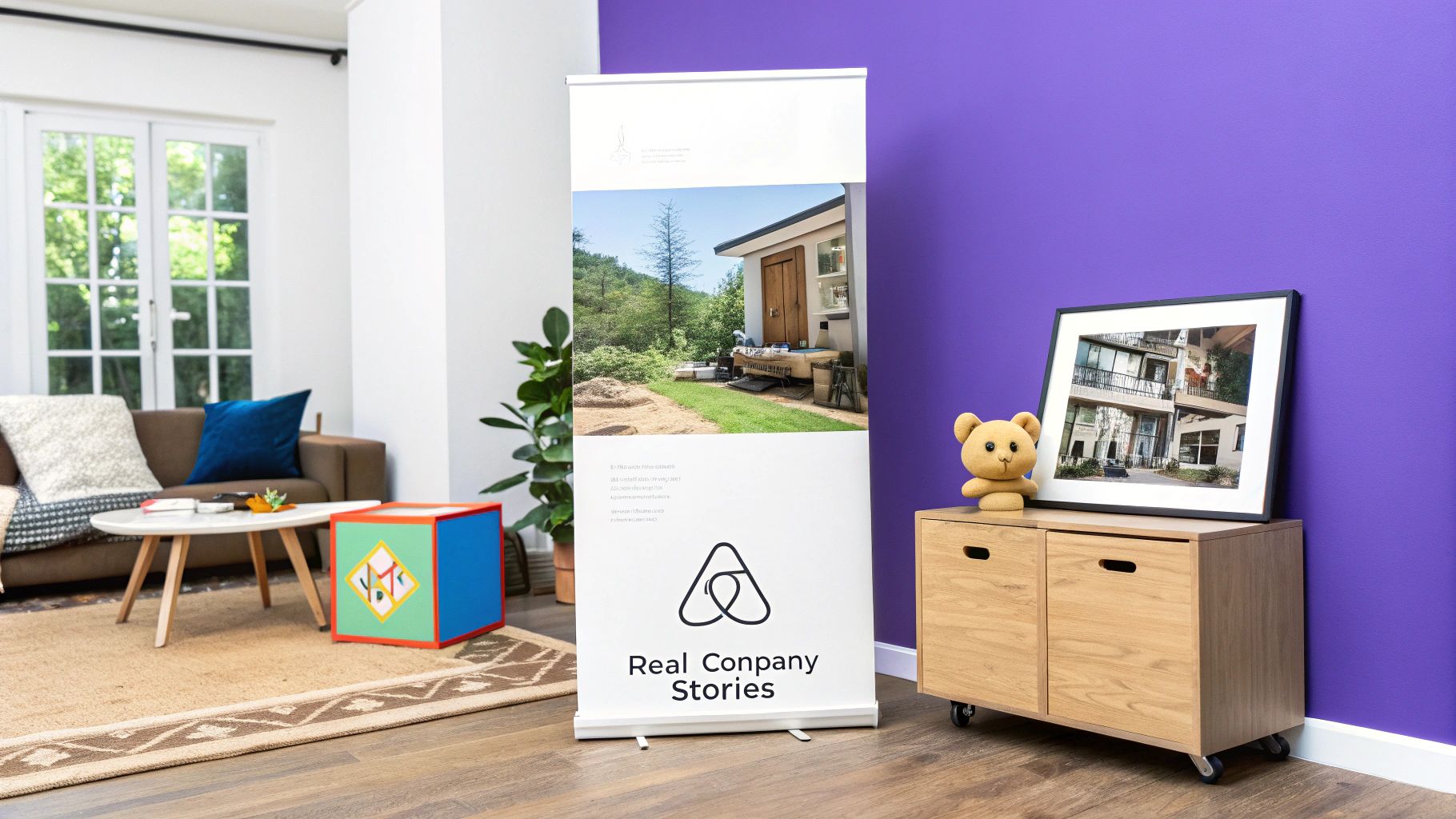
In its early days, Airbnb was teetering on the edge of failure. The company was struggling to find its footing, with revenue stuck at a meager $200 per week. The founders noticed a troubling pattern: the photos of listings in New York City were dark, blurry, and just plain unappealing. Instead of throwing money at a new marketing campaign or endlessly tweaking their code, they went back to basics with Design Thinking.
Their first step was all about empathy. They flew to New York, rented a camera, and started knocking on their hosts' doors. They spent time with them, experienced their spaces firsthand, and took professional-quality photos themselves. This wasn't just about getting better pictures; it was about truly understanding their users' world—their homes, their challenges, and their perspectives.
By immersing themselves in the customer's world, the Airbnb team uncovered a core truth: trust and appeal are built on visual quality. Users needed to feel what it was like to stay in a place before they would ever book it.
That single insight, gained from direct, human-to-human engagement, changed everything. Their platform shifted from being a simple listing service to a curated experience. Within a week of updating the New York photos, their weekly revenue doubled to $400. That small, empathy-driven act saved the company and paved the way for its explosive growth, proving that sometimes the biggest innovations start with just listening.
Dropbox Validates an Idea with Lean Startup
Before Dropbox became a verb, it was just an idea. Founder Drew Houston was staring down a massive technical mountain. Building a seamless file-syncing service was incredibly complex and would cost a fortune. Committing millions to a product that nobody might want was a risk he simply couldn't take.
So, he turned to the Lean Startup model. Rather than building the whole thing, he focused on testing his single most important assumption: do people even want this? His Minimum Viable Product (MVP) wasn't a piece of software at all. It was a simple, three-minute explainer video.
The video walked viewers through how the file-syncing would work, narrated by Houston himself. It was clever, relatable, and packed with in-jokes aimed squarely at its target audience on the tech community site Digg. The whole point was to follow the Lean Startup mantra: build, measure, learn—and do it fast.
- Build: He created the video prototype.
- Measure: He released it into the wild and tracked sign-ups for a beta waiting list.
- Learn: The response was immediate and overwhelming.
Overnight, the beta sign-up list exploded from 5,000 to 75,000 people. This incredibly simple experiment proved there was massive market demand before a single line of the final product's code was even written. Dropbox is the textbook case for how the Lean Startup model de-risks innovation by prioritizing validated learning over blind faith.
LEGO Builds Its Future with Open Innovation
LEGO has one of the most passionate fan bases on the planet. For decades, the company designed every single one of its products behind closed doors. But then it had a brilliant realization: its greatest untapped resource was right there on its doorstep. Its own customers. This led to the creation of LEGO Ideas, a masterclass in Open Innovation.
LEGO Ideas is a platform where any fan can submit their own design for a new LEGO set. If a proposal gathers 10,000 supporters from the community, it officially moves into a review by LEGO's own designers and executives. If the project gets the green light, it's turned into a real product sold across the globe, and the original fan creator gets a cut of the sales. For more inspiration on bringing ideas to market, explore these fascinating examples of product innovation from other successful companies.
It’s a win-win scenario. LEGO gets a constant firehose of market-tested ideas straight from its most dedicated users, which dramatically lowers its R&D costs and risk. And the fans? They get a real shot at becoming part of LEGO history. This strategy has produced some of the brand’s most iconic and beloved sets, proving that sometimes the very best ideas are waiting just outside your own walls.
How to Make Innovation Models Work with a Remote Team
So, you've got the theory down, but how do you actually put these innovation models into practice when your team is scattered across the map? It can feel like a big jump from concept to reality, but here's the good news: remote teams are not just able to do this, they're often the ones doing it best.
The secret is to pair a structured process with the right digital tools. Think of it as setting up a virtual innovation lab. You'll need the right spaces, clear instructions, and a few specialized tools to get your experiments running smoothly. Let's walk through how to make it happen, step-by-step.
Running a Remote Design Thinking Workshop
Design Thinking is all about collaboration and getting into your customers' heads. That can feel tricky when you're not in the same room, but a well-planned remote workshop can be every bit as powerful.
Here’s a simple way to run each phase with your distributed team:
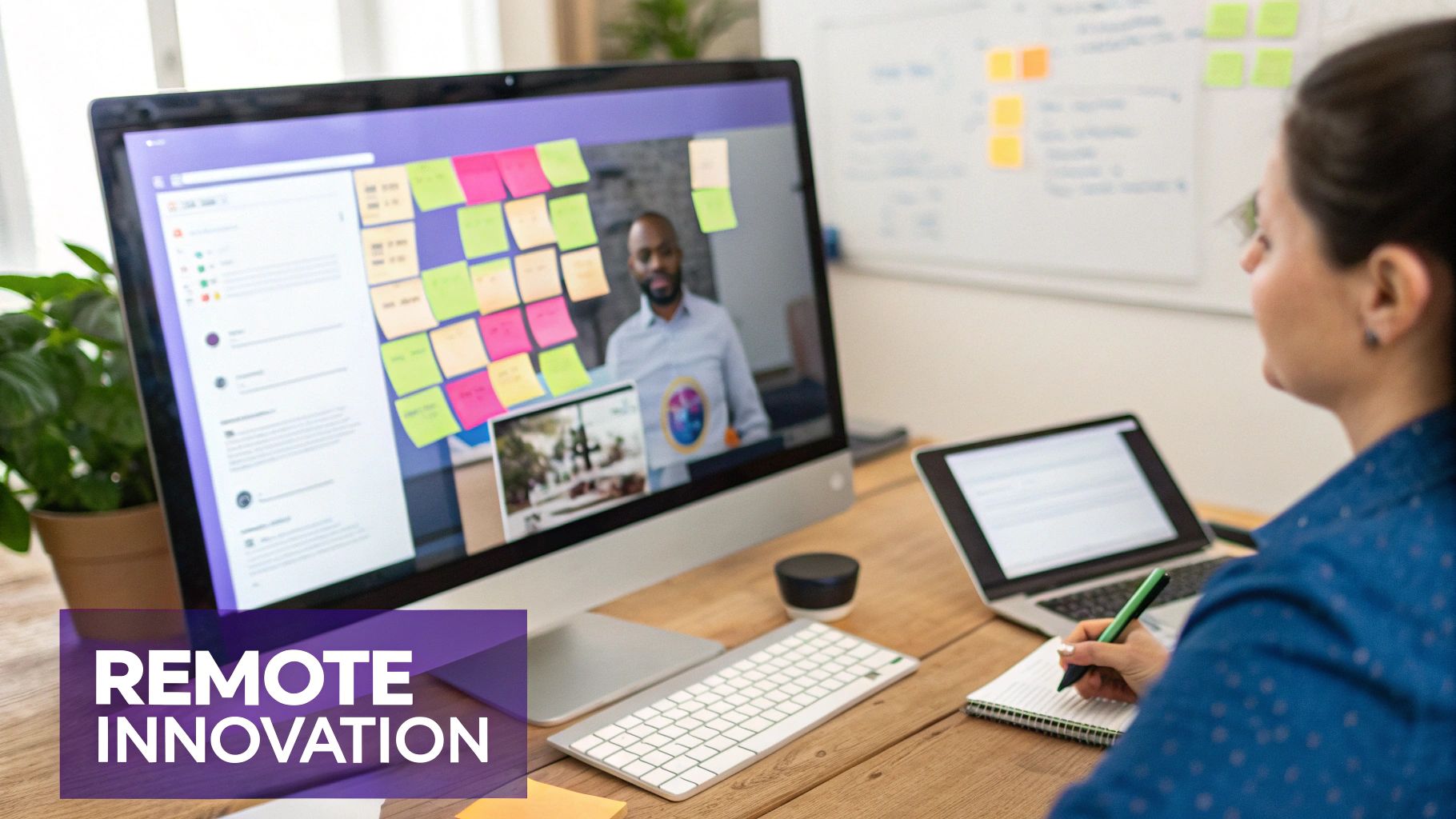
- Empathy Mapping on a Virtual Whiteboard: Fire up a tool like Miro or Mural. Everyone can jump onto the shared digital canvas and drop virtual sticky notes with customer quotes, observations, and pain points you’ve gathered from user interviews.
- Collaborative Ideation: Schedule a dedicated brainstorming session. Using the same virtual whiteboard, have everyone throw their ideas out there. A "yes, and…" approach works wonders here, encouraging people to build on each other's thoughts. Using features like timers and anonymous voting keeps the energy up and ensures the best ideas rise to the top, not just the loudest voices.
- Digital Prototyping and Testing: Tools like Figma or InVision are your friends here. Team members can work together in real-time to build rough mockups. Once you have something to show, you can share your screen with users to get immediate feedback.
Executing a Lean Startup Loop from Anywhere
The Lean Startup’s build-measure-learn cycle feels almost custom-made for agile, remote teams. It’s driven by data, which is perfect for keeping everyone aligned on facts instead of getting lost in opinions—a common pitfall when you’re communicating across distances.
For a remote team, this cycle is all about quick, focused sprints. Start by defining a clear hypothesis on your shared project board. Then, the team works together (often asynchronously) to build the smallest possible thing—the MVP—to test that hypothesis. Finally, you pull in the data using analytics and remote feedback tools to see what happened and decide on the next move together.
If you want to dig deeper into structuring these efforts, our guide on the complete process for innovation is a great next step.
How Bulby Simplifies Remote Innovation
This is where a purpose-built tool can be a game-changer. While general collaboration software gets you part of the way, a platform designed specifically for innovation guides your team through the process. That's exactly what Bulby does.
Think of Bulby as a digital facilitator. It walks your team through the specific steps of each innovation model, providing the structure remote teams often need to stay on track. This stops brainstorming sessions from becoming aimless video calls and makes sure every person’s contribution is captured.
For example, when running a Lean Startup cycle, Bulby can guide your team through structured exercises to define a testable hypothesis, identify key metrics, and even generate ideas for your MVP. It takes the guesswork out of the process, allowing your team to focus on creativity and learning.
It's also worth noting how the entire economy is shifting. We're seeing a huge move from products to services—what some call the X-as-a-Service model. With services now making up over two-thirds of global GDP, companies are focused on delivering ongoing value, not just one-off sales. This shift makes structured, continuous ideation a must-have for remote teams, moving innovation from a rare offsite event to a daily habit. You can read more about how innovative business models are evolving on hospitalityinsights.ehl.edu.
Overcoming Common Remote Challenges
Even with the best plan, remote innovation has its hurdles. Communication can get clunky, and it's easy for team members to feel disconnected. Here are a few practical tips to keep the momentum going:
- Set Clear Communication Rules: Decide where conversations happen. Maybe Slack is for quick pings, video calls are for deep discussions, and your project management tool is for official tasks and decisions.
- Lean into Asynchronous Work: Not every discussion needs a live meeting. Encourage recorded video updates and collaborative docs so people can contribute when it works best for them, across different time zones.
- Block Out "Innovation Time": Put recurring blocks on the calendar dedicated solely to creative work. This sends a clear signal that innovation is a priority and gives everyone permission to step away from the daily grind.
By combining the right innovation models with smart tools and intentional practices, you can build a powerful innovation engine that doesn't just survive in a remote setting—it thrives.
Common Questions About Innovation Models
When teams first start exploring different ways to innovate, a few questions always seem to pop up. Getting straight answers is the best way to move forward without second-guessing yourself. Let's tackle some of the most common things people ask.
Can a Company Use More Than One Innovation Model?
Absolutely. In fact, the smartest companies often mix and match. It's best to think of these models less like rigid rulebooks and more like tools in a toolbox. You wouldn't use a hammer for a job that needs a wrench, and the same idea applies here.
It’s very common to see teams combine the strengths of different frameworks. For instance, you could kick things off with Design Thinking to really get inside your customers' heads and figure out what they truly need. Once a promising idea surfaces, you might switch over to the Lean Startup model to quickly build and test a bare-bones version (your MVP) without breaking the bank.
The real goal is to build a flexible innovation engine, not a rigid, one-size-fits-all process. The trick is to see these models as a kit and simply pick the right tool for the job at hand.
Big companies do this all the time. A large corporation might have a formal Stage-Gate process in place to manage risk and oversee massive, high-stakes projects. But down in the trenches, the actual project teams are often using agile methods like Lean Startup to hit their targets within that larger structure.
What Is the Biggest Challenge for Remote Teams?
For remote teams, the single biggest hurdle is keeping the creative spark alive and everyone on the same page when you’re not in the same room. That spontaneous magic you get from a quick chat in the hallway or a sudden whiteboard session is incredibly hard to recreate on a video call. It's easy for communication to break down, for great ideas to get lost in the shuffle, and for momentum to just fizzle out.
This is exactly why having a structured process and the right digital tools is non-negotiable for distributed teams. Without a clear framework, brainstorming sessions can quickly turn into rambling, unproductive conversations. You have to be much more intentional with facilitation and use platforms that are actually designed to guide a team through the innovation process from start to finish.
How Do You Measure the Success of an Innovation Model?
Your success metrics have to be tied directly to the model you're using and what you're trying to achieve with a specific project. There isn't a universal dashboard for innovation; you need to define your key performance indicators (KPIs) before you even start.
Here are a few examples of what that could look like:
- For Lean Startup: The name of the game is validated learning. Success is all about how fast you can test your biggest assumptions, get feedback from real customers, and use that data to decide whether to change direction or keep going.
- For a Stage-Gate Process: Success here is usually more traditional. You'd track how many projects make it through each gate and, of course, their ultimate return on investment (ROI).
- For Design Thinking: In the early stages, your metrics are often qualitative. You might measure success by the quality of customer insights you uncover or how original your proposed solutions are. Later, these can translate into hard numbers like higher user adoption or better customer satisfaction scores.
How Much Time Should We Dedicate to Innovation?
Sorry, there’s no magic number here. A quick experiment using the Lean Startup model to test one new feature might only take a week. On the other hand, a full-blown Design Thinking project to create a brand-new service could easily take a few months.
The most important thing, especially for remote teams, is consistency. It's far better to block off a dedicated, recurring chunk of time each week than to plan for some massive, one-off "innovation retreat" that keeps getting pushed back. Whether it's a regular "innovation hour" or a virtual sprint every quarter, making innovation a consistent habit is what really gets results.
Ready to overcome the challenges of remote brainstorming and put these models into action? Bulby provides the structure and AI-powered guidance your team needs to generate brilliant ideas, no matter where you are. See how Bulby works and transform your creative process.