
In a competitive market, the smartest person in the room is often the room itself. Tapping into a crowd's collective intelligence is no longer a fringe idea; it's a core strategy for leading innovators. This shift is driven by a simple truth: diverse perspectives lead to more robust, creative, and resilient solutions. But what does this look like in practice? How do you move from theory to tangible results?
This article provides a strategic playbook, unpacking 10 powerful examples of crowdsourcing from companies that mastered the art of collaborative problem-solving. We will move beyond the buzzwords to dissect how organizations across various industries harnessed the power of the many to create groundbreaking products, refine user experiences, and tackle complex challenges. The success of these efforts often hinges on fostering a vibrant and engaged group, which is the ultimate secret weapon for collective genius. To achieve this, understanding the fundamentals is key; you can refer to a definitive guide on how to build an online community to master the foundational principles.
For each example in our list, we will break down the specific strategy, highlight the key takeaways, and offer actionable steps your remote or hybrid team can replicate. Forget generic success stories; this is a deep dive into replicable methods designed to help you transform your team into a hub of collaborative genius.
1. Open Innovation Platforms
Open innovation platforms are digital systems that allow organizations to systematically gather and evaluate ideas from a wide community. This community can include employees, customers, partners, or even the general public. These platforms provide a structured channel for submitting, discussing, and voting on new concepts, making them one of the most powerful examples of crowdsourcing for innovation.

This method transforms the traditional, closed-door R&D process into a transparent, collaborative effort. By inviting diverse perspectives, companies can uncover blind spots, identify new market opportunities, and build products that better reflect customer needs.
Strategic Breakdown
Companies like Dell and Cisco pioneered this approach with platforms that became legendary. Dell’s IdeaStorm, for example, was a public-facing portal where customers could suggest and vote on new product features and service improvements. Cisco’s I-Prize took a different approach, launching a global competition with a significant cash prize to find the next billion-dollar business idea.
These initiatives succeeded because they were more than just digital suggestion boxes. They created a feedback loop where the community could see which ideas were being reviewed, developed, and ultimately launched. This transparency built trust and incentivized continued participation.
Actionable Takeaways for Remote Teams
Remote and distributed teams can easily replicate this model to break down geographical and departmental silos.
- Define Clear Challenges: Instead of a generic "share your ideas" prompt, create specific, time-bound challenges. For example, "How can we improve our new user onboarding in Q3?"
- Establish a Review Cadence: Create a dedicated committee that reviews top-voted ideas on a regular schedule (e.g., bi-weekly). Communicate the timeline and criteria clearly.
- Celebrate and Implement: Publicly recognize contributors whose ideas are selected. More importantly, show progress by implementing the winning concepts and sharing the results.
- Use AI for Structure: Provide AI-powered prompts to help participants flesh out their submissions with details on the problem, proposed solution, and potential impact.
These platforms are one of several powerful ideation techniques for distributed teams. They are most effective when an organization needs to generate a high volume of diverse ideas quickly and has a system in place to filter and act on them.
2. Distributed Problem-Solving Challenges
Distributed problem-solving challenges involve organizations presenting specific business or technical problems to a wide community of solvers. These participants compete to propose the best solutions in exchange for prizes, recognition, or compensation. This approach taps into a global pool of expertise, making it one of the most effective examples of crowdsourcing for complex R&D and technical hurdles.

This model is built on the principle that talent is distributed everywhere, but opportunity is not. By externalizing a problem, companies can access novel perspectives and specialized skills that don't exist within their internal teams, accelerating innovation and reducing development costs.
Strategic Breakdown
Platforms like Kaggle, InnoCentive, and TopCoder have perfected this model. Kaggle, for instance, hosts data science competitions where companies post complex datasets and challenges, offering cash prizes to the data scientists who build the most accurate predictive models. NASA has also used this method extensively, launching challenges to solve everything from robotic arm algorithms to astronaut nutrition.
The success of these platforms lies in their ability to precisely define a problem and its success criteria. A well-defined challenge attracts the right talent and ensures that proposed solutions are directly applicable. This structured competition creates a powerful incentive for participants to deliver high-quality, innovative work that solves a tangible business need.
Actionable Takeaways for Remote Teams
Remote organizations can adopt this challenge-based model to tackle difficult internal or external problems, fostering a culture of innovation.
- Define with Precision: Clearly articulate the problem, constraints, and measurable success metrics. Ambiguity is the enemy of effective problem-solving.
- Provide Essential Resources: Equip participants with the necessary data, background information, and tools they need to get started.
- Create Feedback Checkpoints: For longer challenges, establish milestones where participants can receive feedback. This iterative process helps refine solutions and keeps solvers engaged.
- Celebrate All Good Ideas: While there may be one "winner," publicly acknowledge other valuable or creative approaches to encourage future participation.
This method is ideal when a problem requires specialized, multi-disciplinary expertise that is hard to find in-house. These structured competitions are one of many powerful team problem-solving activities that can drive breakthrough results.
3. Customer Co-Creation and Feedback Loops
Customer co-creation is a process where brands invite end-users directly into the product development lifecycle. Instead of designing in a vacuum, companies use feedback platforms, beta testing programs, and community forums to gather continuous input. This collaborative approach is one of the most effective examples of crowdsourcing for building products people genuinely want and need.
This method shifts the customer from a passive consumer to an active partner. By integrating their feedback at every stage, from initial prototypes to feature updates, organizations ensure their product roadmap is aligned with actual user pain points, leading to higher adoption and loyalty.
Strategic Breakdown
Companies like Slack and Notion built their entire empires on this principle. Slack's early success was fueled by an invite-only beta where they worked intimately with a small group of highly engaged teams. They didn't just collect bug reports; they observed user workflows and built features in direct response to community needs. Similarly, Notion empowers its user base to submit and vote on feature requests, making its public roadmap a living document shaped by its most passionate users.
The key to their success was creating a direct, transparent channel between the user and the development team. This wasn't just about collecting data; it was about building a community and a relationship. Users felt heard and invested, transforming them into brand evangelists long before the product hit the mainstream.
Actionable Takeaways for Remote Teams
Remote product teams can leverage co-creation to stay deeply connected with their user base, even from a distance.
- Establish Diverse Channels: Don't rely on one method. Combine surveys, user interview forums (like a dedicated Discord or Slack channel), and in-app feedback widgets.
- Create a "Feedback Cadence": Designate specific times (e.g., "Feedback Fridays") for the team to review, categorize, and discuss user input.
- Close the Loop: When you implement a feature based on user feedback, announce it publicly and credit the community. This simple act validates their contribution and encourages more engagement.
- Segment Your Feedback: Analyze input based on user personas, subscription tiers, or usage patterns to identify high-impact opportunities for specific customer segments.
This approach is a core component of effective product development. You can learn more about how to structure these conversations by exploring techniques for how to conduct user research remotely. It's most powerful for teams committed to building a user-centric product and willing to make their roadmap flexible and responsive.
4. Community-Driven Content Creation
Community-driven content creation involves leveraging your audience, whether customers, fans, or employees, to produce authentic marketing and brand materials. Instead of creating everything in-house, organizations invite their community to share stories, videos, photos, and reviews. This approach is one of the most effective examples of crowdsourcing for building a scalable and trusted content engine.
A key aspect of this strategy is leveraging what's known as User-Generated Content (UGC), where the brand acts as a curator rather than a sole creator. By featuring real experiences from diverse voices, companies build a more relatable and powerful brand narrative that resonates deeply with potential customers.
Strategic Breakdown
Companies like GoPro and Airbnb have built empires on this model. GoPro's marketing is almost entirely powered by its users, who submit breathtaking videos captured with GoPro cameras. The company simply curates the best content and features it, creating an authentic and aspirational brand image that traditional advertising could never replicate.
Similarly, Airbnb encourages hosts to share their stories and uses professional photography to highlight unique listings, turning properties into destinations with personal narratives. This strategy doesn't just sell a room; it sells an experience, co-created and validated by a global community of travelers and hosts. The success of this model lies in making the community the hero of the brand story.
Actionable Takeaways for Remote Teams
Distributed teams can harness this model to generate authentic content at a massive scale, reinforcing brand trust and community engagement.
- Establish Clear Guidelines: Create a simple-to-understand content submission guide that outlines quality standards, brand voice, and legal permissions. This ensures consistency without stifling creativity.
- Simplify the Submission Process: Use a dedicated portal or a simple form to make it incredibly easy for users to upload their content. Remove any friction that might discourage participation.
- Provide Tools and Templates: Offer basic editing templates, photography tips, or writing prompts to help your community members create higher-quality content that aligns with your brand.
- Recognize and Reward Contributors: Prominently feature contributors and their stories across your channels. Offer attribution, exclusive swag, or even financial compensation to incentivize ongoing participation.
This method is ideal for building a library of diverse and relatable content, which is a key part of many modern content generation ideas. It works best for brands with an active, passionate user base that is eager to share its experiences.
5. Collaborative Product Development and Design Sprints
Collaborative product development, often structured as a design sprint, is a form of internal crowdsourcing that pools the collective expertise of a cross-functional team. This structured, time-boxed process brings together product managers, engineers, designers, and other stakeholders to intensively design, prototype, and test solutions for critical business challenges. It stands out as one of the most focused examples of crowdsourcing for rapid problem-solving within an organization.
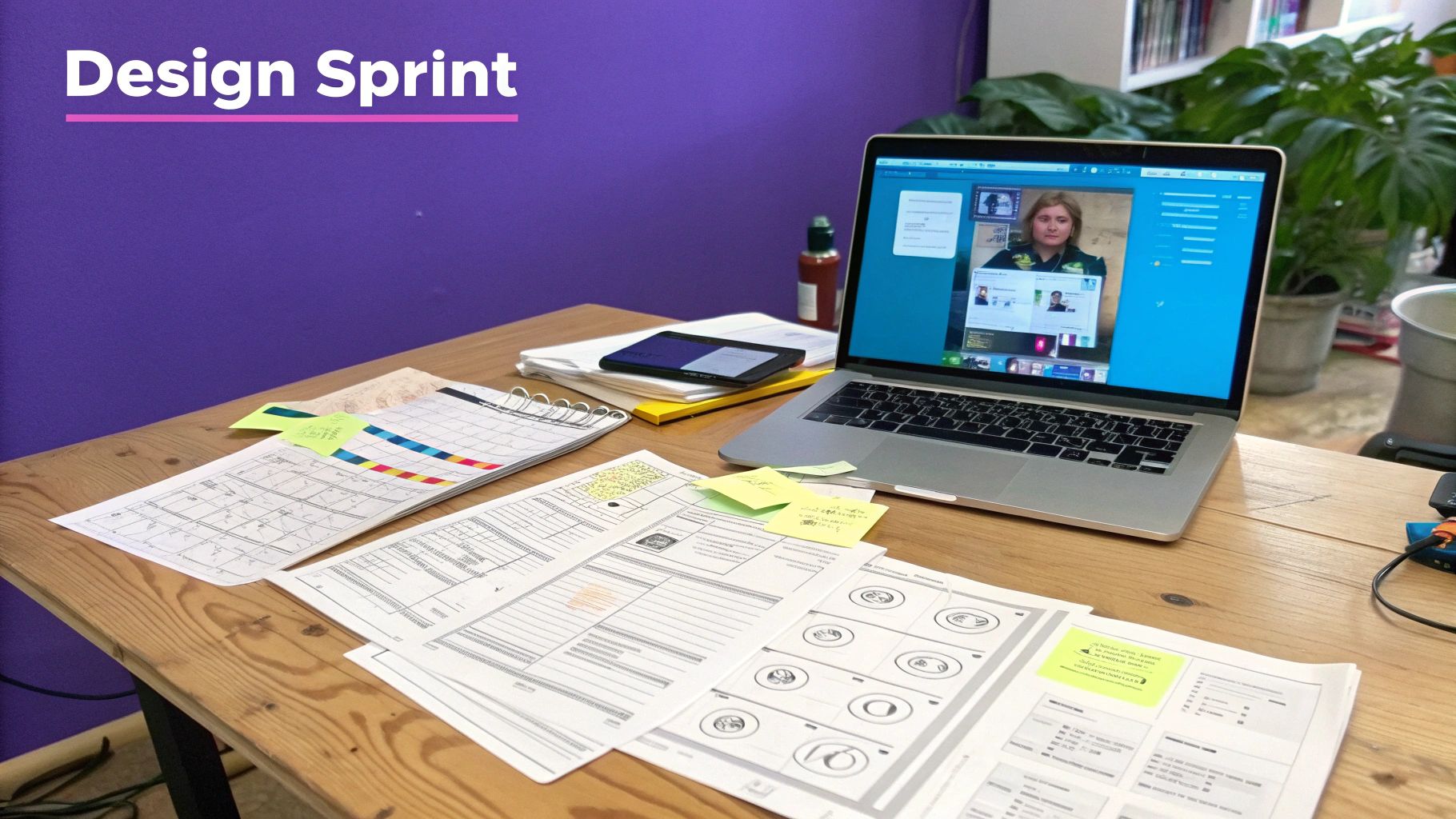
This methodology shortcuts the endless debate cycles typical of traditional development and compresses months of work into just a few days. By leveraging diverse internal perspectives in a highly facilitated environment, teams can de-risk new ideas and align on a clear path forward before committing significant engineering resources.
Strategic Breakdown
Popularized by Jake Knapp at Google Ventures, the Design Sprint methodology provides a step-by-step process for answering critical business questions. Instead of launching a minimum viable product to see if an idea is good, the sprint allows teams to create a realistic prototype and test it with real users. This internal crowd of experts works together to map the problem, sketch competing solutions, decide on the best approach, and build a testable prototype.
Companies like IBM with its Design Thinking workshops and Spotify with its agile squad model have adapted these principles to their own cultures. The core strategy remains the same: harness the collective intelligence of a dedicated, cross-functional group to produce tangible, validated results with incredible speed.
Actionable Takeaways for Remote Teams
Remote and distributed teams can run highly effective design sprints by leaning into digital collaboration tools and structured facilitation.
- Prepare Meticulously: Create a detailed sprint schedule with clear activities, goals, and break times. Share a "sprint brief" in advance so all participants arrive with the necessary context.
- Leverage a Digital Whiteboard: Use tools like Miro or FigJam as the central hub for all activities, from mapping and sketching to prototyping. This creates a persistent, shared workspace.
- Assign Clear Roles: Designate a primary facilitator to guide the process and a "decider" who has the authority to make key decisions. This prevents the sprint from stalling.
- Document and Follow Up: Record key sessions for those who cannot attend live. Immediately after the sprint, send a summary of decisions, key learnings, and assigned next steps to maintain momentum.
This method is ideal when a team faces a high-stakes problem without a clear solution. For a comprehensive guide, explore these best practices for running a remote design sprint.
6. Community Moderation and Governance
Community moderation and governance is a model where organizations empower their user base to manage, moderate, and shape the rules of a community. Instead of relying solely on in-house staff, companies delegate responsibilities like content review, rule enforcement, and peer support to trusted members. This approach is one of the most scalable examples of crowdsourcing for building healthy, self-sustaining digital spaces.
This method transforms community management from a top-down, centralized function into a distributed, democratic effort. By giving members a stake in the community’s well-being, organizations can foster a deeper sense of ownership and scale their operations far more efficiently, especially across different time zones.
Strategic Breakdown
Platforms like Reddit, Stack Overflow, and Wikipedia are built on this very principle. Reddit’s massive network of subreddits is managed almost entirely by unpaid, volunteer moderators who create rules, remove inappropriate content, and cultivate the culture of their specific communities. Similarly, Stack Overflow relies on experienced users with high reputation scores to edit posts, close irrelevant questions, and maintain the platform's high standards for quality.
These systems work because they offer clear incentives, even without direct financial payment. Moderators and high-reputation users gain status, a sense of purpose, and the ability to shape a community they care about. The success of this model depends on establishing clear guidelines, providing moderators with the right tools, and having a transparent process for resolving disputes and handling escalations.
Actionable Takeaways for Remote Teams
Distributed companies can use this model to manage internal communities (like on Slack or Teams) or external customer forums without hiring a massive moderation team.
- Establish Clear Guidelines: Before launching a community or a moderator program, create a comprehensive set of rules and a code of conduct. This document is the foundation for all moderation decisions.
- Create a T-Shaped Moderation Team: Recruit a mix of "generalist" moderators who understand the overall community culture and "specialist" moderators who are experts in specific topics or channels.
- Develop Escalation Paths: Define a clear process for when volunteer moderators should escalate issues (e.g., legal threats, severe harassment) to company staff. This protects both the moderators and the organization.
- Recognize and Empower: Publicly celebrate the contributions of your moderators. Give them special badges, access to a private channel for collaboration, and a direct line of communication with company liaisons.
This approach is highly effective for scaling community-building efforts and fostering genuine user ownership. It is most suitable for platforms that have an active, engaged user base willing to invest time in maintaining the community's health and integrity.
7. Skill-Based Task Marketplaces
Skill-based task marketplaces allow organizations to break down large projects into smaller, specialized tasks and outsource them to a global network of freelancers and independent contractors. This model provides on-demand access to a vast talent pool, making it one of the most flexible examples of crowdsourcing for scaling operations.
Instead of hiring full-time employees for every function, companies can tap into platforms like Upwork, Fiverr, or Toptal to find experts for specific needs. This approach converts fixed labor costs into variable expenses, allowing businesses to stay agile and access specialized skills like graphic design, software development, or financial modeling without long-term commitments.
Strategic Breakdown
Pioneers like Upwork (the result of a merger between Elance and oDesk) and Fiverr popularized this model by creating structured environments for transactions. They provide systems for job posting, bidding, communication, milestone tracking, and payment processing, which reduces the friction and risk of engaging remote freelancers.
The success of these platforms lies in their ability to offer both scale and specialization. A company can find a niche expert for a one-off, four-hour task just as easily as it can assemble a full remote team for a six-month project. This agility is crucial for startups and established companies alike, enabling them to test new ideas and fill skill gaps quickly.
Actionable Takeaways for Remote Teams
Distributed teams can use these marketplaces to augment their core staff and accelerate project timelines without increasing permanent headcount.
- Create Detailed Briefs: A well-defined project brief is essential. Clearly outline the scope, deliverables, deadlines, and success criteria to avoid miscommunication and scope creep.
- Start with a Trial Project: Before assigning a critical or large-scale task, hire a promising freelancer for a small, paid trial project. This validates their skills, communication style, and reliability.
- Build a Bench of Talent: Don't just hire for immediate needs. Cultivate relationships with a few reliable freelancers in key areas so you have a trusted pool of talent ready to go when projects arise.
- Establish Clear Communication Protocols: Define how and when you'll communicate. Set expectations for response times and progress updates using tools like Slack or the platform's messaging system.
This model is most effective when a team needs specialized expertise for a finite period or wants to manage fluctuating workloads without the overhead of traditional hiring. It allows teams to remain lean while accessing world-class talent.
8. Knowledge Crowdsourcing and Wiki Systems
Knowledge crowdsourcing uses collaborative platforms like wikis and shared databases to build and maintain a collective organizational brain. This method allows teams to capture institutional knowledge, document processes, and share best practices in a central, searchable location. For distributed teams, it’s one of the most vital examples of crowdsourcing for maintaining alignment and continuity.
This approach transforms scattered information, often trapped in emails or with specific individuals, into a durable and accessible asset. By democratizing the creation and curation of knowledge, organizations reduce dependency on single points of failure and empower employees to find answers independently.
Strategic Breakdown
Wikipedia is the quintessential public example, demonstrating how a global community can build the world’s largest encyclopedia. In a corporate context, companies like Atlassian (with Confluence) and Notion have productized this concept, enabling organizations to create powerful internal knowledge bases.
The success of these systems hinges on active participation and a low barrier to entry. They work best when contributing is as easy as editing a document, and finding information is faster than asking a colleague. Effective wikis establish a culture where documenting what you do is a natural part of the workflow, not an extra chore. This creates a living repository that evolves with the organization.
Actionable Takeaways for Remote Teams
Remote teams can leverage knowledge crowdsourcing to bridge time zones and ensure everyone has access to the same information asynchronously.
- Establish Clear Guidelines: Create and enforce simple rules for naming conventions, page structure, and tagging. This prevents the knowledge base from becoming disorganized.
- Create Content Templates: Design templates for common document types like meeting notes, project plans, or how-to guides to ensure consistency and quality.
- Assign Knowledge Stewards: Appoint owners for key sections of the knowledge base. Their role is not to write everything, but to periodically review content for accuracy and completeness.
- Gamify Contributions: Recognize and reward active contributors. Simple leaderboards or badges can encourage team members to share their expertise and keep documentation up-to-date.
This model is most effective for capturing tacit and explicit knowledge that is frequently needed across different roles or departments. It creates a single source of truth that is essential for scaling a remote organization effectively.
9. Crowdsourced Research and Data Collection
Crowdsourced research involves gathering data, feedback, and insights from a large, distributed group of people. Instead of relying on a small, internal team, organizations tap into online platforms to conduct surveys, user tests, and observational studies at scale. This approach makes it one of the most efficient examples of crowdsourcing for validating hypotheses and understanding user behavior.
This method democratizes the research process, allowing companies without massive budgets to access high-quality market and user insights. It accelerates the feedback loop, enabling teams to make data-driven decisions faster and with greater confidence.
Strategic Breakdown
Platforms like UserTesting and SurveyMonkey have revolutionized this space. UserTesting allows companies to get video feedback from real people using their websites or apps, often within hours. Similarly, Amazon Mechanical Turk (MTurk) provides access to a global workforce for completing micro-research tasks, like tagging images or answering short survey questions, making large-scale data collection feasible and affordable.
The success of these platforms lies in their ability to connect researchers with highly specific audience segments. A startup can test a new fintech app concept with verified users who have a specific income level and investment history. This precision targeting ensures that the collected data is relevant, actionable, and directly applicable to the strategic questions at hand.
Actionable Takeaways for Remote Teams
Distributed teams can leverage crowdsourced research to stay connected with their users and validate product decisions without the need for in-person labs.
- Start with Clear Hypotheses: Before launching a study, define what you are trying to prove or disprove. For example, "Users will be able to complete the new checkout flow 20% faster than the old one."
- Build in Quality Checks: Include attention-check questions or tasks within your study to filter out inattentive or low-quality participants.
- Pilot Your Study: Test your survey or user test on a small group (5-10 people) first. This helps you identify confusing questions or technical glitches before a full-scale launch.
- Triangulate Your Data: Combine quantitative data from surveys with qualitative insights from user tests or interviews. This provides a more complete picture of the user experience.
This approach is most effective when a team needs to gather specific data from a targeted demographic quickly and cost-effectively. It provides the empirical evidence needed to guide product development, marketing strategies, and business decisions.
10. Distributed Training and Peer Learning Networks
Distributed training and peer learning networks flip the traditional top-down learning model. Instead of relying solely on a formal L&D department, organizations crowdsource knowledge sharing and skill development from their own employees. Experts within the company become mentors and instructors, creating a scalable, internal ecosystem of learning. This approach is one of the most effective examples of crowdsourcing for building a resilient and knowledgeable workforce.
This model decentralizes training, making it more relevant, timely, and accessible. It transforms passive knowledge consumption into an active, collaborative process where everyone has the opportunity to both teach and learn, fostering a powerful culture of continuous improvement.
Strategic Breakdown
Companies like Google have perfected this with internal programs where employees teach courses on everything from Python coding to public speaking. Googlers can sign up to teach subjects they are passionate about, and the company provides the platform and resources. This peer-to-peer system ensures that training is practical and directly applicable to the challenges employees face.
Similarly, Zappos built its culture around a peer-to-peer mentorship program that pairs new hires with seasoned employees. This isn’t just for onboarding; it's a continuous system for skill development and cultural integration. The success of these initiatives lies in formalizing and celebrating the act of internal knowledge sharing, turning it from a sporadic activity into a core organizational function.
Actionable Takeaways for Remote Teams
Distributed teams can use this model to turn geographic separation into a learning advantage, enabling asynchronous knowledge sharing across time zones.
- Identify and Empower Experts: Create a simple system for employees to nominate themselves or others as subject matter experts. Formalize their role with titles like "Internal Mentor" or "Skill Captain."
- Structure the Framework: Don't just hope for mentorship to happen. Create structured programs with clear objectives, timelines, and expected outcomes for both mentors and mentees.
- Record and Distribute: Record all peer-led training sessions and store them in a centralized, easily searchable library. This builds a valuable repository of asynchronous learning assets.
- Recognize and Reward: Publicly celebrate employees who contribute as trainers and mentors. Link this participation to performance reviews or create a small bonus system to incentivize involvement.
This approach is ideal for organizations that need to scale learning and development quickly without a massive budget. It works best when a company wants to preserve and distribute unique institutional knowledge that cannot be outsourced or taught in a generic course.
10 Crowdsourcing Models — Side-by-Side Comparison
| Model | Complexity 🔄 | Resource Needs ⚡ | Expected Outcomes 📊⭐ | Ideal Use Cases 💡 | Key Advantages ⭐ |
|---|---|---|---|---|---|
| Open Innovation Platforms | 🔄🔄 (platform setup, moderation) | ⚡⚡ (software, moderators) | 📊⭐⭐⭐ (diverse ideas; moderate conversion) | Wide-scale ideation; distributed teams | Inclusive idea capture; transparency; scalable |
| Distributed Problem-Solving Challenges | 🔄🔄🔄 (challenge design, IP/legal) | ⚡⚡⚡ (prizes, evaluation panels) | 📊⭐⭐⭐⭐ (high-quality, targeted solutions) | Complex technical/R&D problems | Access to global expertise; incentive-driven results |
| Customer Co-Creation & Feedback Loops | 🔄🔄 (feedback systems, analysis) | ⚡⚡ (platforms, research tools) | 📊⭐⭐⭐⭐ (better product-market fit; faster iteration) | Product dev; feature prioritization | Direct user insight; higher retention; faster pivots |
| Community-Driven Content Creation | 🔄🔄 (guidelines, curation) | ⚡⚡ (submission tools, editors) | 📊⭐⭐⭐ (authentic content at scale) | Marketing, employer branding, social proof | Authenticity; scalable content; cost-effective |
| Collaborative Product Dev & Design Sprints | 🔄🔄🔄 (facilitation, time-boxing) | ⚡⚡ (facilitators, prototyping tools) | 📊⭐⭐⭐⭐ (rapid prototypes; aligned decisions) | Rapid prototyping; cross-functional alignment | Fast validation; focused decision-making; shared ownership |
| Community Moderation & Governance | 🔄🔄 (policy + training) | ⚡⚡ (training, recognition systems) | 📊⭐⭐⭐ (scaled moderation; community ownership) | Large communities; OSS projects; forums | Scalable management; peer accountability; faster responses |
| Skill-Based Task Marketplaces | 🔄🔄 (task specs, QA) | ⚡⚡⚡ (payments, vetting systems) | 📊⭐⭐⭐ (on-demand expertise; flexible capacity) | Short-term specialist tasks; scaling teams | Access to specialized talent; cost flexibility |
| Knowledge Crowdsourcing & Wiki Systems | 🔄🔄 (governance, taxonomy) | ⚡ (platform + stewards) | 📊⭐⭐⭐ (centralized, searchable knowledge) | Documentation, onboarding, SOPs | Reduces silos; async access; improves onboarding |
| Crowdsourced Research & Data Collection | 🔄🔄 (study design, QA) | ⚡⚡ (panels, analytics) | 📊⭐⭐⭐ (rapid, broad insights; variable depth) | Market validation; user research at scale | Fast, cost-effective sampling; global perspectives |
| Distributed Training & Peer Learning Networks | 🔄🔄 (program structure, facilitation) | ⚡⚡ (content tools, time commitments) | 📊⭐⭐⭐ (skill diffusion; increased engagement) | Internal L&D; mentorship; upskilling | Leverages internal expertise; scalable learning |
Putting Crowdsourcing into Practice: Your Next Steps
We have journeyed through a diverse landscape of innovation, exploring ten powerful examples of crowdsourcing that have reshaped industries and redefined what is possible. From the open innovation challenges that solve complex scientific problems to the customer co-creation loops that build beloved products, a single, powerful principle unites them all: the future is built collaboratively. The success of platforms like LEGO Ideas, the life-saving data from Zooniverse, and the vast knowledge base of Wikipedia all prove that a well-organized crowd can achieve what no single individual or internal team can.
For remote and distributed teams, this isn't just an interesting concept; it's a strategic imperative. The geographic distance inherent in remote work can easily lead to siloed thinking and a disconnect from the very customers you serve. Crowdsourcing acts as a powerful bridge, directly connecting your team to a global pool of ideas, insights, and talent. It transforms isolation into an advantage, allowing you to tap into diverse perspectives that fuel genuine innovation and build a more resilient, creative, and engaged organization.
Key Takeaways from Our Exploration
Reflecting on the various crowdsourcing examples, several core themes emerge as critical for success. Mastering these principles will be the difference between a chaotic collection of opinions and a structured engine for growth.
- Structure is Everything: The most successful crowdsourcing initiatives are not free-for-alls. They are built on clear, well-defined frameworks. Whether it’s a structured design sprint, a specific problem-solving challenge, or a guided feedback session, providing clear constraints and goals is essential to channel collective energy productively.
- Motivation Matters: People contribute for a reason. Understanding your crowd’s motivation, whether it’s financial reward, community recognition, a shared passion for a cause, or the desire to learn, is fundamental. Align your incentives with their intrinsic and extrinsic drivers to ensure sustained engagement.
- Clarity Unlocks Contribution: Ambiguity is the enemy of participation. Your prompts, goals, and evaluation criteria must be crystal clear. Participants need to know exactly what you are asking for, how to submit it, and how their contribution will be judged and used. This transparency builds trust and encourages higher-quality input.
Your Actionable Roadmap to Crowdsourcing Success
Moving from theory to practice can feel daunting, but it doesn't have to be. The key is to start with a focused, manageable project where the value of external input is clear. Think of it as a pilot program to build your team's crowdsourcing muscle.
- Identify a Focused Need: Don't try to solve everything at once. Pick one specific, well-defined challenge. Is it generating new feature ideas for your next product update? Sourcing authentic marketing content? Or perhaps gathering diverse user feedback on a new UI mockup?
- Define Your "Crowd": Who are you trying to reach? Is it your existing customer base? A specific segment of skilled freelancers? Your own internal employees from different departments? Defining your audience will shape your platform, your message, and your incentives.
- Choose the Right Tools and Process: Select a method that fits your goal. A simple survey might work for quantitative data, while a structured ideation platform is better for creative brainstorming. Ensure your chosen tool makes it easy for people to contribute and for you to manage the incoming ideas.
- Launch, Learn, and Iterate: Deploy your initiative, gather the input, and most importantly, close the loop. Acknowledge the contributions and share the results with your crowd. Use the lessons from your first project to refine your approach for the next one.
The diverse examples of crowdsourcing we've covered demonstrate that harnessing collective intelligence is no longer a niche strategy but a core business competency. It is the key to staying agile, customer-centric, and innovative in a rapidly changing world. By embracing these principles and taking small, deliberate steps, your remote team can unlock a world of creative potential, transforming passive audiences into active collaborators and co-creators of your success.
Ready to move beyond theory and implement a structured, unbiased crowdsourcing process for your team? Bulby provides the framework you need, using AI-powered exercises to guide your team or customers through effective ideation sessions. Start your first collaborative project today and see the power of collective intelligence in action at Bulby.