
In the world of remote and hybrid work, the casual conversations that once built connection and context have vanished. We jump from one video call to the next, often forgetting the human element that fuels true collaboration and innovation. A generic "how are you?" is no longer enough to gauge if your team is truly ready to create, innovate, and solve complex problems. This is where strategic group check in questions become your most powerful tool.
They go beyond surface-level pleasantries to intentionally assess energy, focus, and psychological safety. These are the foundational pillars of a successful brainstorming session, a productive sprint planning meeting, or any collaborative effort. Asking the right questions before you dive into the agenda can transform a disengaged video call into a dynamic, productive, and genuinely inclusive conversation. This shift from passive attendance to active participation is one of the proven strategies for success when managing remote teams.
This guide provides a comprehensive roundup of essential check-in questions specifically designed to unlock the creative potential of your remote team. You will find practical, actionable prompts categorized to help you quickly:
- Gauge team energy and focus levels.
- Foster psychological safety and comfort.
- Check motivation and engagement.
- Align on context and desired outcomes.
By implementing these targeted questions, you ensure every voice is heard, every perspective is valued, and every idea has the space it needs to flourish. Let's explore the prompts that will make your next remote meeting more effective and connected.
1. Energy Level Check-In
The Energy Level Check-In is a foundational prompt designed to quickly assess the collective mental and physical state of your team. Instead of jumping directly into a task-heavy agenda, this question asks participants to rate their current energy on a simple scale, such as 1 to 10. It provides an immediate, honest snapshot of the group's capacity for engagement, creativity, and complex problem-solving.
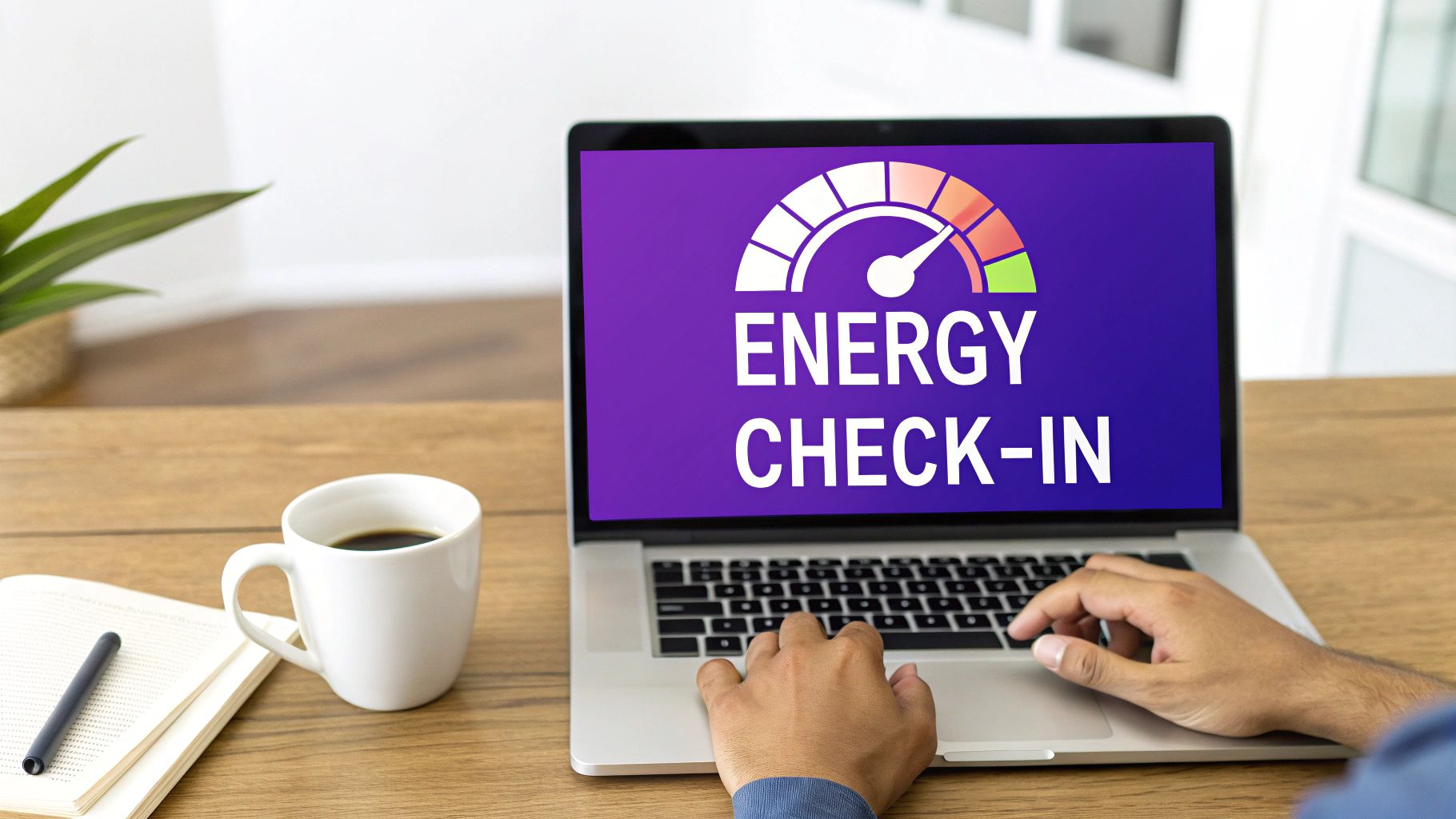
For remote and hybrid teams, this check-in is particularly crucial. Factors like timezone differences, back-to-back virtual meetings, and household distractions can cause energy levels to fluctuate wildly. A low collective score signals to the facilitator that the planned agenda might need adjustment to be effective.
Why It Works
This type of group check in question builds psychological safety by acknowledging that team members are human, not just productivity machines. It gives them permission to be less than 100% and allows the leader to respond with empathy. When a team reports low energy, a facilitator can pivot by introducing a short break, a quick stretching exercise, or reordering the agenda to tackle less demanding tasks first. This proactive adjustment prevents burnout and makes meetings more productive and inclusive.
Actionable Tips for Implementation
- Ask First: Pose the energy question at the very beginning of the meeting, even before introductions. This captures a more authentic baseline before the social dynamics of the meeting influence responses.
- Pair with Energizers: If the group's average energy is low (e.g., below a 6/10), have a few quick energizers ready. Suggest a two-minute stretch, play an upbeat song, or lead a simple breathing exercise. For more structured activities, you can find a variety of engaging options in collections of team icebreaker games.
- Track Patterns: Anonymously log energy levels over several weeks. You might discover that the team's energy is consistently low on Friday afternoons or after a specific recurring meeting, providing data-driven reasons to reschedule high-stakes brainstorming sessions.
- Don't Use it in Isolation: Combine the energy check with another prompt to add context. For example, "On a scale of 1-10, what's your energy level, and what's one thing you're looking forward to this week?"
2. Mental Clarity & Focus Check-In
The Mental Clarity & Focus Check-In is a targeted question designed to gauge a team's cognitive readiness for deep work. It moves beyond general energy levels to assess how present and focused each participant feels, directly addressing their capacity for concentration, strategic thinking, and creative problem-solving. This prompt helps leaders understand if team members are dealing with mental fog, distractions, or excessive cognitive load before diving into complex tasks.
This is especially vital for remote and distributed teams, where the lines between work and home are often blurred. Continuous digital notifications, household interruptions, and the mental tax of context-switching between different projects can severely fragment a person's focus. A quick clarity check reveals whether the team is truly prepared for a high-stakes brainstorming session or a detailed planning meeting.
Why It Works
This type of group check in question directly addresses the invisible barriers to productivity and creativity. By asking about focus, leaders normalize the reality that attention is a finite resource. It gives team members a safe way to express that they are distracted or overwhelmed without feeling like they are underperforming. This vulnerability builds trust and allows the facilitator to make informed decisions.
For example, if a product team reports low clarity before a feature prioritization meeting, the facilitator can adapt. They might postpone the most complex decision, introduce a five-minute mindfulness exercise, or use a structured framework like a simple matrix to guide thinking and reduce cognitive strain. This ensures the meeting's outcome is based on clear, focused thought rather than distracted, surface-level input.
Actionable Tips for Implementation
- Be Specific with Your Scale: Instead of a vague question, ask, "On a scale of 1-5, how clear is your thinking right now?" This simple scale is quick to answer and provides an immediate, quantifiable measure of the group's collective focus.
- Offer an Optional Follow-Up: Pair the rating with a voluntary, open-ended question like, "If you're willing to share, what's one thing occupying your headspace?" This can reveal common distractions, such as a looming deadline or a noisy Slack channel, providing actionable data for process improvements.
- Advocate for Focus Time: Use the data from these check-ins to protect your team's most valuable cognitive resource. If you notice a pattern of low focus before creative sessions, use it as evidence to advocate for dedicated, meeting-free "focus blocks" in the team's calendar.
- Share Aggregate Data: Periodically share anonymized trends with the team, such as "Our average focus score is lowest on Thursday afternoons." This collective awareness helps everyone understand shared challenges and collaboratively find solutions, like implementing "no-notification" periods.
3. Psychological Safety & Comfort Check-In
This check-in moves beyond surface-level feelings to gauge the core health of your team's collaborative environment. It directly asks participants if they feel safe enough to share ideas, ask questions, and contribute without fear of judgment or negative consequences. For remote and hybrid teams, where digital communication can obscure social cues and amplify anxieties, this question is foundational to fostering genuine innovation and preventing groupthink.
Without psychological safety, team members often hold back their best, most creative, or even most critical thoughts. This check-in creates explicit permission for vulnerability, encouraging the kind of diverse thinking that leads to breakthrough solutions. It's an essential diagnostic tool for leaders who want to ensure every voice, especially those of junior or quieter members, is heard and valued.
Why It Works
This type of group check in question directly addresses the invisible barriers to high performance. By normalizing the conversation around safety, it transforms a potentially awkward topic into a standard operational health metric. When a leader actively asks about comfort levels, it signals that they are committed to creating an inclusive atmosphere. This practice helps build trust and empowers team members to take the interpersonal risks necessary for creativity, such as challenging the status quo or admitting a mistake.
Actionable Tips for Implementation
- Normalize the Question: Frame the check-in as a standard part of your process. Start a session with, "Before we dive in, I want to check: On a scale of 1-5, how comfortable does everyone feel sharing any idea today, even if it feels wild or incomplete?"
- Model Vulnerability: As the facilitator, go first. Share your own unconventional or "risky" thought to show that it's safe to do so. This act of leadership makes others more likely to contribute authentically.
- Use Anonymous Tools: For particularly sensitive topics or newly formed teams, use anonymous polling or submission tools for idea generation. This allows ideas to be judged on their merit, free from bias or fear of personal judgment. To dive deeper into this concept, you can learn more about what is psychological safety at work and how it drives innovation.
- Establish Ground Rules: If the safety check reveals low scores, pause the agenda. Co-create a few simple ground rules for the session with the team, such as "Critique ideas, not people" or "All ideas are welcome."
4. Motivation & Engagement Level Check-In
The Motivation & Engagement Level Check-In moves beyond general energy to gauge team members' specific enthusiasm and buy-in for the task at hand. This prompt asks participants to rate their intrinsic motivation regarding a particular project or challenge, uncovering how connected they feel to the work's purpose. It's an essential diagnostic tool for identifying alignment gaps before a team invests significant time and effort.
For remote teams, it’s easy to become disconnected from a project's "why," leading to a drop in engagement. This check-in creates an explicit moment to assess whether the team understands and believes in the value of their work. A low collective motivation score is a critical signal that the project's framing or context needs immediate attention.
Why It Works
This type of group check in question is powerful because it links individual feelings directly to business outcomes. When a product team discovers low motivation, it might stem from an unclear business case. By identifying this early, a leader can pause to bring in a stakeholder for a quick alignment session, reigniting purpose and clarity. It transforms a potentially disengaged work session into a targeted and meaningful one.
This approach builds a culture where it’s safe to admit a lack of connection to a task, which is far more productive than having team members silently disengage. It allows facilitators to reframe challenges, connect ideas to meaningful outcomes, and ensure everyone is rowing in the same direction with genuine enthusiasm.
Actionable Tips for Implementation
- Make it a Two-Part Question: Don't just ask for a number. Pose the question as, "On a scale of 1-10, how motivated do you feel about tackling this challenge, and why?" The "why" provides the crucial context needed to take effective action.
- Provide Context First: Before asking the question, share a clear impact statement. Briefly explain who the work helps, what problem it solves, or how it contributes to the company's mission.
- Pause and Reframe if Needed: If motivation is consistently low, don't push through the agenda. Pause the meeting to discuss the "why" further. Reframe the challenge to connect with what energizes the team, whether it's user experience, technical innovation, or revenue growth.
- Track Motivation Over Time: Log anonymous motivation scores for long-term projects. A downward trend can signal project fatigue or a growing disconnect from the initial vision, prompting a necessary reset. For deeper insights, you can explore strategies on how to motivate remote employees.
5. Context & Preparation Check-In
The Context & Preparation Check-In is a practical prompt that verifies whether participants have the necessary background and information to contribute meaningfully to a meeting, especially a brainstorming session. It shifts the focus from emotional states to readiness, ensuring that valuable time isn't wasted clarifying foundational knowledge. This is a critical step for remote teams, where the informal context-sharing that happens in an office is absent.
This check-in acts as a safety net. For instance, a distributed product team might use it to discover that engineers lack recent customer feedback that the marketing team has. By identifying this gap early, the facilitator can provide a quick summary or a live demo before ideation begins, leveling the playing field for everyone involved.
Why It Works
This type of group check in question prevents unproductive meetings and fosters inclusivity. When team members feel they lack key information, they often hesitate to speak up, leading to shallow ideas or disengagement. By explicitly asking about preparation, you create a safe space to admit knowledge gaps without judgment. It ensures that brainstorming is built on a shared, solid foundation of understanding.
For example, an ad agency can use this check-in to confirm that everyone on a creative call fully understands the client's brief and constraints. This simple step prevents the team from generating brilliant but irrelevant ideas, saving hours of rework and client frustration. It respects everyone's time by making sure the collaborative work is as effective as possible.
Actionable Tips for Implementation
- Ask Directly: Start the session with a direct question like, "On a scale of 1-5, how prepared do you feel for this brainstorm? What's one piece of information that would be helpful?" This frames context as a shared responsibility.
- Send Pre-Work: Distribute essential reading materials or data at least 24 hours in advance. This accommodates different schedules and allows team members to absorb the information asynchronously. You can find more strategies for setting your team up for success in our guide on preparing for a meeting.
- Plan a Context Buffer: Build a 10-15 minute buffer into your agenda specifically for a "context top-up." Use this time to answer questions or have a subject matter expert provide a quick summary based on the check-in's results.
- Document Gaps: Take note of recurring knowledge gaps. If the same questions come up repeatedly, it's a signal to improve your pre-briefing process or create a permanent resource, like a project FAQ page.
6. Perspective & Diversity Check-In
The Perspective & Diversity Check-In is a strategic prompt used to map out the varied viewpoints, skills, and experiences present in a meeting, particularly before a brainstorm or decision-making session. Instead of assuming everyone approaches a problem from the same angle, this question explicitly asks participants to name the lens through which they are viewing the topic. This is a powerful tool for intentionally leveraging cognitive diversity.
This check-in is especially vital for remote and hybrid teams where the subtle cues that signal different departmental backgrounds or cultural contexts are often missing. It helps a facilitator ensure that a brainstorming session doesn’t become an echo chamber and that underrepresented but crucial viewpoints are actively brought into the conversation. It moves beyond demographic diversity to focus on diversity of thought.
Why It Works
This type of group check in question is designed to preempt groupthink and unlock more innovative solutions. By making diverse perspectives visible from the start, it gives participants permission to challenge the dominant narrative and offer unique insights. For example, a product team might hear from a customer support representative who brings the direct voice of the user, preventing engineers and designers from building in a vacuum.
It also fosters a more inclusive environment where every contribution is framed as a valuable piece of a larger puzzle. This encourages quieter team members to speak up, knowing their specific expertise is needed. When a creative agency maps out the perspectives of designers, strategists, and copywriters before a brainstorm, it ensures the final concept is well-rounded and not skewed by the loudest voice in the room.
Actionable Tips for Implementation
- Frame the Question Clearly: Start the meeting with a direct prompt like, "What's one unique perspective or expertise you are bringing to this topic today?" This encourages participants to self-identify their role and contribution.
- Intentionally Solicit Viewpoints: If you notice certain functions or individuals are quiet, call on them directly. For example, "Sarah, from a finance perspective, how does this proposal look?" or "James, thinking as our operations lead, what potential roadblocks do you see?"
- Use Perspectives to Reframe Problems: Actively use the identified diversity to explore a challenge from multiple angles. Ask questions like, "How would a brand-new customer see this?" or "How would our most skeptical engineer approach this problem?"
- Value All Contributions: Explicitly state that diverse and even conflicting perspectives are not only welcome but essential for success. Make it clear that challenging ideas is part of the process and not a personal critique.
- Leverage Visuals for Remote Teams: In a virtual setting, ask team members to add their perspective to their screen name (e.g., "Anna – User Experience") or use a virtual whiteboard to map out the different viewpoints visually. This keeps the diversity of thought top-of-mind throughout the session.
7. Constraints & Feasibility Check-In
The Constraints & Feasibility Check-In is a reality-grounding prompt designed to anchor a team's creative energy to what is practically achievable. Instead of letting a brainstorming session drift into purely theoretical ideas, this question explicitly outlines the budget, timeline, technical, or resource limitations from the start. This ensures that every idea generated is filtered through the lens of real-world feasibility.
For remote and distributed teams, this type of check-in is invaluable. Without the informal context gained from hallway conversations, team members may be unaware of critical business or technical realities. This prompt makes those implicit constraints explicit, aligning everyone on the same set of rules before creative work begins and preventing wasted effort on brilliant but unworkable concepts.
Why It Works
This group check in question channels creativity rather than stifling it. By defining the boundaries of the sandbox, it encourages teams to find innovative solutions within those limits. It prevents the common scenario where engineers have to reject exciting designs due to technical debt, or where a marketing campaign is scrapped because it wildly exceeds the budget. This proactive alignment saves time, reduces frustration, and fosters a more collaborative and realistic approach to problem-solving.
Actionable Tips for Implementation
- Be Specific and Transparent: Don't just say "we have a tight budget." State the facts clearly: "Our budget for this feature is $15,000, the timeline is a three-week sprint, and we have two available developers. What constraints should we keep in mind?"
- Frame Constraints as a Creative Challenge: Use language that inspires innovation. Instead of saying "We can't do X," ask, "How can we achieve a similar outcome while staying within our $50k budget?" This turns a limitation into a creative puzzle.
- Distinguish Hard vs. Soft Constraints: Clearly separate non-negotiable limits (e.g., legal compliance, core technical architecture) from flexible guidelines (e.g., preferred software, internal deadlines). Document which constraints could be challenged if an idea is exceptionally strong.
- Document and Revisit: Keep a visible record of the agreed-upon constraints in a shared document or on a virtual whiteboard. This serves as a constant reference point throughout the session, keeping the team focused and on track.
8. Desired Outcome & Success Metrics Check-In
This forward-looking check-in aligns the team by asking a simple but powerful question: "What does success look like for this session?" It shifts the focus from a vague discussion to purposeful, goal-oriented work. By defining success metrics upfront, every participant understands the target they are aiming for, ensuring the time spent together is both productive and impactful.
For remote teams, where asynchronous work can sometimes lead to misalignment, this check-in is essential. It prevents brainstorms from becoming idea-generation sessions with no clear next steps. A creative agency might define success as "three campaign concepts solid enough to present to the client," while a product team might aim for "15-20 user story ideas for the next sprint." This clarity transforms abstract conversations into tangible outcomes.
Why It Works
This type of group check in question provides direction and motivation. When team members know what they are working toward and how their contributions will be measured, they are more engaged and focused. It also manages expectations and prevents disappointment by ensuring everyone agrees on the session's purpose. Clarifying the desired outcome creates a shared sense of ownership and makes the group’s collective effort feel more meaningful and connected to larger business goals.
Actionable Tips for Implementation
- Ask Explicitly: Start the meeting by asking, "What does a successful outcome look like for us today?" or "By the end of this session, what will we have accomplished to consider it a win?" Document the answers in a shared space.
- Define Both Metric Types: Clarify both output metrics (e.g., quantity or quality of ideas) and process metrics (e.g., 100% participation, a psychologically safe environment). This ensures you value both the result and the way you achieve it.
- Clarify Next Steps: Discuss what happens to the ideas after the meeting. Will there be a voting session, a prototyping phase, or a follow-up evaluation? Sharing the post-session action plan assures the team their ideas won't disappear into a void.
- Connect to Broader Goals: Frame the session's desired outcome within the context of larger team or company objectives. For more on this, you can explore various goal-setting frameworks that help link tactical sessions to strategic initiatives.
- Share Async First: For remote teams, send the desired outcome and success criteria via a shared document or chat message before the meeting. This gives everyone time to process and come prepared, maximizing synchronous time.
Group Check-In Questions: 8-Point Comparison
| Check‑In | 🔄 Implementation complexity | ⚡ Resource / Time required | 📊 Expected outcomes | 💡 Ideal use cases | ⭐ Key advantages |
|---|---|---|---|---|---|
| Energy Level Check‑In | 🔄 Low — simple scale or descriptor | ⚡ 1–2 min; polling/chat | 📊 Real‑time readiness; enables pacing adjustments | 💡 Remote/timezone‑spread teams, before ideation | ⭐⭐⭐⭐ Prevents low‑energy sessions; supports quick energizers |
| Mental Clarity & Focus Check‑In | 🔄 Low–Medium — needs follow‑ups to diagnose distractions | ⚡ ~1–3 min; optional follow‑up questions | 📊 Higher idea quality; fewer cognitive interruptions | 💡 Complex thinking tasks; high‑cognitive workshops | ⭐⭐⭐⭐ Ensures cognitive readiness; predicts idea quality |
| Psychological Safety & Comfort Check‑In | 🔄 Medium — may require anonymity tools & skilled facilitation | ⚡ 1–5 min; may trigger follow‑up actions | 📊 Increased participation and idea diversity | 💡 Cross‑hierarchy teams, sensitive topics, diverse groups | ⭐⭐⭐⭐⭐ Fosters trust; boosts equitable contributions |
| Motivation & Engagement Level Check‑In | 🔄 Low–Medium — two‑part questions useful | ⚡ 2–4 min; may need challenge reframing | 📊 Better buy‑in and relevance of ideas | 💡 Projects needing purpose alignment or re‑engagement | ⭐⭐⭐⭐ Improves idea relevance; enables tailored framing |
| Context & Preparation Check‑In | 🔄 Medium — requires pre‑reads and resource links | ⚡ 2–10 min; prep materials beneficial | 📊 Reduces derails; aligns baseline knowledge | 💡 Technical briefs, client work, distributed teams | ⭐⭐⭐⭐ Prevents wasted time; ensures informed ideation |
| Perspective & Diversity Check‑In | 🔄 Medium–High — facilitation to surface voices | ⚡ 3–8 min; structured prompts or round‑robin | 📊 Greater novelty; reduced groupthink | 💡 Cross‑functional brainstorms; inclusion goals | ⭐⭐⭐⭐ Increases innovation via diverse viewpoints |
| Constraints & Feasibility Check‑In | 🔄 Low–Medium — needs clear constraint definition | ⚡ 2–5 min; leadership input helpful | 📊 More actionable, implementable ideas | 💡 MVP planning, resource‑limited projects | ⭐⭐⭐⭐ Keeps ideas realistic; reduces scope creep |
| Desired Outcome & Success Metrics Check‑In | 🔄 Medium — requires metric alignment beforehand | ⚡ 2–6 min; pre‑defined goals speed the check | 📊 Clear evaluation criteria and next steps | 💡 Outcome‑driven sessions, stakeholder deliverables | ⭐⭐⭐⭐ Focuses ideation toward measurable impact |
From Check-Ins to Breakthroughs: Putting Your Questions into Action
The extensive list of group check in questions you've explored isn't just a menu of icebreakers; it's a strategic toolkit for engineering a more connected, aware, and effective team. Moving beyond generic "how are you?" prompts is a deliberate choice to build a foundation of psychological safety and clarity, which is the bedrock of genuine collaboration, especially in remote and hybrid environments.
Adopting these check-ins is more than just a new meeting agenda item. It represents a fundamental shift in how your team approaches its collective work. By starting each session with intention, you create an environment where creativity isn't just hoped for, it's actively cultivated. The insights you gain from a simple two-minute check-in can save hours of misaligned work and prevent the kind of silent disengagement that erodes team morale.
Turning Insight into Habit
The true power of these questions is unlocked through consistency. A one-off check-in is interesting, but a consistent ritual is transformative. The goal is to make this practice an embedded part of your team's culture, a signal that every voice matters and that context is king.
Here are the actionable next steps to integrate these practices effectively:
- Start Small and Specific: Don't overwhelm your team. Choose one or two questions from the categories that address your most pressing challenges. Is team energy consistently low on Friday afternoons? Use an Energy Level Check-In. Are meetings starting with a lack of focus? Try the Mental Clarity prompts.
- Explain the "Why": Frame the introduction of these check-ins not as another task, but as an investment in better work and well-being. Explain that the goal is to make meetings more efficient, inclusive, and productive for everyone involved.
- Rotate Facilitation: Encourage different team members to lead the check-in. This builds ownership across the team and brings fresh perspectives to the process, preventing it from becoming a stale, top-down mandate.
- Track and Adapt: Pay attention to the responses over time. Are certain patterns emerging? This data is invaluable. For instance, a consistent dip in team morale on a particular day might indicate a recurring workflow issue. Implementing structured routines, sometimes called a Monday Health Check, can provide these valuable insights into well-being and project progress, helping to transform your team's dynamics.
The Broader Impact: Beyond the Meeting Room
Mastering the art of the check-in has ripple effects that extend far beyond the specific meeting in which it's used. It builds a shared language for the team to discuss blockers, energy levels, and support needs. This practice strengthens trust, making it easier for team members to be vulnerable, ask for help, and offer constructive feedback.
Ultimately, these group check in questions are a mechanism for building a more resilient, self-aware, and aligned team. You are moving from a group of individuals who simply show up to a cohesive unit that intentionally tunes in. This alignment is the secret ingredient that transforms passive meetings into active, psychologically safe spaces where innovation can truly flourish. Your journey from a simple list of questions to profound team breakthroughs begins with that first, intentional check-in.
Ready to move from manual check-ins to intelligent, guided facilitation? Bulby uses AI to analyze your team's needs and suggest the perfect warm-ups and exercises to run more effective, engaging, and innovative sessions. Transform your team's creative potential by visiting Bulby today.