

Thinking faster isn't some gift you're born with; it's a skill. And like any skill, you can build it with the right strategies and a bit of practice. The secret is to pair up specific cognitive training drills with some clever mental shortcuts that help you chew through information more efficiently.
Why Thinking Quicker Is a Remote Team Superpower

When your team is remote, speed is everything. The whole world is digital-first now, and it moves at a breakneck pace. The teams that can process information, cook up ideas, and solve problems on the fly are the ones that win.
But here's the catch: remote work itself can sometimes get in the way.
We’ve all been there. Video call fatigue, the black hole of asynchronous communication, the missing "water cooler" moments where great ideas used to pop up. All these little things create cognitive friction, which can kill innovation and drag out project timelines. This is why learning to think quicker isn’t just a nice-to-have skill for personal growth—it's a must-have for any remote team that wants to stay on top of its game.
The Science of Hitting the Mental Gas Pedal
The great news is that mental speed isn't set in stone. We know this for a fact. Major research, like the well-known ACTIVE study on speed-of-processing training (SOPT), has shown that we can absolutely train our brains to be faster.
Participants in that study boosted their processing speed by an incredible 2.5 standard deviations. To put that in perspective, it's like turning back the clock on over a decade of age-related cognitive decline. For remote teams, this is huge. It proves that with the right drills, we can build the mental muscle for lightning-fast pattern recognition, cutting through our own biases and common collaboration snags.
The ability to connect seemingly unrelated ideas and make solid decisions under pressure has a direct impact on the bottom line. It’s that simple. Faster thinking means more dynamic brainstorming, quicker problem-solving, and the agility to pounce on market changes.
Turning Speed into a Real Business Advantage
When a team starts to build these habits, you see the benefits almost immediately. And it’s not just about getting tasks done faster. It’s about raising the bar on the quality of your work together.
Think about a product team that can instantly analyze user feedback and start iterating on new features. They’re always going to run circles around a competitor who’s slower and more hesitant. To see just how much this matters, you can explore how this plays into reducing time to market.
Ultimately, when you build a culture of rapid thinking, you give your team the power to:
- Innovate faster by coming up with and testing more ideas in a shorter amount of time.
- Solve complex problems by getting to the root cause and seeing potential solutions more clearly.
- Communicate more effectively by cutting through the fluff and getting right to the point.
To get started, it helps to understand the core methods we'll be diving into.
Core Techniques for Faster Thinking
Here's a quick look at the methods we'll cover to help you and your team start processing information more quickly and effectively.
| Technique | Core Benefit | Best For |
|---|---|---|
| Mental Shortcuts | Reduces cognitive load by using established frameworks. | Making quick decisions, analyzing problems, and structuring ideas. |
| Rapid Ideation Drills | Generates a high volume of ideas in a short time. | Brainstorming sessions, creative problem-solving, and kick-off meetings. |
| Cognitive Warm-Ups | Primes the brain for focused, high-speed thinking. | The first 5-10 minutes of a meeting or deep work session. |
These techniques aren't complicated, but they are incredibly powerful when you start using them consistently. Let's break down how to put each one into practice.
Fine-Tune Your Brain with Daily Mental Drills
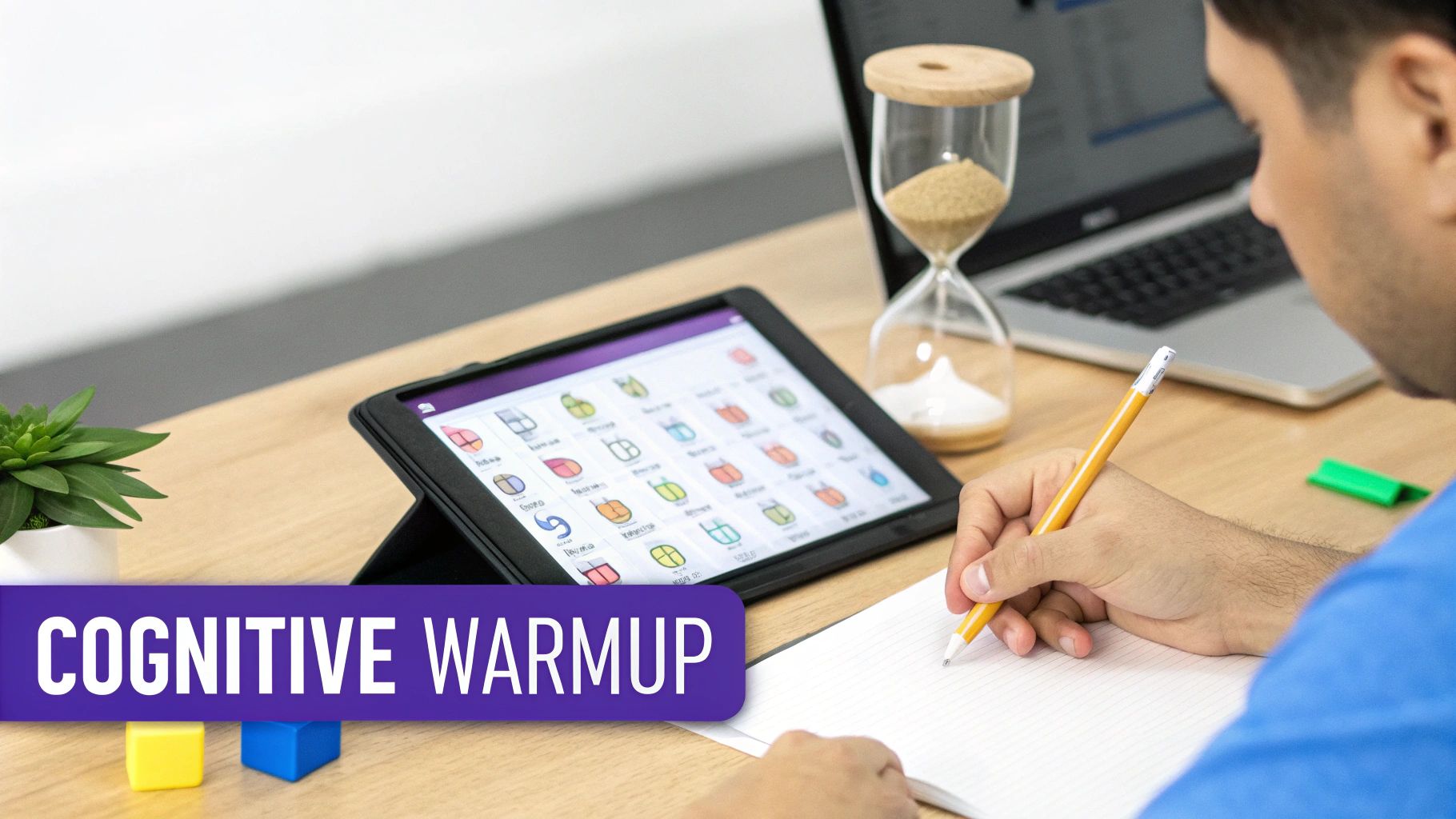
Think of your brain like a muscle. You wouldn't expect to run a marathon without training, and the same logic applies to thinking faster. The secret is to warm up your mind with short, focused cognitive drills that build the neural pathways needed for quick, efficient thought.
This isn't about spending hours cramming. Just 15-20 minutes a day is enough to build a powerful habit that pays huge dividends in meetings, creative sessions, and everyday problem-solving. It's the consistency that rewires your brain to process information at a higher speed.
One major study on big data uncovered a direct link between practice and results. It turns out that around 20 hours of total training can boost your cognitive speed by up to 70-80% of your maximum potential. This really proves that structured practice is the key to unlocking a faster mind.
Simple Drills to Boost Your Processing Speed
Ready to get started? The goal is to challenge specific mental functions that force your brain to make faster connections.
- Pattern Recognition Challenges: Find a complex image or a data set online and give yourself a minute to spot as many repeating elements as you can. This trains your brain to cut through the noise and zero in on what matters.
- Rapid Association Games: Grab a random word—let's say "river"—and list every related word you can think of in 60 seconds. This exercise is fantastic for building your ability to leap between concepts, which is the heart of quick thinking.
- Working Memory Tasks: This is all about holding and juggling information in your head. A classic exercise is to have someone read a sequence of numbers aloud, and you repeat them backward.
These aren't just silly games. They're targeted workouts that directly improve your ability to keep up with the constant flow of information, especially in a remote work setting. Imagine a team doing a five-minute warm-up like this before a big brainstorming call—the ideas will flow much more freely.
How to Make It a Habit
Weaving these drills into your daily routine is easier than it sounds. Try "habit stacking"—tack it onto something you already do, like right after your morning coffee or just before you dive into your inbox.
For remote teams, these drills are the perfect "cognitive warm-up" before a critical meeting. A sharp project manager could kick off a strategy session with a quick, two-minute rapid association game. It’s a simple way to break the ice and get everyone’s brain firing on all cylinders.
Ultimately, being able to react and adapt on the fly is a massive advantage in any role. By learning mental frameworks and practicing these drills, you can truly master how to think on your feet and turn pressure-filled moments into opportunities.
For even more ideas, check out our guide on creative thinking exercises to get your team's innovative juices flowing. The real magic happens when these exercises become a regular, shared practice.
The benefits stack up over time, turning what starts as an individual habit into a huge team advantage. You’re not just learning to think quicker; you're building a foundation for smarter, more agile collaboration.
Use Mental Shortcuts to Accelerate Decision Making
Thinking faster isn't about having a supercomputer for a brain. It’s about being more efficient. The quickest thinkers I know rely on mental models to slice through the noise and get straight to the heart of an issue. These frameworks are like cheat codes for your brain, helping you sidestep analysis paralysis.
Instead of drowning in details, you can apply a trusted structure to organize your thoughts. It's a lifesaver for making smart calls under pressure, especially when you're leading a remote team and can't afford to be slow or unclear.
Break Problems Down with First Principles Thinking
One of the most powerful shortcuts you can learn is First Principles Thinking. The idea is simple but profound: break a complex problem down to its most basic, undeniable truths and then build your solution from there. It forces you to challenge every single assumption you're holding.
Let's say a remote product team wants to improve its project management app. The market is absolutely saturated. The standard approach is to just add another feature, but using First Principles, they'd do this:
- The Assumption: "We need a flashy new dashboard to stay competitive."
- The First Principle Question: "What is the absolute core function of our app? What fundamental problem are users trying to solve?"
- The Fundamental Truth: "Users need to know exactly what to work on next, instantly, without any confusion."
Starting from that simple truth opens up entirely new possibilities. Maybe the real answer isn't another cluttered dashboard but an AI-powered task prioritizer or a super-simple, single-task view. This is how you move from copying features to real innovation.
By stripping away the noise of existing solutions and assumptions, you’re free to build a better, often simpler, solution from the ground up. This is how you stop reacting to competitors and start leading the conversation.
Uncover Hidden Risks by Thinking in Reverse
Another fantastic mental model is Inversion. Instead of focusing on "How do we succeed?" you flip the question on its head: "What could make this project an absolute failure?" By mapping out all the potential disasters and pitfalls ahead of time, you can build a plan to navigate around them.
This shortcut is a total game-changer for project planning. Imagine a team is about to launch a new marketing campaign. Using inversion, they’d list out all the ways it could go wrong:
- The ad copy completely misses the mark.
- We targeted the wrong audience.
- The landing page crashes the second it gets real traffic.
- A competitor launches a nearly identical campaign a week before us.
Once you have this list of potential failures, you can build contingency plans and shore up your weak points. It turns scary what-ifs into manageable risks and dramatically boosts your odds of success. This exercise is also a great way to fight common thinking traps. To go deeper on that, you can learn about the different types of cognitive bias in decision making that often get in our way.
Making these mental shortcuts a regular part of your process gives you a reliable toolkit for any challenge that comes your way. They're not just abstract theories—they are practical frameworks you and your team can put to work immediately to cut through complexity and start thinking faster.
The Surprising Link Between Physical Movement and Mental Speed
When you picture someone deep in thought, what comes to mind? Probably someone sitting perfectly still, hunched over a desk. But what if one of the best ways to get your brain firing on all cylinders is to actually get up and move?
It’s true. The connection between physical activity and mental agility is surprisingly direct, and it’s a total game-changer if you’re trying to think faster.
This isn’t about training for a marathon just to solve a complex problem. Even short bursts of simple, low-intensity movement can make a huge difference. Just getting out of your chair can re-energize your brain, boost your working memory, and sharpen your response times. Think of it as a strategic tool for smashing through mental blocks.
Wake Up Your Brain with Simple Movements
If you work remotely, you know how easy it is to spend hours glued to your screen. That’s why weaving a little movement into your day is so crucial for keeping your mind sharp. The trick is to make it a seamless part of your workflow, not just another task on your to-do list.
Don't just take my word for it—the science backs this up. A 2023 study from Penn State found that everyday activities, like a brisk 10-minute walk, can boost your cognitive processing speed so much that it's like being four years younger. The researchers discovered that movement within the past few hours gives you an immediate neural kick by making your prefrontal cortex work more efficiently. If you're curious about the details, you can read the full research on how physical activity improves cognitive health.
Here are a few practical ways I’ve seen this work wonders:
- Try 'Walk-and-Talk' Meetings: Instead of another soul-crushing video call, take one of your meetings over the phone while you walk. It’s perfect for one-on-one check-ins or brainstorming sessions where you don’t need to share a screen.
- Use the 'Pomodoro Plus' Method: You’ve probably heard of the Pomodoro Technique—working in focused 25-minute sprints. Just add a twist: use the five-minute break for movement. Do some light stretching, walk a lap around your house, or even do a few jumping jacks to get the blood flowing.
- Stretch During Long Calls: Stuck in a long meeting where you’re mostly listening? Mute your mic, turn off your camera for a couple of minutes, and do some simple stretches. It keeps you from zoning out and keeps your mind engaged.
Moving your body is like hitting a reset button for your brain. It breaks the cycle of mental fatigue and opens up new pathways for creative problem-solving and faster idea generation.
Turning Movement into a Cognitive Advantage
Start thinking of physical activity as a tool for your mind, not just your body. It’s not about burning calories; it’s about fueling your brain for peak performance. This simple shift helps you stay sharp and focused all day, keeping that dreaded afternoon slump at bay.
For more resources that can help you integrate physical activity and wellness into your routine, check out GrabGains. By making small, consistent efforts to move, you're not just exercising your body—you're actively training your brain to be more resilient, responsive, and ultimately, quicker on its feet.
Run Rapid-Thinking Sessions with Your Remote Team
Getting one person to think faster is a win, but turning that into a team-wide superpower? That takes a bit of structure. A guided rapid-thinking workshop can transform a slow, rambling brainstorm into a high-energy sprint that actually gets you somewhere. The secret is creating a focused environment—especially for remote teams—where speed and quantity are the only things that matter.
Forget your typical open-ended meetings. A rapid-thinking session is a tightly choreographed event. It's designed to push everyone past their creative blocks and get unexpected ideas out in the open. By putting a clock on every exercise, you force people to bypass that inner critic and just get their thoughts down.
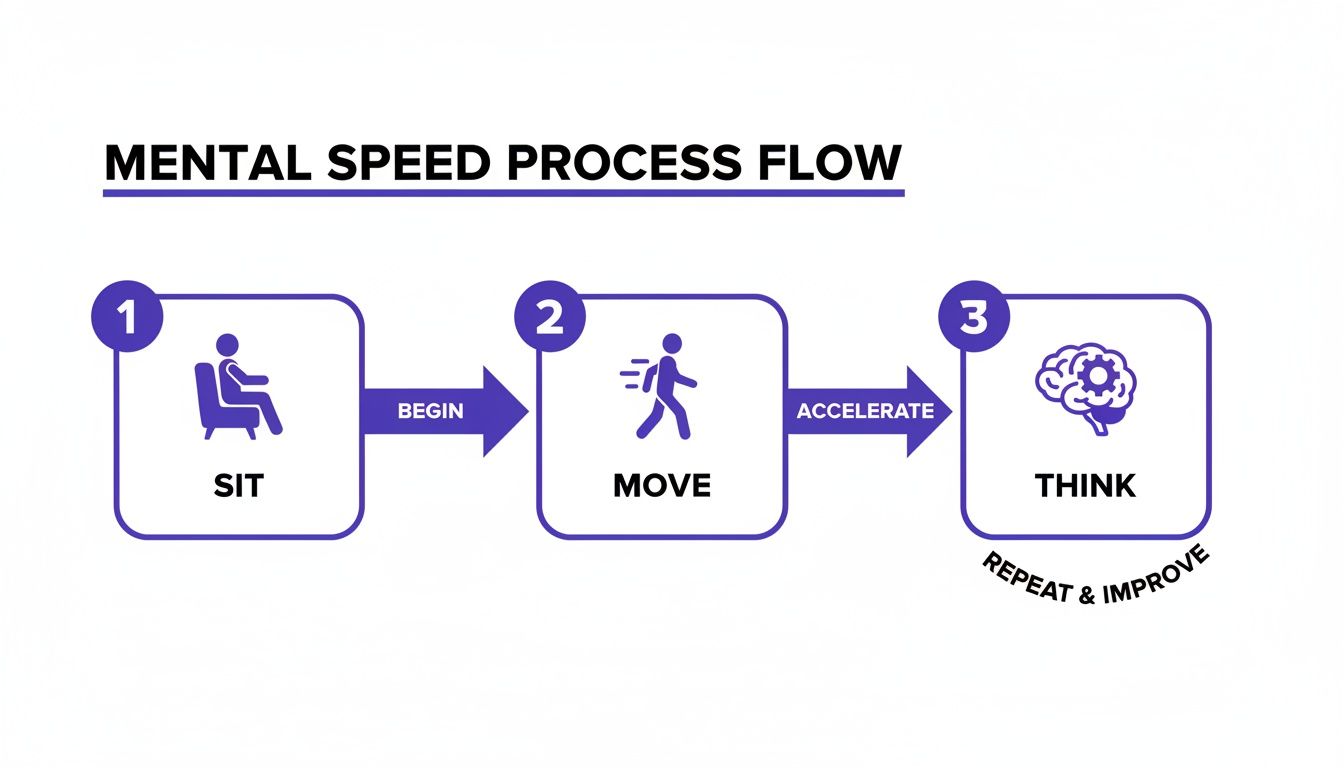
The core idea is simple: intentional shifts between states—sitting, moving, and focused thinking—can give your team's mental speed and creative output a serious boost. It's a repeatable cycle for sharpening cognitive performance.
A Go-To Facilitation Template
To pull one of these sessions off, you need a game plan. A great facilitator keeps the energy up, sticks to the clock, and makes sure everyone has a voice. I like to use a collaborative whiteboard like Miro or FigJam to give everyone a shared space to work in.
Here’s a simple template you can steal and adapt:
- Cognitive Warm-Up (5 minutes): Kick things off with a quick drill to get the creative juices flowing. Ask everyone to spend two minutes silently listing as many alternative uses for a paperclip as they can think of. It sounds silly, but it works.
- Frame the Problem (5 minutes): Be crystal clear about what you're trying to solve. Write it big at the top of the board. Something like, "How might we cut customer onboarding time by 50%?"
- Ideation Round 1 (8 minutes): Now for the fun part. Use a method like Crazy Eights, where everyone sketches eight rough ideas in eight minutes. The only rule is to focus on quantity, not quality. No one's judging the artwork.
- Silent Review (5 minutes): Once the time is up, have everyone quietly look over all the ideas. Give them a few virtual dot stickers to vote on the concepts they find most promising.
This structured, silent approach is a game-changer. It stops the two loudest people from dominating the whole conversation and gives introverts a real chance to contribute. You end up with a much wider, more diverse set of ideas in a fraction of the time.
Integrating Bulby for Guided Sessions
If you want to make these sessions a regular habit, dedicated tools can handle all the setup and timing for you. Platforms like Bulby are built to walk teams through these kinds of research-backed exercises step-by-step.
Instead of fumbling with timers and instructions, the tool does it for you. This frees up the facilitator to focus on what really matters: encouraging people and keeping the momentum going. It ensures every session is consistent, helping your team build a solid habit of quick, effective thinking.
Another fantastic technique that fits perfectly into this structure is Brainwriting 6-3-5, which is brilliant for generating ideas silently and in parallel. By blending sharp facilitation skills with the right exercises and tools, you can teach your entire team how to think faster, together.
Your Questions Answered: Thinking Faster in Practice
Whenever I introduce these techniques, a few questions always pop up. It’s totally normal to wonder how long this stuff takes to work, how it applies to specific problems, and if it's right for your team's unique vibe. Let's get into the most common ones.
How Long Until I See Real Improvements in Thinking Speed?
You don't have to wait forever to feel a difference, but consistency is everything. Think of it like a "dose-response" relationship—the more you practice, the faster you get.
If you can commit to just 15-20 minutes of focused practice each day, you'll likely see real gains in your processing speed and working memory in just a few weeks. Some of the research suggests that hitting about 20 hours of total training is the sweet spot for locking in a big chunk of the cognitive benefits. It’s not about marathon sessions; it's about building a small, daily habit.
Can These Techniques Help with Creative Blocks?
Definitely. Creative blocks are almost always a symptom of cognitive fatigue or being stuck in a mental rut. The drills and shortcuts we've talked about are designed to break you out of those patterns and get your mind firing on new cylinders.
- Rapid Association Drills: These are fantastic for forcing your brain to connect things that don't seem related, which is basically the definition of creativity.
- Mental Shortcuts: Using a framework like Inversion makes you flip a problem on its head, which often reveals solutions you’d never have seen otherwise.
- Physical Movement: Seriously, just get up and walk around. A quick walk can act as a powerful mental reset, clearing away the frustration and opening you up to new ideas.
When your team hits that dreaded wall during a remote brainstorm, these methods are your go-to for getting things moving again. They offer a structured way to push through the block and find your flow.
Are These Methods Suitable for All Types of Teams?
One hundred percent. The need to think on your feet, adapt quickly, and make smart decisions is universal. It doesn’t matter if you’re in marketing, engineering, or sales—these skills are the bedrock of high-performing teams everywhere.
For example, a marketing team can use rapid ideation to spitball dozens of campaign ideas before a big deadline. A sales team can use mental models to quickly grasp a client's core problem and adjust their pitch in the middle of a call. The underlying principles of sharpening your mind and using smart frameworks just plain work. If you're starting from scratch, our guide on critical thinking skills development is a great place to build that foundation.
Ready to turn your remote brainstorming sessions from a slow crawl into a sprint? Bulby gives you the structure and guidance to run these research-backed thinking exercises, helping your whole team bring their A-game. Start your free trial today and see the difference.