You're in a launch meeting with product, strategy, creative, and account leads. Everyone agrees the work matters, but nobody agrees on the audience, the approval path, or what “ready” means. The meeting ends with more notes than decisions, each team returns to its own queue, and the next handoff exposes a problem that was visible from the start.
That isn't a commitment problem. It's a cross team collaboration design problem. Effective collaboration doesn't mean keeping everyone in every conversation. It means giving the right people the right context, preserving functional expertise, and creating deliberate moments for synthesis, decisions, and accountability.
Table of Contents
- Why Cross Team Collaboration Breaks Down and What Good Looks Like
- Set Shared Goals Governance and Clear Decision Rights
- How to Run Cross Team Meetings and Structured Brainstorming That Deliver
- Communication Norms and Tooling Without the Product Roundup
- Measure What Matters and Build Feedback Loops That Stick
- Troubleshooting Common Pitfalls and Scaling Collaboration With Confidence
Why Cross Team Collaboration Breaks Down and What Good Looks Like
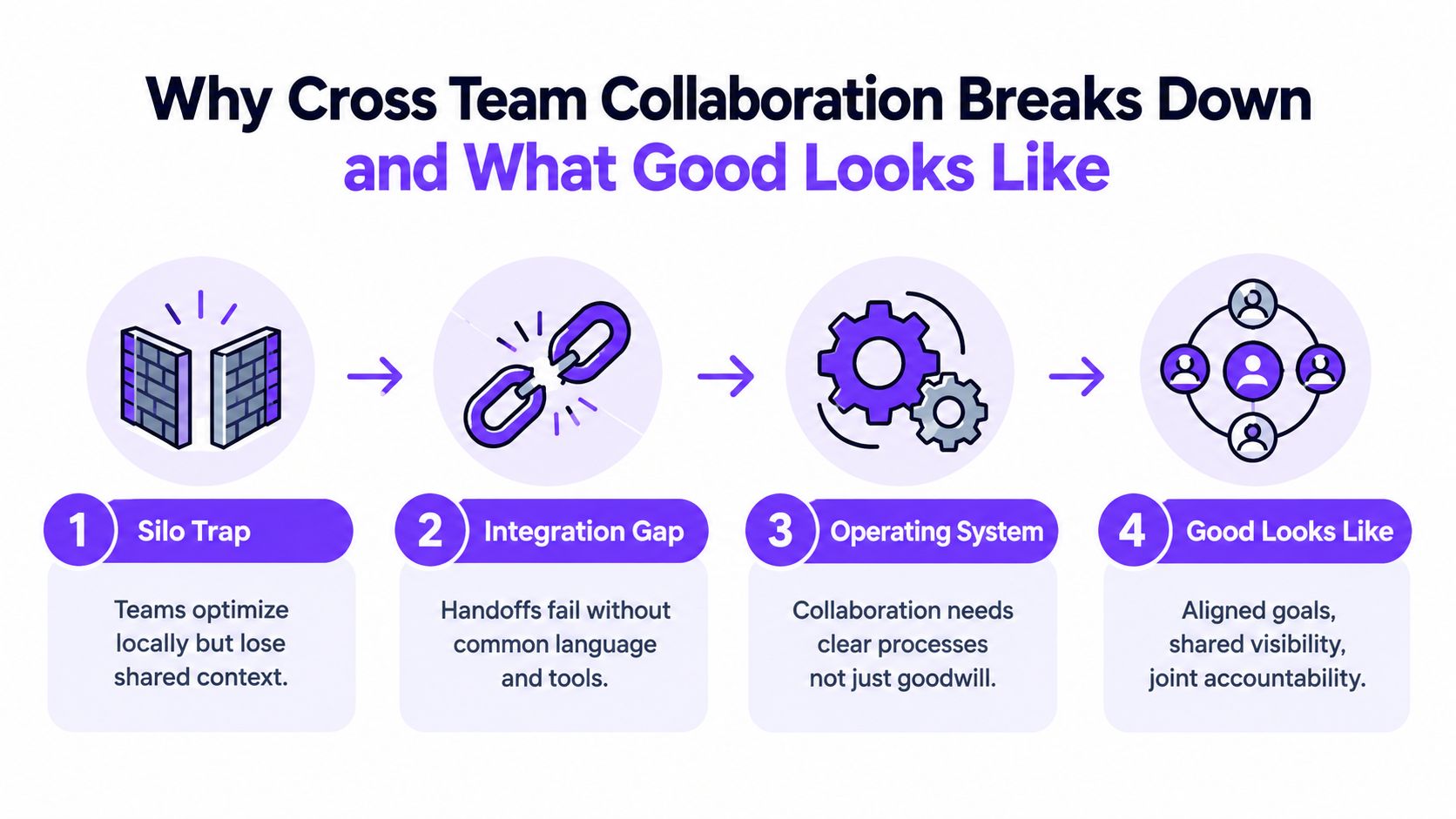
A product manager may want speed, a creative lead may want room to explore, and an account lead may be protecting a client commitment. Each person can act rationally within their role while the combined project still stalls. Teams optimize local work, use different definitions, and assume someone else owns the final call.
The usual response is to add meetings. That rarely solves the underlying issue. More meetings can expose disagreement, but they don't create a shared outcome, clarify decision rights, or repair a weak handoff.
Cross-functional integration is better understood as an ongoing process of collaboration, coordination, and communication among internal functions working toward stronger outcomes for the organization and its external partners. A 2019 literature review on cross-functional integration describes this as a sustained operating process, not occasional teamwork assembled when a project becomes difficult.
Separate expertise before you synthesize it
One of the most useful corrections to generic collaboration advice is that constant togetherness can weaken creative work. Research on cross-functional team structure found that greater differentiation between functional subgroups, even with less cross-functional communication, produced better cross-functional synthesis than a fully integrated structure. The practical implication is straightforward: let specialists work, then bring their outputs together through structured handoffs.
A strategist should be able to investigate the customer and competitive context without defending every early thought in front of the whole group. A designer should have space to explore visual directions before the account team turns the first sketch into a client commitment. Product and engineering should clarify feasibility before a large stakeholder group debates polish.
Good collaboration has four characteristics:
- Shared purpose: Teams can explain the customer or business outcome in the same words.
- Visible dependencies: People know what they need from other teams and when.
- Explicit decisions: Everyone knows who decides, who contributes, and who gets informed.
- Protected focus: Teams don't attend discussions that don't require their judgment.
Use a cross-functional team management framework to diagnose the failure before selecting another platform. If the issue is unclear ownership, a new chat channel won't help. If the issue is weak synthesis, adding every specialist to every working session may make it worse.
Set Shared Goals Governance and Clear Decision Rights
Alignment starts before the kickoff. Write down the outcome, the constraints, the owners, and the decisions that must be made. A useful collaboration charter can fit on one page, but it must answer questions people usually leave implicit.
Start with one shared outcome. “Launch the campaign” is an activity. “Give the target audience a clear reason to choose the new offer” is closer to an outcome, but it still needs a way to judge progress. Define the observable result your teams will use to make trade-offs, then list the constraints that matter, such as audience, channel, positioning, technical feasibility, legal requirements, or client commitments.
Next, map decision rights with RACI or DACI. Don't use the framework as a decorative table. Put actual decisions in the rows:
- Positioning: Who recommends the direction, who decides, and who must be consulted?
- Creative route: Who owns the recommendation, and who has approval authority?
- Scope: Who can remove work when time or capacity changes?
- Escalation: What issue deserves leadership attention, and who raises it?
A study of 232 firms published in 2011 found that the link between cross-functional collaboration and product innovativeness became stronger when firms had higher decision autonomy and shared responsibility, alongside social interaction, trust, and goal congruence. The study of 232 firms supports a practical point: collaboration improves when people have both a shared responsibility for results and enough authority to act.
Build a lightweight governance layer
Governance shouldn't mean another approval tier. It should define how the team works when normal coordination isn't enough. Include a meeting cadence, an async update format, an escalation route, and a rule for unresolved decisions.
For a product and marketing launch, the charter might state that product owns the release truth, marketing owns the market-facing narrative, and one named launch lead decides when evidence is mixed. Account teams can surface client risk, but they shouldn't rewrite the product promise. Engineering can reject an infeasible commitment, but it shouldn't become the sole owner of customer language.
Practical rule: If a decision has no named owner, the meeting is only collecting opinions.
Put the charter where the work happens. A shared document should hold the current outcome, decision log, assumptions, open risks, and links to source material. Each team can maintain its own specialist workspace, but the cross-team layer must make the important context easy to find.
Before work begins, ask each lead to confirm three things:
- What does my team own?
- What do I need from another team, and by when?
- Which decision can I make without waiting for group consensus?
Use a goal-setting frameworks guide to turn broad ambition into a working agreement. The objective isn't to force every team into identical methods. It's to make trade-offs visible before pressure turns them into personal conflict.
How to Run Cross Team Meetings and Structured Brainstorming That Deliver
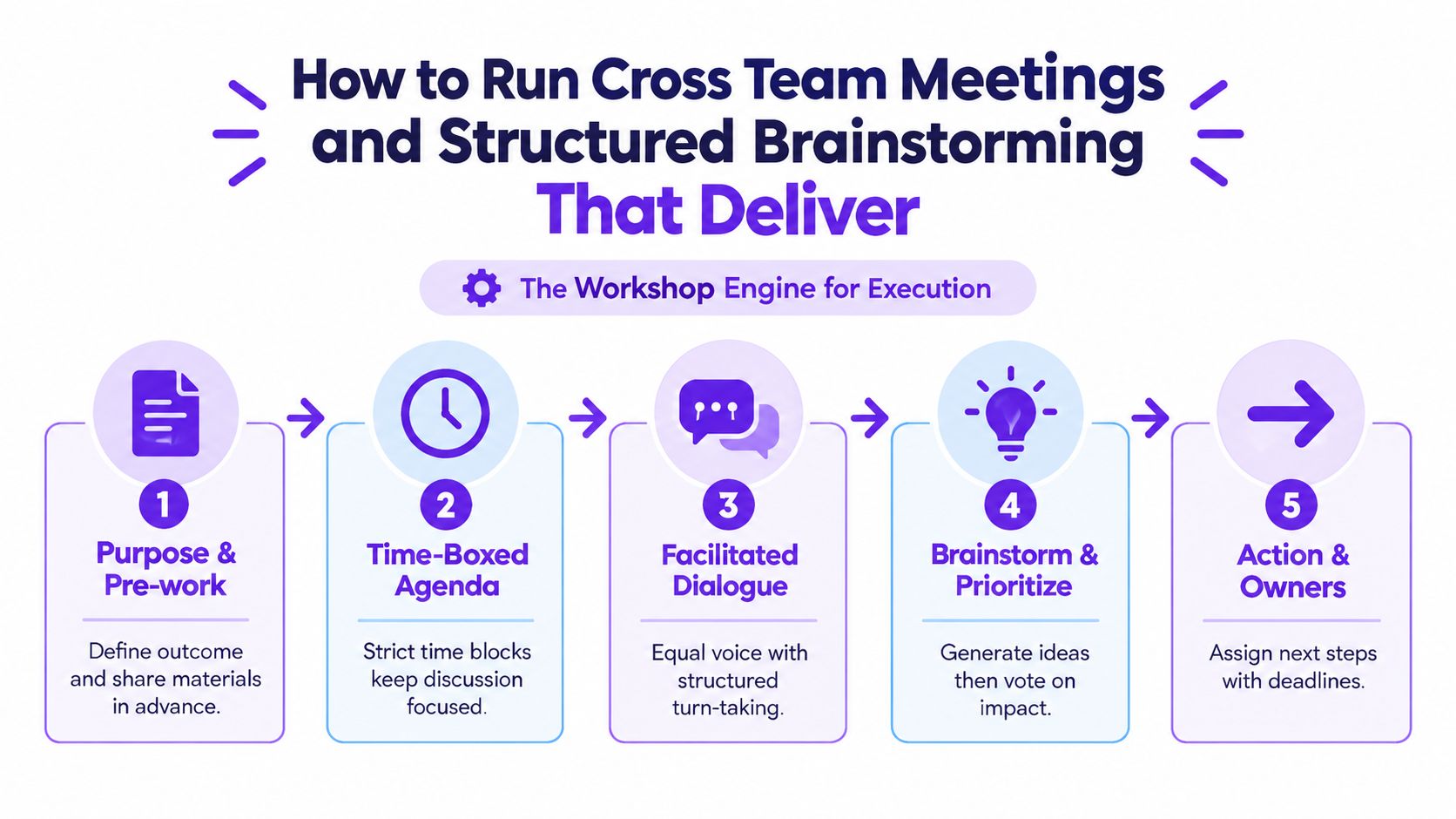
A strong workshop doesn't ask everyone to think together from the first minute. It creates a sequence. First, specialists generate and investigate independently. Then the group compares inputs, builds on patterns, and makes a decision using agreed criteria.
Send pre-work early enough for people to arrive prepared. For a campaign concept session, that might include the brief, audience information, known constraints, previous work, and the decision the meeting must produce. Don't send a vague request for “ideas.” Ask each person to bring a defined input, such as a tension, audience observation, product truth, or alternative framing.
Use a staged workshop flow
The first stage is divergence. Give people quiet time to produce ideas before discussion begins. Anonymous input can help when hierarchy or client sensitivity makes people cautious. The facilitator should collect ideas without immediately evaluating them.
The second stage is clarification. Group related ideas, remove duplicates, and ask questions that improve understanding. Don't let the person with the loudest voice become the unofficial editor. Read the ideas as contributions to the problem, not as extensions of someone's status.
The third stage is synthesis. Ask the group to combine the strongest elements into a smaller set of concepts. A strategist may bring the audience tension, a creative may bring the expression, and an account lead may identify a client-safe route. Synthesis is where those inputs become a coherent proposition.
The final stage is convergence. Score concepts against criteria agreed before the ideas appeared. Useful criteria include relevance to the audience, distinctiveness, feasibility, fit with the brief, and strength of the next step. Voting can narrow the field, but the accountable decision-maker still needs to make the call.
Research on cross-functional structure cautions against treating maximum integration as the ideal. The Academy of Management research found that functional subgroup differentiation could produce better cross-functional synthesis than a fully integrated structure. In practice, keep specialist work separate during exploration, then use a clear synthesis point instead of running an uninterrupted group conversation.
For teams that need guided ideation, Bulby can collect ideas through a shared session, support anonymous contributions, and produce an AI-generated summary with surfaced ideas and next steps. Use it to improve the input and synthesis stages, not to outsource judgment. The team still needs to decide which idea fits the audience, brief, and constraints.
A reusable 60-minute agenda
- 0 to 5 minutes, outcome and constraints: The facilitator restates the decision required.
- 5 to 12 minutes, context: The brief owner shares only the evidence and boundaries people need.
- 12 to 22 minutes, silent ideation: Participants submit ideas independently.
- 22 to 35 minutes, clarification and clustering: The group combines related inputs and identifies patterns.
- 35 to 48 minutes, concept building: Small groups or functional pairs develop the strongest directions.
- 48 to 56 minutes, prioritization: The team applies the agreed criteria.
- 56 to 60 minutes, decision and ownership: The decision-maker confirms the selected route, open risks, and next actions.
A structured brainstorming methods resource can help facilitators choose exercises that match the problem. The important choice isn't the novelty of the exercise. It's whether the exercise produces a usable handoff.
The meeting should end with a decision record, not just an enthusiastic discussion. Name the owner, state what changed, capture unresolved questions, and specify the next review point.
Communication Norms and Tooling Without the Product Roundup
Tools don't create collaboration norms. They amplify the norms already in place. If your team treats every update as a live conversation, adding another workspace can create a better-organized interruption system.
Protect execution time by assigning each type of communication a default mode. A decision that needs debate belongs in a live session. A status update belongs in an async record. A specialist task that doesn't affect another team's immediate work should stay within the specialist team.
Recent industry summaries citing Atlassian and related research report that 87% of knowledge workers lack the time or capacity to coordinate with everyone in execution mode, as described in this industry summary of workplace collaboration research. The operational lesson is not to eliminate collaboration. It's to stop requiring full-team coordination for work that doesn't need it.
| Work Type | Best Mode | Why It Works |
|---|---|---|
| Routine status | Async update | People can scan progress without interrupting focused work |
| Complex decision with disagreement | Live discussion | Participants can test assumptions and resolve ambiguity |
| Early specialist exploration | Separate team work | Experts preserve depth and avoid premature consensus |
| Cross-team dependency | Structured handoff | The receiving team gets context, owner, and acceptance criteria |
| Meeting recap | AI-assisted synthesis plus human review | The team gets a searchable summary without another status meeting |
| Minor clarification | Async comment | The question stays attached to the relevant work |
Make handoffs carry meaning
A handoff shouldn't be a file transfer. It should include the reason for the work, the decision already made, the unresolved risk, and what the receiving team must do next. A creative handoff might include the strategic tension, selected audience, mandatory messages, and review criteria. A product handoff might include the user problem, acceptance conditions, dependencies, and decision owner.
AI can summarize scattered material, compare inputs, and surface repeated themes. It won't automatically create shared interpretation. Recent research on AI-supported teamwork argues that benefits remain concentrated at the individual level unless teams redesign the workflow around shared interpretation, ownership, and coordination. That distinction matters for creative agencies using AI to generate ideas. More outputs can increase noise if nobody has defined how the group will evaluate and integrate them.
Use shared docs for durable context, project comments for decisions attached to work, chat for urgent coordination, and live meetings for ambiguity, conflict, and creative synthesis. A collaboration tools guide for remote teams is useful only after these rules are clear. Otherwise, the team will keep switching channels without improving the handoff.
Measure What Matters and Build Feedback Loops That Stick
Collaboration health isn't captured by asking whether people enjoyed the meeting. A team can report positive sentiment while missing deadlines, duplicating work, or escalating every decision. Measure how work moves and whether the system helps people make better decisions with less coordination drag.
Track four categories:
- Network health: Look at whether the right functions exchange information at the points where dependencies occur. Network density can reveal isolated roles, but high density isn't automatically good. A team that includes everyone in every interaction may be overloaded.
- Meeting effectiveness: Record the purpose, decision required, decision made, and follow-up owner. A meeting that repeatedly produces discussion without decisions needs a format change.
- Focus-time preservation: Monitor how often execution work is interrupted by avoidable requests, status meetings, and duplicate updates.
- Delivery quality: Review rework, missed handoffs, unresolved dependencies, and whether work arrives on time and meets the agreed acceptance standard.
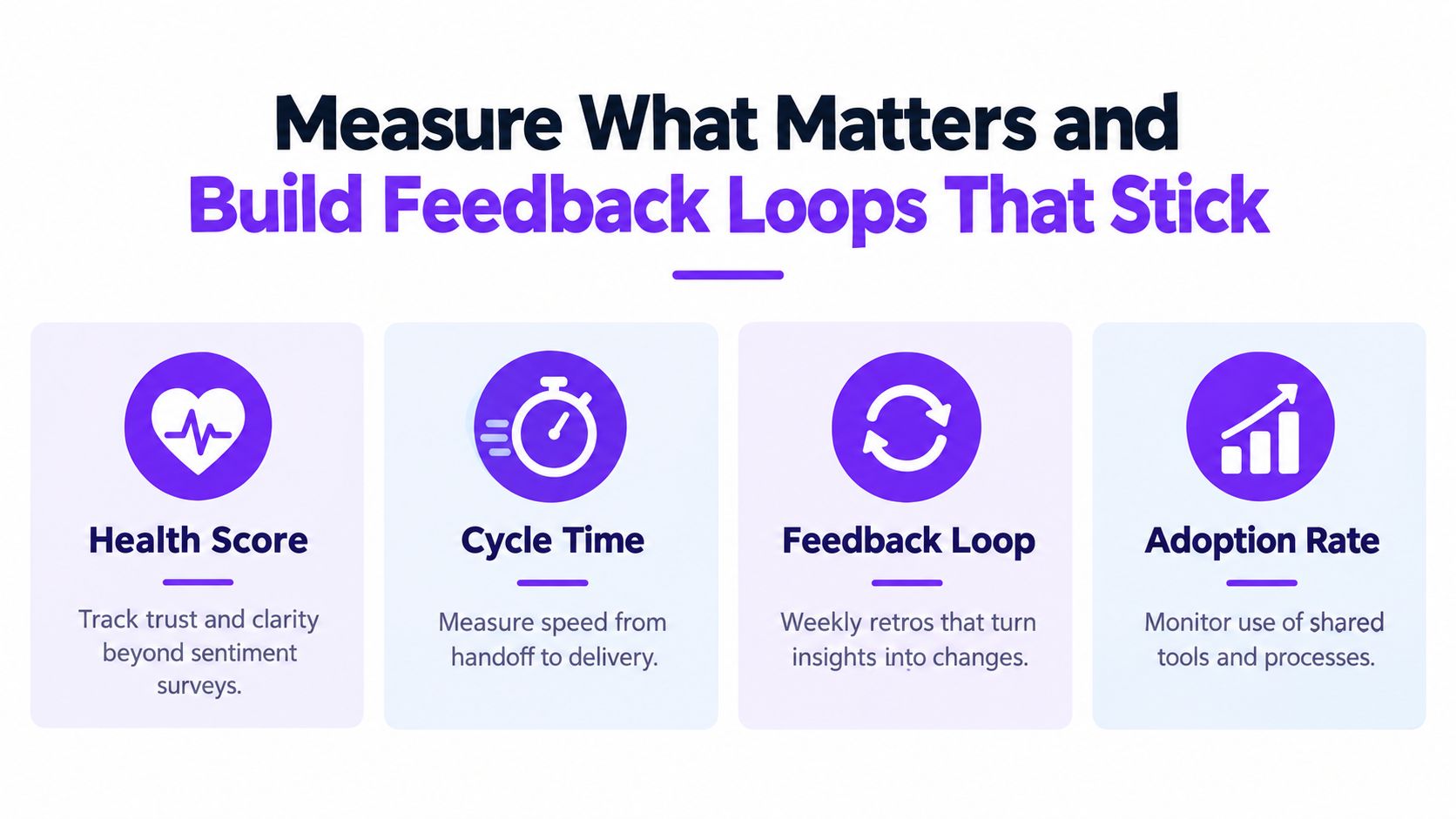
Build a small dashboard
Keep the dashboard close to the workflow. A practical version can include:
- Handoff cycle: How long work waits between teams.
- Decision latency: How long important decisions remain open.
- Rework signal: Which issues repeatedly return to an earlier team.
- Meeting yield: Which recurring meetings produce decisions or remove blockers.
- Shared tracking adoption: Whether teams record dependencies and progress in the agreed workspace.
- Outcome quality: Whether the deliverable meets the shared brief and stakeholder expectations.
Recent cross-functional survey data indicates that executives view collaboration as increasingly important while silos remain a major barrier. The same survey research on cross-functional collaboration indicates that teams tracking work together are more likely to produce high-quality work and meet deadlines. Treat that as a reason to inspect shared work visibility, not as permission to measure activity for its own sake.
Run a short retrospective after meaningful delivery points. Ask what information arrived too late, which decision took too long, where the handoff changed the work, and which meeting could have been async. Choose one process change, assign an owner, and review whether it helped at the next checkpoint.
Use a staff feedback survey template to gather context from participants, but pair perception with workflow evidence. AI deserves the same treatment. If it generates useful individual drafts but the team still debates interpretation in circles, redesign the review and decision path rather than adding more AI features.
Measure the wait, the rework, and the decision path. Activity counts alone won't tell you whether collaboration is working.
Troubleshooting Common Pitfalls and Scaling Collaboration With Confidence
Most collaboration failures repeat in recognizable forms. The fix is usually smaller and more specific than the original problem.
Unclear ownership creates endless consultation. Put the decision in the charter, name one accountable owner, and define who gets consulted before the decision closes.
Meeting bloat appears when status, brainstorming, approval, and escalation share the same calendar slot. Separate those purposes. Move routine updates to an async record and reserve live time for decisions or synthesis.
Weak handoffs leave the receiving team to reconstruct the brief. Require every handoff to include context, decision history, constraints, acceptance criteria, and a named contact.
Loudest-voice bias causes the group to mistake confidence for evidence. Use silent ideation, anonymous collection where appropriate, round-robin input, and pre-agreed evaluation criteria.
AI output overload happens when the team generates faster than it can interpret. Limit the question, group similar ideas, and make a human owner responsible for selecting the next direction.
Scale the system, not the meeting load
Pilot the workflow on a project that crosses functions. Keep the first version lightweight, document where decisions slow down, and change one rule at a time. Once the team has a repeatable pattern, create reusable templates for the charter, handoff, decision log, meeting agenda, and retrospective.
Before extending the model to more teams, confirm:
- Outcome clarity: Every participating team can state the shared result.
- Decision ownership: Each major decision has one accountable owner.
- Staged workflow: Specialist work happens before structured synthesis.
- Channel discipline: Teams know what belongs live, async, or nowhere.
- Focus protection: People aren't invited to meetings without a decision-making role.
- Feedback cadence: The team reviews delivery evidence and changes the system.
- AI boundaries: AI supports collection and synthesis, while humans retain judgment.
Collaboration works when teams share responsibility for the outcome, not when they share every task and every meeting.
Apply the playbook to the next launch, pitch, or campaign. Write the shared outcome, map the decisions, split specialist exploration from synthesis, and inspect the first handoff before adding more process.
Bulby helps creative, marketing, and brand teams run structured brainstorming sessions, collect ideas through a shared link, support anonymous input, and turn group thinking into an AI-generated report with actionable next steps. Visit Bulby to use a clearer brainstorming workflow on your next cross-team project.