

Most advice about AI for marketing strategy still starts in the wrong place. It starts with prompts, copy generation, and content volume. That's useful, but it's not strategy.
Strategy is deciding what not to do, which audience deserves investment, which message can carry the brand without flattening it, and which signals are strong enough to trust. AI can speed parts of that work. It can't own the judgment. Agencies that treat AI like a faster junior copywriter usually get more output and more noise at the same time.
The shift that matters is operational. AI now sits inside mainstream marketing workflows, but value doesn't come from adoption alone. It comes from building a governed decision system around it, then proving that system changed business outcomes. That's the difference between a flashy demo and an agency workflow a client will keep paying for.
Table of Contents
- The Strategic Judgment Gap in AI Adoption
- Building an Execution-Ready AI Foundation
- The End-to-End Agency AI Workflow
- Mitigating Bias and Creative Homogenization
- Redefining Team Roles and Collaboration
- Measuring ROI and Proving Strategic Value
The Strategic Judgment Gap in AI Adoption
Agencies often talk about AI as if the main win is creative acceleration. That story is incomplete.
The harder problem is strategic judgment. In a 2026 B2B marketing report, only 44% of respondents were confident in AI for supporting strategic decisions, and the most-cited AI limitation was strategic thinking at 57%, followed by creativity at 44% and accuracy at 39% according to MMA Global's 2026 AI marketing report. That lines up with what many agency teams feel in practice. AI can produce options quickly, but it struggles to weigh tradeoffs in context.
Where AI helps and where it misleads
AI is strong when the task is pattern synthesis, first-draft exploration, summarizing inputs, or generating multiple angles from an existing brief. It gets weaker when the job requires:
- Brand judgment: Deciding whether a message sounds distinct or merely familiar.
- Market prioritization: Choosing where the client should concentrate budget when several options look plausible.
- Narrative tension: Knowing which customer pain point matters most now, not just which one appears most often in source material.
- Political reading: Understanding stakeholder risk, internal client dynamics, and category sensitivities.
That's why tactical planning and strategic planning need to stay separate in your process. If your team hasn't defined that line clearly, this breakdown on strategic versus tactical planning is worth revisiting before you automate anything.
AI often produces the most probable answer, not the most differentiated one.
False confidence is the real risk
The danger isn't that AI gives you nothing. The danger is that it gives you something polished enough to skip the hard conversation.
Agencies feel this most during pitch prep. A model can generate a convincing market narrative in minutes. But if nobody challenges the assumptions behind it, the team ends up presenting a clean deck built on weak framing. That's where campaigns start to look interchangeable.
A lot of lightweight workflow tools also reinforce that problem by emphasizing publishing speed over strategic scrutiny. A platform focused on one-click social video publishing can be useful when distribution is the bottleneck, but publishing faster doesn't solve positioning, segmentation, or message hierarchy. Those calls still need human ownership.
The real advantage has moved
The strongest agency teams aren't winning because they use AI more often. They're winning because they use it more selectively.
That means keeping humans in charge of:
| Decision area | AI role | Human role |
|---|---|---|
| Audience insight | Surface patterns | Judge relevance and risk |
| Messaging options | Expand possibilities | Select and sharpen the angle |
| Channel planning | Model scenarios | Make tradeoffs based on context |
| Creative development | Generate drafts | Protect distinctiveness |
When agencies get this right, AI becomes part of strategic throughput. When they get it wrong, it becomes a machine for average ideas.
Building an Execution-Ready AI Foundation
Most agencies don't have an adoption problem. They have an operating model problem.
AI use in marketing is widespread, but execution readiness is much weaker. A 2026 marketing data report found only 6% of marketers had fully embedded AI into workflows, 52% did not own their data strategy, and 40% said proving ROI across channels was their top challenge according to Supermetrics' 2026 marketing data report. In a separate 2026 research release, Alexander Group reported that 96% of marketing organizations use AI, while only 41% can demonstrate ROI, as noted in its 2026 AI adoption and ROI findings.
Start with ownership, not prompts
If your agency is feeding AI with scattered exports, partial CRM access, ad platform snapshots, and undocumented assumptions, you don't have a strategic system. You have isolated experiments.
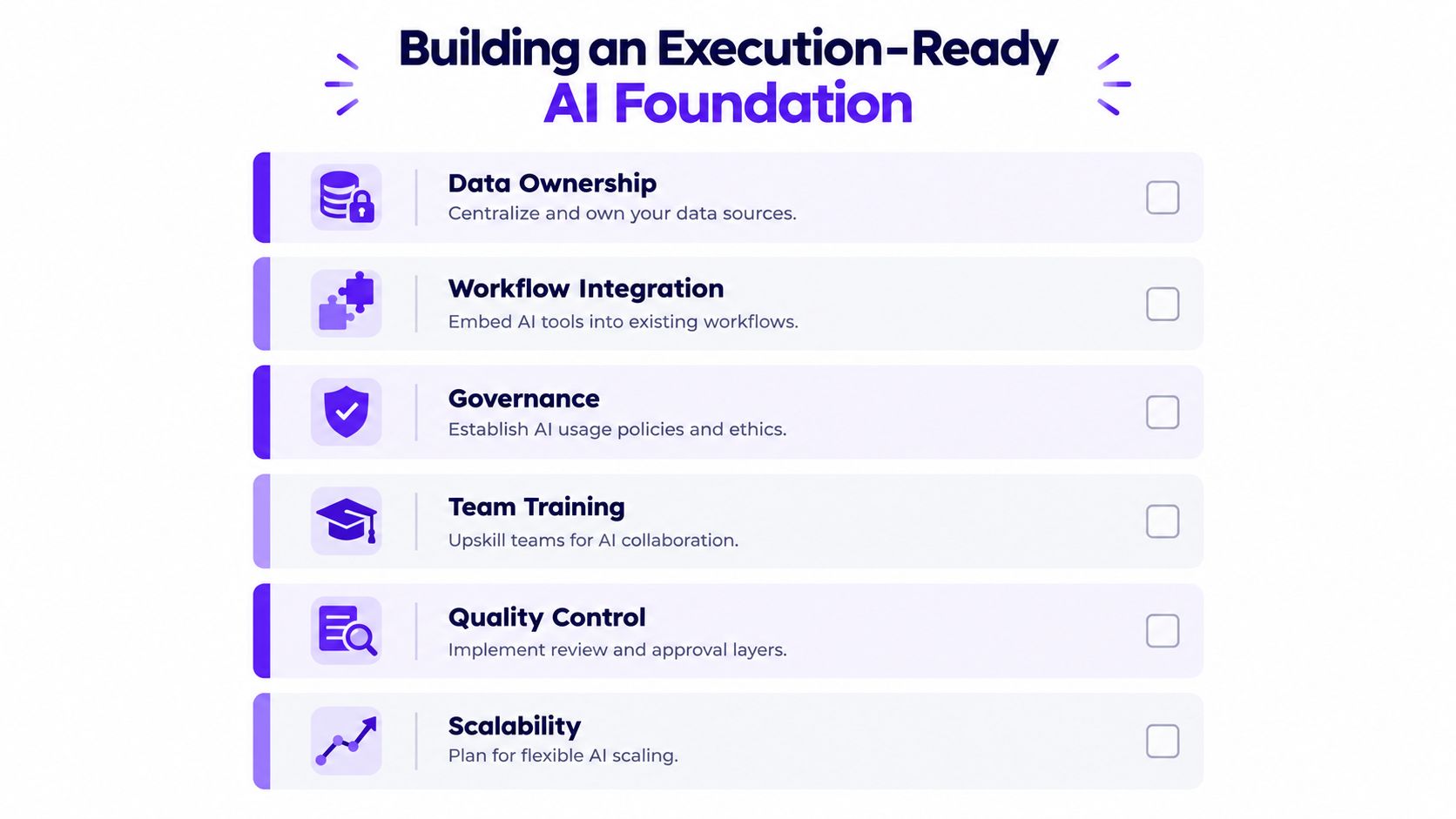
The first requirement is data ownership. That doesn't mean every agency needs a complex custom stack. It means the team needs clear access to the inputs that shape decisions, the definitions behind those inputs, and a documented view of which source is trusted for what.
For agencies building more mature processes, these examples of AI-driven marketing solutions are useful as a reference point, but the underlying principle matters more than the tooling. Connect AI to the workflow your team already runs.
Build governance into the workflow
A lot of AI failures come from asking good tools to operate inside bad process.
Use a basic governance layer:
- Define approved use cases: Separate research support, draft generation, analysis assistance, and automation. Each has different review requirements.
- Set review responsibility: Assign one owner for prompts, one for output review, and one for final approval when client-facing work is involved.
- Document baselines: Before AI touches a workflow, record the existing performance or process standard.
- Tie each use case to a KPI: Qualified lead rate, conversion rate, cost per acquisition, content production speed, or reporting turnaround all work if they map to real client outcomes.
- Create retention rules: Decide what data can enter a model or connected tool and what must stay out.
Practical rule: If an AI use case doesn't have a baseline, an owner, and a review step, it isn't ready for client delivery.
Use test-and-learn discipline
AI confidence has risen fast, but confidence alone doesn't protect the work. The same Alexander Group release notes that among marketers using AI, confidence in AI-generated outputs rose from 82% in November 2025 to 93% in May 2026, while extensive testing rose from 50% to 70% in the same period. That's the right direction, because stronger usage without stronger testing creates expensive ambiguity.
A simple agency protocol works:
- Pre-test snapshot: What does the current campaign, workflow, or channel performance look like now?
- Controlled change: Introduce one AI-assisted intervention at a time.
- Measurement window: Give it enough time to collect decision-worthy results.
- Holdout comparison: Compare against the prior baseline or a non-AI variant.
- Decision log: Record what changed, what improved, and what failed.
That's the foundation. Without it, AI produces activity. With it, AI supports strategy.
The End-to-End Agency AI Workflow
A useful agency workflow for AI isn't “prompt, generate, publish.” It's a chain of decisions where some steps benefit from automation and some need human pressure.
AI is now part of the competitive baseline in marketing. One 2026 industry report says 91% of marketers actively use AI in their work, up from 63% the year before, and another reports 87% use generative AI in at least one workflow, compared with 51% in 2024 according to UseCarly's roundup of AI marketing statistics. That level of adoption means clients increasingly assume agencies have AI inside the process. What they rarely see is a clean workflow for where it belongs.
Here's the version that tends to work.
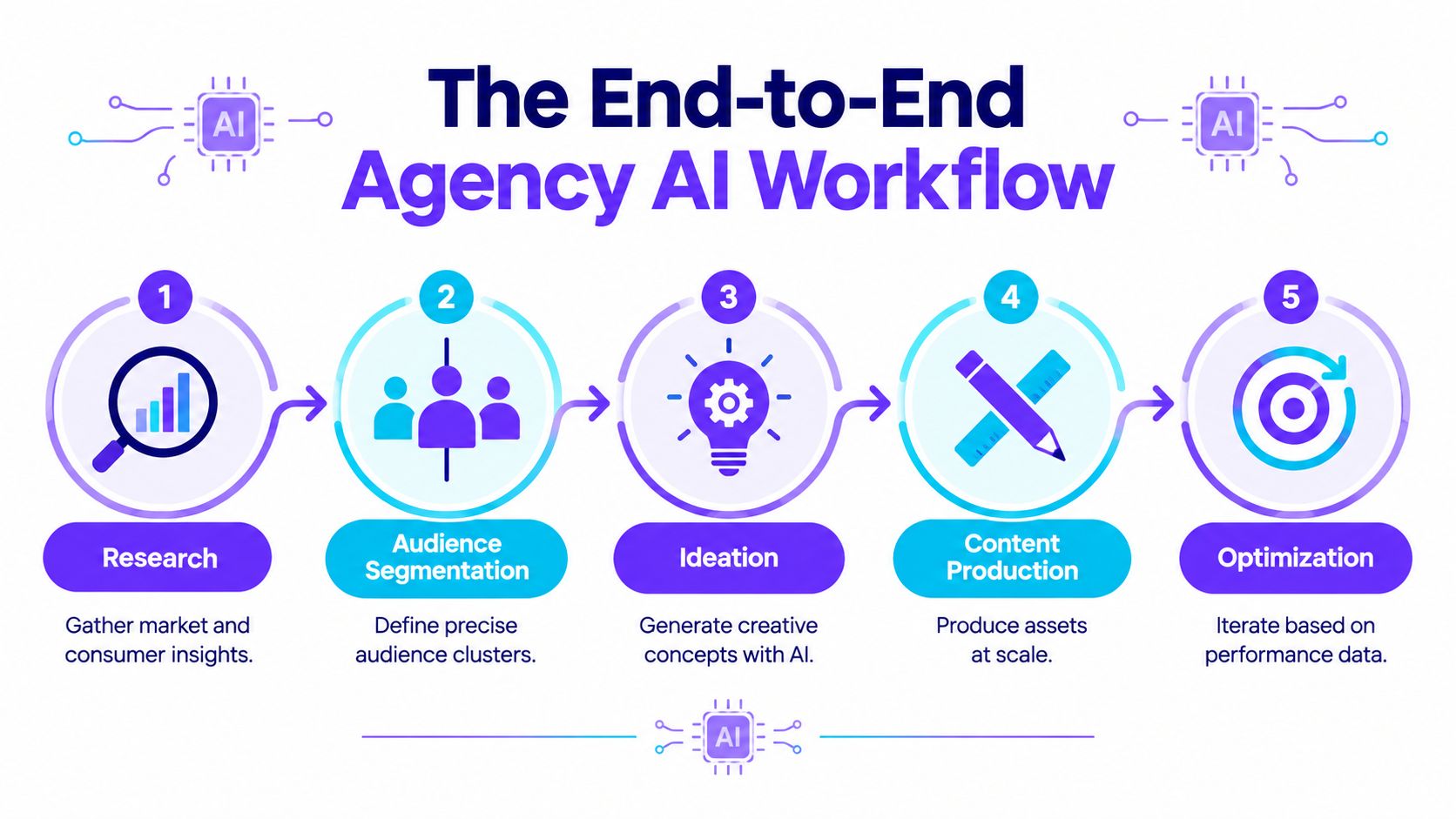
Step one through step three
The first half of the workflow should narrow options, not multiply noise.
Research intake
Feed the model structured inputs: category notes, client materials, sales call transcripts, landing pages, audience research, campaign history, and competitor messaging. Ask for synthesis, not conclusions.Good prompt:
Review these inputs and identify recurring customer tensions, objections, and purchase triggers. Separate observed patterns from inferred patterns. Do not recommend messaging yet.
Audience segmentation
Use AI to cluster language patterns, needs, and behavioral themes. Don't let it invent segments from thin evidence. The strategist decides whether the segments are commercially useful or just analytically tidy.Strategic framing
Humans take over. The team chooses the market lens, campaign objective, and message hierarchy. AI can pressure-test the brief by surfacing contradictions or unanswered questions, but it shouldn't decide the brief.
Step four through step six
Once the strategy is stable, AI becomes more useful again.
A practical explainer on AI content creation 2026 is helpful if your team wants examples of how content workflows are changing, but content generation should sit after strategic framing, not before it.
Before moving into execution, many teams also benefit from a guided brainstorming layer. One option is Bulby, which helps agency teams run structured brainstorming exercises and turn scattered inputs into campaign concepts, messaging angles, and summary outputs without relying on blank-page prompting.
After that:
- Ideation and concept expansion: Ask the model for contrasting routes, not more of the same route.
- Draft production: Generate variants for channels, formats, and audience versions.
- Review and refinement: Creative and strategy leads cut overlap, remove generic phrasing, and restore brand texture.
A better ideation prompt looks like this:
Generate three campaign territories based on this brief. Territory one should lean emotional, territory two should lean category-disruptive, territory three should lean proof-led. For each, include the strategic risk, likely audience appeal, and what would make the idea feel generic.
That last line matters. It forces the system to critique itself.
This walkthrough is worth watching if your team is mapping where AI fits inside execution:
Step seven through measurement
The back half of the workflow is where agencies usually lose the thread. They produce assets, launch campaigns, and stop documenting which part of the result came from AI support versus normal optimization.
Use a simple handoff structure:
| Workflow stage | Best AI use | Human checkpoint |
|---|---|---|
| Research | Summaries, clustering, pattern extraction | Validate source quality |
| Segmentation | Cohort drafting, language analysis | Approve business relevance |
| Messaging | Variant generation | Select position and tone |
| Production | Adaptation across formats | Review quality and compliance |
| Optimization | Performance synthesis | Decide next test |
For personalization and automation, the upside can be meaningful when the process is disciplined. A 2025 Duke CMO Survey summary reported that AI and machine learning powered 17.2% of marketing activities, with leaders projecting 44.2% within three years, while generative AI accounted for 15.1% of marketing activities, up from 7.0% in Spring 2024. The same set of benchmark reporting also notes that AI-driven personalization has been associated with 22% improved conversion rates in one study, while broader evidence reports 27% higher engagement and 19% lower churn probability for personalized cohorts in ToolixLab's 2026 AI marketing statistics summary.
Those gains don't come from turning everything over to AI. They come from using AI in the right step, then forcing proof at the end.
Mitigating Bias and Creative Homogenization
The fastest way to make AI-generated marketing worse is to ask for ideas before you've defined the boundaries of originality.
Most models are trained to return plausible patterns. In agency work, plausible is often the problem. You get language that sounds polished, references that feel familiar, and concepts that resemble what the category has already rewarded. The result is competent sameness.
Why homogenization happens
Three things usually drive it:
- Biased source material: If your inputs overrepresent one customer type, one geography, or one internal stakeholder view, the output narrows around that bias.
- Prompt conformity: Teams reuse the same prompt structures, so they keep getting the same shape of answer.
- Weak review culture: People accept fluent output as strategic output.
This matters most in segmentation and creative development. Overfitting is a real risk. The benchmark guidance behind personalization and AI targeting warns teams to validate segment lift with controlled tests, monitor sample-size sufficiency, and avoid scaling model-driven audience rules until they outperform the current baseline in a holdout group, as discussed in the earlier ToolixLab benchmark summary.
Practical ways to widen the thinking
Use structured divergence before convergence.
A few reliable tactics:
Run contrast prompts
Ask for one mainstream angle, one unconventional angle, and one angle the model expects a risk-averse client to reject. Then compare the assumptions behind each.Split source sets
Don't feed every source at once. Run separate passes using customer language, sales language, competitor language, and brand language. Look at where they clash.Require counter-positioning
For every recommendation, ask the model to produce the strongest argument against it.Bring more voices into ideation
Creative bias shrinks when strategists, account leads, and channel specialists react to the same stimulus from different angles. That's one reason team-based ideation still beats isolated prompting.
If your team wants a useful lens on how hidden assumptions distort creative work, this piece on unconscious bias in creative ideas and inequality in innovation is relevant to the review process, not just the brainstorm.
Distinctive campaigns rarely come from the first answer. They come from challenging the answer that arrived too easily.
Clean outputs still need scrutiny
There's also a smaller but practical issue. AI-generated copy sometimes carries hidden formatting artifacts that create publishing or editing headaches when text moves between tools. If your production team keeps running into odd characters in drafts, a utility like remove hidden characters from AI text can help clean the output before it enters design, CMS, or ad platform workflows.
That kind of cleanup doesn't improve strategy. It just removes friction. The strategic work is still deciding whether the idea is fresh, true to the brand, and worth scaling.
Redefining Team Roles and Collaboration
AI changes agency roles less by replacing tasks and more by redistributing attention.
When teams first add AI to the workflow, they often assume strategists will become more analytical, creatives will become prompt operators, and account managers will coordinate faster delivery. That's too narrow. The bigger shift is that everyone spends less time assembling inputs and more time evaluating direction.
What each role should own
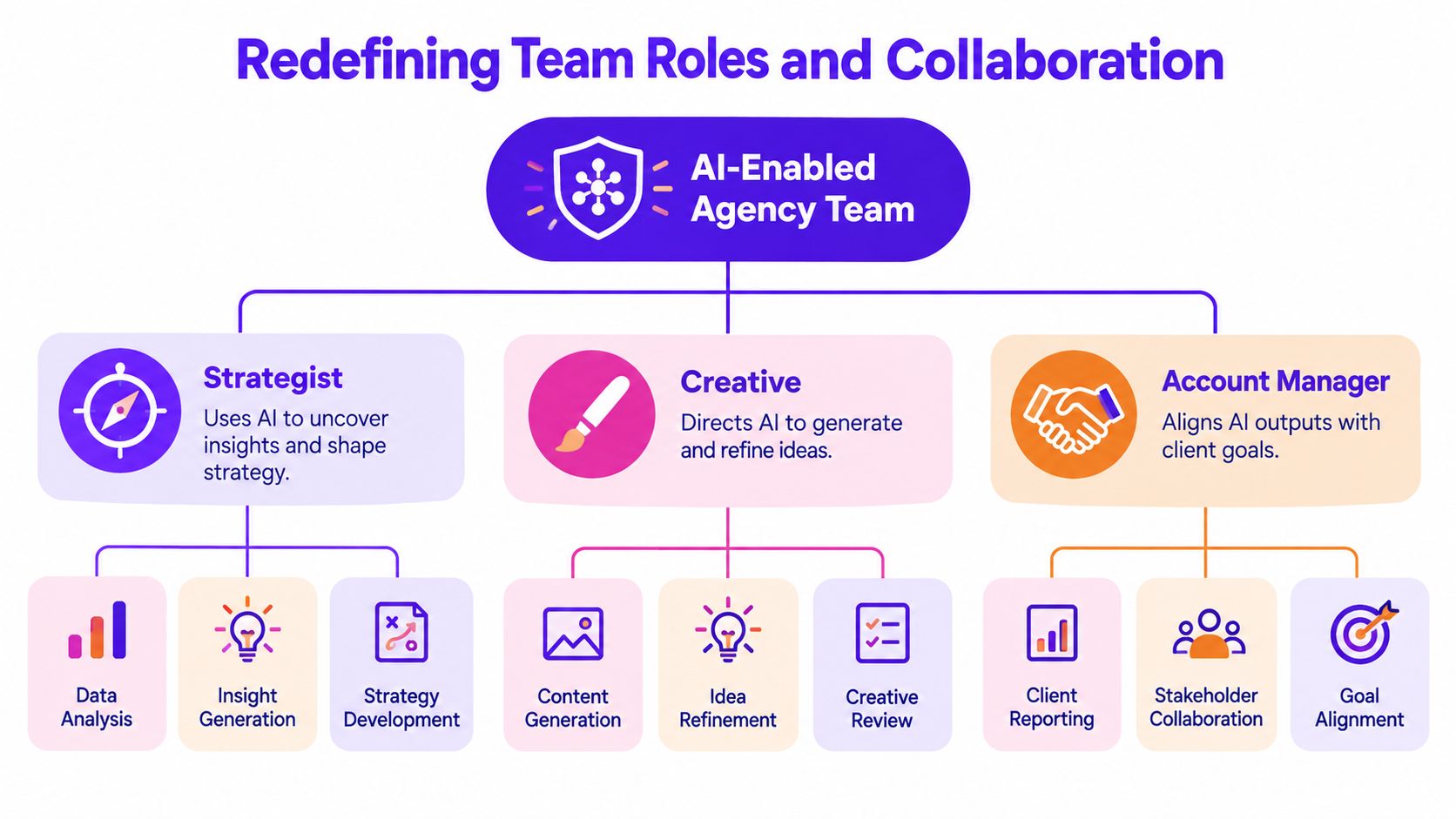
The cleanest model looks like this:
| Role | Primary responsibility in an AI workflow |
|---|---|
| Strategist | Frame the question, judge tradeoffs, define success |
| Creative | Direct concepts, protect distinctiveness, refine expression |
| Account manager | Translate client goals, control scope, align approvals |
This sounds obvious, but agencies often blur those boundaries once AI enters the room. A strategist starts polishing copy because the tool made it easy. A creative starts shaping audience logic without enough context. An account lead pushes generated output forward because it looks presentation-ready.
That's when collaboration gets messy.
Better sessions produce better outputs
The strongest collaborative sessions are structured around decision points, not around tool access. The team should know:
- what question AI is being asked,
- which source materials are in scope,
- who is validating the output,
- and what will happen if the output conflicts with prior assumptions.
A lot of agencies also need a stronger collaboration rhythm between departments. This article on collaboration for innovation is useful because it reinforces a point that applies directly here. Better ideas don't come from more voices alone. They come from voices organized around a shared decision.
Working rule: Let AI synthesize the pile. Let people decide the direction.
What clients still need from humans
Clients don't hire agencies to run prompts. They hire agencies to reduce uncertainty.
That means account managers need to get better at explaining why the team used AI in one part of the process and not another. Strategists need to defend the framing decisions behind the recommendation. Creatives need to show where AI accelerated exploration without flattening the brand.
A practical team model often looks like this in meetings:
- Before the session: Strategy prepares inputs and defines the decision to be made.
- During the session: AI helps synthesize ideas, cluster themes, and pressure-test routes.
- After the session: Humans resolve disagreement, choose the route, and prepare the client narrative.
The role shift is healthy when it frees talented people from admin and repetitive synthesis. It's unhealthy when it strips ownership from the people clients trust to make judgment calls.
Measuring ROI and Proving Strategic Value
AI usage is easy to demonstrate. Strategic value is harder.
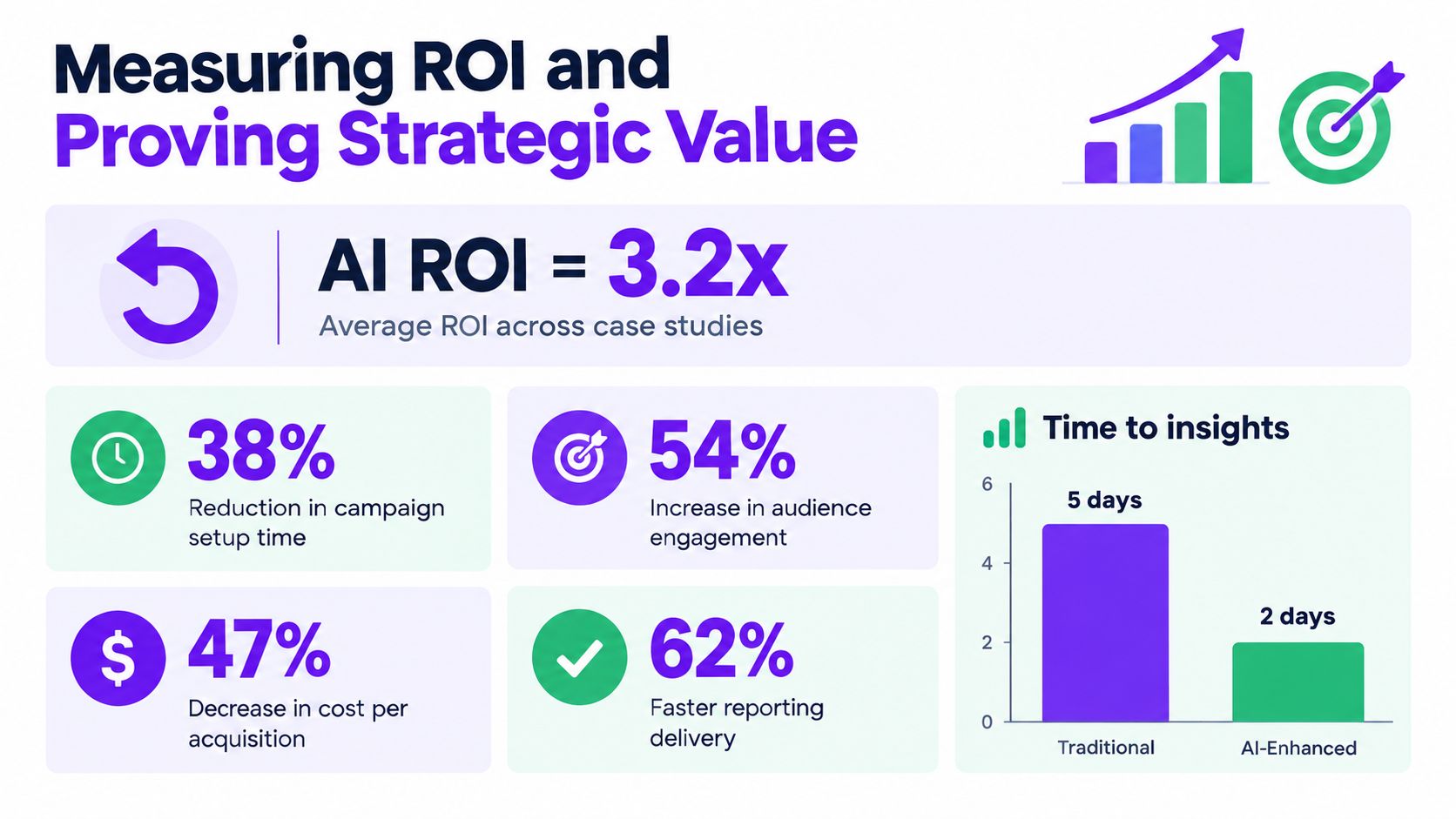
That's the gap most agencies still haven't solved. One major benchmark says 75% of marketing organizations now use at least one form of AI, while CMOs allocate 15.3% of marketing budgets to AI initiatives. The same research also reports that 73.9% of companies use AI in marketing for content creation, up from 49.2% in fall 2023, and attributes an average 14.1% improvement in sales productivity to AI in these 2026 AI marketing benchmarks. Those numbers show AI is now a core operating layer. They do not prove your agency's implementation worked.
Measure by use case, not by tool
Don't ask whether “AI worked.” Ask whether a specific AI-assisted use case improved a specific part of the workflow or campaign.
Useful KPI pairings include:
- Audience segmentation: qualified lead rate or conversion quality
- Creative versioning: production turnaround and approval efficiency
- Personalized messaging: conversion rate or engagement by cohort
- Reporting support: decision speed and insight clarity
- Media optimization support: cost per acquisition or downstream lead quality
If your attribution model is fuzzy, fix that before making bold claims about AI impact. This overview of what attribution modeling is is a good checkpoint for teams that are still mixing channel contribution with workflow contribution.
A practical client reporting model
Client reporting gets easier when you separate operational gains from commercial gains.
Use two layers:
Workflow impact
Show what changed in process. Faster draft cycles, cleaner synthesis, more testable variants, better reporting cadence.Performance impact
Show whether those changes moved a KPI that matters to the client.
This prevents a common mistake. Agencies often present improved speed as if speed alone were the value. Sometimes that's valid. Often it isn't. Clients care about speed when it creates better decisions, faster learning, or stronger performance.
Design experiments that can survive scrutiny
A simple ROI framework is enough if the discipline is strong.
| Question | What to document |
|---|---|
| What changed? | The exact AI-supported intervention |
| Compared to what? | Prior baseline, control, or non-AI variant |
| Over what period? | A defined measurement window |
| Measured by which KPI? | One primary metric and limited secondary metrics |
| What did we learn? | Keep, revise, or stop |
The teams that prove value consistently usually do three things well:
- They limit variable overload: one major change per test.
- They preserve a control condition: even a simple comparison is better than none.
- They keep a decision log: not just metrics, but what those metrics justified.
That matters because broad adoption doesn't equal broad value. AI in marketing is close to universal in many organizations, but proof remains uneven. Agencies that can connect AI-assisted work to strategic outcomes will stand out quickly because so many others still stop at usage metrics.
A final note. ROI reporting should never be a post-campaign scramble. Build the measurement method into the brief, the workflow, and the approval process. Then AI becomes part of a system the client can trust, not just a technique the team happens to use.
Bulby helps agency teams run structured brainstorming sessions that turn raw inputs into campaign concepts, messaging routes, and actionable summaries without relying on loose prompting alone. If you want a more disciplined way to use AI for marketing strategy, especially in pitches, workshops, and collaborative planning, visit Bulby.