
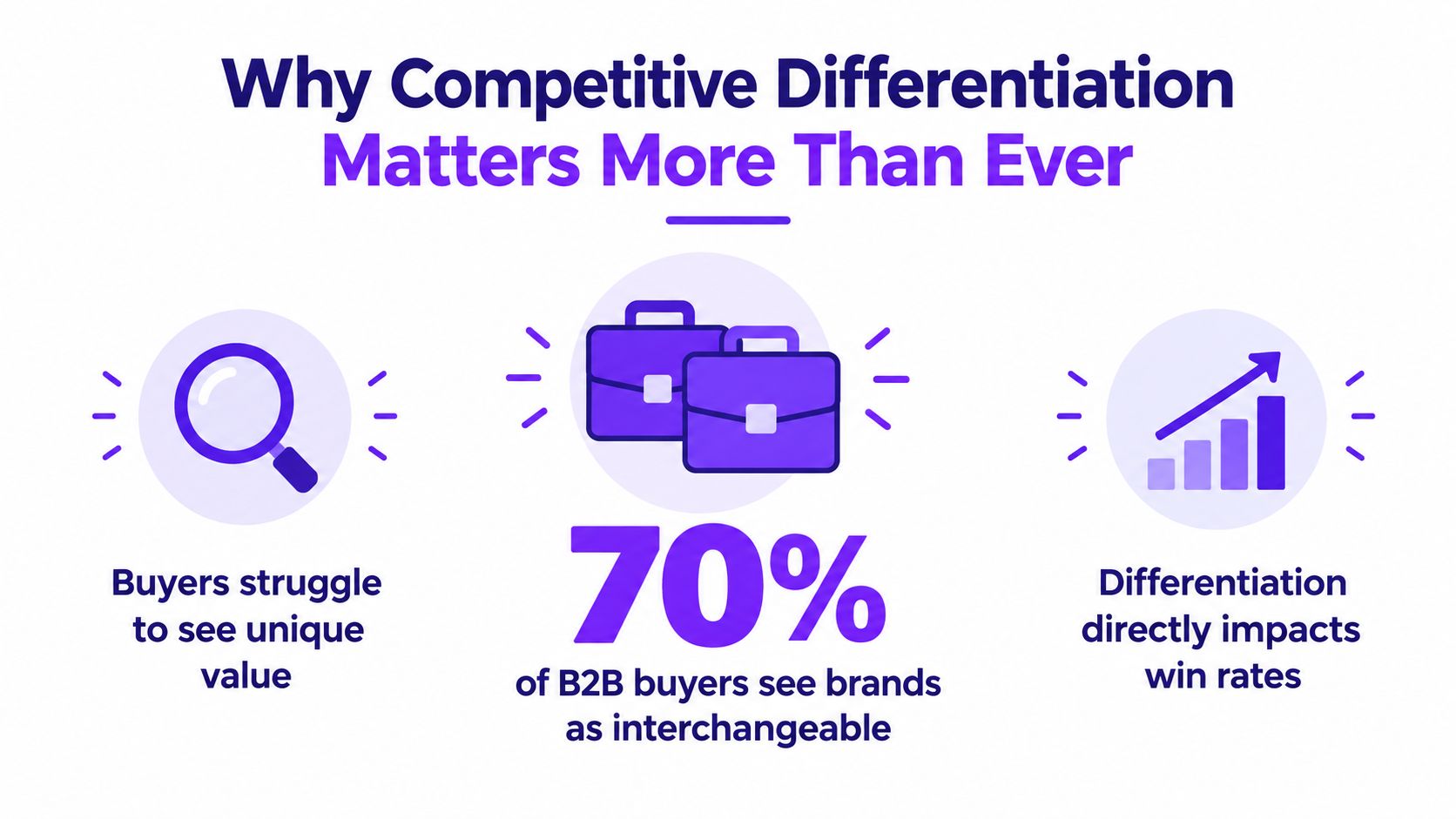
Seventy percent of B2B buyers reportedly can't meaningfully distinguish between the brands in their consideration set. That finding should change how agencies approach positioning. If your client sounds like every competitor, better media, more features, and lower prices rarely solve the underlying problem. Buyers can't assign a premium to a difference they can't recognize.
Competitive differentiation is therefore more than a memorable slogan or a new visual identity. It's a structural choice about where a company can become less substitutable, more relevant to a defined audience, and easier to choose. The strongest strategy connects what the business can deliver with what buyers value enough to notice, remember, and pay for.
Table of Contents
- Why Competitive Differentiation Matters More Than Ever
- What Competitive Differentiation Actually Means
- Feature-Based vs Positioning vs Experience Differentiation
- How Differentiation Protects Margins and Converts Attention
- A Repeatable Framework for Discovering and Crafting Differentiators
- Agency Case Examples of Differentiation in Action
- Running a Competitive Differentiation Workshop with Bulby
- Conclusion Treating Differentiation as a Discipline
Why Competitive Differentiation Matters More Than Ever
For agencies, the reported 70% confusion rate among B2B buyers becomes a commercial problem: longer sales cycles, more procurement objections, and earlier discount requests. A client may deliver better work, yet buyers cannot defend a premium if every competitor makes the same promises. Positioning has to give sales teams a claim they can prove, not another polished phrase for the website.
Research summaries associate consistent, differentiated brand presentation with average revenue increases of 10% to 20%. The same summary also identifies value for the price among the leading decision factors across nearly every category surveyed by Morning Consult. The practical implication is straightforward. A vague position forces buyers to evaluate cost before they understand the value.
The cost of sounding interchangeable
Sameness creates pressure across the buying journey:
- Pricing: Similar offers become substitutes, giving procurement a reason to use one vendor against another.
- Sales: Account teams spend meetings explaining capabilities instead of proving why the client's situation calls for their approach.
- Creative: Campaigns repeat category language. Approval may come faster, but recall and preference stay weak.
- Growth: The brand must keep paying for attention because it has not earned a distinct place in memory.
There is also a gap between delivering a strong experience and making that experience legible in the market. One industry summary reports that 81% of customers are willing to pay more for a superior experience. If prospects cannot identify what makes that experience different before or during the sales process, the operational advantage remains commercially underused.
Practical rule: Remove your logo from a pitch slide. If the claim still describes five competitors, it is not a differentiator.
A competitor grid is a useful starting document, but feature inventories rarely produce a defensible position. Ask where the client creates a different outcome, workflow, or relationship, then test whether buyers can recognize and value that difference. A broader set of innovative marketing strategies can provide executional options, but channels and tactics come after the claim. The agency's job is to identify a difference the business can deliver, prove, and repeat across every customer touchpoint.
What Competitive Differentiation Actually Means
Competitive differentiation is the deliberate choice to become meaningfully distinct on attributes buyers value, then deliver and communicate that distinction consistently. Unusual colors, phrases, or campaign devices create attention, but they do not create preference unless they signal a difference buyers recognize and want.
Porter's generic strategy framework places differentiation alongside cost leadership as a fundamental route to competitive advantage. A differentiation strategy seeks uniqueness on attributes valued by buyers and can support a premium when customers recognize the value. The University of Cambridge's overview of Porter's generic competitive strategies provides the strategic foundation. The trade-off is clear: a differentiated position demands evidence and operational follow-through, while a low-cost position depends on efficiency that competitors may also pursue.
The concept has an older brand-management lineage. In 1931, the American Marketing Association defined a brand as something that identifies goods or services and distinguishes them from competitors. The practical test remains the same: distinction matters only when it helps buyers identify one offer against another.
A working test for client conversations
Use four questions to separate a defensible differentiator from decorative language:
- Does it matter? The difference must solve a problem, satisfy a priority, or improve an outcome buyers care about.
- Can the business deliver it? Positioning that operations cannot support becomes a credibility liability.
- Is it difficult to substitute? A rival should not be able to match the claim by copying its wording or adding a similar feature.
- Can buyers perceive it? An invisible advantage cannot influence consideration or willingness to pay.
Only 5% of brands are considered unique by consumers, according to the cited Brand Aperture data. That scarcity explains why differentiation has commercial value and why positioning projects often stall. Companies may invest in identity systems, messaging workshops, and launch campaigns, yet stop before selecting a difference that changes buyer preference.
For practical brand work, brand strategy and management guidance should lead to a choice, not a catalogue. A positioning statement that lists every strength protects nobody. A sharper statement names the audience, the meaningful problem, the distinctive way the company solves it, and the proof that makes the claim believable. That claim-level discipline gives agency teams a stronger basis for scrutiny, testing, and workshop decisions.
Feature-Based vs Positioning vs Experience Differentiation
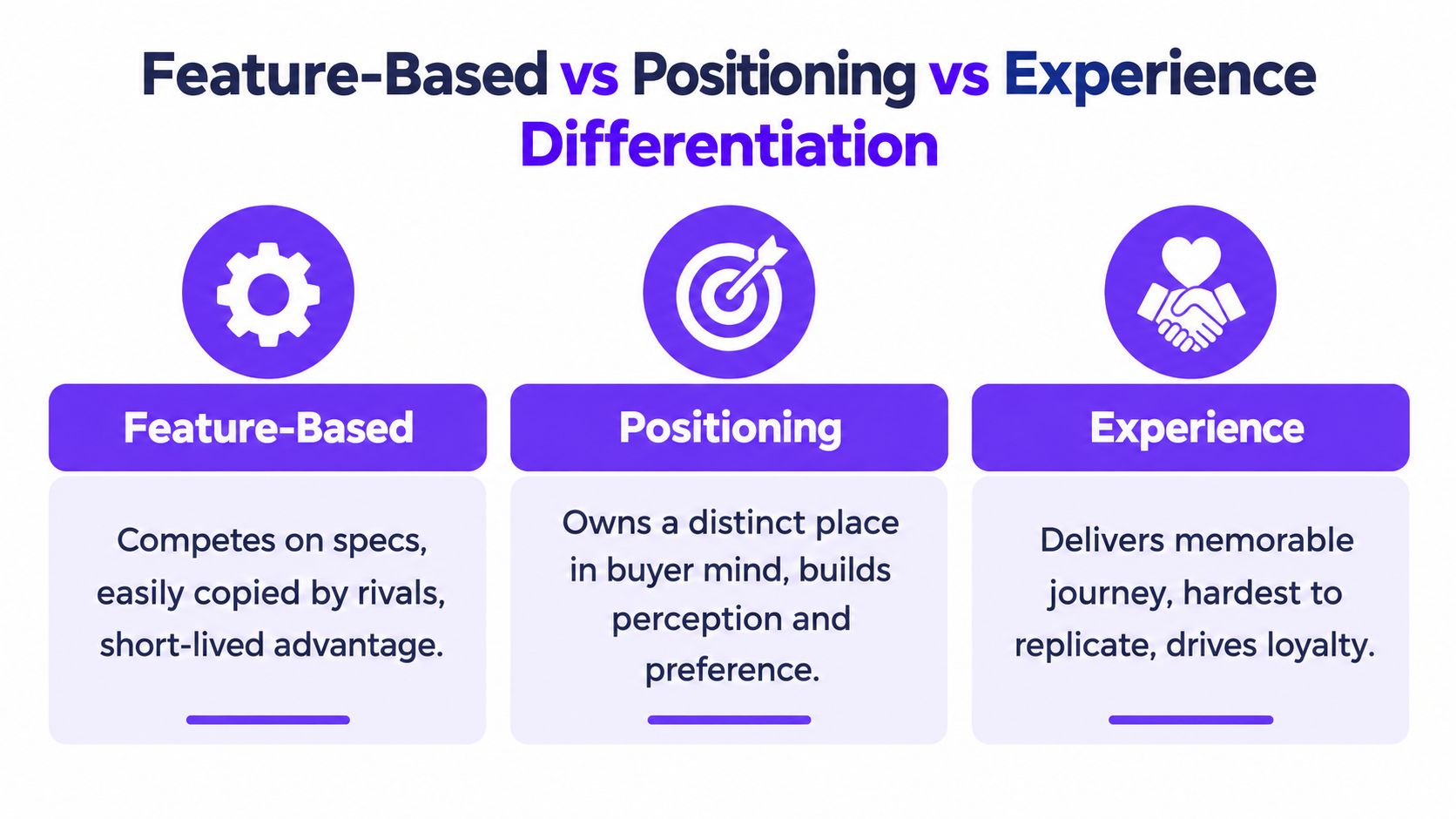
Feature-based differentiation is the easiest path to explain and the easiest path for rivals to copy. A product team adds another integration, dashboard, service tier, or automation, then marketing turns the addition into a headline. The feature may matter, but it becomes weak competitive differentiation when buyers see it as a standard expectation or when competitors can reproduce it quickly.
Three routes, three levels of durability
| Route | What buyers notice | Main weakness | Strategic test |
|---|---|---|---|
| Feature-based | Specs, functions, and product components | Rivals can copy or neutralize the difference | Does the feature change the buying decision? |
| Positioning-based | A distinct category role or point of view | Perception collapses if delivery contradicts it | Can buyers describe why this brand is for them? |
| Experience-based | The quality and ease of the customer journey | It demands operational consistency | Does the journey remove friction or improve an outcome? |
Positioning works at the level of meaning. A specialist can become the obvious choice for a particular use case, audience, or operating context without claiming to serve everyone. That focus may shrink the apparent market, but it can make the brand more relevant inside the segment that matters.
Experience differentiation works at the level of interaction. It can appear in onboarding, guidance, response quality, workflow design, handoffs, or how quickly customers reach value. The strongest experience claims aren't abstract promises such as “we care more.” They describe a customer-visible behavior that competitors struggle to reproduce consistently.
The durable difference is usually not the extra feature. It's the reason the feature, position, or experience changes what buyers can expect from the relationship.
Research on differentiated products offers an economic reason to prefer meaningful distinction over superficial additions. An empirical analysis of oligopolists found that competitor presence lowers prices, but the effect is smaller when the rival offers a different product type. In practical terms, differentiation reduces direct substitutability. That's why a specialized workflow or distinctive service model can protect margins more effectively than a longer feature list.
For teams evaluating their current claims, ask whether the difference is durable, relevant, and observable. If it fails all three tests, a focused brand-positioning strategy will need to do more than rearrange the existing copy.
How Differentiation Protects Margins and Converts Attention
The pricing mechanism is straightforward. When buyers see several offers as close substitutes, demand becomes more sensitive to price. When a brand solves a distinct problem or delivers a noticeably different experience, buyers have fewer direct comparisons. The company can defend its profit pool because the decision no longer rests entirely on a spreadsheet.

This doesn't mean every distinctive brand can charge any price. Buyers still assess value, trust, alternatives, and evidence. The useful agency question is whether the proposed difference changes the comparison set. A vendor positioned as another generalist competes with every generalist. A vendor built around a specific customer problem may be judged against fewer equivalent options.
From message difference to buyer action
Differentiation also affects the funnel. Recent evidence indicates that a brand-differentiating message can strengthen the path from awareness to liking, consideration, purchase intention, and purchase, although the research base still has limited work isolating message-level differentiation across real advertisements and funnel stages. The published analysis in the Journal of the Academy of Marketing Science makes the practical opportunity clear: teams should test the claim itself, not just the visual distinctiveness of the ad.
A campaign can look different and still leave the buyer with the same category impression. Claim-level differentiation asks a harder question: after seeing the message, can the audience explain what this brand does differently and why that difference matters?
Use this chain during creative review:
- Attention: Does the message interrupt category expectations?
- Meaning: Does it attach the interruption to a useful buyer benefit?
- Preference: Does the benefit create a reason to choose this brand?
- Proof: Can the company demonstrate the promise through product or experience?
A value proposition should make that chain easy to follow. This practical guide to writing a value proposition can support the wording stage, but agencies still need to challenge whether the underlying promise reduces substitutability.
A video can help teams see how positioning and message design connect in practice:
The strongest differentiators appear repeatedly across sales decks, landing pages, onboarding, service scripts, and campaign concepts. Consistency doesn't mean repeating one sentence everywhere. It means every customer-facing expression reinforces the same reason to believe.
A Repeatable Framework for Discovering and Crafting Differentiators
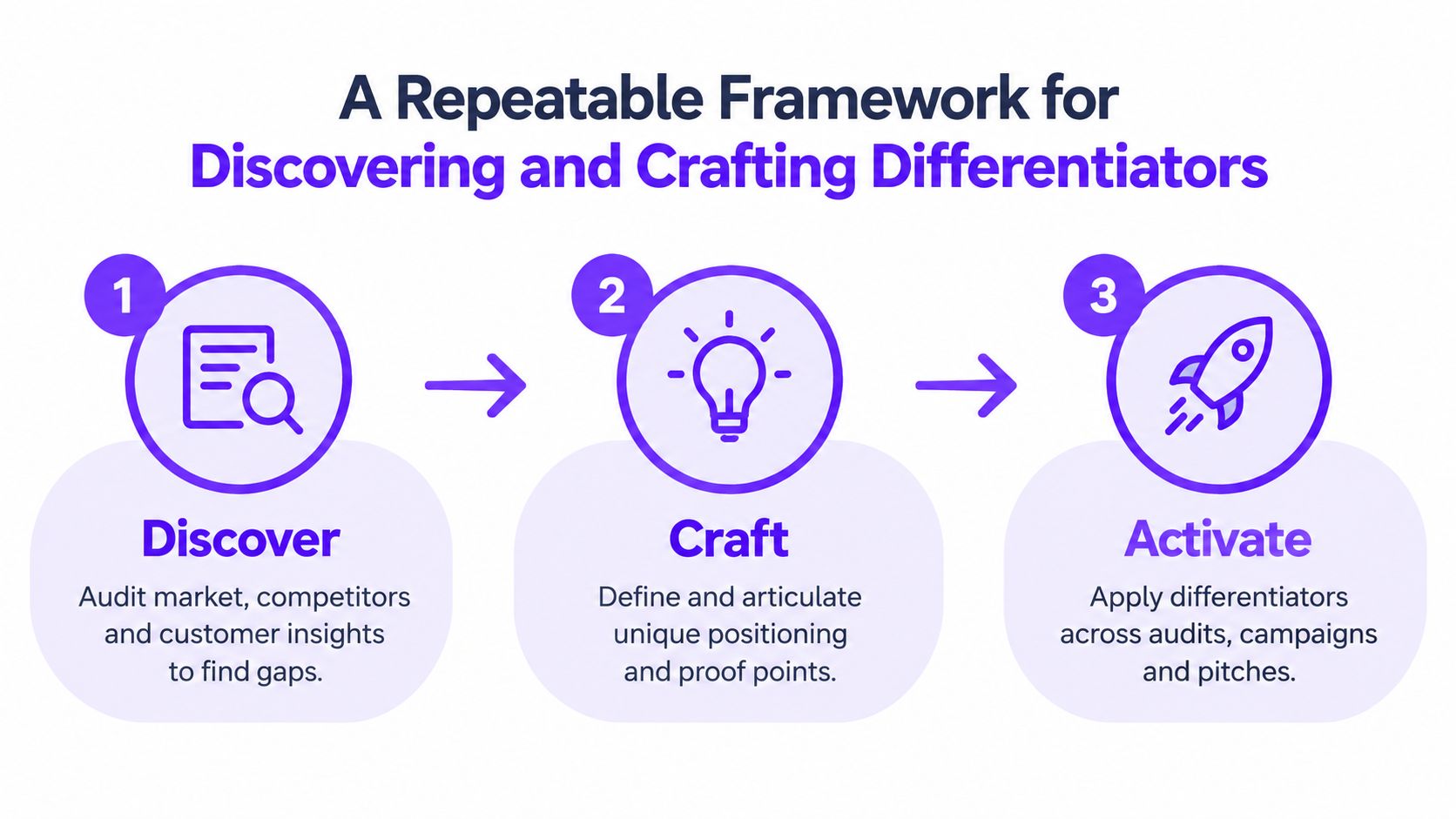
Teams rarely lack ideas. They lack a decision system that turns market evidence into a defensible position. A repeatable process moves through Discover, Craft, and Activate, with each phase answering a different question and producing material the next phase can test.
Discover the gap
Begin with evidence, not a blank brainstorming board. Review competitor pages, sales objections, customer interviews, support conversations, win and loss notes, onboarding friction, and the language customers use to describe the problem. This connects positioning theory with the buyer's actual decision criteria.
Map the market before selecting a position. SemDash's landscape mapping framework helps organize competitor promises, audiences, proof points, and whitespace without reducing the exercise to a feature checklist.
Ask:
- Where do competitors make the same promise?
- Which buyer group receives generic treatment?
- Where does the customer journey create repeated friction?
- Which internal capability does the client deliver unusually well?
- What do customers value but rarely see expressed in category messaging?
Separate observations from claims. “Customers complain about slow handoffs” is an observation. “We're the fastest partner” is a claim that requires evidence and a delivery model capable of supporting it.
Craft the choice
Cluster the raw material into possible territories, then reject any territory based only on tone or creative style. A viable territory connects a specific audience, a meaningful need, a distinctive approach, and proof that buyers can recognize.
The choice must fit the business model, which is where a defined creative strategy process helps teams align positioning with delivery. Research summarized in a formal strategic review links clear generic strategy, either differentiation or cost leadership, with stronger performance than an incoherent position. That supports a necessary client conversation: a business cannot credibly promise premium specialization while operating and selling like an undifferentiated volume provider.
Activate and test
Turn the selected territory into claim variations, then test recognition and preference. Ask buyers what they think the brand does, who it serves, and what makes it different. Compare those responses with the intended position, then revise wording that sounds distinctive internally but generic externally.
Track behavior rather than workshop applause. Useful signals include fewer switching concerns, stronger adoption in the chosen niche, greater willingness to pay, or lower churn. The measure depends on the offer. The principle remains consistent: a difference earns strategic status when customer behavior supports it. Teams can use this Discover, Craft, and Activate workflow in Bulby workshops to generate claim-level differentiators instead of generic value statements.
Agency Case Examples of Differentiation in Action
A claim earns its place in an agency pitch when the client can defend it with operating evidence. Consider a workflow platform serving operations teams. “Powerful automation for modern businesses” describes a category, so it gives competitors little to challenge. A stronger route is: “Cut approval time from four days to four hours without rebuilding the existing process, evidenced by handoff logs.” The claim identifies the buyer's problem, states the outcome, preserves a delivery constraint, and names proof the sales team can verify.
That level of specificity changes the work that follows. The landing page can show the approval path before and after. The demo can focus on handoff delays instead of touring every feature. Customer stories can document the time reduction, while the campaign brief defines which operations leaders should recognize themselves. The trade-off is narrower appeal, but the agency gives the client a defensible position rather than another capability statement.
Example one with experience as the product
A professional services firm may discover that prospects fear opaque handoffs more than technical complexity. The agency can build the position around visible progress, clear ownership, and updates that support decisions. Those elements should appear in the service itself, not only in the copy.
A campaign might show the path from intake to recommendation, identify who owns each stage, and display the format of a decision-ready update. Sales materials can use the same structure, giving prospects a preview of the engagement. The differentiator becomes a repeatable operating behavior that the firm can demonstrate in a pitch and deliver after the sale.
Example two with niche specialization
A generalist consultancy may have strong expertise but weak recall. Choosing a segment where its accumulated knowledge improves the fit can sharpen both the message and the proof. Campaigns should address the decisions that segment faces, use its language, and present relevant work. The cost is reduced broad-market relevance. The gain is a clearer reason for qualified prospects to choose the consultancy.
Experience-led positioning also creates an execution risk. Market commentary associated with Gartner says over 80% of organizations expect to compete mainly on customer experience, while Forrester's 2024 US Customer Experience Index found CX quality at an all-time low, with 39% of brands declining. The summary of those findings points to a practical problem: companies may promise better experiences without changing the workflows customers encounter.
The pitch should therefore name one interaction the client can improve, the behavior customers will notice, and the evidence that will prove the change. A specific service moment survives scrutiny better than “better CX.”
Running a Competitive Differentiation Workshop with Bulby
A differentiation workshop should produce fewer, stronger claims, not a long wall of adjectives. Run it with strategists, creatives, account leads, and people close to customers. Include separate input before discussion so the loudest voice doesn't define the answer.
Use a shared workspace such as Bulby, an AI-powered brainstorming platform that guides teams through structured exercises, supports anonymous submissions, and generates prompts or sparks to help turn scattered input into actionable ideas.
Start with raw signals
Give participants the same evidence pack: competitor messages, customer language, objections, product facts, service details, and known friction points. Ask each person to submit answers independently:
- What does this client do that competitors rarely explain?
- Which customer problem receives the least useful treatment?
- What would a buyer miss if the client disappeared?
- Which promise can the business prove through its actual workflow?
- Which category expectation should the client challenge?
Keep the first round expansive. Don't let the team edit claims while they're still collecting observations. Anonymous input is useful here because junior team members and account staff may notice customer realities that a senior strategist has learned to overlook.
Converge on meaningful differences
Group similar ideas, remove unsupported assertions, and name the underlying territory. “Personal service” may conceal faster escalation, senior access, proactive diagnosis, or clearer communication. Those are more useful directions because they describe behavior.
Score each territory against four criteria: buyer importance, delivery credibility, resistance to copying, and clarity in one sentence. A claim that sounds exciting but fails delivery credibility shouldn't survive just because it feels creative.
Stress-test the shortlist
Give every finalist to the team as a competitor challenge. Ask how a rival could copy the language, whether the buyer would notice the difference, and what operational evidence would prove it. Then write three executions for each claim, such as a landing-page headline, a sales argument, and a campaign concept.
The winning differentiator should survive all three formats. If it works only as a slogan, it's probably decoration. If it shapes decisions across strategy, creative, and account management, the team has found a usable platform.
Conclusion Treating Differentiation as a Discipline
Competitive differentiation becomes durable when the business, message, and experience reinforce the same choice. A feature can attract attention, but a coherent position gives that feature meaning. An unusual campaign can earn notice, but a consistent customer experience gives buyers a reason to remember and prefer the brand.
The strategic target is reduced substitutability. A brand earns more room on price when buyers see fewer equivalent alternatives. It converts more effectively when its claim is clear enough to move people from recognition to preference. It stays credible when operations can demonstrate the promise at every important interaction.
That work doesn't end when the positioning deck is approved. Agencies should revisit the competitive environment, listen to customer language, examine sales objections, and test whether buyers still recognize the intended difference. Teams managing external specialists can also use resources such as LatHire's flexible hiring perspective when they need additional capacity to support research, content, or activation without diluting the strategic core.
Treat differentiation as a working discipline, not a one-time naming exercise. Bring the framework into the next pitch, reject generic claims earlier, and require every proposed message to answer three questions: different from what, valuable to whom, and proven how?
Use Bulby to run a structured differentiation workshop with your strategists, creatives, and account team. Turn customer signals and competitor patterns into claim-level positioning your next pitch can defend, then carry the strongest ideas into campaigns, messaging, and brand strategy.