
Most creative strategy guides start with the same advice: get the team in a room and brainstorm. That advice sounds collaborative, but it often produces predictable ideas, uneven participation, and a long argument about personal taste. A stronger creative strategy process treats ideation as only one part of the work. The discipline is deciding what problem to solve, creating enough options before choosing, and giving every decision a visible standard.
Research on brainstorming has challenged free-form group ideation for decades. A review of 34 studies found that 24 showed nominal groups outperforming brainstorming groups on idea quantity, with an average effect size of 0.572 for the relationship between group type and ideas generated (review of brainstorming research). The practical lesson is simple: let people think independently before asking them to build together.
The process below is designed for agencies, product teams, and brand groups that need more than a wall of sticky notes. It creates structured divergence first, then structured convergence, with explicit checkpoints for human judgment and carefully limited use of AI.
Table of Contents
- Why Most Creative Strategy Sessions Underperform
- The Five Stages of a Strong Creative Strategy Process
- Workshop Prompts and a Sample Session Plan You Can Run Tomorrow
- Choosing the Right Format for Your Brief and Team
- Making Creative Decisions Less Subjective and Faster
- Common Traps and How to Fix Them Mid-Process
Why Most Creative Strategy Sessions Underperform
A great creative strategy doesn't start with a group brainstorm. It starts with a defined problem and enough private thinking that the room isn't forced to follow the first confident suggestion.
Alex Osborn's 1953 book Applied Imagination helped popularize brainstorming as a structured way to generate ideas. Since then, research has repeatedly questioned whether spontaneous group discussion is the strongest foundation for creative work. Traditional brainstorming groups can produce fewer nonoverlapping ideas per person than individuals whose ideas are pooled later, a pattern linked to production blocking, evaluation apprehension, and social loafing (foundational brainstorming review).

Four signals that the room is already drifting
The brief is vague. If attendees spend the first part of the meeting restating the challenge, the inputs aren't ready. A useful brief should identify the audience, the business problem, the desired shift, the relevant truth, and the constraints. Without those elements, the team generates responses to different questions.
The room converges too early. Someone offers a reasonable route, and discussion immediately improves that route instead of creating alternatives. The signal is easy to spot: the wall contains one developed concept and a handful of undeveloped fragments.
Senior voices set the direction. If two people do most of the talking, junior participants often edit themselves before sharing. This is closely related to groupthink in psychology, where agreement can become more important than examining alternatives.
Evaluation starts before ideation ends. Comments such as “that won't work” or “the client would never buy it” may be accurate later, but they damage divergence when introduced too soon. The facilitator should capture risks without allowing them to become a premature kill switch.
Facilitator rule: Separate the moment when the team creates options from the moment when the team judges them.
AI adds another complication. It can accelerate research, pattern-spotting, stimulus creation, and variation, but using it before humans have explored the problem can narrow the option space. A 2025 Nature Human Behaviour study found ChatGPT-assisted brainstorming produced narrower idea sets, with diversity dropping significantly in 37 of 45 statistical comparisons (summary of the Nature Human Behaviour study). AI belongs in the process, but not as the first voice in the room.
The operational fix is a sequence: solo framing, individual divergence, group expansion, concept development, explicit evaluation, and delivery. The five-stage model makes those moves repeatable instead of leaving quality to the personality of the facilitator.
The Five Stages of a Strong Creative Strategy Process
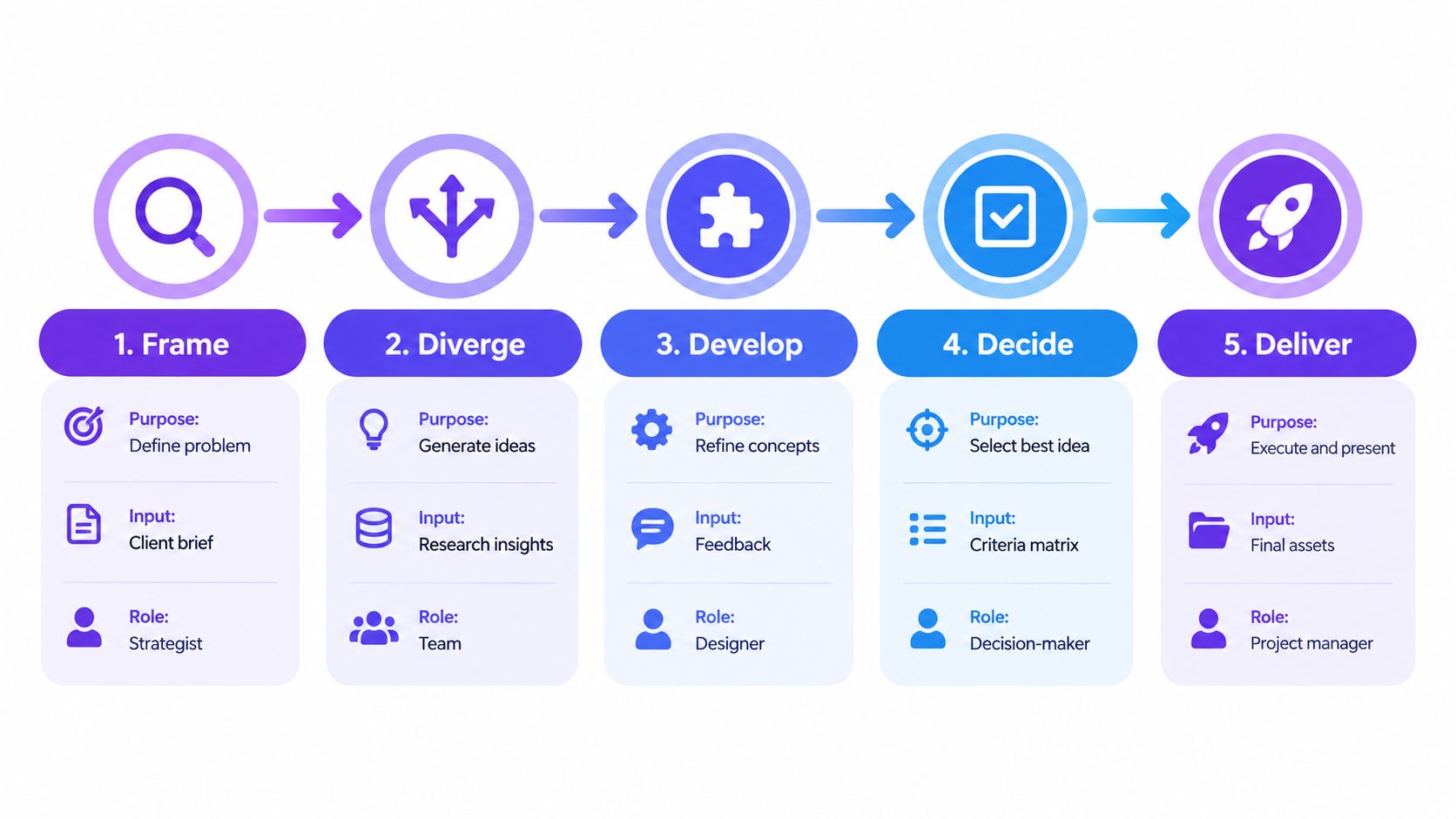
A reliable process uses five stages: Frame, Diverge, Develop, Decide, and Deliver. Each stage has a purpose, a responsible role, a time boundary, and an output that must exist before the next stage begins.
Frame
The strategist works alone first, reviews the client brief, studies relevant research, and identifies the tension that creative work must resolve. The output is a one-page creative brief containing the problem, audience, insight, desired response, strategic constraints, and decision criteria. Account leadership, strategy, and the eventual decision owner should review it before ideation starts.
Don't use the group meeting to discover what the assignment means. Use it to create and improve responses to a meaning everyone already shares.
Diverge
Begin with silent individual generation. Ask each participant to capture rough concepts without defending them, then bring the team together to expand and remix the pool. A useful working target is at least 30 raw concepts, not because every concept must be good, but because quantity creates room for unexpected combinations. Research has found strong relationships between idea quantity and high-quality ideas, including reported correlations of r = 0.82 and r = 0.69 in classic experiments (brainstorming research review).
The strategist facilitates, creatives and subject specialists contribute, and the decision owner observes without steering too early.
Develop
Select the strongest five to ten concepts for development. Turn each into a territory with a clear route, central hook, audience implication, channel possibilities, and executional notes. The designer or creative lead can test how the territory might look or sound, while strategy checks whether the idea still answers the original brief.
A concept isn't ready for approval because it has a clever line. It needs enough shape for stakeholders to understand its potential and its limitations.
Decide
Apply a weighted rubric, then use a binary go-or-kill vote. Record the decision owner, the chosen route, the trade-offs accepted, and a short dissent note that captures credible objections. No AI tool can replace the human judgment required here. The team must decide which risks are acceptable and which strategic requirements are essential.
Deliver
Package the chosen territory into a strategy document, manifesto, and presentation. Include the insight, strategic argument, creative expression, examples, constraints, and next actions. The project manager or account lead confirms ownership, dependencies, and review points.
No stage can be skipped. Teams that jump from raw ideas directly to presentation usually create confusion during approval because the reasoning and selection logic are missing. For teams working on emerging discovery environments, a resource on creative AI search advertising strategies can provide useful stimulus, but the team still needs to make its own strategic choices.
Workshop Prompts and a Sample Session Plan You Can Run Tomorrow
A facilitator needs more than a vague instruction to “think big.” Prompts should force a change in perspective, and they should appear in writing so participants aren't improvising different versions of the task.
Use this 90-minute plan:
Minutes 0 to 15, solo divergence. Give everyone the brief and ask them to work on their own. Use these prompts verbatim:
- “What is the enemy of the brand in this category?”
- “If we had to make a film no one could scroll past, what is the single image?”
- “What would our audience say about this problem when nobody from the brand is listening?”
- “What familiar category rule could we break without breaking trust?”
Minutes 15 to 40, pair expansion. Each pair selects promising fragments and remixes them through forced connections. Try prompts such as, “How would a museum, emergency service, streetwear brand, or late-night host solve this?” and “What changes if this idea has to work as a ritual rather than an advertisement?”
Minutes 40 to 60, clustering and naming. Put every concept where the group can see it. Cluster by underlying behavior, tension, or promise, not by surface wording. Name each territory with a memorable phrase that describes its strategic direction.
Minutes 60 to 90, structured critique. Review the territories through three questions: Is it true to the insight? Is it ownable? Is it executable within budget? Capture evidence and concerns separately from personal preference.
A printable worksheet can fit on one page:
- Brief: problem, audience, insight, desired response
- Raw idea: one concept per card
- Territory: name and one-line promise
- Evidence: why the audience might care
- Risk: what could weaken the route
- Next test: the smallest useful validation
Transition line: “We aren't choosing yet. We're making the option set strong enough to choose from.”
At the clustering stage, say, “Group these by the change they create, not by who suggested them.” Before critique, say, “Score the work against the brief, not against your personal taste.”
A sample output might look like this:
- The Category Escape: Make the brand the route out of a stale category habit.
- Proof in Public: Turn a private audience tension into visible, useful action.
- The Small Rebellion: Give people a low-effort way to reject the behavior frustrating them.
AI can generate variations only after the human raw set is captured. For a facilitator who wants a repeatable agenda and printable structure, this workshop agenda template can support the planning layer without replacing the work of framing or judgment.
Choosing the Right Format for Your Brief and Team
The right workshop format depends on the brief's scope, the number of people involved, and the cost of making the wrong decision. A tactical execution doesn't need the same machinery as a brand platform.
| Brief Type | Team Size | Recommended Format | Duration | AI Role |
|---|---|---|---|---|
| Tactical execution | Solo strategist or small pair | Solo dive followed by share-back | Short working block plus review | Stimulus, variations, feasibility checks |
| Campaign concept | Three to five core contributors | Structured group session with pre-work | Extended workshop | Pattern mining after human divergence |
| Brand platform | Ten or more cross-functional participants | Multi-stage facilitation with stakeholder checkpoints | Several staged sessions | Research support and synthesis, not final judgment |
For a small tactical brief, ask one strategist to produce an initial set, then use a focused share-back to challenge assumptions. A campaign concept benefits from independent preparation followed by a live session where the group expands and compares territories. A brand-level platform needs stakeholder alignment before ideation, senior review at defined gates, and a decision owner who can resolve competing priorities.
A live group begins to plateau once it grows beyond roughly six or seven members, and per-person output declines as group size increases (research summary on group size). That doesn't mean larger organizations can't contribute. It means the facilitator should split them into small working groups and bring their outputs together later.
Remote versus in-person
Remote sessions make silent writing, digital clustering, and asynchronous pre-work easier. They also make fatigue, multitasking, and uneven participation harder to detect.
In-person sessions help people read energy and build on physical artifacts. They can also give the loudest participant more influence unless the facilitator designs private writing and round-robin sharing.
Use this five-minute heuristic: if the brief needs a fast execution, work solo first; if it needs a shared platform, use a small facilitated team; if the stakeholders are numerous, add checkpoints instead of placing everyone in one brainstorm.
The creative brief template is useful for making the input consistent before selecting a format. AI tools can help mine patterns, create stimulus, and test feasibility. They shouldn't lead the first divergent round, because a shared prompt can push everyone toward similar answers.
Making Creative Decisions Less Subjective and Faster
The approval bottleneck usually isn't a shortage of ideas. It's unclear judgment. In a 2025 industry survey, only 10% of respondents said ideas are always assessed against clearly defined criteria, only 30% of agencies said clients provide clear and constructive feedback, and 77% of agencies said the brief isn't always used when ideas are judged (2025 industry survey on creative ideation).
That pattern creates familiar agency language: “I don't love it,” “It doesn't feel like us,” or “Can we see something safer?” Those reactions may contain useful information, but they aren't decision criteria.
Surface the standard before the debate
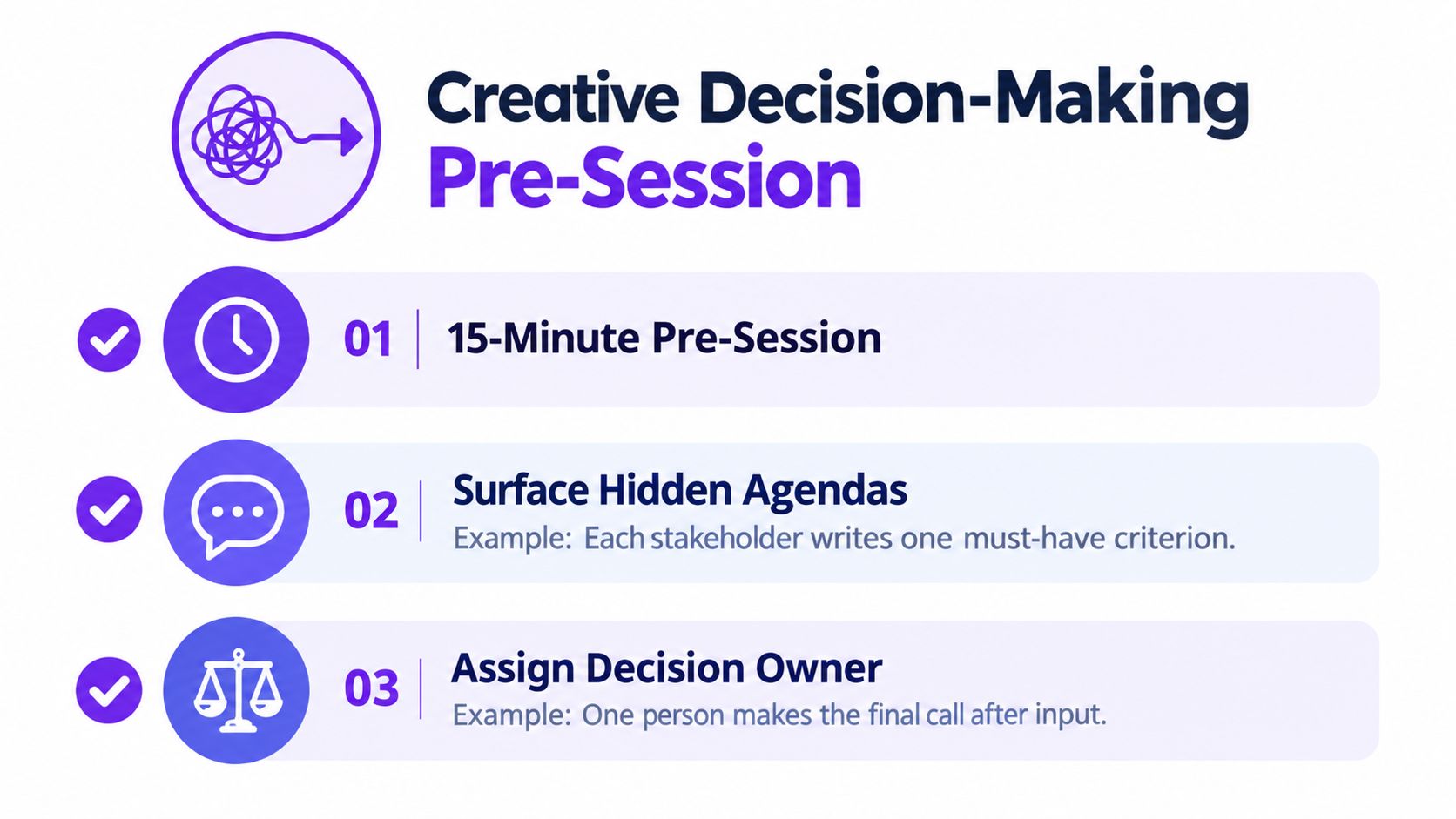
Run a short pre-session with the strategist, account lead, decision owner, and relevant stakeholders. Ask each person to write the one thing the idea must achieve, the risk they won't accept, and the evidence they would need to support approval. Compare the answers and turn them into a shared rubric.
Use five to seven criteria, each scored from 1 to 5:
- Strategic fit: Does the concept answer the stated problem?
- Audience truth: Does it reflect a credible audience tension?
- Distinctiveness: Can the brand claim the territory meaningfully?
- Executability: Can the team produce it within the constraints?
- Scalability: Can it extend across relevant channels or moments?
- Emotional pull: Does it create a response beyond comprehension?
- Risk: Are the legal, cultural, reputational, or operational risks manageable?
Anchor the scores. A low strategic-fit score means the concept solves a different problem. A high score means the connection is direct and evidenced. A low execution score means the route depends on resources or behavior the team can't reasonably secure.
Decision principle: Don't debate every score. Debate the scores where the reviewers disagree most.
Use two passes, then document the call
First, have reviewers score concepts independently and without discussion. Second, discuss only the largest differences. This prevents the first speaker from framing the entire evaluation and directs time toward genuine uncertainty.
Every shortlisted concept should pass the minimum threshold on essential criteria before the team discusses preference. Assign one decision owner and one named backup. The owner listens to the evidence, makes the call, and explains the trade-off.
Close with a decision log containing the chosen route, rationale, rejected alternatives, accepted compromises, open risks, and the next review date. Teams looking to compare practical approaches can use these decision-making frameworks as a reference, but the useful framework is the one people apply consistently.
Common Traps and How to Fix Them Mid-Process
Agency rooms rarely fail dramatically. They drift. A facilitator who recognizes the drift early can correct it without restarting the session.
The loudest voice takes the room
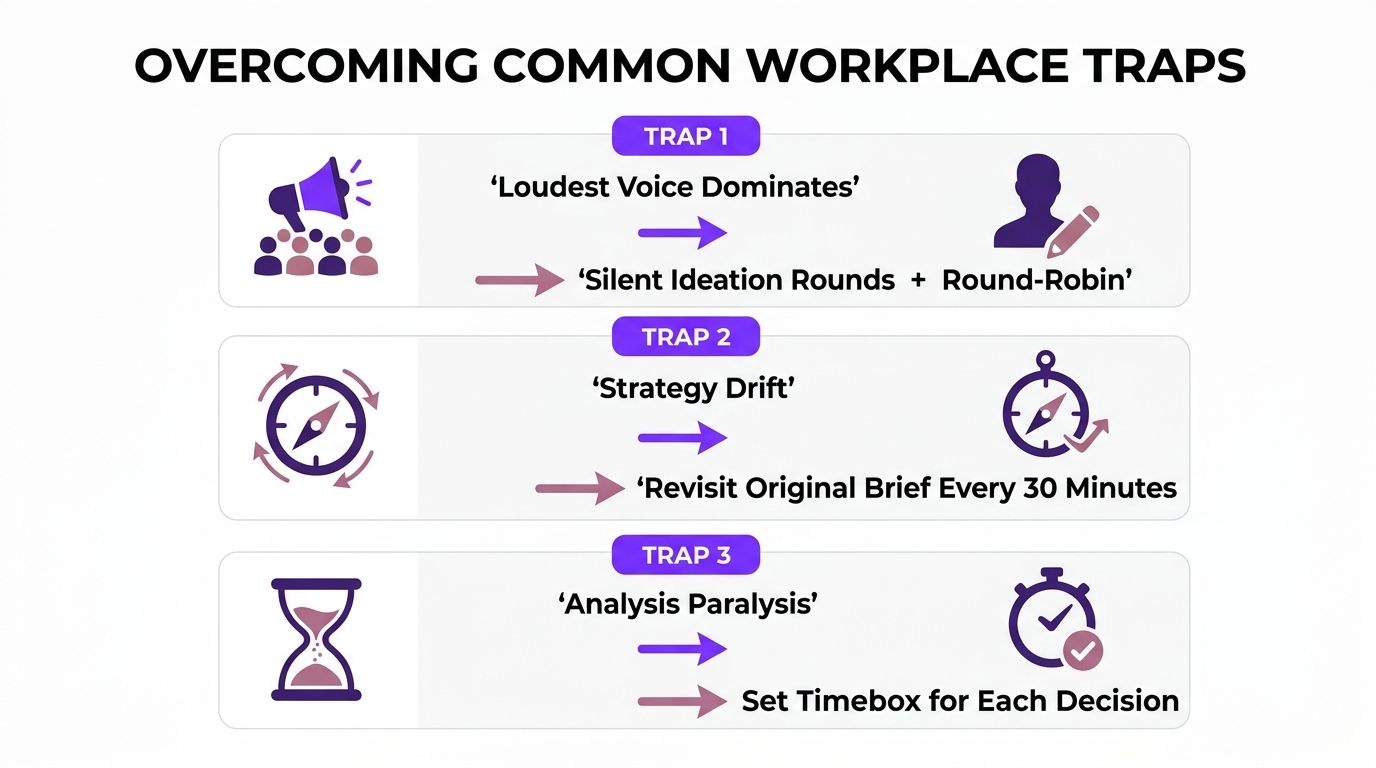
The signal is obvious: two or three people carry most of the conversation, while everyone else reacts with nods or silence. Pause the discussion, give participants a silent writing round, and ask each person to pitch one idea in turn. The facilitator should record every contribution before inviting responses.
Execution replaces strategy
A team starts debating headlines, formats, or production details before it has agreed on the territory. At the next checkpoint, reread the brief and ask each group to rewrite its concept against the strategic pillars. If the idea sounds like an isolated asset rather than a repeatable direction, send it back for development.
The first decent idea becomes the answer
The signal is affection without comparison. People are polishing one concept while the wall still contains too few alternatives. Set a rule that no concept receives extended discussion until at least eight rough options are visible. The quantity rule protects the room from confusing familiarity with strength.
A stakeholder ambush arrives at the final review
Late rejection usually means the decision criteria were never aligned. Schedule stakeholder check-ins during development, not just at presentation, and ask reviewers to respond against the agreed rubric. A decision log also makes it harder to reopen settled questions without naming what new information changed.
AI creates a swarm of similar concepts
When everyone uses the same tool with similar prompts, the outputs can look productive while repeating the same assumptions. The checkpoint signal is linguistic sameness, with identical structures, tones, and category references appearing across the board. Keep the first divergent phase human-led, then use AI as a stimulus layer for variations, counterarguments, or feasibility questions. A curated set of AI marketing tool recommendations can help teams compare tools, but tool choice won't fix a process that evaluates too early.
Facilitators should also watch for confirmation bias, authority bias, and availability bias. This guide to cognitive bias in decision-making can help teams name the pattern before it shapes the outcome.
Mid-process reset: “We have a direction, but we haven't earned a decision yet. Let's return to the brief, add alternatives, and make the trade-offs visible.”
Bulby gives marketing and creative teams a guided way to turn a defined challenge into exercises, collect contributions, summarize themes, and identify actionable next steps. Use Bulby after the human-first framing and divergence work to help organize the option set, then keep final evaluation and delivery with the people accountable for the strategy.