
A strategy lead is pinning Post-its to the wall on a Tuesday morning. A junior designer is staring at a blank notebook. Everyone in the room has ideas, but the conversation keeps circling the same three suggestions: launch a discount, redesign the landing page, or post more often.
That meeting looks like brainstorming, but it isn't working as brainstorming. The team is sharing familiar opinions without a clear process for producing, expanding, or sorting new possibilities. To understand what brainstorming is in design thinking, you need to see it as a structured move from a focused problem toward a wide range of possible responses.
Table of Contents
- Where Brainstorming Fits in Design Thinking
- The Design Thinking Stages Around Ideation
- Original Rules and Modern Principles
- Methods and Templates Worth Knowing
- Facilitating a Session That Actually Works
- How AI Is Changing the Brainstorm
- Common Pitfalls and How to Spot Them
Where Brainstorming Fits in Design Thinking
Brainstorming is the divergent heart of the ideate phase. The team temporarily stops asking, “Which idea should we choose?” and starts asking, “What else could solve this problem?”
That distinction matters. Casual idea sharing usually rewards the fastest speaker, the most senior person, or the safest suggestion. A design-thinking brainstorm creates different conditions. The challenge is framed in advance, participants work within a defined activity, early judgment is postponed, and the group measures progress by the range of options it can create, not by how polished the first suggestions sound.
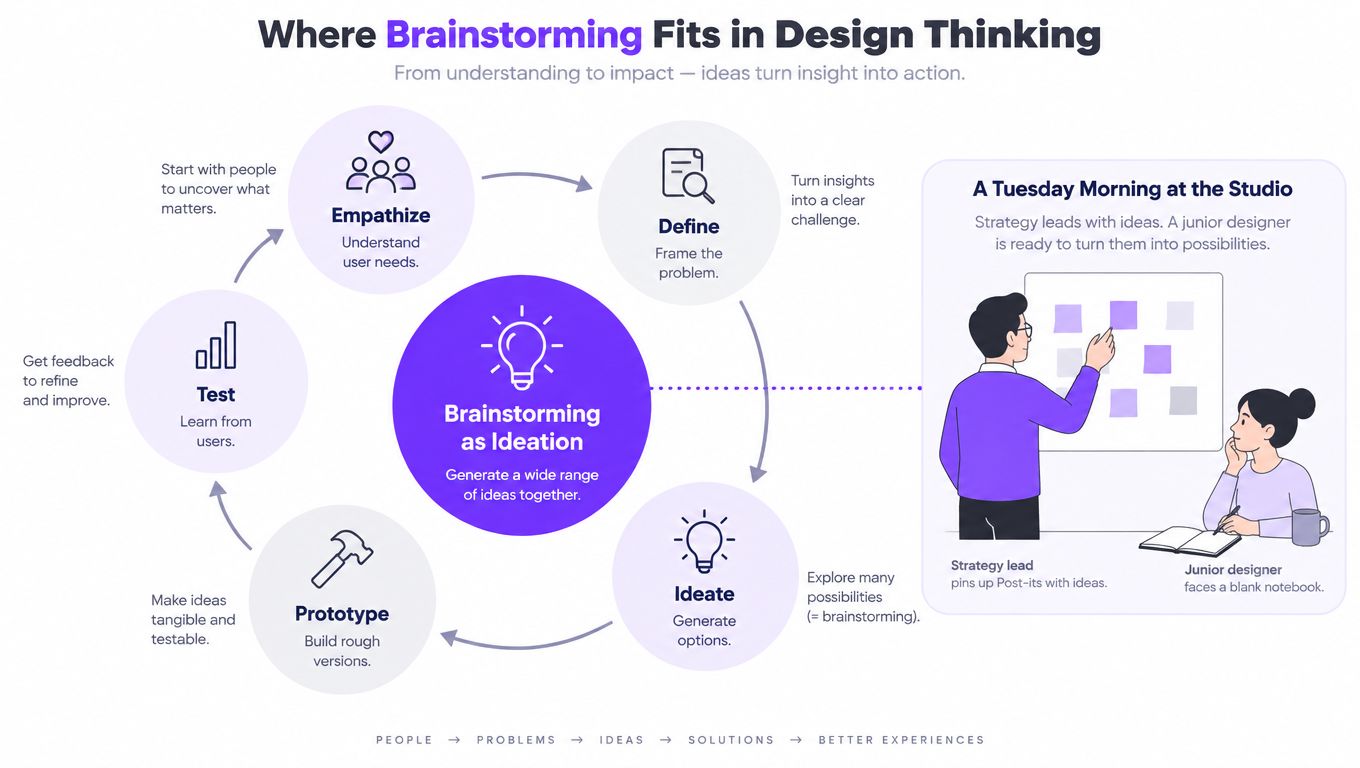
Consider an agency working on a grocery app. The client doesn't need “better marketing” in the abstract. The team might need ways to help first-time shoppers feel confident choosing products, completing checkout, and returning for a second purchase. A useful brainstorm turns that challenge into many possible directions, such as guided baskets, an aisle-based audio mode, reassurance messages at checkout, or a service that lets shoppers ask a human for help.
The output isn't a final campaign or a finished feature. It's a raw field of possibilities that can later be grouped, combined, prototyped, and tested. Brainstorming therefore differs from synthesis. Synthesis looks for patterns and meaning. Brainstorming deliberately expands the field before the team narrows it.
A deliberate creativity process
Brainstorming has a clear historical origin. Alex F. Osborn developed it in the late 1930s as a structured “idea finding” method for advertising teams, described it in his 1942 book How to Think Up, and popularized it in Applied Imagination in 1953. A design-creativity retrospective notes that professionals were already adopting the approach in the 1950s and that 15 papers containing the word “brainstorming” appeared between 1954 and 1963.
The history corrects a common misconception. Brainstorming wasn't originally casual group chatter. It was a deliberate creativity process, and that purpose still matters in design thinking. A useful overview of the design thinking process steps can help teams place the activity inside the wider loop rather than treating one meeting as the entire method.
Practical rule: Brainstorming creates options. It doesn't prove that any option will work.
A strong session usually ends with ideas captured clearly enough for another activity. The team might cluster related suggestions, identify tensions, select concepts for rough prototypes, or write questions for user research. The judgment comes later, after the group has given divergent thinking enough room to do its job.
The Design Thinking Stages Around Ideation
Design thinking gives brainstorming a useful sequence. The common arc moves through empathize, define, ideate, prototype, and test, although real projects often loop backward when new evidence changes the team's understanding.
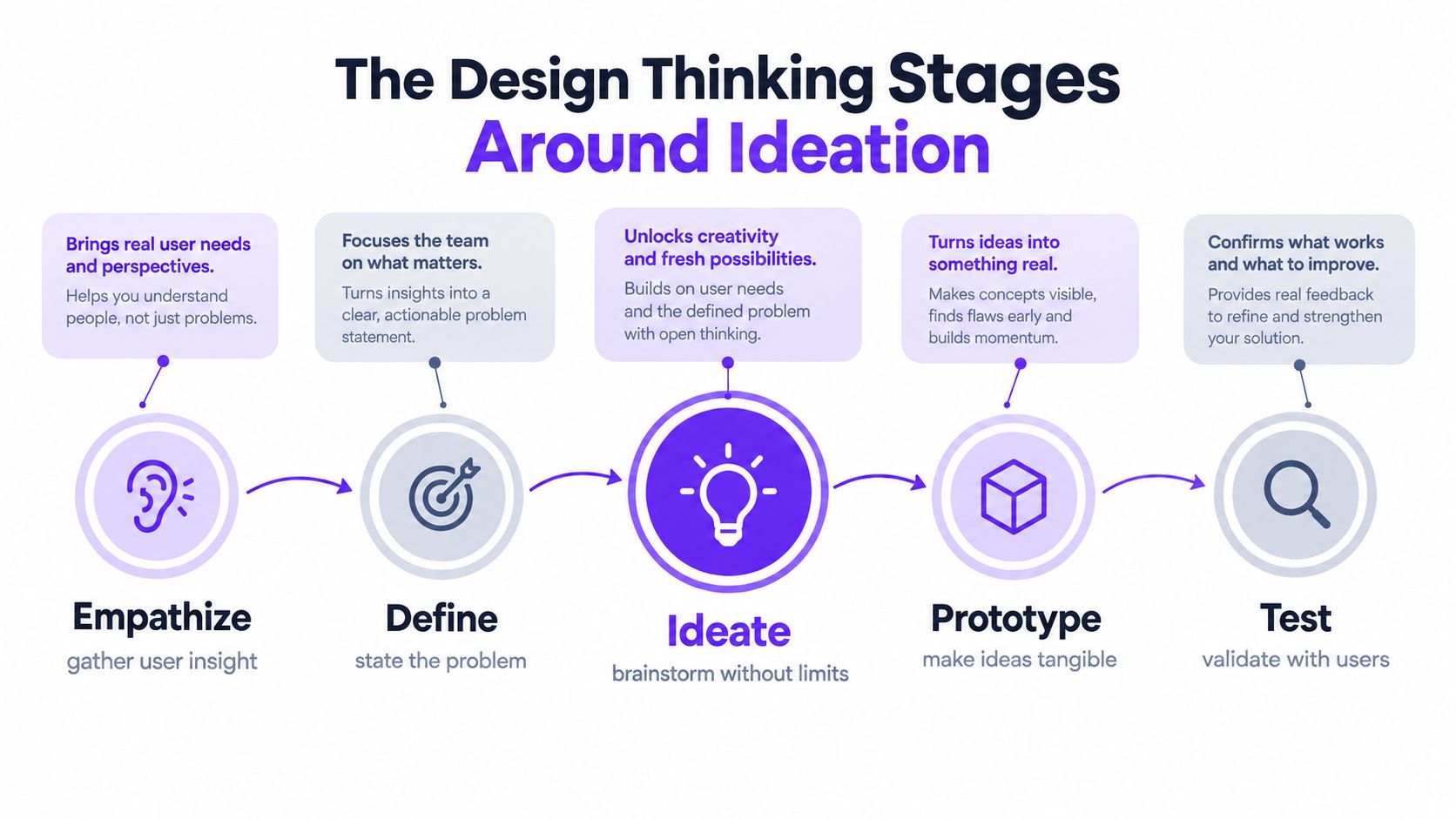
Empathize supplies the human material. Researchers listen to users, observe behavior, review support conversations, and identify unmet needs. A retail bank might learn from small business owners that they feel invisible after opening an account. That statement is more useful than a vague instruction to “improve small-business banking,” because it points toward an emotional and practical experience.
Define turns those observations into a workable point of view. The team could frame the opportunity as, “How might we help small business owners feel recognized and supported during everyday banking?” This isn't a solution. It gives the group a direction while leaving room for different types of response. The definition of ideation becomes much clearer when the team understands that ideation begins with a well-shaped challenge, not with random ideas.
Ideate expands the question
During ideation, the banking team might generate service concepts such as a named business adviser, proactive cash-flow check-ins, a peer community, or a dashboard that explains financial changes in plain language. At this point, participants don't need to defend feasibility. They need to make the possibility visible.
Prototype changes the team's mode of thinking. A service script, paper dashboard, role-play, or clickable screen makes an idea concrete enough to inspect. Making exposes missing details that a Post-it can hide.
Test brings the rough concept to users. Their reactions may confirm the direction, reveal a different need, or send the team back to the definition. This is why brainstorming shouldn't be treated as a one-way path to approval. Its ideas become useful when the team turns them into learning opportunities.
A poorly defined challenge can produce a busy wall of Post-its and still leave the team with shallow thinking.
If the retail bank had started with “What new products should we launch?”, participants would likely produce familiar product features. The stronger question preserves the user experience as the center of the work. Define narrows the lens, ideate widens the options, and prototype narrows them again through making.
Original Rules and Modern Principles
The familiar brainstorming rules came from a practical need: people often evaluate ideas before they have finished generating them. A facilitator can interrupt that pattern by separating divergence from evaluation.
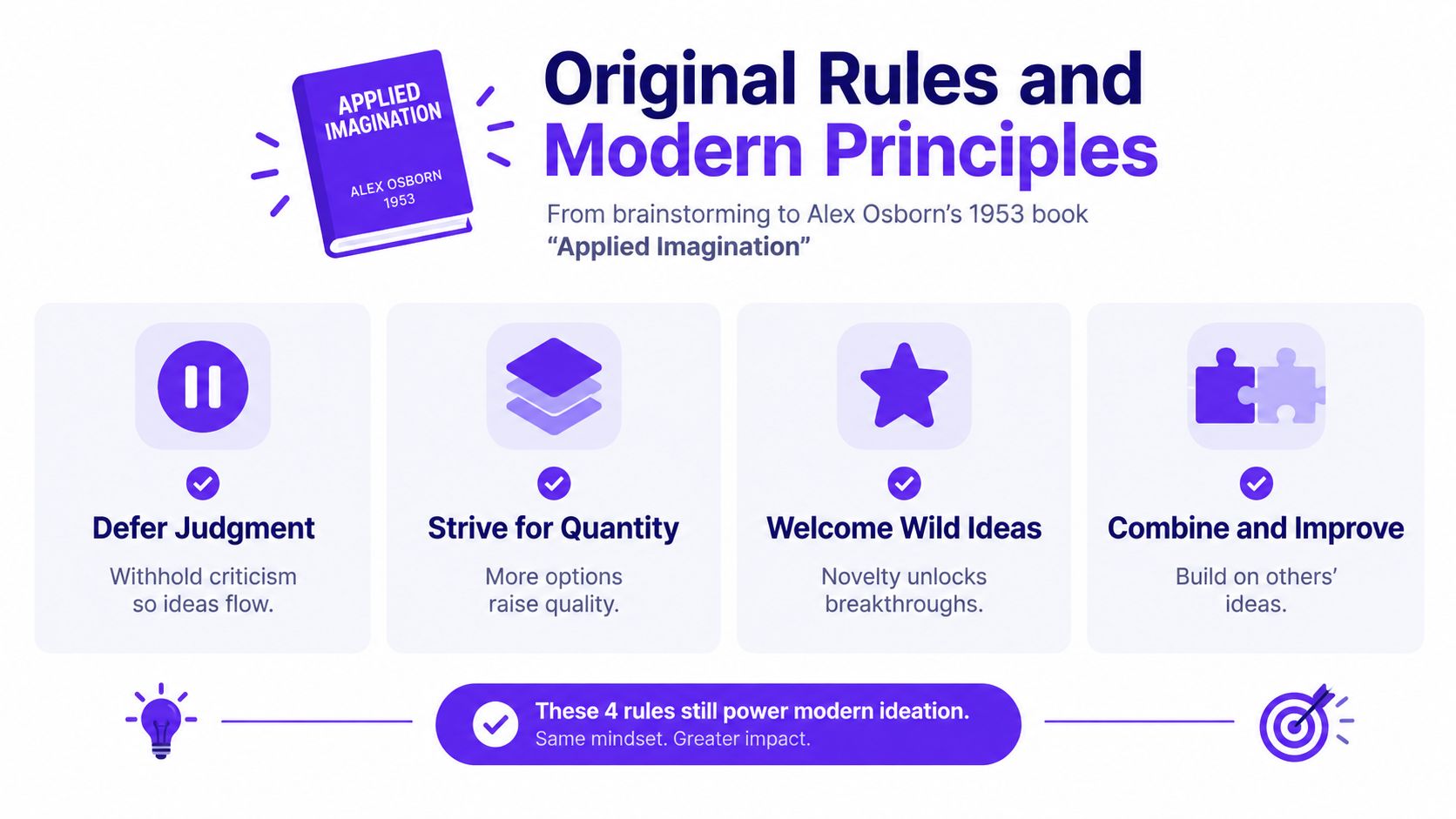
Alex Osborn's work gives modern teams a useful foundation. The principles commonly associated with his approach are to defer judgment, pursue quantity, welcome unusual ideas, and combine or improve suggestions. These principles remain useful, but they don't work as a magic spell. A silent room with no criticism can still produce repetitive ideas if the prompt is vague or the activity has no structure.
What the classic rules protect
Defer judgment protects fragile ideas from being dismissed before they develop. A junior strategist may offer an awkward starting point that another participant can make useful. If the room evaluates every suggestion immediately, people learn to share only ideas they can already defend.
Strive for quantity keeps the group from treating the first plausible answer as the answer. More options create more material to compare, combine, and transform. Welcome wild ideas pushes participants away from minor variations on familiar solutions. An implausible suggestion can reveal a need, mechanism, or experience that a practical concept later adopts.
Combine and improve makes the group collaborative rather than sequential. “Build on that” is more productive than “I have a completely separate idea,” because it helps participants develop relationships between concepts.
Research shows why the rules need more precise handling. In design-thinking experiments, resource constraints combined with “Yes, and” prompts produced 64% more ideas than a baseline design-thinking condition, while a “Reverse Ideas” prompt produced about twice as many original ideas as the expanded condition. The research on design-thinking ideation prompts demonstrates that the operator changes the output, not just the mood in the room.
A facilitator's wall checklist
Post a short set of rules where everyone can see it:
- Separate generation from evaluation: Capture first, assess later.
- Pursue range: Ask for a different direction when ideas start repeating.
- Make unusual ideas welcome: Explore the useful part before rejecting the whole.
- Build visibly: Connect, combine, and extend suggestions on the shared board.
- Stay with the challenge: Park unrelated topics instead of letting them take over.
- Change the mode when energy drops: Move from speaking to writing, sketching, or reframing.
- Give every perspective room: Don't let hierarchy determine which ideas appear.
The durable lesson isn't “never criticize.” It's criticize at the right time. Evaluation belongs after the team has created enough material to make comparison meaningful.
Methods and Templates Worth Knowing
A campaign team may spend an hour discussing a grocery app and still produce the same three ideas. The problem may be the method, not the team's creativity. Verbal discussion creates momentum, while silent writing gives independent thinkers room to contribute. Structured prompts change the direction of thought, and AI can supply starting points that people question, adapt, or reject.
| Method | Best for | Group size | Output style | Watch out for |
|---|---|---|---|---|
| Verbal brainstorming | Fast, social exploration | Small to medium | Spoken ideas captured on a board | Dominant voices and production blocking |
| Brainwriting | Quiet contributors and mixed seniority | Small to large | Independent written concepts | Participants may need a clear handoff into discussion |
| SCAMPER | Improving an existing product or campaign | Small to medium | Variations created through substitution, combination, adaptation, and other reframes | Incremental ideas if the team never changes the frame |
| Reverse brainstorming | Finding risks and failure modes | Small to medium | Ways to cause the problem, then prevent it | Teams can become stuck in criticism |
| How-Now-Wow matrix | Sorting ideas after generation | Any workable group | Concepts grouped by feasibility and novelty | Sorting too early can suppress useful extremes |
| AI-assisted prompting | Expanding directions before or during a session | Individual or team | Alternative prompts, perspectives, and concept starters | Anchoring on generic model output |
Match the method to the blockage
Use verbal brainstorming when the group needs energy and can extend ideas aloud. It works well for a small agency team exploring campaign concepts, but fast speakers can create production blocking, where others lose their ideas while waiting to talk.
Use brainwriting when hierarchy, remote participation, or different speaking speeds limit contribution. Give everyone the same challenge, allow independent writing, then collect and discuss the concepts without identifying authors at first. That sequence separates the idea from the status of the person who created it.
Use SCAMPER when the team has an existing landing page, service, product, or campaign. Ask what could be substituted, combined, adapted, modified, put to another use, eliminated, or rearranged. For a grocery onboarding campaign, replacing feature explanations with a guided first shop may produce a more useful direction than asking for “more ideas.”
Use reverse brainstorming to examine a confident assumption. Ask, “How could we make onboarding as confusing as possible?” The answers reveal failure modes, such as unclear instructions or poorly timed messages, which the team can later address.
For a fuller catalogue of techniques beyond these six, see this guide to brainstorming methods. Teams comparing digital ideation workflows can use the startup AI tools blog to examine concrete uses of AI for prompt generation, research synthesis, and creative exploration. Choose software for the task, since adding a tool does not automatically improve thinking.
If ideas keep repeating, change the activity before adding participants. Move from speaking to writing, writing to sketching, or human prompts to AI-assisted exploration. A new format can expose a different angle, while another round of the same format usually produces more of the same response.
Facilitating a Session That Actually Works
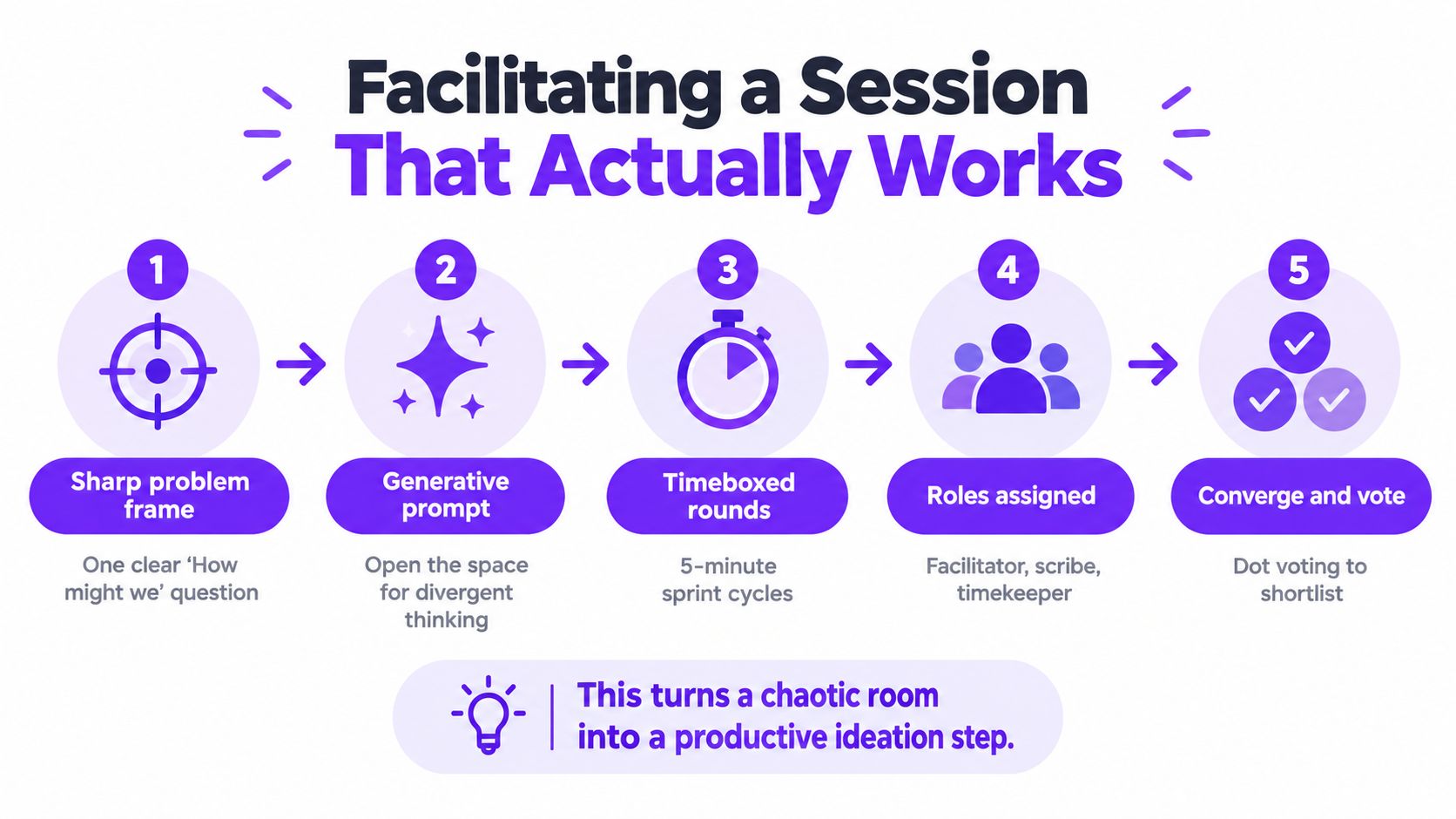
A productive session begins before anyone touches a marker. The facilitator needs a sharp challenge, a visible process, and a way to protect the distinction between creating ideas and judging them.
Frame the work before the room fills
Start with one How might we question. “How might we reduce onboarding drop-off for first-time grocery shoppers?” gives the team an outcome and a user context. “How might we improve onboarding?” leaves too much interpretation and invites people to solve different problems.
Share the relevant user evidence in a short pre-read. Participants don't need every research note, but they do need a common understanding of the people, situation, and constraints. Ask them to bring observations, not solutions.
Assign roles before generation begins:
- Facilitator: Protects the process, watches participation, and keeps evaluation out of the divergent rounds.
- Scribe: Captures ideas in the speaker's language without polishing them into a different meaning.
- Timekeeper: Calls the end of each activity and protects momentum.
- Challenge owner: Answers factual questions without turning into the session's decision-maker.
The facilitator shouldn't ideate. If they contribute their own concepts, participants may treat those ideas as approved directions, especially when the facilitator has authority. Their job is to create conditions in which other people think clearly.
Run short rounds, then change the pressure
Begin with a silent round so participants can work without waiting for a turn. Follow it with a verbal build round, then introduce a constraint or reversal. A resource constraint might ask, “What could we do with no new app feature?” A reversal might ask, “What would make the first shop feel deliberately difficult?”
A study of structured electronic brainstorming found that serial, step-by-step scaffolding produced greater idea elaboration than free brainstorming, as reported in the 2025 research on structured ideation. The implication is practical: don't tell people to “just ideate.” Give them a sequence that helps them develop raw suggestions.
Place unrelated issues in a parking lot. Cluster only after the generative work has ended, then ask the team to identify concepts that are understandable, distinct, and testable. Don't ask which idea is “best” before the group has clarified what each idea means.
This video shows the kind of facilitation flow teams can adapt for their own sessions:
A facilitator can invite quieter contributors without putting them on the spot. Ask, “Who sees a different user need here?” or invite someone who hasn't spoken to choose one idea and extend it. Guidance on facilitator skills is most useful when it translates into these small, observable interventions.
How AI Is Changing the Brainstorm
AI changes the starting conditions of ideation. A strategist facing a blank page can ask a language model for alternative framings, stakeholder perspectives, campaign territories, or ways to challenge an assumption. That can help an individual move past the first obvious response.
The tradeoff appears at group level. ChatGPT can improve the creativity of individual ideas while reducing idea diversity within a group, according to the 2025 research summarized in this study of generative AI and idea diversity. If every participant asks the same model to solve the same brief, the room may receive more polished versions of similar thinking.
That risk matters in design thinking because perspective range is raw material. A product manager may notice an operational constraint. A customer-support specialist may recognize a recurring frustration. A copywriter may hear a language problem that others miss. AI can add useful directions, but it shouldn't replace those distinct lenses.
Use AI before convergence begins
A practical pattern is to use AI for expansion, then bring the human team together to diverge on the framing.
- Ask AI for several ways to describe the user problem, including emotional, behavioral, operational, and cultural perspectives.
- Inspect the output for generic language, hidden assumptions, and repeated solution patterns.
- Turn the useful differences into prompts for the human session.
- Ask participants to generate ideas independently before showing them the model's suggestions.
- Use AI later to cluster, summarize, or expose connections, with a person checking every interpretation.
This sequence reduces AI anchoring, the tendency to treat the first plausible machine-generated suggestion as a reference point. It also preserves human disagreement, which often reveals where the problem needs better definition.
Use AI to widen the question, not to close the conversation.
Teams should keep a simple checklist nearby. Were the prompts varied? Did people generate ideas before seeing model output? Did the group include perspectives the model couldn't know from the brief? Did anyone challenge a fluent but unsupported assumption? Does the final shortlist contain different approaches, or only different wording?
AI-assisted brainstorming works best when the team treats model output as a provocateur and organizer, not as an answer engine.
Common Pitfalls and How to Spot Them
Most weak brainstorms don't fail because participants lack imagination. They fail because the process actively rewards familiar behavior.
Anchoring appears when the first plausible concept becomes the center of every later idea. In a campaign meeting, someone suggests an influencer partnership and every following suggestion becomes a variation on influencer selection. Ask, “What would the opposite look like?” Then require a direction that removes the original mechanism.
Social loafing appears when people assume others will carry the creative load. It becomes more likely when a senior stakeholder speaks first and junior participants wait for approval. Ask, “Whose perspective is missing from the wall?” A silent writing round gives people a way to contribute before hierarchy shapes the conversation.
Production blocking happens when participants must wait for their turn to speak. People forget ideas, abandon half-formed thoughts, or just follow the current speaker. Ask, “What ideas haven't been captured because we're taking turns?” Switch to simultaneous writing or use a shared digital board.
Catch judgment disguised as efficiency
Premature judgment often arrives in polite language: “Can we quickly check whether that's realistic?” or “Would legal ever approve that?” The question may be valid later, but during divergence it pulls the group into defense mode. Ask, “Are we generating, or are we evaluating?” Put feasibility concerns in a visible parking lot and return to them during selection.
A compressed calendar creates another trap. A ten-minute gap between meetings may be enough to collect reactions, but it rarely gives people room to explore a challenge from several angles. Ask, “Have we protected a distinct generation phase, or are we trying to choose before we have options?”
The broader risk is groupthink, where maintaining agreement becomes more important than examining alternatives. This guide to groupthink in psychology can help facilitators recognize how pressure for harmony affects participation and decision-making.
Run a pre-flight check
Before the meeting, confirm:
- Shared context: Everyone has the challenge and relevant user evidence.
- Clear prompt: The question describes an outcome, not a preferred solution.
- No-judgment timer: The session has a visible period for generation before evaluation.
- Participation design: The format includes silent or anonymous contribution.
- Capture method: Someone owns the exact recording of ideas.
- Evaluation boundary: The group knows when feasibility and prioritization begin.
- Next action: Selected concepts will become prototypes, research questions, or experiments.
Brainstorming in design thinking isn't a promise that every idea will be original or useful. It's a designed interruption to habitual thinking. When the team frames the right problem, varies the prompts, protects participation, and uses AI with care, the wall becomes more than a collection of Post-its. It becomes a working map of possibilities.
Bulby helps marketing agencies, creative teams, and brand strategists move from a defined challenge through structured brainstorming exercises, anonymous submissions, AI-generated idea sparks, and organized outputs. If your next design-thinking session needs a clearer path from raw concepts to actionable directions, visit Bulby and explore how the platform can support the work.