
Your team just finished an intense week of workshops, and the walls are covered with campaign territories, product sketches, and positioning statements. The work feels creative. It also feels productive. Then a client or senior stakeholder asks a simple question. Which of these ideas is genuinely new, and what evidence supports that claim? Innovation assessment gives you a clear way to answer, before you commit serious time and budget to the wrong concept.
Table of Contents
- When Busy Idea Work Is Not the Same as Innovation
- What Innovation Assessment Actually Measures
- The Three Layers Every Assessment Should Track
- Scoring Ideas Before Launch Under Uncertainty
- Real Options, Kill Criteria, and Portfolio Reviews
- Beyond R&D and Patents What Assessment Misses
When Busy Idea Work Is Not the Same as Innovation
A strategy team walks into a pitch room with three campaign routes, a thick concept deck, and research photos from a customer workshop. They've run two brainstorms. They've renamed a product feature. They've produced mood films for each route. By any activity measure, it's been a strong week.
Then the client asks what changed for customers because of this work. Silence. One route repackages an existing claim in bolder language. Another depends on a service improvement the client hasn't approved. The third is genuinely different, but nobody has tested whether the target audience understands it.
Activity Is Easy to Count
Teams often track what's visible. Ideas generated, workshops held, concepts presented, and decks delivered all fit neatly into a status report. Those numbers describe effort, not innovation. A team can generate hundreds of ideas and still ship nothing new, or ship something new that customers ignore.
That confusion is easier to spot when you separate work products from results, a distinction covered well in outcomes and deliverables explained. A deck is a deliverable. A customer choosing your product for a new reason, or a team adopting a better way of working, is an outcome.
A full wall of sticky notes proves people participated. It doesn't prove anything changed.
The Questions Assessment Should Answer
Good innovation assessment forces three practical questions into the open. First, what's actually new here compared with what you offered before? Second, has it reached real users, or is it still a concept on a slide? Third, what changed once people encountered it?
If you're still clarifying the starting point, it helps to revisit what it truly means to innovate in practice before you build a scorecard. Without that shared definition, every review becomes an argument about taste. A creative director calls a route novel because it looks unfamiliar. A product manager calls a feature novel because engineering found it difficult. A client calls both risky because neither has evidence behind it.
Assessment doesn't remove judgment. It gives judgment a structure. You can compare options fairly, explain why you're backing one concept over another, and decide whether to continue, revise, or stop. That discipline is the difference between busy idea work and innovation you can defend in the room where budgets get approved.
What Innovation Assessment Actually Measures
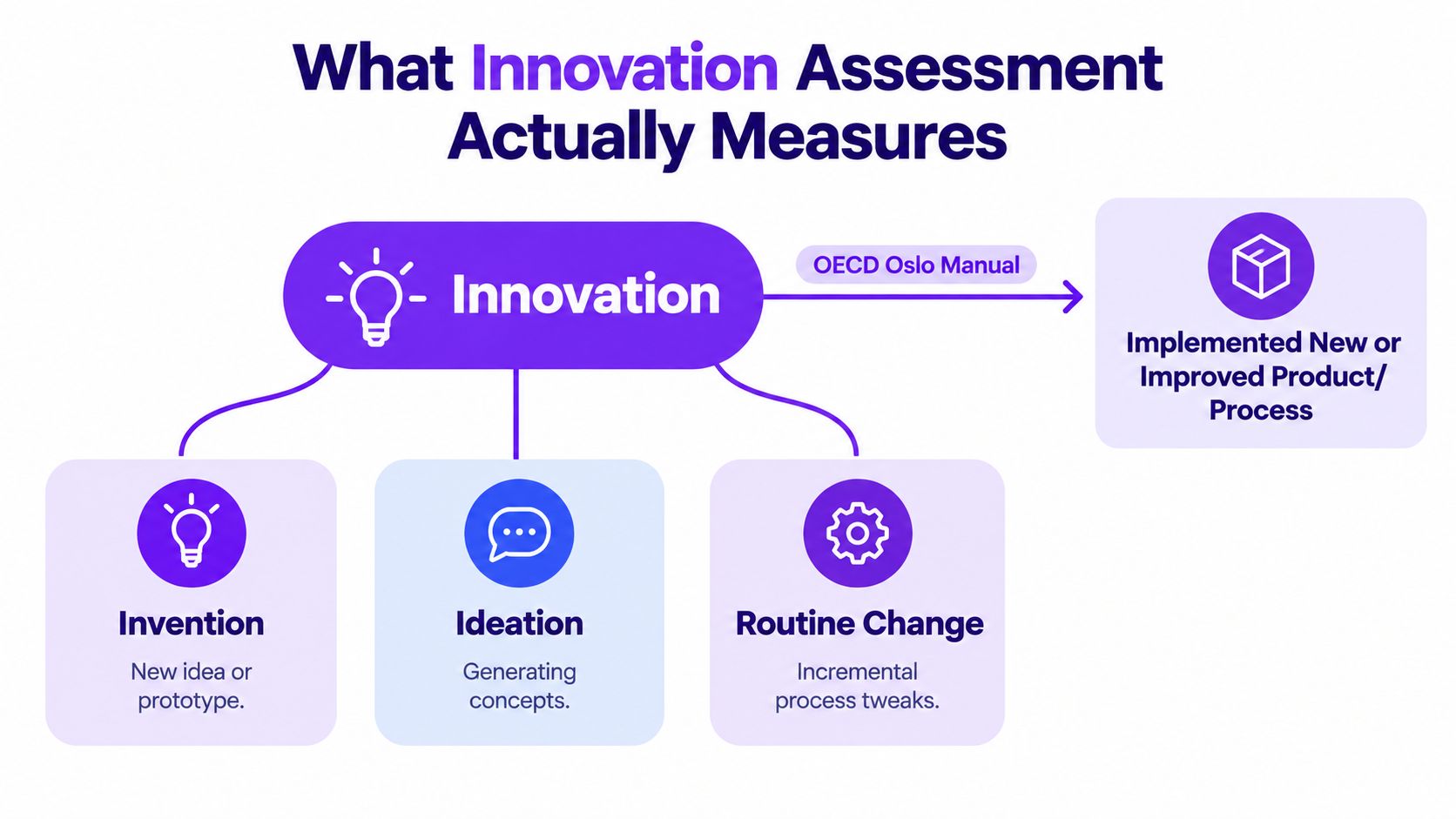
Start with a definition your whole team can apply the same way. An idea is a possibility. An invention is something new that exists, perhaps as a prototype. Innovation happens when that new or improved thing reaches people and gets used.
The OECD and Eurostat Oslo Manual 2018 full report formalizes that threshold. National experts reached an international agreement in Oslo in 1991, and the first edition appeared in 1992. It first focused mainly on technological product and process innovation in manufacturing.
How the Definition Broadened
Revisions widened the lens. The 2005 edition added organizational and marketing innovation. The fourth edition in 2018 took an economy-wide view covering businesses, government, nonprofit organizations, and households. That matters for agency and product teams because your innovation might be a new service process, a different go to market model, or a new way clients approve creative work, not only a physical product.
The 2018 definition is specific. An innovation must be a new or improved product or process that differs significantly from previous offerings and has either been made available to potential users or brought into use. A campaign concept in a deck doesn't meet that bar. A launched proposition that customers can buy, or a new internal process your account team now uses every week, does.
Before you label a concept innovative, teams working on new ventures can borrow practical checks from how to validate your startup idea. The underlying logic is the same. Does a real problem exist, and will real people act on your solution?
Why a Shared Threshold Protects You
A precise threshold lets you compare fairly across teams, sectors, and countries. It also prevents premature victory laps. Consider two projects. One team prototypes a loyalty app feature and presents it internally. Another team ships a simpler feature to a pilot group and learns customers use it weekly. The second team has stronger innovation evidence, even if the first prototype looks more impressive.
When you classify work, it also helps to name which of the main types of innovation in business you're assessing, since a process change needs different evidence than a product launch. Ask three questions in every review. Is it significantly different? Has it been implemented? Who can use it now? If you can't answer the last two, you're assessing potential, not innovation yet. That distinction isn't pedantic. It's what keeps your scorecard honest.
The Three Layers Every Assessment Should Track
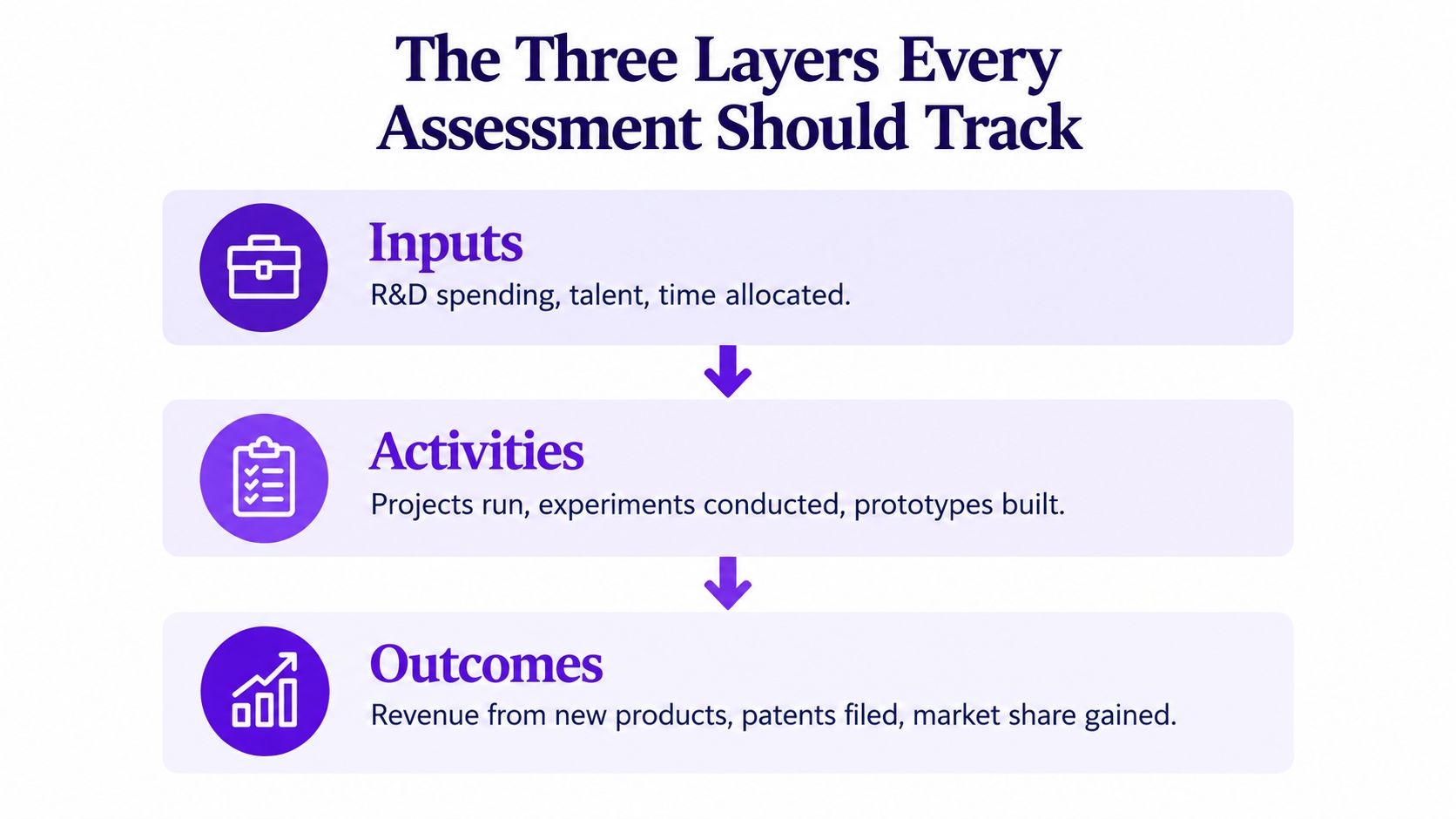
One metric can't tell the whole story. High spending can produce nothing useful. A long list of launched features can still leave customers cold. You need three layers connected in sequence, inputs, outputs, and outcomes.
The scale of proper measurement shows why definitions matter. The National Center for Science and Engineering Statistics 2019 Annual Business Survey findings estimated about 4.8 million U.S. for-profit companies with at least one employee, and nearly 30% reported introducing at least one innovation during 2016 to 2018. A product innovation had to reach the market, and a process innovation had to be implemented inside the firm. That survey measured realized change, not brainstorming volume.
What Each Layer Can and Cannot Prove
Inputs show commitment. The OECD Frascati guidance on research and development measurement84/en/pdf) defines R&D inputs mainly as annual expenditure and personnel. For an agency, inputs might be strategist hours, research budget, or time protected for exploration. Inputs answer one question only. What did you invest?
Outputs show what that investment produced. Validated concepts, tested prototypes, launched campaigns, and patents sit here. Patent counts capture some inventive output, but they miss non-patented service, organizational, and marketing innovations. A repositioned brand that wins a new audience segment may never generate a patent.
Outcomes show effect. Adoption, revenue contribution, productivity improvement, client performance, or social impact belong in this layer. Outcomes need a baseline, otherwise you can't tell whether your innovation caused the change or the market moved on its own.
| Layer | What It Proves | Common Measures | Team-Level Indicator |
|---|---|---|---|
| Inputs | Resources committed | R&D expenditure, personnel, exploration time | Exploration effort normalized by team size |
| Outputs | Validated work produced | Concepts tested, prototypes, launches, patents | Concept to test and concept to launch conversion |
| Outcomes | Real-world effect | Adoption, revenue, productivity, customer impact | Change against a defined baseline |
Wiring the Layers Together
Track conversion between layers, not just totals within them. If inputs rise but validated concepts don't, your problem is idea quality or testing capacity. If outputs rise but outcomes stay flat, you're launching things people don't want or can't find. Teams that want concrete assessment structures can compare their scorecard against practical formal assessment examples for teams and adapt the format.
Practical rule: Never report an input number in a review without the output it produced and the outcome you're tracking next.
Where patents are relevant, adjust for quality rather than counting raw filings. Corrected priority filings or triadic patent measures better represent internationally significant inventive output. For most creative and product teams, the equivalent discipline is simpler. Count a concept as an output only after it's been tested with users, not when it first appears in a presentation. That single rule stops high-volume ideation from masquerading as progress.
Scoring Ideas Before Launch Under Uncertainty
Most assessment tools look backward. Revenue, adoption, patents, and market share tell you what happened after launch. Your hardest decisions happen earlier, when a concept is still a rough territory, a prototype, or a positioning hypothesis and reliable market data doesn't exist yet.

A 2025 framework for in-process innovation metrics under uncertainty notes that more than 150 R&D performance measures exist, yet most are ex-post indicators. It argues instead for in-process measures tied to desirability, feasibility, and viability across discovery, development, and commercialization. In plain terms, score the quality of evidence you're gathering while you can still change direction.
Score Evidence, Not Forecasts
Early forecasts for unfamiliar ideas are usually fiction with decimal points. A new campaign platform can't credibly promise a sales lift before anyone has seen it. What you can score is evidence maturity. How severe is the customer problem? How distinctive is the concept against alternatives customers already have? How reversible is the next investment if you're wrong?
Use separate scores for each dimension.
- Desirability evidence: Customers describe the problem unprompted, engage with a concept, or take a costly action like joining a waitlist
- Feasibility evidence: Your team or the client can deliver the promise, produce the asset, or operate the service
- Viability evidence: A plausible path exists to revenue, cost saving, or strategic value worth the effort
Structured early testing keeps those scores grounded. If you're evaluating a digital product concept, a guide to validating app concepts offers useful rapid checks you can adapt for campaign propositions too. Pair that with disciplined concept testing methods for early-stage ideas so different concepts face comparable evidence standards.
Set Thresholds for Each Stage
Discovery needs problem evidence. Development needs proof people understand and prefer your solution over a familiar alternative. Commercialization needs signs they'll act at real prices and real effort levels. Don't judge a discovery-stage idea by commercialization metrics. That's how unfamiliar ideas get killed for scoring poorly on measures designed for mature products.
Tools can support this discipline if they organize evidence rather than just generating more ideas. For example, Bulby is an AI-powered brainstorming platform that guides teams through structured exercises and synthesizes contributions into reports, which can help a team capture assumptions and concepts in one place before testing. The tool doesn't replace evidence. It makes the material you're assessing easier to compare.
One final reframe matters. An idea with modest early demand signals may still deserve to advance if the next test eliminates a critical uncertainty or produces unusually valuable learning. You're not only buying a launch candidate at this stage. You're buying information that improves every later decision.
Real Options, Kill Criteria, and Portfolio Reviews
Think of early funding as buying a future decision, not committing to a full launch. That's real-options reasoning in plain language. You make a small, reversible investment, learn something specific, then continue, pivot, or stop based on evidence.
The visual below summarizes how those three practices fit together in a review cycle.
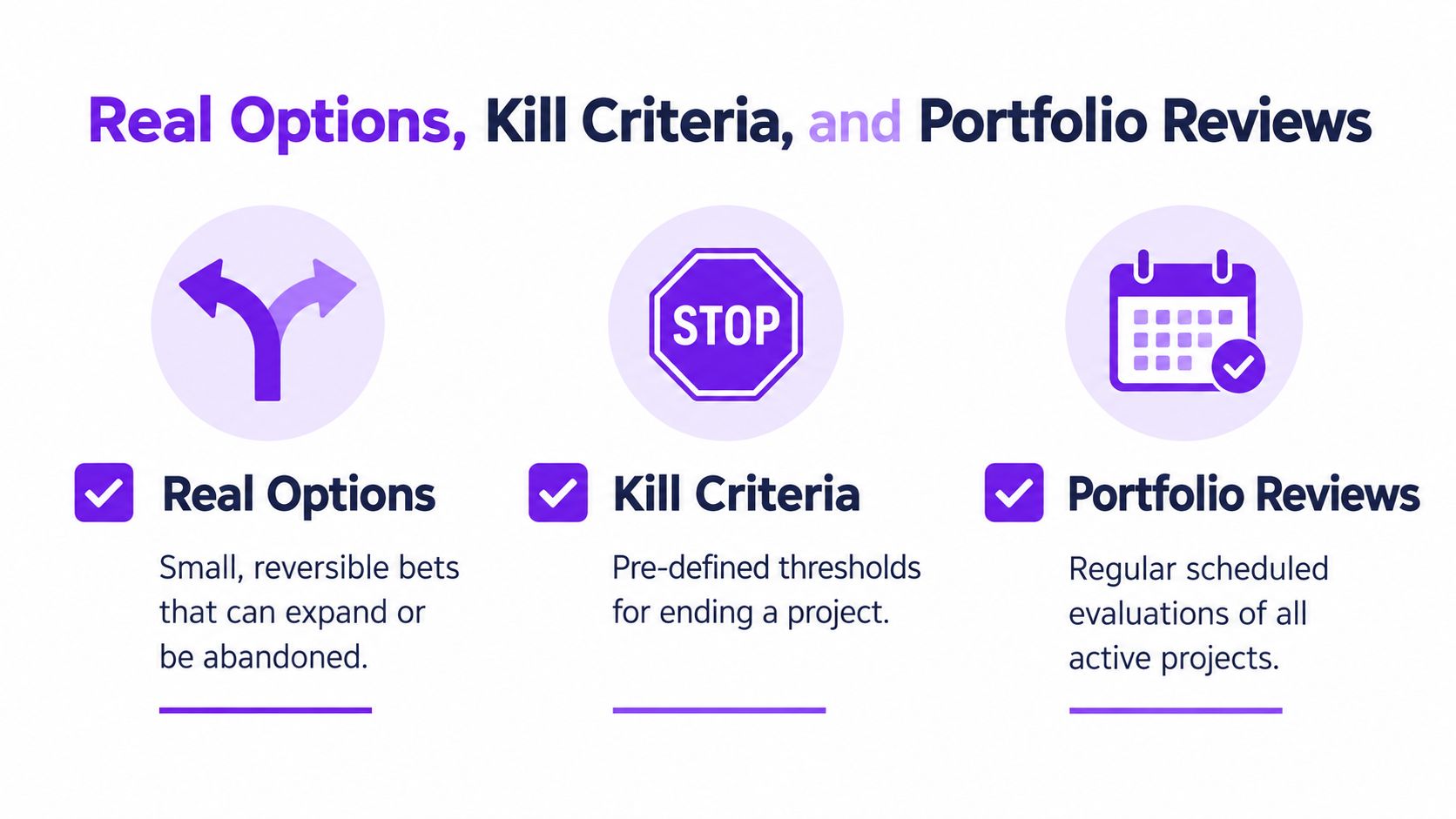
Research using 137 innovation portfolios found real-options reasoning was positively associated with portfolio innovativeness and, through it, portfolio success, as documented in the TU Berlin repository record on real-options reasoning in innovation portfolios. The mechanism is practical. Experiments reduce uncertainty while your financial exposure stays limited until evidence justifies escalation.
A Worked Agency Example
A brand team has three campaign territories and budget to produce only one properly. Instead of picking the route the room likes most, they treat each territory as an option. They test the audience tension behind each one with short concept statements, rough key visuals, and message variants. Each test is cheap and reversible. Production money stays untouched.
One territory wins on comprehension but feels generic. Another is distinctive but confuses part of the audience. The third shows moderate comprehension and strong distinctiveness, with a fixable clarity problem. The team advances the third, revises the headline, and kills the first with a documented reason. That is portfolio management, not creative guesswork, and it fits inside a broader structured innovation management process for teams.
The video below walks through related portfolio decision thinking you can apply in your next review.
Run Reviews Against Pre-Set Criteria
Give every initiative a learning agenda before it gets more money. Name the key assumption, the experiment cost, the time to evidence, the decision threshold, and the maximum additional investment. Then review the portfolio on evidence gained per unit of spend, not on how attached the team has become.
| Criterion | Evidence It Provides | Decision It Should Trigger |
|---|---|---|
| Novelty | How different the concept is from current offers | Advance if distinct, rework if generic |
| Feasibility | Whether delivery is technically and operationally possible | Continue, narrow scope, or stop |
| Desirability | Whether users want and understand it | Advance, reposition, or pivot audience |
| Evidence maturity | How much uncertainty the last test removed | Escalate funding or require another test |
Require a written kill or pivot decision when thresholds aren't met. Without that rule, weak ideas survive on sunk-cost bias, and your portfolio fills with projects nobody believes in but nobody will end.
Beyond R&D and Patents What Assessment Misses
Conventional scoreboards favor organizations with big R&D budgets, mature patent pipelines, and tidy reporting systems. That creates a quiet bias. A service firm, creative agency, or public-sector team can innovate in ways those measures barely register.
A 2025 study on innovation measurement and open innovation networks argues that firm-centric frameworks overlook knowledge exchange and system-level collaboration, creating a black box around how innovation emerges. Data gaps compound the problem. The 2025 Global Innovation Index model contains 9,631 available data points out of 10,842 possible points, leaving 11.2% missing across 139 economies. If measurement capacity differs that much at country level, imagine the gaps between a global client team and a small regional studio.
What to Track Instead
Value often sits between organizations, not inside one. A strategist reframes a client's problem using insight from a supplier. A community of users shapes a product improvement. A partner's distribution makes a modest idea commercially powerful. None of that shows up in a patent count.
Add collaboration measures to your scorecard alongside the formal ones.
- Network reach: Which partners, users, and specialists contributed knowledge you used
- Diversity of contributors: Whether different disciplines and perspectives influenced decisions, not just attended meetings
- Knowledge reuse: How often insight from one project improves another
- Quality of exchange: Whether cross-functional feedback changed the work in traceable ways
A lower patent or R&D score doesn't necessarily mean weaker innovation. It may mean your model creates value through services, creativity, or ecosystems that conventional indicators undercount.
Use this as your closing check in every review. Did we measure implementation, not just activity? Did we track inputs, outputs, and outcomes separately? Did early concepts face stage-appropriate evidence thresholds? Did we document kill and pivot decisions? And did we credit the collaboration that made the work possible? If you can answer yes to all five, your innovation assessment reflects how innovation really happens in product and creative teams, messy, collaborative, and decided long before launch day.
If your team generates plenty of ideas but struggles to organize, compare, and develop them into concepts worth testing, Bulby can help you run structured, AI-guided brainstorming sessions that turn scattered input into focused campaign and product directions. Bring your next brief, define the challenge clearly, and use the session output as the starting evidence for your assessment scorecard.