
Your team says it values fresh thinking. The workshop feels energetic, the sticky notes fill a wall, and people leave with promising ideas. Then client deadlines take over, nobody owns the next test, and the ideas disappear.
An innovation culture assessment helps you investigate that gap. It asks whether people can actually do what leaders encourage, and what happens when they try. A low score isn't a verdict on the team. It's a reason to look more closely at the conditions people work in.
Table of Contents
- What an Innovation Culture Assessment Measures
- Key Dimensions and the Questions to Ask
- Who Feels Safe Enough to Take a Risk
- How to Run an Assessment Step by Step
- Reading Results Without Fooling Yourself
- Turning Findings into a 90-Day Improvement Cycle
What an Innovation Culture Assessment Measures
Say a creative agency gets glowing responses to its innovation survey but hasn't launched anything new recently. Leaders see enthusiasm. Employees see approval queues, overloaded calendars, and the risk of looking foolish in front of clients.
Both views can be sincere. Neither, on its own, explains the agency's ability to innovate.
An innovation culture assessment examines the conditions that make new ideas possible and the results those ideas produce. Think of a health check: a clinician considers blood pressure, sleep, symptoms, and medical history rather than asking only whether you feel fine.
Separate conditions from results
The World Intellectual Property Organization's Global Innovation Index separates innovation inputs from outputs, organizing inputs into institutions, human capital and research, infrastructure, market sophistication, and business sophistication, and outputs into knowledge and technology outputs and creative outputs.
That's an economy-level framework, not an employee questionnaire. Its useful lesson for a team is the separation between what makes innovation possible and what people accomplish.
- Inputs: Psychological safety, leadership support, protected exploration time, learning resources, cross-functional participation, and access to useful information.
- Outputs: Implemented ideas, new offerings, revenue from new work, intellectual property, and measurable customer improvements.
This team activity is a useful starting point, but the assessment also needs to follow what happens afterward.

Choose measures before choosing software
An agency might have generous exploration time but no route to client testing. A product team might ship improvements while employees quietly avoid uncertain ideas. Those situations need different interventions.
If you're starting with broader workplace questions, an organizational culture assessment can help distinguish general working conditions from innovation-specific barriers. When comparing implementation options, Turn On Work's guide to culture survey tools and pricing is a useful resource for checking tools against your reporting needs and budget.
Choose software after you've decided what evidence you need. A polished dashboard can't compensate for questions that miss the actual bottleneck.
Practical rule: Measure the conditions, the behavior, and the outcome. Don't let an engagement average or a pile of ideas stand in for all of them.
Key Dimensions and the Questions to Ask
Culture isn't directly visible. You infer it from what people report, how they behave, and what the organization supports or discourages.
A useful questionnaire separates stated priorities from everyday experience. Otherwise, someone who agrees that creativity matters may appear to be confirming that they have the time, authority, and safety to practice it.
Build a diagnostic toolkit
The Innovation Quotient validation paper examines six dimensions through 54 perception-based items: values, resources, behaviors, processes, climate, and success. Use those dimensions as different viewpoints, not sealed compartments.
Six innovation culture dimensions and how to measure them
| Dimension | What It Reveals | Sample Question | Behavioral Signal |
|---|---|---|---|
| Values | Whether experimentation is stated as a priority | Do leaders reward a well-tested idea that failed? | Share of funded ideas that carried real uncertainty |
| Resources | Whether time, budget and tools exist for exploration | Do you have protected time each month to explore ideas? | Hours of exploration time per person per month |
| Behaviors | What people actually do in meetings and daily work | How often do you challenge a plan in a team meeting? | Ideas submitted per person and dissenting comments raised |
| Processes | How ideas move from concept to test | How clear is the path from an idea to a first test? | Days from idea to first prototype |
| Climate | Whether people feel safe to take risks | If your idea fails, what happens to you? | Share of non-managers who submit ideas |
| Success | Whether ideas lead to results | Have recent new ideas changed a decision or product? | Share of tested ideas adopted and revenue from new work |
Notice the difference between values and climate. Leaders can sincerely reward experimentation in principle while employees remember a public criticism that made participation feel dangerous.
Resources and processes also differ. Having a prototyping tool doesn't tell an employee who can approve a customer test.
Turn topics into answerable statements
The table's questions are prompts for investigation. For a repeatable survey, convert them into statements that employees can rate consistently, from strongly disagree to strongly agree.
For example, ask whether someone can challenge a proposed approach without negative consequences. Separately, ask whether they know how to request resources for a test. Combining those ideas would leave you unsure which part a respondent disagreed with.
- Ask about observable experience: Prefer manager behavior and recent work over broad claims about being creative.
- Keep the reference point consistent: Specify whether respondents should consider their immediate team, department, or organization.
- Allow uncertainty: Include a not-enough-experience option so new employees don't have to guess.
- Keep wording stable: Changing the wording between surveys makes comparisons harder to interpret.
Use these innovation survey questions as drafting prompts, then adapt them to the work people do.
The validation paper also found insufficient separation between dimensions and differences in reliability across organizational groups. In plain language, apparently different scores may partly reflect the same underlying experience, and a questionnaire may work differently for different audiences.
Don't conclude that resources caused poor outcomes just because those scores move together. Treat that relationship as a question to investigate through interviews, work records, and a carefully chosen change.
Who Feels Safe Enough to Take a Risk
A leader's invitation to experiment isn't proof that employees can safely accept it. Assessments that ask only whether innovation is encouraged miss the more difficult question: what does someone risk by acting on that encouragement?
In PwC's 2025 survey of 49,843 workers across 48 countries, only 56% felt safe trying new approaches, while just 54% said their teams treated failures as opportunities to learn and improve. Those findings concern workers across countries, not a benchmark that an individual agency should automatically adopt.
Look beneath the average
Say a strategy team's brainstorms sound lively, but senior colleagues make most of the comments. Junior strategists contribute privately afterward because they don't want to challenge an account director in public.
The overall climate score could still look healthy. Senior employees may feel safe, while quieter colleagues interpret enthusiasm for innovation as the answer they're expected to give.
Ask who can take an interpersonal or career risk, in which situations, and with what consequences.
Compare responses by seniority, function, geography, employment status, and demographic group where you can protect confidentiality. Don't publish a narrow combination of attributes that makes a respondent recognizable.
Then compare reported experience with actual participation:
- Voice: Who submits ideas, asks difficult questions, or disagrees during a review?
- Permission to stop: Can someone end an unpromising experiment without being treated as the problem?
- Access to resources: Whose ideas receive attention, budget, or customer access?
- Learning after failure: Are lessons recorded, discussed, and used, or does the team move on without reflection?
Protect people while investigating
Participation tracking should reveal patterns, not become an employee surveillance exercise. Explain what you'll collect, who can see it, and how you'll use it before you begin.
If people expect managers to inspect their individual answers, an anonymous survey label won't create trust. Avoid attributing open-text comments, and don't ask managers to guess who wrote them.
Practical guidance on creating psychological safety can help turn a worrying pattern into changes in meeting behavior and manager response.
The strongest diagnostic combines anonymous pulse questions, meeting participation patterns, and a record of which ideas were tested, rejected, or abandoned without notice. Enthusiasm tells you people like the idea of innovation. These checks help you understand whether they can participate in it.
How to Run an Assessment Step by Step
Start with a decision, not a survey template. You might need to understand why concepts stall before prototyping, whether a leadership change affected participation, or which teams need support.
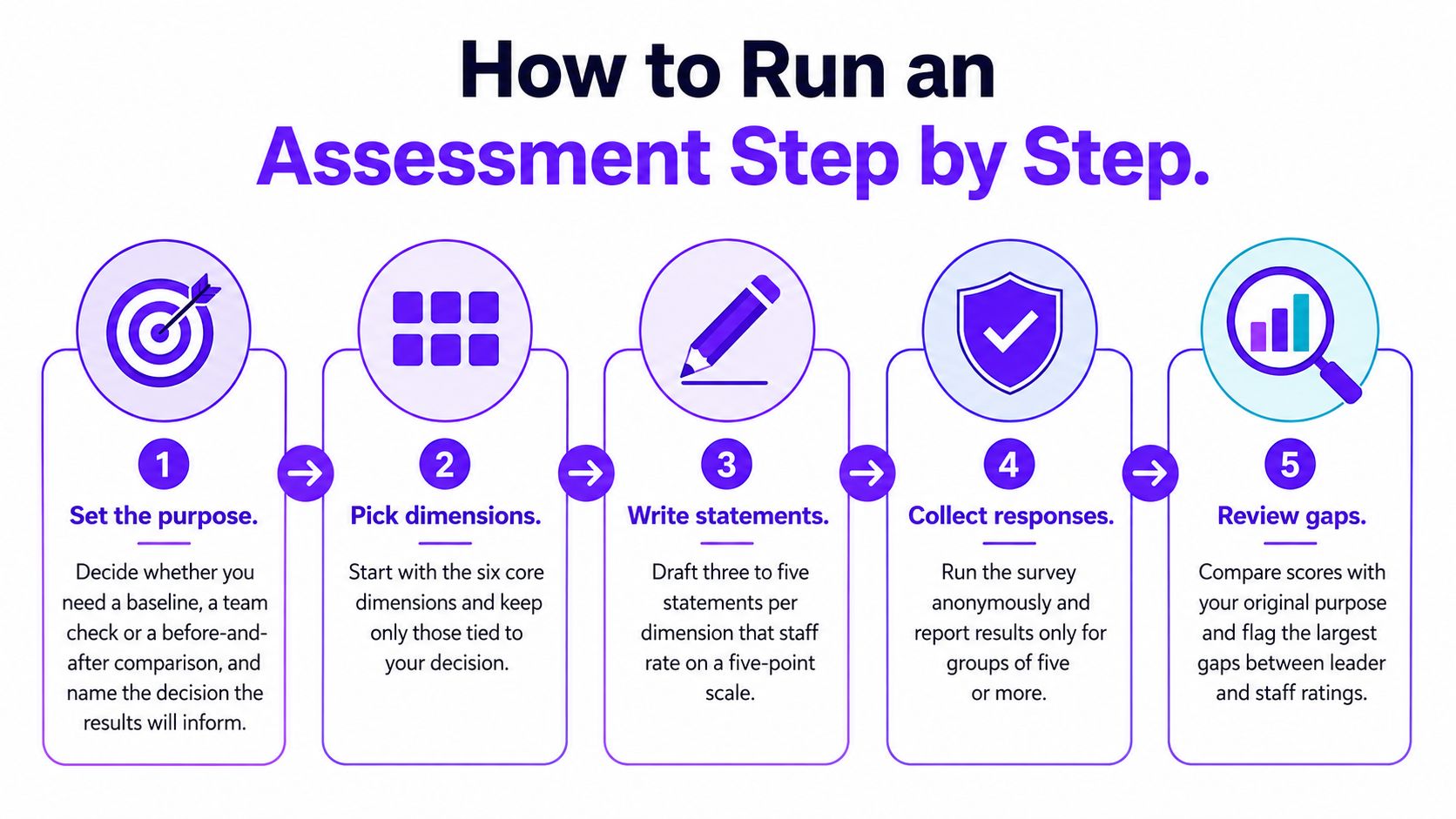
The process visual provides a compact overview of the preparation and review work.
Prepare and collect the evidence
Set the purpose. Write down the decision the assessment will inform. Choosing between more exploration capacity and a clearer approval process is specific enough to guide measurement.
Pick relevant dimensions. Use the diagnostic toolkit without assuming every topic needs equal attention. Keep a short set of clear statements for each selected dimension, with a consistent agreement scale.
Pilot the questionnaire. Ask a small, mixed-role group to explain how they interpret each statement. Check internal consistency within audience segments; where the sample supports it, involve a measurement specialist to test whether the proposed dimensions fit the responses using confirmatory factor analysis.
Collect confidential responses. Invite strategists, creatives, account leads, and product or innovation managers. Set a minimum reporting group size before collection, suppress identifiable breakdowns, and explain that anonymous surveys and confidential interviews offer different protections.
Gather matching behavioral records. Use the same assessment period for distinct concepts, ideas advancing through evaluation, time to prototype, cross-functional participation, adoption, and customer impact. Define each measure before counting it.
Save a usable baseline. Record the questionnaire version, response coverage, team composition, and operational definitions. Schedule the follow-up before everyone returns to delivery work.
Review with mixed roles. Invite people with different responsibilities and levels of authority to interpret the charts. Ask what else could explain each pattern before choosing an intervention.
A 2024 study of SMEs in Germany and Thailand, involving 213 respondents, found that an experimental, adaptable culture was a key driver of organizational innovation in both contexts, with enhanced performance particularly in financial and customer-related dimensions. It supports examining culture alongside outcomes, but doesn't establish universal causality.
Keep collection separate from judgment
For ongoing feedback, HubEngage, Inc.'s guidance on how to build a modern employee listening strategy offers useful context for connecting surveys with follow-up conversations. Employees need to know not just that you've listened, but which decisions their input will influence.
If you use structured brainstorming as an observed activity, keep its results separate from the culture score. At Bulby, our process starts with entering a challenge and inviting the team through a shared link. Participants receive unique random exercises, write and share ideas anonymously with AI-powered inspiration, and then receive automatically collected and summarized ideas, with AI surfacing the best and providing actionable next steps; the AI-generated report can be shared with the team.
That workflow can supply material for a follow-up discussion. It doesn't, by itself, establish whether employees feel safe challenging a manager or whether decision-makers will resource an idea.
Use the video below alongside your team's preparation discussion.
Reading Results Without Fooling Yourself
Suppose idea generation stays steady while implementation falls. Don't immediately commission another creativity workshop. Investigate what happens after selection: ownership, approvals, client access, or the capacity to build a testable artifact.
Now suppose concepts keep repeating and employees report little reflection after experiments. A plausible explanation is that the team isn't using what it learns. Structured debriefs and hypothesis reviews are a better starting point than asking everyone to produce more ideas.
Read combinations rather than isolated scores
A validated innovation-climate instrument published by Hogrefe, tested with 372 employees using 21 items, identified activating leadership, continuous reflection, consistent implementation, and professional documentation, and showed criterion validity against outcomes including product and process innovation and solution quality in group discussions.
Those factors offer a practical interpretation lens. Look at how managers frame challenges, how teams reflect, whether selected ideas reach testing, and whether people preserve the rationale for decisions.
Result patterns, likely meanings and what to check next
| Pattern | Likely Meaning | Check Next |
|---|---|---|
| High idea volume, low implementation | Execution bottleneck after ideas are chosen | Share of selected ideas that reach a testable artifact |
| Stable ideas, repetitive concepts, low reflection | Weak learning loops, not weak creativity | Frequency of structured debriefs and hypothesis reviews |
| High overall climate score, low scores among non-managers | Voice concentrated among senior staff | Ideas submitted and dissent raised, split by seniority |
| Low resources score, normal behaviors | Time or budget limits, not willingness | Hours of protected exploration per person |
| Many ideas, few tested | Weak conversion from concept to test | Days from concept to first prototype |
| Strong behaviors, low success score | Ideas may not reach decision-makers | Share of ideas that received resources or a decision |
These are working explanations, not automatic diagnoses. Strong behaviors and weak success could also reflect poor customer fit, immature experiments, or a long decision cycle.
Check whether the apparent change is credible
Compare results with the baseline and examine who answered. A different mix of respondents can shift an average even when nobody's experience has changed.
Small movements may be normal survey variation. Look for a sustained pattern across repeated assessments, supported by behavioral evidence, before declaring improvement or decline.
Pebb's guide to overcoming bias in engagement surveys is useful when reviewing question wording, response pressure, and interpretation. For operational definitions beyond the survey, use a consistent approach to measuring innovation.
Before acting: Write down your leading explanation, a plausible alternative, and the evidence that would distinguish them.
Don't delay action on reports of retaliation or other serious harm while waiting for another survey. Measurement uncertainty is a reason to investigate carefully, not a reason to ignore a credible concern.
Turning Findings into a 90-Day Improvement Cycle
Treat the coming quarter as an experiment in how your team works. Your deliverable isn't a cultural grade. It's a baseline, a short list of plausible causes, and a change you can evaluate.
Start with the dimensions where uncertainty affects an important decision. If you're unsure whether people lack permission or only lack time, ask about those experiences and track participation alongside progress toward testing.
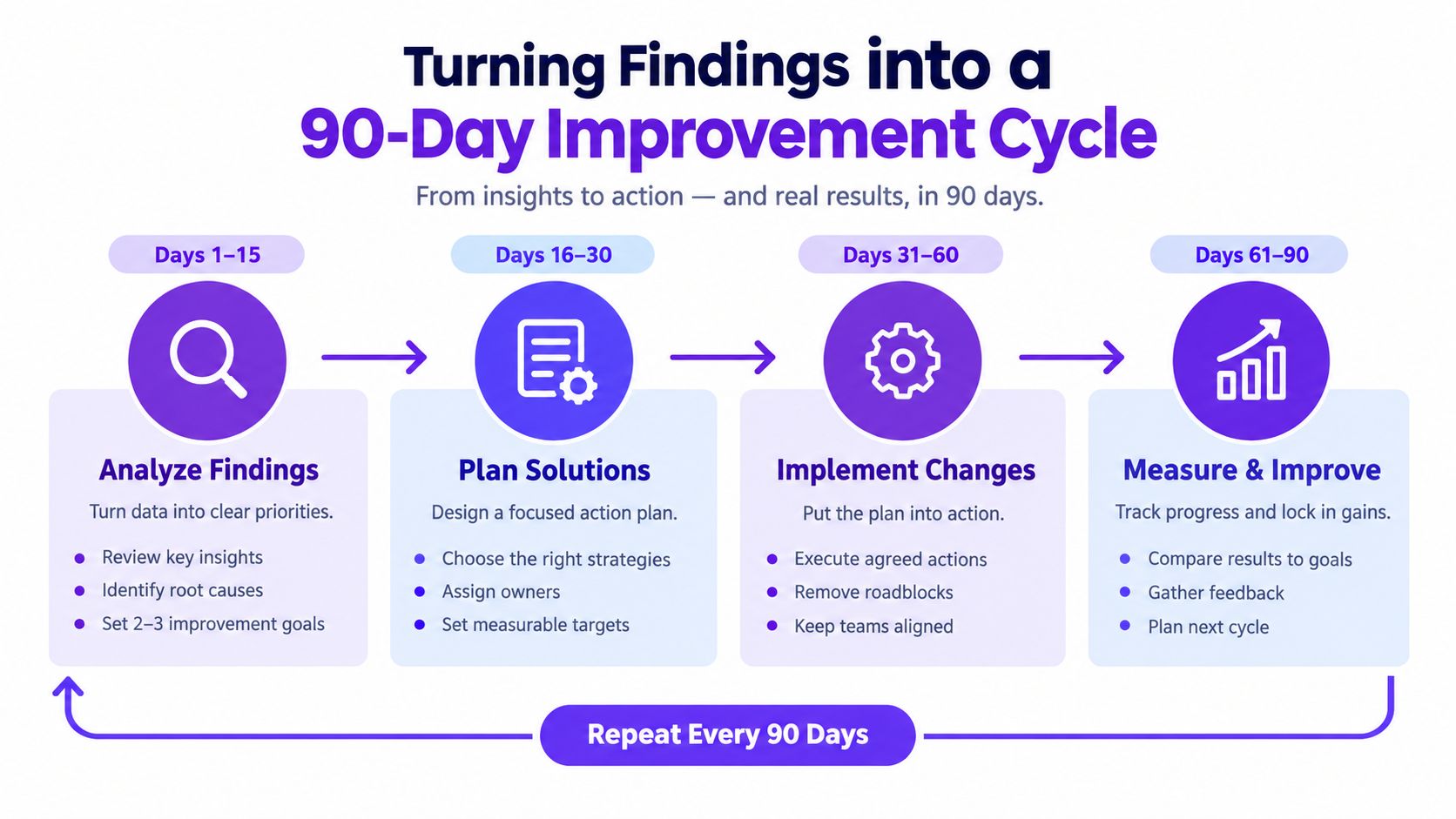
Use the timeline as a planning aid, adapting it to your delivery calendar.
Establish the baseline and choose a bottleneck
Begin by collecting the short pulse and matching work records. Share the findings with the whole team, including meaningful differences between roles where confidentiality allows, but never publish identifiable individual responses.
Ask employees what the pattern looks like during real work. A low resources score might mean overloaded calendars, missing customer information, or repeated interruptions rather than a need for new software.
Then choose the constraint that blocks the most important outcome. Write a testable goal tied to that constraint, such as broader participation from non-managers or a clearer route from selected concept to customer test.
- Name an owner: Someone must have the authority to protect the change when delivery pressure returns.
- Define the observation: Agree what you'll count and what would make the change worth keeping.
- Record competing explanations: Note staffing changes, unusual deadlines, or client restrictions that could affect results.
Run a small change and evaluate it
If time is the constraint, put protected exploration into the calendar and remove conflicting work. If reflection is weak, introduce a short debrief after tests. If decisions disappear, use a shared log that records the proposal, decision owner, rationale, and next action.
Choose the intervention that matches the evidence. These continuous improvement examples can help translate a broad concern into a manageable change.
Avoid launching unrelated fixes together. Otherwise, you won't know which change helped, and employees may experience the assessment as extra work rather than practical support.
Before the cycle closes, repeat the pulse using the same wording and collect the same behavioral measures. Decide whether to keep, adjust, or stop the intervention, and explain the decision to the team.
Reward learning rather than appearances
Recognize a well-designed test that rules out a weak idea, not just a fast launch. Otherwise, people may choose safe proposals to protect their visible success rate.
If a participation gap persists, investigate who gets interrupted, whose proposals receive serious consideration, and how managers respond to challenge. Rearranging the workshop calendar won't address those behaviors.
For teams working in design thinking, hackathons, or product development, we use Bulby to support structured idea work. Keep the assessment question separate: did the changed working method improve access, participation, or progress toward a useful test?
The improvement cycle succeeds when the team can explain what changed, what evidence supports that conclusion, and what it will try next.
Bulby offers structured brainstorming with anonymous idea sharing and AI-powered inspiration, giving your team a practical way to test changes in how people contribute. Visit Bulby to try the public demo without logging in, using the question “How might we improve team meetings to save time?”