

Business innovation models aren't just abstract theories; they're the practical blueprints that turn a spark of an idea into real-world results and lasting growth. They give you a structured way to think about how your company creates, delivers, and captures value.
Think of it less like a minor product tweak and more like rethinking the entire engine of your business. It's your recipe for not just surviving, but thriving.
Why Business Innovation Models Are Your Team's Blueprint for Growth
Staring down a huge goal without a clear plan is paralyzing. This is especially true for remote teams trying to connect the dots across different time zones and digital tools. Ideas get lost in Slack channels, brainstorming meetings go nowhere, and creative burnout starts to feel inevitable.
This is where innovation models step in to cut through the noise.
Instead of just crossing your fingers and hoping for a breakthrough, these frameworks give you a repeatable process to follow. They create a shared language that gets everyone—from developers to marketers—pulling in the same direction. It’s not just about managing ideas; it's about building a reliable engine for growth.
From Abstract Goals to Actionable Steps
A solid innovation model helps solve the classic problems that kill momentum, particularly when your team is spread out. By committing to a framework, you'll start to see real changes:
- Clarify Direction: Everyone finally gets the "why" and "how" behind a project, which cuts down on confusion and wasted time.
- Focus Creativity: Brainstorming stops being a free-for-all. Instead, you're channeling that energy toward solving specific problems, which leads to much better ideas.
- Streamline Decision-Making: The model gives you a clear set of criteria for judging new ideas, making it easier to decide what to pursue and what to put on the back burner.
- Encourage Participation: When there’s a clear process, people at every level feel empowered to contribute. You're no longer relying on just the loudest voices in the room.
An innovation model transforms creativity from a sporadic event into a systematic business capability. It’s the difference between catching lightning in a bottle and building your own power plant.
Fueling the Engine of Progress
You can see the impact of structured innovation everywhere. In 2023, companies poured a staggering $1.2 trillion into R&D, a 6.1% jump from the year before. That huge number shows just how critical business innovation models are to driving the global economy. The top companies aren't just spending money; they're investing it strategically.
At the end of the day, these frameworks are practical tools that build momentum. They’re not just for classroom discussion. To make sure your model truly acts as a blueprint for growth, you have to know how to validate product ideas fast.
Choosing the right model helps your remote team work together more smoothly, make smarter decisions based on data, and build a culture where great ideas don't just happen—they're engineered. For a closer look, check out our guide on the power of business model innovation.
7 Key Business Innovation Models Explained
Thinking about innovation can feel like trying to solve a puzzle without the picture on the box. You know you need to build something new, but the path forward is a bit of a mystery. That's where business innovation models come in. They're like proven playbooks that guide your team from a rough idea to a real-world solution.
Instead of starting from scratch every time, you can stand on the shoulders of giants. These models aren't strict rules; they're flexible toolkits. They give your team a shared language and a clear path, helping you channel all that creative energy into making smart, confident decisions.
This visual shows exactly how a structured model can turn the chaos of early ideas into a clear blueprint for growth.
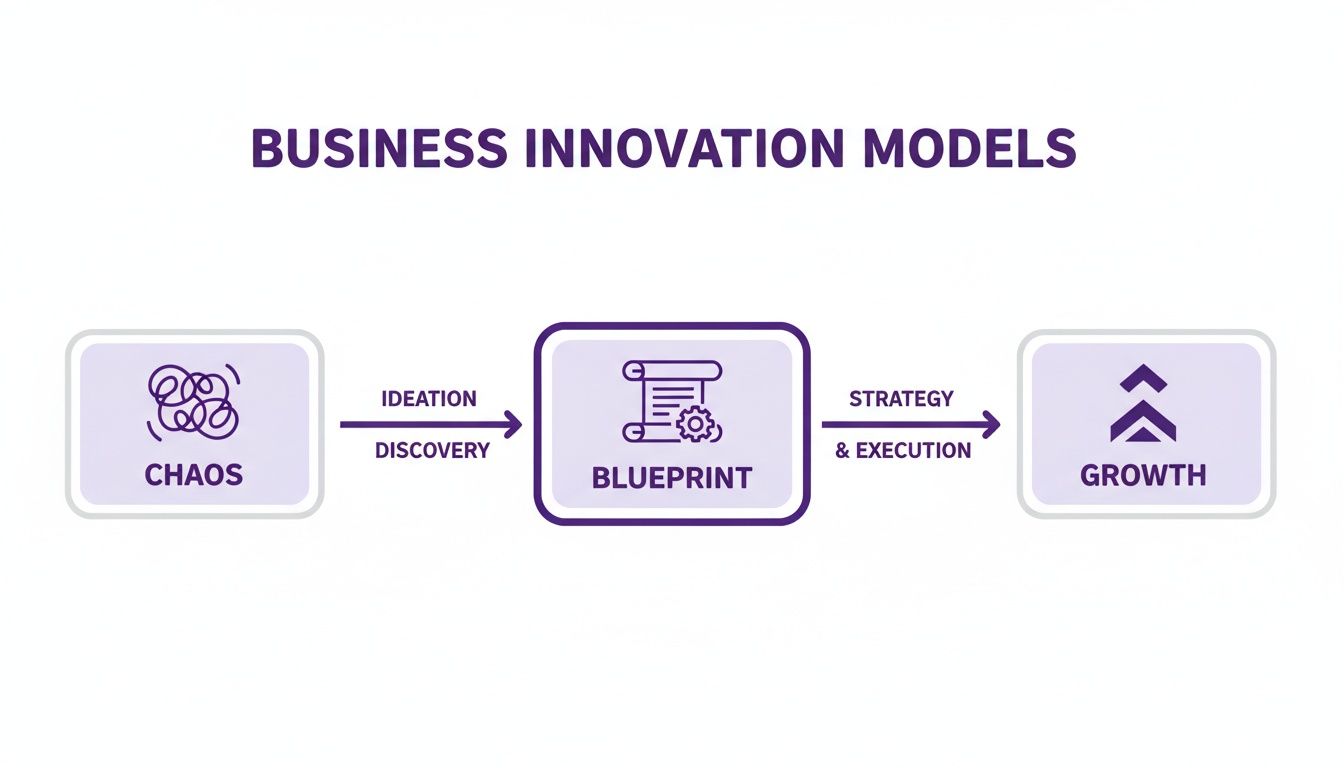
The journey from scattered thoughts to a scalable success story needs a plan. These models provide just that.
To help you get started, here's a quick rundown of seven of the most impactful innovation models being used today.
A Quick Guide to Key Business Innovation Models
This table breaks down each model, explaining what it’s all about, when it’s most useful, and which companies have famously put it into practice.
| Innovation Model | Core Focus | Best For | Real-World Example |
|---|---|---|---|
| Disruptive | Creating simpler, more affordable alternatives that start at the bottom of the market and move up. | Smaller companies challenging large, established players with complex or costly products. | Netflix (vs. Blockbuster) |
| Open | Sourcing ideas and solutions from outside the company (customers, partners, academia). | Solving complex problems, speeding up R&D, or when expertise is needed from various fields. | LEGO Ideas |
| Business Model | Changing how value is created, delivered, or captured, rather than changing the product itself. | Industries where products are becoming commodities or when customer access can be simplified. | Dollar Shave Club |
| Lean Startup | Rapidly testing ideas with a Build-Measure-Learn feedback loop and Minimum Viable Products (MVPs). | Startups and teams operating with high uncertainty, aiming to find product-market fit quickly. | Dropbox |
| Design Thinking | A human-centered process that uses empathy to solve complex problems for end-users. | Tackling ambiguous problems where understanding the user experience is critical to success. | Airbnb |
| Platform | Creating an ecosystem that connects two or more distinct user groups (e.g., producers and consumers). | Industries with fragmented supply and demand where a central hub can create significant value. | Uber |
| Frugal | Doing more with less by creating simple, affordable, and sustainable solutions for core needs. | Emerging markets or serving price-sensitive customers who value function over frills. | M-Pesa |
Each of these models offers a unique lens for looking at innovation. Let's dig a little deeper into how they work.
1. Disruptive Innovation
Disruptive innovation isn't about just building a better mousetrap. It’s about creating a completely new kind of trap—one that's cheaper, simpler, and initially appeals to customers the big players are ignoring. Over time, that new solution gets better and better, eventually pulling customers away from the old, established products.
Think of it as a small speedboat zipping past a massive cruise ship. The cruise ship is powerful and serves its existing passengers well. But the speedboat is nimble, serves a whole new crowd, and eventually changes how everyone thinks about getting on the water.
- When to Use It: This is the classic playbook for a smaller company looking to take on an industry giant with a complex and expensive product. You enter from the bottom and work your way up.
- Example: Netflix is the textbook case. They didn't try to out-Blockbuster Blockbuster. They started by serving a niche group of people who hated late fees. Their mail-order DVD service was seen as a novelty at first, but it steadily improved, pivoted to streaming, and ultimately made the entire video rental industry obsolete.
2. Open Innovation
The old-school mindset was that all the best ideas had to come from inside your own R&D lab. Open Innovation flips that script. It’s about deliberately looking outside your own four walls—to customers, startups, universities, and even competitors—to find fresh ideas, technologies, and solutions.
It’s like hosting a potluck dinner instead of trying to cook a five-course meal all by yourself. By inviting others to bring their signature dishes, you end up with a much richer and more interesting spread than you ever could have managed alone.
Open Innovation is built on a simple truth: not all the smart people work for you. It’s about creating a system to tap into that external brainpower to speed up your own progress.
This approach is more than just a trend. In 2023, 83% of executives either kept or increased their spending on innovation, and 79% of companies ranked innovation as a top-three priority. Many are turning to open models to get there faster. You can find more stats about the growing innovation management market and see how collaboration is driving growth.
- When to Use It: Go with open innovation when your internal R&D is costly, the industry is changing fast, or you're stuck on a tough problem that needs diverse perspectives to solve.
- Example: LEGO Ideas is a fantastic example in action. The platform lets fans submit their own designs for new LEGO sets. If an idea gets 10,000 votes, LEGO officially reviews it for production and shares a slice of the sales with the original creator.
3. Business Model Innovation
This one isn't about reinventing the product, but reinventing how the product gets to the customer. Business Model Innovation means rethinking fundamental parts of your operation—like your pricing, distribution channels, or customer relationships—to find a new competitive edge.
It’s like an orchestra creating a breathtaking new sound, not by inventing new instruments, but by completely rearranging how the existing ones play together. The pieces are familiar, but the result is something entirely fresh.
- When to Use It: This is a powerful move when your product is becoming a commodity, or when you spot a way to serve customers that’s fundamentally easier or more efficient.
- Example: Dollar Shave Club didn't invent a better razor blade. They innovated the business model. They sold decent razors for a low monthly fee, shipping them right to your door and completely sidestepping the retail game dominated by giants like Gillette.
4. Lean Startup
Made famous by Eric Ries, the Lean Startup model is all about speed and validated learning. The core of it is a simple loop: Build-Measure-Learn. Instead of spending a year perfecting a product in secret, you build a Minimum Viable Product (MVP)—the most basic version that works—and get it in front of real customers as fast as possible.
Think of it like a scientist running a series of small, quick experiments. Each test provides real data that guides the next one, preventing you from wasting a ton of time and money on a big bet that might be totally wrong.
- When to Use It: This is the go-to model for startups and even corporate teams navigating high levels of uncertainty. It helps you find out if people actually want what you're building before you run out of cash.
- Example: Dropbox used this method brilliantly. Before building out their complex file-syncing infrastructure, the founders just made a simple video explaining how the product would work. When the video went viral and their sign-up list exploded, they knew they were onto something big.
5. Design Thinking
Design Thinking is a deeply human-centered approach to solving problems. It all starts with building real empathy for the end-user to uncover the needs and frustrations they might not even be able to articulate themselves. The process generally moves through five key stages: Empathize, Define, Ideate, Prototype, and Test.
It's like being a detective who doesn’t just analyze the evidence at the crime scene. A great detective interviews witnesses, digs into motives, and tries to understand the "why" behind what happened. That’s what Design Thinking does for user problems.
- When to Use It: Use this when you're facing a messy, poorly defined problem, especially one where the human experience is at the heart of the solution.
- Example: Back when Airbnb was a struggling startup, its founders used Design Thinking to figure out why they weren't growing. They realized the photos on their listings were terrible. Their solution? They flew to New York, rented a nice camera, and went door-to-door taking professional pictures of their hosts' apartments. This empathy-driven fix doubled their weekly revenue almost instantly.
These are just some of the powerful frameworks for innovation available to guide your team's creative journey.
6. Platform Innovation
Instead of making and selling a product, platform innovation is about building a digital space—or ecosystem—where different groups can connect and create value for each other. The platform owner doesn’t create the service; they create the marketplace.
Think of yourself as a bridge builder. You don't make the cars or tell people where to go. You just build the essential infrastructure that allows all that traffic and commerce to flow smoothly.
- When to Use It: This model is incredibly powerful in markets where you have lots of fragmented buyers and sellers. A central platform can create huge value by making it easy for them to find each other.
- Example: Uber is a classic platform business. It doesn't own a fleet of cars or employ drivers in the traditional sense. It built a technology platform that seamlessly connects people who need a ride with drivers who are available, creating a win-win for both sides.
7. Frugal Innovation
Also known as "Jugaad" innovation in India, this model is all about doing more with less. It's focused on creating simple, affordable, and surprisingly effective solutions by stripping out non-essential features and using resources in clever ways. The goal is to deliver great value at a super low cost.
This is the art of building a perfectly functional shelter out of whatever materials you can find nearby. It’s not about luxury; it’s about meeting a core need in the most efficient way possible.
- When to Use It: Frugal innovation is a must in emerging markets, but it's also fantastic for creating accessible products for price-sensitive customers anywhere in the world.
- Example: M-Pesa in Kenya is a groundbreaking example. They built a revolutionary mobile payment system using simple SMS technology that worked on even the most basic cell phones. It solved a huge problem—lack of access to banking—without needing expensive smartphones or complex infrastructure.
How to Choose the Right Innovation Model for Your Team
Picking an innovation model isn't about grabbing the most popular one off the shelf. The best framework for your team depends entirely on your company’s DNA—where you stand in the market, how much risk you can stomach, and what you’re actually trying to achieve.
Getting this right is crucial. It gives your team a playbook that’s built for the game you’re actually playing. You’ll align your efforts, clarify the strategy, and avoid the classic trap of forcing a square peg into a round hole.
Start by Answering Three Critical Questions
Before you jump into any single framework, get your team together for an honest conversation. Your answers to the following three questions will act as a compass, pointing you toward the innovation model that makes the most sense right now.
Think of it as a quick strategic check-up.
What is your market position? Are you the established leader everyone else is chasing, or are you the scrappy underdog trying to carve out a niche? Leaders often need models that let them explore new ideas without wrecking their main business (like Open Innovation). Challengers, on the other hand, benefit from asymmetric attacks (like Disruptive Innovation).
What is your risk tolerance? How much time, money, and energy can you realistically afford to lose if an experiment goes south? A bootstrapped startup needs to find answers fast, making the Lean Startup model a perfect fit. A larger, well-funded company can afford to place bigger, long-term bets on more ambitious ideas.
What is the focus of your innovation? Are you trying to dream up a brand-new product? Or maybe you need to fix a clunky internal process? Perhaps the goal is to completely reinvent how you make money. A product goal might lead you to Design Thinking, while a revenue goal points straight to Business Model Innovation.
The right innovation model isn’t a rigid set of rules; it’s a flexible guide that helps you make smarter decisions under conditions of uncertainty. Its purpose is to structure your thinking, not restrict it.
Matching Your Situation to the Right Model
Once you’ve got clarity on those questions, you can start connecting your situation to the most appropriate models. While every company is unique, a few common scenarios pop up all the time.
Use this as a starting point for your team’s conversation:
- If you’re a challenger aiming to unseat an incumbent: Disruptive Innovation is your best bet. Find a neglected corner of the market and create a simpler, more affordable solution that incumbents are ignoring.
- If you’re facing a murky, ambiguous user problem: Start with Design Thinking. Its focus on empathy forces you to truly understand your customers' hidden needs before you even think about building a solution.
- If you’re a startup with high uncertainty and low funds: Embrace the Lean Startup model. The Build-Measure-Learn cycle is your lifeline, helping you find product-market fit without burning through your cash.
- If your product is solid but your growth is flat: It’s time for Business Model Innovation. Look beyond the product itself and explore new ways to create and capture value—like shifting from a one-time purchase to a subscription model.
To help structure these critical discussions, it’s worth exploring different decision-making frameworks for your team to make sure you land on the best approach together.
The Power of a Hybrid Approach
Here’s the thing: the most successful innovators rarely stick to just one model. They get creative and blend elements from different frameworks to build a custom approach that works for them.
This is where the real magic happens when applying business innovation models.
For example, a team might use the empathy-led discovery process of Design Thinking to uncover a major customer pain point. With that deep insight in hand, they could then switch gears to the Lean Startup model to rapidly build and test a series of minimum viable products (MVPs).
This hybrid method gives you the best of both worlds. You get the deep, human-centered insight to solve the right problem, combined with a fast, data-driven process to validate the solution. By staying flexible, you build a powerful innovation engine ready for whatever challenge comes next.
Bringing Innovation Models to Life with Remote Teams
It’s one thing to talk about innovation models in theory, but putting them into practice with a remote team? That’s a whole different ball game. Distributed teams are up against some unique hurdles, from the all-too-real "Zoom fatigue" to communication gaps that can kill a great idea before it gets off the ground.
But here’s the flip side: these challenges hide some serious opportunities. If you get it right, remote work can actually become an innovation superpower. It forces you to be more deliberate about how you communicate, document your work, and make sure everyone feels included.
The secret is adapting whichever model you choose to fit the reality of your distributed workforce. This means setting up structured virtual workshops, relying on async tools to keep work flowing, and consciously building a culture where people feel safe sharing their thoughts online.
Overcoming Common Remote Innovation Hurdles
Let's face it, a full day of video calls is enough to drain anyone's creative battery. To make innovation happen, you have to ditch the idea of a traditional all-day workshop and build a process that works with your team's energy, not against it.
Here are a few practical ways to get started:
- Structure Your Virtual Workshops: Don't even think about a single eight-hour marathon. Instead, break your brainstorming into shorter, laser-focused sessions spread out over a few days. Use digital whiteboards and other tools to keep everyone engaged and organized.
- Embrace Asynchronous Work: Not everything needs a meeting. Let your team contribute ideas, give feedback, and do their research on their own time. Shared docs, project boards, and quick video messages work wonders here.
- Build Psychological Safety: In a remote setting, it's way too easy for quieter voices to get lost. Use tools that allow for anonymous idea submission and structured feedback rounds. This helps ensure every idea is judged on its merit, not on who said it.
For remote teams, structure is freedom. A well-defined process doesn't stifle creativity; it creates the predictable and safe environment needed for bold ideas to emerge.
This idea of a structured approach isn't just a hunch; global data backs it up. The Global Innovation Index 2023 named Switzerland the world's most innovative economy for the 13th year in a row, with Sweden and the US close behind. These rankings show how strong national innovation frameworks drive progress, and they offer a blueprint for remote teams on how to build a creative engine, no matter where they are. You can check out the full World Intellectual Property Organization's 2023 report for more.
Adapting Models for a Remote-First World
The best innovation models are flexible enough to work beautifully in a digital-first environment. For example, an Open Innovation model gets a massive boost when you can build global digital communities to source ideas from a much wider pool of talent.
Likewise, a team running with the Lean Startup model can seriously speed up their Build-Measure-Learn loop. Remote user testing tools let you gather feedback from diverse customers all over the world in a fraction of the time it used to take. Tapping into global talent is another huge advantage. Bringing in dedicated offshore developers, for instance, can give you the specialized skills and speed needed to build and test prototypes quickly.
By thoughtfully adapting these frameworks, you can turn the so-called challenges of remote work into a real strategic advantage. For a deeper look, check out our guide on fostering innovation in remote teams. The goal isn't just a one-off brainstorm; it's to build a repeatable system that makes innovation a natural part of your remote culture.
Putting Your Innovation Model Into Action with Bulby
Picking one of the many business innovation models is a huge step, but honestly, it’s just the starting line. A great framework on paper is pretty useless without a solid process for actually doing something with it, especially when your team is spread out all over the place. This is where theory crashes into reality, and where a tool built for remote work can be a total game-changer.
Turning a model into a real project needs structure, clear communication, and a way to make sure everyone’s voice is heard. Without that support, even the best ideas can get lost in the digital chaos of remote work.
From Framework to Actionable Initiatives
Bulby is designed to be that bridge between your chosen innovation model and getting things done. It provides the structured playground remote teams need to turn abstract concepts into concrete, actionable steps. Instead of just talking about a model, you can run guided exercises that bring it to life.
For example, let's say your team has decided to go with Design Thinking. Bulby can walk you through an empathy mapping workshop, providing prompts and a clear flow to make sure you're digging deep into what your users actually need, not just guessing. This turns a complex methodology into a simple, repeatable process that anyone can follow.
The platform is really built to support the core ideas behind many popular innovation models:
- Guided Workshops: You get step-by-step exercises for frameworks like Design Thinking and Lean Startup, making sure every session is actually productive.
- AI-Powered Prompts: The AI is there to challenge your team’s hidden biases and groupthink, which is absolutely critical when you're trying to validate assumptions in a Lean Startup sprint.
- Inclusive Participation: Its structured, often asynchronous, features give every single team member a chance to contribute ideas without having to fight for the spotlight. The "loudest voice wins" problem just disappears.
This is what it looks like in action—creating a shared space where teams can visually organize ideas and build on them together.

This kind of organized layout helps everyone see the connections between different thoughts and keeps the whole process moving forward without losing steam.
A Practical Case Study: The "GreenRoute" Startup
Let's cook up a fictional startup called GreenRoute. Their mission is to build a B2B platform that helps logistics companies find the most efficient delivery routes to slash their carbon emissions. They decide on a hybrid approach, blending Design Thinking with the Lean Startup model.
Here’s how they could use Bulby to make it happen:
Empathy and Definition (Design Thinking): The fully remote GreenRoute team kicks things off with a guided empathy mapping session in Bulby. They use it to dump all their notes from interviews with logistics managers, quickly building a detailed persona that reveals their biggest headaches—not just high fuel costs, but the mounting pressure for sustainability reporting.
Ideation (Design Thinking): Next up, they run an idea-generation workshop. Bulby's prompts push them to think past the obvious stuff. One quiet team member, who rarely speaks up on video calls, anonymously drops in an idea to "gamify" carbon savings for drivers. The team loves it.
Prototyping and Testing (Lean Startup): With a core concept in hand, GreenRoute whips up a Minimum Viable Product (MVP)—a simple dashboard visualizing potential carbon savings. They even use Bulby’s AI features to draft unbiased questions for their first user interviews, making sure they get brutally honest feedback.
A tool like Bulby basically acts as the digital facilitator in the room. It keeps the process on track, pushes for deeper thinking, and makes sure the principles of your chosen innovation model are actually followed, not just talked about.
This structured process keeps the GreenRoute team from falling in love with their first idea. The feedback loop is tight and driven by data, which helps them pivot fast when they learn that their customers care way more about compliance reporting than driver gamification. Bulby helps them document these changes, creating a clear history of what they’ve learned. If you’re looking to sharpen your own facilitation, you might find some good inspiration in these creative innovation workshop ideas that work well alongside a tool-driven approach.
In the end, Bulby helps them turn their chosen innovation models from a textbook theory into a living, breathing system for building a product that people actually want.
Weaving Innovation Into Your Company's DNA
So, you’ve picked an innovation model. Great. But the real work is just beginning. Think of these models less as a one-and-done solution and more as a starting point. They aren't rigid instruction manuals. True success comes from weaving them together and adapting them as your team grows and the market shifts. It’s about building a culture where trying new things is second nature.
This all comes down to empowering your team to start small, run tests, and feel safe doing it. You're aiming for a system where innovation is just part of the daily grind, not some special, once-a-year event. For remote teams, getting this culture right is a game-changer. It turns the challenge of being distributed into a genuine advantage.
Think of an innovation model as a compass, not a map. It gives you a direction and a way to orient yourself, but you still have to navigate the actual terrain as you encounter it.
Taking That First Step
Building an innovative culture takes more than just a well-meaning Slack message. It requires a real system that gives everyone on your team the tools and the confidence to pitch in. You need to create a space where asking "what if?" is encouraged, where failed experiments are just learning opportunities, and where a great idea can come from anyone, anywhere.
By committing to a process that’s both structured and flexible, you stop talking about innovation and start doing it. It becomes a real capability, not just a buzzword. And the first step is always the simplest: just begin. Pick a model, run a small experiment, and let that initial spark build the fire that will move your team forward.
Got Questions? We've Got Answers
Diving into the world of business innovation models can feel a little overwhelming at first. Let's tackle some of the most common questions that pop up as teams start exploring these frameworks.
What’s the Best Innovation Model for a Small Startup?
For most startups just getting off the ground, the Lean Startup model is a fantastic place to start. It's all about moving fast, testing ideas with real customers, and not wasting precious time or money on things that don't work.
Think of it as a cycle: build a small version of your idea (the Minimum Viable Product, or MVP), get it in front of users, and learn from their feedback. This helps you find that sweet spot known as product-market fit without burning through your cash.
A lot of smart startups also weave in Design Thinking at the beginning. This ensures they’re solving a real, painful problem for their customers before they even write a single line of code.
Can We Mix and Match Different Innovation Models?
You absolutely can, and you absolutely should. The most innovative companies rarely stick to just one playbook. They create a hybrid approach that fits their unique situation.
A classic combo is using Design Thinking to get inside your customers' heads and really understand their world. Once you have a promising idea, you can switch over to the Lean Startup model to build and test it quickly.
Another example? A big, established company might use Open Innovation to bring in fresh ideas from the outside while also using a Disruptive Innovation lens to challenge its own long-standing products from within. Being flexible is the name of the game.
How Do We Know if Our Innovation Efforts Are Actually Working?
This is a big one. The key is to define what "success" looks like before you start and tie it directly to the model you're using.
There’s no magic, universal metric. It really depends on your goals.
- Using Lean Startup? You'll be watching metrics like how much it costs to acquire a new customer, how much that customer is worth over time, and how many people are signing up for your MVPs.
- Trying Open Innovation? You might track the number of high-quality ideas you get from partners or how much faster you can launch new products.
- Aiming for Disruptive Innovation? Success might look like capturing a small but growing slice of a market that the big players are ignoring.
The most critical step is setting those Key Performance Indicators (KPIs) upfront. That's how you know if you're winning.
Ready to put these ideas into practice? With Bulby, you can run guided brainstorming sessions that bring frameworks like Design Thinking and Lean Startup to life for your remote team. Start innovating today.