
The day before a client pitch, someone opens the deck and spots the problem. The agency is about to reuse a tagline it has already sold to three clients. The team has talent, good instincts, and plenty of experience. Its habits are narrow. The loudest voice wins, the first plausible idea survives, and nobody tests the obvious angle before the client does.
That's why creative brainstorming techniques matter. A method won't make weak thinking brilliant, but it can change who contributes, which assumptions get challenged, and when criticism enters the room. Alex Faickney Osborn's original approach separated idea generation from evaluation, a principle that still supports structured workshops and innovation sprints (the history of brainstorming and its four rules).
This list gives you ten practical methods for agency work. Each one names the bias it counters, explains the trade-off, and gives you a clear rule for using it in pitches, campaign briefs, and account reviews. For more perspectives on building creative systems, explore these innovation lab insights.
Table of Contents
- 1. Brainwriting
- 2. Mind Mapping
- 3. SCAMPER Method
- 4. The Six Thinking Hats Method
- 5. Reverse Brainstorming
- 6. The Walt Disney Creative Strategy
- 7. Forced Connections
- 8. Analogical Thinking
- 9. Brainstorming with Constraints
- 10. Role Storming
- Comparison of 10 Creative Brainstorming Techniques
- Matching the Right Technique to Your Next Session
1. Brainwriting
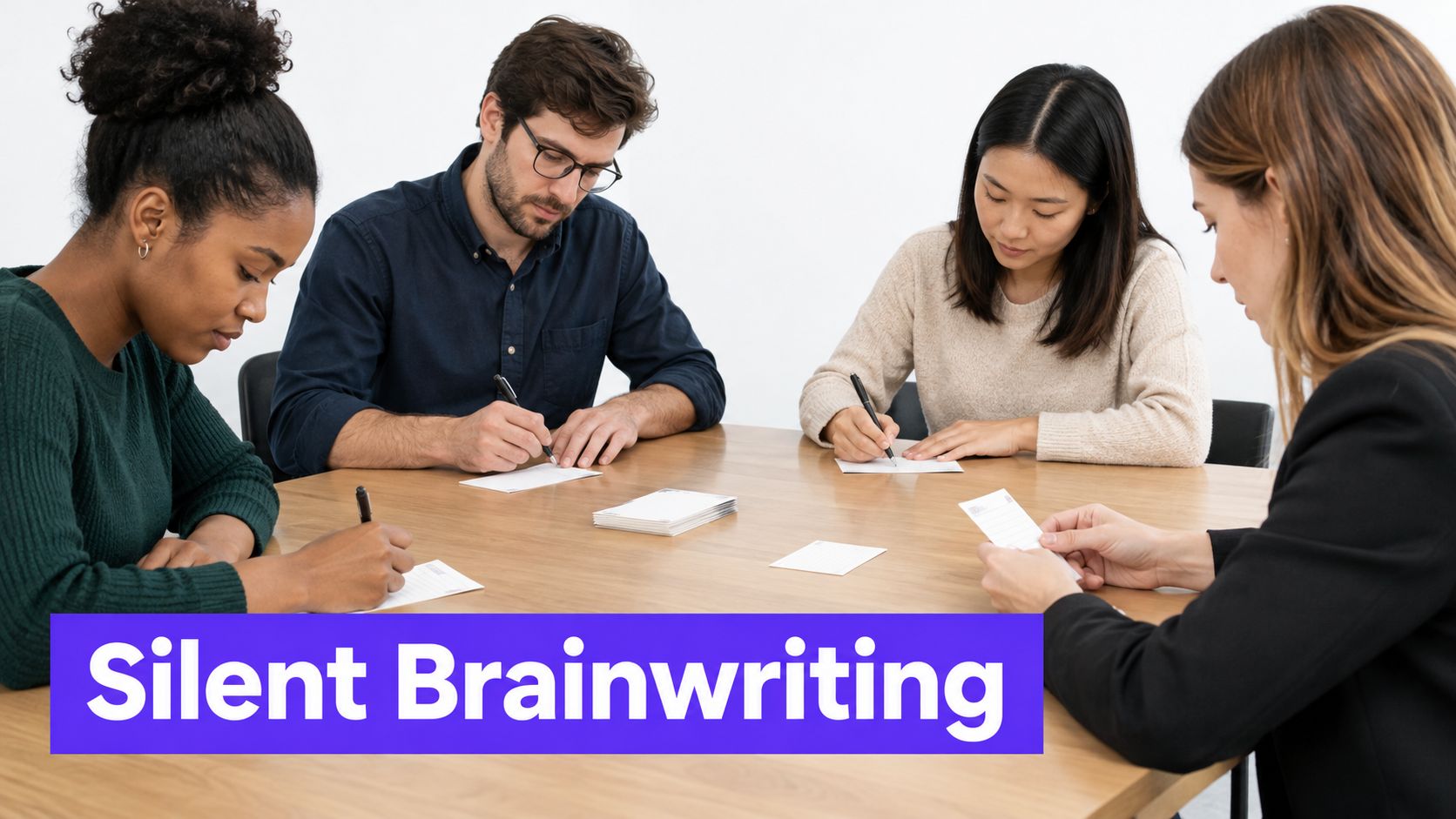
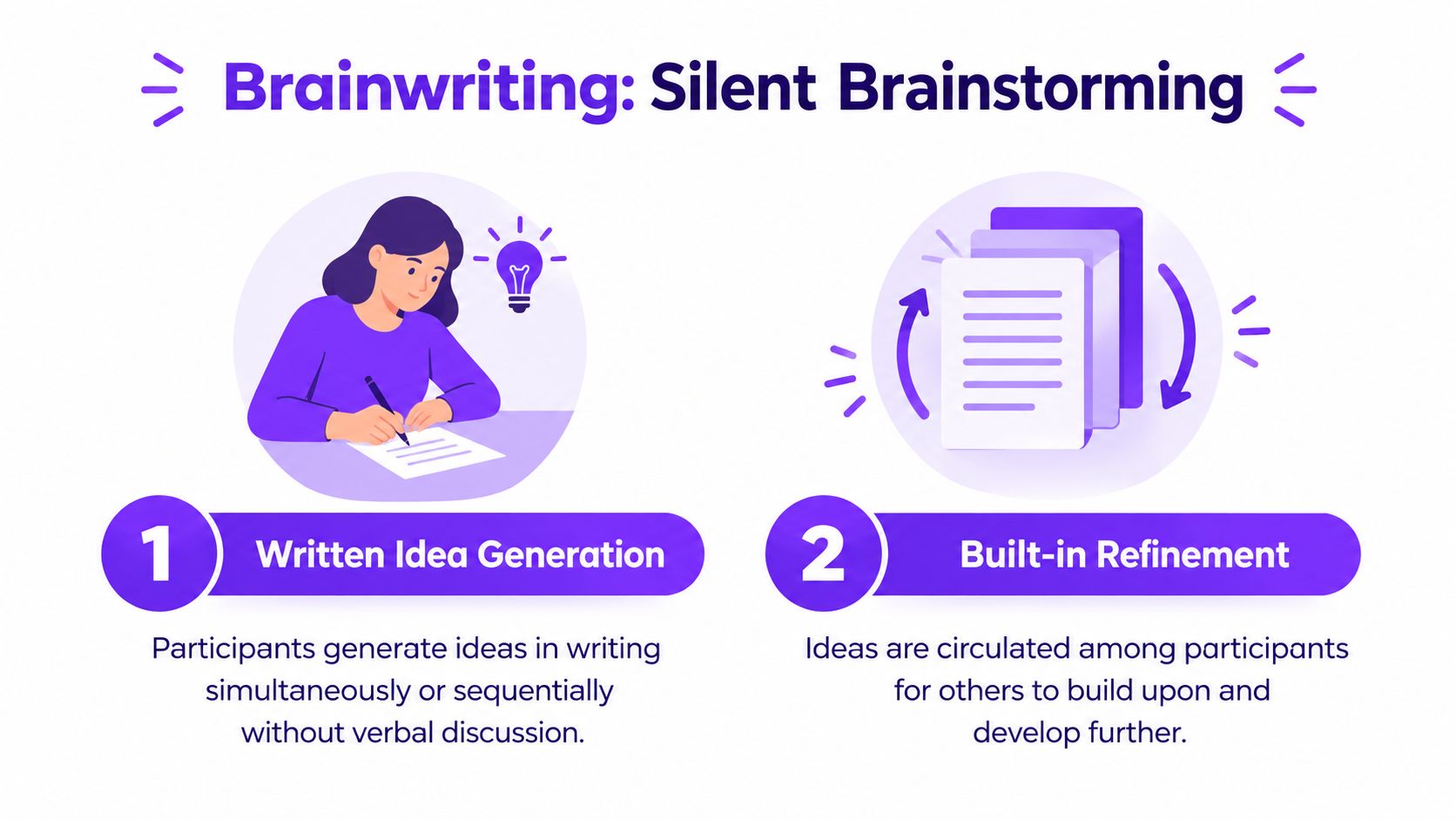
Brainwriting replaces the open-floor contest with quiet, written ideation. Everyone responds to the same brief independently, then passes ideas to colleagues who extend, combine, or challenge them without needing to speak first.
This directly counters production blocking, evaluation apprehension, and status bias. Only one person can talk at a time in a normal discussion, and junior staff may hold back when a creative director has already praised an early concept. Research comparing interactive and nominal groups found that independent idea generation followed by pooling typically produces more creative output than face-to-face discussion alone (the Yale brainstorming study and later review).
How to run it
Write one focused prompt, such as “Find a campaign idea that makes switching energy providers feel like an act of control.” Give everyone a short silent round. Collect the responses without names, then ask each participant to build on several ideas before the group sees the full set.
Use a shared board for remote sessions, or paper cards in a room. A practical anonymous brainstorming format can protect contributors from early judgment while still allowing the team to discuss and develop the strongest directions later.
Practical rule: Use brainwriting when the loudest voices dominate, when the team is remote, or when a senior stakeholder's opinion could anchor the room too early.
The trade-off is speed of discussion. You'll spend less time talking at the start, but you'll need a deliberate clustering and review stage. Don't turn the first silent round into an editing exercise. Capture rough thoughts first, then improve them.
2. Mind Mapping
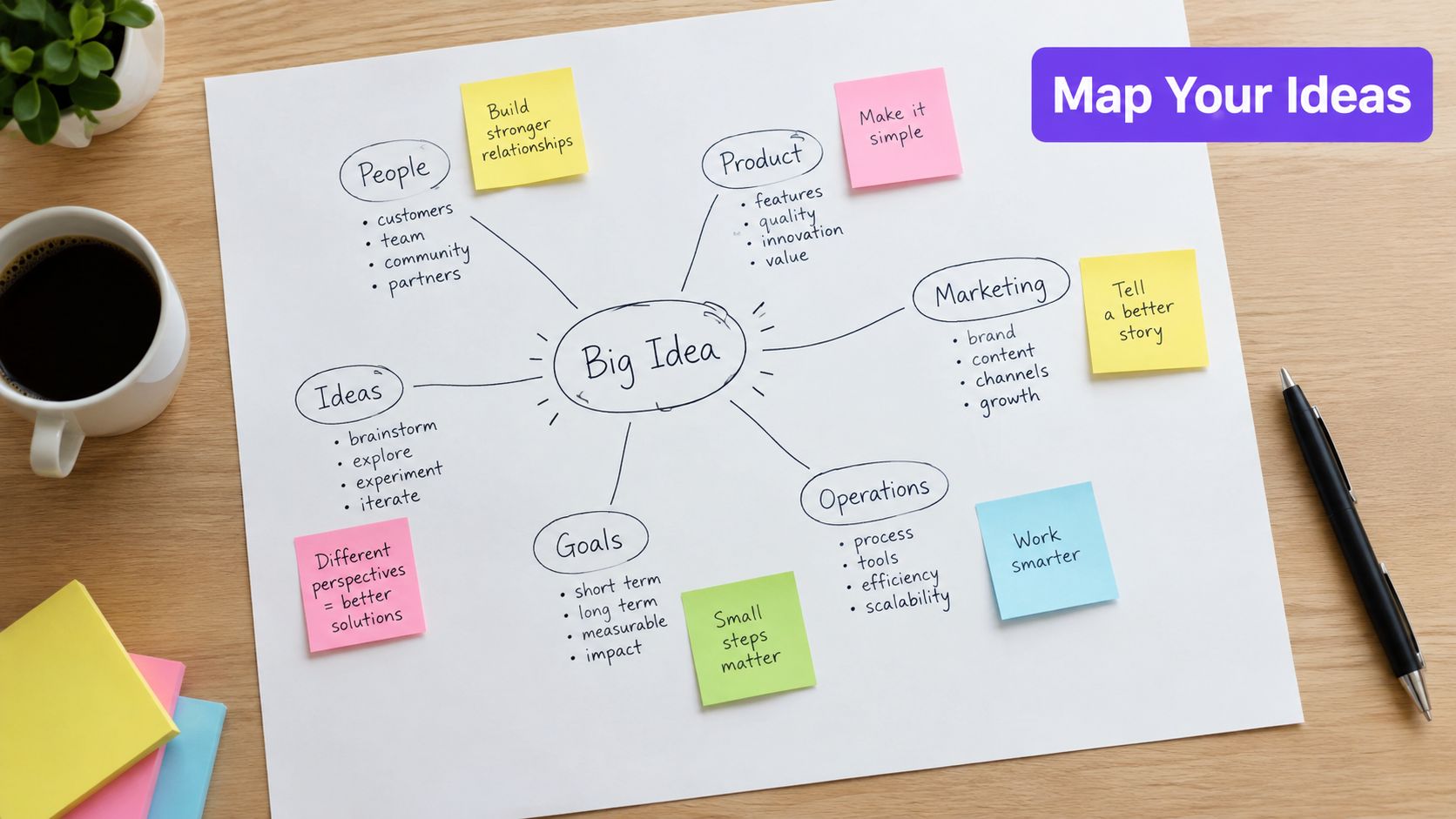
A mind map is useful when the brief feels broad, tangled, or full of disconnected inputs. Put the central challenge in the middle, then branch into audiences, tensions, product truths, cultural cues, channels, and possible outcomes.
It counters linear thinking and premature narrowing. In a conventional meeting, the team may follow the first interpretation of the brief and keep adding detail to it. A radial map makes alternative paths visible. A content strategist can start with a campaign promise, branch into audience anxieties and desired behaviors, then connect those branches to formats and proof points.
Use the map to expose connections
Begin with a precise center. “Launch campaign” is too vague. “Make first-time renters feel confident choosing our insurance” gives the team something useful to explore.
Keep the first pass loose. Add words, symbols, rough images, and uncomfortable associations without scoring them. Then reorganize the map. Look for a branch that has emotional relevance but no execution yet, or a product strength that hasn't been connected to an audience need.
Concept maps and mind maps for collaborative ideation can help distributed teams build the same visual structure without crowding around one whiteboard.
Use this method for a new campaign brief, a brand-positioning review, or an account where the client keeps describing the problem in general terms. Don't use it when you already have a sharply defined decision and need to choose between a small set of concepts. The map will create more territory when the team needs a decision.
3. SCAMPER Method
SCAMPER is a useful stress test for an idea that already exists. Its prompts ask the team to substitute, combine, adapt, modify, put to another use, eliminate, or reverse parts of a product, message, experience, or campaign.
It counters functional fixedness and attachment to the first concept. Teams often treat an approved direction as finished, then make only cosmetic changes. SCAMPER forces a more uncomfortable question: what happens if we alter the structure rather than the surface?
Apply the prompts to the brief
Take a familiar campaign platform and move through the prompts deliberately. Could you substitute the spokesperson with a customer? Combine the product demonstration with a public service? Adapt the idea for an unexpected setting? Eliminate the voice-over? Reverse the audience journey so the proof appears before the promise?
You don't need to force a usable answer from every prompt. The value comes from testing the idea from several angles. A campaign team might discover that “put to another use” creates a retail activation, while “reverse” reveals a stronger opening for social video.
For a broader set of creative thinking exercises for groups, use the same principle: give people a clear frame, then make the frame flexible enough to produce variations.
Use SCAMPER when: You have a promising platform that feels familiar, or a client wants more routes without approving an entirely new strategy.
The main trade-off is false novelty. A modified idea can look fresh while keeping the same weak assumption underneath. After the exercise, test each variation against the brief, the audience tension, and the brand's right to speak.
4. The Six Thinking Hats Method
Some teams generate strong ideas but review them badly. A strategist raises a factual concern while a creative is still exploring. An account lead jumps to the client's likely objection. The group then treats one person's risk response as a final verdict.
Six Thinking Hats counters mode confusion and personal conflict by asking everyone to use the same perspective at the same time. The white hat focuses on facts and missing information. Red covers emotion and instinct. Black examines risks. Yellow looks for value. Green creates alternatives. Blue controls the process and records decisions.
Change the question, not the person
For a pitch concept, begin with green thinking and generate possibilities without judgment. Move to white thinking to identify what the team knows and what it's assuming. Use red thinking to ask how the idea feels to the audience. Bring in black thinking only after the concept has had space to develop.
A client-review rehearsal can use the sequence to anticipate objections without letting objections kill the idea. The team might ask what evidence supports the promise, where the campaign could be misunderstood, and which emotional response the work should create.
The method works best when the facilitator announces each shift. A colored card on a video call or a physical hat in the room can make the change visible. Parallel thinking explained for collaborative decisions offers a useful reference for keeping the perspectives separate.
Use this technique for a high-stakes pitch, a difficult approval meeting, or a campaign that has drawn conflicting feedback. It can feel theatrical with a small team, so keep the language simple and focus on the discipline rather than the props.

5. Reverse Brainstorming
Ask the team, “How could we make this campaign fail?” The question changes the energy immediately. Instead of defending the preferred route, people look for ways the idea could confuse the audience, trigger resistance, miss the brand, or collapse in execution.
Reverse brainstorming counters optimism bias, confirmation bias, and planning fallacy. Teams that love an idea tend to collect reasons to protect it. A failure-focused round gives skepticism a defined job without turning one participant into the permanent pessimist.
Turn risks into design decisions
Start with a specific failure condition. “How could this product launch become irrelevant to younger buyers?” produces better material than “What could go wrong?” List the answers quickly. The campaign might sound like an industry lecture, rely on a claim nobody believes, or ask the audience to do too much.
Then reverse each point into a prevention question. If the message feels generic, how could the team make the product truth visible? If the audience doubts the promise, what proof could appear in the first interaction? Record both the risk and the response so the account team can explain the reasoning later.
Use reverse brainstorming when a client is worried about reputational risk, when a rebrand has internal opposition, or when the pitch needs a strong objection-handling section. It's also useful during an account review, before a small issue becomes an expensive production change.
The method can become unproductive if people use it to display cynicism. Set a clear boundary. The point isn't to prove the idea is bad. The point is to make the idea harder to break.
6. The Walt Disney Creative Strategy
The Walt Disney strategy separates the room into three roles: Dreamer, Realist, and Critic. The Dreamer imagines the most ambitious version of the idea. The Realist works out how the team could deliver it. The Critic looks for gaps, risks, and improvements.
This counters premature criticism and role blending. In many agencies, the same person tries to be visionary, practical, and skeptical in one sentence. The result is a safe idea with its own brakes already attached.
Move through the roles in order
Start with the Dreamer. Ask what the campaign would do if the team had permission to be bold. Don't discuss production, media, legal, or client comfort yet. Capture the concept in its strongest form.
Then switch to the Realist. Define the audience action, message, channel behavior, production needs, and dependencies. A large experiential idea may become a focused social mechanic. A vague brand film may become a clear series of customer stories.
Finish with the Critic. Ask what the audience might reject, what the client might challenge, and where the idea loses strategic connection. Criticism should produce a revision, not a dismissal.
Separate the creative role from the review role. Otherwise the reviewer wins before the idea has been properly described.
Use this method for integrated campaigns and ambitious pitch platforms that need both imagination and a credible delivery path. It can feel slow for a simple headline task. In those cases, use a shorter version with one strong concept rather than processing every rough thought.
7. Forced Connections
Forced connections deliberately joins things that don't naturally belong together. For an agency team, that could mean combining a financial brand's trust promise with the rituals of a neighborhood restaurant, or pairing a product feature with a behavior from live entertainment.
This counters semantic fixation and industry tunnel vision. Marketing teams often search their own category for inspiration, then produce work that resembles the category. A forced connection introduces a different structure, rhythm, or emotional code.
Build a small combination grid
Create a few columns based on the brief. One column might list audience situations. Another can list cultural behaviors. A third can hold brand assets or product truths. Select combinations deliberately or at random, then ask what a campaign would look like if those elements belonged together.
The first results will be awkward. That's useful. “A mortgage application as a backstage pass” may be unusable, but it could reveal a stronger idea about access, preparation, or confidence.
Keep the evaluation separate from the generation. First ask what the combination suggests. Then test whether it has audience relevance, brand linkage, and a workable execution. Lateral thinking techniques for breaking familiar patterns can help facilitators create better prompts for the exercise.
Use forced connections when a pitch needs a distinctive territory, when category conventions are strong, or when the team has exhausted obvious campaign angles. Don't use it as a substitute for audience understanding. Strange combinations only become valuable when they connect back to a real human tension.
8. Analogical Thinking
Analogical thinking asks how another field handles a similar problem. A campaign team working on customer onboarding might study a museum guide, a sports coach, or a theme-park queue. The goal isn't to copy the surface. It's to borrow the underlying system.
This counters industry assumptions and solution blindness. A team may believe that its category's usual format is the only credible one. Analogy breaks that rule by changing the reference point.
Find the structure underneath
State the problem without marketing language. Instead of “How do we make our onboarding content more engaging?”, try “How do we help a nervous person take the next step without feeling lost?” Then list unrelated domains that solve a similar problem.
A coach breaks a difficult skill into stages. A museum guides attention through a sequence. A good host makes an unfamiliar guest feel expected. Each analogy offers a different design principle that the team can translate into messaging, content, service, or campaign experience.
For a brand-positioning session, ask each participant to bring an analogy from outside advertising. Push beyond predictable references such as “this brand is like Apple.” The useful analogy may be a train conductor, a street market, or a rehearsal room.
Use the method for breakthrough positioning, a stale category brief, or a pitch where every route looks like a competitor's work. The risk is decorative comparison. If the analogy only supplies a visual style, it hasn't improved the strategy. Make the team explain what behavior or system it contributes.
9. Brainstorming with Constraints
Unlimited brainstorming sounds generous, but it often produces familiar ideas. Add a real constraint and the team has something specific to solve. Limit the platform, channel, audience action, production approach, or available brand asset.
This counters choice overload and abstraction. A vague prompt lets people hide behind broad concepts. “Create a campaign” is difficult to act on. “Create a campaign that works through one customer action and one recurring visual device” gives the team a sharper creative problem.
Make the constraint visible
Write the limits at the top of the board. For a pitch, the constraints might include the client's existing product proof, a specific audience tension, and a fixed channel environment. For an account review, ask how the idea could work with fewer production dependencies or a simpler content system.
Start with a wider round if the team needs exploration. Then tighten the frame. A campaign idea may begin as a broad emotional platform and become more useful when the team must express it through a single interaction, a short film, or a recurring social format.
Use constraint-based ideation when the budget and timeline are fixed, when the client has rejected expansive routes, or when the team keeps generating ideas nobody can produce. The method can over-tighten thinking, so distinguish between real constraints and temporary creative rules. Remove artificial limits during a later expansion round if they're blocking a stronger direction.
A good constraint doesn't make the work smaller by default. It makes the decision visible.
10. Role Storming
Role storming asks participants to generate ideas as someone else. A strategist might speak as a skeptical buyer. A designer might take the role of a competitor. An account lead might act as the client's legal reviewer or a customer who has never heard of the category.
This counters egocentric bias, professional bias, and false consensus. Agency teams know the brief, the brand history, and the internal vocabulary. The audience may not. Role storming makes that gap harder to ignore.
Give every role a point of view
Write a short role card with priorities, fears, language, and a reason to care. “Customer” is too broad. “First-time buyer who distrusts hidden fees” gives the team something concrete. “Competitor brand manager protecting market leadership” creates a different perspective.
Run the roles in sequence. Ask the buyer what would make the message believable. Ask the competitor what weakness it would attack. Ask the brand steward what must remain recognizable. Then switch roles so people don't settle into the first perspective they receive.
Use the method for a client pitch, a campaign that has been developed entirely inside the agency, or an account review where the team needs to understand why work keeps getting rejected. Ground roles in customer research and known stakeholder concerns. Otherwise, participants may perform stereotypes instead of generating useful insight.
Capture which role produced each idea, but don't treat the source as a quality score. A surprising observation from a competitor role may reveal a real weakness in the brief. The facilitator's job is to test it, not dismiss it because it arrived through play.
Comparison of 10 Creative Brainstorming Techniques
| Technique | 🔄 Implementation complexity | ⚡ Resource requirements (speed/efficiency) | ⭐ Expected effectiveness | 📊 Expected outcomes | 💡 Ideal use cases / Key advantages |
|---|---|---|---|---|---|
| Brainwriting (Silent Brainstorming) | Medium, set rounds and circulation rules | ⚡ Moderate, small groups, paper or digital tools; slower than verbal | ⭐⭐⭐⭐, high idea quantity and quality | High volume of documented ideas; layered refinements | Great for remote/distributed teams, introverts; reduces groupthink |
| Mind Mapping | Low–Medium, easy to start, needs upkeep | ⚡ Moderate, whiteboard or digital mapping tools | ⭐⭐⭐⭐, strong for relational insight | Visual organization of themes; reveals connections | Best for complex topics, planning, visual thinkers |
| SCAMPER Method | Low, checklist-driven, easy to teach | ⚡ Moderate, facilitator + prompts; low tooling | ⭐⭐⭐, reliable, practical variations | Incremental innovations and implementable options | Useful for product/campaign tweaks and repositioning |
| Six Thinking Hats | Medium–High, requires training and structure | ⚡ Moderate, time blocks per hat, visual cues | ⭐⭐⭐⭐, balanced multi-angle evaluation | Diverse perspectives captured; fewer conflicts | Ideal for strategic sessions, contentious teams, client prep |
| Reverse Brainstorming | Medium, needs clear reframing and facilitation | ⚡ Moderate, low tooling; risk of slower mood | ⭐⭐⭐⭐, uncovers hidden risks and novel fixes | Risk identification; unconventional solution leads | Use when teams are stuck or to build contingency plans |
| Walt Disney Creative Strategy | High, sequential roles, spatial/temporal shifts | ⚡ Low, time- and space-intensive | ⭐⭐⭐⭐, comprehensive creative + feasibility | Fully developed ideas with practical checks | Best for major campaigns, storytelling, deep development |
| Forced Connections (Morphological Analysis) | Medium, matrix design requires thought | ⚡ Moderate, research + matrix tools; can be large | ⭐⭐⭐⭐, high novelty potential | Many unusual combinations; unique campaign angles | Strong for unique positioning and exploring possibility space |
| Analogical Thinking | Medium, needs good analogy selection | ⚡ Moderate, research-heavy for good analogies | ⭐⭐⭐⭐, breakthrough potential when analogies fit | Cross-domain solutions; memorable metaphors | Excellent for breakthrough campaigns and repositioning |
| Brainstorming with Constraints | Low–Medium, define useful constraints upfront | ⚡ High, fast, focused sessions under limits | ⭐⭐⭐⭐, yields practical, implementable ideas | Feasible concepts tailored to real project limits | Ideal for tight budgets, fast turnarounds, platform rules |
| Role Storming (Role-Based Brainstorming) | Medium, persona prep and role guidance | ⚡ Moderate, personas, facilitation; can be playful | ⭐⭐⭐⭐, diverse stakeholder insights | Empathy-driven ideas and stakeholder-specific angles | Best for messaging, customer-centric campaigns, stakeholder alignment |
Matching the Right Technique to Your Next Session
Don't run all ten techniques in one workshop. That creates activity without direction. Pick the method that matches the problem in front of you, then give it enough structure to produce material the team can review.
Use brainwriting when the loudest voices dominate or when the team needs independent thinking before discussion. Use reverse brainstorming when a client is worried about risk, when the concept has attracted strong internal attachment, or when the team needs to anticipate objections. Use constraint-based ideation when the budget, timeline, platform, or production model is already fixed.
A useful session has two distinct phases. First, protect divergence. Let people produce, combine, sketch, question, or challenge without asking them to defend every idea. Then move into evaluation with a shared rubric. Assess audience relevance, strategic fit, distinctiveness, brand connection, feasibility, and the potential to earn attention. That separation matters because only a minority of agencies and marketers consistently use briefs to evaluate ideas, while research from the advertising industry also describes creative evaluation as subjective and inconsistent (the WFA findings on idea evaluation).
AI adds another decision. Treat it as a stimulus or synthesis partner, not an automatic replacement for human ideation. Research summarized by Wharton found that ChatGPT-assisted groups produced narrower idea sets, while other evidence found that exposure to AI ideas could reduce people's subsequent creative fluency and originality (the evidence on AI and creative diversity). For agency work, let people generate privately before showing AI suggestions. Then ask the team to create an anti-AI round that deliberately avoids the most obvious machine-shaped patterns.
Run the chosen method once. Log which ideas survived client or internal review, which criteria separated strong ideas from attractive distractions, and where the process stalled. Use that record to adjust the next session. A practical brainstorming guide can provide more prompts, but your own review history should determine what your agency repeats.
Bulby can guide teams through structured steps from raw ideas to more focused outcomes. That can help strategists, creatives, and account teams keep the session moving without letting the review stage arrive too early.
Bulby gives marketing and creative teams guided brainstorming and brainwriting exercises, including anonymous contribution and prompts that help people move beyond habitual ideas. Visit Bulby to structure your next pitch, campaign brief, or account review from first thought to client-ready direction.