

Ever been on a video call, staring at a grid of faces, waiting for a brilliant idea to magically appear? It’s a familiar scene, but genius rarely strikes on command. The truth is, old-school, unstructured brainstorming just doesn't cut it for modern remote and hybrid teams. It often leads to more frustration than innovation.
Why Old Brainstorming Methods No Longer Work

Just throwing everyone on a call and asking "any ideas?" usually creates a creative traffic jam. The loudest voices tend to dominate the conversation, while the quieter, more introverted team members hold back. This isn't a problem with your team; it's a problem with the method. Without a clear framework, great ideas get lost in the noise or never get shared in the first place.
This all-too-common scenario gets worse because of powerful cognitive biases that can completely derail productive idea generation for business.
- Groupthink: People start to agree with the first few ideas to keep the peace, which shuts down more creative or out-of-the-box thinking.
- Anchoring Bias: The team latches onto the very first concept shared, and all subsequent ideas are measured against it, which severely limits exploring other, potentially better, paths.
These biases create an environment where the best idea doesn't win—the first or most popular one does. This free-for-all approach is especially clunky for remote teams, where the digital format can make silences feel more awkward and make it harder to pick up on social cues. You can dive deeper into the core principles of this process in our detailed definition of ideation.
The goal isn't just to get ideas; it's to create a space where the best ideas can surface from every team member, regardless of their personality or position.
This is exactly why having a structured process is so important. In fact, recent studies show that simple changes like allowing anonymous idea submissions or structured turn-taking can boost contributions from quieter participants by a massive 40–60%. The right process really does deliver better results.
What’s needed is a system that gives everyone psychological safety and a level playing field. It's time to transform brainstorming from a disorganized mess into a focused, productive, and truly inclusive exercise.
The Simple Science Behind Better Ideas
Great ideas don't just magically appear. They're the product of a well-defined process, one that's less about a mythical spark of genius and more about a repeatable system built on some simple cognitive principles. If you want to unlock consistent innovation, you first have to understand the "why" behind the method.
At the heart of it all are two very different ways of thinking: divergent and convergent.
Imagine you're standing at the edge of a huge, unexplored forest. First, you need to fan out and explore as many paths as you can find. This is divergent thinking—going wide, generating a ton of options, and not worrying about quality just yet. The goal is sheer volume.
Once you’ve mapped out all the potential trails, it’s time to switch gears. Now, you need to analyze those paths and choose the single best route to your destination. This is convergent thinking. It’s the critical, analytical phase where you evaluate, refine, and select the most promising ideas from the big list you just created.
Creating the Right Environment
A good process isn't just about organizing thoughts; it's about managing the human element. For genuine creativity to flourish, people need psychological safety. This is the shared belief that you won't be shut down or embarrassed for sharing a half-baked idea, asking a "silly" question, or making a mistake.
When team members feel safe, they’re far more likely to toss out those weird, unconventional thoughts that often become the seeds of a breakthrough. This kind of environment also nurtures cognitive diversity, which is key to seeing a problem from every possible angle. If you're curious, you can learn more in our guide on what cognitive diversity is.
A structured process ensures every single voice gets heard, flattening hierarchies and stopping the loudest person in the room from steering the whole conversation.
The real power of a structured process is that it creates an equitable playing field. It gives everyone permission and a clear pathway to contribute their unique perspective, leading to a richer, more diverse pool of ideas.
The Measurable Impact of Structure
Moving from chaotic brainstorming to a structured approach isn't just about feeling more organized—it delivers real, measurable results.
For many teams, an unstructured brainstorm feels familiar but often leads to a few dominant voices and a narrow set of ideas. A structured, guided process, especially for remote teams, changes the game completely.
Let's compare the two.
Unstructured Brainstorming vs Structured Ideation
| Characteristic | Unstructured Brainstorming | Structured Ideation |
|---|---|---|
| Participation | Dominated by a few loud voices; quieter members stay silent. | Equal opportunity for all to contribute, often anonymously. |
| Idea Quality | Tends to circle around familiar, safe concepts. | Encourages diverse, unconventional, and high-quality ideas. |
| Efficiency | Often disorganized, runs off-topic, and lacks clear outcomes. | Focused, time-bound exercises with a clear goal and output. |
| Psychological Safety | Low; fear of judgment stifles creative risk-taking. | High; process is designed to be inclusive and non-judgmental. |
| Follow-Through | Ideas get lost; no clear next steps or ownership. | Built-in steps for evaluation, prioritization, and action. |
The difference is clear. A bit of structure doesn't stifle creativity; it channels it into something powerful and productive.
The numbers back this up. Companies that use guided ideation techniques report converting 10–25% of their raw ideas into actual, validated experiments. That's a huge leap from the 2–8% typically seen with unstructured methods.
For remote teams, the impact is even more pronounced. Structured platforms can boost participation rates by a staggering 30–60%. As you can see from the Global Innovation Index analysis on WIPO, having a system isn't just a nice-to-have; it's a reliable engine for innovation.
Proven Idea Generation Techniques You Can Use Today
Alright, now that we have a feel for the thinking behind great ideas, let’s get our hands dirty. It’s time to move from theory to practice. These are tried-and-true techniques you can start using right away to come up with better business ideas, and they work especially well for remote or distributed teams.
Think of the idea process as a journey. You start wide, exploring tons of possibilities, and then you gradually narrow things down to the very best ones. This visual breaks it down nicely.
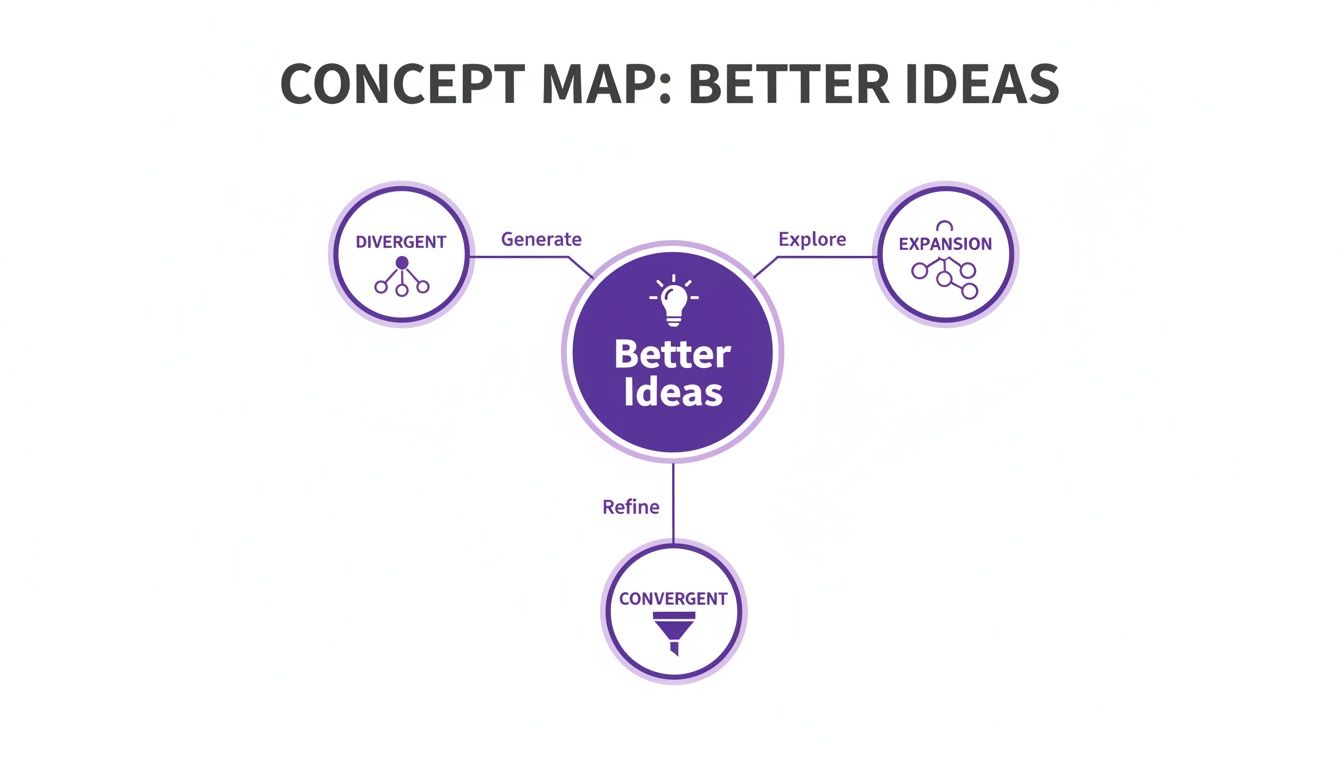
This map shows the core path every solid idea follows: you diverge to create options, then converge to make a decision. The methods below are designed to walk your team through this exact flow.
Round Robin Brainstorming for Equal Airtime
Let's be honest—one of the biggest headaches in any brainstorming session is making sure everyone actually gets to contribute. Round Robin brainstorming cuts through the noise by creating a simple, turn-based system where everyone gets a turn.
Here's how it works:
- Frame the Problem: The facilitator kicks things off with a clear question or challenge.
- Go Around the Room: Each person shares one idea when it's their turn. Simple as that.
- No Pressure to Pass: If someone is drawing a blank, they can just say "pass," and the turn moves to the next person.
- Keep It Going: You can continue for a set number of rounds or until time is up.
This approach is a lifesaver for remote teams, completely getting rid of that awkward dance where people talk over each other on video calls. It forces everyone to listen and often helps build on the ideas that have already been shared.
For an even quieter, written version, give brainwriting a shot. It's a fantastic alternative for more introverted team members. You can learn more about this silent but powerful method right here: https://www.remotesparks.com/brainwriting/.
Reverse Brainstorming to Uncover Problems
Sometimes, the most direct path to a brilliant idea is to think about everything that could go wrong. Reverse brainstorming flips the whole script by asking you to focus on problems, not solutions.
Instead of asking, "How do we succeed?" you ask, "What could absolutely wreck this project?" or "How could we create the worst possible customer experience?"
By intentionally seeking out potential failures, you start to see hidden weaknesses and risks you might have missed otherwise. Once you have a good list of problems, you just flip them back into positive challenges. For example, a problem like "Our checkout process is way too confusing" becomes a challenge: "How can we make our checkout process ridiculously simple?" This is an incredibly effective idea generation for business technique for shoring up your plans and improving processes.
Using SCAMPER to Innovate on Existing Ideas
Not every great idea has to be a lightning bolt from a clear blue sky. Often, the best innovations are new twists on old ideas. The SCAMPER method is a brilliant checklist for doing just that, helping you look at your existing products or services through seven different creative lenses.
- Substitute: What can you swap out?
- Combine: What can you merge together?
- Adapt: What can you add or change to fit a new situation?
- Modify: Can you change the size, shape, or feel of it?
- Put to another use: How else could this be used?
- Eliminate: What could you get rid of to simplify it?
- Reverse: What would happen if you did the exact opposite?
For instance, if you're trying to improve customer service, you could "Substitute" phone calls with proactive chat support or "Combine" your FAQ page with short video tutorials. Of course, to make sure these ideas hit the mark, it helps to understand how to find content ideas that resonate with your audience.
How to Lead a Creative Session That People Actually Enjoy
Having a list of great idea-generation techniques is one thing, but the real magic happens when a skilled person is leading the charge. A great facilitator can take what could be a painfully awkward meeting and turn it into an energizing session that gets brilliant ideas flowing.
Your job isn't to be the smartest person in the room with all the answers. It’s to create a space where your team feels safe and inspired enough to find those answers together.
The success of any creative brainstorm really boils down to how well you set the stage. This means getting crystal clear on the problem you’re trying to solve before anyone even whispers a solution.
A vague prompt like, "Let's brainstorm new marketing ideas," is a recipe for a scattered conversation. Instead, get specific: "How might we connect with a younger audience on TikTok without a big ad budget?" A sharp focus like this gives everyone a clear target, which keeps the energy high and the discussion on point.
Setting the Stage for Success
Think of yourself as the architect of the experience. A well-run session is like a great movie—every scene has a purpose, the pacing feels just right, and everyone understands their part. You're not just managing an agenda; you're managing the group's energy, which is especially important on a long video call.
To get things started on the right foot, try these simple but powerful steps:
- Establish Clear Ground Rules: Lay down some simple rules of engagement from the very beginning. Things like "no bad ideas in a brainstorm" or "build on what others are saying" create the psychological safety people need to share freely.
- Use an Icebreaker: Kick things off with a quick, fun activity. It helps everyone relax, switch into a more creative gear, and feel more connected—a must for remote teams.
- Timebox Everything: Put a timer on the screen for every exercise. This little bit of pressure creates a sense of focused urgency and shows you respect everyone’s time by keeping things moving.
By creating this structure, you're building a container where creativity can actually happen. For a deeper dive into these skills, our guide on how to facilitate workshops has plenty more strategies.
Guiding the Flow and Drawing Out Ideas
As the facilitator, your role is to guide, not to dictate. You're the co-pilot, steering the conversation and making sure everyone gets a chance to contribute. This is absolutely critical for hearing from the quieter, more introverted folks on your team who often have incredible ideas but might not jump in on their own.
Listen closely and look for ways to connect different threads. You could say something like, "That's a great point, Sarah. It makes me think of what John said earlier about customer feedback. What if we tried to combine those two thoughts?"
The best facilitators are masters of inclusive communication. They make a conscious effort to invite quieter voices into the conversation, ensuring that the final pool of ideas represents the full spectrum of the team's collective intelligence.
Finally, always end with a clear plan. Don't let all that great energy and momentum vanish the second the video call ends. Make sure you reserve the last 10-15 minutes to recap the best ideas, decide on clear next steps, and assign someone to own each one. This is how a fun discussion turns into a real plan that actually makes a difference.
Using AI as Your Creative Co-Pilot

The idea of bringing artificial intelligence into a creative session might feel a bit sterile, but the reality is anything but. This isn't about replacing human ingenuity. It’s about giving your team a serious upgrade.
Think of AI as a tireless creative assistant, ready to supercharge your brainstorming from beginning to end. Modern tools are perfect for handling the grunt work of idea generation for business. They can instantly sort through a mountain of digital sticky notes, group related thoughts, and even play devil's advocate by suggesting angles your team might have missed.
How AI Boosts Human Creativity
AI is a catalyst, not a creator. It shines at the exact tasks that tend to bog down a brainstorming session, freeing up your team’s brainpower to focus on what people do best: thinking deeply, connecting disparate dots, and cracking tough problems.
It's a powerful partnership. The technology manages the logistics, which lets your team stay locked in a creative flow for longer.
AI doesn't have the ideas for you; it creates the perfect conditions for your team to have better ideas. It shortens the distance between a raw thought and a fully-formed, actionable concept.
For instance, instead of a facilitator spending half an hour manually sorting sticky notes, an AI tool can analyze the raw ideas and surface the top three themes in seconds. This keeps the energy high and the session moving forward without interruption.
The results speak for themselves. Around 35% of companies are already using AI in some part of their business. More telling, innovation programs that use AI-assisted brainstorming have seen idea evaluation time drop by a staggering 30–70%. For remote teams, these tools have boosted the number of usable ideas per session by up to 3x, shrinking the entire idea-to-experiment cycle.
Practical Ways to Use AI in Brainstorming
So, what does this actually look like in a real session? Here are a few ways AI can directly improve the quality and speed of your idea generation.
- Generate Research-Backed Prompts: Don't start with a blank slate. AI can kick things off with insightful questions and challenges based on real market data or customer feedback.
- Challenge Assumptions: A good AI co-pilot can introduce "What if?" scenarios or bring up opposing viewpoints to help your team break free from groupthink.
- Instant Summaries: When the session wraps up, AI can provide a clean summary of key takeaways, top-voted ideas, and clear next steps, making sure no great thought gets left behind.
Ultimately, AI is at its best when it empowers creative people, not when it tries to replace them. For a deeper dive on this, check out this great read on how AI can be a superpower for creative individuals. By taking the tedious tasks off your team's plate, you let their true talent shine through.
Turning Your Best Ideas Into Real-World Impact
That buzz of creative energy after a great brainstorming session is fantastic, but let's be honest—a great idea is just the starting line. The real challenge is turning that spark into something tangible that actually makes a difference for your business.
Without a clear path forward, even the most brilliant concepts get stuck on a digital whiteboard, forgotten as soon as the meeting ends. This is where you have to connect imagination to execution. The goal isn't to chase down every single idea; it's to find the few that will deliver the most value and go after them.
Prioritizing for Maximum Impact
So, how do you pick the winners? One of the simplest and most effective tools out there is the Impact vs. Effort matrix. It’s a straightforward way to visually map out your ideas so you know exactly what to tackle first.
You just sort every idea into one of four quadrants:
- High Impact, Low Effort: These are your quick wins. Jump on them immediately.
- High Impact, High Effort: These are the big, strategic projects. They promise a huge payoff but need serious planning.
- Low Impact, Low Effort: Think of these as fill-in tasks. Nice to do if you have downtime, but not a priority.
- Low Impact, High Effort: These are time sinks. Steer clear of these for now.
By starting with the high-impact, low-effort ideas, your team gets to see immediate results from their work. That momentum is a powerful motivator and keeps everyone bought into the innovation process.
This simple sorting exercise gives you a clear roadmap, turning your team's hard work into real business outcomes. It’s a critical step in building a complete innovation pipeline. To see what that full journey looks like, check out our guide on moving from idea to implementation.
Common Questions About Idea Generation
Switching from "let's just throw ideas around" to a more structured process naturally brings up some questions. Let's tackle a few of the most common ones teams have when they first start building a real system for innovation.
How Do You Encourage Quiet Team Members to Participate?
It's a classic problem: a few people dominate the conversation while others hang back. The best way to fix this is to use methods that give everyone a dedicated turn. Something like a Round Robin, where each person shares one idea at a time, completely changes the dynamic and stops louder voices from unintentionally steamrolling the discussion.
Another great tactic is to let people submit ideas anonymously at the start. This takes the fear of judgment right out of the equation. Suddenly, introverted or more junior team members feel much more comfortable sharing a raw or "out-there" idea. A good facilitator will also make it crystal clear that in the early stages, there are no bad ideas.
The whole point is to build a system where the quality of the idea matters, not the volume of the person who shared it. Creating that feeling of psychological safety is the foundation for truly inclusive and powerful brainstorming.
What Is the Ideal Group Size for Brainstorming?
For most brainstorming sessions, you're looking for a group of five to eight people. That’s the magic number. It's big enough to get a healthy mix of different viewpoints but small enough that the session doesn't descend into chaos and everyone still gets a chance to speak.
What if your team is bigger? No problem. Just split them into smaller groups. Let each subgroup work on the challenge at the same time and then have them bring their best ideas back to the larger team. This keeps everyone engaged and dramatically increases the number of unique ideas you'll get.
How Often Should a Team Hold These Sessions?
This really depends on your team's goals and how fast your industry moves. A product or marketing team in a competitive space might need to run dedicated idea sessions monthly, or even every couple of weeks, just to keep their edge.
For bigger, more strategic thinking, quarterly or twice-a-year sessions usually make more sense. The most important thing isn't the exact schedule—it's consistency. Treat idea generation as a regular, planned part of your team's routine, not just a panic button you hit during a crisis.
Ready to transform your team's creative process? Bulby provides the guided structure and AI-powered tools you need to run brainstorming sessions that deliver real results. Explore how it works at https://www.bulby.com.