

A meeting check-in is so much more than just a quick "who's here?" It’s a deliberate, short activity you run right at the start to get a feel for the room's energy, strengthen team bonds, and get everyone focused on why you're all there. For remote teams, this little ritual is absolutely essential for creating a space where people feel safe to speak up and are truly present from the get-go.
Why Your Remote Meeting Check-In Is So Important
When your team is spread out, that digital distance can feel huge. The first few minutes of a meeting are your golden opportunity to close that gap. A thoughtful check-in pushes back against the sense of isolation that can creep into remote work, transforming a routine video call into a real moment of human connection.
Think of it as setting the temperature for the rest of the conversation. It's a quick pulse check that clues you in on your team's headspace. Knowing this helps you adjust the meeting's tone and pace, fostering an atmosphere where people feel comfortable sharing their best work.
Beyond Logistics to Building Connection
The real magic happens when you move past just confirming who showed up. The goal isn't just to see who's present; it's to make their presence felt. This short opening can either kill momentum with a boring round of status updates or lay the groundwork for a truly collaborative session. Done right, check-ins are a powerful tool for improving workplace communication company-wide.
The move to remote work has made this a non-negotiable part of our daily routines. The average employee is in 10.1 virtual meetings a week, and with 86% of workers in meetings with at least one remote person, the digital check-in is pretty much universal now.
A well-run meeting check-in does more than start the meeting—it frames it. It signals that every person's voice matters, which is the cornerstone of psychological safety and innovative thinking.
Setting the Stage for Success
Ultimately, having a clear check-in process establishes a positive and inclusive tone right from the start. It ensures those first few minutes are spent building rapport and getting on the same page, not just plowing through the agenda.
That small time investment pays off big time. Here’s how:
- Boosts Engagement: Everyone gets a chance to speak early on, which makes them way more likely to jump in later.
- Enhances Focus: It helps people mentally switch gears from their last task and actually "arrive" at the meeting.
- Strengthens Team Cohesion: These small, shared moments build relationships and team spirit, one meeting at a time.
Mastering this simple habit can completely change your virtual gatherings. For more tips on making every interaction count, check out our full guide on how to run effective meetings.
Choosing the Right Check In Format for Your Team
There's no single "best" way to run a meeting check-in. The right approach really depends on your team's size, what the meeting is about, and frankly, how much time you've got. The trick is to pick a format that energizes everyone, not one that feels like just another box to tick.
What works for a tight-knit daily stand-up is going to fall flat in a big monthly all-hands meeting. To get this right, you have to match the format to the moment. Let's look at three practical ways to do this that you can start using right away.
The Quick Round-Robin
This is the classic for a reason—it’s fast, straightforward, and perfect for smaller groups. A round-robin is exactly what it sounds like: you go around the virtual room, and each person shares a quick update based on a single, focused prompt.
This is my go-to for recurring meetings like daily huddles or weekly team syncs. When time is tight and you just need to get everyone on the same page quickly, it's unbeatable. For a team of five, you can breeze through it in under 5 minutes, which keeps the meeting moving.
To make it effective, keep the prompt simple:
- For speed: "What’s your top priority for today?"
- For focus: "Share one win from yesterday."
- For team energy: "In one word, how are you feeling this morning?"
The only real danger is the conversation derailing. Be upfront about the time. I often say something like, "Alright team, let's do a quick 30-second round-robin on our main focus for the day." It sets a clear expectation.
Structured Breakout Rooms
Once your team grows past about 10 people, a round-robin just doesn’t work anymore. It takes forever, and people start tuning out. This is where breakout rooms are a game-changer. Splitting everyone into smaller groups of three or four instantly creates a more personal and comfortable space to connect.
Breakouts let people have a real conversation without eating up the entire meeting agenda. They're fantastic for longer workshops, project kick-offs, or virtual off-sites where you need to build some genuine rapport. You can even borrow ideas from engaging team building activities for remote workers to make these small group chats more memorable.
Give each breakout a clear prompt and a firm time limit—five minutes usually does the trick. When you bring everyone back, ask one person from each group to share a quick takeaway or a fun highlight.
Asynchronous Check-Ins
But what about teams scattered across different time zones? An asynchronous check-in is the answer. Instead of doing it live, you use a tool like Slack or Microsoft Teams to collect responses before the meeting starts.
Just post your check-in question in a team channel the day before. People can chime in with their written thoughts when it works for them. This approach is not only inclusive for different schedules but also gives introverts or deep thinkers more time to craft a thoughtful response.
I find async check-ins incredibly useful for prepping a big strategic discussion. Asking something like, "What’s one major question you hope we answer in tomorrow's planning session?" gets people primed and helps you fine-tune the agenda based on their input. It’s a bit like the pre-work done for a start stop continue exercise, where reflection happens before the group discussion.
Meeting Check In Format Comparison
Choosing the right format can feel like a tough call, but it really boils down to your specific needs for that particular meeting. Here's a quick comparison to help you decide on the fly.
| Format | Best For | Time Required | Key Benefit |
|---|---|---|---|
| Round-Robin | Small teams (under 10), daily stand-ups, recurring meetings. | 30-60 seconds per person. | Fast, simple, and ensures every voice is heard quickly. |
| Breakout Rooms | Larger groups (10+), workshops, team-building sessions. | 5-10 minutes. | Fosters deeper, more personal connections in a large setting. |
| Asynchronous | Teams across time zones, pre-meeting prep for big topics. | N/A (done before meeting). | Inclusive for all schedules and encourages more thoughtful responses. |
Ultimately, the goal is to start the meeting on a human note. Don't be afraid to experiment with these formats to see what resonates best with your team's culture and workflow. What matters most is creating a consistent ritual of connection.
Crafting Questions That Spark Real Conversation
The quality of your questions is the single biggest factor separating a check-in that falls flat from one that genuinely connects your team. Let's be honest, "How is everyone?" rarely gets you more than a few "goods" and "fines." To spark a real conversation, you need to be more intentional.
A well-crafted question is like a key. It can unlock richer insights, surface hidden challenges, and build much stronger bonds. The trick is to match your question to the meeting's purpose. Are you trying to warm everyone up for a team-building session? Or do you need to get the group laser-focused for a critical project review? Each scenario demands a different approach.
Questions for Building Rapport
When you're working with a new team or just want to strengthen existing relationships, you want to keep things light and low-pressure. The goal is to make it easy for people to share a small piece of their personality without feeling put on the spot.
Here are a few I've had success with:
- What’s one thing you're looking forward to this week, personal or professional?
- Share a recent small win that made you smile.
- If you could have any superpower for the day, what would it be and why?
These kinds of questions set a positive, relaxed tone. They’re a simple reminder that we're all humans behind the screens, which is absolutely crucial for building trust, especially on a remote team.
This little flowchart can help you decide which check-in format and question type makes the most sense based on your time and goals.
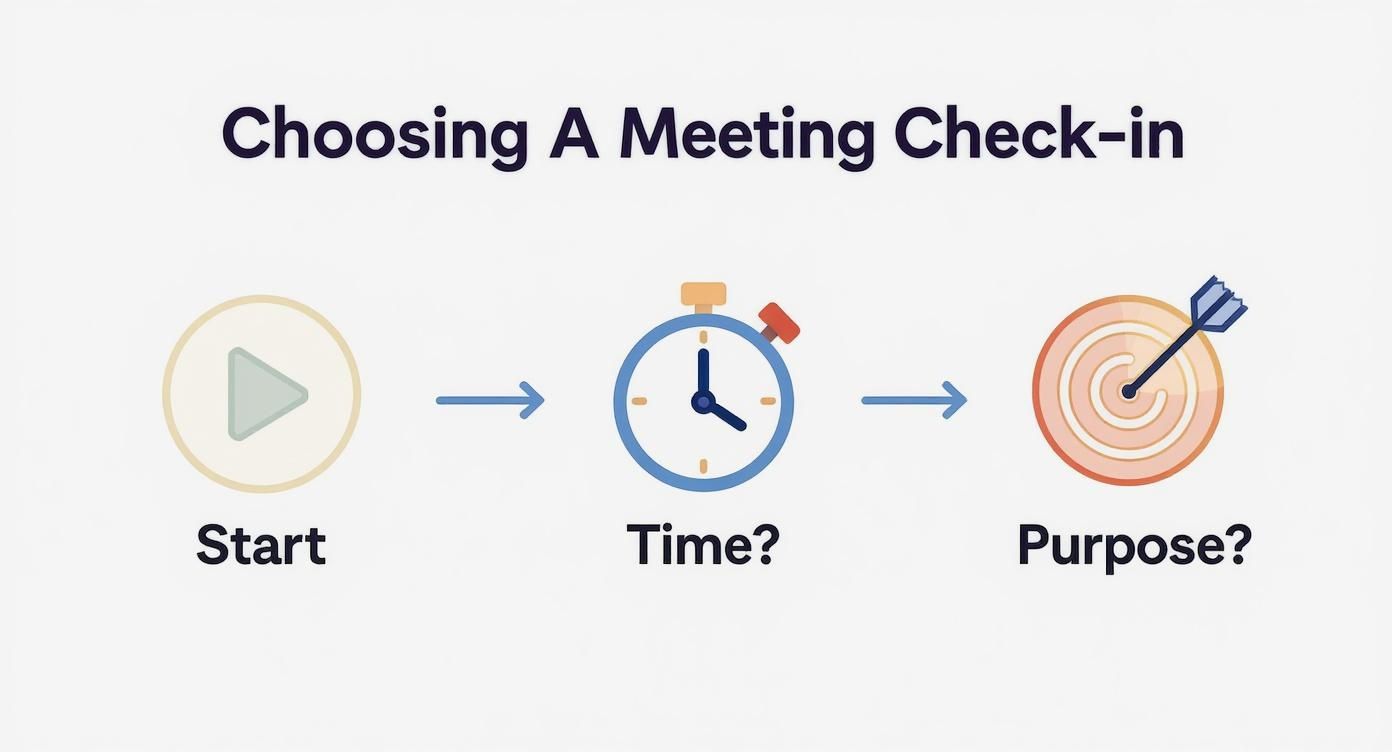
As you can see, thinking through how much time you have and what you want to achieve—connection, alignment, or well-being—points you toward the perfect check-in.
Questions for Team Alignment
Now, for meetings with a tactical mission, your check-in should act as a primer. You want to get everyone's head in the game and aligned on the task at hand.
The goal here isn't just to connect, but to connect with purpose. A focused question gets everyone’s mental energy flowing in the same direction right from the start.
For your next project meeting or weekly sync, try one of these:
- What is your main priority related to this project right now?
- What’s one thing that’s feeling crystal clear, and one thing that’s a bit foggy about our goal?
- From your perspective, what is the single most important thing we need to solve in this meeting?
These questions create a seamless transition into your main agenda. Better yet, they often surface potential roadblocks or different assumptions early on, making the rest of the meeting way more efficient.
Questions for Personal Well-Being
A check-in can also be a powerful moment to gauge team morale and show you care. These questions are a bit more reflective and personal. The key here is to always make sharing optional to ensure people feel psychologically safe.
You could ask something like:
- What’s taking up most of your energy this week?
- On a scale of 1-10, how is your workload feeling right now?
- What’s one thing you did to recharge over the weekend?
Learning to ask good open-ended questions is a skill that pays dividends. It shows genuine care and helps build a culture where people feel supported. By rotating between these different question types, you keep your check-ins fresh, engaging, and perfectly tuned to the needs of each specific meeting.
Making Your Check-Ins Genuinely Inclusive
https://www.youtube.com/embed/p8Qvd1gVQfY
A great check-in is less about the question you ask and more about the space you create. Your real job as a facilitator is to make sure everyone feels safe and comfortable enough to share an honest answer. It's about ensuring every voice is heard, not just the loudest or quickest ones. This takes a gentle but firm hand to build a truly equitable space for your team.
The move to remote work really drove this point home. By 2022, virtual meetings had exploded, jumping from 48% to 77% of all meetings worldwide. With only 14% of meetings happening fully in-person anymore, the check-in is now a digital-first ritual for most of us. For leaders, platforms like Zoom even provide detailed attendance reports, turning the check-in into something we can track. You can see more on this in a recent report on meeting statistics.
In this digital-first world, being an intentional facilitator is more important than ever.
Keep an Eye on the Clock and an Ear Out for Everyone
Time management is the bedrock of an inclusive check-in. It's so easy for one or two people to accidentally dominate the conversation, leaving others with no time to share. The best way to prevent this is to set clear expectations right from the jump.
Before you even start, state the goal and the time limit. Something simple works best: "Alright team, let's take the next five minutes for a quick check-in. We'll go around and everyone can share for about 30 seconds." This little bit of framing helps everyone keep their updates short and sweet.
Of course, someone will eventually go over their time. When that happens, you have to interject, but you can do it gracefully. Try one of these:
- "That's a fantastic point, and I want to hear more. Let's add it to the agenda to dig into after everyone gets a chance to check in."
- "Thanks for sharing that! To make sure we get to everyone, let's move on to the next person for now."
This isn't about being rude or cutting people off. It’s about protecting the time so that everyone gets a turn to speak.
A facilitator's role is to be the guardian of equity. You’re not just managing the clock; you’re ensuring that the space is shared fairly among all participants.
Drawing Out the Quieter Voices
In every group, you'll have people who are naturally more reserved. Your goal is to make it easy for them to contribute without ever putting them on the spot.
One of the simplest tricks is to establish a clear speaking order from the start. Just go alphabetically or follow the order of faces on your screen. This completely removes the social pressure of figuring out when to jump in, which can be a huge barrier for more introverted team members.
Active listening is also your secret weapon here. When someone shares—especially a quieter person—acknowledge their contribution. A simple nod or a quick, "Thanks for sharing that, Sarah," goes a long way. This small act of validation makes people feel seen and heard, making them much more likely to speak up again next time.
If you want to go deeper on managing these kinds of group dynamics, we have a whole guide on group facilitation techniques that's packed with practical strategies you can start using today.
Keeping the Conversation on Point
It happens all the time. A simple check-in suddenly spirals into a deep problem-solving session or a debate. While those conversations can be valuable, the check-in just isn't the right place for them. Your job is to gently guide the conversation back to its original purpose.
This is where having a "parking lot" is incredibly useful. When a new, important topic comes up, acknowledge it and suggest setting it aside for later. You could say, "That’s a really important issue. I'm adding it to our parking lot to make sure we come back to it after the check-in is done." This honors the person's contribution while keeping the meeting's structure intact.
Using Technology for Smarter Meeting Check Ins
Let's be honest, manual check-ins are great, but they can get a little stale. When you’re juggling everything else, coming up with fresh questions and remembering who said what last week is a tall order. This is where the right technology can make your meeting check in feel less like a routine and more like a real opportunity to connect.
Think of it this way: instead of spending your energy on the logistics, you can focus on the people. A smart tool handles the repetitive parts—the question prompts, the reminders, the record-keeping—so you can be fully present in the conversation. It's a simple switch that makes this opening ritual so much more effective.
Automate and Elevate with Dedicated Tools
This is where platforms like Bulby really shine. They're built to weave these check-in moments right into your team's existing workflow. You can set up automated questions that rotate based on what’s important right now—maybe this week is about project alignment, next week is about morale, and the one after is just for fun. It completely removes the "what should I ask today?" pressure.
But the real magic is in the data. Imagine seeing a visual trend of your team’s energy levels over a month, or noticing that the same blocker keeps popping up for different people. Suddenly, your check-in isn't just an icebreaker; it’s a powerful tool for spotting problems before they get serious.
Here’s a quick look at how a smart check-in dashboard can organize everyone's input and make it easy to understand.
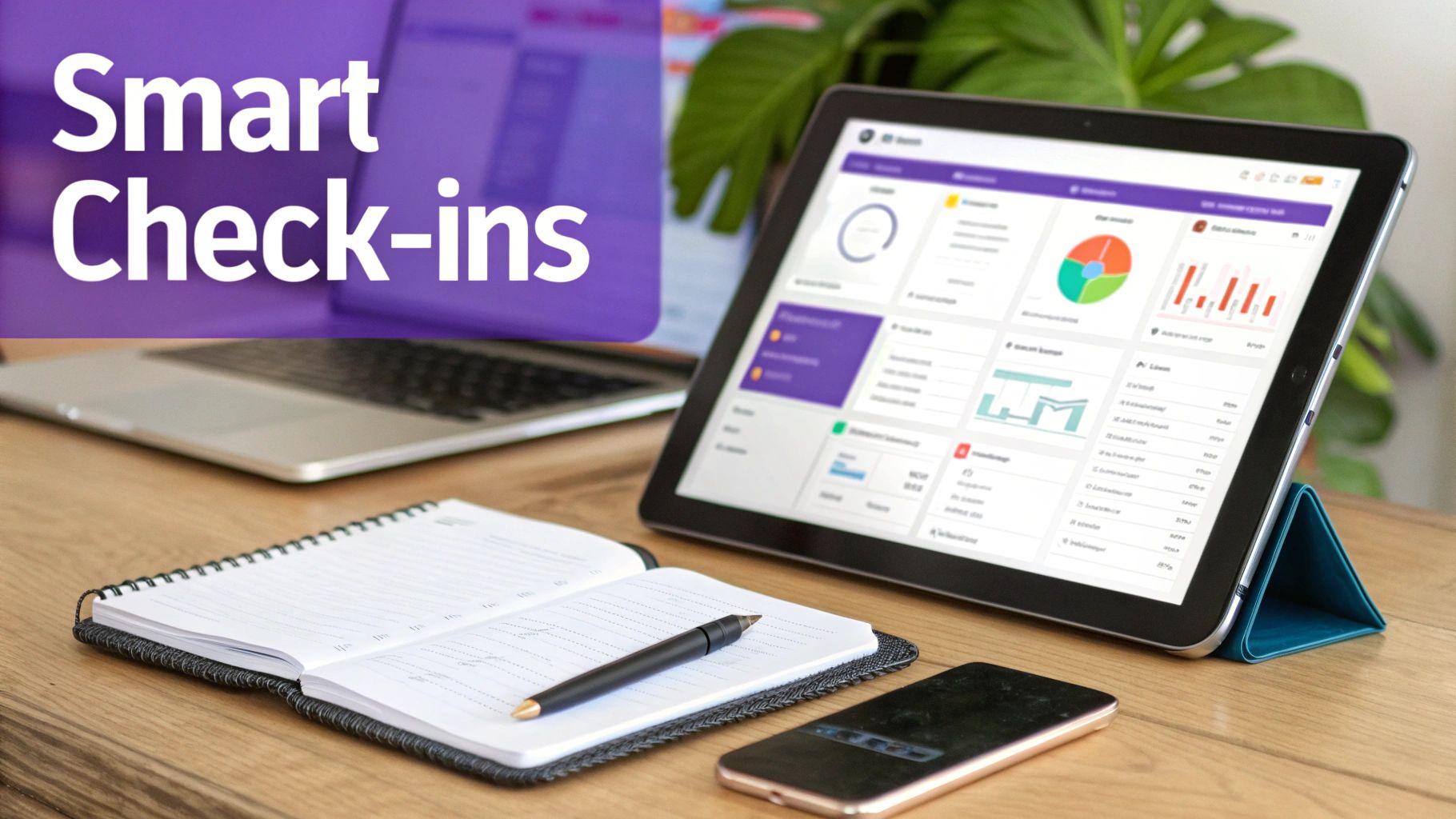
This kind of visual snapshot lets you digest team feedback in seconds, helping you spot patterns you’d almost certainly miss if you were just relying on memory from a verbal go-around.
Gaining Deeper Insights
When you use a dedicated tool, you're building a history of your team’s pulse. Over time, this data paints a much richer picture of your team's dynamics than you could ever get from standalone conversations.
Technology transforms the meeting check-in from a fleeting moment into a continuous conversation. It gives you a structured way to listen to your team at scale, making sure no one’s voice gets lost in the day-to-day shuffle.
Many of these tools also offer smart suggestions, giving you prompts based on recent projects or team goals. You get all the benefits of variety without any of the mental load.
For any remote team trying to build a more connected and efficient culture, exploring different collaboration tools for distributed teams is a no-brainer. Adding technology doesn't replace the human touch; it just frees you up to be more human by handling the boring stuff and giving you sharper insights.
Common Meeting Check-In Questions Answered
Even when you’re excited to start using meeting check-ins, some practical questions always pop up. I often hear from managers wondering about timing, how to handle shy team members, or if this whole thing even works for client meetings.
Let's walk through some of the common hurdles you might run into.
How Long Should a Meeting Check-In Take?
Finding the right timing is all about balance. You want connection, not a complete derailment of your agenda.
For a small team of 5-8 people, I’ve found that a quick round-robin works best when kept under five minutes total. That gives each person about 30-60 seconds to share—just enough time for a real update without getting lost in the weeds.
If you're running breakouts with a larger group, you can stretch it a bit. Aim for 5-7 minutes for the small group chats, then bring everyone back for a minute or two to have a spokesperson from each group share a quick highlight.
The most important thing is to state the time limit clearly at the start. Just saying, "We'll take three minutes for a quick check-in," frames the exercise perfectly. It helps everyone stay concise and signals that this is about adding energy, not creating a delay.
What If Team Members Are Hesitant to Share?
It's completely normal for some people to be reluctant to participate, especially when this is a new routine. The last thing you want to do is force it. True engagement comes from psychological safety, and that’s something you have to build brick by brick.
The best place to start? Model the behavior yourself. As the leader, when you share something genuine and brief, you set the tone for everyone else. It shows it's safe to open up. You can also ease into it by starting with low-pressure, work-focused questions before ever diving into anything more personal.
It also helps to offer a few different ways to participate:
- Always give people the option to "pass" if they're not feeling it that day. No judgment.
- Invite them to type their answer in the chat instead of speaking up.
Consistency is your friend here. Once the team sees that the check-in is a reliable and positive part of your meetings, even the most hesitant folks will start to come around.
Can You Do a Check-In for a Formal Client Meeting?
Absolutely, but you have to shift your strategy. For a client meeting, the check-in isn’t about personal connection—it's about professional alignment. The goal is to get everyone focused on the same outcome right from the jump.
Skip the fun icebreakers and go with a sharp, results-oriented question. Something like, "To make sure this meeting is a huge success, what's the one thing you're hoping we accomplish today?" works wonders.
This kind of professional meeting check-in is incredibly powerful. It gets all stakeholders on the same page instantly and shows the client you respect their time and goals. It’s a simple way to set a collaborative tone for the entire conversation.
Ready to transform your check-ins from a routine task into a powerful team-building tool? Bulby guides your team through structured exercises that spark creativity and ensure every voice is heard. See how it works at https://www.bulby.com.