

When it comes to making smart decisions, effective problem solving is your secret weapon. It’s all about making sure you’re tackling the right problem before you even start thinking about a solution. So many great ideas fall flat, not because the solution was bad, but because it was aimed at a symptom instead of the real, underlying cause.
This guide will walk you through how to connect solid problem analysis to better, more impactful decisions.
Why Better Decisions Begin with Clearer Problems

Have you ever seen a team pour weeks into a project, launch it, and then realize they completely missed the point? It’s a painfully common story. A team sees user engagement numbers dipping and immediately jumps to the conclusion that they need a new marketing campaign. They spend a ton of time and money on ads and promos, but the metrics don't move.
Why? Because the real issue wasn't a lack of awareness—it was a clunky user interface that made new users want to tear their hair out. The marketing "fix" was just a costly distraction. This gets at a fundamental truth: the quality of your decision is capped by the quality of your problem definition.
Think Like a Detective
A great way to think about this is to picture yourself as a detective at a crime scene. A good detective doesn't just slap the cuffs on the first person they find nearby. They carefully gather clues, analyze the evidence, and piece together the whole story before they even think about naming a suspect.
Jumping to a conclusion—or a solution—without doing that groundwork is how you end up with the wrong person in jail. In business, it’s how you end up with wasted resources and unsolved problems. You have to resist that urge to grab the first, most obvious solution and instead, commit to a bit of diagnostic work first.
The most common and costly mistake is rushing to find a solution before the problem is fully understood. This 'solution-first' thinking often leads teams to address symptoms instead of the root cause, resulting in wasted time and resources.
It All Starts with the Right Question
The very first—and most important—step is to frame the right question. A well-defined problem acts like a compass for your team, making sure everyone is moving in the same direction. It turns a vague sense of "something's wrong" into a clear, actionable challenge.
For instance, instead of asking, "How can we boost sales?" you could reframe it as, "Why have repeat purchases from our top customer segment dropped by 15% in the last quarter?" That specificity immediately gives you something concrete to dig into.
If you need a hand with this, our guide on writing problem statements breaks down exactly how to nail this crucial first step. Get this part right, and you're building a solid foundation for everything that comes next.
The Foundations of Analytical Problem Solving
Behind every smart business decision, there's a powerful engine running in the background: analytical thinking. It’s all about taking messy, complicated challenges and breaking them down into smaller, more manageable pieces. This simple shift moves your team from a state of overwhelming confusion to one of focused clarity, making sure your choices are grounded in evidence, not just a gut feeling.
This kind of structured thinking isn't just a nice-to-have skill anymore; it’s a core business need. In fact, analytical thinking is now the top skill employers are looking for globally. A staggering seven out of ten companies see it as absolutely essential for success. This isn't surprising, as it's the key to dissecting complex data and making solid predictions. You can read more about this in the World Economic Forum's Future of Jobs Report 2025.
The High Cost of a Flawed Diagnosis
Let's imagine a software company is seeing a scary spike in customer churn. The leadership team quickly huddles up. They notice a competitor just dropped their prices and immediately conclude their own pricing must be too high. So, they pour weeks into financial modeling and marketing meetings to launch a new, cheaper subscription plan.
Three months later, nothing has changed. The churn rate is still just as high.
Why? The real problem was never about the price. If they had dug into user behavior data, they would have seen that 90% of customers who left did so within their first 14 days. The issue wasn't the cost; it was a clunky and frustrating onboarding process that never showed new users the product's true value.
This story makes one thing crystal clear: a flawed problem diagnosis guarantees a flawed solution. That team wasted precious time and money treating a symptom while the real disease—a poor user experience—kept driving customers away. Great problem-solving always starts by resisting the temptation to jump on the most obvious answer.
Crafting a Problem Statement That Works
To sidestep that trap, you need to start with a precise problem statement. This isn't just a complaint scribbled on a whiteboard; it’s a clear, concise description of the issue that acts as a compass for your entire team. It gets everyone pointed in the same direction, aiming at the same target.
A solid problem statement usually has three parts:
- The Current State: A factual description of where you are right now. (Example: "Our customer churn rate for new sign-ups has jumped from 5% to 15% in the last quarter.")
- The Desired State: A clear picture of what success looks like. (Example: "We need to get the new-user churn rate back down to our 5% baseline.")
- The Gap: The specific hurdle keeping you from getting there. (Example: "We've found that users who don't complete the core setup tasks within 48 hours are the ones most likely to cancel.")
A well-crafted problem statement transforms a vague complaint into an actionable challenge. It aligns your team by giving them a shared understanding of what they are trying to solve and why it matters.
Getting this foundation right is non-negotiable. By defining the problem with this level of precision, you set your team up for a much smoother and more effective decision-making journey. For a deeper look at how to structure this, check out our guide on the essential problem-solving process steps.
Choosing the Right Problem-Solving Framework
You wouldn't use a hammer to saw a piece of wood, right? The same logic applies to solving problems at work. Not every challenge calls for the same approach, and picking the right tool for the job makes all the difference.
Choosing the right problem-solving framework is about matching your method to the situation. Is the problem urgent? How complex is it? How much information do we actually have? Answering these questions first helps your team focus its energy, avoid getting bogged down in endless analysis, and ultimately land on a better solution.
Before you can solve anything, you have to know what you're up against. This decision tree lays out the essential first steps for diagnosing any problem: first, you analyze the situation, and then you nail down what the core issue really is.
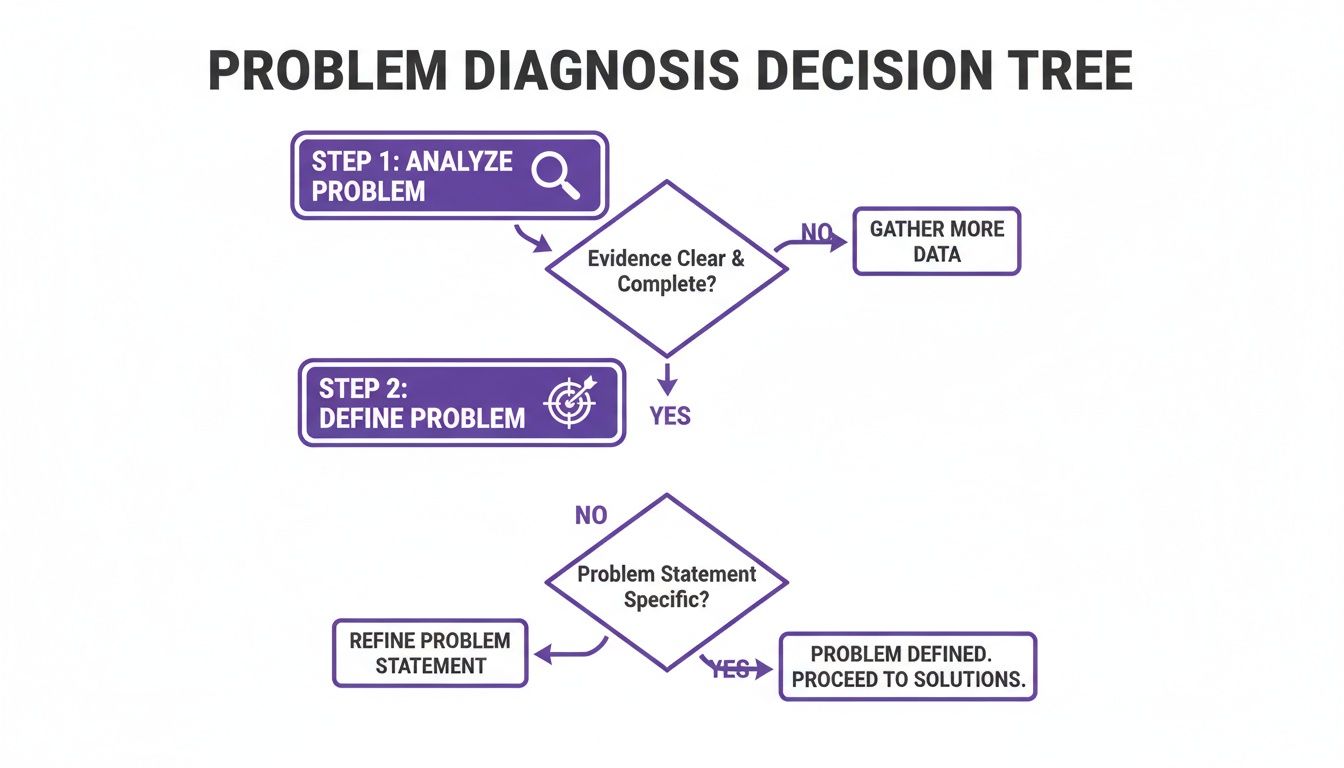
This initial diagnosis is critical. It makes sure you're treating the actual disease, not just the symptoms, which is the perfect setup for picking one of the more advanced frameworks below.
To help you get started, here’s a quick comparison to help you select the best problem-solving framework for your team's situation.
Matching the Framework to Your Problem
| Framework | Best For | Key Feature | Example Use Case |
|---|---|---|---|
| Root-Cause Analysis (RCA) | Chronic, recurring problems with unknown origins. | A "detective" approach that digs deep by repeatedly asking "why?" | Finding out why a specific feature in your app keeps crashing every month. |
| OODA Loop | Fast-paced, competitive situations requiring quick action. | A rapid cycle of observing, orienting, deciding, and acting to gain an edge. | Responding to a competitor's sudden price drop in a key market. |
| PDCA Cycle | Making incremental improvements to existing processes. | An iterative, four-step loop for testing changes and refining workflows. | Fine-tuning your team's onboarding process to reduce new hire confusion. |
| Decision Matrix | Choosing between multiple viable options with complex trade-offs. | A structured grid that scores options against weighted criteria. | Selecting a new project management tool from a list of three top contenders. |
Each of these frameworks offers a unique lens through which to view a problem. Let's dig a little deeper into when and how you'd use each one.
When to Dig Deep with Root-Cause Analysis
Is your team fighting the same fire over and over again? If you're dealing with a stubborn, recurring issue, then Root-Cause Analysis (RCA) is your best friend. Think of it as playing detective. You’re not just looking for the obvious culprit; you keep asking "why?" until you uncover the real story.
RCA is perfect for digging into complex operational glitches, persistent software bugs, or a nagging dip in customer satisfaction. It forces you to move past the surface-level symptoms and find the systemic flaw that's causing all the trouble.
- Best For: Unraveling chronic, complex problems where the initial cause isn't obvious.
- Example: A support team uses the "5 Whys" technique to trace a high volume of customer complaints all the way back to a single, confusing sentence in their onboarding guide.
By getting to the source, you can implement a fix that prevents the problem from ever happening again. That’s a huge win for saving time and resources down the road.
How to Act Fast with the OODA Loop
In a fast-moving, competitive world, speed is often your greatest weapon. The OODA Loop—Observe, Orient, Decide, Act—was literally built for high-stakes situations where sitting still means falling behind. Developed by military strategist John Boyd, it’s a mental model for making smart, quick decisions under pressure.
This framework is ideal when you need to react to a competitor’s surprise announcement, handle a PR crisis, or navigate a sudden shift in the market. It’s less about finding the one perfect, forever solution and more about making the best possible move right now to stay ahead.
The OODA Loop is all about agility. It teaches that the team who can cycle through observing the situation and acting on it the fastest will consistently outmaneuver the competition.
For more hands-on methods to tackle tough issues, you can explore various structured problem-solving techniques like DMAIC or Six Sigma.
When to Drive Continuous Improvement with PDCA
The Plan-Do-Check-Act (PDCA) cycle is the heartbeat of continuous improvement. It’s a simple but incredibly effective four-step loop for testing ideas and making processes better over time. While RCA is about looking backward to figure out what went wrong, PDCA is all about looking forward to make small, incremental gains.
This framework really shines when you’re trying to optimize a workflow, improve a product feature, or boost your team's productivity. It creates a natural feedback loop, allowing you to run small, controlled experiments that minimize risk while building a culture of learning and adaptation.
For a deeper dive into different models and where they fit, check out our guide on decision-making frameworks.
How to Weigh Complex Options with a Decision Matrix
So you're stuck between a rock and a hard place—or more likely, between several really good options, each with its own pros and cons. This is where a Decision Matrix comes in. It's a straightforward but powerful tool for bringing objective clarity to a complicated choice.
A decision matrix helps you score and compare your options based on what truly matters. It’s the perfect tool for situations like:
- Choosing a new software vendor for your team.
- Prioritizing which features to build in the next quarter.
- Deciding where to allocate your marketing budget.
By scoring each option against your most important criteria, you strip away the emotion and personal bias that can cloud judgment. It helps ensure the final call is logical, easy to explain, and perfectly aligned with your team's goals.
A Practical Guide to Team Decision Making

Knowing a good framework is one thing, but actually getting a team to use it is a whole different ball game. Strong problem solving in decision making isn't about luck; it’s about having a clear, repeatable process that everyone on the team understands and can get behind.
When you have a solid structure, chaotic debates transform into productive collaboration. It’s how you ensure the final call is well-reasoned and, just as importantly, has the full support of the team.
Here’s a five-step process that works whether you’re all in a conference room or spread across different time zones. To make it real, let's follow a remote software team trying to solve a common headache: picking a new project management tool.
Step 1: Define the Problem as a Team
You can't find the right answer if you're not asking the right question. The first move is always to get the team on the same page about what the problem really is. This isn't one person laying down the law; it's a group effort to pinpoint the gap between where you are and where you need to be.
- Here’s how it looks: The software team is fed up with their current tool. Instead of just grumbling, "We need new software," they get specific. They work together to frame the problem: "Our current project management tool lacks the automation and integration we need for our faster development cycles. As a result, each developer is losing an average of 5 hours per week to manual status updates."
See the difference? That definition is sharp, measurable, and zeros in on the real pain point—wasted time—not just the tool itself.
Step 2: Brainstorm Solutions Creatively
With the problem clearly defined, it's time to open the floodgates for ideas. Right now, the goal is quantity, not quality. Encourage wild suggestions and hold off on any judgment. You want to create a space where everyone feels safe to throw an idea out there, no matter how out-of-the-box it seems.
For remote teams, digital whiteboards or shared docs are perfect for this. They let everyone contribute their thoughts without being swayed by the first person who speaks up.
- Here’s how it looks: The team lead fires up a shared whiteboard in Bulby. Everyone asynchronously adds sticky notes with different software options, ways to tweak their current tool, or even bold ideas like building a simple version themselves. This way, groupthink doesn't take over, and the introverts on the team have just as much say as the extroverts.
Step 3: Evaluate Options with Data
Okay, time to switch gears from creative brainstorming to critical thinking. The team needs to weigh all those potential solutions against a set of objective criteria. The key is to make sure these criteria tie directly back to the problem you defined in the first step.
For our software team, the criteria might include:
- Integration capabilities with their current tech stack.
- Automation features that actually reduce manual work.
- Total cost of ownership, including subscription fees and training time.
- Ease of use to get everyone on board quickly.
A simple decision matrix is a great tool here. The team can score each option against the criteria, which helps strip away emotion and personal bias. It forces the conversation to focus on what will actually solve the problem.
Step 4: Commit to a Decision and Action Plan
Once the data has been crunched, a front-runner usually emerges. Now, it's time to make the call and, crucially, build an action plan. This plan needs to be crystal clear about who is doing what, by when, and what success will look like.
A decision without a clear action plan is just a conversation. The plan is what translates discussion into tangible progress and holds the team accountable for the outcome.
- Here’s how it looks: The team agrees on the software that scored highest in their matrix. They don't just celebrate and move on; they immediately map out next steps. One engineer is tasked with leading a two-week trial. A project manager will get training sessions on the calendar. Their success metric? To cut down manual update time by 80% within the first month.
Step 5: Review the Outcome and Adapt
The job isn't done when the decision is made. The final, and arguably most important, step is to circle back and review the results. Did the new tool actually fix the problem from Step 1? This feedback loop is where the real learning happens.
It gives the team a chance to adjust if things aren't working perfectly and makes the entire group better at problem solving in decision making the next time around. You can find more practical methods in our guide to improving decision making in groups.
How to Outsmart Common Cognitive Biases
The biggest hurdle to a great decision isn't a lack of data or a broken process. More often than not, the real culprit is your own mind. Our brains are hardwired with mental shortcuts, or cognitive biases, that help us make sense of a complex world. While they're useful for quick, everyday judgments, they can seriously derail high-stakes problem-solving.
Think of these biases as invisible currents pulling your logic off course. If you try to navigate a ship without accounting for the tide, you’ll end up miles from where you wanted to be. The first step to overcoming them is simply learning to spot them in the wild.
Unmasking Confirmation Bias
One of the most frequent offenders is Confirmation Bias. This is our natural urge to hunt for information that proves what we already believe is true. It’s a subconscious filter that conveniently ignores any evidence that might challenge our assumptions.
We’ve all seen it happen. A team is absolutely certain their new feature will be a game-changer. They latch onto glowing feedback from a few friendly users but write off critical survey data as just "outliers." This isn't a deliberate act of sabotage; it's just the brain trying to avoid the uncomfortable feeling of being wrong.
The only way to fight it is to actively seek out disagreement.
- Appoint a Devil's Advocate: Give someone on the team the official job of poking holes in the group's logic. Their mission is to challenge the consensus and force everyone to back up their claims with real evidence.
- Run a Premortem: Before you green-light a decision, fast-forward six months and imagine it has failed spectacularly. Get the team to brainstorm all the reasons why it fell apart. This simple exercise flips the script from confirming an idea to stress-testing it.
Dismantling Groupthink
Another massive roadblock is Groupthink. This is what happens when the desire for harmony overrides the need for critical thinking, leading to some truly dysfunctional decisions. It’s when people prioritize fitting in over speaking up.
You know the scene: a couple of senior people share their opinion, and suddenly the room goes quiet. No one wants to be the one to rock the boat, so valuable dissent gets silenced. This creates a false sense of agreement that often paves the way for a terrible choice.
Groupthink is the enemy of innovation. It prioritizes social cohesion over critical thinking, creating an echo chamber where bad ideas go unchallenged and great ideas are never voiced.
To break its spell, you have to create safe ways for people to think independently. Anonymous feedback tools are fantastic for this. When team members can share their real concerns without fear of judgment, you get a much clearer picture of what’s actually going on. For a closer look at these mental traps, you can explore our detailed guide on cognitive bias in decision making.
The rise of AI adds a new twist to these old biases. A 2025 McKinsey report found that while almost every company is investing in AI, only a tiny 1% say they've fully matured their capabilities. This gap is a breeding ground for error, as teams might blindly trust AI insights that just happen to confirm what they already believed. But when leaders get it right, the payoff is huge; 29% of IT professionals report major time savings from AI, freeing them up to solve problems faster and more objectively. You can learn more about these emerging AI trends on aristeksystems.com.
Using Data to Turn Insights into Action

The best teams don't just guess their way to success—they build a strategy. This requires a big shift in how they approach problem solving in decision making. It’s about seeing data as more than a report card on past performance. Instead, data becomes a compass that points toward the best path forward.
When you let evidence lead the way, you stop relying on gut feelings and start validating assumptions, forecasting potential outcomes, and actually measuring the impact of your choices. This culture of proof is a powerful antidote to the hidden biases that can trip up even the sharpest teams. If you want to move beyond hunches and ground your decisions in reality, understanding the importance of data-driven decision-making is the perfect place to start.
From Information Overload to Clear Signals
It's easy to feel like you're drowning in data these days. But having more information doesn’t guarantee better decisions. The real skill is finding the signal in all that noise—the key insights that tell you what to do next.
This is where smart tools and AI can be a game-changer for the problem-solving process. They can sift through massive, complex datasets in ways no human team could, spotting patterns and connections that would otherwise go unnoticed. Think of it this way: your team can see the individual trees, but AI gives you a satellite view of the entire forest, making the right path obvious.
Building a culture where evidence consistently trumps opinion leads to more confident, defensible decisions that deliver measurable results and move your business forward.
When you use data to frame a problem, you create a shared, objective starting point for your team. This gets everyone aligned and helps shift conversations away from debating personal theories and toward interpreting the facts together.
The Tangible Impact of Data-Driven Decisions
Leaning on data isn't just a nice idea; it creates a serious competitive edge you can see on the bottom line. Data-driven organizations are a staggering 23 times more likely to acquire customers and 6 times as likely to retain them. Why? Because integrating analytics helps them solve problems faster and more accurately.
Companies that get this right often see 10-15% bumps in revenue and 5-10% reductions in costs. This approach essentially turns your decision-making process into a reliable, repeatable engine for growth.
A Practical Framework for Data-Informed Action
To make this real, your team needs a simple, structured way to turn numbers into action. This prevents crucial insights from getting buried in a spreadsheet.
Here’s a straightforward, three-step approach:
- Question the Data: Get specific. Instead of asking, "How's our user engagement?" try asking, "Which user segment has the lowest 30-day retention rate, and what actions do they fail to complete?"
- Visualize the Insight: Don't just look at raw numbers. Turn them into charts, graphs, and dashboards. Seeing the data visually helps everyone grasp the story it's telling and sparks much more creative discussions.
- Translate to an Experiment: Frame every decision as a hypothesis you can test. For example, "We believe that simplifying our onboarding checklist will increase 30-day retention for new users by 15%."
This method ensures every decision is grounded in evidence and is measurable, so your team learns and gets smarter with every choice it makes.
Frequently Asked Questions
Let's dig into some of the questions that pop up when teams start getting serious about problem solving and decision making. Here are a few common sticking points and how to work through them.
What Is the Biggest Mistake Teams Make in Problem Solving?
The single biggest mistake? Rushing to a solution before anyone truly understands the problem.
This "solution-first" trap is incredibly common. Under pressure to act, teams latch onto a symptom and start trying to fix it, completely ignoring the root cause. It's a recipe for wasted time and effort on solutions that won't stick.
Think about it: sales are down, so the immediate reaction is to blame the latest marketing campaign. But what if the real issue is a new bug in the checkout process? Or a competitor just launched a killer feature? If you don't pause to investigate, you'll pour resources into the wrong place, and the real problem will just keep festering.
Taking the time to collaboratively define the problem is the most important investment you can make. It ensures every single step that follows is actually aimed at the right target.
How Can a Leader Encourage Better Problem Solving?
Great leaders are architects of the right environment. They build psychological safety, making it okay for people to ask tough questions, poke holes in assumptions, and challenge the status quo without fear of being shut down. That's where real analysis begins.
They lead with curiosity, always asking "Why?" and treating failures as learning moments, not blame games. A good leader champions a clear process but gives the team the space to work within it, helping everyone build their own problem-solving skills.
Here’s what that looks like in action:
- They champion different perspectives: They know that a team with diverse viewpoints will consistently outperform a room full of brilliant people who all think the same way. The research backs this up.
- They celebrate the 'how': They give praise for a rigorous process and thoughtful debate, not just for who came up with the "right" answer the fastest.
What Should We Do When We Have Incomplete Information?
You'll almost never have all the information you want. Don't let that paralyze you. The trick is to get organized about the uncertainty.
Start by mapping out what you know for a fact, what you don't know, and what you're just assuming. This simple exercise immediately shows you where to focus your energy. Instead of trying to boil the ocean, you can zero in on gathering the most critical missing pieces.
When you're facing a big, "one-way door" decision, use smaller, reversible choices to gather data. For example, instead of committing to a massive product redesign, why not A/B test a single new feature with a small user group? These pilot tests provide real-world data, dramatically lowering the risk before you have to go all-in.
Bulby is a brainstorming and problem-solving tool built to guide remote teams through these exact challenges. It gives your thinking structure, helps you spot and overcome bias, and turns your best ideas into clear, actionable decisions. Learn more and start your free trial.