
Innovation isn't some mystical lightning strike of genius. It’s a structured, repeatable journey that takes a rough idea and carefully shapes it into a solution ready for the real world. Think of it like building a bridge—every single stage is critical if you want a structure that's strong and built to last.
From Abstract Idea to Tangible Impact
At its heart, the innovation process is about laying out a clear roadmap. It starts with spotting a problem and ends with launching a solution that actually works. This framework takes the guesswork out of the equation, turning innovation into a predictable, manageable part of your business strategy.
The path isn't always a straight line, of course. You'll often find yourself looping back, gathering feedback, and making refinements. But having a structured approach keeps your resources focused squarely on the most promising opportunities.
This visual shows exactly how a simple idea can evolve into a successful outcome when guided by a solid framework.
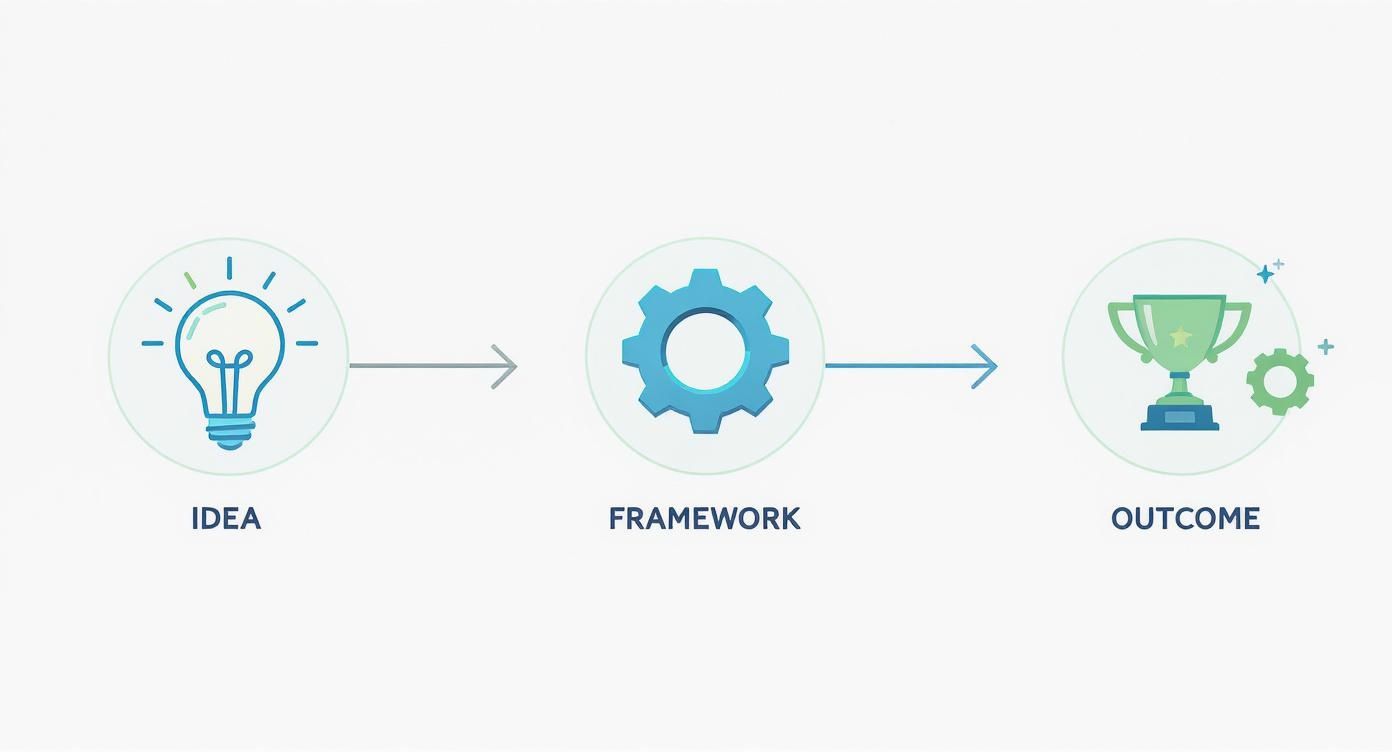
As the infographic makes clear, without a system to guide them, great ideas often stay just that—ideas. They rarely reach their full potential.
Why a System Matters
A repeatable framework is what separates the companies that consistently innovate from those just hoping for a lucky break. It’s what turns raw creativity into a reliable engine for growth.
Without a defined system, even brilliant concepts can get swallowed up by organizational chaos, lose steam, or drift away from what the business actually needs. A clear process gives you:
- Direction: It tells your teams what to do next, so they don't get stuck in "analysis paralysis."
- Efficiency: It ensures your time, budget, and people are invested in ideas that have a real shot at succeeding.
- Alignment: It ties your innovation efforts directly to your company's bigger goals.
A well-defined innovation process is crucial for companies to maintain competitiveness and achieve sustainable growth. While the specifics may vary, the best models are structured, repeatable, and fit the organization's unique conditions.
The Innovation Lifecycle
The journey from a spark of an idea to a full-blown launch looks a lot like other established business practices. If you want to dig deeper into how a product moves from concept to market, it's worth exploring the guide on Mastering the Product Development Lifecycle Stages.
This lifecycle perspective reminds us that innovation doesn't stop once a product is out the door; it's an ongoing cycle of management and improvement. Understanding these broader https://www.remotesparks.com/definitions-of-innovation-in-business/ can give you a richer context for building your own process.
This guide will break down the essential stages of this system, offering a clear blueprint that any team can follow. By adopting these principles, you can build a culture where turning raw ideas into tangible outcomes becomes second nature, making the entire process more efficient and effective from start to finish.
The Four Core Stages of Innovation
The journey from a vague idea to a real-world solution isn't some mystical event; it's a structured process. While it’s tempting to picture a straight line from A to B, innovation is almost always a cycle. Teams often loop back to an earlier stage as they learn more, refining their approach along the way.
Breaking it down into four core stages provides a clear map for navigating the complex, and sometimes messy, path of bringing something new to life.

This framework helps turn innovation from a high-stakes gamble into a repeatable system for growth.
Stage 1: Discovery and Ideation
Every great innovation starts with a question. The Discovery and Ideation stage is all about exploration—finding unmet customer needs, spotting gaps in the market, or seeing a better way to do things. At this point, it's less about having the perfect answer and more about asking the right questions.
Once you have a problem to chew on, the goal is to generate as many potential solutions as you can. Think of it like casting a wide net. The focus is on quantity over quality, encouraging wild ideas and diverse perspectives. This is the time for brainstorming, customer interviews, and digging into feedback.
The first phase of innovation is really about empathy. You have to get inside your user's world and understand the problems they might not even know how to describe.
This is where guided tools like Bulby really shine. By providing structured exercises, it helps teams get past creative blocks and ensures everyone’s voice is heard. The result? A much richer pool of ideas to choose from.
Stage 2: Validation and Prototyping
Okay, you've got a list of promising ideas. Now what? The Validation and Prototyping stage is where you separate the game-changers from the wishful thinking. This is a critical reality check that can save you a ton of time and money down the road.
Instead of spending months building a full-blown product, teams create a Minimum Viable Product (MVP) or a simple prototype. This could be anything from a few sketches of an app to a physical mock-up. The goal is to get something tangible in front of real users for honest, unfiltered feedback.
This back-and-forth is the heart of validation. It helps you answer the tough questions:
- Does this actually solve the problem we think it does?
- Is it easy and intuitive for people to use?
- Would anyone actually pay for this?
A study by CB Insights found that a staggering 35% of failed startups blamed "no market need" for their collapse. That number alone shows just how crucial it is to validate your ideas before you go all-in.
Stage 3: Development and Implementation
Once you have an idea that’s been tested and refined, it’s time to build it for real. The Development and Implementation stage is where the polished, final solution gets engineered and rolled out. This is typically the most resource-heavy phase, bringing together designers, engineers, and project managers.
All the detailed work from the earlier stages really pays off here. The clear specifications and user feedback from prototyping give the development team a solid blueprint, making sure they’re building something people actually want.
A successful rollout also means getting the rest of the organization ready. This could involve training your staff on a new internal tool or prepping the marketing team for a public launch. The goal is a smooth transition that gets people on board from day one. To get a closer look at what this takes, you can explore our other guides on the essential innovation steps and processes that drive success.
Stage 4: Scaling and Diffusion
Launching a product isn't the finish line; it’s just the beginning. The final stage, Scaling and Diffusion, is all about growth. Now the focus shifts to expanding the product's reach and making sure it sticks. This means smart marketing, effective sales strategies, and keeping a close eye on performance.
Success here is measured by adoption rates and market impact. The innovation needs to move beyond a small group of early fans to a much broader audience. This often means tweaking the business model, finding the right distribution channels, and constantly listening to customer feedback to make the next version even better. Ultimately, this is the stage that turns a cool project into a sustainable, thriving part of the business.
The Four Stages of the Innovation Process at a Glance
To bring it all together, here’s a quick overview of the innovation lifecycle. Think of this table as a cheat sheet for understanding what happens at each step, what you’re trying to achieve, and what roadblocks to watch out for.
| Stage | Key Activities | Primary Objective | Common Pitfalls |
|---|---|---|---|
| Discovery & Ideation | Brainstorming, market research, customer interviews, problem identification | Generate a wide range of potential solutions to a well-defined problem | Focusing too early on a single idea; ignoring diverse perspectives |
| Validation & Prototyping | Creating MVPs, user testing, gathering feedback, A/B testing | Test assumptions and confirm there's a genuine need for the solution | Building too much too soon; falling in love with the prototype |
| Development & Implementation | Product engineering, software development, project management, internal training | Build a high-quality, market-ready solution and integrate it into the business | Scope creep; poor communication between teams; underestimating resources |
| Scaling & Diffusion | Marketing campaigns, sales strategy, performance monitoring, customer support | Achieve widespread adoption and market penetration | Poor product-market fit; failing to adapt to feedback; weak launch strategy |
Each stage presents its own unique set of challenges, but by understanding the flow, you can navigate them much more effectively and keep your project moving forward.
Building an Environment for Innovation to Thrive
Great ideas are a bit like seeds. You can have the best one in the world, but it won’t go anywhere without the right soil. A brilliant concept will quickly wither if it’s planted in a culture that stifles creativity or punishes failure. The process of innovation isn't just about checklists and frameworks; it's about building a supportive ecosystem where new ideas can actually take root and grow.

This ecosystem isn't confined to the walls of your company, either. It’s influenced by everything from industry trends to government policies that can either fuel or stall progress. To truly innovate, you have to be proactive about cultivating a space that doesn’t just allow for new ideas but actively encourages them.
The Bedrock of Innovation: Psychological Safety
At the very heart of any truly innovative team, you’ll find psychological safety. It’s the shared belief that you won’t be punished or humiliated for speaking up with ideas, questions, concerns, or mistakes. When people feel safe, they’re far more willing to toss a wild idea into the ring or challenge the way things have always been done.
Think of it as a creative safety net. If your team knows they won't get dinged for an experiment that doesn't pan out, they're more likely to try something ambitious. In this kind of environment, "failure" isn't a black mark; it's just a data point—a lesson learned. A team that feels secure is a team that innovates, period. You can learn more about what psychological safety at work truly means and see just how critical it is.
Building this trust isn't an accident; it takes deliberate effort from leadership. It starts with:
- Modeling vulnerability: When leaders admit their own mistakes, it signals that it's okay for everyone else to do the same.
- Encouraging curiosity: Creating a space where every question is a good question and exploration is rewarded.
- Responding productively: Framing failed attempts as valuable learning moments, not as costly blunders.
Without this foundation of trust, any effort to achieve sustainable innovation is ultimately just wishful thinking.
The Macro Environment Fueling Progress
Of course, innovation doesn’t happen in a bubble. The external world—shaped by industry norms and government action—plays a huge role. Things like fair competition, open markets, and clear regulations create a level playing field where the best ideas can win on merit, not just because they came from the biggest player.
The 2025 CTA Global Innovation Scorecard makes this crystal clear, showing that the most innovative countries are the ones that actively create these conditions. The entire process of innovation hinges on an environment that allows for experimentation, failure, and pivots. The top-ranking "innovation champions" all have strong partnerships between the public and private sectors, working together to tackle big challenges in health, climate, and infrastructure.
Innovation flourishes when countries establish fair regulatory frameworks and open markets that level the playing field for all competitors.
This larger ecosystem gives businesses the stability they need to invest in long-term R&D. When the rules of the game are clear and fair, companies feel more confident taking the kinds of calculated risks that lead to real breakthroughs.
Actionable Steps for Cultivating Innovation
So, how do you actually build an environment where innovation can thrive? It takes a mix of cultural shifts and structural changes. You're essentially creating a system that nurtures ideas from a tiny spark to a fully realized project.
Here are a few concrete steps any leader can take to get started:
Allocate Dedicated Resources: Innovation can't just be a side project. You need to earmark specific time, budget, and people for experimentation. Google’s famous "20% Time" is a classic example, giving employees the freedom to explore passion projects that could become the next big thing.
Reward Smart Risk-Taking: Don't just celebrate the wins; celebrate the intelligent failures, too. Acknowledge a team that took a bold swing, learned something important, and shared that knowledge—even if the project itself didn't work out. This shows everyone that experimentation is what you truly value.
Break Down Silos: Get people from different departments talking to each other. When you put engineering, marketing, and customer support in the same room, you get a collision of perspectives that almost always leads to more creative and complete solutions.
Implement a Clear Process: While you want freedom, you don't want chaos. A structured innovation process gives teams a roadmap to follow, providing guardrails that keep projects on track. Tools like Bulby are designed for this, guiding teams through focused exercises that spark diverse thinking and turn abstract concepts into solid, actionable plans.
How to Measure Your Innovation Progress
That old business saying, "If you can't measure it, you can't improve it," hits the nail on the head when it comes to innovation. Without some way to track what’s working, you're just guessing. You have no real way of knowing if your efforts are sparking genuine growth or just spinning your wheels.
So, how do you measure something that can feel so abstract? The trick is to look past the obvious, surface-level numbers and focus on what really moves the needle. It’s about managing innovation like any other critical business function, not like a game of pure luck.
Moving Beyond Vanity Metrics
It's tempting to measure activity just for the sake of it. Counting the number of ideas from a brainstorm or the hours your team puts in feels productive, right? But those numbers tell you very little about the quality of the work or its actual potential.
Real measurement is more thoughtful. It looks at both leading indicators (the forward-looking metrics that predict success) and lagging indicators (the metrics that show past results). For instance, the number of prototypes you test with real users is a great leading indicator. Revenue from a new product, on the other hand, is a lagging one. You need both to get the full story. For a deeper look, our guide on how to measure innovation breaks down more frameworks.
Building a Comprehensive Innovation Scorecard
To really understand what's going on, you need to pull metrics from several different areas. Think of it like a dashboard for your car—you wouldn't just look at the speedometer. You need gauges for fuel, engine temperature, and oil pressure to see the whole picture.
A data-driven scorecard helps you spot which ideas are gaining traction and where you should invest your time and money.
Here are a few key categories to get you started:
- Input Metrics: What are you putting in? This covers everything from R&D spending and employee time to your investment in new tools and training.
- Process Metrics: How healthy is your innovation pipeline? Look at things like the average time it takes to get from an idea to a working prototype or the number of projects that involve teams from different departments.
- Output Metrics: What are the tangible results? This is where you count the number of new products launched, patents filed, or new features shipped to customers.
- Impact Metrics: This is the big one—how is all this work affecting the bottom line? Track revenue from new products, customer satisfaction scores, and any growth in market share.
A balanced scorecard keeps you from over-investing in one area while neglecting another. It’s the difference between being busy and actually creating real, tangible value for your company and your customers.
Global Benchmarks for Innovation
Zooming out to look at the bigger picture can give you some powerful context. Global trends in patent activity, R&D investment, and even talent demand can offer clues about where the world is heading. A 2025 technology trends outlook from McKinsey suggests that combining these signals can create an "innovation score" that points to real technological momentum.
Patents and academic papers show progress, but things like news articles and search trends gauge public interest, while investment and hiring show where the money and talent are flowing. This global view helps you see where you fit in and what new opportunities are on the horizon.
By keeping an eye on these external signals alongside your own internal metrics, you can make smarter strategic decisions. It ensures your innovation efforts aren't just effective but are also perfectly timed for a world that's always changing.
Using AI and Data in Your Innovation Process
In today's world, technology isn't just a helper—it's a core partner in how great ideas come to life. AI and smart data management are completely changing the game for how companies dream up, test, and launch new products. They're a powerful boost at every single stage of the process of innovation.

From sparking brand-new ideas in a brainstorming session to fine-tuning complex prototypes, these tools turn abstract data into a company's most powerful asset. The trick is to stop just collecting data and start using it to make sharper, faster decisions.
Supercharging Ideation and Prototyping
Generative AI is a massive help during those early, creative stages. It can chew through mountains of market data, customer reviews, and industry news to point out fresh opportunities you might have missed. This opens up the floodgates for new ideas, helping your team think beyond the usual suspects. If you're curious about how this works, we've explored how AI can help us be more creative in more detail.
When you move on to prototyping, advanced analytics can run simulations to see how an idea might perform in the real world. This helps you spot potential problems long before you build a physical model, which saves a ton of time and money. It's a data-first approach that lets you iterate quickly and reduces the risk of expensive mistakes down the road. For instance, knowing how to integrate AI into your website can create direct feedback loops right within your innovation system.
The Reality of AI Adoption Challenges
While the promise of AI is huge, getting there isn't always a walk in the park. A lot of companies hit roadblocks that keep them from really tapping into their data's potential. It's a common (and costly) problem: you have the tech, but your organization isn't quite ready to use it.
Recent research really puts a spotlight on this. A 2025 Deloitte survey found that while 75% of manufacturers are spending more on data management for AI, almost 70% say data problems—like quality and accuracy—are their biggest obstacle. Even more telling, only 51.6% of these companies actually have a formal AI strategy. That’s a huge gap between wanting to innovate and having a real plan to do it.
The biggest challenge isn't acquiring AI; it's preparing your data and organization to use it. Without a clear strategy and high-quality data, even the most advanced tools will fail to deliver meaningful results.
Turning Data Into Your Strongest Asset
To really make AI and data work for you, you need a plan. It’s all about building a solid foundation first, before you start piling on fancy tech.
Here are three essential steps to get you started:
Prioritize Data Quality: First things first—clean up your data. Get it organized, make sure it’s accurate, and put systems in place to keep it that way. If you feed garbage into your AI models, you'll get garbage out. It’s that simple.
Develop a Formal AI Strategy: Don't just buy a tool and hope for the best. Build a clear plan. What do you want AI to do for you? How does it help you meet your business goals? Who's in charge of making it happen?
Invest in Skills and Culture: Your team needs to know how to use these new tools. Put money into training and build a workplace culture that encourages people to experiment and think with data. This is how you make sure your tech investments actually pay off.
Your Blueprint for Sustainable Innovation
Getting the process of innovation right isn't about chasing a single flash of brilliance. It’s about building a reliable, repeatable system that consistently turns creative sparks into real-world value.
Think of it like building an engine for growth. It needs the right parts, the right fuel, and a good maintenance schedule to keep it running smoothly and powerfully, day in and day out. This blueprint is how you assemble that engine.
Your Final Innovation Checklist
So, how do you put all this into practice? Let's get practical. You don't need to boil the ocean overnight. Instead, start by weaving these core habits into your team's everyday work.
Map Out the Four Stages: Make sure everyone on your team knows the difference between Discovery, Ideation, Validation, and Scaling. When people understand the playbook, they know which moves to make and when.
Create a Safe Space for Ideas: Let's be honest: innovation requires failure. You have to make it safe for your team to take smart risks and learn from what doesn't work. Treat missteps as data points, not disasters.
Measure What Actually Matters: Ditch the vanity metrics. Focus on a scorecard that tracks the real inputs, outputs, and business impact of your efforts. Good data helps you make good decisions.
Bring in the Right Tech: Use tools like AI to give your team superpowers. Whether it's brainstorming new angles or crunching market data, the right technology acts as a co-pilot, helping you navigate faster and more accurately.
At the end of the day, a sustainable innovation process is really an ecosystem. It’s the perfect blend of a clear structure, a supportive culture, smart measurement, and the right tools.
By focusing on these pillars, you’re not just encouraging your organization to have more ideas—you’re equipping it to actually execute them. This is how innovation stops being a buzzword and becomes the reliable engine driving your company forward.
Got Questions About Innovation? We've Got Answers.
Even with the best roadmap, you're bound to hit a few tricky turns on the innovation journey. Let's tackle some of the most common questions that pop up.
Think of this as your practical field guide to the real-world challenges of making innovation happen.
Is There a Single “Best” Innovation Process?
Short answer? No. There's no magic, one-size-fits-all formula for innovation.
The best process is always the one that fits your company's culture, industry, and specific goals. A fast-moving tech startup is going to operate very differently from a pharmaceutical giant, which has to deal with long development cycles and heavy regulations. It just makes sense.
The trick isn't to copy-paste someone else's model. It's about understanding the core principles behind the stages—Discovery, Validation, Development, and Scaling—and then tailoring them to fit your team. The goal is to build a framework that feels like a natural extension of how you already work, not a rigid process you have to fight against.
What's the Real Difference Between Innovation and Improvement?
This is a great question, and the distinction is crucial. While they're related, they serve very different purposes.
Improvement is all about making small, steady changes to what you already have. It’s about making your existing products, services, or internal processes a little better, a little faster, or a little cheaper. It’s refinement.
Innovation, on the other hand, is about creating something fundamentally new that provides a huge leap in value. This could be a totally new product, a disruptive business model, or a novel solution to an old customer problem.
Improvement keeps you in the game today. Innovation makes sure you’re still playing tomorrow.
Continuous improvement is essential for staying efficient, but real innovation is what fuels long-term growth and keeps you ahead of the curve. It's the difference between polishing a horse-drawn carriage and inventing the car.
What's the Most Common Reason Innovation Fails?
If there’s one killer mistake that sinks more great ideas than any other, it’s a lack of customer validation.
It happens all the time. A team gets excited about a brilliant idea, falls in love with it, and dives headfirst into building a solution. They spend months, sometimes years, perfecting a product without ever stopping to ask if anyone actually wants or needs it.
The result? A beautifully engineered product with absolutely no market. It's a classic trap, and research consistently shows that a massive number of startup failures boil down to building something nobody will pay for.
The only way to avoid this is to make the Validation stage a non-negotiable part of your process. You have to get out of the office, talk to real people, and test your assumptions early and often. It's the single best way to make sure you're building something that truly matters.
Ready to make your innovation process more collaborative and effective? Bulby provides guided brainstorming sessions that help remote teams generate, refine, and validate ideas. Discover how Bulby can transform your team’s creativity.