
A product discovery framework is really just a structured way for product teams to hash out ideas, check their assumptions, and figure out what to build. Think of it as your strategic blueprint—it makes sure you're solving a real problem for a real customer before you sink a ton of time and money into development. It’s a repeatable recipe for taking the guesswork out of the equation.
Why Your Team Needs a Product Blueprint
Without a solid process, product development can feel like throwing darts in the dark. It’s easy to fall into the "feature factory" trap, where you’re just pumping out features based on who yells the loudest. The result? A product full of things nobody actually uses.
A good discovery framework flips that script. It gets everyone on the same page, creating a shared language and a clear path forward, which is a lifesaver for remote teams. This isn't about adding red tape; it's about building a learning engine. The goal shifts from just shipping features to creating a cycle of continuous learning that makes the product better over time. It’s a way to get the tough questions answered before you write a single line of code.
The Core Purpose of a Framework
At its heart, a product discovery framework is all about tackling the four big risks that can kill any project before it even gets off the ground:
- Value Risk: Will people actually want this? Will they pay for it?
- Usability Risk: Can users figure out how to use it without a manual?
- Feasibility Risk: Can we actually build this with the team and tech we have?
- Viability Risk: Does this solution actually work for our business?
By working through these risks one by one, you move from "we think this will work" to "we have evidence this will work." You start building your product strategy on a foundation of facts, not just feelings.
The essence of product discovery is to transform assumptions into knowledge. It’s about being clear on what nobody in the room knows yet, allowing the team to make informed decisions instead of taking accidental risks.
To help break this down, here are the fundamental pieces that make up any solid product discovery framework.
Core Components of a Product Discovery Framework
| Component | Objective | Key Activities |
|---|---|---|
| User Research | Understand user needs, behaviors, and pain points. | User interviews, surveys, persona creation, empathy mapping. |
| Problem Framing | Clearly define the specific problem to be solved. | "How Might We" sessions, problem statements, JTBD analysis. |
| Ideation | Generate a wide range of potential solutions. | Brainstorming, mind mapping, sketching, storyboarding. |
| Prototyping | Create low-fidelity versions of solutions to test. | Wireframes, mockups, interactive prototypes, user flow diagrams. |
| Validation | Test assumptions and solutions with real users. | Usability testing, A/B testing, user feedback sessions. |
Each of these components plays a crucial role in building a learning loop, ensuring that what you're building is valuable, usable, and aligned with your goals.
Shifting from Guesswork to Validation
Putting a discovery process in place is a smart investment. The upfront cost for a proper discovery phase, often between $5,000 to $8,000, might seem like a lot, but it’s a drop in the bucket compared to the cost of building the wrong product entirely. This initial work saves countless hours and a whole lot of money down the road.
This structured process ensures everything your team does is directly tied to a genuine user need—something you can only find through dedicated research. A great starting point is learning https://www.remotesparks.com/how-to-conduct-user-research/. By checking your ideas early and often, you create a straight line from your team’s effort to real customer value.
For a great deep dive, check out this tactical guide for product managers on product discovery. Ultimately, a good framework gives you the guardrails to navigate uncertainty, making sure every decision you make is a confident step toward building a product people truly love.
The Four Phases of a Successful Discovery Journey
Think of product discovery not as a single event, but as a structured journey. It’s the roadmap that guides your team from a foggy, half-formed problem to a crystal-clear, validated solution that’s actually ready to be built. It's like a four-act play where each scene sets up the next, creating a story that makes sense.
This journey is your insurance against building features nobody wants. It ensures you’re solving real problems for real people in a way that aligns with your business goals. Let’s walk through the four essential phases that turn a vague idea into a solid plan.
Phase 1: Alignment and Framing
First things first: you have to set the stage. This phase is all about getting everyone in the same room (even a virtual one) and reading from the same script. Before you can even think about finding a solution, the entire team has to agree on what problem you’re actually trying to solve. This step alone prevents countless hours of wasted effort, where teams run off in different directions chasing different goals.
The main objective here is to build a shared understanding. Your team will work together to frame the problem, nail down what you want to achieve for the business, and agree on what a "win" looks like. It’s less about having all the answers and more about asking the right questions.
Key activities in this phase often include:
- Defining the Problem Statement: Crafting a single, clear sentence that gets to the heart of the issue.
- Setting Business Goals: Connecting the dots between this problem and the company’s bigger objectives.
- Stakeholder Interviews: Talking to people across the business to understand their perspectives and constraints.
A huge part of this initial work is getting to know your users on a deeper level, often through exercises like creating buyer personas. This foundational step makes sure your team is solving a problem for a real, well-understood audience right from the get-go.
Phase 2: Research and Ideation
With a sharply defined problem in hand, it’s time to dive headfirst into the user’s world. This is where curiosity and creativity really shine. Your mission is to gather deep, meaningful insights into what your users need, how they behave, and what’s causing them headaches.
This isn’t about just asking users what they want. It's about watching them, listening to them, and uncovering the struggles they might not even be able to articulate. Once you're armed with that rich user context, the team can start brainstorming solutions. And I mean really brainstorming—no idea is too out-there at this point. The goal is quantity over quality, just to see what’s possible.
The objective of research and ideation isn't to find the "perfect" solution immediately. Instead, it's to generate a diverse set of hypotheses that can be tested and validated in the next phase.
This creative exploration helps you push past the obvious answers. For teams wanting to get more from this process, exploring different product discovery techniques can provide a bit of structure to help spark fresh ideas and find those game-changing insights.
Phase 3: Prototyping and Validation
Now we get to the fun part—where ideas meet reality. You take the most promising concepts from the ideation phase and turn them into something tangible, even if it’s rough. A prototype can be anything from a few sketches on paper to a clickable digital mockup. It just needs to be real enough for a user to interact with.
The purpose is dead simple: get feedback early and often. By putting these low-cost prototypes in front of real users, you can find out what works and what doesn't without writing a single line of production code. This loop of building, testing, and learning is the real engine of product discovery.
Validation activities usually involve:
- Building Low-Fidelity Prototypes: Creating simple, testable versions of your best ideas.
- Conducting Usability Tests: Watching actual users try to navigate the prototype to see where they get stuck or what makes them smile.
- Gathering Qualitative Feedback: Asking open-ended questions to understand the "why" behind what people are doing and thinking.
This phase is all about de-risking your solution. Every bit of feedback helps you tweak your concept, pivot to a new direction, or even scrap an idea that’s just not landing—saving you a massive amount of time and money down the road.
Phase 4: Refinement and Handoff
Finally, you’ve landed on a solution that users have validated and that makes sense for the business. It’s time for the final polish. In the refinement phase, you take that validated prototype and start filling in the details. This means writing out user stories, thinking through all the edge cases, and making sure every requirement is documented clearly.
But the handoff to your development team shouldn't feel like you’re just throwing a document over a wall. It needs to be a conversation. The product manager, designer, and lead engineer should work together to ensure there’s a shared understanding of both the problem and the proposed solution.
A good handoff means the context and user insights you worked so hard to gather are carried over into the building phase. When that happens, you get a development team that’s empowered, informed, and ready to build the right thing, right from the start.
Choosing The Right Product Discovery Framework
Picking a product discovery framework isn't about finding the one "best" method. It’s about finding the one that fits your team, your product, and your current challenge. Think of it like a toolbox. You wouldn't use a sledgehammer to hang a picture frame, right? The same logic applies here.
The right framework depends on things like your company's size, how mature your product is, and how quickly your team can move. A scrappy startup trying to find its first paying customers has very different needs than a large enterprise trying to boost engagement on a well-established platform.
Let's walk through three of the most effective and widely used models. Each one is built to tackle different challenges, so you can find the perfect match for your team's situation.
This diagram lays out the typical path you'll take, starting with getting everyone on the same page and moving all the way through to launch and refinement.
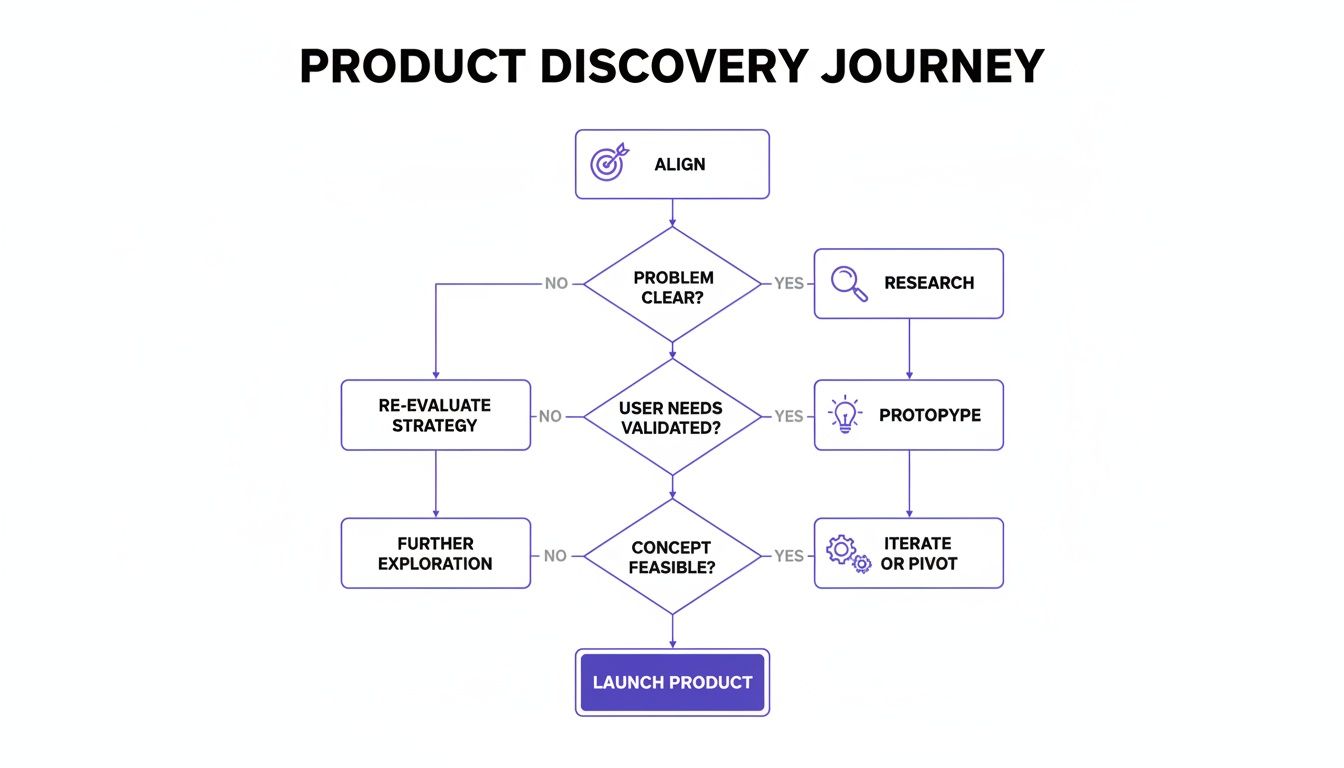
As you can see, a solid discovery process is a journey, not a single event. You build from a foundation of shared understanding before you ever start talking about solutions.
Dual-Track Agile For Continuous Momentum
Dual-Track Agile is a fantastic model for teams that are already up and running and need to ship features consistently without losing sight of the customer. The idea is simple: you run two workstreams—or tracks—at the same time.
There’s a Discovery track and a Delivery track.
Think of it as an engine with two gears turning in sync. The Discovery gear is always spinning, exploring new ideas, interviewing users, and running quick experiments. Once an idea is validated, it's passed over to the Delivery gear, which builds and ships the production-ready feature.
This approach keeps you from hitting a "what's next?" wall. While the engineering team is building, the product manager and designer are already validating the next set of valuable problems to solve.
- Best For: Mature product teams working on an existing product in a fast-moving market.
- Key Advantage: It makes discovery a continuous, everyday habit instead of a clunky, start-and-stop project phase.
- Main Challenge: You have to be militant about communication. If the two tracks fall out of sync, you’ll end up with disconnected efforts.
The Four Big Risks Framework For De-Risking Ideas
Popularized by product guru Marty Cagan, this isn't so much a rigid process as it is a powerful mental model. It’s all about stress-testing your ideas against the four biggest reasons products fail before you write a single line of production code.
The whole point is to find cheap and fast ways to answer these four questions:
- Value Risk: Will people actually want this? Will they pay for it?
- Usability Risk: Can they figure out how to use it? Is it intuitive?
- Feasibility Risk: Can we actually build this with the team, tools, and time we have?
- Business Viability Risk: Does this actually work for our business? Will it support our sales model, marketing efforts, and legal obligations?
By tackling these risks upfront, you can kill bad ideas early and avoid the soul-crushing experience of building something nobody wants or that your business can't support.
The Opportunity Solution Tree For Strategic Clarity
Developed by the brilliant Teresa Torres, the Opportunity Solution Tree is a visual way to connect every single thing your team works on back to a tangible business goal. It’s the ultimate antidote to "feature factory" thinking, where teams just ship feature after feature without a clear purpose.
You start at the top with a desired outcome, like “Increase user retention by 15%.” From there, you branch out by brainstorming the customer problems—the "opportunities"—that stand in the way of that outcome. Then, for each opportunity, you brainstorm and test multiple solutions.
The Opportunity Solution Tree makes your thinking visible. It creates a shared map that shows everyone on the team exactly how the feature they are working on contributes to the company's strategic goals.
This framework is a lifesaver for remote teams because it creates a clear visual artifact that keeps everyone aligned. It ensures every experiment and feature is tied directly to a meaningful goal. If you're looking for more ways to organize your high-level goals, our guide to product strategy frameworks is a great next step.
Framework Comparison: Dual-Track Agile vs. Opportunity Solution Tree
So, how do two of these popular frameworks stack up against each other? Both are powerful, but they shine in different scenarios. This table breaks down the key differences to help you see which one might be a better fit for your team right now.
| Aspect | Dual-Track Agile | Opportunity Solution Tree |
|---|---|---|
| Primary Goal | Maintain a continuous flow of validated work into the delivery pipeline. | Connect all work directly to a specific business outcome. |
| Focus | Process and workflow efficiency. | Strategic alignment and problem-solving. |
| Key Artifact | A prioritized and validated backlog of user stories. | A visual tree diagram linking outcomes to opportunities and solutions. |
| Best For | Mature teams optimizing an existing product. | Teams needing to improve their strategic focus and decision-making. |
| Main Output | A steady stream of shippable features. | A clear rationale for prioritizing certain customer problems. |
| Team Structure | Requires tight integration between discovery (PM, Design) and delivery (Eng). | Fosters collaboration across the entire product trio (PM, Design, Tech Lead). |
Ultimately, Dual-Track Agile is about how you work—keeping the engine running smoothly. The Opportunity Solution Tree is about what you work on—making sure the engine is driving you toward the right destination. Many advanced teams even find ways to use them together.
How to Make a Product Discovery Framework Work for a Remote Team
Putting a product discovery framework into practice is a huge win, but let's be honest—doing it with a remote team is a different ballgame. You can't just huddle in a conference room and sketch ideas on a whiteboard when your team is scattered across time zones. To make it work, you have to be deliberate about how you communicate, what tools you use, and the routines you create.
For a team that isn't in the same office, a shared framework is more than just a process. It’s the glue that holds everyone together, making sure you're all speaking the same language and pulling in the same direction. It turns a simple Slack message from a status update into a real conversation about what users need. The trick is to take those classic discovery techniques and make them work online.
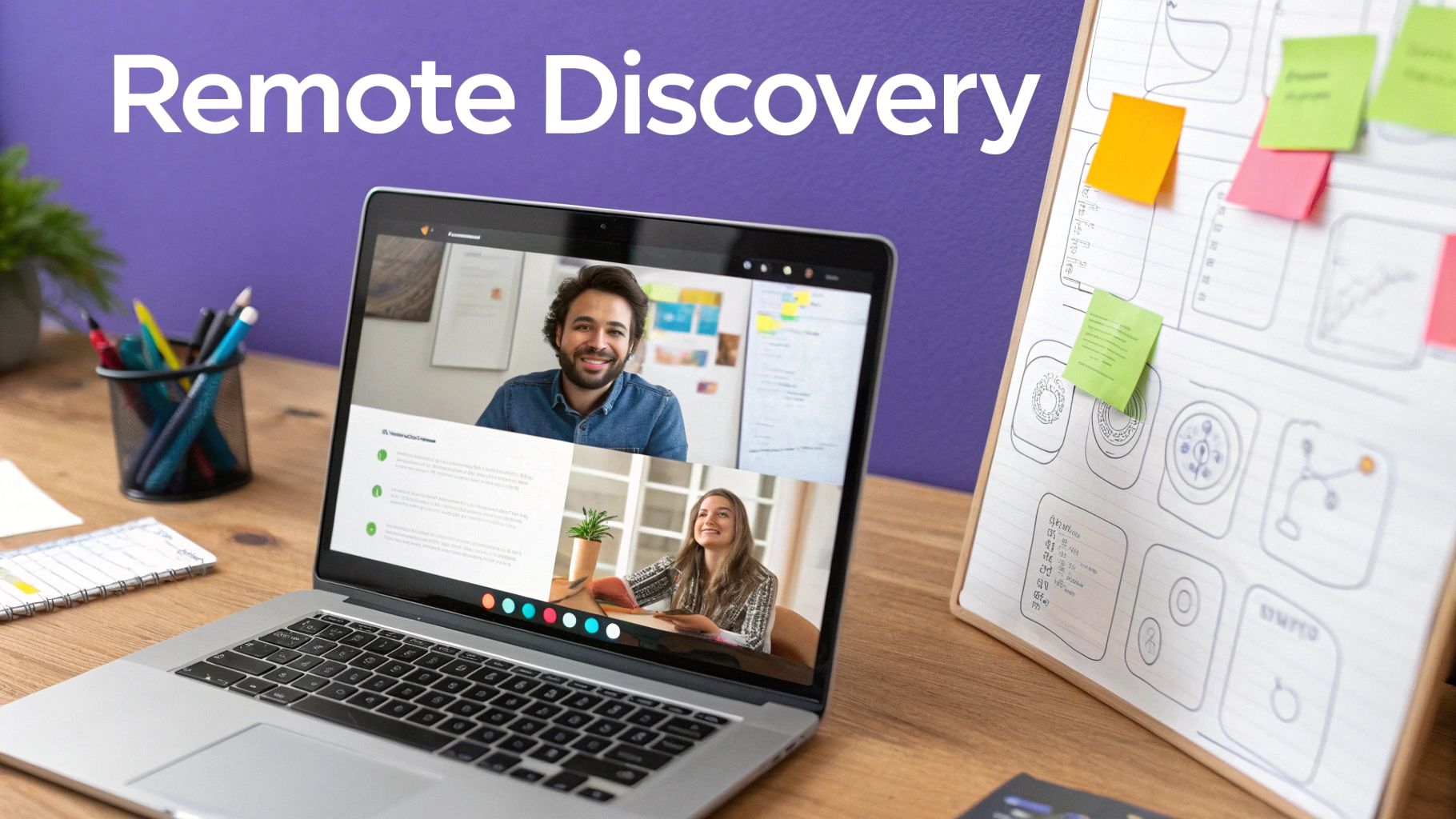
This isn’t about just copy-pasting your in-office habits into a video call. It’s about creating that same spark of collaboration and trust that lets great ideas flourish, no matter how many miles are between you.
Getting Your Remote Discovery Toolkit Ready
First things first: you need the right set of digital tools. The right tech can make physical distance feel irrelevant, almost like you’re all in the same room. Look for platforms that are easy to use, support live collaboration, and play nicely with the software you already have.
A solid remote toolkit should cover these bases:
- Digital Whiteboards: You absolutely need something like Miro or Mural. These become your team's shared brain for brainstorming, assumption mapping, and creating user story maps.
- Video Conferencing: A solid platform like Zoom or Google Meet is your go-to for running user interviews, holding workshops, and having those crucial face-to-face team chats.
- Asynchronous Communication: While Slack or Microsoft Teams are great for quick daily chats, you also need a home for your important documents. A tool like Notion or Confluence acts as the single source of truth for all your research findings and big decisions.
- Prototyping Tools: With Figma or Sketch, your team can build and share interactive prototypes that you can test with users anywhere in the world.
The goal isn't to have the most tools, but the right tools. A streamlined, well-integrated tech stack reduces friction and allows your team to focus on the discovery work itself, not on fighting with software.
Setting Up Clear Roles and Routines
Once your tools are in place, it’s time to define how your team actually works together. When you’re remote, ambiguity is the enemy. Everyone needs to know exactly what their role is and what’s expected of them.
Start by writing down who does what. Who’s in charge of scheduling user interviews? Who’s responsible for pulling insights from the research? Who owns the prototype? Nailing this down from the start prevents a lot of headaches and dropped balls later.
Next, create a steady rhythm for your discovery work with a few key routines. These aren't just more meetings on the calendar; they're structured check-ins designed to keep the momentum going.
Key Routines for Remote Discovery
- Weekly Discovery Sync: Set aside 30-45 minutes each week to go over what you learned, decide on the next research steps, and tackle any roadblocks.
- Async Idea Generation: Use a shared whiteboard or document where people can drop ideas on their own time. This is great for different time zones and for those who like to think things through before speaking up.
- Virtual Research Debriefs: Schedule calls where the whole team can dive into the findings from user interviews or tests. This makes sure everyone gets the benefit of the insights.
For more intense, focused work, you can adapt powerful methods for a remote setup. Our guide on how to run a remote design sprint shows you how to pack months of work into one super-productive week.
How New Tech is Changing the Game
The world of product discovery is always evolving, and new technology is a big part of that. For example, Deloitte's research shows that many consumer product companies are using artificial intelligence to speed up their innovation. These tools can help teams generate more and better ideas in less time. One big trend is figuring out how to use large language models in discovery, since they process information so differently from old-school search.
By combining a solid framework with smart remote practices and the right tools, your team won't just overcome the challenges of being apart—you can turn it into an advantage, tapping into talent from all over the world to build something truly amazing.
How to Measure the Impact of Your Discovery Work
So, you’re doing all this discovery work. How do you actually prove it's adding value and not just spinning wheels? Measuring the impact of product discovery isn't about counting how many features you ship. It's about measuring learning, building confidence, and killing risk before you write a single line of code.
The whole point is to show how this upfront work prevents incredibly expensive mistakes down the road. This requires a mental shift away from old-school delivery metrics. Instead of tracking features launched, you need to track indicators that prove you're building the right thing for the right people. It's all about making smarter, evidence-based decisions.
Moving Beyond Output Metrics
To really demonstrate the value of discovery, you have to connect your activities to business outcomes. It’s not enough to say, "We did 10 user interviews." You need to show how those interviews stopped the team from building a feature nobody wanted, saving hundreds of engineering hours in the process.
Focus on metrics that quantify learning and de-risking. These are the KPIs that tell a powerful story to stakeholders about why this process is non-negotiable.
Here are a few key discovery metrics to track:
- Time to Validation: How quickly can your team test a critical assumption? A shorter cycle means you're learning faster and burning less time on ideas that are going nowhere.
- Confidence Score Improvement: Start tracking the team's confidence in a solution from the initial brainstorming session to a fully validated concept. A huge jump in this score shows the real value of your research and testing.
- Number of Discarded Ideas: This one feels a bit backward, but killing bad ideas early is a massive win. You have to frame this metric as money and time saved by avoiding dead ends, not as a failure.
Linking Discovery to Business Outcomes
Ultimately, you need to draw a straight line from your discovery efforts to tangible business results. When you can show leadership how your work directly impacted the bottom line, getting buy-in for future discovery becomes a whole lot easier. This isn't just a trend; it's a major business investment. The Data Discovery Market was valued at USD 4.8 billion in 2024 and is projected to hit USD 12.2 billion by 2033, which shows just how much companies are banking on data to guide their strategy.
A successful product discovery framework doesn’t just produce ideas; it produces evidence. Its true value is measured in the costly mistakes it helps you avoid and the successful outcomes it makes possible.
Connect your work to these powerful, easy-to-understand outcomes:
- Reduced Engineering Rework: By validating solutions before a single line of code is written, you slash the number of changes and fixes needed after launch. This is a direct cost saving that every leader understands.
- Increased Feature Adoption Rates: When a feature is born from a rigorous discovery process, it’s practically guaranteed to solve a real user problem. Naturally, these features see much higher engagement and adoption.
- Improved Team Morale and Focus: Nothing motivates a team like knowing they are working on validated, high-impact problems. Their sense of purpose skyrockets, leading to better work and lower turnover.
By tracking these kinds of metrics, you build a rock-solid case for your product discovery process. For a deeper dive, check out our guide on how to measure innovation for even more ideas. You’ll be able to prove that discovery isn't just another process—it's a strategic advantage that builds better products and a healthier business.
Common Product Discovery Mistakes and How to Avoid Them
Even with a solid product discovery framework, it’s surprisingly easy to fall into a few common traps. These mistakes usually start with the best intentions but can quietly sabotage your efforts, leading to wasted cycles and features nobody wants. Knowing what these pitfalls look like is the first step to sidestepping them.
One of the biggest blunders is treating discovery like a one-off project. A team will "do discovery," find what they think is the answer, and then charge ahead into development, never looking back. This completely misses the point. Discovery is a continuous habit, a muscle your team has to build and flex all the time to keep up with your customers' real, ever-changing needs.
Another classic mistake is falling in love with a solution too early. We’ve all been there—you get a great idea, and it feels brilliant. But that emotional investment is dangerous. It leads straight to confirmation bias, where you start looking for data that proves you’re right and conveniently ignore anything that suggests you might be on the wrong track.

Building a Resilient Discovery Culture
So, how do you avoid these traps? You build a more resilient, learning-focused culture with a few practical countermeasures. These simple habits help your team navigate the often messy reality of discovery and keep everyone focused on learning, not just shipping code. The real goal is to make it safe to be wrong.
The objective of product discovery is not necessarily to ship features. Rather, it’s to promote an environment of learning that will help you improve your product incrementally and consistently.
This shift in mindset is everything. When learning is the main goal, killing a bad idea isn't a failure—it's a win. It’s a cheap lesson that just saved you from making a very expensive mistake down the road.
Actionable Countermeasures to Common Problems
Here are a few practical ways to keep your discovery process honest and effective:
- Create an Idea Graveyard: This sounds morbid, but it works. Set up a dedicated space, maybe a page in Notion or a Miro board, for all the ideas you've parked. This makes it emotionally easier for the team to let go of an idea that isn’t panning out. It’s not gone forever, just resting in peace for now.
- Involve Engineers from Day One: Seriously, don't wait for a "handoff." Bringing engineers into the conversation from the very beginning is a game-changer. They provide an immediate reality check on feasibility and often come up with creative technical solutions you’d never have considered.
- Use Structured Interview Guides: To fight your own biases during user research, create a consistent interview guide. This helps you stick to open-ended questions that uncover what users actually need, rather than accidentally leading them toward the answer you want to hear.
- Focus on Problems, Not Features: Always, always frame your work around a user problem. Instead of saying, “We need to build a new dashboard,” try, “Our users can’t get a clear, at-a-glance view of their performance.” This simple switch keeps the team grounded in customer value, not just output.
Got Questions About Product Discovery? Let's Dig In.
Switching to a new way of working always brings up some questions. It's only natural. Let's tackle a few of the most common ones I hear from teams making the shift to a real discovery-first mindset.
How Do We Juggle Discovery Work with Our Delivery Deadlines?
This is probably the number one question on everyone's mind. It feels like a classic tug-of-war, but the trick is to stop thinking of discovery and delivery as two separate, competing tracks.
The best teams, especially remote ones, weave them together. Think of something like dual-track agile. You have a small discovery crew—maybe a product manager and a designer—working a couple of weeks ahead of the engineers. They're busy validating ideas, running quick tests, and teeing up work that's already been de-risked. This creates a steady, confident pipeline of work for the delivery team, so they're never left guessing or building the wrong thing.
The point isn't to hit pause on development to go "do discovery." It's about creating a continuous rhythm where well-understood, validated ideas are always ready to be built. This makes the whole operation smoother and way more effective.
What Happens When User Research Tells Us Our Business Goal Is Wrong?
First off, congratulations! This isn't a problem; it's a huge win. When what users are telling you clashes with a business objective, you've just uncovered a flawed assumption before you wasted months building on it.
Don't try to force a feature that users clearly don't want. Instead, take that data back to your stakeholders. Frame it as a strategic insight. Show them what you learned and start a conversation about how to pivot. This is exactly where a solid product discovery framework shines—it turns a potential disaster into a smart, data-informed change in direction.
We're a Small Team with No Budget. How Can We Even Start?
You don't need a fancy lab or a dedicated research department. Product discovery is a mindset before it's a process. It’s about curiosity and a commitment to learning.
You can absolutely start small and lean. Here’s how:
- Talk to five users. Seriously, just five. You'll be amazed. This simple step can uncover 85% of the major usability issues and give you incredible insight into what really matters.
- Use simple tools. A quick survey, a free online whiteboard for brainstorming, or even just a shared document can get you started. The tool doesn't matter as much as the conversation.
- Pick one big assumption. What's the one belief you hold that, if it turned out to be wrong, would completely sink your project? Start there. Find a cheap, fast way to test just that one thing.
Discovery can be as big or as small as you need it to be. The most important part is just starting the habit of learning before you leap into building.
Ready to make your brainstorming sessions more focused and effective? Bulby provides guided exercises that help remote teams uncover genuine user needs and build products people love. Start your journey at https://www.bulby.com.