
Product prioritization frameworks are simply tools that help you stop guessing what to build next. Instead of just going with your gut or listening to the loudest person in the room, they give you a structured way to make decisions. Think of it as a shared compass for your entire team, ensuring everyone is focused on work that actually delivers value to your customers and moves the business forward. It’s how you turn a messy, chaotic backlog into a clear, strategic roadmap.
Why Prioritization Frameworks Are a Lifeline for Remote Teams
Ever finish a great brainstorming session with dozens of fantastic ideas, only to have that energy fizzle out when it's time to decide what to do first? For remote teams, this is a classic momentum-killer. Without a system in place, decisions often come down to whoever makes the most compelling argument on a video call, which is rarely the best way to build a great product.
This is where prioritization frameworks bring some much-needed order to the chaos. It's like a head chef planning the menu for a packed restaurant. They can't possibly make every dish someone might want. Instead, they have to strategically choose the appetizers, main courses, and desserts that will not only delight their customers but also keep the kitchen from grinding to a halt. A good framework is your recipe for making those tough calls.
Creating a Single Source of Truth
One of the biggest hurdles for any distributed team is just getting everyone on the same page when you're not in the same physical space. A prioritization framework becomes your single source of truth, cutting through the noise of different time zones and Slack channels. It creates a transparent, objective system for looking at every single idea, feature request, and bug fix.
Here’s how a structured approach makes a real difference:
- It cuts down on subjective debates. The conversation shifts from, "I feel like we should do this," to, "This is our top priority based on the criteria we all agreed on."
- It makes the process transparent. Everyone can see exactly why one project is at the top of the list and another isn't. This builds trust and minimizes office politics.
- It gives you the confidence to say "no." With a clear rationale to back you up, it's much easier to push back on lower-priority requests and protect your team's focus.
By giving product, engineering, and business teams a common language, these frameworks turn opinion-based arguments into data-driven conversations about what truly creates value.
Aligning Your Distributed Workforce
When your team is scattered across the globe, getting—and staying—aligned is everything. A framework ensures that every single person, from the engineer in Poland to the designer in Brazil, understands why they are building a particular feature. That connection to the bigger picture is a massive motivator.
If you’re looking to get better at running these kinds of collaborative sessions, you might be interested in learning more about the best remote facilitation practices.
In the end, using one of these systems is about more than just organizing a to-do list. It's about building a remote team that's more focused, efficient, and aligned. It’s your guarantee that all the hard work your distributed team puts in is directed at the things that truly matter.
Comparing the Top Product Prioritization Frameworks
Trying to pick the right product prioritization framework can feel like being a chef with a hundred different knives—each is designed for a specific job. If you use a bread knife to chop vegetables, you’ll get the job done, but it’s going to be messy and inefficient. The trick is understanding what each framework is built for and matching it to your team's specific needs and the decisions you have to make right now.
To make this real, let’s walk through five of the most popular frameworks. We'll apply them to a hypothetical scenario: our team is building a collaborative whiteboarding tool and we need to decide what to build next.
A good framework brings order to the chaos of a sprawling backlog. It gets everyone on the same page and helps you build a roadmap with intention, not just guesswork.
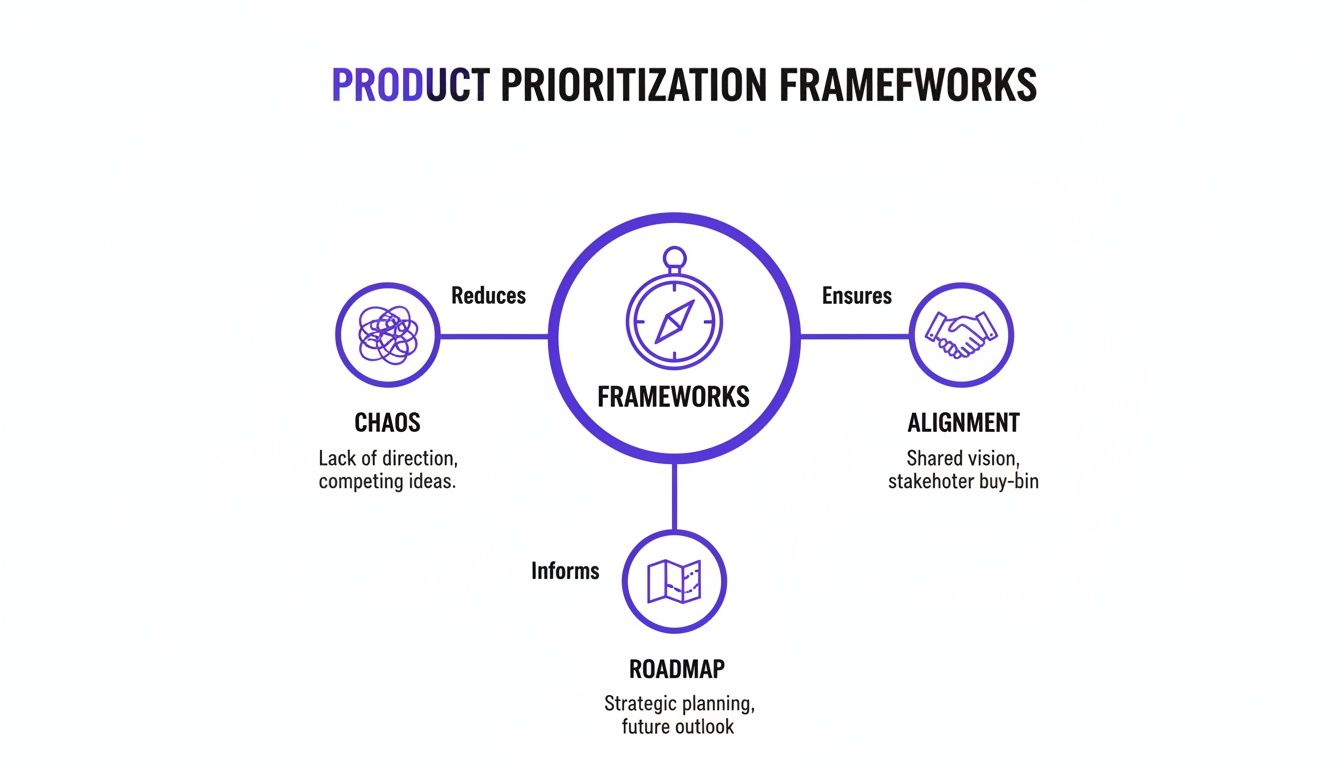
As you can see, the goal is to replace subjective debate with a clear, systematic approach. This leads to better team alignment and a product roadmap that truly reflects your strategic goals.
The RICE Framework for Data-Driven Decisions
When you need to take emotion and gut feelings out of the equation, RICE is your go-to. It’s a quantitative model that forces you to evaluate every idea against four data-backed criteria, making it especially powerful for mature products with a steady stream of user analytics.
The formula is straightforward: (Reach x Impact x Confidence) / Effort.
- Reach: How many people will this touch in a set period? (e.g., 500 users per month)
- Impact: How much will this move the needle for an individual user? (e.g., 3 for massive impact, 2 for high, 1 for medium)
- Confidence: How much do you trust your estimates? (e.g., 100% for high confidence, 80% for medium)
- Effort: What’s the total time investment from your team? (e.g., person-months)
In a world where product teams are often spread out, RICE has become a lifeline. A 2023 Productboard survey found that 49% of product managers say their biggest challenge is prioritizing without direct customer feedback, which is exactly where RICE shines. For remote teams, it’s a game-changer; some studies show that structured frameworks like this can cut misalignment by up to 40% by making scores visible and objective for everyone.
The MoSCoW Method for Scope Alignment
The MoSCoW method isn't about complex scores. It’s about communication and alignment. Think of it as a tool for having direct, honest conversations about what is truly essential for a specific release or sprint.
You simply sort every potential feature into one of four buckets:
- Must-have: These are the absolute non-negotiables. The product won't launch or work without them.
- Should-have: Important features that add major value but aren't deal-breakers for the release.
- Could-have: Great "nice-to-have" ideas that you'll tackle if there’s leftover time and resources.
- Won't-have: Features that are explicitly out of scope for this release, period.
For our whiteboarding tool, a Must-have is the basic ability to draw a shape. A Should-have might be seeing other users' cursors in real-time. A Could-have? A library of pre-made templates for brainstorming sessions.
MoSCoW is perfect for managing stakeholder expectations and getting everyone to agree on what's realistically possible in a set timeframe.
The Kano Model for Customer Delight
The Kano Model forces you to look at your roadmap through your customers' eyes. It helps you understand that not all features are created equal; some are expected, while others have the power to create true delight and loyalty.
Features are grouped based on how users react to them:
- Basic Needs: These are the table stakes. Customers expect them, and they'll be unhappy if they're missing. Think of the "save" button on our whiteboard—no one is thrilled it’s there, but they’d be furious if it wasn't.
- Performance Needs: With these features, more is always better. The faster our board loads or the smoother the drawing feels, the happier users will be.
- Delighters: These are the unexpected gems that create "wow" moments. Their absence causes no harm, but their presence can turn casual users into raving fans. Imagine an AI feature that automatically tidies up your messy, hand-drawn diagrams.
This model is fantastic for balancing the foundational work with the exciting innovations that set you apart. It fits beautifully with philosophies like the Eric Ries Lean Startup methodology, which is all about validated learning and focusing on what customers truly value.
The Value vs Effort Matrix for Quick Wins
When you need to move fast and can't afford to get bogged down in analysis, the Value vs. Effort matrix is your best friend. It’s a simple 2×2 grid that gives you a quick, visual gut check on where to focus.
You just plot each feature based on two simple questions:
- How much value does it deliver? (Low to High)
- How much effort will it take to build? (Low to High)
This instantly gives you four distinct quadrants:
- High Value, Low Effort (Quick Wins): Do these immediately.
- High Value, High Effort (Major Projects): These are strategic bets that need careful planning.
- Low Value, Low Effort (Fill-ins): Only tackle these if you have downtime.
- Low Value, High Effort (Time Sinks): Avoid these like the plague.
This is the perfect framework for startups or any team that needs to prioritize speed and momentum over perfect, detailed scoring.
At-a-Glance Comparison of Prioritization Frameworks
With so many options, it helps to have a quick reference. This table breaks down the core differences between the frameworks we've discussed so you can see which one might be the best fit at a glance.
| Framework | Core Focus | Best For | Complexity |
|---|---|---|---|
| RICE | Quantitative, data-driven scoring | Mature products with access to analytics; removing subjective bias | Medium |
| MoSCoW | Scope management and alignment | Defining MVP scope and managing stakeholder expectations for a release | Low |
| Kano Model | Customer satisfaction and delight | Balancing foundational needs with innovative "delighter" features | Medium |
| Value vs. Effort | Speed and identifying quick wins | Early-stage products, startups, or when you need to decide quickly | Low |
| Weighted Scoring | Custom, strategy-aligned evaluation | Teams with unique business goals that don't fit a standard model | High |
Each of these models offers a unique lens through which to view your backlog. The key isn't just to pick one, but to understand what kind of clarity you need most right now.
Weighted Scoring for Custom Prioritization
Sometimes, an off-the-shelf framework just doesn't cut it. Your company's goals might be so specific that you need a custom-built model. That's where Weighted Scoring comes in.
It’s a flexible system you build yourself:
- Define Your Criteria: First, decide what really matters. Is it "Strategic Alignment," "Customer Retention," "Revenue Generation," or something else?
- Assign Weights: Now, give each criterion a weight based on its importance. Maybe "Strategic Alignment" is worth 40%, while "Customer Retention" is 35%.
- Score Your Ideas: Rate each potential feature against every one of your criteria, typically on a simple scale like 1-10.
- Calculate the Score: Finally, multiply each score by its weight and add them all up to get a final, custom priority number.
This is the most adaptable framework of the bunch, giving you total control to create a system that perfectly mirrors your unique business strategy. If you want to dive even deeper, you can explore other powerful prioritization techniques to add to your toolkit.
How to Choose the Right Framework for Your Product
Picking a product prioritization framework isn't about finding the single "best" one. It’s about finding the one that’s right for you—right now. Think of it like picking a tool for a job. You wouldn't use a sledgehammer to hang a picture frame, right? The same logic applies here. The framework you choose has to fit your team, your product's current needs, and the challenges you're facing.
One of the most common traps teams fall into is over-engineering the process. The whole point is to bring clarity and speed to your decision-making, not get bogged down in a complex system that takes more time than the work itself. Your framework should feel like a trusted compass, not a bureaucratic straightjacket.
To find your best fit, you'll need to ask some honest questions about your product, your team, and the data you actually have on hand. The answers will point you toward a system that helps you move faster and with more confidence.
Assess Your Product’s Maturity Stage
Where your product is in its lifecycle is probably the biggest factor. A brand-new product trying to find its footing has entirely different priorities than a mature product with a massive user base. Your framework needs to reflect that reality.
Early-Stage Products (Pre-Product-Market Fit): At this point, it's all about speed and learning. You’re running on more assumptions than hard data. Simple, qualitative frameworks are your best friends. The Value vs. Effort matrix is perfect for this stage, helping you quickly spot high-impact ideas to test your core hypotheses and get the ball rolling.
Growth-Stage Products: Now you've got a real user base and quantitative data is starting to flow in. The focus shifts to scaling what works and optimizing the user experience. This is a great time to bring in a more data-informed model like RICE, which helps you balance potential reach and impact against your available resources.
Mature Products: With a large, established user base, the game changes. Your priorities are now about retaining customers, fending off competitors, and finding new ways to delight your audience. The Kano Model shines here, as it helps you distinguish between must-have features and the delightful surprises that build true brand loyalty.
Evaluate Your Data Availability
Every prioritization framework runs on some kind of input, and that input is data. But what kind of data do you have? Being realistic about this is critical.
A 2023 McKinsey study found that while 90% of leaders see capacity planning as crucial, very few feel their company does it well. This just goes to show how often there's a gap between wanting to be data-driven and actually having the data to do it.
If you have great analytics tools and a data team on standby, you can lean into quantitative models like RICE or Weighted Scoring. These systems need reliable metrics on things like user engagement, conversion rates, and market size to really work.
But if you're mostly working with customer interviews, survey results, and stakeholder feedback, you’re better off with a qualitative framework. Models like MoSCoW or Value vs. Effort are designed for exactly this scenario—they don’t need precise numbers and are great for sparking strategic conversations and getting everyone on the same page.
The most common pitfall is adopting a data-heavy framework without having reliable data to support it. This leads to "garbage in, garbage out" scenarios where your prioritization scores are based on wild guesses, making the entire process meaningless.
Consider Your Team Culture and Time
Finally, think about your team’s personality. How much time can you realistically set aside for prioritization? Does your team love process, or do they prefer to keep things light and move fast?
If your team thrives in a fast-paced environment, a complex framework with a dozen steps is dead on arrival. It’ll be seen as a chore and quickly abandoned. A simple matrix you can knock out in a single workshop is a much better cultural fit.
On the other hand, for teams that value thorough analysis and debate, a more rigorous system like Weighted Scoring can be a game-changer. It allows you to build a custom model that reflects your unique strategic goals. Just know that it requires a real investment of time upfront to define the criteria and agree on the weights.
Understanding this trade-off is key to choosing a system your team will actually embrace. For more insights on this initial phase, our guide on the product discovery framework can be a great resource.
A Step-by-Step Guide to Putting a Framework into Action
Picking a product prioritization framework is just the starting line. The real magic happens when you turn that theory into a repeatable process that actually brings clarity to your team, not more bureaucracy.
Let’s walk through five simple steps to make this happen. We’ll use a hypothetical scenario to make it real: prioritizing new features for a project management app.
Following these steps will help you transform that messy wish list into a strategic, defensible roadmap your whole team can actually get behind.
Step 1: Get Everything in One Place
You can't prioritize what you can't see. Right now, your team's great ideas are probably scattered everywhere—Slack DMs, customer support tickets, random meeting notes, and half-forgotten documents. The first job is to herd all of those potential features, bug fixes, and improvements into a single, master list.
For our project management app, this means gathering everything from "add Gantt chart view" to "integrate with calendar apps" and "fix the notification system" into one backlog. This single source of truth is the bedrock of the entire process.
Step 2: Define What "Good" Looks Like
A framework is totally useless if the scoring rules are fuzzy. What does "high impact" even mean? Or "low effort"? These terms mean different things to different people, so you have to define them in plain, objective language that everyone on the team agrees on.
Let's say we picked the RICE framework for our app. We’d need to get specific about each part:
- Reach: What do we mean by "number of users"? Daily active users? All signed-up accounts? Let's decide it means "the number of unique users who will encounter the feature in their first month."
- Impact: How do we score impact on a scale of 1-3? We could agree that a 3 directly helps our main goal (like user retention), while a 1 is more of a minor, nice-to-have improvement.
- Effort: This needs a standard unit. We'll define it as "person-weeks"—the total time needed for design, engineering, and testing.
Doing this work upfront stops arguments before they start because everyone is playing by the same rules. This is especially important when you’re just getting started. If you're building a new product, a helpful guide to MVP development for startups can help you focus on the most critical features for a successful launch.
Step 3: Gather Input (Without Calling a Huge Meeting)
Prioritization shouldn't happen in an echo chamber, but a big meeting can easily go off the rails. For remote teams, an asynchronous approach is a game-changer. Share your unified backlog and scoring rules in a collaborative tool like a spreadsheet or a product management app.
Give key stakeholders—from your engineering lead to the sales manager—a few days to add their scores and comments on their own time. This gives people space for thoughtful input without the pressure of a live meeting. It also respects different time zones and gives quieter team members a chance to share their insights. To keep things organized, try using a structured workshop planning template to guide the process.
Step 4: Run the Numbers and Rank Your List
Once all the feedback is in, it’s time for a little math. Tally up the scores for each item based on your framework's formula. This simple calculation will spit out a ranked list, transforming your chaotic backlog into a clear hierarchy.
The ranked list isn't a final command; it's a conversation starter. Think of it as a data-informed suggestion that shows where the collective wisdom of your team is pointing.
Suddenly, you might see that the "Gantt chart view" has fallen below "calendar integration" because its effort score was way higher than its estimated impact. This ranked list gives you an objective starting point for a final, strategic discussion.
Step 5: Share the Roadmap and the "Why"
The final, and most important, step is to communicate the why behind the decisions. Don't just email a link to the ranked list and call it a day. Present the newly prioritized roadmap to the entire team and your key stakeholders.
Walk them through how you got there, explain the trade-offs you had to make, and show how the final order connects back to the company's big-picture goals. This kind of transparency builds trust and gets people excited. When an engineer knows why they’re building a calendar integration instead of a Gantt chart, they’re far more engaged. A well-communicated roadmap gets everyone pulling in the same direction.
Running Effective Prioritization Sessions Remotely
Let’s be honest: a remote prioritization meeting can go off the rails fast. Without a solid plan, you're looking at a session that devolves into chaos, with a few loud voices dominating the call while others quietly disengage. The goal is a focused, collaborative, and decisive meeting, but that rarely happens by accident.
The secret is to stop thinking of prioritization as a single, high-stakes meeting. Instead, treat it as a structured process that blends thoughtful prep work with a focused live discussion. Think of it like a "flipped classroom"—the heavy lifting happens before the call, so your precious time together is spent on strategic alignment and hashing out the tough trade-offs.
This simple shift turns a potentially draining video call into an energizing session where everyone leaves feeling confident in the decisions made.
Prepare for Success Before the Meeting Starts
The best remote sessions are won long before anyone clicks "Join Meeting." Solid preparation isn't just nice to have; it's non-negotiable. When everyone shows up with the right context, the live session transforms from a frantic data-gathering scramble into a sharp, decision-making workshop.
Here's how to set the stage:
- Circulate a Clear Agenda: Send out a detailed agenda at least 48 hours ahead of time. It should clearly state the meeting's goal, the specific items up for discussion, and exactly what decisions need to be made.
- Share Pre-Reading Materials: Give everyone access to a shared space, like a document or a digital whiteboard in Miro or Mural. This should contain all the initiatives, along with relevant data, customer feedback, or your initial scoring estimates.
- Assign Asynchronous "Homework": This is the game-changer. Ask each participant to review the materials and add their initial scores, thoughts, or questions before the meeting. This surfaces disagreements early and gives quieter team members a chance to make their voices heard.
Pre-meeting prep isn't just about efficiency; it's about inclusivity. It creates a level playing field where thoughtful async contributions carry as much weight as loud in-meeting opinions, leading to better, more balanced decisions.
Facilitate an Engaging and Decisive Session
With the groundwork laid, your job as the facilitator is to steer the conversation toward a clear outcome. In a remote setting, you have to be much more active in managing the flow to keep everyone engaged and on track. Vague, rambling discussions are the enemy.
Try these techniques to keep the energy high and the meeting moving:
- Time-Box Every Discussion: Assign a specific time limit to each agenda item. Put a timer on the screen where everyone can see it. This creates a sense of urgency and prevents one topic from hijacking the whole session.
- Focus on the Disagreements: Thanks to your pre-work, you already know where everyone agrees. Don't waste time on that! Jump straight to the items with the biggest scoring differences and dedicate your time to a focused debate.
- Use Silent Brainstorming: To get input from the whole team, not just the fastest talkers, try techniques like "silent dot voting." Give everyone five minutes to silently place votes on their top priorities on the digital whiteboard before you open the floor for discussion.
- Assign a Decider: Sometimes, even with a great process, the team will get stuck. For these moments, a pre-assigned decider (usually the product manager) must be empowered to make the final call based on the team's input.
By combining thorough prep with disciplined facilitation, you can run remote prioritization meetings that actually build momentum, create genuine alignment, and produce a roadmap the entire team can get behind.
Common Questions About Prioritization Frameworks
Let's be honest: even with a great framework, things can get messy. Moving from theory to practice always unearths a few tricky questions. It’s a totally normal part of the process as your team finds its groove.
This section is all about tackling those common hurdles head-on. We'll walk through the questions we hear most often and give you practical answers to help you sidestep the pitfalls and get better results, faster.
How Often Should We Reprioritize Our Backlog?
There's no single magic number here, but a good rule of thumb is to review your backlog at the start of every development cycle. For most teams, that means a quick check-in every two-week sprint. This keeps everyone aligned on what's immediately in front of them.
Bigger, more strategic reprioritization sessions should happen less frequently—usually quarterly. Think of these as your team's chance to zoom out and react to the bigger picture.
You'll know it's time for one of these major resets when you see triggers like:
- Game-changing customer feedback that uncovers a new problem or a huge opportunity.
- A major market shift, like a competitor making a bold move.
- New business goals or a change in direction from leadership.
The goal is to be flexible enough to react to change without giving your development team whiplash from constantly shifting priorities.
What Is the Biggest Mistake Teams Make?
The single most common trap is treating a framework's score as the absolute, final word. It’s not. A framework gives you a number to start a conversation, not end one.
When you blindly follow the math without talking through the context, you can make some really poor choices. A feature might get a sky-high RICE score, but if it completely contradicts the company's long-term vision, is it really the right thing to build? Probably not.
Always remember that prioritization frameworks are tools for discussion, not decision-making machines. The real magic happens in the conversation after the numbers are on the board.
Can We Combine Different Frameworks?
Absolutely! In fact, most seasoned product teams don't stick to just one. They create their own hybrid models by cherry-picking the best parts of different frameworks to fit their specific needs. This lets you play to the strengths of each method at different stages of your planning.
You might use a simple, high-level framework for big-picture planning and a more detailed, data-driven one for your day-to-day work.
Here’s a popular hybrid approach:
- Quarterly Planning: Start with the MoSCoW method to get all the key stakeholders to agree on the big "Must-have" initiatives for the quarter.
- Sprint Planning: Once you have your "Must-haves," use the RICE framework to score the individual features and stories within that bucket. This helps you figure out the most logical order for the next two-week sprint.
This approach gives you both strategic alignment from the top and data-informed execution on the ground. The best system is always the one that brings your team clarity. To get started, you might find it helpful to use a pre-built prioritization matrix template to keep things organized.
How Do We Handle Disagreements During Meetings?
First off, disagreements aren't a bad thing. They're a sign that your team is engaged and cares about the outcome. The trick is to keep them productive.
The best way to do this is to bring the conversation back to the framework's objective criteria. Instead of getting stuck in a loop of "I just feel like this is more important," guide the discussion back to the data.
Try asking questions like, "That's an interesting point. Can you walk me through why you scored the impact as an 8 while the rest of us had it closer to a 5?" This shifts the focus from gut feelings to a shared understanding of the criteria.
It also helps to have a designated facilitator whose job is to keep the conversation on track, put a time limit on debates, and make sure everyone gets a chance to speak. If you hit a true deadlock, the product manager should have the final say, armed with all the inputs and perspectives from the team.
At Bulby, we believe that great ideas are the starting point for any successful product. Our platform is designed to help remote teams move from brainstorming to clear, actionable insights, ensuring your best ideas get the attention they deserve. Discover how Bulby can guide your team through structured, creative exercises to unlock your next big innovation.