
Cognitive diversity isn't about what people look like, but how they think. It’s the mix of different thinking styles, information processing habits, and problem-solving approaches you find within a group. This variety in perspective and knowledge is a massive asset for any team, especially when you're trying to innovate.
Going Beyond the Buzzword of Cognitive Diversity
Many companies today are focused on demographic diversity—differences in age, gender, or ethnicity. That's incredibly important, but it doesn't automatically mean you'll have a team that thinks differently. You can easily fill a room with people from diverse backgrounds who all went to the same schools, worked in the same industry, and ended up thinking in a very similar way.
True cognitive diversity is about intentionally building a team with different intellectual toolkits. Think of it like this: trying to build a house with only a hammer is a recipe for frustration. You can get some things done, sure, but you'll struggle to cut wood or turn screws. A high-performing team is like a complete toolbox, equipped with saws, screwdrivers, and measuring tapes. Each tool has a unique purpose, and together, they can build something remarkable.
The Core Components of Thought Diversity
So, what does this "toolbox" of thinking styles actually contain? While everyone is unique, cognitive diversity often shows up in a few key ways:
- Problem-Solving Approaches: Some people are linear thinkers, methodically breaking problems down into sequential steps. Others are big-picture thinkers, seeing connections and patterns first.
- Information Processing: You'll have team members who are deeply analytical and data-driven, needing solid evidence to move forward. Others might be more intuitive, relying on their experience and gut feelings.
- Perspective and Experience: Different professional training, industry backgrounds, and life experiences all create unique viewpoints that can seriously enrich group discussions.
This blend is more than just a nice-to-have; it has a real impact on the bottom line. A landmark study highlighted in the Harvard Business Review found that teams with greater thought diversity solved problems up to 3 times faster than teams of like-minded people.
By focusing only on traditional diversity metrics, leaders risk creating an echo chamber of similar thinkers. Cognitive diversity breaks this cycle by valuing the intellectual friction that leads to more robust and innovative outcomes.
At its core, understanding cognitive diversity is about recognizing that our individual minds are shaped by a lifetime of unique experiences. These differences aren't obstacles to overcome; they are strategic advantages just waiting to be unlocked. Of course, it’s also crucial to be aware of how our own thinking patterns create blind spots. You might find our guide on how cognitive bias in decision making can impact your team's performance helpful. Harnessing diverse viewpoints is the secret to building resilient, adaptable, and truly high-performing teams.
The Real Business Impact of Diverse Thinking
So, what does cognitive diversity actually do for a business? It's not just a feel-good HR initiative. It's a strategic advantage that directly impacts innovation, decision-making, and, most importantly, the bottom line.
When you bring together a team of people who think in different ways, you build a more robust and adaptable unit. This natural variety is your best defense against the inertia of groupthink, where everyone nods along to the same old ideas.
Fueling Innovation and Superior Problem-Solving
Teams that think alike tend to get stuck in a rut. They recycle the same solutions and often miss huge blind spots right in front of them. Cognitive diversity shatters that echo chamber. It introduces the kind of healthy friction that sparks real innovation.
Imagine a team with an analytical planner, a big-picture dreamer, a creative storyteller, and a detail-oriented implementer all tackling the same problem. They'll poke holes in each other's logic and examine the challenge from every conceivable angle, leading to far more complete and creative solutions.
As this graphic shows, getting different minds on a problem doesn't just improve the outcome—it makes the whole process faster.
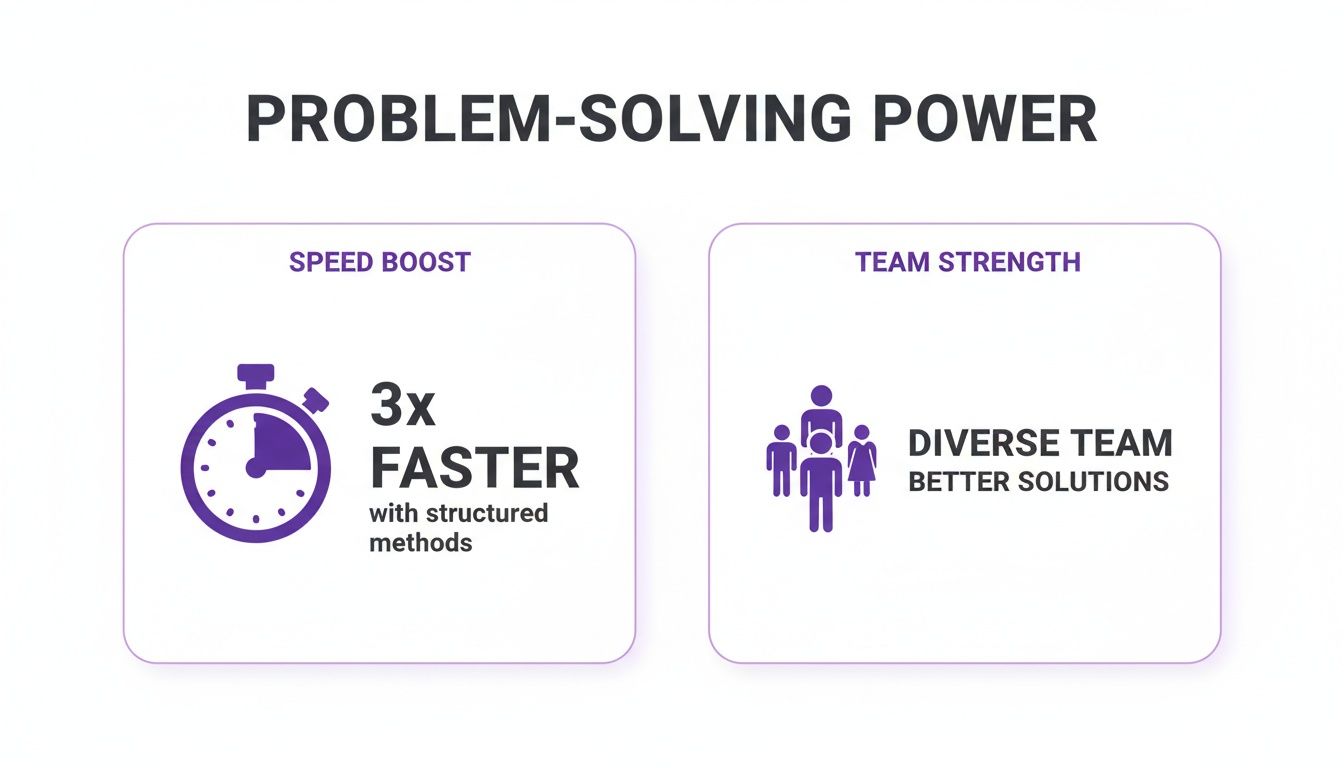
The data backs this up. A mix of thinking styles accelerates the entire problem-solving cycle, from identifying the issue to implementing a fix.
This ability to move quickly and creatively is a massive advantage for any company trying to stay relevant. It's also worth noting the significant overlap with the benefits of neurodiversity in the workplace, which add another powerful layer to team performance.
Driving Measurable Financial Growth
The business case for cognitive diversity isn't just about better ideas; it shows up in black and white on the balance sheet. When you build a culture where different ways of thinking are truly valued, you see incredible financial returns and higher employee retention.
A team that thinks differently is far more likely to spot market opportunities that others miss, challenge flawed assumptions before they become costly mistakes, and create products that appeal to a wider customer base.
One eye-opening analysis followed companies for 11 years. It found that businesses with strong inclusive cultures—the bedrock for cognitive diversity—saw their revenue grow by a staggering 682%. Their less-inclusive competitors? They only managed 166% growth over the same timeframe.
Cognitive Diversity vs Homogeneous Teams A Performance Comparison
To really see the difference in action, a side-by-side comparison makes it crystal clear. When you stack a cognitively diverse team against a homogeneous one, the performance gap is obvious.
This table highlights just how stark those differences can be.
| Performance Metric | Cognitively Diverse Teams | Homogeneous Teams |
|---|---|---|
| Innovation Rate | High; new ideas are frequently generated and explored. | Low; often relies on proven, traditional methods. |
| Decision Quality | Strong; decisions are well-vetted from multiple angles. | Variable; prone to groupthink and overlooked risks. |
| Adaptability | High; able to pivot quickly in response to change. | Low; struggles to adapt to unexpected challenges. |
| Problem-Solving Speed | Faster; multiple approaches are applied simultaneously. | Slower; often gets stuck in a single line of thinking. |
| Employee Engagement | High; team members feel their unique input is valued. | Lower; can lead to conformity and disengagement. |
The takeaway is simple. While building a team with diverse thinking styles takes real, intentional effort, the payoff is enormous. It’s a powerful competitive advantage that’s hard for anyone else to copy.
Encouraging a diversity of ideas is more than just good management—it's how you build a resilient and successful business from the ground up.
Recognizing the Hidden Risks of Thinking Alike
While diverse thinking sparks growth, a team that thinks the same way is silently steering toward trouble. The real danger isn't a shortage of good ideas; it's the lack of healthy friction needed to kill bad ones. This kind of environment, what we call cognitive homogeneity, creates a dangerous echo chamber where flawed thinking goes completely unchecked.
When everyone in the room approaches problems from the same angle, they also share the same blind spots. Sure, this can feel efficient at first. Meetings wrap up quickly, and everyone agrees. But that harmony is an illusion. It's the quiet before a storm of bad decisions, missed opportunities, and failures that were entirely preventable.

The Catastrophic Cost of Groupthink
One of the most infamous risks here is groupthink. It’s what happens when the desire for consensus becomes so strong that it silences critical thinking and common sense. A room full of brilliant people can unanimously agree to a terrible plan, all because nobody wants to be the one to rock the boat.
History is littered with cautionary tales. Think about Kodak sticking to film while digital photography took over, or Blockbuster passing on the chance to buy Netflix. These weren't clueless leaders. They were smart people, surrounded by other smart people who all saw the world the same way, reinforcing a shared—and ultimately fatal—point of view.
The fallout from this kind of collective blindness can be devastating:
- Failed Product Launches: A team might get excited about a product that only makes sense to them, completely missing what the actual market wants or needs.
- Strategic Miscalculations: They might misread a competitor's move or ignore it entirely because it doesn't fit their pre-existing script for how the industry works.
- Ethical Lapses: The pressure to conform can lead a team to rationalize or overlook unethical choices, leading to massive legal and reputational blowback.
Knowing how to spot these patterns is a critical leadership skill. For a deeper dive, check out our guide on how to prevent groupthink and start building a more resilient team culture.
The Silent Toll of Conformity
Beyond the big, headline-grabbing disasters, a lack of cognitive diversity takes a quieter toll on your most important asset: your people. When team members get the message that their unique viewpoints aren't welcome, they quickly learn to keep them to themselves. They stop asking tough questions. They stop offering up those weird, out-of-left-field ideas that often lead to breakthroughs.
This pressure to conform doesn't just stifle innovation; it kills engagement. Employees who can't bring their full intellectual selves to work become disengaged, leading to higher turnover and a significant loss of creative potential.
It’s a vicious cycle. The lack of diverse thinking leads to poor results, which often makes leaders double down on hiring people who "fit in," reinforcing the very problem that caused the failure in the first place. In the end, a lack of cognitive diversity isn't just a missed opportunity—it's an active and expensive liability.
How to Build a Cognitively Diverse Team
Building a team with real cognitive diversity doesn’t just happen. It takes deliberate effort, starting long before a new person even walks through the door (or logs into Slack). It’s about making a fundamental shift from simply filling a role to strategically adding a new way of thinking to your team.
This means you have to look past the resume and the list of technical skills to get a feel for how someone ticks. The real goal is to bring together a group of people who can attack problems from all sides, making the team as a whole far more resilient and creative.
Rethink Your Hiring Process
Let's be honest—the traditional hiring process is often a filter for conformity. We have a natural bias toward hiring people who think like us, who share our background, and who give the "right" answers in an interview. If you want cognitive diversity, you have to actively fight this instinct.
A great place to start is by ditching the vague idea of "culture fit." Too often, this is just code for "someone like us." Instead, start looking for a culture add—someone who brings a perspective or thinking style that enriches and expands your team's current dynamic.
Here’s how to do that:
- Widen Your Talent Pool: Stop recruiting from the same few universities or industries. Look for candidates with unconventional backgrounds or zig-zag career paths. They often bring the freshest insights.
- Use Scenario-Based Interviews: Move beyond the standard questions. Give candidates a real, messy problem your team has actually faced and ask them to talk you through how they'd solve it. This shows you their thinking style in action, not just their prepared answers.
- Involve a Diverse Interview Panel: Make sure the people evaluating candidates have different ways of thinking themselves. A panel with varied perspectives is far more likely to spot and appreciate a wider range of problem-solving approaches.
When you start focusing on what people are capable of, not just what's on their resume, you open the door to thinkers who can challenge old assumptions and push your team in exciting new directions.
Identify and Map Existing Thinking Styles
Before you can add new perspectives, you need a clear picture of the ones you already have. If you skip this step, you risk accidentally hiring more of the same type of thinker, which only reinforces your team’s existing blind spots.
One practical way to do this is with thinking-style frameworks or assessments. Tools like the Herrmann Brain Dominance Instrument (HBDI), or even simpler team self-assessments, can help you visualize your team's cognitive landscape. Are you overloaded with analytical, data-driven thinkers but missing anyone who’s a creative, big-picture dreamer?
Understanding your team's current cognitive makeup isn't about putting people in boxes. It's about identifying gaps so you can hire strategically to create a more balanced and intellectually robust team.
This mapping process gives you a much clearer target for your next hire. You’re no longer just looking for another software engineer; you're looking for an engineer who brings a divergent, experimental mindset to a team of methodical planners.
Ask Questions That Reveal How People Think
The right interview questions can peel back the layers of a candidate's experience to reveal their core problem-solving DNA. Instead of just asking what they did, you need to dig into the how and the why behind their choices.
Here are a few examples of questions designed to get past the surface:
- "Tell me about a time you had to solve a problem with incomplete information. What was your process?" This uncovers how they handle ambiguity. Are they more intuitive, or do they scramble to find any data they can?
- "Describe a project that failed. What did you learn, and what would you do differently now?" This question is great for testing intellectual humility and their ability to learn. It shows you if they can analyze a complex situation without just pointing fingers.
- "If you were given a completely new, undefined project, what would be your very first steps?" This tells you if they're a planner who needs structure, a collaborator who immediately seeks input, or an experimenter who just wants to dive in and try something.
These questions shift the focus from past achievements to future potential. They help you see not just what a candidate knows, but how they think—the very essence of building a team with true cognitive diversity. For more structured ways to see this in action, you might explore adapting the Nominal Group Technique to surface individual thinking styles in a group exercise.
Creating a Culture Where Diverse Thinkers Succeed
Hiring for cognitive diversity is a fantastic first step, but it’s only half the battle. If you just assemble a team of brilliant, different thinkers without changing the underlying culture, you’re setting them up to fail. It’s like planting exotic seeds in concrete—nothing will grow. The real magic of varied perspectives is only unlocked when you have an inclusive culture built on psychological safety.
Without that safety net, different viewpoints can easily lead to friction and conflict instead of innovation. An analytical, detail-oriented person might dismiss a creative’s idea as impractical. A big-picture thinker might get frustrated with a colleague who’s focused on the tiny details. If you don't manage these natural clashes, they can curdle into resentment and silence, killing the very benefits you were trying to create.

The Essential Role of Psychological Safety
So, what is psychological safety? It's the shared belief that it's safe to take risks on your team. It’s that feeling in your gut that tells you you won't be shut down, punished, or humiliated for speaking up with a new idea, a tough question, or even admitting a mistake. For a cognitively diverse team, this is the secret sauce that turns potential conflict into healthy, productive debate.
When team members feel genuinely safe, they’re much more willing to:
- Challenge the status quo. They’ll poke holes in the dominant idea and point out flaws, which is your best defense against groupthink.
- Offer up wild ideas. They feel comfortable sharing those "half-baked" thoughts that might just lead to a huge breakthrough.
- Admit mistakes and ask for help. This creates a culture of learning and growth, not a culture of blame.
Research backs this up. Studies show that cognitive diversity absolutely boosts team performance, but there's a catch. The positive effect is often blocked if team members start categorizing each other into "us vs. them" camps. It's high psychological safety that breaks down those barriers and lets the ideas flow freely.
Ultimately, inclusivity is the key that turns a diverse group of individuals into a high-performing team. It ensures every unique viewpoint is heard, valued, and applied to solve your organization's biggest challenges.
Building this kind of environment is an active, ongoing effort. For a deeper dive, our guide on what psychological safety is and how to build it at work offers some really practical steps for leaders.
Practical Tactics for Fostering Inclusivity
Creating a safe and inclusive space requires intentional leadership. It’s all about modeling the right behaviors and setting clear rules of engagement that encourage healthy debate, not personal attacks. The best leaders here act more like skilled facilitators than top-down dictators.
Here are a few concrete tactics you can start using right away:
- Model Intellectual Humility: Leaders need to openly admit when they don’t have the answer or when they’ve messed up. This sends a powerful signal to the team that it's okay to be vulnerable and that no one is expected to be perfect.
- Actively Invite Dissent: Don't just hope someone will disagree—ask for it. Try using phrases like, "What are we missing here?" or "I'd love to hear a counterargument to this." This gives people explicit permission to challenge your thinking.
- Establish Clear Ground Rules: Set explicit norms for discussions and debates. This could be as simple as "attack the idea, not the person" or making sure everyone gets a chance to speak without being interrupted.
Supporting Different Ways of Working
A truly inclusive culture also gets that people don't just think differently—they work and learn differently, too. You have to accommodate these variations to make sure everyone can bring their A-game. Understanding the different learning styles in adults is a huge part of making sure your whole team can actually process and contribute information effectively.
For example, some people on your team might thrive in a rapid-fire, verbal brainstorming session. Others need quiet time to process and write down their thoughts before they feel ready to share. Your job as a leader is to create space for both.
This could mean sending an agenda with key questions before a meeting so your reflective thinkers can prepare. Or you could use tools that allow for asynchronous brainstorming, where people can add ideas on their own time. By giving people multiple ways to participate, you ensure the loudest voice in the room isn't the only one that gets heard.
Common Questions About Cognitive Diversity
As leaders start digging into cognitive diversity, a few questions always seem to pop up. Let's tackle them head-on, because getting these answers straight is the key to moving from a cool idea to something that actually works for your team.
Is Cognitive Diversity the Same as Demographic Diversity?
Not quite, though they're definitely related. Think of it this way: demographic diversity is what you can see—differences in age, gender, ethnicity, and background. Cognitive diversity is what’s going on inside—the different ways people think, approach problems, and connect ideas.
A team with diverse backgrounds is more likely to have diverse thinkers, simply because different life experiences shape our minds in unique ways. But it’s not a given. You can have a team that looks diverse but everyone thinks in lockstep, or a team that looks similar but is full of different problem-solving styles. The real magic happens when you aim for both.
How Can I Measure Cognitive Diversity in My Team?
You don’t need a complicated lab setup to get a feel for this. You can go the formal route with assessments like the Herrmann Brain Dominance Instrument (HBDI) or even the Myers-Briggs Type Indicator (MBTI). These tools give you a structured map of your team's thinking preferences.
But you can also measure it just by paying attention. Watch how your team tackles a problem. Who jumps straight to the data? Who starts sketching out wild ideas? Who asks about the impact on people? The goal isn't to put everyone in a box. It’s to see the different tools each person brings to the table so you can use them together.
The real win from measuring cognitive diversity isn't about creating neat little profiles. It's about spotting your team's collective strengths and, just as importantly, discovering its blind spots.
What Is the Biggest Challenge of Leading a Cognitively Diverse Team?
The single biggest challenge? Managing the friction. When you have different thinking styles in one room, they’re bound to bump into each other. The person who needs every detail before starting can easily get frustrated with the person who just wants to dive in and figure it out as they go.
As a leader, your job is to be the mediator and the facilitator. You have to create an environment where people feel safe to disagree, set clear ground rules for communication, and constantly frame these differences as a strength, not a weakness. Without that guidance, all that creative tension just turns into… well, tension. But with it, that same friction becomes the spark that ignites better ideas and smarter decisions.
Ready to unlock your remote team's full creative potential? Bulby provides the structured, AI-guided exercises you need to harness cognitive diversity and turn different ways of thinking into your most powerful asset. Start your free trial today.