

Ever been in a group project where it feels like you're doing all the heavy lifting? That feeling has a name: social loafing.
It’s the simple, almost unconscious tendency for people to put in less effort when they're working in a group than when they're working alone. Think of a group tug-of-war. When it’s just you on the rope, you pull with everything you’ve got. But when you’re one of eight people, it’s easy to ease up just a little, assuming everyone else will pick up the slack.
This isn’t about being lazy. It's a subtle psychological quirk that can quietly drain a team's energy and productivity.
Unpacking the Tug of War Effect

The whole idea of social loafing was first spotted over a century ago in a surprisingly simple experiment. An engineer named Max Ringelmann noticed something odd during a rope-pulling test. He found that when people pulled on a rope by themselves, they gave it 100% of their effort.
But in a group of eight? Each person's individual effort dropped to just 49% of what they could do alone.
It's not that people consciously decide to slack off. It's a natural reaction when individual contributions get buried in the group effort and personal accountability starts to feel fuzzy.
The Core Psychological Triggers
So, why does this happen, even on teams full of smart, motivated people? It boils down to a few key psychological drivers that pop up in group settings.
-
Diffusion of Responsibility: When everyone is responsible, no one is. In a group, that feeling of personal ownership gets spread thin. It’s easy to think, “Someone else has got this,” or, “My small contribution won’t really change the outcome.” That shared responsibility makes it easier to back off without feeling bad about it.
-
Loss of Individual Recognition: In a big team project, who gets the credit? When it’s hard to see who did what, the motivation to go above and beyond can plummet. If people feel their hard work will just get lost in the crowd, they’re less likely to put in that extra effort because there's no clear link between their work and personal recognition.
-
Low Perceived Impact: People need to see the "why" behind their work. If a team member doesn't understand how their specific task fits into the bigger picture, their work can start to feel pointless. This disconnect between effort and outcome is a huge motivation killer and a major cause of social loafing.
Social loafing is ultimately a symptom of a system, not just a flaw in an individual. It signals a breakdown in accountability, role clarity, or team cohesion. Addressing these systemic issues is the key to re-engaging every member.
The antidote is building a team where every single person feels their contribution matters. This means creating a culture where individual efforts are seen and celebrated, which ties directly into creating psychological safety at work. When people feel safe to take ownership and be visible, they’re far more likely to stay engaged and pull their full weight.
The Psychology Behind Why We Socially Loaf
Social loafing isn't just about being lazy—it's a surprisingly predictable human reaction to working in a group. To really get a handle on it, you have to understand what’s going on in our heads. At its heart, social loafing kicks in when the comfortable anonymity of a team erodes our personal sense of responsibility.
Think about being in a crowded lecture hall when the speaker asks a question to the room at large. What happens? Usually, silence. Everyone assumes someone else will speak up. That's social loafing in a nutshell. It's a natural instinct to save our energy when we think our individual effort won't be seen or won't really move the needle.
The Diffusion of Responsibility
The biggest psychological driver here is the diffusion of responsibility. This is the feeling that when a task is shared by a group, your personal duty to get it done shrinks. The more people you add to a team, the more that sense of responsibility spreads out, becoming thinner and less powerful for each individual.
This quietly feeds the "someone else will do it" mindset. If you're on a one-person project, you feel 100% of the responsibility. Add just one more person, and suddenly your share feels like 50%. On a team of ten, you might subconsciously feel you only own 10% of the outcome. We don't do this math consciously, but it’s a mental shift that makes it way easier to check out.
This is exactly why a vague request like, "can someone take care of the presentation slides?" often means no one takes care of them. Without clear ownership, the task just floats in a cloud of shared, but unclaimed, responsibility. This problem gets even trickier during group decision-making, where it's easy for individual accountability to get lost in the shuffle. Learning better methods for decision-making in groups is a great way to tighten up roles and fight this diffusion.
The Sucker Effect: Avoiding Unequal Effort
Another powerful force is what psychologists call the "sucker effect." This happens when your hard-working, motivated team members see others slacking off. Nobody wants to be the "sucker" who does all the work for the same reward, so they start to pull back on their own efforts to match what they see from their peers.
It's a totally human, self-protective instinct. Why would you give 110% if others are barely phoning it in? This can trigger a downward spiral of productivity, where the entire team's performance eventually sinks to the level of its least productive members.
Key Takeaway: The sucker effect is contagious. One person’s loafing doesn’t just impact their own output; it can poison the well and demotivate your best people, setting off a chain reaction of disengagement.
Anonymity and Motivation
Finally, when people feel like their individual work is invisible, their motivation plummets. It’s hard to get excited about a project when your specific contributions are just blended into the final group product. If no one knows what you did, the connection between your effort and any kind of recognition is completely broken.
This ties into a bigger idea. To get a better sense of how people learn from and contribute within a group, it’s helpful to look at social learning theory, which shows how our behavior is shaped by our social environment and its consequences. When positive consequences (like praise or recognition) disappear, so does the drive to contribute.
Once you understand these three forces—diffusion of responsibility, the sucker effect, and anonymity—you see that social loafing isn't a problem of "bad employees." It's a problem with the system. It happens in environments that fail to make each person's contribution feel visible, valued, and essential to the team’s success.
How Remote Work Can Be a Breeding Ground for Social Loafing
The move to remote and hybrid work has been a game-changer, offering a level of flexibility we'd never seen before. But there's a flip side. This new way of working has, without anyone meaning for it to, rolled out the red carpet for social loafing.
When we lose the physical office, we lose more than just a commute. We lose the subtle social pressures and structures that keep everyone accountable. It's the little things—seeing a teammate laser-focused on a problem, the buzz of a productive morning, or a quick hallway chat—that remind us we're all in it together.
Without that ambient energy, it’s far too easy for individual contributions to get lost in the digital ether. People become icons on a screen, and that strong sense of being a unified team can start to fray. This digital distance is exactly where social loafing takes root.

The Invisibility Factor
Back in the office, just being present was a form of participation. You were physically there, and your engagement—or lack of it—was plain for everyone to see. Remote work strips away this natural layer of oversight.
An employee’s status can be green, but they might be completely checked out. It's incredibly difficult for anyone to tell the difference. This creates a low-accountability environment where the diffusion of responsibility, a key driver of what is social loafing, goes into overdrive. When work is mostly asynchronous, the line between contributing and coasting gets dangerously blurry.
In a remote setting, visibility isn't just about being present in a chat channel; it's about making individual contributions and progress clear and tangible to the rest of the team. Without this, anonymity can flourish, and effort can decline.
Weakened Social Bonds and Team Cohesion
Let's be honest: it’s harder to build strong relationships through a screen. The casual "water cooler" chats, shared lunches, and inside jokes that build real camaraderie get replaced by scheduled, agenda-driven video calls.
When communication becomes purely transactional, team identity suffers. If team members don't feel personally connected to each other, they're less likely to feel that pull of collective responsibility. Their work starts to feel like a checklist of individual tasks instead of a shared mission. This is why it’s so critical to learn how to manage remote teams effectively by being intentional about building genuine connection.
The Blurring of Work and Home Life
While flexibility is a huge perk, it also means that home-life distractions are a constant. For some, this can lead to a quiet reprioritization of effort away from work, especially when they feel like no one is watching.
A 2016 study dug into this, finding that team makeup in a virtual setting really matters. Researchers discovered that remote teams with members who had heavy family responsibilities saw higher rates of social loafing. Without face-to-face accountability, it simply became easier to let domestic duties take precedence over professional contributions.
Challenges in Remote Team Management
Many classic management techniques just don't work in a distributed world, which makes it even harder to spot and stop social loafing.
- Difficulty Gauging Engagement: Managers can no longer rely on body language or office buzz to get a feel for who's engaged and who's struggling.
- Ambiguous Communication: A quick Slack message can easily be misinterpreted, leading to fuzzy expectations and deadlines that create gray areas for loafing.
- Uneven Workload Distribution: It’s much tougher to see who’s drowning in work and who has extra bandwidth. This can lead to the "sucker effect," where overloaded team members reduce their own effort out of frustration.
To get ahead of these problems, leaders have to be much more deliberate. This is why learning how to manage remote teams effectively is so important; it requires a proactive focus on clear goals, consistent communication, and a culture built on trust. Without these intentional structures, a remote team risks becoming just a collection of isolated individuals instead of a powerful, collaborative force.
Common Signs of Social Loafing to Watch For
Social loafing doesn't exactly show up waving a red flag. It’s more of a slow fade—a quiet, gradual slide into disengagement that often gets mistaken for something else. To catch it early, you have to look past the obvious stuff like missed deadlines and start noticing the subtle, recurring behaviors that show someone is checking out.
Spotting these patterns is the first real step. It's not about jumping on someone for having an off day; it’s about recognizing a consistent trend before it starts to poison team morale and drag down results.
Low Visibility and Vague Contributions
One of the classic tells of a social loafer is that they just seem to fade into the background, especially when work needs to be done. They’re physically present in meetings but mentally absent, rarely speaking up or offering any real input during a brainstorm.
When you ask for an update, their answers are often frustratingly vague. You get a lot of non-committal language that sounds productive but says nothing.
- In-Office Example: They're the person in the meeting who nods along with everything but never once offers a fresh idea or challenges a weak one.
- Remote Example: Their updates in a project tool like Asana or Jira are just filler: "Working on it" or "Making progress," with zero proof of what's actually getting done.
This ambiguity is intentional. It lets them ride the wave of the group's momentum without ever having to paddle.
The Pattern of Passivity
Another dead giveaway is chronic passivity. The social loafer is almost always waiting for someone else to step up—to make the tough decisions, to volunteer for the hard tasks, to take the lead. They rarely, if ever, raise their hand for a new assignment and will consistently choose the path of least resistance.
This isn't about introversion; it’s a deliberate avoidance of ownership. They are perfectly content to let others steer the ship, which conveniently means they never have to take the blame if it hits an iceberg.
A core sign of social loafing is when an individual consistently outsources their accountability to the group. They let the team's collective effort shield them from personal ownership, creating a dynamic where they benefit from the success without contributing to the work.
Decreased Proactive Communication
Team members who are truly invested communicate proactively. They’ll warn you about potential roadblocks, ask questions to get clarity, and share useful info without you having to ask. The social loafer? They’re purely reactive.
You’ll find yourself constantly chasing them for updates, and their response times to emails and messages will get slower and slower. This isn't just a communication breakdown; it's a symptom of deep disengagement. The project has simply fallen off their radar. Remotely, this looks like a perpetual "away" status on Slack or a ghost-like presence in team channels.
Disproportionate Focus on Low-Impact Tasks
Sometimes, a social loafer can look surprisingly busy while cleverly dodging the work that actually matters. They’ll fill their time with minor, low-impact tasks that are easy to check off a list but do little to move the project forward. This creates a convincing illusion of contribution without any of the heavy lifting.
For instance, they might eagerly volunteer to format the slide deck but conveniently disappear when it's time to do the hard research and analysis for the content. It's a subtle way to claim they "helped" while sidestepping the responsibilities that truly drive results.
Identifying Social Loafing In-Office vs. Remote
Spotting these behaviors can be tricky because they look different depending on where your team works. A quiet person in the office might just be focused, but a silent person on a remote team could be completely checked out.
Here’s a quick guide to help you translate these signs for in-office, hybrid, and fully remote environments.
| Behavioral Sign | How It Looks in an Office | How It Looks When Remote |
|---|---|---|
| Low Visibility | Physically present in meetings but mentally absent; avoids eye contact; never speaks up. | Camera is always off in video calls; rarely contributes in chat channels; goes "dark" for long periods. |
| Vague Contributions | Gives verbal updates like, "It's going well," without offering specifics or showing work. | Task updates in project tools are generic ("in progress"); avoids sharing screens or showing concrete work. |
| Passivity | Never volunteers for new tasks; waits to be assigned the easiest parts of a project. | Ignores open calls for help in team channels; is always the last to claim a task from a shared backlog. |
| Reactive Communication | You have to walk over to their desk to get an update; never initiates conversations. | Slow to respond to DMs and emails; only provides information when directly and repeatedly asked. |
| Focus on Trivial Tasks | Spends excessive time on administrative or "housekeeping" tasks instead of core project work. | Volunteers for easy tasks like scheduling meetings but avoids complex, high-impact assignments. |
Recognizing these signs isn't about pointing fingers. It's about understanding that the environment shapes behavior and being equipped to support your team—and call out disengagement—no matter where they are.
Actionable Strategies to Prevent Social Loafing
Spotting the signs of social loafing is one thing, but getting ahead of it is the real goal. The best strategy isn't about punishing someone who has checked out; it's about building a team culture where disengagement can't find a foothold in the first place. When you create an environment built on clarity, accountability, and a shared sense of purpose, you dismantle the very dynamics that let people fade into the background.
The trick is to make every person's contribution both visible and valuable. Once ambiguity disappears and you can draw a clear line from individual effort to team success, the psychological cover for loafing vanishes. It’s all about shifting social pressure from a negative force that encourages hiding to a positive one that motivates everyone to pull their weight.
This diagram breaks down the common tells of a disengaged team member.
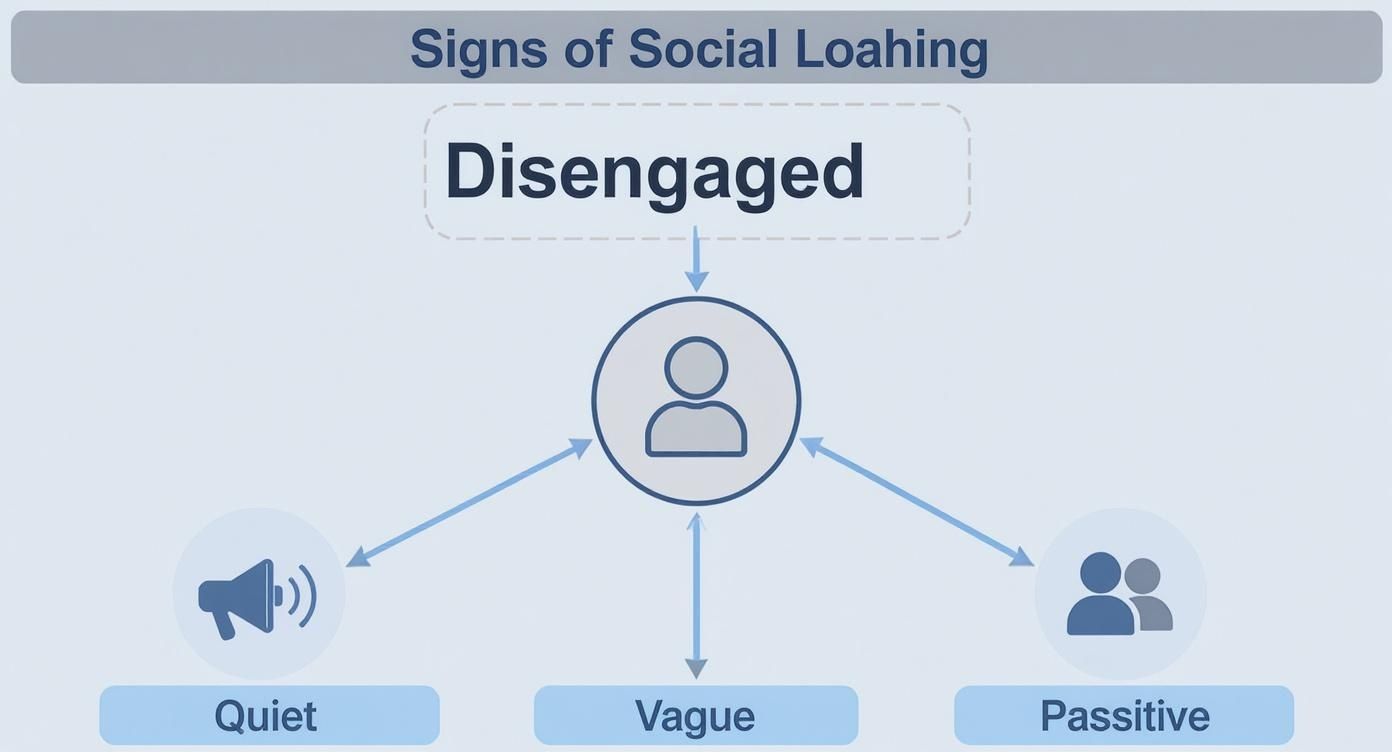
It really highlights how disengagement often shows up as passivity, vague updates, or just a general quietness during collaborative sessions. These are the key signals to watch for.
Make Individual Contributions Visible
If you do just one thing, make it this. Visibility is the most powerful antidote to social loafing. When people know their work will be seen and recognized, they’re far more likely to give it their all. Think of it this way: anonymity is the best friend of disengagement, while transparency is the bedrock of accountability.
A landmark 2013 study on motivation drove this point home beautifully. When individual performance metrics were posted publicly for the group, the team members actually outperformed people working alone—completely flipping the social loafing effect on its head. But when those same metrics were kept private, the group’s performance tanked, proving that visibility is a massive motivator. The full study on how performance visibility reduces social loafing is a fascinating read.
Core Principle: People won't coast if they can't hide in the crowd. Design your workflows to shine a light on individual inputs, and you'll eliminate the shadows where disengagement thrives.
Define Crystal-Clear Roles and Goals
Ambiguity is a breeding ground for social loafing. If your team members aren't sure exactly what they're supposed to be doing or what "done" looks like, it’s all too easy for tasks to slip through the cracks. Every single project should kick off with clearly defined roles and measurable goals.
- Assign Direct Ownership: Stop saying, "The team needs to finish the report." Instead, try, "Sarah is owning the data analysis, and Ben is writing the summary." This simple shift gets rid of the diffusion of responsibility.
- Set Specific, Measurable Goals (SMART): Vague targets like "improve the landing page" are an open invitation to loaf. A goal like, "Increase landing page conversion by 15% by the end of Q3" gives the whole team a concrete target to aim for.
When everyone knows exactly what they're on the hook for, there’s no room to think, "Oh, someone else has probably got this."
Strengthen Team Cohesion and Identity
Let's be honest—people are far less likely to let down teammates they actually like and respect. Building a strong sense of group identity is a powerful, proactive defense against social loafing. When a group feels less like a collection of individuals and more like a real team with a shared mission, members are motivated by mutual respect and a genuine desire not to disappoint their peers.
This doesn't happen by magic, especially on remote or hybrid teams. It takes intentional effort. Regularly using thoughtful employee engagement questions can spark conversations that build trust and help people feel seen as human beings, not just as job titles.
Keep Team Sizes Manageable
As a group gets bigger, the risk of social loafing skyrockets. It’s just human nature. In a massive team, it's easy for individuals to feel like their contribution is just a drop in the ocean or that no one will notice if they ease up. Amazon’s famous "two-pizza rule"—if you can't feed a team with two pizzas, it's too big—is a brilliant, practical guideline here.
Smaller teams naturally create more accountability. Each person's input is more critical, and it's much harder to fly under the radar. If you have a large project that needs more people, break the group into smaller, focused sub-teams or squads. Each one gets its own clear objective, preserving that small-group dynamic while still tackling a big challenge.
Building a High-Trust Culture to Eliminate Loafing
While specific tactics can help manage social loafing, they often just treat the symptoms. If you want a real, lasting cure, you need to build a culture of high trust. This isn't about awkward team-building games; it’s about the daily, consistent actions of leaders that make disengagement feel impossible.
Think about it. When managers genuinely trust their people, show they have their backs, and make fair decisions, everything changes. Team members stop worrying about being taken advantage of and start focusing on doing great work. This creates a powerful sense of psychological safety where everyone feels secure and valued.
On the flip side, a culture rife with organizational politics is toxic. When people feel that decisions are driven by favoritism, gossip, or secret deals, they become cynical. Why bother giving your best effort if you think the game is rigged? In that kind of environment, holding back feels like a smart act of self-preservation.
The Direct Link Between Trust and Effort
This connection between trust and effort isn’t just a nice theory; there's hard evidence to back it up. Recent studies show a direct line between a leader's trustworthiness and a team's tendency to loaf.
A 2023 study found a significant negative correlation (r = -0.21) between an employee's trust in their supervisor and their social loafing behavior. In simple terms: as trust in a leader goes up, social loafing goes down. That same study revealed a positive correlation (r = 0.25) between the perception of organizational politics and loafing, proving that a toxic atmosphere directly fuels disengagement. You can dig into the data on how these workplace dynamics impact team effort in the full study.
This research highlights a crucial truth. Nurturing a supportive, transparent culture isn't a "soft skill" or a nice-to-have. It's a fundamental business strategy for getting the most out of your team and starving social loafing of the oxygen it needs to survive.
Key Takeaway: Trust is the bedrock of accountability. When people trust their leaders and their teammates, they hold themselves—and each other—to a higher standard. Proactive contribution becomes the default, not the exception.
Practical Steps for Cultivating Trust
Building this kind of culture takes deliberate, intentional work from leaders. It begins with small but consistent behaviors that prove you’re on your team’s side. For a more detailed playbook, check out our guide on how to build trust in teams.
Here are a few places to start:
- Practice Radical Transparency: Don't hide the tough stuff. Be open about company challenges, the reasons behind decisions, and key performance metrics. When people understand the "why," they feel less like employees and more like partners.
- Lead with Empathy: Genuinely listen to your team’s concerns, whether they're about a project or what’s going on in their lives. Simply acknowledging their struggles and offering support creates an incredible bond of loyalty.
- Ensure Fairness and Consistency: Apply rules, hand out praise, and address issues the same way for everyone. Nothing erodes trust faster than the feeling that there are double standards or favorites.
Ultimately, in a high-trust environment, social loafing becomes socially unacceptable. When everyone feels connected, supported, and treated fairly, the group itself creates a powerful expectation to pull your own weight.
A Few Final Questions on Social Loafing
To wrap things up, let’s tackle some of the most common questions that come up when people try to get their heads around social loafing and how it works.
Isn't Social Loafing Just Plain Laziness?
Not quite. It’s easy to mix them up, but laziness is more of a personality trait—a general lack of motivation. Social loafing, on the other hand, is all about the situation.
Even your most driven, high-achieving team member can fall into the social loafing trap if they feel like their work doesn't matter, isn't seen, or is just getting lost in the shuffle. It's a reaction to the group environment, not a fundamental character flaw.
Does This Happen in Small Teams Too?
Absolutely. While it’s definitely more common in bigger groups where it's easy to become anonymous, small teams aren't immune.
In a smaller setting, it often happens when roles are fuzzy or when one person’s slacking triggers the “sucker effect” in others. The rest of the team starts thinking, "Why am I working so hard when they aren't?" and they pull back their own effort to avoid feeling exploited. It can quickly become a downward spiral.
The real issue isn't the size of the team; it's the lack of individual accountability. Even in a tiny team of three, if it isn't clear who's doing what, someone can easily fade into the background.
How Can I Deal With Social Loafing Without Crushing Morale?
The key is to focus on fixing the system, not pointing fingers. Publicly calling someone out is a recipe for resentment. A much better approach is to build processes that make everyone’s contributions visible and valued.
- Set crystal-clear roles. Everyone should know exactly what they own.
- Shout out individual wins. When someone does great work that helps the team, make sure everyone knows it.
- Have private conversations. If you're concerned about someone's engagement, talk to them one-on-one to see what's going on and how you can help.
This way, you’re building a culture of accountability that feels supportive, not punitive.
One of the best ways to make sure every voice is heard during crucial moments like brainstorming is to use a structured process. Bulby guides your team through activities that make individual input not just visible but essential, designing social loafing right out of your creative process. You can see how it works at https://www.bulby.com.