

Blue Ocean Strategy is a method for creating new, uncontested market space instead of competing in crowded industries. W. Chan Kim and Renée Mauborgne introduced it in 2005, based on a study of 150 strategic moves across 30 industries.
A creative team usually encounters the problem before it encounters the framework. A client asks for a campaign in a crowded category, the competitors all use similar messages, and the brief becomes a request to produce a slightly better version of what already exists. The team compares ads, borrows familiar formats, adds another feature, and hopes stronger media spend will create separation.
That pattern produces activity, but not necessarily distinction. Blue Ocean Strategy gives agencies and product teams a different question: instead of asking how to beat the current alternatives, what could we change so buyers see a new kind of value?
Table of Contents
- The Problem With Competing in Red Oceans
- What Is Blue Ocean Strategy Defined
- The Four Actions Framework Explained
- Real-World Examples of Blue Ocean Success
- How to Apply Blue Ocean Strategy in Your Agency
- Common Pitfalls and How to Avoid Them
- Key Takeaways and Next Steps
The Problem With Competing in Red Oceans
A fitness brand brief can become a red ocean within minutes. Every competitor promotes discounts, signs fitness influencers, highlights app features, and promises a better version of the same transformation. Your team creates another campaign with energetic music, confident testimonials, and a limited-time offer. The work may be polished, but the strategic territory is already occupied.

In a red ocean, companies compete inside established market boundaries. Buyers already understand the category, competitors use similar proof points, and teams measure success against familiar alternatives. That makes the work feel safe, but it also encourages imitation. Each brand adds another offer, claim, feature, or promotion until the category becomes harder to move through and more expensive to enter.
The creative cost is just as serious as the commercial cost. Teams spend their time refining executions rather than questioning the assumptions behind the brief. A review becomes a debate about which headline sounds fresher, even though every headline makes the same promise.
Practical rule: If your campaign could be placed beside three competitor campaigns without changing the audience's understanding of the category, you're probably optimizing inside a red ocean.
Why differentiation needs a sharper starting point
Competitive analysis still matters. Your team needs to understand what competitors offer, how they communicate, and which expectations buyers bring to the category. A practical competitive analysis process helps reveal the pattern you need to escape.
The next step is to challenge the pattern. Instead of asking how your fitness client can make a discount more attractive, ask which people avoid gyms altogether, what they dislike about existing fitness routines, and what value a fitness company could offer without copying the category's usual format.
That shift also matters for software teams. Anyone working on product differentiation for SaaS founders faces the same risk, especially when competitors all advertise similar integrations, dashboards, and automation. Blue Ocean thinking starts before the campaign idea. It changes the market question underneath the campaign.
What Is Blue Ocean Strategy Defined
So, what is Blue Ocean Strategy? It's a structured approach to creating new market space by changing the factors on which an industry competes. Rather than fighting for a larger share of existing demand, a company redesigns its offer to make a different group of buyers interested, or to give existing buyers a reason to choose a new category experience.
W. Chan Kim and Renée Mauborgne introduced the framework through their 2005 book, Blue Ocean Strategy: How to Create Uncontested Market Space and Make the Competition Irrelevant, published by Harvard Business School Press. The book drew on a study of 150 strategic moves across 30 industries, which gave the concept a research base rather than leaving it as a catchy metaphor. The book's publication record and description provide the core historical context.
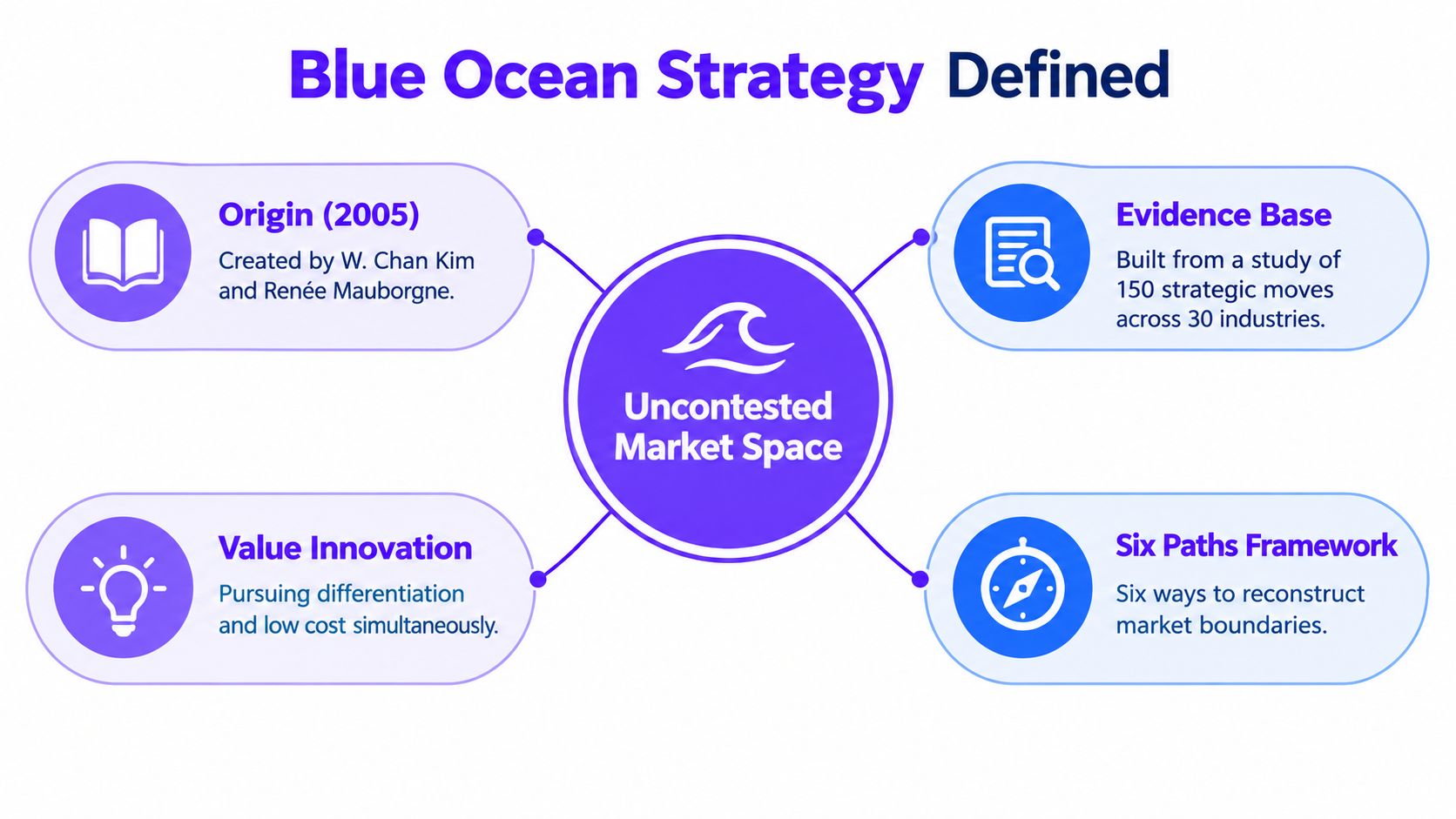
The two ideas that hold the framework together
The first idea is value innovation. It means pursuing differentiation and low cost at the same time, instead of assuming a company must choose between a distinctive offer and an efficient one. A creative agency applies this by removing expensive category conventions while creating a stronger reason for the audience to care.
The second idea is reconstructed market boundaries. Your team doesn't have to accept the category as competitors describe it. A fitness brand could stop behaving like a gym and instead combine accountability, social connection, flexible routines, or a different form of progress tracking. The opportunity may come from looking at alternatives outside the category, not from adding another feature within it.
The framework became widely recognized over time. A summary of its development notes that the book's ideas grew from the authors' earlier 1997 Harvard Business Review work on value innovation, and that the framework has been translated into 43 languages and sold over 3.5 million copies. The broader history of Blue Ocean Strategy records those milestones.
The important distinction is simple. Red Ocean Strategy asks, “How can we perform better than the current players?” Blue Ocean Strategy asks, “Which elements of this market can we remove, reduce, raise, or create so the offer no longer follows the same rules?”
The Four Actions Framework Explained
The Four Actions Framework turns an ambitious idea into a working discussion. Known as the ERRC grid, it asks your team to examine what the category does by default and decide whether each factor deserves to stay at its current level.
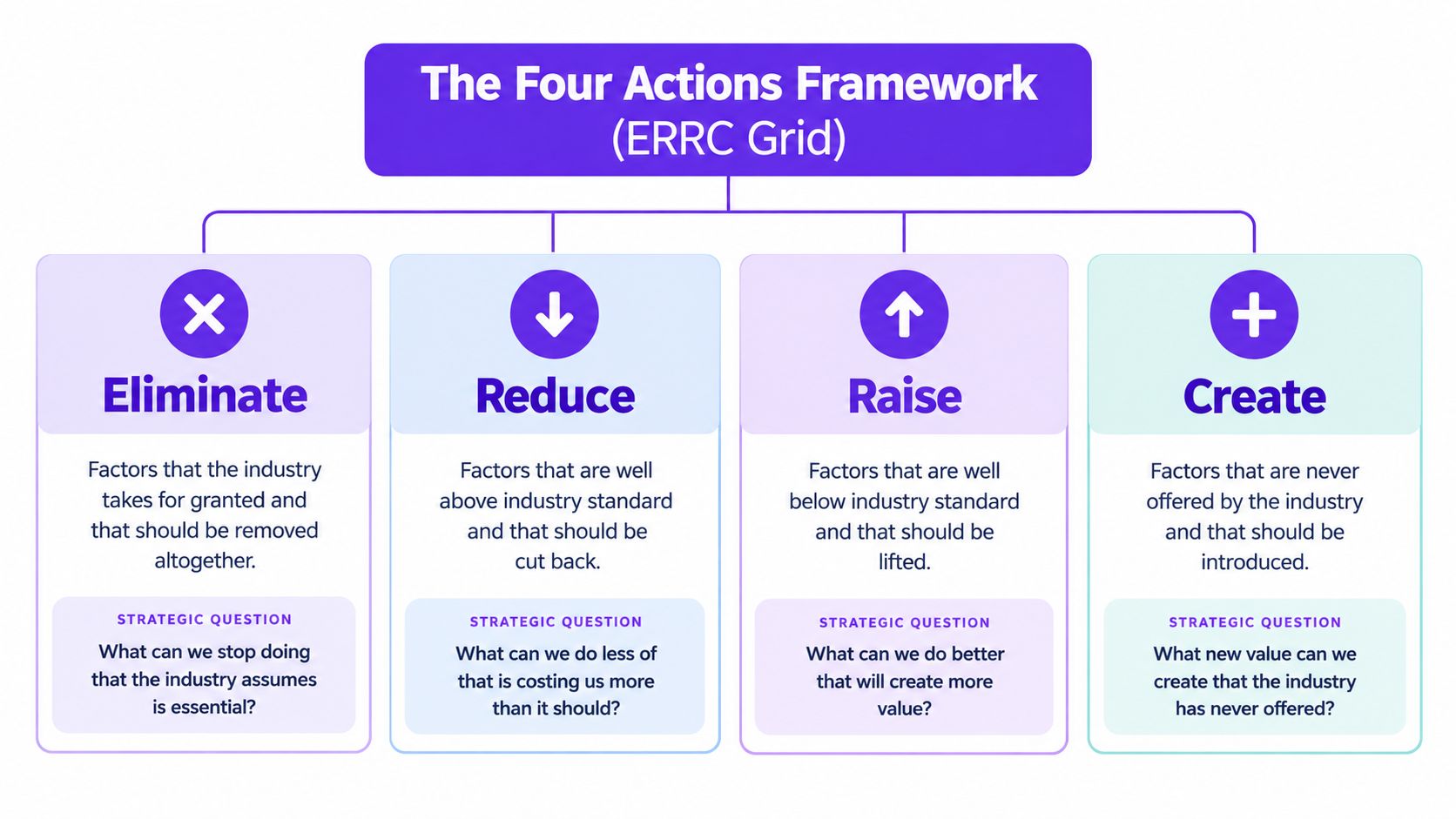
Start with the category's existing value curve. List what competitors promote, what buyers compare, and where teams spend money or creative attention. Then apply four questions:
| Action | Question | Example |
|---|---|---|
| Eliminate | Which factors does the industry take for granted that could disappear? | Remove complex membership tiers from a fitness offer. |
| Reduce | Which factors receive more investment than buyers need? | Reduce jargon, production complexity, or unnecessary feature depth. |
| Raise | Which experience should be much stronger than the category norm? | Raise personal accountability and clarity of progress. |
| Create | What could the category offer that it has never made central? | Create a community-led routine for people who dislike traditional gyms. |
Eliminate and reduce
Teams often jump straight to creation because new ideas feel more exciting. The first two actions are harder and often more revealing. Eliminate asks what the industry treats as mandatory even though customers may not value it. Reduce asks what can be simplified or delivered at a lower level without weakening the core promise.
For an agency, elimination might mean removing the expected celebrity partnership from a campaign. Reduction could mean using fewer messages, fewer audience segments, or a simpler production format. Those decisions can lower cost and make the central idea easier to understand.
Raise and create
Raise identifies the experience that deserves disproportionate attention. A product team might raise onboarding clarity, trust, or speed of first success instead of adding more settings. A campaign team might raise participation, usefulness, or emotional relevance.
Create is the boundary-breaking move. Look at noncustomers, adjacent categories, and substitutes. A fitness brand might create an offer for people who don't identify as fitness consumers at all. The point isn't novelty for its own sake. The new factor must give buyers a reason to enter the space.
For more context on building a distinctive market position, teams can use this guide to how to differentiate your business. A brand positioning map can then help visualize how the proposed value curve differs from familiar competitors.
Real-World Examples of Blue Ocean Success
The framework becomes easier to understand when you watch a company change the basis of competition. The examples below aren't instructions to copy a brand's surface features. They show how a team can combine elimination, reduction, raising, and creation into a different customer experience.

Netflix changed the rental question
Traditional video rental centered on physical access, store visits, and the rules attached to borrowing. Netflix moved toward streaming, which changed the customer's relationship with the service. The strategic lesson isn't just “use technology.” It's to identify which parts of the existing experience create friction, then build a model around a more convenient form of access.
For a product team, the equivalent might be removing a setup process that competitors assume customers will tolerate. For an agency, it could mean creating a campaign around access, convenience, or control rather than repeating product specifications. The opportunity appears when the team studies the job customers want done, not just the format competitors sell.
Cirque du Soleil redesigned the circus
Cirque du Soleil moved away from familiar circus conventions, including animal acts and the traditional emphasis on star performers and multiple rings. It raised artistic value and created elements associated with theater, such as narrative, music, and dance. The result was a different live entertainment experience rather than a direct attempt to make a conventional circus slightly better.
That is a useful creative prompt: Which neighboring category contains a value your industry has ignored? A financial service might borrow reassurance from hospitality. A software product might borrow guidance from coaching. A campaign might combine the emotional role of entertainment with the practical utility of education.
Dyson made appliance performance visible
Dyson changed expectations around household appliances by emphasizing engineering, design, and technology that customers couldn't see in the usual product comparison. Its lesson for product and brand teams is to make an invisible benefit concrete. If a technical advantage remains abstract, the audience may not understand why it matters.
The strongest blue ocean ideas often connect a functional improvement with a new way of explaining it. Teams looking for more examples of companies that changed the competitive frame can explore these disruptive innovation examples. Each story should prompt a question about the customer's underlying problem, not encourage imitation of a famous brand.
How to Apply Blue Ocean Strategy in Your Agency
An agency or product team can run the process as a focused working session rather than treating it as a strategy document. Begin with one client problem and one audience. Broad prompts produce familiar answers.
Start with the market boundary
List the obvious competitors, then add alternatives customers use instead. A fitness brand competes with gyms, but also with home routines, walking groups, personal commitments, and doing nothing. A project-management product competes with software, but also with spreadsheets, meetings, email, and informal team habits.
Next, draw the current value curve. Put the major factors on one axis and the relative level of attention or investment on the other. Don't aim for mathematical precision. The visual pattern matters because it shows where competitors converge.
Run the ERRC discussion
Ask each question separately. Give the team time to generate options before judging them.
- Eliminate: What does the category defend even though customers rarely mention it?
- Reduce: What creates cost, complexity, or anxiety without adding equivalent value?
- Raise: Which customer outcome deserves a much better experience?
- Create: What would attract noncustomers or people using an alternative?
Keep a “why now?” prompt beside the grid. A new idea needs a reason the audience can understand today, not just an unusual feature.
Build and test the offer
Use the six-step logic associated with the framework: restructure market boundaries, focus on the big picture, reach beyond existing demand, get the strategic sequence right, overcome execution hurdles, and align execution with strategy. These steps stop the workshop from ending with an imaginative concept that no team can deliver.
Your strategic sequence should answer four practical questions:
- Utility: Does the idea solve a meaningful problem?
- Price: Would the intended audience consider the offer accessible or worthwhile?
- Cost: Can the team deliver it without restoring the complexity it removed?
- Adoption: What would stop customers, partners, or internal teams from accepting it?
For a repeatable session format, a creative strategy workshop can help your team move from category analysis to campaign territory. Bulby is one option for structured, AI-guided brainstorming exercises that help teams generate and refine campaign concepts, messaging angles, and creative strategies.
Finish with a one-sentence proposition. If the team can't explain the new value clearly, the concept probably needs sharper focus. A compelling blue ocean direction should feel different in the customer's language, not only in the strategy deck.
Common Pitfalls and How to Avoid Them
Blue Ocean Strategy doesn't mean ignoring competitors. Competitor research shows the assumptions your team may want to challenge. The mistake is treating the current category as a permanent rulebook.
It also doesn't belong only to large corporations. Agencies can use the framework for a campaign platform, a service package, or a new business proposition. Product teams can apply it to onboarding, pricing structure, audience selection, or the way customers experience a familiar job.
Avoid the novelty trap
A strange idea isn't automatically a blue ocean. If a new feature adds cost but doesn't create meaningful customer value, it's just extra complexity. The same applies to campaigns that use an unusual visual style while keeping the same promise, audience, and category logic.
Check the idea against these questions:
- Customer value: Does the change solve a real frustration or attract a neglected audience?
- Strategic difference: Does the value curve diverge from competitors?
- Operational fit: Can the organization deliver what the campaign promises?
- Learning path: Can the team test the riskiest assumption before scaling?
Recent review literature argues that Blue Ocean Strategy works more reliably when combined with complementary approaches such as the resource-based view, open innovation, and lean manufacturing, rather than used as a complete operating system by itself. The systematic review and its findings also frame blue ocean moves as something that may require repeated reconstruction over time.
Execution creates another common failure point. Research on the framework links outcomes to dynamic capabilities, management control, HR policies, and organizational sense-making, which means a clever concept won't compensate for weak alignment. Teams can use a groupthink prevention guide to give dissent a structured role in the workshop.
A blue ocean is an opening, not a permanent shield. Once others notice the opportunity, the team must continue learning, improving delivery, and deciding which new assumptions to challenge.
Key Takeaways and Next Steps
Blue Ocean Strategy creates new market space by changing what customers receive and what the category considers important. Its central principle, value innovation, combines differentiation with low cost rather than treating them as opposites.
The ERRC grid gives creative teams a practical way to work:
- Eliminate accepted factors that no longer earn their place.
- Reduce costly or excessive elements.
- Raise the outcomes customers value most.
- Create a new reason for people to choose the offer.
For your next client or product challenge, write down the category's shared promises and familiar formats. Map the competitors, include substitutes, then ask the four questions before anyone writes a headline. Invite noncustomers into the discussion, test the proposition against utility and delivery constraints, and turn the strongest direction into a clear sentence.
The framework won't remove uncertainty. It will improve the quality of the questions your team asks before committing creative and product resources. That change in perspective is often where original work begins.
Bulby helps marketing agencies, creative teams, ad agencies, and brand strategists run structured brainstorming sessions with AI-guided prompts, turning scattered input into campaign concepts, positioning ideas, content themes, and actionable creative strategies. Visit Bulby to give your next blue ocean workshop a clearer path from category assumptions to original ideas.