
Most creative strategy workshop advice starts with the wrong instruction: put smart people in a room, remove constraints, and wait for brilliant ideas. That format feels collaborative, but it often gives the loudest participant control of the room while everyone else edits their thinking in real time. Creativity isn't a mood you create with snacks and sticky notes. It's a process you design.
The strongest workshops separate idea generation from evaluation, protect quieter contributors, and make decisions against an explicit brief. They also treat digital tools and AI as interventions that need careful timing, not as substitutes for creative judgment. The result is less theatrical than an improvised brainstorm, but far more useful to an agency, product team, or client.
Table of Contents
- Why Traditional Brainstorming Fails
- Pre-Workshop Preparation and Team Setup
- The Three-Act Workshop Structure
- Integrating AI and Digital Collaboration
- Common Pitfalls and How to Avoid Them
- Post-Workshop Follow-Through and Measurement
Why Traditional Brainstorming Fails
Traditional brainstorming asks people to speak, build on one another's ideas, and postpone judgment. In practice, that format often rewards speed and confidence rather than originality. Alex Osborn helped establish brainstorming as a standard group ideation practice in 1953, but later controlled research exposed consistent weaknesses in verbal sessions. Participants who write ideas down before sharing can produce 20% more ideas overall and 42% more original ideas, while structured methods such as brainwriting, SCAMPER, and round-robin formats can generate up to 50% more creative solutions than unstructured meetings, as documented in research on workshop facilitation.
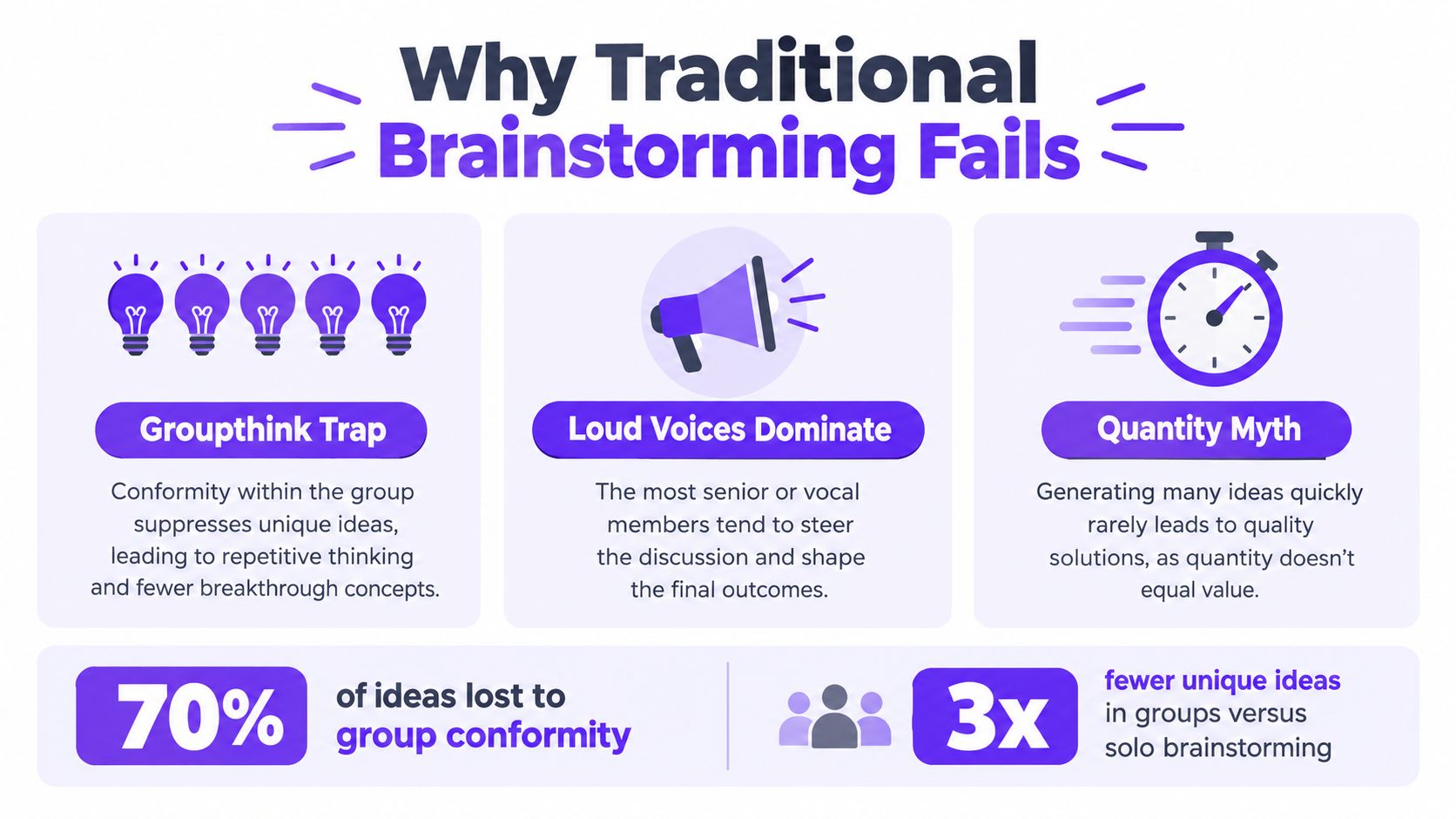
The issue is group conversation, not a lack of imagination. Production blocking forces people to wait while someone else speaks, which can interrupt a thought or redirect attention toward listening. Evaluation apprehension makes participants withhold ideas that might sound naive, impractical, or difficult for the client to accept. Social loafing reduces individual effort because responsibility is spread across the room.
Status can narrow the field even faster. A creative director, founder, or senior client may establish an implicit direction with one comment. The team can continue generating suggestions, yet many will orbit the first idea that received approval. That is refinement presented as exploration.
Structure beats spontaneity
Facilitation changes the conditions for useful thinking. Large-scale data across nine procedure variants found that facilitated brainstorming groups produced 5x more ideas than unfacilitated groups. A separate report involving 750 IT leaders cited a 28% improvement in idea generation compared with unstructured meetings. These findings are summarized in this overview of brainstorming research, alongside the limits of open discussion.
A structured workshop does not require a rigid script. It requires deliberate interventions at the points where group bias takes over. Silent writing protects initial thinking. Timed rounds prevent fast speakers from consuming the session. Anonymous submission lowers status pressure. Visible capture keeps ideas from disappearing, while delayed critique preserves range before the team starts selecting.
The facilitator's job is to sequence these conditions, not perform enthusiasm.
Practical rule: Do not ask a group to generate and judge ideas at the same time. Those are different cognitive jobs.
An effective creative strategy workshop uses collaboration in stages. Individuals generate options first, the group interprets and combines them next, and evaluation follows only after the team has created enough variety to make a meaningful choice. That sequence produces better material than asking participants to compete for airtime in an open conversation.
Pre-Workshop Preparation and Team Setup
A workshop can't rescue a vague brief. Before scheduling the session, turn the client's discomfort into a question the team can answer. “Make the campaign more exciting” isn't a strategic prompt. “How might we make first-time buyers feel confident choosing this product?” gives participants a problem, an audience, and a direction for exploration.
Write the question in one sentence and test it against three checks:
- Decision focus: Does answering it lead to a decision, such as a campaign platform, positioning route, or content territory?
- Audience relevance: Does it identify whose behavior, belief, or experience needs to change?
- Creative latitude: Does it leave room for multiple solutions rather than prescribing the execution?
Share the brief, known constraints, available evidence, and expected output 48 hours before the session, as recommended in the workshop plan. Participants should arrive with context and questions, not spend the opening minutes discovering what the meeting is about. For broader meeting preparation and participation guidance, iScribe meeting best practices offer useful principles for keeping discussions purposeful and documented.
Choose the room for perspective, not status
The strongest group isn't necessarily the most senior group. A room filled with senior art directors may converge quickly on visual treatments, while a strategist, account lead, researcher, product manager, or junior creative may expose a different problem entirely. Include people who understand the customer, the business constraint, the channel, and the creative opportunity.
Keep the working group to six to eight people. That size is small enough for each person to participate and broad enough to include different functional perspectives. If more stakeholders need visibility, separate contributors from observers and name one decision-maker before the meeting.
Define the output before the invitation goes out
A session can produce raw concepts, a sharpened positioning statement, a prioritized set of campaign territories, or a solution to a specific creative block. It shouldn't try to accomplish all of them at once.
Add the expected deliverable to the calendar invite. Then prepare the working surface, whether that's a physical wall, Miro board, shared document, or structured platform. The workshop planning template can help translate the brief into exercises, responsibilities, and a usable session record.
The Three-Act Workshop Structure
A reliable creative strategy workshop moves from divergence to synthesis to convergence. The order matters. If the team evaluates the first idea before exploring alternatives, the room starts optimizing for safety. If it generates endlessly without a decision mechanism, the session ends with a crowded board and no strategic direction.
Act One creates independent input
Begin with 15 to 20 minutes of silent solo ideation. Nobody presents, debates, or reacts. Give participants the strategic question, a small set of constraints, and a clear instruction such as:
“Write one idea per note. Push for range rather than polish. You can propose a message, behavior, visual territory, product experience, or objection to solve.”
Brainwriting works well here because participants can capture ideas quickly without competing for airtime. Ask for several directions, including one safe answer, one unexpected answer, and one answer that challenges the assumptions in the brief. The facilitator should circulate, answer clarification questions, and avoid endorsing any direction.
This phase addresses production blocking directly. A meta-analysis of 50 studies identified production blocking as the largest driver of lost productivity in brainstorming, and found that methods reducing blocking, especially brainwriting and electronic brainstorming, perform significantly better than classic verbal sessions, as summarized in this analysis of brainstorming methods.
Act Two makes ideas shareable
Move into structured sharing rather than open discussion. Each person presents one idea at a time, moving around the group in a round-robin. The facilitator records the idea in the participant's language, asks only clarifying questions, and postpones criticism.
Use a second pass for combinations. Invite participants to connect two unrelated notes, strengthen an underdeveloped thought, or adapt an idea for a different audience or channel. A coach-facing collection of workshop activities for coaches can provide additional exercises, but the selection should serve the strategic question rather than fill time.
Act Three turns range into direction
Only after sharing and combination should the group cluster, compare, and choose. Define the criteria before voting. Useful criteria include fit with the brief, distinctiveness, audience relevance, feasibility, and potential to extend across executions.
| Act | Primary Activity | Key Rule |
|---|---|---|
| Act One | Silent solo ideation | Generate independently before anyone reacts |
| Act Two | Round-robin sharing and combination | Give every contributor equal airtime |
| Act Three | Clustering, voting, and strategic selection | Critique ideas against agreed criteria |
Use anonymous voting where possible, then discuss the strongest and most divisive clusters. The facilitator should ask, “What makes this strategically useful?” rather than “Do we like it?” A creative strategy workshop earns its value when the final directions explain not just what the team might make, but why that direction answers the brief.
Integrating AI and Digital Collaboration
Digital collaboration expands access to the workshop, but it doesn't automatically improve thinking. A shared canvas can preserve every contribution, support asynchronous input, and make patterns easier to see. It can also turn the session into a flood of disconnected notes if nobody defines the question, sequence, or decision rule.
Recent collaborative creativity research illustrates the trade-off. In a randomized controlled experiment with N=96 participants, AI peers generated more original ideas than human participants, but exposure to those ideas could reduce human fluency and originality. The same research found that round-based interaction encouraged more co-construction than live interaction, which supports a staged format rather than constant human and AI exchange. A separate 2024 experiment reported 23.6% more unique ideas with Co-GPT Ideation than with self ideation, with 119 total post-its versus 108, as described in the collaborative creativity research.
The practical implication is simple: don't expose the team to AI output too early. Let people generate independently first. Then use AI to challenge fixation, propose counter-angles, reframe a problem, or identify combinations the group hasn't considered. Treat the output as material for discussion, not as an answer.
Design the digital sequence deliberately
A remote or hybrid session needs more explicit mechanics than an in-person meeting. Tell participants where to write, when to switch modes, and how decisions will be recorded. Anonymous submission can reduce status effects, while a visible activity timer helps participants understand that silence is part of the work.
Bulby can support AI-guided brainwriting, anonymous submissions, structured exercises, clustering, and summaries with next steps. It belongs in the workflow where it solves a process problem, such as collecting input from a distributed team or introducing a fresh angle after the first human round.
Use AI in bounded moments:
- After independent generation: Ask for contrasting perspectives that test the team's assumptions.
- During combination: Use it to suggest links between ideas that appear unrelated.
- Before convergence: Ask for risks, audience objections, or missing perspectives.
- After selection: Use it to summarize the rationale, open questions, and assigned actions.
For teams building a broader workflow around artificial intelligence, AI for marketing strategy provides useful context. The key is preserving human ownership of the brief and the final decision.
A short visual walkthrough can help facilitators see how a structured digital session differs from an open chat:
Common Pitfalls and How to Avoid Them
Workshops usually fail through small process breaches rather than dramatic mistakes. Someone announces an idea too early. A senior person reacts with visible approval. The facilitator lets discussion replace generation. By the time the team notices, everyone is improving the same direction and calling it consensus.
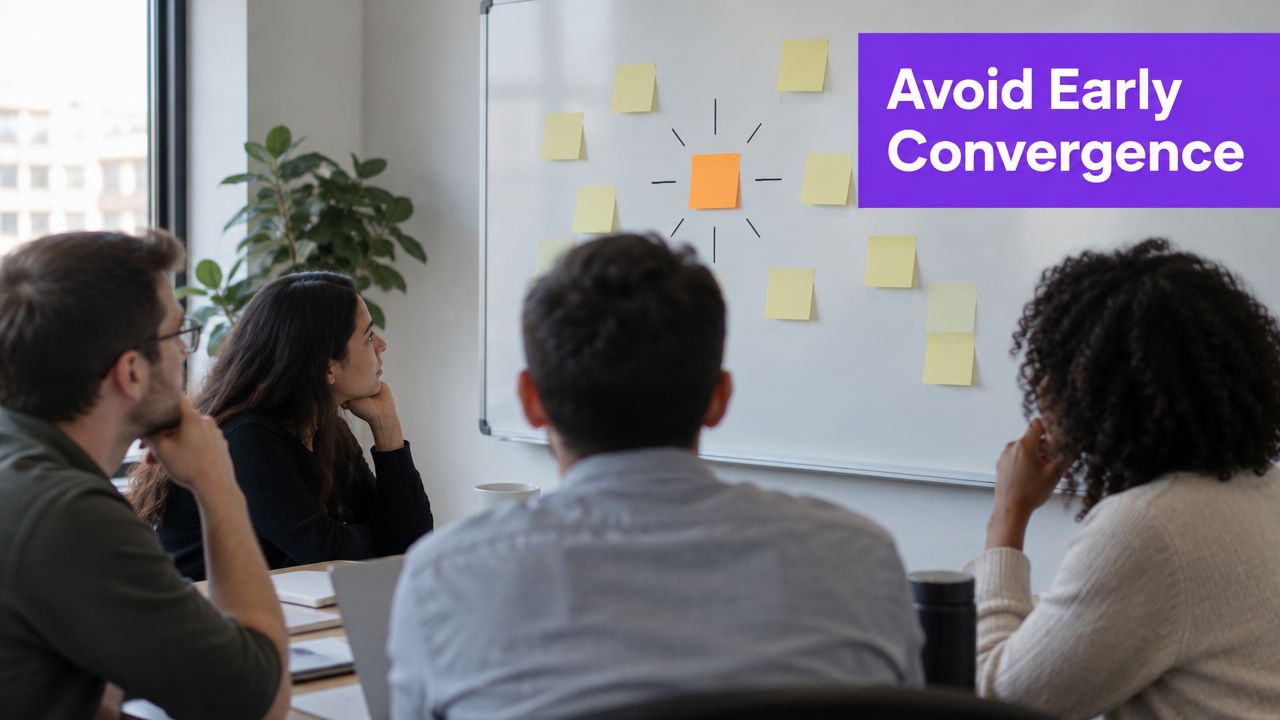
Premature convergence is the first warning sign. Enforce the silent opening, collect ideas before discussion, and use anonymous voting during selection. If one proposal attracts immediate enthusiasm, record it without treating it as the answer. Ask the group to produce alternatives that solve the same problem in a different way.
Facilitator move: When the room settles too quickly, say, “We have one viable route. Let's deliberately create three alternatives before we evaluate any of them.”
Compare the failure mode with the intervention
| Failure mode | What it looks like | Structural intervention |
|---|---|---|
| Seniority bias | Participants echo the creative director or client lead | Collect ideas privately and invite junior contributors to present early |
| Groupthink | The team rejects unusual directions without testing them | Ask for evidence against the preferred route and preserve dissenting clusters |
| Unclear output | The meeting ends with enthusiasm but no decision | Define the deliverable and assign an owner to every selected direction |
| Comfort seeking | Participants choose familiar ideas because they feel easy | Add constraints, counter-briefs, and criteria tied to the client problem |
| Hybrid exclusion | Remote contributors respond less or disappear from discussion | Use one shared digital workspace and make every contribution visible |
A workshop should feel safe enough for people to contribute, but it shouldn't optimize for comfort. Research on conformity bias warns that even seeing another person's choice can influence idea selection, which makes anonymous input and explicit intervention more than etiquette. The groupthink prevention guide offers additional methods for protecting disagreement without making the session adversarial.
The final trap is confusing volume with quality. A large collection of notes doesn't prove that the workshop worked. The team needs a small number of documented directions, each connected to the brief, supported by reasoning, and clear enough for someone who wasn't in the room to understand.
Post-Workshop Follow-Through and Measurement
The workshop ends when the decision record is complete, not when the video call closes. Send a concise summary within 24 hours containing the brief, key observations, idea clusters, selected directions, unresolved questions, and rejected routes worth preserving. Include screenshots or links to the working board so the reasoning remains visible.
Assign one owner to each action. “The strategy team will explore this” is too vague. “Maya will draft the positioning territories and circulate them for review” gives the work a person, an output, and a next move.
Use a decision record, not a scrapbook
A practical summary can follow this format:
- Strategic question: The exact problem the group addressed.
- Useful insight: The audience or business tension that shaped the discussion.
- Selected direction: A plain-language description of the route.
- Reason for selection: The criteria it satisfied.
- Open risk: The assumption that still needs evidence.
- Next action: The next concrete piece of work.
- Owner and date: The person accountable for moving it forward.
Schedule a progress check one week later. Keep it short and focused on evidence of movement. Has the strongest direction become a campaign concept, messaging system, product hypothesis, or testable creative route? Has the unresolved risk been investigated? If nothing has moved, the problem is usually ownership, scope, or approval authority rather than a lack of workshop energy.
Measure usefulness instead of applause
Don't judge the session by how enjoyable it felt or how many ideas filled the board. Judge it against the original brief. Did the team resolve the creative block? Did it create a direction the client can act on? Did it surface a risk early enough to prevent wasted execution? Did the final work become more coherent across channels?
Collect participant feedback after delivery begins. Ask which exercise produced useful thinking, where people felt blocked, whether the decision criteria were clear, and which voices were missing. Then update the next agenda accordingly. A workshop becomes a repeatable capability when the team learns from its process instead of treating every session as a fresh performance.
For the validation stage, use a defined method rather than relying on internal enthusiasm. The idea validation process can help teams test whether a promising direction deserves further investment before production begins.
Bulby gives marketing and creative teams a structured way to run brainwriting, collect anonymous contributions, use AI to challenge fixed thinking, cluster themes, and produce a summary with next steps. Try applying it to your next creative strategy workshop, then visit Bulby to see how the platform can support the path from a focused brief to actionable creative directions.