
Companies that improve personalization commonly gain 10% to 15% in revenue, yet only 24% of CX practitioners rate their own personalization as highly personalized. That split tells you where to invest first. Your constraint isn't ambition or another AI feature. It's the operating system that turns a customer insight into a shipped, staffed, measured change. Fix orchestration, and customer experience innovation starts paying back. Leave it broken, and every new tool just makes the disconnect faster.
Table of Contents
- Why Most CX Innovation Quietly Fails
- What Customer Experience Innovation Actually Means
- The Business Impact You Can Defend
- A Framework Agencies Can Actually Use
- The Five-Phase Implementation Playbook
- Two Mini Cases That Show the Difference
- Choosing the Right Metric and What to Do Next
Why Most CX Innovation Quietly Fails
Most programs don't die in a launch meeting. They die in handoffs. Research finds a signal, creative builds a concept, product scopes a version that fits the sprint, service learns about it from customers, and finance never sees a baseline. Nobody killed the idea. The organization never agreed who would act, by when, and what success would cost to deliver.
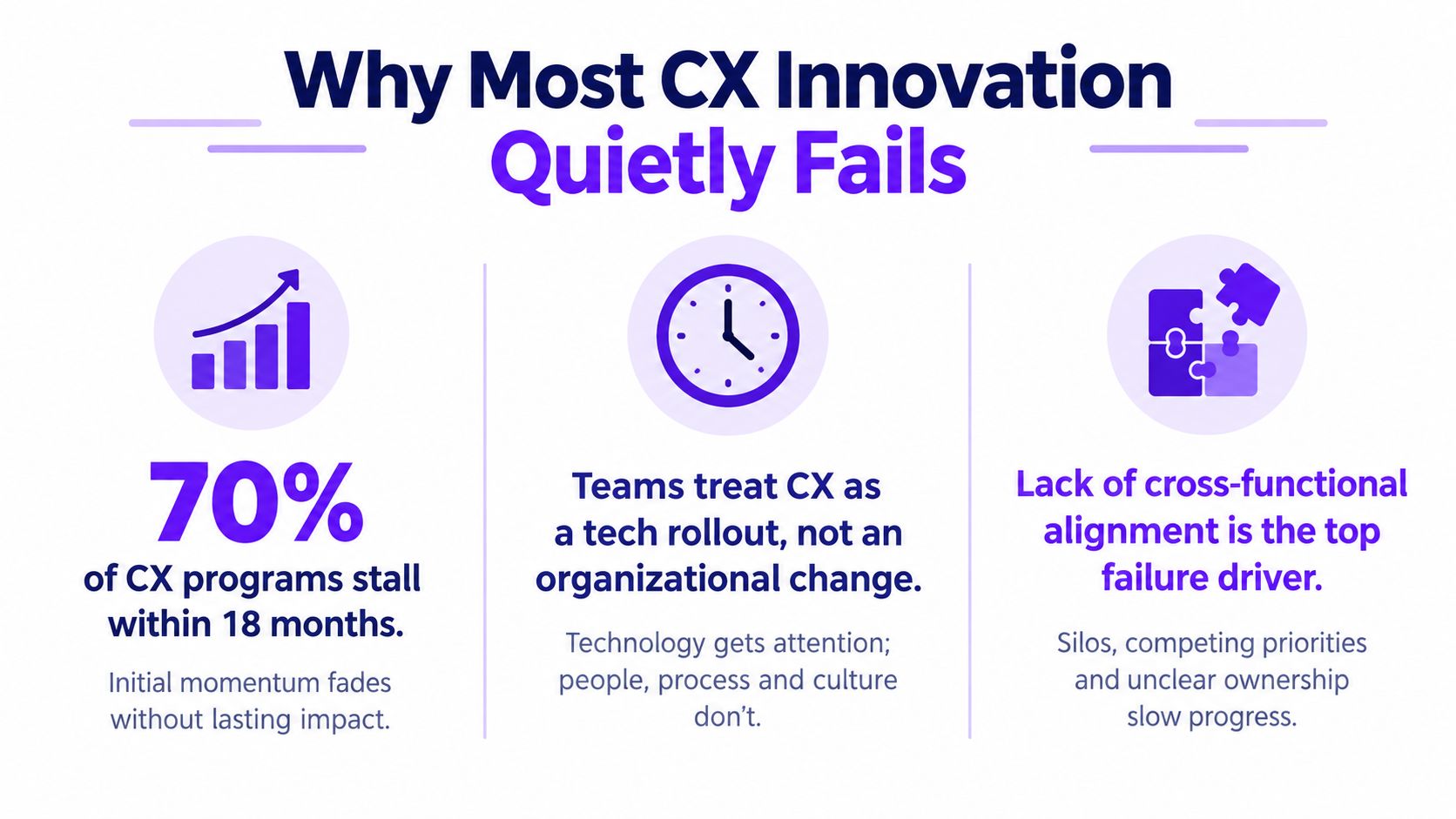
Treat that as an orchestration failure, not a technology shortage. Ipsos research across 735 CX and EX professionals in 45 markets found only 57% of organizations consistently deliver experiences aligned with their brand promise, while AI automation was the leading 2026 priority at 35%, deeper customer understanding ranked 31%, and proving ROI ranked 30%, as detailed in the Ipsos Global Voices of Experience 2026 findings. Read those priorities together. Leaders want automation, but they almost equally lack customer understanding and financial proof.
Audit the Stall Before You Buy Anything
Start inside the client team, not in a vendor demo. Trace the last three insights that should have changed a journey and ask where each one stopped.
- Discovery stall: The team has interviews and dashboards, but no agreed interpretation of the customer's job.
- Decision stall: Everyone likes the concept, and nobody owns the trade-off against operations or margin.
- Delivery stall: The frontstage experience ships before support scripts, staffing, data, or escalation paths change.
- Proof stall: The launch has engagement reporting but no pre-agreed business metric.
That's why a disciplined approach to conducting user research matters only when research outputs enter a decision pathway. Another data point sharpens the problem. One recent CX study summarized in the Ipsos material reported that 88.5% of teams felt confident surfacing actionable signals, but only 56% proactively acted before the opportunity passed. Don't ask for more signals until you've fixed the route from signal to action.
Practical rule: If a concept can't name an owner, a delivery change, and a metric, it's not an innovation yet. It's a suggestion.
What Customer Experience Innovation Actually Means
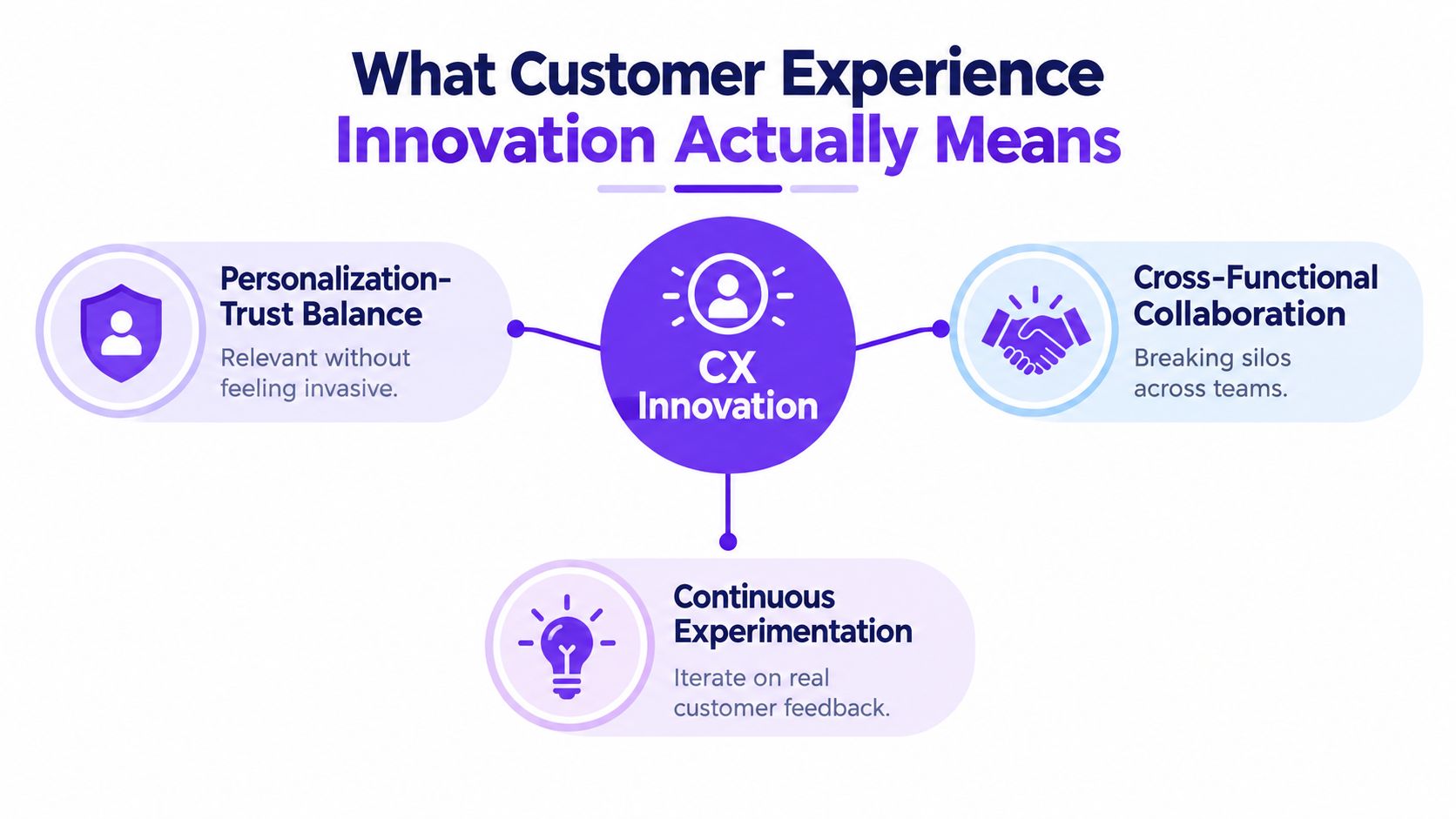
Customer experience innovation is a change to a customer moment that makes the interaction more useful, easier, or more trusted, and that the organization can deliver repeatedly. A new message isn't enough. A chatbot isn't enough. You're redesigning how context, people, process, and technology work together across a journey.
Choose the Mechanism Before the Technology
A study of 32 retail cases involving beacon technology identifies automation, augmentation, and customization as distinct mechanisms for technology-enabled experience innovation, according to the Wiley research on technology-enabled customer experience innovation. Use that distinction in every brief.
Automation removes effort. A service team triggers status information automatically so the customer doesn't search, call, or repeat details. Judge it by whether work disappears without creating errors or a dead end.
Augmentation improves a human decision. An account or service employee gets relevant context before responding, so the conversation gets better. The person still owns judgment, empathy, and recovery. That's often the safer agency recommendation when trust or complexity is high.
Customization adapts the experience. Content, offers, sequencing, or support changes based on observed context and preferences. This carries the highest relevance upside and the highest risk of inaccuracy. Don't call it innovation if it merely creates more variants for the team to manage.
Build Trust Into the Concept
Customers don't evaluate personalization in the abstract. They judge whether the benefit is visible and whether the data use feels proportionate. The trade-off is now central because direct feedback has weakened. Only three in ten customers reportedly explain why they leave, a context discussed in the Qualtrics global consumer experience trends overview. You can't wait for complaints to reveal invasive design.
Put consent, explanation, human escalation, and recovery into ideation criteria, not into a legal review at the end. A strong voice of customer system should capture perceived risk as well as stated demand.
Customer experience innovation is the disciplined redesign of a journey moment so a customer gets more value with less effort, while employees can deliver it and executives can measure it.
The Business Impact You Can Defend
Put the commercial argument on one slide, then spend the meeting on execution risk. Executives don't need twelve benefit statements. They need to know what's at stake, what customers reward, and what bad implementation destroys.
Revenue and Repurchase
McKinsey's 2021 research found 71% of consumers expected personalized interactions, 72% expected businesses to recognize them as individuals, 76% said personalized communications influenced brand consideration, and 78% said such content made them more likely to repurchase, as reported in McKinsey's analysis of the value of getting personalization right. The same research reports common revenue gains of 10% to 15%, with a wider range of 5% to 25% depending on sector and execution capability, and estimates more than $1 trillion in value from top-quartile personalization across U.S. industries.
Don't present that range as a promise for your client. Present it as evidence that execution capability drives variance. The agency opportunity sits in closing the distance between a relevant idea and a reliable operating model.
Brand Choice, Satisfaction, and the Capability Gap
The customer-side signal is equally direct. Medallia's 2024 report found 82% of customers said personalization drives brand choice, customers who rated experiences as highly personalized gave satisfaction an average of 9.4 out of 10, and only 24% of CX practitioners rated their own efforts as highly personalized, according to the Medallia State of CX Personalization report. Your pitch should therefore sell capability building, not only campaign output.
Flag the downside early. Boston Consulting Group research summarized in the available evidence surveyed more than 23,000 consumers and found about two-thirds had experienced an inaccurate or invasive personalized interaction that caused them to end the interaction. That fact changes the business case. Accuracy testing, suppression logic, data quality work, and human fallback aren't nice extras. They're value protection.
What Belongs in the Investment Case
- Upside: The journey moment, expected customer behavior change, and financial metric it should influence.
- Cost to deliver: Data, content operations, employee workflow, support load, and quality assurance.
- Risk cost: Inaccuracy, opt-outs, repeat contact, accessibility failures, and loss of trust.
- Decision threshold: The result that justifies scaling, revising, or stopping.
If finance can't see those four lines, you don't have a defensible case. You have enthusiasm.
A Framework Agencies Can Actually Use
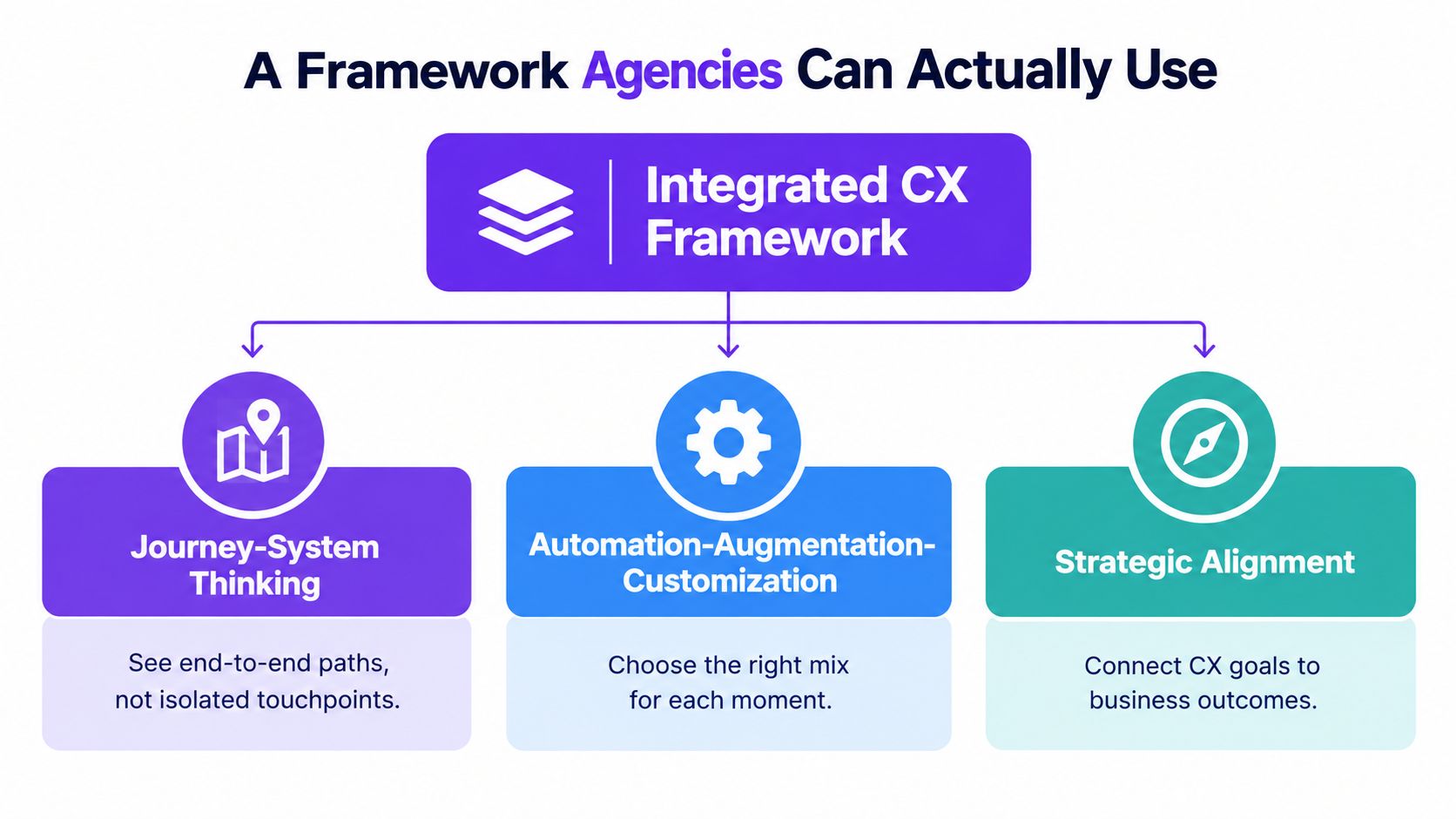
Stop running three separate conversations about journey mapping, technology selection, and measurement. Combine them into one working frame. Every concept must answer three questions in the same brief.
The Three Questions
First, which journey moment changes? Name the stage, the customer's goal, the current failure point, and the downstream consequences. “Improve onboarding” is too broad. “Reduce abandonment between identity verification and first successful use” can be designed and tested.
Second, which mechanism creates the change? State whether you're automating effort, augmenting a human decision, or customizing the experience. That choice determines the prototype, the owner, the risk review, and the metric. It also prevents teams from buying an AI tool before deciding what kind of value it must create.
Third, who acts and how will you know? Assign a decision owner, delivery owner, review date, baseline, and target metric. Insight without that chain is comment, not innovation management.
Treat the Journey as a System
Service-design research supports this systems view. One mobile-service study used three iterative service-design cycles and 61 customer interviews to identify and incorporate experience factors across ideation and implementation, as described in the service-design research on innovation in experiential services. Use service blueprinting to connect what customers see with the backstage systems, policies, and employees who make it possible.
A structured product discovery framework can help teams keep that evidence connected from problem framing through concept selection. For teams in sectors where the buying journey is long and operationally complex, Foundation's guidance on how to build a customer experience strategy offers a useful example of aligning stage-by-stage experience decisions with delivery realities.
The brief test: Customer moment, behavioral mechanism, delivery change, owner, metric. Missing one means the concept goes back for work.
Use this frame in pitches, kickoffs, and quarterly planning. In a pitch, it shows commercial discipline. In a kickoff, it exposes operational gaps before creative development consumes the budget. In quarterly planning, it lets leadership compare concepts by mechanism and expected outcome instead of comparing polished presentations. That's the point. You're not trying to generate the longest idea list. You're building a portfolio the client organization can ship.
The Five-Phase Implementation Playbook
Run the work in phases, with a hard checkpoint at each transition. Don't let a strong workshop compensate for a weak operating decision.

Frame, Map, and Choose
Phase one is cross-functional problem framing. Bring strategy, creative, product, service, data, and operations into the same session. Define the customer problem, business outcome, constraints, and non-goals. The checkpoint question is simple. Can every function describe the same problem in one sentence? If not, don't ideate yet.
Phase two is journey-system mapping. Map the frontstage steps, customer effort, backstage dependencies, handoffs, and known failure points. Include employees who handle exceptions, because they'll identify work the polished journey map hides. The common failure is optimizing a screen while fulfillment or support creates the key delay.
Phase three is mechanism selection. Sort concepts by automation, augmentation, and customization. For structured ideation at this stage, teams can use Bulby as one option to gather anonymous input and turn workshop contributions into summarized next steps. Rank ideas by expected customer value, delivery feasibility, data readiness, and trust risk. A concept that needs data the client doesn't reliably have isn't a near-term innovation.
Prototype and Defend
The video below is useful context for how teams translate experience ambition into operating choices before they scale a concept.
Phase four is prototype with a testable hypothesis. Write it in plain language. For this customer, at this moment, this mechanism will change this behavior because it removes effort, improves a decision, or increases relevance. Then define the comparison, the minimum viable delivery change, and the failure-recovery path. Test accuracy before reach, especially for customization.
Phase five is metric defense. Baseline the current journey before launch, assign who reviews results, and set the scale, revise, or stop decision in advance. Agencies lose credibility when they present activity after the fact and search for a favorable metric. Decide the evidence standard while everyone still agrees.
Align these phases with your broader steps in the innovation process so client teams see CX work as repeatable management, not a one-off creative sprint.
The One-Page Brief
- Customer moment: The stage, goal, and current failure.
- Mechanism: Automation, augmentation, or customization.
- Delivery change: The process, content, data, or staffing change required.
- Trust safeguard: Consent, explanation, human escalation, or recovery.
- Metric and owner: Baseline, target movement, review date, and decision maker.
Two Mini Cases That Show the Difference
These illustrative patterns show how the same budget produces different results depending on whether the team starts with a mechanism or a tool.
The Support Team That Automated the Right Work
An agency team maps a support journey and finds customers repeatedly contact the brand for status information employees already have. The problem isn't empathy or agent skill. It's avoidable customer effort. The team chooses automation, but only for the narrow status moment.
They blueprint the exceptions first. Customers with a simple status need receive proactive information. Customers with an ambiguous issue route to a person with context intact. Support leaders help write the fallback, and the team baselines time to resolution, repeat contact, abandonment, and post-interaction satisfaction before launch.
The decisive move isn't the automation itself. It's the boundary around it. The team removes repetitive work, protects human handling for complexity, and knows which metric should move. When leaders review the result, they're judging an operating change, not admiring a new interface.
The Checkout Team That Mistook Complexity for Innovation
Another team starts with AI personalization for checkout. They add prompts and product suggestions before validating whether customer data is accurate or whether shoppers understand why they're seeing each recommendation. Nobody owns suppression rules. Nobody tests what happens when the inference is wrong.
The concept creates more decisions for customers and more maintenance for the client. Opt-out and privacy-friction signals become the important evidence, but the team didn't plan to review them as primary outcomes. They measured engagement, then discovered too late that relevance couldn't compensate for inaccurate assumptions.
The lesson is uncomfortable but useful. The second team had more visible technology and a weaker innovation. The first team changed a defined moment through a defined mechanism and gave employees a workable role. That's the difference your clients are paying for.
Choosing the Right Metric and What to Do Next
Don't judge every concept with one CX score. Match the metric to the mechanism, then review the risk signal alongside it.
| Mechanism | What It Changes | Primary Metric | Risk to Watch |
|---|---|---|---|
| Automation | Removes or compresses effort | Cycle time, task completion, error rate, service cost | Dead ends, repeat contact |
| Augmentation | Improves human judgment | Decision quality, task success, engagement | Slow or inconsistent employee adoption |
| Customization | Adapts content or service | Relevance, uptake, retention, conversion | Opt-outs, inaccuracy, privacy friction |
If you're selecting measurement support, browse product intelligence options with those mechanism-specific requirements in mind, rather than buying a dashboard first. Pair that discipline with a clear view of how to measure innovation across the wider portfolio.
In the next 30 days, pick one client journey, write the one-page brief, identify the mechanism, baseline the metric, assign the decision owner, and schedule the post-launch review. Start with one moment you can deliver well. Scale only after the evidence earns it.
Bring your next client journey into Bulby and run a structured ideation session that forces every concept to name its customer moment, mechanism, owner, and metric. Bulby helps agency teams gather broader input, reduce predictable thinking, and turn raw ideas into clear next steps you can defend in the room.